Content
In the nearly three years since Hamas’s attack on October 7, as the world has changed, I’ve often wondered what future there is for Jewish life in the West.
It doesn’t take much prompting to think about: One scroll on social media and you’re flooded with blood libel conspiracies. When I turn my phone off, in the hopes of touching some grass, I look up to see graffitied swastikas in subway stations or protests in a park calling for the death of America and Israel.
It’s not only Jews who are faced with this question, but everyone who believes the West is exceptional and worth fighting for.
Earlier this month, I spoke with two of the clearest thinkers in this moment: Coleman Hughes and Haviv Rettig Gur. Both are essential voices on this topic, and I’m proud to call them my Free Press colleagues. We were speaking in a Toronto synagogue, at an event hosted by the Friends of Simon Wiesenthal Center. The backdrop was that Canada, a country where Jews have thrived for centuries, is now a country that has experienced a 670 percent increase in antisemitic incidents since October 7—shootings at Jewish schools, synagogues firebombed, one Toronto synagogue vandalized seven times in a single year.
In our discussion, we covered a lot of ground. We discussed why the Iranian regime won’t fall the way people hope, and why many Americans insist on seeing Israel as a reflection of their own national guilt. We also spoke about growing antisemitism on the right, and why Coleman thinks it’s different from Jew-hate on the left. He spoke about the loss of the black-Jewish alliance, and how we might get it back. And despite all of that, we ended on a high note: the promise––the exception––of the English-speaking world, where, even still, the darkest predictions about Jewish life haven’t yet come true.
Transcript
0:03 · Thank you so much for the lovely introductions and for being here everyone. This is really such a special community and we’re all honored to to be on stage and and with you guys. Um I’m especially honored to be on stage with Coleman and Haviv. Um I might be biased, but they are really some of the most important sense makers of this deeply disorienting moment. They’re who I turn to.
0:28 · Um they are who I turn to when I am confused. Um and that seems like it’s you know every day now. Um and I’m honored to call them my colleagues. Um there’s a lot for us to get into and I’m going to start with the news cuz I can’t kick the reporter in me. Um it’s been about 2 months since the war with Iran started and a lot has unfolded since then. Uh just yesterday the UAE was attacked by Iran.
0:54 · Haviviv I wonder before we talk about how the war has changed the region the impact it has had in the west if you can just give us a state of affairs of what’s happening on the ground in Israel specifically in Israel in the region in the region um the the big story is the standoff between the United States and the uh Iranian regime and uh they’ve essentially entered a game of economic chicken uh the blockade by Iran of the Strait of Hormuz and a counter blockade by uh the United States.
1:27 · Um it’s a game in which I suspect the Americans are going to prove much more steadfast than the Iranians believe. The Iranians have been unfortunately reading uh so much of the Western press and Western think tanks that insist that the West can’t fight, can’t hold out, can’t hold the line. And the Iranians believed that.
1:52 · And so they agreed to go into a game of chicken that so far uh the Americans uh for some strange reason think that they’re winning. Um as Secretary Rubio said today, the Iranian currency is in freef fall. It has been in freef fall for a long time. It is more in freef fall than it was two weeks ago. Um and uh at some point the revolutionary guards won’t be able to pay uh the salaries of the of their soldiers. And then really the the thing hopefully begins to uh break down. It’s not going to end quickly.
2:24 · It’s not going to end easily. This is the kind of regime that doesn’t fall. It is a regime built on a martyrdom ethos that is willing to burn Iran itself to the ground. Uh so that’s where things stand. Uh Trump looks like he’s trying to avoid a renewal of hostilities. He thinks he seems to think um that the blockade alone is going to be enough if he uh sticks it out. He seems to be willing to do this through the midterms, which the Iranians, I think, are going to find out the hard way.
2:57 · Um I hope I’m not wrong about that. the Israelis are in a completely different place which is um they believe they will need to challenge the Iranians permanently, constantly, consistently for years potentially until that system collapses. And so we’re in that standoff. Uh I don’t think this is a bad thing. Uh I know the price at the at the at the pump is very high, but um if Iran maintains control of Hormuz, and that’s how this war ends, the price at the pump will stay high for a very long time. As you’ve said, this is a regime that was built to survive.
3:29 · And yet when the war started, you had people dancing in the streets and and in the West at least, it felt like this might be a glimmer of hope that the regime might fall. And what you’re saying is that’s not possible. How do we reckon with that? And what does that really look like? Um yeah. Um, luckily for me, 3 days before the war started, I put out a podcast episode where the YouTube thumbnail literally said, “Bombs will not topple this regime.” Because you’re a Msad agent. Uh, because I’m a Mossad agent.
3:59 · Um, so now I can tell you something I said before the war started. So, it’s not, you know, everybody’s clever right after the fact. Um, this regime is built on a very specific idea, which I will try to do the 30 secondond version of. It is a profound idea. uh it is an old idea. It is a rich idea with many intellectual streams uh that contributed to the idea and the idea is what they call in Arabic the mukawa uh the resistance. It is far more than what the word resistance means in English.
4:32 · It is a vision of history and a vision an explanation for why it’s actually okay that Islam is weak in the modern age and struggling to meet the challenges of the modern age. And in fact, because we are weak, we are pure and we have and the divine help will come when we engage the enemy. And we must maintain permanent sustained war for all time. And our very death will deliver the victory. And martyrdom therefore is inherently innately victory. Those in the room who are experts in Shia esquetology will hear echoes of Imam Hussein, of course.
5:04 · Uh that’s just for the nerdy crowd. Um and and it’s a vision that kamas in a very different Sunni version but it comes to the exact same conclusions and also has the same origins uh shares andah shares and the Iranian regime shares and some other militias in Syria and Iraq. It is an ideology that says it is okay to burn our own societies to the ground on the altar of the destruction of the great enemy that is holding Islam down.
5:32 · It is a conspiratorial martyrdom cult that has countries in its grip that it will see to their destruction. Everybody sees what happened to Gaza. You might not know much about Gaza. You might just say the evil Israelis. I what you need to also understand is that is planning that future for Lebanon on the altar of the destruction of Israel. And so this is a regime where there is totally undeterable because of that modern demos.
6:07 · There is no amount of damage that can be caused to Iran to make it fall. The only way you make it fall is if the Iranian people reject it to such an absolute extent that the thing can’t literally maintain itself. And the only way to do that and I’ll finish with this. Sorry Coleman, you were going to talk also at some point. Um, we know each other well. They knew what they were doing. No.
6:32 · Uh but just to finish the thought, um this regime owns the revolutionary guards literally that military owns half of the oil industry of Iran and uses that vast money to create the biggest patronage system maybe in the world outside of North Korea. And that has to fall. In other words, you have to bankrupt them to the point where there are no sectors of Iranian society they can fall back on.
6:59 · And that I think is the current American strategy. You know, whether the US should have been involved in this war at all has deeply fractured the left and the right. Coleman, you’ve spoken to Glenn Greenwald, Shotti Hamid, Ben Shapiro, and you’ve made the strong case that the US Trump got involved in this war for reasons that had nothing to do with Israel. You know, their nuclear trajectory, his assassination attempt. I wonder what you think on the right and the left unite this idea that we shouldn’t have been involved and whether it’s about the fact that they don’t view Iran as an existential threat to the country in the west. Yeah.
7:32 · So clearly we benefit from Iran becoming weaker. Um and by we I mean I mean America. I’m American obviously. Um, you know, I if if Iran’s missile stocks are depleted, if their nuclear program is set back years, we benefit from that, right? That is, you know, you’re not going to find many people that say that’s not in the US national interest. What you will find is people that say that’s not worth fighting a war over. Right? In America, we don’t go to war just to weaken our enemies.
8:04 · We expect to get to the end of the war and have something to put in our pocket much bigger than setting our enemy back 3 to 5 years in in its ambitions. And that’s where you’re going you have a lot of trouble and Trump has a lot of trouble persuading people even in his own collision that this war has been worthwhile. It’s not over yet to Havib’s point. So we don’t know what we’re going to have in the bag at the end of this.
8:38 · But if when all is said and done, all we have is a weakened enemy, that is in our national interest to be clear. So it’s not it it doesn’t present a mere shimer problem as to why we would do this, right? It’s not against our national interest, but it may not be worth fighting a war over in the eyes of the median American voter.
8:55 · M you know so much of this conversation as you know all of us know is from journalists uh podcasters in places like New York or London or Los Angeles talking about this war in really hypothetical terms and have you responded to this Ezra Klein podcast from the New York Times um that kind of talked about this one state reality and first I kind of wonder what you took issue with and why you chose to respond.
9:27 · Um, I’m I’m trying to decide how polite I need to be in a crowd full of Canadians.
9:34 · Um, the uh the uh the way that so many people in this earth build a moral vocabulary around us, us as actors in their morality plays is uh maddening to me.
9:53 · Let’s imagine for a moment that they’re not Israelis, they’re Martians.
9:59 · And the Palestinians are Jupiterians, Jovians, I don’t know what that would be. And we don’t know anything about these people. We don’t speak their languages. We don’t understand their cultures. We don’t understand the ideologies and the historical experiences that animate their politics.
10:18 · And we propose that these two people with all the other things being exactly drawn from all the data, all the actual being the Israeli Palestinian conflict will now have a one-state solution. We’ve solved everything and we feel super comfortable with that. We sitting in New York going to our little dinner parties. Um it’s maddening to me. It is a cartoonicization of people who in your own mind serve only as uh as as figures in a morality play you’re telling yourself about yourself.
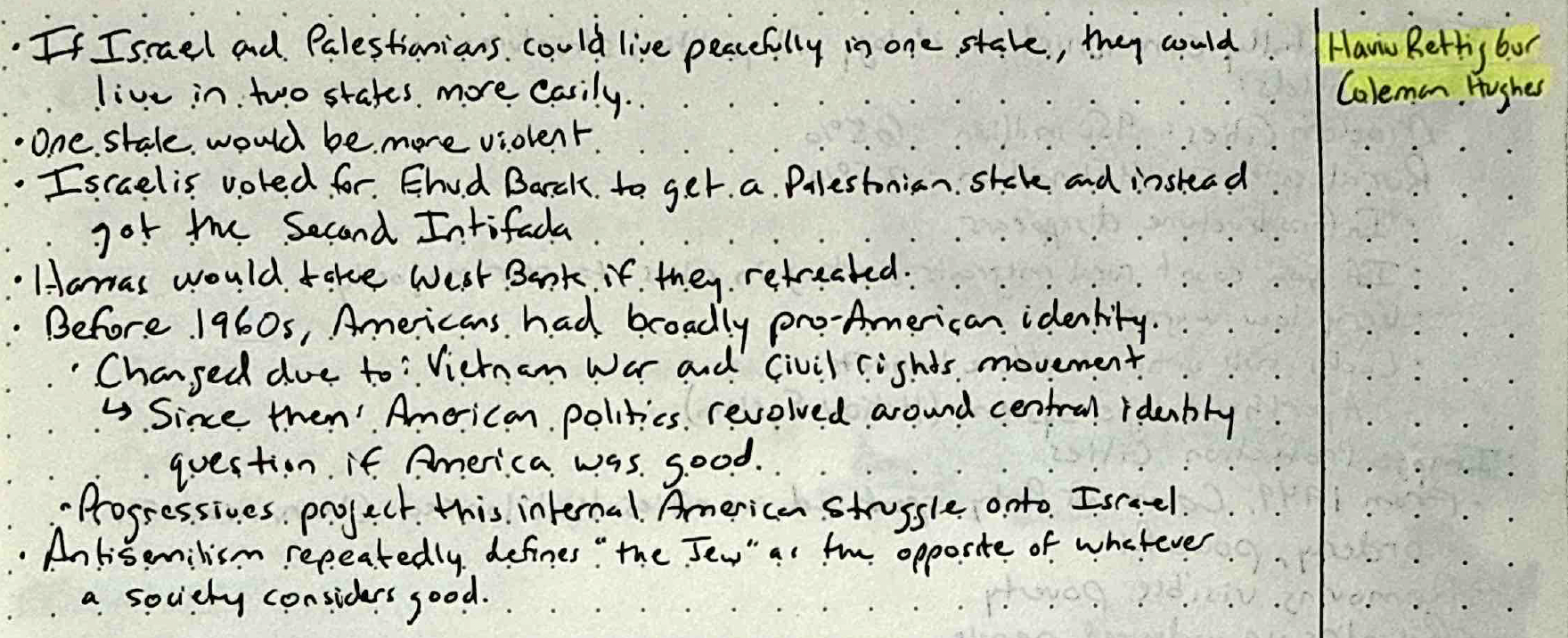
10:47 · Folks, if the Israelis and Palestinians could live in one state, they could live in two states much more easily. the people who’d say things like we have to acknowledge the one-state reality and go from there. One state reality is vastly more violent than a two-state reality. The if what you’re saying is there’s military rule over Palestinians in the West Bank. We have to end it.
11:20 · Then you have to go to the Israelis and you have to pull them and you have to use all the tools of political campaigning. You have to hack the human brain stem. You have to get marketing people into it and you have to say hey Israelis why aren’t you behaving the way I want you to behave and then you will discover reasons hard deep reasons historical experience I know me khiv sitting here know people who died in the second inif after I voted Barak to build that Palestinian state and then
11:52 · I spent the next two years as a as a young soldier sitting in ambushes in the West Bank trying to catch the suicide bombers because 140 of them were getting past us and blowing up in Jerusalem.
12:04 · And I would love to know how to pull out of a West Bank where kamas has won every poll in 15 years. You want to really really destroy the Palestinian cause, have the Israelis pull out of the West Bank right now. There is no chance that Kamas doesn’t take over. Zero chance. The Fatak are pulling in the single digits. And then you know what happens when kamas has a territory 16 times the size of Gaza that is the mountains overlooking all of our cities and population centers and shrinks Israel down to n down to 9 miles wide.
12:39 · You will see a Gaza but worse and bigger. Please don’t do that to Palestinians because in New York at the dinner party your friend said well two states is gone.
12:50 · If you know who is it Thomas Soul who said there are no solutions there only tradeoffs.
12:57 · Well, there’s a little more to that. I think that’s very deep and very rich and very important to understand. But there’s more to it, which is that when there are no solutions, you have to find the pivots. You have to find the anchor points so that you can move things powerfully. You need to change what the Israelis think the Palestinian response to withdrawal would be by changing how Palestinians talk to Israelis. My one complaint, I’m sorry, I’m finishing. My one complaint about the anti-Israel movement isn’t that they’re hateful and it isn’t even that they’re ignorant. Everybody has a right to be hateful and ignorant.
13:36 · I know I’m at Friends of Simon Wthal Center. I I take that back. Um it’s that they’re not even pretending to actually be concerned with how any of this ends. They’re far too invested in the moral drama that it represents. And so I saw this conversation about, well, we have to start considering the possibility that some moral journey all of us New York Jewish intelligencia were on 25 years ago might not be an approach. None of it has anything to do with the reality on the ground.
14:06 · And and I think it’s time for people to get serious, to learn seriously. Assume the Israelis aren’t stupid. Assume the Palestinians aren’t stupid. and assume that your moral story isn’t the topic. Not that I’m bitter.
14:26 · Coleman, you both of us live something closer to the New York dinner parties where people like to say fashionable things than we do to, you know, the world of bunkers in the West Bank. And I kind of wonder how you think about what the the harm is in the fact that a lot of people are consuming this kind of this kind of rhetoric that makes them feel morally informed. Like what is the end result of that?
14:57 · Well, I I I want to double click what what Hav said, why it is that Americans care so much and are moved uh by this issue, especially on the left.
15:10 · what happened, and this is well explained in a book by Shelby Steele called Shame. Um, before the 1960s, Americans had for the most part a pretty simple pro-American identity. And that held whether you were a liberal or a conservative, that was not a big issue, right? It was big whether you were Protestant or Catholic, right? That split up families. But bring a conservative to dinner, nobody cared.
15:34 · Everyone had a basic assumption unquestioned that America was good. And then the 60s and the 70s happened. And what happened in those decades? Well, Vietnam government lied to us. the first time we experienced ourselves in America as perhaps the villains of a war story and the civil rights movement which um was a fantastic movement that secured basic citizenship and made America a multi-racial democracy. But on the way there it also required that Americans admit America had not given black people a fair deal.
16:09 · Both of those things combined unsettle the assumption that America is good. So then what happens is that American politics since the 1960s has basically just been attempts to answer the question are are we good or are we really a country that’s steeped in white supremacy, racism, imperialism, indigenous genocide. That’s been the question that has been like if America were a person, we would be paying out the nose for therapy trying to answer that question.
16:43 · And that’s like what every culture war issue at some level is about. Fast forward to Israel. What what Americans on the left think they see in Israel is a recapitulation of the American story thousands of miles away in the Middle East. So, we don’t see the history of how Jews actually got there, who Jews are in their own words, who the Palestinians are in their own words. We don’t see any of that because we are like almost like a a self-absorbed parent trying to relive their life through their kids so that you can’t actually even see the kid.
17:18 · And then you end up doing and saying all of this stuff that has way more to do with you than it has to do with the situation you’re looking at. That’s why we care about Israel Palestine and why no other conflict in the Middle East even when it has 10 times the casualty rate rate um um grips us. And the result of this is that well it it it really deranges our politics. It destroys our ability to assess the issue as the world superpower um in objective terms.
17:51 · And if we’re wrestling our own demons rather than looking at this foreign policy situation and saying what can we as America Americans do do about it, that’s a very dangerous place.
18:03 · I I want to talk about what I know is on everyone’s mind, which is what feels like a truly untameable anti-semitism that we’re seeing unfold. Uh we’re in Toronto. You know, I don’t need to tell you guys this, but you know, 80% of all religiously motivated hate crimes since October 7th are against Jews, who are about less than 4% of your population.
18:23 · Um, the Free Press published a big investigation which basically describes a 670% increase in anti-Semitic incidences in Canada, uh, shooting at Jewish schools, synagogues firebombed, a synagogue vandalized, uh, seven times in one year. Um, I could bring up just as awful stats about the US, but we know them. My question is something I wrestle with a lot, you know. Um, I I had the honor of speaking with a Holocaust survivor recently, and she said to me, uh, you either can leave too early or too late, and I would suggest you leave early.
18:55 · Um, but I care about America a lot in the way that I know the people in this room care about Canada a lot. And I wonder there are days where I’m thinking, should I be making aliyah and raising my kids in a world where they’re not scared to go to Jewish school or should we be fighting the fight at home? And I wonder how you have you think about that. Looking at all of this from Israel.
19:20 · Uh we would love to have you. Um is how I get away from answering the question. Um, look, uh, the Zionist movement made an argument before anybody else was making it. And it came out of a deep sociological analysis of European modernization and urbanization of the rise of nationalisms after the multi-thnic empires all collapsed in the 19th century.
19:45 · And the Zionist said, “It is not an accident that all of this tremendous unprecedented turmoil unseen in human history um all of this displacement, all of this new way of thinking about identity and being in a place uh is is um is resulting in an unbelievable explosion of anti-semitism to the point where it pervades every interaction a Jew can have with everybody around them from the Russian steps to to Paris and Madrid And this new Europe will turn on their Jews. And by the way, not just their Jews. The Zionist writers were talking about other minorities as well.
20:21 · And it and and don’t believe the veneer of parliamentarism and liberalism. And they’re discovering the atom and the electron and it’s all the veneer. The truth is the murderous impulses. And so there’s a catastrophe coming, Herzel said, and everything has to be we have to desperately get out. And if you read Bengurian, I don’t mean the quote mines on Twitter by the bigots. I mean actually read Bengurian richly over multiple pages, which obviously is too much to expect today.
20:57 · But still, if you were to do that or have someone read it to you, um you will discover a man gripped by the desperate knowledge that something is coming. And then it happened and it happened everywhere. And the only place it didn’t happen was every place that spoke English. And so something about the English-speaking world broke the entire Zionist theory of the case. And I I have theories of what that is.
21:29 · Radical Protestantism that led to a kind of individualism, including in the British case, the Americans are the extreme, but it it’s true of Australia. They can be deeply bigoted against Jews. They can pass laws preventing Jews from coming to America or Australia or Canada during the Holocaust. They can do terrible things, but they won’t actually massacre or expel on mass their own Jews. That is not something the English speaking world has ever been capable of. And so it always always the angophone liberal world always broke the mold.
22:01 · The Zionists were right about everybody except Canada. And so my real advice, look, we really could use you. Okay? I said I don’t care who you would vote for, you would vote for one of the good ones.
22:20 · But I’m just saying my advice uh as someone who has visited Canada twice in his life um is to fight for Canada because if a world in which Canada is no longer what the Canada that the Jews discovered, the Canada that didn’t fall into the myasma of the 20th century, uh is a much much darker world.
22:47 · There is a light shining from the English-speaking world that the Jewish experience clarifies very very starkly.
22:54 · And the day that turns out, uh there are no more democracies. There is no more freedom, safety, or prosperity that we have seen since the English speaking world has become preeminent. And it has been the best period in all of human history. And so your task, for some reason, you happen to live here at a time when this place is struggling through that is to fight for it. Beautifully said.
23:23 · As everything we described kind of plays out in real time, in real life, you see it walking around down the street, you know, then you go on your phone um and mainly on Twitter, I would say, and it’s so so much worse. It is blatant blood liel and conspiracy um in a way that I I didn’t maybe naively think was possible growing up.
23:46 · And you have people with massive followings like Candace Owens, uh Tucker Carlson, um and people like to say that their popularity is maybe overstated, but I don’t think it is. And Coleman, I wonder if how how seriously we should be taking these threats and if it is reflective of a reality or if it is indeed just a sliver of the internet that we should not pay so much attention to. So one way of thinking about this question is is the threat worse on the right or the left right now?
24:22 · I think the the the truth is it’s still worse on the left for the following reason. the core ideology of modern progressives is and I think is for the foreseeable future going to be anti- Israel and anti-Jewish whenever it matters um for the reasons I laid out in my last answer because that is like the id in the soul of of progressive ideology.
24:53 · Now, what’s going on on the right, what’s going on the right is very recognizable to Jews. It’s just basically warmed over Nazism. Not even really warmed over, right? It’s just the whatever the psychology of Nazism was, that’s roughly copy paste what’s happening with Nick Fuentes and his his acolytes mixed in with some internet trolling, youthful rebellion. um saying the thing that you’re not allowed to say precisely because it’s the thing you’re not allowed to say. Um my theory with that is it is more temporary than the anti-semitism you see on the far left that it’s somewhat more based on a fad.
25:36 · It’s based on the social psychology of coolness. Something becomes cool every generation because it’s what you’re not allowed to do. It’s what your parents told you not to do. And then you hit a certain age and you start becoming your dad instead of rebelling against your dad. And what sounded super cool when you were 18 just basically you sound like an to yourself. And there’s a lot of that happening on the young male right which is driving this trend and that’s Fuentes. Um the second part is that they don’t really have a political program with respect to their anti-semitism, right?
26:08 · They’re not going to expel the Jews. um the the their entire political program is like we should stop giving 4 billion a year to Israel. Sure, a lot of Israelis would agree with that. In fact, the the the like the the funhouse mirror clean break memo that nobody’s actually read and everyone talks about as this like here’s the proof that the Jews control us recommended terminating aid to Israel, right? So, um, you know, okay, once you’ve done that and you wake up on the next day, then what?
26:39 · They have no political program. I don’t think they have staying power for that reason. I I agree with you that the anti-semitism on the left is more concerning. I remember being at Colombia before October 7th and kind of screwing my head off about this and being told, “This is a phase. These are young activist radicals and they they’ll grow out of it.” And there was a time where we had thought maybe we’ve reached peak woke. But I don’t think that that’s the case at all.
27:11 · And in a way, I think that what we’re seeing online on the left and in real life actually does have some level of political promise. And so if the right is a fad, I hope you’re right.
27:23 · But what does that mean for the left? Look, they might grow out of smashing the windows of Hamilton Hall at at Colombia and then asking for food deliveries from the Colombia staff while they vandalize it. Right.
27:36 · Melatonin gummies. Yeah. And uh humanitarian aid, as she put it, right? They might grow out of that extraordinarily embarrassing style of activism. I don’t know. I don’t think they will grow out of the core philosophy that the world’s divided into oppressor and oppressed. Whiteness equals oppression. POCess equals oppressed. And that is the lens through which not to to view not just Israel Palestine but virtually every issue like you have said on the left on the right and many Israelis um including Netanyahu at some points has said that is Israel should wean off of US aid.
28:10 · I wonder maybe if you can start with what you make of the of that idea if that’s ultimately good for Israel and for the US frankly. Yeah, I I uh I think it’s a good idea.
28:29 · Um there are huge restrictions on US aid.
28:34 · Uh all the people who ever pushed for American aid to Israel were American patriots. And uh so that sucks because what that means is that uh almost all of it has to be spent in the United States.
28:48 · Uh what that means is instead of bolstering the Israeli indigenous defense industry, it actually uh undermined parts of it. It means that in when a war comes, we have learned in the last three years we’re dependent on American missile deliveries because we don’t have our own production lines because either for economic reasons and sometimes also because that’s part of the agreement for the aid. That all has to happen in America because it’s a federal grant program. It’s essentially a coupon handed to Israel to buy from American contractors.
29:12 · Um there are a lot of reasons and uh since Hamas took over Gaza in 2007 until today, Israel’s GDP per capita has doubled and so it’s just not a poor country that can’t afford it.
29:32 · And finally, we are entering a whole new stage of human warfare and you see it now. Iran has no functioning military and it doesn’t need a functioning military. It can dismantle and disable and disrupt the entire global economic system just with incredibly cheap drones and missiles. Drones and missiles are the future of war. If you can handle drones and missiles, if you can defend against drone and missiles, if you can deploy drones and missiles better than the other guy, you will win the war. And that is a radically different place to be in. And Israel does not produce.
30:02 · America is by far the world’s biggest producer of all kinds of very clever interceptors. The new patriots are amazing. uh the THADs America’s two years of production were shot by its Gulf allies to whom it sent these missiles uh in I think two weeks of the Iran war, three weeks of the Iran war. And so America is producing probably a 50th of what it needs to be producing in terms of the rate if it ever has a war. If it for example wants to push back Russia or push or fight China over Taiwan, that’s going to be a radically different scale.
30:36 · Israel needs to massively up its production in that arena and to have it indigenous so we’re not dependent on everybody all of that means independence and you know what it won’t hurt if it also cuts out that excuse nobody obsesses about Israel because they support Israel u militarily the the the question that is often asked you have never in the history of wars and in the history of western protests had protests like you have on Israel not I mean not in wars happening concurrently with the Gaza war with three times the death toll, not Yemen, which was catastrophically.
31:14 · It was an order of magnitude of a different scale and it was fought with American weapon systems by American by Western allies who were literally shipping oil and intelligence help to allow for the Saudi war effort that included a blockade that starved to death 250,000 people and not a march, not a single march, a few columns here and there, not a march, not anything. Why does the world obsess to this extent in the in in the just scale of these marches, the duration, the millions upon millions, the international and people answer, well, you know, Israel is the only country that my own tax dollars support this terrible war I don’t agree with or genocide like but I just described Yemen.
31:49 · I mean that is not correct. That is not actually correct. So why actually and why not why is this worse than wars that is that for example America and Britain actually fought like Iraq that didn’t have this scale of protest and the they they never managed to answer it. But the excuse is I support their military. So let’s get rid of that excuse and then they’re going to need to find a more uh clever excuse.
32:15 · Well, it kind of brings us, you know, to to 2028, which is that like you like like Holman said, Israel is kind of this caricature of what people on the left see wrong with their country, but on the right, you kind of have this growing isolationist movement that is not the military question is really a veneer for for allyship. And I wonder how Coleman, let’s start with you. 2028 plays out because it kind of feels like Israel is just a losing issue. You have the DNC talking about referendums against Apac. It’s really not isolated to the left or the right. Yeah.
32:50 · I mean, one possibility is that Trump is such a singularly potent uniter of the various strands of the right that no one else can hold those two strings together like like he can with whatever weird voodoo charisma he seems to have um that doesn’t translate well when transcribed onto a piece of paper.
33:09 · Um, so one possibility is that with him gone, the JD Vance, the elements of JD Vance, which are isolationist, which are cozied up to anti-semitism, take over. Um, personally, I don’t think that’s going to happen. I don’t think that JD Vance and anti-semitism has enough staying power, like I said, on the right to be a motivating issue in the next election.
33:37 · I think by the by by 2028, you’re already going to see the cresting of this issue kind of not be cool anymore um on the right. And I question whether JD Vance ever had enough true popularity with the rank and file Republican supporter um as opposed to this the right-wing Silicon Valley quote unquote tech bros um who who really loved him and kind of put him in the White House. So, I don’t know who will claim that mantle.
34:08 · It’s uh not in the prediction game, but I wouldn’t be so pessimistic. From your mouth to God’s ears. Um, Israel is also headed into an election. Have uh Bennett and Laid recently joined coalition forces with hopes of ending Netanyahu’s political career. Is it viable? What does that mean?
34:34 · Can I respond to Coleman first? Yeah. Um there are about five Kesset seats that have left Likood and everybody’s vying for them and whoever gets them wins the election. That’s it. That’s the Israeli thing. Um, but the anti-semitism question, um, is really deep because, um, I don’t, it’s not that I disagree with Coleman because he knows these people and I don’t and he’s read all their books and I, I can’t.
34:57 · And, um, but I think anti-semitism is very poorly understood um, by English speakers. because uh you’ve you’ve had so little experience with it. And so I just want to say one thing that to me suggests a very dark future in American politics. In Canadian politics, it will very much be the uh the left much more than the right. The right in Canada is much less colorful.
35:30 · Um sorry less orange. Sorry to the right in Canada. It’s it’s more stayed. You know, you you don’t have a Trump. Um okay. um
35:47 · anti our great master rabbi and teacher on anti-semitism David Nerburgg I’ve never met him I don’t know if he knows I call him that uh he wrote a beautiful history and historical analysis he’s a professor a great expert on it called anti-Judaism and he makes an argument that uh Max Weber the sociologist taught us that even when a society secularizes the assumptions about the world the understandings the patterns of thought are sustained into secular life even if the actual religious content that created that those patterns of thought are gone and therefore the Protestant uh ethos etc.
36:19 · Um that happened with anti-semitism on the left and so in other words anti-semitism began in early Christianity by coding by positioning the the Jew as the antithesis to the Christian. How do I know what a Christian is? It’s the opposite of what the Jew is. But then I have to decide to decide what a Christian is, I have to decide what the mirror image of the Jew is. And so the Jew becomes legalistic.
36:52 · The Jew become as opposed to I who it’s all about love. The Jew becomes somebody who um denies the great revelation and truth as opposed to I who accepts and embibes and lives in the great revelation and truth. And Islam makes exactly the same use. And then when we get to the middle ages, the Jew has a certain kind of as the cris economic crisis hit medieval Europe, the Jew is the money lender, destabilizing economies. And and then we reach into the modern age where for the communists, the Jew is the particularist, the tribal.
37:23 · And for the tribalists, like for example, the Nazis, the Jew is the universalist, is the exact opposite of what it the Jew is to the communist. The Jew is the opposite of me. Edward Seed did a beautiful thing in his book orientalism where he basically said this pattern of thought of projecting the opposite of what I believe I am or what I want to think I am onto the other to build myself was how Europe built its own identity. Europe’s identity as the west built itself in the 20th in the 18th 19th 20th centuries by projecting onto the east Islam and Hinduism in his case uh projecting onto the east the opposite.
37:58 · So if I am masculine, rational, scientific, and advanced, then the east is effeminite, irrational, uh, all the opposite of whatever else I said. Um, and there was this wonderful book by a guy named Derek Penslar. Uh, he edited actually a book of essays called Orientalism and the Jews. He was the head of Israel studies at Harvard. I think he’s retired now. And in that book uh the argument is made in various essays that say ignored the role of the Jews in that construction of the orientalist position of Europeans.
38:33 · So where did Europeans learn to project the antithesis of what they are as a way of describing who they think they are onto Muslims? They learned it on the Jews. A people called the oriental people by Europeans for centuries. The Jew is coded as the opposite of the thing that I believe I am, of the opposite of good. The Jew is the bad, so that I’m the good. Fast forward to today. Let’s imagine that we want to oppose imperialism and colonialism and oppression. You’d think we’d have an opinion on China.
39:14 · You’d think we would be strongly moved and animated and emotionally perturbed by Russia.
39:20 · And if we are not any of those things, but Israel defines our politics. It is definitional. There are a whole lot of issues in this world. Israel is an identity issue in progressive spaces. And to be pro- Israel is to be a betrayer of a progre.
39:39 · In other words, the definition of what I am is the opposite of what that is.
39:44 · You know what that is? It’s a secularized exactly the same structure that anti-semitism always was. I suspect all of that was a long way to say. The left’s not going to abandon Israel as the evil against which it defines itself and project onto it all the evils it imagines it’s cured of because now it gets to fight against those evils. The right is not going to either. The right is going to find a new way to take whatever crisis, whatever trouble, whatever economic dislocation.
40:15 · The right in America has no idea how to save the working class. Has no idea in the age of AI how to fix the American economy so manufacturing jobs come back to America. It has no idea how to actually do the things it’s complaining are broken. How to actually fix them. And there will always be a Jew who is the opposite of whatever the good is to dump everything on. And I think we should expect the right and the left in America to get a lot more anti-semitic going forward. But what you said before, which is that the English-speaking world was an exception to this idea that something was coming, I would argue it’s not. I think it is coming. And this conspiracy that you’re lying out, which is of course what anti-semitism is, does not feel like it’s going anywhere.
40:50 · And you’re saying it’s not going away on the right or the left. So where does that leave us?
41:02 · You say it, you scream it, you show it, you teach it. We have generations of Americans and Canadians and British young people who don’t know anything about their history. One of the most uh adorable videos I’ve seen in the last 3 years was uh the uh British uh comedian and podcaster Constantine Kissen sitting on a panel in front of a bunch of British uh young people and saying, “You know, every major civilization in history had slavery. We were the first ones to cancel slavery and to actually give the order to the British Navy to actually crack down on slavery.
41:33 · And the British Navy went out and did that for decades and actually broke the transatlantic slave trade. The British did that. And they did that after a debate on the morality of slavery in Parliament and passing a law, the whole shebang. Why are we not proud of that?
41:51 · Nobody else did that. A and and he was booed, of course, because these kids had never heard this before. They didn’t know this. This is foundational to the 19th century British experience, but they don’t learn their own experience anymore. All they learn is what Coleman described is there’s a great evil and I’m definitionally that evil. Um, we need to people to remember what good is. We need people to remember their history. We need people to know where they come from, to know to know how shallow these ideologies, these these guilt ideologies really actually are in the historical record. And so you don’t have to just get up and fight politically in defense of Jewish organizations. I of Jewish communities, excuse me.
42:25 · I I I got an an email from an American uh Jewish advocacy something or other. I forget who it is. Uh that they just got a lot of money from some state government in the United States for protecting synagogues.
42:44 · And my heart sank. If the answer is to get more money to protect synagogues, you are seeding society itself. The answer is not money to protect synagogues. Get rid of all the money to protect synagogues. have more shootings at synagogues because you know what happens then? Nobody can pretend it’s not happening. And then we have a conversation about the heart and core and soul of a society that is rotting from within because its sensemaking elites have abandoned it. The English-speaking world has a story of such beauty and glory and it has abandoned it and ignored it. You don’t even have to worry about being ethnosentric. You have no ethnos in the English- speakaking world except maybe the English themselves.
43:19 · Um so you this is a huge educational project. It is a retaking of society’s own story across a vast part of the west. This is not about Israel. And that’s why you will have marches an order of magnitude larger than any marches ever conducted on any issue anywhere in history in the west on the Gaza war. Because it’s not about the Gaza war. It’s not even about the Jews.
43:47 · It’s about whether we Westerners even have a story. And that’s the animating power of it. So that’s the scale of the war you now have to undertake in your cultures. Easy peasy.
44:04 · So much of the breeding ground of what you’re describing is our institutions of higher education. And what we have seen is not just a severe inhosp like a severe real hatred of Jews, but for people who just believe in western values that America is good, that Canada is good, that these are values worth fighting for. And I wonder, you know, there have been funding cuts in the US to universities. These are places that have been tried that have tried to been reformed by the government, by people on the inside. But if there’s anything that I’ve learned in the last four years, it’s that these institutions are just people.
44:39 · It’s the Edward SES and all of the other professors that are tenured. It’s the administrators who, you know, kind of turned a blind eye to complaints of anti-semitism. And I wonder maybe Coleman, you can start how we how we should be thinking about reforming these places, if at all, and what it means if they’re just inhospitable to us. And by us, I mean people who believe in Western values, not just Jews. I think you have two options.
45:07 · Say you’re thinking of, you know, you’re you’re coming up on college time, you have kids, and you’re sensitive to these issues. You’re alive to these issues. One option is to go into the existing institutions, arm your children with the right communities and the right values and a strong sense of identity going in
45:32 · because once they go in, they will be buffeted by wave after wave that will tend to drift them towards this narrative that America is evil, the West is evil, we have no story worth defending, which is the opposite of the truth. Um, like there’s a reason that almost every person in this room had ancestors that came from somewhere else and came to here to to to the place that
45:59 · was based on the values that so far are the very best we know of to make human beings thrive in in community with one another regardless of of race, color, or creed. So either, you know, if you’re going to send your kids into institutions, you have to send them armed with a really strong sense of who they are and what they believe to begin with and then uh a plan for how they’re going to find like-minded people.
46:23 · Otherwise, they’re they’re going to be uh a wash in in in a force of of social um contagion so strong that most the average person doesn’t really have the mental fortitude to withstand it. Option two is to go hard into parallel institutions that are being built. I teach at the University of Austin. It is that rarest of things at a new university. Um when I teach I teach a course on slavery in uh at the University of Austin and we learn about how the British ended slavery.
46:59 · We learn about how slavery existed all around the world. we learn, we actually read both sides. Uh we read conservatives and liberals, which automatically makes it heads and shoulders above any other similar class you’re going to find um in American higher education. And you should not be afraid of these new institutions. There’s always a a a fear to dip one’s toe to something new because it could be a failure. It could be emar it could be embarrassing.
47:24 · It doesn’t have the automatic legitimacy or seeming legitimacy that comes with a 100red years of brand power. But ultimately the new institutions are a very important uh tool that we have to fight this fight because it’s extremely difficult to actually fundamentally change an institution that’s been around for hundreds of years, has a bureaucracy with hundreds of people. Um it’s just it’s it’s extremely difficult.
47:58 · I was a product of of avenue number one, which was that I got to Colombia really armored and I risked every party invite or not sharing group chat because of that. Um, but at a certain point it was demoralizing because professors, administrators, students, um, there was no place for me there. And the result was me leaving early and working for the free press because that that was the way I felt like I could help build something that was in complete contradiction to what I saw.
48:27 · But so many of the people around me who agreed with me could not rid themselves of what I would describe as really an addiction to a level of prestige or acceptance that is not going anywhere. And I wonder what to do with that
48:47 · because I don’t think we can rely on the on the people who are not risk adverse and will go to the to the UATXs and the people that are willing to frankly like commit social suicide and risk grades and everything else in the name of being principled frankly. either of you I mean I I would say for for starters
49:11 · accept that there is no easy choice here accept it you if you are a Jewish kid in America post October 7th or or Canada you are going to you’re going to be presented with a set of obstacles that are are not the same as as as other kids you if if you come from uh a Zionist family or or you are are a Zionist, you’re going to be in really difficult social situations where you’re going to have to choose between being liked in this room right now and standing up for what I believe and know to be true.
49:45 · The longer you I think fight or hand ring that that reality, the worse it’s going to be for you. And I would encourage people to look at it with an attitude of acceptance and gratitude. You have an opportunity to stand up for your values in a in a difficult time and you have an opportunity for personal growth. Um because you are going to be in these tough situations and you should embrace that today.
50:11 · The sooner you embrace it, the sooner the pain turns to maturity and growth. you know, watching these videos of of these Holocaust survivors, watching these videos of these Holocaust survivors with their grandchildren, then talking about October 7th.
50:29 · You know, my friends, my co-workers make fun of me because I watch a lot of Holocaust documentaries and read a lot of books about the Holocaust and they think it’s kind of massistic, but it actually makes me feel really hopeful because you realize we have been through so much worse and we kind of built our way out of it. And I wonder Haviv if you think that this reality, what you’re describing, what we’ve been talking about is just innate to the Jewish experience and it maybe won’t go away and we should kind of reckon with that.
51:06 · I uh interviewed on the podcast a professor of um Roman history who I’d always known there was a Roman rebellion against a Jewish rebellion against Rome and yay, we’re proud of them. and we have a whole holiday. And then and then he described the sheer scale and competence and how there were four distinct Jewish rebellions and the Romans were so scared of these rebellions. The Colosseum in Rome is an emperor building a a a grand testament to his own ability to defeat no less than a Jewish rebellion.
51:47 · And I was like, whoa. Uh, that’s that’s so much cooler than whatever, you know, education day they forced me to go on to Msada or whatever. Um, I I I adversity, you know, this is just to pick up from what Coleman said. If your kids really do face that trial, that question that they have to choose, good. Good. Because those kids falling into line in the absolute and total ideological monoculture on campus, they’re the ones being hurt.
52:19 · They’re the ones being destroyed. They’re the ones who will turn into supine cowardly human beings without an original thought in their whole damn lives. And uh if your kids have adversity and suffer and have to defend their identity or not defend their identity and be ashamed of it and then come to you and ask you how to defend and then try again, your kids are going to come out of it three-dimensional serious human beings.
52:48 · We um not to you know wave the flag but uh in Israel we don’t have a problem with millions of young people falling into deep depression being tracked by the health authorities of every single western country because their lives are lives of utter meaninglessness meaninglessness. Uh we don’t have that problem in Israel because there’s adversity and there’s dignity and doing hard things and there are hard things that need doing and they know it.
53:19 · And across the political spectrum I meet a young person who’s going to go into an army that will fight a war. Not an army that you know like I don’t know what Belgium Canada’s been in a couple scrapes. Um but will actually go to war and that kid knows what it is that that means. And then I met a kid in Israel who decided to be a pacifist and refused to go to the army even when the country really faces foes and genuinely believes in it and is willing to go to jail for 3 months for it. That also is an Israeli. How many people would do that in the world? That also is courage. That kid’s also going to come out. I actually have a good friend who’s one of the best guitarists in Israel who was a pacifist and wouldn’t go to the army.
53:55 · Awesome guy. By the way, October 7 kind of radicalized him to the right.
54:07 · I’m just saying serious courageous person. You want kids who will tow the line at Colombia or do you want to raise a bunch of Mayas? Thank you.
54:22 · My mom is going to like flip that and send it to all of her like anti-semitism group chats. Um um you know, one thing that really stood out to me in Christiey’s opening is just how allyship has really defined the Jewish experience. But we do not have the allies that we used to. We are a far cry from Abraham Abraham Hessel marching with MLK and the black Jewish relationship has completely deteriorated. And I wonder, Coleman, what your prescription of that is and if there’s a hope for for rebuilding it.
54:57 · Yeah, I mean this goes back to before October 7th when the movie Selma came out. There uh many people in the Jewish community noted that Rabbi Hesshel was nowhere to be found in the moment of his famous picture with Dr. King, his great glory. He was airbrushed out of the movie. Um, you know, Martin Luther King in his last book wrote that during the civil rights movement, uh, other black folks would always come up to him and if they got to talking about Jews, someone would always say, “Well, they must have come to this country with with money, right?”
55:36 · And Dr. King would say to them, who was very well read and and knew his history, he said, “No, no, no, no, no. They they were fleeing pilgrims. They were coming from Eastern Europe. They had they had they had nothing. Whatever it is they’ve built, whatever it is you think they’ve built by 1965, they’ve built through community, values, and hard work. Why is it that so many people are coming to Dr. King saying, “What what were black people just like weirdly fascinated by like historical facts about Jews?” No.
56:05 · It got to something very core about the black American story, which is that one of the deepest challenges for African-Americans in our own telling of our own story is why are we not more successful economically in this country? We’ve been here for a long time, you know, at least since 1965, 1967, we’ve had voting rights. We’ve been part of this multi-racial democracy. Why is it that we’re still earning X on the dollar compared to white Americans, right? Who we compare ourselves to? And one of the arguments on this front has been, well, look at the other minorities that came here. The Irish were not wanted when they came here. The Italians were not wanted.
56:41 · Um, and we’ve sort of been able to brush away these arguments by saying, well, those groups weren’t really oppressed as badly as we are. But then the Jews come. The problem from the African-American perspective with Jews is that there’s no actual way to deny how oppressed Jews have been historically. It’s too well doumented.
57:08 · It’s too wellknown. Uh it’s, you know, the Holocaust is just the most salient example. So that easy excuse that we have in comparison to other groups is not really there for Jews. And so what do people do when given a choice between rethinking your own identity and denying someone else’s? Well, most people are going to deny. And that’s what we see in the black community towards Jews for quite a while now. Sadly, much higher rates of Holocaust denial in the black community than among white Americans. And this does not have to do with a random fascination with history.
57:36 · It has to do with what the fact of Jewish oppression and Jewish success despite that oppression does to threaten our own sense of our own story. And that’s a very deep psychological thing. And it’s part of the reason why the black Jewish relationship is constantly on the fritz despite the fact that we have the same really the same common enemy historically. And I’ll finish with what which what Dr.
58:06 · King said in that same book should be the black attitude towards Jews which is and get ready for this. Put away your pitchforks people because Dr. King said it. I didn’t say it. Dr. King said it. Black people should emulate Jews in terms of looking at how Jews started in this country, what they’ve built since then, despite the challenges that they face, the fact we’ve had the same common enemy. Is there something to be learned there that we could learn from?
58:42 · We’re running out of time and I want to end on a high note. I know it doesn’t sound like it at first, but bear with me. Um, Havib, a couple of months ago, you spoke at Habford College and before your talk began, these protesters just stormed the room. And I I have to be honest with you, I I heard about this because I was scrolling on Instagram and saw a video. And I scrolled past it at first because I’m so sick of watching videos of a bunch of kids in Kafas screaming in lecture halls. Like, I I just can’t do it anymore. Um, but then I could not look away because something remarkable happened.
59:12 · And I want to read back uh what you wrote in the free press about it. The more I treated them like neglected children hungry for knowledge, the more likely they were to respond in healthy and productive ways. I didn’t meet violent illiberal radicals that evening in Hav at Havford. I met children playing at violent illiberal radicalism. I met young people starve for wisdom and authority who had been told that their every emotional kink and outburst was valid and an unassalable truth. And so they listened. They couldn’t help themselves. They’d never heard this history of the refuge corps of the Zionist experience. And as soon as the strange speaker from evil Israel told them they were ignorant children, they grew quiet and began to learn.
59:48 · Oh, and they cried. Yes. On three separate occasions, people who had come to intimid started to cry. No one cursed.
1:00:02 · No one yelled. They cried at quiet words of substantive answers. And in that moment, you gave them what their professors have criminally denied them of. And it left me with this profound hope because you did something that we’re all trying to do, which is which is reasonably change minds. And I wonder for, you know, the people in this room who are not speaking at colleges or are not on podcasts, what they can be doing to to emulate that.
1:00:33 · Um, give us your secrets.
1:00:39 · Yeah, here it is. Give me your secrets. I mean, I told them things that are so basic. Um, but I I I did also tell them to shut up.
1:00:51 · And honestly, I I have four kids. They are you’ll be shocked to learn uh talkative and assertive and uh obnoxious uh and very curious and uh and I that when I when that switch happened in my head the kids suddenly felt they stayed to the end to the very end and the three who walked out asked questions and then walked out after getting their questions trying to pretend it’s in a huff but listen to every word of the answer and that tells me that their professors are failing them catastrophically.
1:01:17 · You cannot at Hammerford College $100,000 a year tuition which is one of the top of the top in America. It’s it’s the colleges adjacent to the Ivy League. So if you’re not a university but a college, it’s the Ivy League level of that. Um you cannot learn the DP experience that is a quarter of the IDF in the 48 war. You want to talk about the Nakba without knowing that a quarter of the IDF are Holocaust survivors who could not leave those DP camps to anywhere on Earth for 3 years. They’re in Bergen Bellson waiting for any passport anyone on earth will give them and nobody will.
1:01:52 · You don’t think that’s part of the social story of the founding of Israel of the beginning of the and they don’t and they l you cannot access. There is information on universities ordinary historical information that the finest universities in the west will not teach because it doesn’t fit the story.
1:02:09 · You know who that abuses? Not Jews. That abuses their own kids. And their own kids are falling apart because of it.
1:02:17 · They do that on every issue, by the way, not just our issue. Um, what’s my advice? I don’t have any advice except teach the story. Teach the story. When the Jews had to start dealing with the world without a land, when they had to make their culture portable, when they had to begin to actually write down the oral law and the traditions that we know had existed for hundreds of years, but it was changing because it’s oral. And then they had to write it down because you can’t travel with oral law into new cultures and new languages. And so they had to produce kazal had to begin to produce the tomud. They gave us one of the very first things they gave us was the seder.
1:02:47 · And the other thing they gave us was every other holiday which is all just an educational system. It’s a pedagogy. Um Herzel gave us one piece of advice. He gathers together the first Zionist Congress at Basil in 1897. He chose the city of Basil because it was a railway hub. people were coming from Russia, from Britain, from America, from Italy, from Spain. They all needed to come to a place that’s convenient. So, he chose that the hall where they held the Congress was literally adjacent to the railway station. And there were Jews there from every corner of Europe and not just Europe.
1:03:28 · And he writes in his diary, he’s a journalist, he’s very funny, he’s very witty. His diary is actually a fun read.
1:03:35 · He writes in his diary that these people are driving him nuts. Okay? Every person here in a Jewish organization knows what I’m talking about. Guy gets off the train and comes to Herzel with the receipt and says, “You owe me the price of this ticket. It’s your conference.” And he gathers these people together.
1:03:52 · He’s got the Russian Marxist Jews and the British aristocrat Jews and they’re all screaming in different languages. is the only thing he could force everybody to do was bring a suit or sometimes he had to get them a suit so that there’d be one picture of everyone in suits that he could take around to the respectable middle classes and governments of Europe. But that was the only thing he could get them to do together. Everything else was was was a tower of babel. And when he walks out of that conference, he writes in his diary to his own private person at Basel I founded the Jewish state.
1:04:24 · In five, if I said it out loud today, they will laugh at me. He writes, in five years, they will know it is true. And if not in five, then in 50, he writes this 51 years before the declaration of the state of Israel. Why? What did this extremely perceptive, very sarcastic, very cynical man whose career was a journalistic career see at Basel from this hodgepodge of crazy people? To be a Zionist in 1897 is to be nuts. What did he see in them? He saw in them the core, the nucleus.
1:04:56 · They would go, he by the way was absolutely correct. They went on. He didn’t build the bank. He didn’t build a movement. He didn’t build a newspaper. He didn’t build. They would go on to build the institutions, the movements, the ideas, the debates. He saw the core. We do not today. Our kids walk the college campuses of the West not knowing the first damn thing about their own story. They don’t know where they come from. They don’t know what they’re about. They don’t know how Canadian jewelry came about. They don’t know how American jewelry came about. They simply do not know.
1:05:25 · We have neglected their educations of their own identity, of their own story for five or six generations because, by the way, the English speaking world allowed us to just be Canadians and just be Brits and just be Americans. And that’s a beautiful thing.
1:05:46 · But now they actually need to know because their story is under sustained assault. And so we need to build out first that core, that nucleus that produces the curricula that sends it out. The Montreal Jewish Federation, I hope I’m not stepping on any toes in Toronto, literally in the last month finalized a 2-year process with historians. They even put me on the committee um to build out a Jewish history education that can be deployed in every school in North America and every school in the English- speakaking world that covers the history that our kids do not know. There’s a beginning of an awakening and a beginning of an understanding that we need to teach our own story.
1:06:17 · You do that any if I ask for a show of hands who’s on TikTok? I won’t be able to see your hands because of the lights. But none of the adults are on Tik Tok. Our kids live in information and a civilizational environment in a cultural environment. None of us even comprehend. So if we’re not going to go to Tik Tok to get to our kids, we need to teach our kids who they are. They will tell us how to fight a tick- tock war against the bad guys. So that’s it. We tell our story. We learn our story. We teach our story. That is all we have ever been.
1:06:51 · And we forgot it because we didn’t need it for a century. It’s time to get those muscles back in shape and start doing that again.
1:07:09 · Um, I could I have a million questions for you guys and I could talk to you for hours, but you guys know where to find find their podcast and their writing. Um, thank you guys both so much and thank you uh for just welcoming us so so warmly and openly into your community. We’re really all so so honored to be here. Thank you.