Source and reading routes
Interview: Haviv Rettig Gur Talks Israel–Hamas, Benjamin Netanyahu, Political Views & Criticism, Protests +More, The Breakfast Club, 20 October 2026; approximately 98:55. Hosts include Charlamagne tha God, DJ Envy, and Loren LoRosa. Notes follow the supplied automated transcript; names and punctuation are normalized where clear. Speaker changes in the ASR are imperfect. Historical assertions below remain attributed unless independently checked.
Watch: full interview · publisher’s audio and automated transcript · Gur’s own episode link · Attachment (file not included in this release).
Integrated topic notes: Russian Jewish history and rescue chronology · American migration · definition of Zionism · Second Intifada · peace-process mechanism · recognition and persuasion · colonialism and removability. This is a separate conversation from the .
What I should retain
Rescue: Gur’s Russian Jewish story explains Zionism’s appeal through persecution, blocked alternatives, and the need for a state able to admit and protect Jews.
Trust: He says the Second Intifada shattered his support for the peace process. He explicitly remains Zionist, acknowledges Palestinian suffering, and supports Palestinian statehood.
Political mechanism: Repeated attacks on ordinary civilians discredit promises that concessions will yield security. His escalating American hypothetical makes this loss of political confidence imaginable to the hosts.
Persuasion: His proposed route to compromise combines pressure against injustice with a credible future for both peoples. The hosts repeatedly ask whether this explanation gives sufficient urgency to Palestinian freedom and civilian protection now.
Notebook pages (B5)
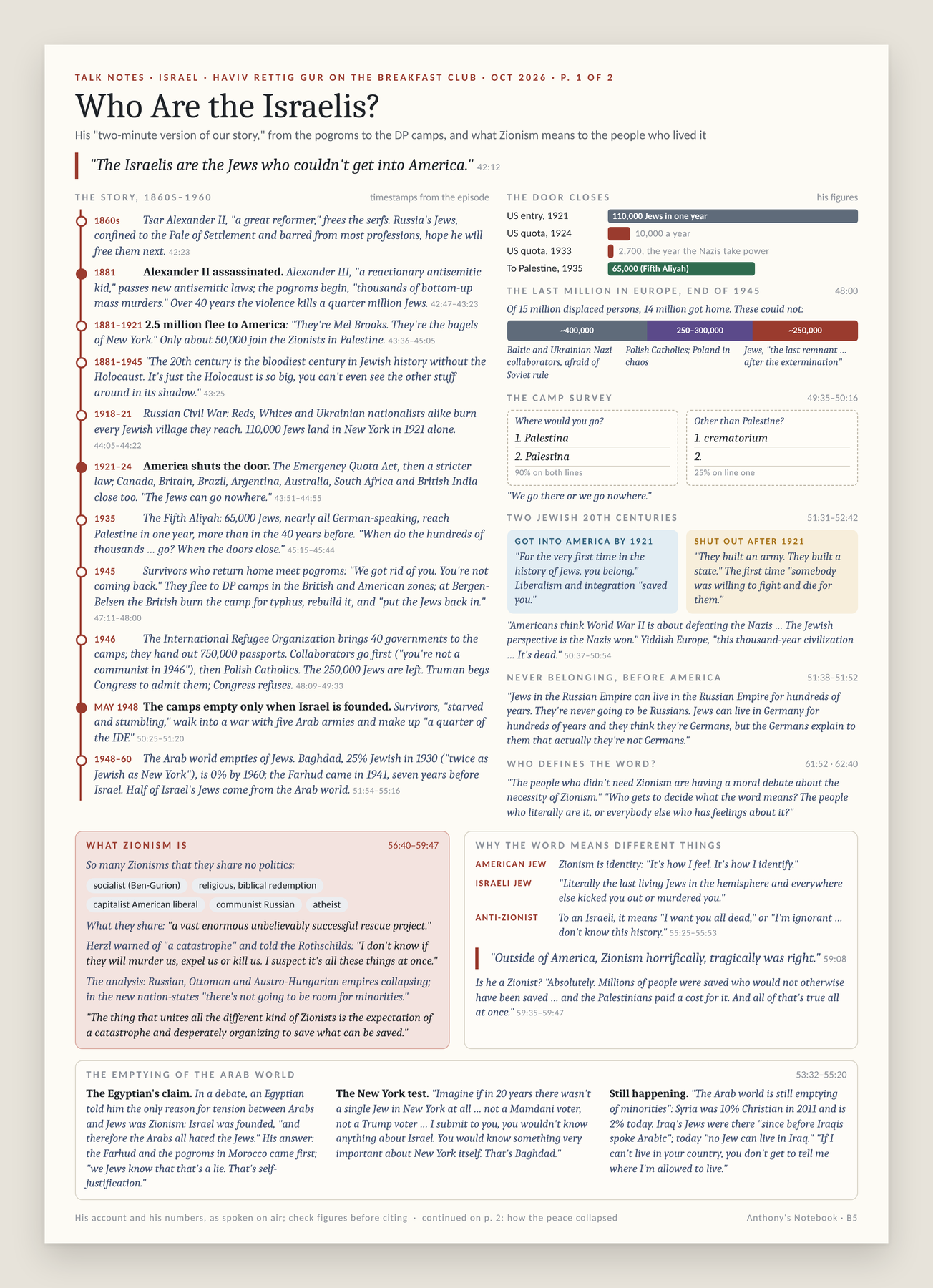
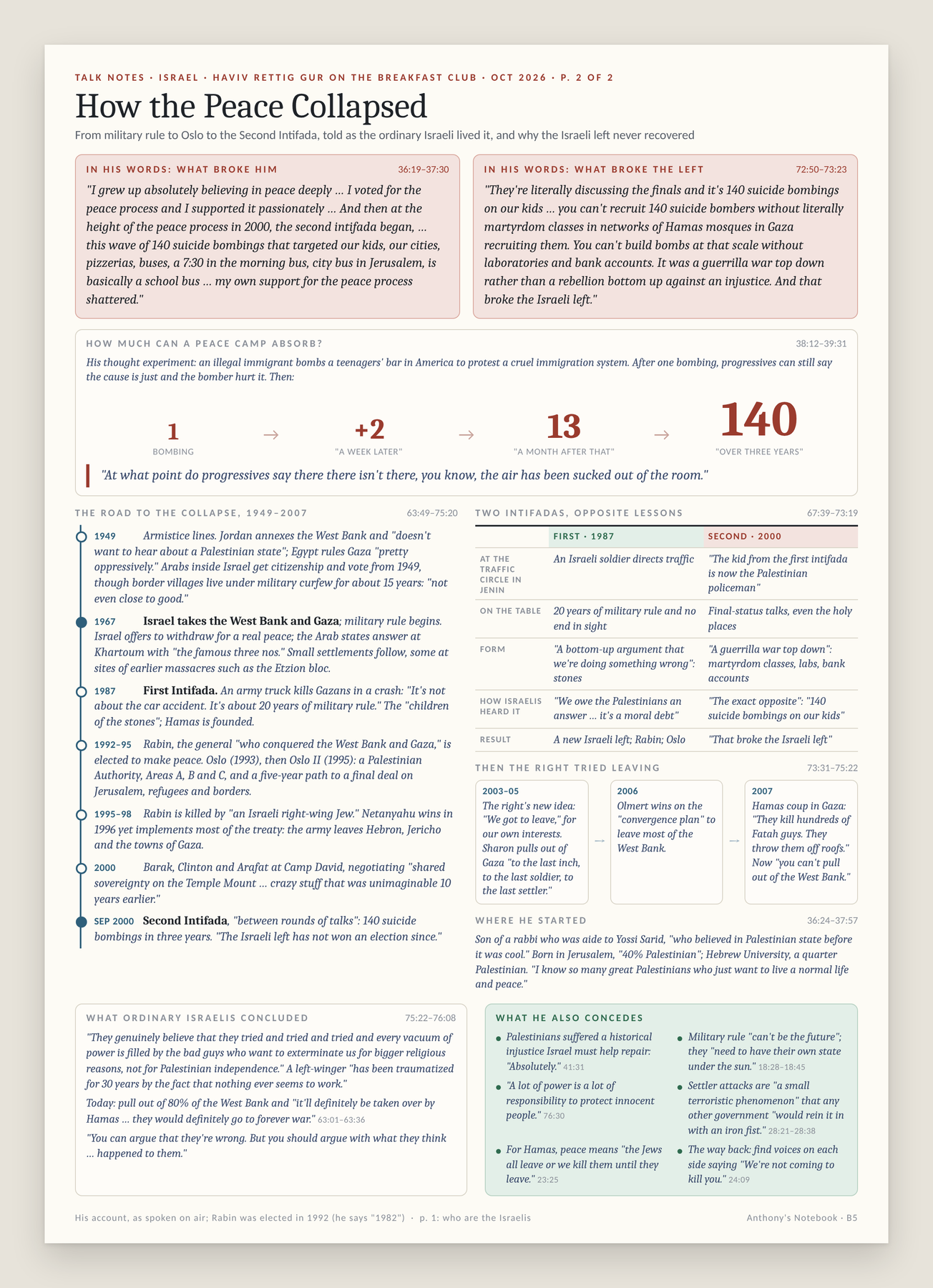
Page 1 · Who Are the Israelis?
His history from the 1881 pogroms through the closed doors of 1921–24, the DP camps and May 1948, with charts of his figures; his definition of Zionism as a rescue project; and the emptying of the Arab world. Source: Attachment (file not included in this release).Page 2 · How the Peace Collapsed
His words on the 140 suicide bombings and what they broke, the escalation thought experiment, the road from 1949 to the Second Intifada, the two intifadas compared, the Gaza withdrawal and Hamas coup, and what he concedes. Source: Attachment (file not included in this release).
Through line and progression of the conversation
Gur wants listeners to understand the history that makes Jewish statehood feel like a condition of survival to many Israelis. His central move is to replace an account of Israel as a detachable foreign project with an account of an enduring society made from communities whose alternatives failed. This supplies his operational definition of Zionism as rescue and explains why denying that society’s legitimacy can harden the people whom activists hope to move.
The hosts keep testing the distance between that explanatory framework and present conduct: civilian deaths, settlement violence, Netanyahu’s choices, Palestinian agency, and what Palestinians can do while their freedom remains conditional on Israeli confidence. Their challenges are part of the argument. Gur’s concessions—Palestinians need their own state, a legitimate war aim cannot excuse crimes, and Israelis must also see Palestinians beyond their worst representatives—help distinguish his defense of Jewish national existence from a defense of every Israeli policy.
- Establish how slogans and national stories carry different meanings to different audiences.
- Separate criticism of Israeli government and military conduct from denial of the Israeli people’s future.
- Explain lost confidence in peace through personal testimony and an escalating terrorism analogy.
- Ground Zionism in Russian Jewish migration, closed exits, Holocaust survivors, and Jews from Arab countries.
- Reconstruct Israeli political learning from Oslo through the Second Intifada and Gaza withdrawal.
- Propose recognition and credible security as resources for compromise; face the hosts’ reciprocal and immediate-rights objections.
Time-coded argument map
00:00–10:35 — Stories, slogans, and the audience hearing them
Gur starts from two real peoples with substantial historical experiences. Each can assemble a persuasive national narrative. He argues that understanding a conflict requires hearing both, while activists often select one and explain the other away. His “All lives matter” analogy shows why a slogan’s literal words and political use can diverge: “Free Palestine” can express a claim he supports—Palestinian freedom—or accompany a program he fears, depending on who says it and what outcome they advocate. 01:19 · 03:47.
The hosts insist that Palestinians and Israelis must be distinguished from Hamas and the Israeli government. Gur agrees. His broad assertions about mutual public fear and activist motives should be read as his diagnosis; the interview supplies no source for his “90 percent” polling formulation.
10:35–18:50 — Defending a people while criticizing its government
Gur attacks the Israeli government’s competence and extremist coalition partners, and its failure to articulate a credible civilian future after the war. The hosts ask whether defeating Hamas can justify the killing of children. His answer is that a legitimate war objective cannot justify crimes committed in pursuing it. The interview does not establish the legality of particular attacks. 10:35.
His positive commitment is explicit: Palestinians need freedom, independence, self-determination, and a state, becoming masters of their own fate. Military rule over another people is untenable. Preserve these statements beside his security arguments. 18:15.
18:50–35:55 — Palestinian plurality, regional danger, and political responsibility
Ordinary Palestinians can oppose Hamas, dislike the Palestinian Authority, fear Israel, and want normal lives at the same time. Gur argues that Israeli policy needs Palestinian partners and must stop undermining credible alternatives. He brings in Iran, Hezbollah, family vulnerability, coalition politics, and settler violence to explain the surrounding constraints. His fatherhood and his children’s future military service make these stakes personal. 21:53.
He describes violent settler attacks as terroristic and later advocates counterterrorism measures against their perpetrators. The hosts challenge his description of Netanyahu’s failures as incompetence when some conduct appears deliberate. Claims about elections and alliances belong to this October 2026 conversation. His theory about American strategic motives concerning Iran and China is explicitly conjectural, introduced as a suspicion without Washington contacts. 28:02 · 31:50.
36:10–40:40 — “My own support for the peace process shattered”
Gur establishes his prior commitment: his father worked with Yossi Sarid and was involved in Rabbis for Human Rights; Gur grew up on the Israeli peace left and voted for the peace process. He then describes the Second Intifada as a wave of “140 suicide bombings” aimed at the ordinary places where children and families lived. A Jerusalem city bus at 7:30 a.m., he explains, functions as a school bus. 36:10.
The transformation he claims is a loss of faith in a political process, not a rejection of Zionism. He still knows Palestinians who want peace. His problem is how a concession-seeking movement can persuade its public that those partners can deliver security against organized armed spoilers.
He asks the hosts to imagine an undocumented immigrant committing a suicide bombing against American teenagers, citing a genuine immigration injustice. A progressive might acknowledge the grievance while condemning the killing. Then imagine one attack → two more → thirteen → 140 over roughly three years. The sheer repetition changes the political setting: a morally defensible reform can lose its constituency when opponents associate it with repeated civilian vulnerability. This is an invented perspective-taking exercise, not an allegation about actual immigrants. The “140” count is Gur’s, not an independently established tally in these notes. 37:42–39:45.
The hosts turn the mechanism back on him: Israeli violence can similarly harden Palestinians and outside observers. Gur accepts the legitimacy of war criticism, then argues that some criticism expands into denial of Israel’s existence. Their exchange leaves a live question: how far does his distinction accurately describe the particular critic being addressed? 39:15–40:40.
41:30–55:25 — The Russian Jewish story and the experience of rescue
The detailed chronology belongs in History of Israel and Jewish People by Haviv Gur, rather than being repeated here. The chain is Russian imperial exclusion and pogroms → migration, often toward America → immigration restrictions → Nazi destruction and displaced survivors → Jewish sovereignty as an institution of refuge. Gur then adds Jews from Arab countries. 41:30.
Three phrases carry the emotional argument. “The Israelis are the Jews who couldn’t get into America” translates national origins into denied entry. “The Nazis won” distinguishes the destruction of European Jewish civilization from the Allied military outcome. The “crematorium” survey anecdote dramatizes survivors’ perceived lack of alternatives; its precise details remain unverified. His New York–Baghdad counterfactual asks the audience to examine what happened to a minority in its home society instead of assigning all responsibility to Israel. 49:00 · 52:40.
56:20–63:40 — His definition of Zionism and the struggle over words
What unites capitalist and socialist, secular and religious Zionists? Gur answers with a “vast enormous unbelievably successful rescue project.” He reads Herzl as recognizing that collapsing multiethnic empires and exclusionary nationalisms could turn Jewish vulnerability into catastrophe. The interview’s reported Herzl–Rothschild words lack a primary reference and should not be circulated as authenticated verbatim quotations. 56:20.
Asked whether he is a Zionist, he replies “Absolutely,” grounds that identity in lives saved, and adds that “the Palestinians paid a cost for it.” This is his governing interpretation of Zionism, rather than a neutral dictionary settlement of every use of the term. 59:34.
“Who gets to decide what the word means?” places semantic authority with people living that identity. The hosts immediately demand the same charity for “Free Palestine.” This is the strongest reciprocal test of his language argument: ask both speakers what institutions, rights, and outcomes they intend before attaching the most threatening meaning to their label. His characterization of particular public figures’ anti-Zionism is contested in the conversation. 62:00–63:40.
63:49–77:59 — Oslo, the Second Intifada, and unilateral withdrawal
Gur narrates an Israeli sequence of experimentation and disappointment. The First Intifada made the moral problem of ruling Palestinians unavoidable; Oslo offered negotiated separation; the Second Intifada undermined confidence in that route. Sharon’s unilateral Gaza withdrawal offered another route, and Hamas’s later takeover undermined faith in unilateral separation as well. 63:49.
Use the corrected scaffold: 1987 First Intifada; 1992 Rabin elected; 1993 mutual recognition and Oslo I; 1994 Palestinian Authority established; 1995 Oslo II and Rabin’s assassination; 2000 Camp David and Second Intifada; 2005 Gaza withdrawal; 2007 Hamas takeover. The automated transcript’s “1982” after discussing 1987 is chronologically inconsistent; his later dating of the PA is compressed. Oslo transferred specified interim governing powers and left final-status issues unresolved; it did not itself deliver full Palestinian sovereignty or guarantee an automatic state in 2000.
Gur stresses organized infrastructure behind sustained bombing: financing, bomb-making, recruitment, and incitement. His explanatory distinction is between justified grievance and organized action capable of destroying a constituency for compromise. Retain his qualifiers that this is what Israelis concluded as they understood events and that they could be wrong. The broader causal record in Peace Offers also includes Israeli rejectionism, settlements, implementation failures, and Rabin’s assassination. 71:25–76:00.
78:00–91:30 — How a movement can make compromise politically possible
Gur describes two levers: make injustice costly to sustain, and provide a credible path away from it. His Martin Luther King analogy emphasizes an appeal to a society’s own professed ideals: America should honor its promise. Applied here, an appeal to Jewish self-determination could make Palestinian self-determination intelligible through a principle Israelis already value. His imagined “We need Zionism” is a request for the same capacity for self-rule, not a demand that Palestinians become Jewish. 78:00 · 88:44.
His 100/0 versus 90/10 contrast describes moral framing. If the opponent embodies pure evil, compromise becomes betrayal; acknowledging even a portion of the other’s legitimate claim creates political room. These are illustrative proportions, not polling, a division of rights, or a technical game-theory result. 82:00.
His “peel off” analogy contrasts removing an unjust regime with imagining the removal of a national society. It asks whether a critic’s proposed future contains the people who live there. It does not establish that every structural comparison with colonialism demands population removal. The hosts ask why dead children are insufficient to compel empathy without a legitimating story. Gur’s explanation of what can produce a public mandate for durable compromise leaves their immediate civilian-protection challenge pressing. He affirms that Israelis must also see Palestinians beyond Hamas, and supports two states. 85:00 · 87:59.
92:00–98:55 — The hosts’ closing test: what can Palestinians do now?
The hosts ask what options Palestinians retain while Israeli security fears block change. Gur proposes credible partners and regional security arrangements, illustrating Israeli fears through the West Bank’s proximity to major population and transport centers. These are risk scenarios and proposals, not proof that Palestinian independence must produce those outcomes. 92:00.
His sweeping claim that Palestinian leaders have never addressed or recognized Israel needs qualification against the PLO’s formal 1993 recognition. A narrower claim about the persuasiveness of national recognition to Israeli audiences is a different proposition. Finally, the hosts observe that each side often hears the other through its most extreme representatives—Ben-Gvir for one audience, militant Palestinian voices for another. Gur agrees. That reciprocal correction is a useful endpoint for the interview’s theory of misrecognition. 96:49.
Language, argumentation, and persuasion to retain
| Device | How it works in this conversation | Best question to ask of it |
|---|---|---|
| Insider testimony | Peace-left upbringing, family, and children establish a speaker with something to lose and a prior position that changed. | How representative is this testimony beyond Gur himself? |
| Concrete civilian detail | A morning city bus becomes a school bus; “security” becomes children’s daily life. | Are Palestinian civilian lives given comparable concreteness? |
| Escalating hypothetical | One → two → thirteen → 140 forces listeners to imagine cumulative political effects. | Does the analogy illuminate repeated violence while leaving the conflicts’ different structures visible? |
| Compressed identity sentence | “Jews who couldn’t get into America” makes blocked refuge immediately memorable. | Which histories and choices disappear in the compression? |
| Shock reversal | “The Nazis won” shifts attention from military victory to an annihilated civilization. | Has the intended cultural meaning been explained before reusing the phrase? |
| Emotionally decisive anecdote | The DP “crematorium” story makes an unavailable alternative feel existential. | Can the specific survey be documented? Until then, attribute it. |
| Definition through common purpose | Rescue supplies a shared function across rival Zionist ideologies. | Does explaining a common purpose settle the justice of each practice? |
| Concession followed by distinction | He accepts Palestinian statehood and possible Israeli crimes, then distinguishes these from denying a people’s future. | Is that distinction responsive to this host’s actual objection? |
| Immanent critique | King’s appeal and the Palestinian self-rule analogy recruit values the audience already accepts. | What concrete reciprocal institutions follow from the shared principle? |
| Reciprocity imposed by the hosts | “Free Palestine,” responses to violence, and extremist representatives are turned back on his framework. | Does the same interpretive charity operate in both directions? |
| Regime/people distinction | “Peel off” asks whether political transformation preserves the resident people. | Has a structural critique been unfairly recast as a call to expel people? |
The reusable argumentative sequence is establish lived stakes → explain the mechanism → acknowledge the other’s injury → specify a future in which both remain. Its persuasiveness depends on factual accuracy and consistent reciprocity, not simply on memorable phrasing.
Selective claim audit — corrections and limits
- “140 suicide bombings”: Gur’s repeated number and approximate period, not a count verified here. Preserve the attack category; do not relabel it “140 terrorist attacks” of every kind or date the full Second Intifada to only three years.
- US quotas: 1921 and 1924 national-origins restrictions, not a literal ban on Jewish persons. USHMM.
- 1935 immigration: official registered total 61,854; previous abode Poland 27,843, Germany 8,630. His near-exclusive German-refugee example is inaccurate. Hansard.
- DP narrative: the crisis and Israel’s major resettlement role are documented; his survey percentages, “passport fair,” selection anecdotes, and fraction of the 1948 army remain unverified. Substantial Jewish DP resettlement in America also occurred. USHMM.
- Oslo: distinguish formal recognition, interim autonomy, final-status negotiations, and actual sovereignty. The 1993 Declaration left core final-status questions open. Primary text.
- “No Palestinian recognition”: the PLO recognized Israel’s right to exist in the 9 September 1993 exchange. Whether subsequent leaders persuaded Israeli publics is a separate argument. Recognition letters.
- King and Malcolm X: Gur speaks as if they personally debated. Stanford records only one brief meeting, on 26 March 1964; compare strategies without inventing a historical debate. King Institute.
- Other sweeping claims: his mutual-fear percentages, migration and civil-war totals, generalized activist intentions, “last Jews” language, and assertions about particular politicians need their own evidence. Contemporary casualty, election, military-capability, and legal claims are not audited here. Do not treat the interview as a comprehensive fact-check of the war.
Questions for Reflection
- When does recognizing a people’s attachment improve negotiation, and when might demanding recognition postpone protections already owed to civilians?
- What evidence would distinguish the effect of bombing from settlement policy, failed implementation, leadership decisions, and other causes of Oslo’s collapse?
- Can a critic apply the same test to both populations: describe a practicable future that protects their continued collective existence and equal individual rights?
Short recall answers
What did Gur lose confidence in? The peace process; he still affirms Zionism and Palestinian statehood.
What connects the Russian story to his definition? Exclusion and blocked exits create a demand for collective admission, protection, and self-government.
What does the American hypothetical test? Whether a reform movement can retain a constituency through repeated attacks associated with the proposed political opening.
What do the hosts add? Reciprocal hardening, semantic charity for Palestinians, present civilian suffering, and the question of what Palestinians can do now.
Optional next learning step
Make a two-column Goodnotes page: Gur’s strongest claim / the hosts’ strongest reply. Reconstruct the 37:42–40:40 exchange before reopening it; then test whether your own preferred argument survives the same reciprocal standard.