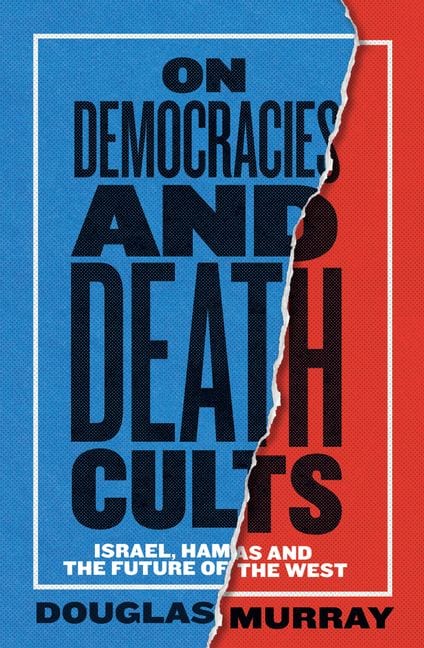

Attachment (file not included in this release)
DESCRIPTION
In his travels through Israel and Gaza, #1 International Bestselling author Douglas Murray has seen the best and the worst humanity has to offer, and he has no trouble choosing a side. Murray is not Jewish and before October 7, he had never lived in Israel. However, he objects to being lied to, and Israel has been on the receiving end of the biggest, deepest, longest lies in history. Israel’s commitment to fundamental Western values—capitalism, individual rights, democracy, and reason—has made it a beacon of progress in a region dominated by authoritarianism and extremism. Israel’s principles vividly contrast with the ideology of Hamas, which openly proclaims its love of death over life. With incisive moral clarity, On Democracies and Death Cults exposes how the campus left and international establishment confuse this conflict by: Calling on Israel for restraint and proportionality, while Hamas commits genocide. Slandering Israelis as white colonialists, while only a third of Israelis are Jews of European ancestry. Framing the conflict as oppressor vs. oppressed, when it is really between a thriving multi-ethnic democracy and a death cult bent on its annihilation. Drawing from intensive on-the-ground reporting in Israel, Gaza, and Lebanon, Douglas Murray places the latest violence in its proper historical context. He takes readers on a harrowing journey through the aftermath of the October 7 massacre, piecing together the exclusive accounts from victims, survivors, and even the terrorists responsible for the atrocities. If left unchecked, misplaced sympathy could embolden forces that seek to undermine not only Israel, but all of Western civilization.
My Summary
Main Ideas, Takeaways & Similarities
Questions
I. What is the problem?
A. How is this problem formulated?
B. Why is this problem important?
C. What is the history of this problem?
D. Which prominent personalities have been interested in this problem?
II. What solutions to the problem are there?
A. What are the conclusions reached?
B. By what argument(s) is the conclusion reached?
C. What facts or assumptions serve as premises?
D. When a prominent personality offers a solution, does he also argue for or against other prominent personalities? Does he raise objections to alternative solutions? Does he consider objections to his own solutions?
III. Evaluation
A. What are the advantages and disadvantages of the alternative formulations to the problem?
B. Has the importance or history of the problem ever been misrepresented?
C. Are the solutions logically related to the premises?
D. Are the facts true? Are the assumptions acceptable? Are the objections answerable?
AI Summary
1) The scale, nature, and intent of the October 7 attacks
- The book underscores the unprecedented scale of the Hamas attacks for a small nation (Israel ~9M): by population ratio, October 7 equates to ~44,400 Americans killed and ~10,000 kidnapped in a single day (Page 8).
- Operational deception fueled terror and confusion: terrorists wore IDF uniforms (some stolen from bases), causing victims to hesitate and misidentify attackers (Page 6–7).
- A defining feature was the relish and public boasting about atrocities—calls home celebrating murders; family members praising killers—contrasted with the Nazis’ attempt to conceal genocidal crimes (Pages 12–14).
- The text details sexual violence and sadism at the Nova festival and elsewhere (e.g., mutilations, rapes, use of civilians as human shields), emphasizing brutality as a tactic and a message (Pages 29, 87, 93).
2) A moral and strategic asymmetry
- Hamas leadership is depicted as embracing civilian death—both Israeli and Gazan—as “necessary sacrifices”to win information war narratives (Pages 15–16, 147).
- Israel is portrayed as fighting to free hostages and destroy Hamas while taking extensive precautions (evacuation texts/leaflets, media takeovers to warn civilians), even though Hamas blocks evacuations and embeds in civilian sites (schools, hospitals, mosques, homes, children’s rooms) (Pages 95–98, 143–146).
- The book argues that debates about “proportionality” are selectively applied to Israel and misunderstand war aims: victory and deterrence, not “evening the score,” should guide strategy (Pages 88–90).
- Claimed casualty ratios (if taken at face value) suggest unusually low civilian-to-combatant rates compared with historical urban warfare (Page 148).
3) Hostages and the social contract
- No-one-left-behind is framed as a core Israeli ethic; Hamas exploited this by maximizing kidnappings to leverage pain and pressure (Pages 26, 54–56, 95, 150).
- The muted global response to mass hostage-taking—compared to other incidents (e.g., Iran 1979)—is presented as a striking moral inconsistency (Pages 55–56, 58).
4) Global and societal reaction: antisemitism, denial, and inversion
- Immediately after the attacks, celebratory/justifying protests erupted in Western cities; posters of kidnapped Israelis were torn down; Jewish institutions were attacked in places like Canada (Pages 10, 101–106, 104).
- On elite campuses, parts of the faculty and student bodies are shown romanticizing or rationalizing the massacre, framing Israel as a colonial oppressor; polling of younger Americans reflects weak support for Israeland tolerance for extremist rhetoric (Pages 105–114).
- The narrative highlights Iranian regime support for Western protest movements (financial and rhetorical) and praise from Hamas/Iranian leaders for student encampments (Pages 106–108, 120–121).
- The author criticizes international bodies (e.g., UN/UNICEF/UNRWA) for ineffectiveness or complicity and Western media for credulity toward Hamas-aligned “journalists” (Pages 139–151, 159–160).
5) Historical context and the persistence of antisemitism
- Traces ideological roots: Khomeini’s revolution, Iran’s regional imperialism, PLO (pre-1967) goal of eliminating Israel, and the Mufti of Jerusalem’s Nazi collaboration—arguing that Nazi-style antisemitismmigrated and flourished in parts of the Middle East (Pages 19–20, 121–126, 166–168).
- Explores the Left’s shift post-1967 from sympathy for Israel to aligning with Palestinian militancy as anti-colonialism became a master frame (Pages 124–127).
- Presents antisemitism’s shape-shifting (religion → race → statehood) and double binds (Jews condemned whether integrated or distinct; rich or poor; stateless or with a state) (Pages 127–129).
6) Gaza under Hamas: siege narratives vs realities
- Notes population growth in Gaza and Israel’s non-Jewish demographics to rebut “ethnic cleansing” claims; cites aid inflows and development (promenades, amenities) contrasted with massive tunnel networks (350+ miles) and weapons in civilian spaces (Pages 27–31, 139–144).
- Emphasizes Hamas’s use of civilians (e.g., old woman in wheelchair as cover; child couriering bomb), the strategic siting of tunnels near UN/foreign outposts, and Egyptian border tunneling (Pages 146, 185–186, 200–201).
7) Israeli society: trauma, resilience, service
- First-person testimonies show horror, delayed rescue, and worldview shifts among survivors (e.g., Be’eri, Nova attendees; Druze rescuers) (Pages 39–43, 78–87).
- The IDF is portrayed as reluctant fighters motivated by protecting life, with universal service creating shared stakes across society (Pages 156, 190–191).
- Vignettes of young women soldiers and veterans highlight a culture of responsibility, contrasted with Western youth entitlement and declining patriotism (Pages 156–157, 132, 154–155).
8) Information war and institutional failures
- The book critiques Western media skepticism toward evidence of Hamas entrenchment (e.g., Shifa Hospital) despite prior reporting; calls out selective outrage and rhetorical devices like “pinkwashing” used to neutralize counter-facts (Pages 151–158).
- Frames international legal moves (e.g., ICC) as politicized, sometimes labelling Hamas leaders as “victims” while pursuing Israelis (Pages 195–196).
9) Strategic lessons and conclusions
- Doctrine: Hit the enemy’s real centers of gravity/vulnerability (not just mass) and neutralize the information battlespace (Pages 89–91).
- Borders/Iron Dome: Missile defense can induce complacency; durable security ultimately requires offensive measures against launch infrastructure (Pages 38, 182–184).
- Moral core: The central contrast is between a movement that “loves death” and a society that chooses life. The author argues that civilization prevails by loving life enough to fight for it (Pages 211, 161).
Through-line
Across history, ideology, and battlefield detail, the book’s thesis is that October 7 exposed a death cult ethos within Hamas and its ecosystem, met by a democratic society’s imperfect but determined defense of life and liberal civilization. The global aftermath—campus apologias, NGO hesitancies, media inversions, external state sponsorship—reveals a broader struggle: whether Western institutions can still tell moral truth and defend themselves when confronted by adversaries who weaponize both civilians and narratives.
Highlights
Introduction (Page 6)
The people by the car were dressed in the uniforms of Israeli soldiers. They started shooting at him. Incidents like this caused utter confusion on top of the terror. Why would they be shooting at me? was his first thought. But some of the Hamas terrorists had come into the country wearing versions of the uniforms of Israeli soldiers. Others had taken them off the bodies of the dead in the military bases Hamas had already overwhelmed. (Page 7)
Israel is a country with a population of just 9 million people. America is a country of some 333 million people. To put it in perspective, the death toll on October 7 was the equivalent of some 44,400 Americans being killed by terrorists on a single day. Or around fifteen 9/11s. The kidnap toll if it had happened by ratio in the US would have been almost 10,000 Americans taken from their homes as hostages. It would be the equivalent of some 5,000 Canadians being killed in a single day and a thousand taken hostage. Or 8,400 French or British people being slaughtered in a single day and another 1,750 taken hostage. (Page 8)
While this protest was going on in New York, the massacres were still going on in the south of Israel and the terrorists had still not yet been pushed back. (Page 10)
In Canada alone, after October 7, synagogues were firebombed and shot at, Jewish schools were shot at, Jewish shops were firebombed, and Jewishowned bookshops were vandalized. (Page 10)
It was that the terrorists of October 7 did what they did with such relish. (Page 12)
It was the fact that all of this gave them such intense joy. And that they were proud of their actions. (Page 13)
One of the recordings from the 7th, from that first atrocity video, was a recording of one of the terrorists who had got into the kibbutz of Mefalsim, a community of just over a thousand people in the south of Israel. In the midst of the attack the terrorist made a phone call back to his family in Gaza. The excitement in his voice was obvious. “Hi Dad,” the three-minute call begins. “Open my WhatsApp now and you will see all those killed. Look how many I killed with my own hands! Your son killed Jews!” The father replies, “May God protect you.” The son is exultant. “Dad, I’m talking to you from a Jewish woman’s phone. I killed her and I killed her husband. I killed ten with my own hands.” He goes on and on repeating himself. Boasting. “Dad I killed ten! Ten with my own hands! Put Mum on.” (Page 13)
Oh my son. God bless you,” say the parents. Their son keeps making the same boasts to his mother. “I wish I was with you,” she replies. “Mom, your son is a hero,” he boasts. “Kill, kill, kill.” Next the man’s brother comes on the line and the young man brags to him too. “I killed ten. I swear!” “Hold your head up father. Hold your head up.” One of the men on the other end says, “Come back, come back.” “What do you mean, come back?” replies the son. “There is no going back. It is either death or victory. Open the WhatsApp. See the dead. Open it. Open WhatsApp on my phone and see the dead. How I killed them with my own hands.” (Page 13)
But as the historian Andrew Roberts has also remembered, toward the end of his life George often reflected on the fact that in his view, “There are people who are worse anti-Semites than the Nazis.” (Page 14)
George would be the last person to ever downplay the culpability of the Nazis who had killed so many of his friends and family. But he noted, as many historians have, that as evil as they were in general, the Nazis attempted to cover over the worst of their crimes. (Page 14)
Consider what the head of the SS, Heinrich Himmler, said in his speech to his most senior lieutenants in October 1943 as he detailed what the Nazis sought to achieve with the Holocaust: “We can talk about it among ourselves, yet we will never speak of it in public… . I am referring to the evacuation of the Jews, the extermination of the Jewish people… . It is,” he said, “a page of glory in our history that has never been written and is never to be written.” Himmler and his SS were among the most evil people in human history, yet even they had sought to cover over their crimes. Here, in 2023, in the form of Hamas, were people who were boasting of their crimes, were proud of their crimes, and indeed wanted to broadcast their crimes for all the world to see. (Page 14)
After twenty-two people—most of whom were young girls—were blown up by a suicide bomber at an Ariana Grande concert at Britain’s Manchester Arena in 2017, the response, pushed onto the public by the media and others, was to sing an Oasis song—“Don’t Look Back in Anger.” As though, after twenty-two young people have their bodies blown to smithereens by a bomb packed with nails and ball bearings, the important thing was just not to be angry. But why? If the murder of young women for the crime of being at a concert shouldn’t make you angry, then what should? Perhaps the British, like other people, just didn’t know what to do about it. (Page 15)
None has had to fight against an opposition whose leadership (as intercepted messages from the leader of Hamas in Gaza have made clear) sees the loss of their own (Page 15)
civilians as desirable because of the advantages it can bring them in the war for international public opinion. Because in this era war is not just waged on the battlefield, but in the efforts to delegitimize a conflict abroad, turning victims into culprits and culprits into victims. It seems to me that the right of Israel to fight and win such a war is vital not just for the sake of that country, but so Britain, America, and every other Western country will be able to fight such a war if—or when—the time comes. (Page 16)
matters to me also because I believe that what Israel stared into that day is a reality we might all stare into again at some point soon— and that some of us have already glimpsed. (Page 16)
Chapter 1 What Happened (Page 19)
many Western intellectuals and journalists celebrated the flight of Khomeini from Paris. Among them was Michel Foucault, the leftwing French philosopher, who saw Khomeini as bringing a spiritual revolution to Iran that would finally do away with the Western sins of capitalism and materialism. (Page 19)
While decrying Western imperialism, the Iran of the ayatollahs became one of the biggest imperial powers of the age. (Page 20)
While accusing Israel of being a colonialist outpost of America, Tehran was busy setting up colonialist outposts everywhere. (Page 20)
Many of the communities have communal dining areas, and communal play areas for the children. It is hard to think of a more idyllic or safe place for a child to grow up in. Members of the communities often talk about how their children can run around playing till relatively late in the evening because, since everybody in the community knows each other, they all know where the children are and that they will be safe. (Page 21)
e withdrawal from Gaza was one of the most difficult decisions in modern Israeli history. The territory (which had previously belonged to Egypt) was captured by Israel during the war of 1967. Although there were strategic reasons to hold on to the territory, it had always been a headache for consecutive Israeli governments. Policing the Strip was costly in lives and treasure. Still, it was thought to be a remarkable change of tone in the early 2000s, when Ariel Sharon—known as being a hard-line right-wing prime minister and military leader—decided to withdraw. (Page 22)
In the distance paragliders appeared in the sky. They were being operated by Hamas terrorists who had managed to fly into Israel from Gaza. These were fitted with high-powered guns. By this time many festivalgoers had started to run. At the entrance to the festival Hamas trucks filled with heavily armed terrorists drove in. Then the shots began to ring out. (Page 25)
Hamas knew what they were doing in not just killing but also kidnapping Israeli civilians. Part of the social contract in Israeli society—and the Israeli military in particular—is that no person should be left behind. A core tenet of the state is that if one Israeli is caught, then the government and people will do anything they can, at any price, to get the hostage back. (Page 26)
In 1948, the year of Israel’s independence, the non-Jewish population of Israel was 156,000. By 1970 the non-Jewish population of Israel (mainly Arab Muslims, Arab Christians, and Druze) had almost tripled. By 2000 it had reached 1,413,900. By 2015 the non-Jewish population was 2,078,000. In 2024, amid Israel’s supposed genocidal war, the non-Jewish population of Israel was 2,653,000. In other words, from 1948 to 2024 the non-Jewish population of Israel had grown almost exactly seventeen-fold While the in Ramallah government consistently claimed that the Israelis were “ethnically cleansing” Jerusalem of non-Jews, the same pattern emerged. In 1948 the Muslim population of Jerusalem was 40,000 people. By 2022 the Muslim population of Jerusalem had grown by over nine times, to 371,400. the Palestinian Authority in Tehran and (Page 27)
In 1941 a Nazi-inspired pogrom broke out in Baghdad, Iraq. The Farhud (Arabic for “violent dispossession”) massacre targeted Iraqi Jews who had been in the country since the time of the Babylonian empire. Some six hundred Jews were massacred by Iraqi Muslims carrying knives, swords, and guns. A red hand (hamsa) sign was painted on Jewish homes to direct the crowds there. As one survivor told the BBC seven decades later, the crowd shouted “Allah” and “Cutal al yehud” (“Slaughter the Jews”). Hiding in a palm tree, the young Jewish boy watched the crowd set upon the house of his mother’s best friend. They set the house on fire and were “shouting from joy.” In their hands, in jubilation, they were carrying something that looked “like a slab of meat in their hands.” It took a moment for the nineyear-old boy to realize what it was. “Then I found out, it was a woman’s breast they were carrying—they cut her breast off and tortured her before they killed her, my mother’s best friend, Sabicha.” (Page 28)
Some months after the Nova festival massacre, the Guardian newspaper ran a report on sexual violence on the morning of the attack. The paper described how one woman who was raped was “shredded to pieces” and another “stabbed repeatedly in the back while she was being raped.” One young woman who attended the festival recounted in the paper how she had been shot in the back and was hiding among the vegetation just off route 232 when a large group of Hamas terrorists arrived. As she lay there she saw them rape and kill at least five young women. “They laid a woman down and I understood that he is raping her,” she attested. “They passed her on to another person and he cuts her breast, he throws it on the road and they are playing with it.” (Page 29)
In 2010 there were a number of shark attacks by the Egyptian sea resort of Sharm el-Sheikh. There was a risk that these attacks could further hurt the tourism industry in Egypt, which was already suffering a downturn. But local journalists and politicians knew who to blame. A number of them— including the governor of the region, Mohammad Abdul Fadhil Shousha— suggested that it was possible Israel’s Mossad agency had placed the shark in the sea in order to damage the Egyptian tourism industry Similar “Jewish-controlled animals” scandals regularly erupted in the region. In 2013 a kestrel was found in the eastern Turkish province of Elazig. The bird was accused of having an Israeli monitoring footband and so was condemned on suspicion of being an Israeli spy. It was taken in for examination, including X-rays, before being freed Similar accusations have been made against eagles, bee-eater birds, and dolphins. While this might seem comical to an outsider, it is not so outlandish to anyone who understands the mindset of the region. (Page 30)
Egypt (Page 30)
There were copies of Mein Kampf, copies of The Protocols of the Learned Elders of Zion, and a range of other conspiracy tracts focusing on Israel and the Jews. (Page 30)
It is a combination of superiority and inferiority complexes, and it helps the sufferer in every way. If the Jews are successful at defending themselves or innovating or growing their society, they can be portrayed as allpowerful. And that provides an easy excuse for the failures of the societies around them. (Page 31)
This was one of the most compelling justifications for the idea of Zionism. It was part of the argument that Theodor Herzl recognized in his 1896 work, The Jewish State. It was Herzl’s belief even then—before the (Page 32)
ultimate catastrophe of European Jews—that the only people who could or would protect the Jewish people would be the Jewish people. Although Herzl spent all of his life building up to this argument, and then traveling around Europe proselytizing for it, the realization came to him because of something he saw in person in 1895. That was when Herzl witnessed the public humiliation of Captain Alfred Dreyfus. (Page 33)
that the only people who could or would protect the Jewish people would be the Jewish people. (Page 33)
Shortly after Israel handed over Gaza to the Palestinian Authority in 2005, it was dragged into a second war in Lebanon after Hezbollah ramped up its firing of rockets into northern Israel. In 2006 Hezbollah fired thousands of rockets as far into Israel as the city of Haifa. (Page 35)
On a visit to the city of Sderot in the early 2010s, I sat with the town’s mayor and some of the population as rockets came over from Gaza. I could see the effect this had on people, and parents told me the effect that this (Page 35)
constant fear, air-raid sirens, and running for shelter had, especially on the children. I asked a pretty obvious question: why anyone would live like this? (Page 36)
“If we cannot live in Sderot then we cannot live in Ashkelon. And if we cannot live in Ashkelon then we cannot live in Ashdod. And if we cannot live in Ashdod then we cannot live in Tel Aviv or Jerusalem. And so we cannot live.” (Page 36)
It was a hard logic. But it was one that Hamas and other jihadist groups in Gaza were also relying on testing. If people were too afraid or traumatized to live in the south of Israel, then eventually they would be too afraid to live in the center. And if Hezbollah squeezed Israel from the other direction—top down—then eventually you would have no Israel. People like the mayor of Sderot and the leadership of Hamas knew the same thing. Except that one side wanted to continue living where they were and the other wanted them gone. (Page 36)
By 2023 Hezbollah was estimated to have stockpiled somewhere between 120,000 and 200,000 rockets in southern Lebanon. (Page 37)
If Canada fired thousands of rockets into America, or France fired a similar barrage for over a decade into Britain, the likelihood is that the public in the country being targeted would not be content when their government simply came up with better and better ways in which to shoot the rockets down. But Israelis got used to it, and to the idea that whatever the enemy threw at them they would be able to find an answer. (Page 38)
The residents of Be’eri included a seventy-four-year-old Canadian-born peace activist, Vivian Silver. Vivian had spent decades of her life working for peace between Israelis and Palestinians as a cofounder of Women Wage Peace and as a member of the board of directors of the far-left-wing human rights group B’Tselem. Every week she took part in a joint Israel-Gazan initiative in which she would drive Palestinian children and others in need of highly specialized medical treatment from Gaza to hospitals inside Israel. (Page 39)
Avida recalled, “He told me, ‘Dad, when you bury me, please bury me with my surfboard.’ He was a surfer. He was a sailor. He liked the sea. And I told him, ‘Carmel, don’t even say it.’ ” After a few minutes of shorter and shorter breaths, he stopped, and died. (Page 42)
Aside from the horror, two things were especially striking about Avida’s testimony. The first was the shock he continued to feel about that first promise he had given to his wife and children. The promise, like so many parents that morning, was that the IDF would be there in minutes. Instead nobody found them for almost fourteen hours. The second thing that was most striking was the shift in his own worldview after the terrorists destroyed his community. Avida had, by his own admission, always been a man of the left. He had believed in the idea of peace. But now he felt differently. “The enemy has changed,” he said. Even between two enemies “there is a contract: what you can do and what I can do. And the contract was broken. Something changed.” As he saw it, there was nothing Israel could do about Egypt or Lebanon. But the country could choose if they (Page 42)
wanted to live beside Gaza. Because the residents of Gaza had changed. “The young people burn us, the others shoot us, and the old ones kidnapped us.” He could see no way in which Israel could live beside Hamas-run Gaza. “We need potatoes. We need peanuts. We need orchards. And we need avocadoes. Until the sea. All the way.” (Page 43)
Critics like Naomi Klein would subsequently not even permit the Israeli people to have such trauma. Writing in the Guardian, Klein would later argue that Israelis had performed a “dangerous weaponization” of their grief and trauma and had done so to justify “imperial aggression and grotesque rights violations.”14 Meaning that Israelis could not even be traumatized without being accused of being traumatized for their own evil purposes. (Page 44)
In 2009, an eighty-eight-year-old white supremacist carried out a fatal shooting at the United States Holocaust Memorial Museum in Washington, DC. In March 2012, a thirty-year-old rabbi, his sons, ages three and six, and an eight-year-old girl were all killed by a twenty-three-year-old Frenchman of Algerian origin at a Jewish school in Toulouse, France. In 2014, a seventy-three-year-old neo-Nazi opened fire at a Jewish community center and a Jewish retirement home near Kansas City, Missouri. In May 2014, the Jewish Museum in Brussels, Belgium, was attacked by a twenty-nine-yearold Frenchman of Algerian origin. Four people were killed (Page 45)
And then October 7 happened, and a doubt spread among Jews in Israel and around the world. What if we aren’t safe in Israel either? (Page 46)
Born in 1962 in Khan Younis, when Gaza was still ruled by the government of Egypt, Sinwar was recruited into Hamas by the group’s founder, Sheikh Ahmed Yassin. He soon rose to become one of the heads of the group’s internal security unit, tasked—among other things—with finding and punishing Palestinians accused of “collaboration” with Israel. In 1988, one year after the outbreak of the First Intifada, Sinwar was arrested and imprisoned for the murder of four Palestinians he had believed were informers. He told his Israeli interrogators that he had killed them himself, strangling one with his bare hands and suffocating another with a kaffiyeh. Sinwar reportedly admitted to these crimes without any remorse and in fact boasted that he regarded these killings as a religious duty. (Page 47)
From hours of speaking with him he was adamant that the motivating factor for Sinwar’s extreme ideology “wasn’t political, it was religious.” (Page 48)
“That night, we saw a video that was posted on the social media of the Hamas kidnapping her,” said Adva. “She was on a golf cart with four armed terrorists around her being paraded in the streets of Gaza as people were celebrating and clapping their hands and acting like kidnapping an eighty-five-year-old woman makes sense.” (Page 51)
For a country to lose hundreds of its civilians in this way is almost unheardof. In 1979, when the Shah was overthrown in Iran and the Ayatollah Khomeini’s revolutionary Islamic movement came to power, supporters of (Page 54)
the ayatollah stormed the American embassy. They held more than fifty Americans hostage for over a year. It was a cause of such shame and rage for the American public that it was one of the factors that caused them to throw out the president on whose watch this had happened—Jimmy Carter —and replace him with Ronald Reagan, who promptly ensured the release of the hostages. (Page 55)
When 250 Israeli hostages were taken on October 7, 2023, the world’s response was muted. Perhaps it took time for the world to realize the scale of what had happened, or perhaps it labored under the belief that the situation between Israel and Hamas was simply “complex.” But there was no campaign like that for the Chibok schoolgirls. Aside from Jewish celebrities and influencers there was no organized campaign to pressure Hamas to release the hostages. Even the fact that people from a range of nationalities had been abducted on the 7th drew a strangely muted response. (Page 55)
The abductees included American, British, French, and German citizens. Yet in each of these countries there was minimal political, diplomatic, or social pressure for the release of the kidnapped. The one place where there inevitably was a huge and immediate campaign was inside Israel. (Page 56)
He mentions the Red Cross, who have just made a demand to the Israelis that they be allowed to visit Palestinian prisoners in Israel. But with them and other international bodies like the United Nations, Moran cannot understand why his family seems not to be of any importance. (Page 58)
On the way, his ex-wife, Liron, called him, screaming hysterically. “Where are you, Nimrod? Where is the IDF?” Her new boyfriend, Nir, was from Kibbutz Nir Oz and was trapped at that very moment in his safe room along with his two little girls. Hamas were in his house, shooting at the door to the safe room. Liron pleaded with him to go and save her partner and his daughters. “I’m already on my way, just send me a pin of his house, I’ll get to them.” Now he was a man with a clear destination. (Page 60)
Near the side of the road he found the body of a young woman with her tights and underwear down, and blood on her backside. “It was obvious from the scene that they were raping the women,” he said. Out of some instinct, Nimrod pulled up the girl’s pants and tights to give her some decency in death. (Page 61)
“Our army was caught by surprise that day. I now know what happens to the Jewish people when they are without an army, even for half a day. Women were raped, kids were killed in their cars, families burned, some with body parts, some without. The damage to buildings was like a tornado had passed through.” (Page 61)
I asked him about his statement “I’m an Arab, I’m a Muslim.” Did it have any effect on them? “No,” he said firmly. They saw him as a hostage. They wanted to use him. They believed that the IDF could not kill them from the air if they had Tariq there as “a human shield.” The terrorists used the time that they bought to kill other people. As Tariq says again, “They didn’t care if I am a Muslim.” (Page 65)
The first is that the security consensus in Israel had for many years been unified around what became known as the “conception.” This “conception” held, among other things, that while Hamas was undoubtedly an apocalyptic Islamist movement, its leadership had fallen into a familiar pattern of terrorist movements that ended up in government. That is, eventually the trappings of power and the enjoyment of the benefits it brings supersede the dreams of the movement’s youth. From the Soviet Union, among other precedents, we commonly see revolutionaries end up simply enjoying being corrupt. (Page 66)
Their actions aside, it was never hard to judge Hamas’s leadership and its aspirations by their words. In 2012, the deputy speaker of the Hamas parliament said in a sermon, “Oh Allah, destroy the Jews and their supporters. Oh Allah, destroy the Americans and their supporters. Oh Allah, count them one by one, and kill them all, without leaving a single one.” In 2019, senior Hamas official Fathi Hamad said, “You have Jews everywhere and we must attack every Jew on the globe by way of slaughter and killing.” In April 2023, six months before the October 7 attacks, senior Hamas official Sheikh Hamad al-Regeb said, “Bring annihilation upon the (Page 67)
Jews. Paralyze them, destroy their entity.” And perhaps most importantly there was the leader of Hamas in Gaza, Yahya Sinwar. (Page 68)
In 2018 he gave an address to the citizens of Gaza in which he said, “We’ll take down the border [with Israel] and tear out their hearts from their bodies.” The Israeli leaders who believed in their own “conception” would not be the first group of people who failed to take an enemy at their word. But in all of these cases the Hamas leadership said it because they meant it, because they wanted to act on it and were planning to do so. (Page 68)
Chapter 2 What I Saw (Page 69)
He writes, “An amazing thing was that the swine utilised everything, even paper and fabric—anything which could be useful to anyone, was important and useful to these swine. Only the most precious thing in the world, a human life, was trampled by their boots.” (Page 70)
Despite the charred debris, and the ruin and the blood everywhere, it was worth trying to remember what a tranquil and peace-loving community this was until this Armageddon. (Page 74)
When it came to the survivors of the Nova party, there was one story in particular that the Israeli media barely mentioned: in the aftermath of the party a number of the young people who had survived had been sectioned into mental institutions. A number had killed themselves. Others had tried to kill themselves in the hospitals. (Page 78)
A number of those who survived had been on cocaine, which is a stimulant. (Page 79)
Perhaps the worst drugs to have been on when the massacre began were consciousness-expanding drugs, which involve a psychedelic “trip” and can make people feel at peace with the world. These drugs include LSD, MDMA, and psilocybin mushrooms. People who had taken them would have almost no ability to comprehend the situation they found themselves in. People who had literally prepared themselves to be at one with the best aspects of the universe instead found themselves face-to-face with the worst things anyone could see. Who can comprehend the confusion and terror that many of the young people on one or other of these drugs felt in their final moments? (Page 79)
One of the truths about trauma is that anyone who has been through a dangerous situation is in an infinitely better position if they were in some way anticipating the situation or expecting to go into harm’s way. But anyone who comes across such a thing completely unexpectedly is far more likely to suffer long-term trauma from the event. (Page 79)
“Their minds just collapsed,” she explained. The mixture of openness and horror, tranquility and terror was too much for the brain. (Page 79)
These were unarmed Gazan civilians, in civilian clothing, not Hamas terrorists, he explained. They were part of the large number of people who flooded into Israel after the terrorists had broken through the border. They were women and men and they were looting the cars that had been left at the festival parking site. When they found someone alive in one of the cars they alerted the terrorists, who then came and killed them. (Page 83)
Even in the religious petri dish that is the Middle East, the Druze are a remarkable people. Today the community totals less than a million people, spread out between Israel, Lebanon, and Syria. Though they speak Arabic and have many Arab customs, their religion is unique. It bears similarities with Islam and Christianity but is generally regarded as a breakaway from Shia Islam. Druze communities in Israel are relatively independent (the religion opposes intermarriage and it is not possible for an outsider to convert in). And although they make up only slightly more than 1 percent of the Israeli population, many Druze serve in the IDF. A number of prominent Druze have reached cabinet level. (Page 84)
Amar was in the bar area that morning and came across another young partygoer whose head had been caved in with hammers. He described how he wet the lips of the young man as he lay dying. (Page 86)
There was one last, terrible question I still felt I had to ask them. There had already been multiple reports of rape and sexual violence being perpetrated at the Nova massacre—against men and women. Multiple witnesses as well as first responders confirmed that some of the dead and those who survived had been raped and gang-raped by the terrorists that morning. But equally—and predictably—there were already attempts to deny that any such thing had occurred. Many of the people in the West who had spent recent years saying “Believe all women” did not believe the women who said they had been violated in the Negev that morning. Since the Druze men had seen more than most that morning, I said I was sorry to have to ask this, but that the world was currently seeing real-time denial about this question. Among all the violence they saw that morning, did any of them actually see anyone being raped? There was a pause and then one of the family said, “No, I only saw them shoot a girl in the genitals.” (Page 87)
Something that has dogged Israel in each of its recent conflicts is the idea of “proportionality” and “disproportionality.” It is a curious concept that has gained prominence almost solely in wars involving Israel. For years, whenever Israel had responded to an assault on its people, the world’s media has fallen into a debate on “proportionality.” By contrast, it is rare to hear a discussion of whether the Ukrainian response to Russian aggression is “proportionate” or not. Or whether the Western and Kurdish assault on ISIS strongholds like Mosul, Iraq, was “proportionate” or not. (Page 88)
And there are no wars in human history in which the response to aggression can be exactly calibrated as equal to the initial aggression. (Page 88)
There are laws of war. And there is a rightful concern with arbitrary or excessive use of force. But the aim of a war can never be to simply even the scores or respond in kind. The aim of any war is to achieve a strategic, and preferably also moral, victory. Also, one must deter the enemy or any future enemy from trying to achieve their aims in a similar way. (Page 89)
The great Prussian general Carl von Clausewitz (1780–1831) is still studied today because of his posthumously published work, On War. It contains an insight into what was once widely seen as one of the key rules of war: that to defeat an enemy, that enemy should be struck at its “center of gravity.” For Clausewitz, that center existed where the largest mass of the enemy was concentrated. To hit them there and defeat them in their position of greatest strength was the surest way to achieve victory. (Page 89)
To knock an enemy off balance it is in fact best to hit them where they are at their weakest. (Page 90)
On the morning of the 7th, Hamas entered Israel from around sixty different places on the border. But taking over the Erez crossing was one of their greatest victories. Videos uploaded by the Qassam Brigades on their own Telegram channels that day showed that the terrorists made a significant breach at the crossing with an explosive device. They then swiftly overwhelmed the soldiers based there in a gun battle. Even weeks later the buildings at the crossing were still covered in shattered glass and other evidence of intensive fighting. Many rooms bore the blast marks across the walls, floors, and ceilings that showed hand grenades had been thrown into them. The soldiers at the crossing were overwhelmed and hundreds of terrorists in hundreds of vehicles poured through with enough weaponry for what one soldier would describe as “a long stay” inside Israel. (Page 91)
In one exchange a male terrorist points to the handcuffed girls and says, “Here are the girls that can be impregnated. Here are the Zionists.” One of the Hamas terrorists then says coaxingly to one of the terrified young women lined up against the wall, “You are so beautiful.” (Page 93)
CCTV footage subsequently found inside the Shifa compound showed a number of the hostages being taken there on the 7th. (Page 94)
The Israelis had two stated objectives: to free the hostages and to destroy Hamas (Page 95)
Hamas was reported to be stopping people in the north from leaving their homes, making sure that their fighters who wore civilian clothing and operated from civilian buildings continued to blend in among the civilian population as much as possible. (Page 95)
They had messaged the civilian population of the north—by text messages and leaflet-drops from planes—telling the civilian population there to make their way south. (Page 97)
Every day thousands of Gazans were now moving this way. Twenty-five thousand had done so the day before. Fifty thousand the day before that. And it was not an easy task for the Gazans to simply follow the instructions of the IDF. Just a day earlier, video had emerged from up the highway where the road was strewn with the bodies of Gazan civilians shot by Hamas for trying to make their way south. Hamas had actually been gunning down the Gazan civilians, even as they accused the Israelis of wishing to do the same. Roadways like this one were already covered in bodies. (Page 98)
Chapter 3 How the World Turned (Page 101)
The Times Square rally against Israel took place on October 8, while Hamas terrorists were still murdering their way through the south of Israel and the battles were still going on. That same day there was a protest in Manchester, England, at which one of the cofounders of Palestine Action told the crowd, “When we hear the resistance, the Al-Aqsa Flood, we must turn that flood into a tsunami of the whole world.” (Page 101)
The following day, October 9, thousands of anti-Israel protesters gathered outside the Israeli embassy in the Kensington section of London to (Page 101)
celebrate the attacks, carry out acts of criminal damage on the area, and attack Israel in their own way. Many of the attendees carried signs saying “End the Occupation.” Chants included “Intifada, Revolution.” Other celebratory crowds gathered outside the prime minister’s house at 10 Downing Street, again lighting flares, chanting “Allahu Akbar,” and read carrying signs praising “Decolonization is not a metaphor.” In these early celebrations the vast majority of the participants were British Muslims, with the men dressed in terrorist chic and many of the women in burkas and other face coverings. the massacres. Just one of these (Page 102)
The first big march against Israel in London took place on October 15, this time with thousands of people in attendance. At this and smaller protests the previous day, whenever the crowd spotted anyone they identified—rightly or wrongly—as Israeli, they chased them. The British police stood by idly during almost all of this, allowing the mob to police the streets themselves, with the Metropolitan Police as some sort of bystander. By October 21, central London was just one of the British cities that came to a standstill as over 100,000 anti-Israel protesters gathered in the capital. That demonstration included the group Hizb ut-Tahrir, an Islamist group that is banned in a number of Muslim and European countries. One of their members in the United Kingdom, Luqman Muqeem, had already declared that the Hamas attacks of October 7 “made us all very, very happy” and had shared a message on social media about “killing the Jews.” (Page 102)
At the October 21 rally the group’s members held a huge banner reading “Muslim Armies! Rescue the people of Palestine.” One of the speakers in London shouted out, “What is the solution to liberate people in the concentration camp called Palestine?” In reply the crowd shouted, “Jihad, jihad, jihad!”19 Other marchers waved the flags of Islamic Jihad and other terror organizations. Some wore depictions of hang gliders, of the same type as those that had descended on the Nova party. Two young Muslim girls these—presumably celebratory—emblems were eventually found and appeared before a Muslim judge who let them go without charges. spotted with (Page 102)
In the year that followed October 7, I saw protests in a bewildering array of cities. I saw crowds protesting against Israel in snow-covered Toronto and icy Vancouver, in Sydney and Melbourne, in Johannesburg and Cape Town. Everywhere the same thought came to my mind: What has it got to do with you? Why does this one conflict matter so much? Of all the conflicts going on around the world, from Syria to Myanmar, from Sudan to Ukraine, why was this the one that it seemed people from around the world had chosen to immerse themselves in, to throw themselves into, and not against the invaders but against the victim? (Page 104)
In city after city across the West, Jewish communities and others put up posters of the kidnapped Israelis. And in city after city, they were torn down. In almost no place outside of Israel did these posters stay up. (Page 104)
In Dublin, members of the Bibas family, among other hostage families, went on a visit to the Irish government to plead for the plight of their family members. At the age of just eight months, Kfir Bibas was the youngest hostage stolen into Gaza by Hamas on October 7. One of his family members described getting out onto the streets of Dublin for their visit and seeing a poster of his by then one-year-old relative. The poster had been ripped through, as if there was anything that a one-year-old could have done to make himself a culprit or undeserving of sympathy. (Page 104)
If the protests in Britain seemed to be taking place from the bottom up, those in America seemed to be coming from the top down, and not least at its most expensive, elite, and historic schools. (Page 105)
On October 7 itself a number of prominent professors at the most storied American universities gave their immediate takes on X. As the massacre was going on and news of civilians being murdered was already out, Yale University professor Zareena Grewal issued a tweet saying, “Settlers are not civilians. This is not hard.” In another post she wrote: “My heart is in my throat. Prayers for Palestinians. Israel is a murderous, genocidal settler state and Palestinians have every right to resist through armed struggle, solidarity freepalestine.” (Page 105)
Albany Law School professor Nina Farnia wrote, “Long live the Palestinian resistance & people of Gaza, tearing down the walls of colonialism and apartheid. As the Biden admin builds more walls at US borders, the people of the world are rising up and tearing walls down. The Palestinians are a beacon to us all.” (Page 105)
Professor Danny Shaw of City University of New York posted his view: “These Ziˆnists are straight Babylon swine. We need to protest their neighborhoods. Where is your humanity? Why are you racist arrogant bullies? You think you are better than others? Zionism is beyond a mental illness; it’s genocidal disease. israel gaza gaza_genocide.”22 Cornell University history professor Russell Rickford was filmed at an antiIsrael rally praising Hamas’s massacre and telling the crowd, “It was exhilarating. It was exhilarating, it was energizing. And if they weren’t exhilarated by this challenge to the monopoly of violence, the shifting of the violence of power, then they would not be human. I was exhilarated.” (Page 106)
Harvard University who seemed to be under the impression that the world expected them to have a foreign policy and were awaiting their pronouncement, issued a joint statement: “We, the undersigned student organizations, hold the Israeli regime entirely responsible for all unfolding violence.” (Page 106)
On October 12, just five days after the massacre, there was a “martyr vigil” at Georgetown University. (Page 106)
By the following July, US director of national intelligence Avril Haines released a statement in which she gave her assessment that the Iranian government, which was the prime backer, financier, and trainer of Hamas, was also “providing financial (Page 106)
support to protesters.”27 Iranian agents had already been caught in 2022 attempting to assassinate former secretary of state Mike Pompeo and former national security advisor John Bolton. On American soil. But this seemed to be an intervention in American society at least as brazen as these acts, and markedly more successful. (Page 107)
Protesters were also filmed vowing to repeat the terrorist attacks of October 7. One speaker used the platform of Columbia’s protest movement to promise more massacres. Of October 7 he screamed that it “[w]ill happen (Page 107)
not 1 more time, not 5 more times, not 10 more times, not 100 more times, not 1,000 more times, but 10,000 times!” (Page 108)
The central claim of many of these protesters was not just that Israel was a terrorist state that needed to be dismantled, but also that activism of the kind these students were involved in could actually make it happen. They had been trained to believe that the highest form of student life is protest and they were trying to live up to the examples that had been set. (Page 108)
As people who had been on faculty told me during the period in which the encampment was going on, for many years the faculty had expressed a number of views to students as points of truth. These included (as K had said) the idea that the highest expression of higher education in America is to be found in creating “activists”—people who will know that when their time comes they can have their own 1968 moment, or perhaps something even grander. Second, there was the idea, apparently baked into the curriculum across every discipline, that America itself was a colonialist, racist, and apartheid state in its past—and potentially in its present—but that anyone who wanted to identify a state guilty of all of these crimes and more could find its most egregious exemplar in the State of Israel. (Page 109)
Intifada is not a neutral term, any more than “Sieg heil” is a phrase that simply means “Hail victory.” (Page 110)
For example, on June 1, 2001, during a beautiful summer evening in Tel Aviv, scores of young Israelis were milling around the city’s beachfront, many of them lining up to get into a nightclub exactly like that which students from Columbia and Harvard might go to on the weekend. The Dolphinarium was packed that evening. A Hamas terrorist detonated a bomb right beside a group of young women in line for the club. It killed twenty-one of them. Sixteen of them were teenagers. The youngest, who was also in the area, was fourteen-year-old Maria Tagilchev. Eyewitnesses described the limbs of the young victims lying strewn all across the road. Many of the bodies lay in piles. (Page 110)
On July 31, 2002, during the Second Intifada, students at the Hebrew University of Jerusalem were enjoying a lunchtime break in the crowded cafeteria of the Frank Sinatra International Student Center. A bomb planted by Hamas exploded as they were ordering their coffees and eating their lunch. Survivors streamed out—eighty-five of them seriously wounded— with limbs missing and burns from which they would never recover. Among the nine people lying dead inside the wreckage of the cafeteria were five American students, including Benjamin Blutstein, twenty-five, from Harrisburg, Pennsylvania; Marla Bennett, twenty-four, from San Diego; and David Gritz, twenty-four, from Massachusetts. (Page 111)
In December 2023, just two months after the Hamas massacres, a Harvard CAPS/Harris poll asked Americans about their support of Israel. Overall the survey found that 81 percent of respondents backed Israel in its fight against Hamas. The only age demographic in America in which this was not the case was the youngest one. Among eighteen- to twenty-fouryear-olds polled, an extraordinary 51 percent said they agreed with the statement that Israel “should be ended and given to Hamas and the Palestinians.” Fully 60 percent of people in the same age bracket agreed that the attacks of October 7 were justified. When the questions came closer to home, the poll showed that 53 percent of eighteen- to twenty-four-yearolds believed students should be able to advocate the genocide of the Jews without sanction. (Page 112)
It is bewildering that these opinions come from the exact same generation of students who were brought up to believe that words are violence and that (Page 112)
silence is violence. Yet calls for genocide appear to be just about the only thing that is not violent. (Page 113)
It was also perfectly obvious to members of the congressional committee that no other minority group in America would be expected to put up with the type of incitement that had become the norm against Jews at American Ivy League campuses. If there had been even one call for, say, the lynching of black Americans or the killing of trans people, it could be said with a considerable degree of certainty that such a student would be detained, carted off campus, expelled, and most likely hit with criminal charges. Yet when it came to open calls for genocide against the Jewish people, Gay and her fellow college heads suddenly became First Amendment absolutists and more. (Page 114)
Magill was asked if “calling for the genocide of Jews violate[s] Penn’s rules or code of conduct” if it leads to “bullying and harassment.” Magill replied, “It is a contextdependent decision.” (Page 114)
When Gay was asked whether calling for the genocide of Jews violates “Harvard’s rules of bullying and harassment? Yes or no,” she too replied, “It can be, depending on the context.” Pressed and pressed, Gay, like the others, continued to insist that all of this depends on context. (Page 114)
ChatGPT was distinctly more moral than the presidents of Harvard, UPenn, and MIT. (Page 115)
“intersectionality” (Page 116)
Another Jewish student at Columbia, a senior, Eve, saw a video on her phone of a Columbia student standing beside a group of visibly Jewish students on campus. The protester was holding a sign that read “Al-Qasam’s Next Targets” and was pointing it at the Jewish students (“my friends,” as Eve put it). She went straight to where she knew the video was being shot. “I thought my friend was going to get punched.” But as is often the case, the pro-terrorist students were experimenting with violence and working out the limits of their intimidation tactics. As Eve said, by the time she got there and joined her Jewish friends, “They were screaming at us: ‘You fucking inbreds,’ ‘Uncultured-ass bitches,’ and ‘All you do is colonize.’ ” As the Jewish students started to walk off campus, a new person screamed at them, “Go back to Poland!” (Page 117)
During these protests a number of interesting things emerged. The first was that a form of revolutionary cosplay appeared to be going on. Students did not require “humanitarian aid,” but a large number seemed to enjoy the pretense, as well as the identity that the protests gave them. After the first (Page 117)
encampment at Columbia was cleared, a second encampment sprang up. And like the first, it seemed that part of what was on offer was an identity for students who clearly felt they didn’t have one but deeply needed one. An undergraduate at the second encampment, Jillian, told a student journalist about the activities available: “We had dabka lessons, which is a Palestinian dance. We had the People’s Library for Liberated Learning. There were books in there we could check out. A main takeaway for me was applying the learning I’ve done in my own classes, where we have talked about transnational movements against imperialism, capitalism, colonization. There was a really strong understanding that all of these struggles were intertwined.” (Page 118)
Just as the strategy of Hamas in Gaza was to push the Israelis into killing innocent civilians in their search for hostages and terrorists, so the American students seemed to want to be hurt for the cameras. The levels of violence were different, to be sure. But the aim was the same: hurt me for the cameras and then the whole world will be able to see what you are really like. (Page 119)
In May 2024, one of the leaders of Hamas, Khaled Mashal, addressed a conference in Istanbul hosted by the Muslim Brotherhood. The conference was called “Flood of the Free.” During his remarks the Hamas leader made sure to thank the “great student flood” that had emerged at American, British, and other Western universities. Mashal also spoke of the multipronged international strategy that he and his colleagues in Hamas were pursuing. In his words there needed to be a “financial flood” to supply the Palestinian people with weapons. He called for an even greater “media flood” to spread the narrative that Hamas endorsed. He called for a “legal flood” involving moves such as those already afoot at the International Criminal Court (ICC) to prosecute Israel’s leaders. He reminded his audience that there should also be a flow of blood, specifically a “jihadi flood,” from holy war. In the words of Hamas’s own leadership, what students on Western campuses were doing was all part of Hamas’s plan. A plan that led direct from campus demonstrations in America to jihad on the streets of Israel. (Page 120)
The endorsements kept coming. In May 2024, the supreme leader of the Iranian revolutionary Islamic government, Ayatollah Ali Khamenei, wrote a letter to the students of America. At the opening of his letter the leader of the Islamic Revolution thanked and praised the students protesting on American campuses: “You are now part of the Resistance Front, and you have begun a dignified struggle under the ruthless police pressure of your government that evidently defends the oppressive and brutal Zionist regime.” There’s more than one irony in this, but in the years since the Islamic Revolution in 1979, Khamenei and his predecessor, Ayatollah Khomeini, have killed, tortured, and imprisoned thousands of Iranian students—especially when they have come out and protested against their own government. In 2009 alone, during the thwarted “Green Revolution,” many students came out onto the streets of Iran. The government’s Basij security forces shot the student protesters in public. The young Iranian philosophy student Neda Agha-Soltan was shot through the chest by a member of Khamenei’s police force; the shooting was caught on camera. (Page 120)
After the crackdown the Iranian authorities ordered the digging of mass graves for the bodies of those who were murdered and tortured. Students who were detained in the regime’s prisons in the aftermath of these protests attested to having been raped in prison, with batons and bottles. (Page 121)
But the ayatollah wasn’t going to allow something like his own track record to get in the way of destabilizing America. In his letter to American students, Khamenei talked about “Zionist” and US government involvement in “state terrorism and ongoing injustice.” He said, “I want to assure you that today, the situation is changing. Another fate awaits the sensitive region of West Asia. Many consciences have awakened on a global scale, and the truth is becoming clear. The Resistance Front has also grown stronger and will continue to strengthen while history is also turning a new page.” He concluded his salutations with citations from the Quran and said, “I empathise with you, young people, and I respect your steadfastness.” (Page 121)
The fact that 2024 saw a record surge in executions inside Iran was left out of Khamenei’s letter to American students, as was the fact that his regime publicly executes people convicted of homosexuality by hanging them from cranes. Khamenei was clearly pleased with the ignorance of America’s students and his own ability to foment dissent in a country he describes as “The Great Satan.” (Page 121)
The PLO was founded in 1964. Yasser Arafat, who was born in Egypt, became its chairman five years later. For those people in the West who chant about Israeli “occupation,” the year 1964 ought to be suggestive. After all, when Arafat and his friends founded their movement they did so in order to object to “Israeli occupation.” Yet 1964 was three years before the Six-Day War of 1967, when Israel took control of Judea and Samaria (Page 121)
(the West Bank) and Gaza. The Israelis did so in order to prevent another invasion of Israel from these territories. While the legal status of the West Bank is still disputed, what cannot be disputed is that Israel holding the hills of Judea and Samaria prevents the thin slice of land that is Israel from being under constant rocket attack from those hills. Go to the hills of Judea and Samaria at night and you will see the lights of Tel Aviv blinking clearly in the distance. (Page 122)
The PLO was set up in 1964 because it believed that all of Israel was an occupying force and that nothing but the complete “liberation” of every piece of the land, including Tel Aviv and Haifa, would be sufficient. (Page 122)
But even then, many Western celebrities and intellectuals joined in this movement. The PLO may have been kicked out of Jordan in 1971 after bringing terrorism to that land. And it may have been kicked out of Lebanon in 1982 after bringing terrorism to that country. And it may have finally left Tunisia in 1991 after bringing violence to that place too. But the organization could always rely on a certain type of Westerner to sprinkle some celebrity stardust on their campaign. The gay French author Jean Genet wrote an entire love letter to the Palestinian liberation movement in an obscene 1970 book called Prisoner of Love. (Page 122)
But the most interesting development was the movement’s adoption of the Palestinian cause. In the aftermath of the 1967 and 1973 wars in Israel, something crucial shifted in the international left’s attitudes toward the Jewish state. From 1948 until 1967, Israel had broad sympathy and support from the international left. In part this was because of the leftist origins of the state itself including the kibbutznik movement. Time spent working on a kibbutz in Israel was almost a rite of passage for leftists in those days. At that time there was no contradiction in a figure like the British Labour Party leader Harold Wilson being an ardent Zionist and even writing a book (The Chariot of Israel, 1981) that expressed those sentiments. Leftists supported Israel for a number of reasons, but one that has often been a baseline of leftwing politics was support for the perceived underdog. From 1948 to 1967, Israel was the plucky underdog in the Middle East. Its neighbors had attempted to wipe it out but the Israelis had seen them off. (Page 124)
In the aftermath of the 1967 and 1973 wars in Israel, something crucial shifted in the international left’s attitudes toward the Jewish state. (Page 124)
The change came about in part because Israel had won those two wars with relative ease. Also, they had taken ground from the places their enemy had attacked them from (principally Judea and Samaria and the Golan Heights). At the same time the idea grew that the Arabs who lived in Israel were not to be referred to as Arabs, like their brothers and sisters in Egypt, (Page 124)
Jordan, or Iraq, but rather as “Palestinians” with a unique and longrecognized identity of their own. With the turning of the Arabs into Palestinians it was now the Palestinians who were the beleaguered minority and the Israelis who were seen as the oppressive majority. So the Palestinians became the new Jews, with the Jews becoming the imperialist, brutish overlords. (Page 125)
Members of the German left took this to its most logical conclusion. Solidarity with the Palestinian cause became a shibboleth on the German left as much as support for the Jews may have been in the 1950s. Palestinian nationalist movements were suddenly anti-imperialist and anticolonialist movements. And it was here that a remarkable turn occurred. Many parts of the New Left made common cause with the various militant Palestinian factions that had already emerged, including the Popular Front for the Liberation of Palestine. Groups like the so-called Revolutionary Cells went into active cooperation with them. Left-wing groups coordinated with the Palestinian terrorists who carried out the massacre of Israeli athletes at the Munich Olympics in 1972. They worked with Ilich Ramírez Sánchez, aka Carlos the Jackal, who targeted Jews around the world, including prominent businessmen in London. Most notoriously, they were central to one of the worst terrorist events of the 1970s. (Page 125)
Palestinian nationalist movements were suddenly anti-imperialist and anticolonialist movements. (Page 125)
The German left of that generation showed (Page 126)
that somebody’s whole political foundations could be based on antiNazism, only for them to end up behaving exactly like Nazis. (Page 127)
For anti-Semites the history of anti-Semitism is itself a justification for anti-Semitism. In their rationale the fact that the Jewish people have been so hated and so persecuted so often is proof that there is something wrong with them. (Page 127)
As the late rabbi Jonathan Sacks, among many others, pointed out, Jews were once hated because of their religion. Then sometime after the Enlightenment it became hard to hate people because of their religion. At that point the Jews were hated because of their race. Then, after the twentieth century it became unacceptable to hate people because of their race. So, in the twenty-first century, when civilized people cannot hate the Jews for their religion or their race, Jews can be hated for having a state—and for defending it. (Page 127)
The scene neatly encapsulates one of the tragedies of anti-Semitism. The older Jewish woman stands out because she is Jewish. For that reason some people dislike her. Yet when she tries to be like the non-Jewish people around her, she is despised afresh. This is just one of the impossible moves that the anti-Semite condemns the Jews for: integrating and not integrating. (Page 128)
There are a number of other versions of the same impossible conundrum. For example, historically it is the achievement of the Jewish people to be able to be hated for being rich and also for being poor. Much nineteenthcentury anti-Semitism was based on the idea that Jews were poor and dirty. This was in part a reflection of the Jews from czarist Russia and Eastern Europe who escaped pogroms and went west with nothing to their name. Yet at exactly the same time in history the Jews were stereotyped for being rich. The Rothschild family, among others, came to be seen by anti-Semites as almost typical Jews. Jews could also be hated for being religious and for being atheistic. This was never more so than after Karl Marx and Leon Trotsky. (Page 128)
Finally, for centuries Jews were hated for being stateless. “Rootless cosmopolitans” was one of the phrases that the extreme right once used in their discussions of Jews. The idea of the Jew as stateless and therefore likely to destabilize any country they were in was a commonplace of antiSemitism for centuries. Yet from 1948, the Jews once again had a state— (Page 128)
reestablished in their ancestral homeland. Today the only acceptable form of anti-Semitism comes in hatred of the Jews for having a state. (Page 129)
He starts by making a statement of fact. “Anti-Semitism can take many forms,” he says, “from a mocking, contemptuous ill-will to murderous pogroms.” It can be met “in the market and in the Presidium of the Academy of Sciences, in the soul of an old man and in the games children play in the yard.” It has been equally strong, he says, “in the age of atomic reactors and computers as in the age of oil-lamps.” But it is what he says next that takes the passage to another level. Grossman writes, “AntiSemitism is always a means rather than an end; it is a measure of the contradictions yet to be resolved. It is a mirror for the failings of individuals, social structures and State systems. Tell me what you accuse the Jews of—I’ll tell you what you’re guilty of.” (Page 129)
Today the government most responsible for spreading the accusation that the revolutionary Islamic Israel government in Iran, which has spent recent years assiduously expanding its colonies. What has Gaza become but a colony of Iran? Or Iraq after Iran moved into the vacuum left by America after the overthrow of Saddam Hussein? Or Yemen? Or Syria, into which Iran had poured Hezbollah and other forces? Iran and its proxies and mouthpieces in the West have spent years accusing Israel of being a colonial, expansionist state while all the is expansionist and colonialist is (Page 130)
time expanding and colonizing everywhere they can reach in the region. Why did the mullahs order Hezbollah to engage in the Syrian civil war except to prop up Syria as a forward base of Iran? And what of Lebanon, which even in 2006 still had a government able to distance itself from the actions of Iran’s army Hezbollah. By the time Hamas started its October 2023 war against Israel and Hezbollah joined in, Lebanon had become a virtual colony of Iran—with Hezbollah ruling the country by terror and setting up their weaponry among Lebanese civilians. For years they had set up checkpoints at Beirut Airport to act as passport control and government of that country, whether the people wanted them or not. And there is much evidence that they do not. (Page 131)
Everywhere the same rule holds. Groups like Hamas that delight in their bloodlust accuse the Israelis of being insatiable killers. Palestinian groups and their supporters who encourage their youth to view death through “martyrdom” as the highest form of valor claim that the Jews are bloodthirsty child-killers. People who use rape as a weapon of war accuse the Israelis of insatiably raping prisoners in Israeli jails. President Erdogan’s regime in Turkey consistently accuses the Israelis of being “occupiers,” while Turkey has been illegally occupying northern Cyprus (part of an EU member state) since 1974. (Page 131)
Young Americans agree with their British contemporaries about the ills of their own country. A 2022 Harvard Youth Poll found that almost half of Americans ages eighteen to twenty-nine would vote for a candidate who agrees that pupils in K–12 public schools should be taught that racism “is a fixture of American laws and institutions.”47 They are also demonstrably less patriotic than older Americans. As recently as 2013, 85 percent of Americans ages eighteen to twenty-nine said they were “extremely” or “very” proud to be an American. By 2023, just 18 percent of young Americans agreed with the statement that they were “extremely proud” to be American Perhaps that’s because among Americans ages eighteen to twenty-nine, 44 percent had a positive view of socialism while only 40 percent had a positive view of capitalism Or because by 2020 only 39 percent of Americans under the age of thirty saw their founding fathers as heroes while an astonishing 31 percent saw them as “villains.” (Page 132)
How does Grossman’s law apply to these people then? Perhaps all that is required is a slight twist to his phrase: “Tell me what you accuse the Jews of —I’ll tell you what you believe you are guilty of.” (Page 132)
Chapter 4 The Disconnect (Page 133)
In March 2024, two survivors of the Nova party traveled to the UK to talk about their experiences as victims of terrorism and to raise funds for a nonprofit organization they had cofounded to help other victims. The men, brothers Neria and Daniel Sharabi, had saved the lives of a number of other partygoers on the morning of the 7th. Both reportedly suffer from PTSD. They arrived into the UK through Manchester Airport, arriving in a city that might have been able to share their experiences. But as they went through British customs they were detained by immigration authorities. Asked what they were doing in the UK, the brothers said that they were survivors of the October 7 massacres and were here to share their story. “The second I said it, he just flipped,” said Neria. “From that moment he just started to interrogate us. He told us to sit over there, don’t move, we need to interrogate you.” Detained for over two hours, they were reportedly humiliated and degraded by the border authorities. Officials shouted at them, “We are the bosses, not you!” When asked why they had chosen to detain the young Israelis, the border officials told them, “We need to make sure you are not going to do here what you are doing in Gaza.” (Page 135)
New York City mayor Eric Adams attended the exhibition with the families of some of the victims. But outside the exhibit in lower Manhattan a large protest gathered. The protesters lit flares and smoke canisters, waved the flags of Hamas and Hezbollah, and made genocidal chants. On the way to the protest the masked activists swarmed subway cars demanding that any “Zionists” identify themselves. (Page 136)
In New York a few months later the girl’s father walked straight into the demonstration of people supporting the killing of his daughters. “I cannot find the words how I felt when somebody [is] shouting and supporting the people who murder your daughters,” he said. “It was like they killed me again and again and again.” The protesters harassed and tried to intimidate people going into the exhibit. (Page 136)
Even some anti-Israel activists like Congresswoman Alexandria Ocasiothat “the callousness, Cortez condemned dehumanization, and targeting of Jews on display at last night’s protest outside the Nova Festival exhibit was atrocious antisemitism—plain and simple.” this behavior, saying (Page 137)
It is telling, this claim that Gaza was a concentration camp and that to even live or dance beside it makes a person complicit in a Nazi-like evil. Telling because accusing the Jews of setting up a concentration camp has been a constant claim against the Jewish state. From the moment the Israelis withdrew from Gaza it was claimed that the Strip was a “concentration camp.” (Page 137)
In 2005, when Israel (Page 137)
withdrew all Jews from Gaza, the population of the Strip was around 1.3 million. By 2023 it was over 2 million. That would make it the first concentration camp in history in which the population actually grew. There was no population boom in Auschwitz in the 1940s. (Page 138)
So why the claim? There are many things that Gaza under Hamas may have been called. But why a “concentration camp”? It seems it was for the same reason that Israel was accused of being “Nazi-like” in its actions. The aim of Israel’s critics for many years seemed to be not just to insult Israel and smear its actions, but to try to use the most powerful terms in Jewish history to wound and hurt the Jewish state. (Page 138)
The same people who claimed that their own countries had no involvement in the Holocaust or who tried to downplay their own involvement in the concentration camps were strangely eager to accuse the Jews of carrying out just such atrocities in the here and now. It is as though if the Jews can be accused of running concentration camps and carrying out “ethnic cleansing” today, then it is easier to say first, “You see, we all do it,” then to move on to say, “But the Jews actually do it more.” (Page 139)
One of many things that Mélenchon and others seem unable to accept—and with a lack of empathy that should be unusual—is that nothing had to be this way in Gaza. For almost two decades taxpayers in Europe and North America poured money into Gaza through direct aid and through international aid programs. (Page 139)
Since 2009 alone, two years after Hamas took full control of Gaza, the US government sent over $400 million there, mainly through the United States Agency for International Development Between 2021 and 2024 alone, USAID also sent more than $500 million to the Palestinian authorities in Gaza and the West Bank After October 7 the Biden administration announced a further $100 million in aid to Gaza and the West Bank Tens of millions of dollars of additional US funds were sent in the preceding decade through a labyrinthine set of government agencies (Page 139)
In 2023 alone, the European Union sent over $100 million euros to Gaza, and according to the Associated Press, between 2014 and 2020 UN agencies sent almost $4.5 billion to Gaza, with funding from Qatar alone from 2012 to 2021 totaling $1.3 billion Most of the UN funding to Gaza went (Page 139)
through UNRWA. In 2021, the US was UNRWA’s largest contributor, with donations of more than $338 million. Germany was the next-biggest donor, with more than $176 million. (Page 140)
For years the Israelis had warned the US, UN, and others that UNRWA in Gaza was part of Hamas’s network and for years the Americans and Europeans continued to throw money at them anyway. Even after up to a dozen UNRWA employees were found to have taken part in the October 7 massacres, support to UNRWA from the British government and others continued. It seemed that these governments didn’t care where the money went in Gaza, just so long as they kept sending it. (Page 140)
In an interview in August 2024 for the YouTube channel SamaQuds, one of the sons of Hamas leader Ismail Haniyeh even boasted how wonderful Gaza had been. Abd Al-Salam Haniyeh said on camera: After the 2008–09 [war], the world opened up [to Gaza]. For the first time, a huge thing happened. There were twelve hundred martyrs, and there was destruction… . I don’t know … The world, Al-Jazeera TV, the media, there was an Arab summit, and people were sympathizing. It was a big deal. The convoys to break the siege started… . These convoys started, the tunnels began to be active, and whatever… . Then there was the Arab Spring and then, in 2013 … It was a time of progress, and [in 2012], the emir of Qatar came, and laid the cornerstone for the reconstruction… . People who came to Gaza in 2020–21 could not believe that this was Gaza, because it was so beautiful—buildings, the Doha Promenade, the Egypt Promenade, restaurants, and so on and so forth. (Page 141)
So all the time that Hamas’s paymasters and mouthpieces in the region and across the West were saying that Gaza was a concentration camp and a humanitarian disaster, Hamas’s princelings knew that it was a place that much of the rest of the region would envy. There are no Olympic pools in Yemen; no beautiful, peaceful promenades in Sudan. Yet the Hamas authorities insisted simultaneously that this place was under “siege” and that Gaza was beautiful. (Page 141)
If the leadership of Hamas was able to tell two different stories to the world, it was nothing compared to the cognitive dissonance outside the region. (Page 142)
In fact, besides being longer than the entire London Underground, the network was also much more elaborate. In the 140 square miles of Gaza, Hamas spent its years in power constructing over 350 miles of tunnels, with around 6,000 different tunnel entrances. (Page 142)
An American by birth, Major “Y” went to Israel immediately after the 7th to use his expertise. What he had seen in the months since the IDF went into Gaza had shocked even him. Stories that had already emerged in the international press about Hamas explosives being found smuggled inside children’s toys were just the start. By two months into the war his estimate was that somewhere between every two to every three civilian homes in Gaza had military weapons, including AK-47s, grenades, and rocket launchers, or tunnel entrances in them. From very early in the conflict he and his team had worked out where to search whenever they entered a civilian house. If they were looking for weapons, rockets, or tunnel entrances they no longer searched the main rooms, the kitchens, or the parents’ bedroom. They now went straight to the children’s bedrooms, since that was where tunnel entrances and weapons were generally located— including under kids’ cots. While Israeli families built safe rooms to protect their children from rockets, these Gazan families actually used their families to protect their rockets. (Page 143)
Hamas explosives being found smuggled inside children’s toys were just the start. (Page 143)
If they were looking for weapons, rockets, or tunnel entrances they no longer searched the main rooms, the kitchens, or the parents’ bedroom. They now went straight to the children’s bedrooms, since that was where tunnel entrances and weapons were generally located— including under kids’ cots. While Israeli families built safe rooms to protect their children from rockets, these Gazan families actually used their families to protect their rockets. (Page 143)
He turned over the crib and underneath it was a rocket-propelledgrenade. (Page 143)
Copies of Mein Kampf in Arabic were one of the most common books they came across in civilian homes, as well as tracts like “How to Kill Jews.” (Page 144)
While Hamas was claiming their members were devout Muslims, they had no problem at all putting tunnel entrances and hiding large stores of weaponry—again against every rule of war—inside Gaza’s mosques. Whether schools, hospitals, or mosques, Hamas’s cynical strategy turned out to work. If they could hide their armory in civilian buildings, then whenever the IDF even searched such a building Hamas could rely on the world condemning Israel for such a flagrant breach of etiquette. (Page 144)
As the major told me, “Every school and kindergarten we go into we find guns in the basement. In each one we found more than ten AK-47s, machine guns, and grenades.” And this was when there weren’t any Hamas terrorists in the buildings. (Page 144)
Outside Israel there was bewilderment about how such a terrible thing could have happened. But not inside the country. Hearing about how low morale was in the battalion that had made the mistake, Yotam’s mother sent a message direct to the soldiers. “I am Yotam’s mother. I wanted to tell you that I love you very much, and I hug you here from afar,” she said. “I know that everything that happened is absolutely not your fault, and nobody’s fault except that of Hamas. At the first opportunity,” she continued, “you are invited to come to us, whoever wants to. And we want to see you with our own eyes and hug you and tell you that what you did—however hard it is to say this, and sad—it was apparently the right thing in that moment.” (Page 145)
Among the many laws of war that Hamas blithely ignores is that members of its terror army dress as civilians. They operate in civilian areas, out of civilian buildings, and dress in civilian clothing. They do so in the knowledge that this makes it easier for their gunmen to operate and the certainty that if civilians are caught up in it, that will be an advantage to Hamas. (Page 145)
He described a recent occasion when his unit spotted an old woman in a wheelchair alone on a street corner in the south of Gaza. From a distance members of the unit approached the elderly lady, “who looked like my grandmother.” As they approached her they were suddenly fired on by a Hamas terrorist who was lying flat on the ground underneath her wheelchair so that he could fire on the soldiers. It may seem strange to the Western way of war that anyone would even use an elderly, disabled woman as a human shield, but for Hamas it is normal operating procedure. (Page 146)
old woman in a wheelchair (Page 146)
On another recent occasion the major’s unit was beside an UNRWA school. The soldiers saw a thirteen-year-old boy running with a bag near one of the schools. He put the bag down and ran away. A few minutes later it detonated, badly wounding one of the Israeli soldiers nearby. As the major said, Hamas didn’t think for a moment “about the Palestinian civilians” who were also nearby when the bomb went off. (Page 146)
thirteen-year-old boy (Page 146)
And a tragedy like that of the shooting of the three Israeli hostages? I asked why Israeli troops have to treat even people coming toward them with white flags with suspicion. The major starts to list the many occasions just in recent weeks when he had seen Hamas use this tactic to carry out attacks. Recently, he said, “a group of old women and old men” came out of a building waving a white flag. Suddenly someone came out from among them and started shooting at the soldiers. They knew that because of the civilians, the Israelis could not shoot back. Situations like this happen every day, according to the major and numerous other soldiers I spoke with on the battlefield. (Page 146)
The search for the hostages was made more difficult not just by Hamas’s tactics, but by the tactics that the Israelis used in response. In Gaza and Lebanon it was the Israeli way of war to drop leaflets, take over radio and television channels, and send millions of text messages to warn residents when a building was going to be hit. One special forces soldier whose job (Page 146)
In Gaza and Lebanon it was the Israeli way of war to drop leaflets, take over radio and television channels, and send millions of text messages to warn residents when a building was going to be hit. (Page 146)
involved hostage rescue said that on a number of occasions he came across places where Israeli hostages had recently been held. He saw cages in which they had been kept as well as handcuffs and T-shirts from people from the kibbutz. He told me, “We always felt one step behind. Because we kept telling the Gazans when we were coming.” (Page 147)
He told me, “We always felt one step behind. Because we kept telling the Gazans when we were coming.” (Page 147)
In one of the messages, Sinwar described the deaths of civilians in Gaza as “necessary sacrifices.” In a letter to his fellow Hamas leader Ismail Haniyeh, whose three adult Hamas sons had just been killed in an air strike, Sinwar said that their deaths would “infuse life into the veins of this nation.” (Page 147)
If the Hamas figures were true and the Israeli figures for Hamas operatives killed in Gaza are accurate, then at the very most this would mean a civilian-to-terrorist death toll of one-to-one. That is a terrible figure, to be sure, but it would also be the lowest civilian death toll per enemy combatant in military history. (Page 148)
Take Muhammad Washah, whom Al Jazeera presented as a stellar part of the press corps. Since 2022 he was in charge of research and development for aerial weapons for Hamas. Washah was able to present himself by day as a journalist, but in the evenings he’d get back to his job as a senior Hamas commander firing rockets at Israel. He might have gotten away with it if the IDF had not managed to find his laptop in Gaza. (Page 149)
In January 2024, two Al Jazeera “journalists” were killed in an air strike in Rafah. Al Jazeera and much of the Western press immediately presented this as an intolerable attack on the free press. Hamza al-Dahdouh was the son of Al Jazeera’s Gaza correspondent Wael al-Dahdouh. And while the network complained that the Israelis had no right to hit the vehicle they were traveling in, they did not mention that these “journalists” were in a (Page 149)
vehicle with a Hamas drone operator while it was targeting Israeli soldiers. Nor did they mention the fact that Wael was not in fact a “journalist,” but was a member of Palestinian Islamic Jihad who was actively involved in attacks against the Israelis. (Page 150)
It was the same story the following month when another Al Jazeera “journalist,” Ismail Abu Omar, was injured in Khan Younis. (Page 150)
What Omar’s employers failed to note was that Omar was not simply one of their “correspondents.” He was also the deputy commander of Hamas’s eastern battalion in Khan Yunis. On October 7 he had gone into Israel with Hamas. In Kibbutz Nir Oz, Abu Omar could be seen screaming with joy that “the friends [Hamas] have progressed. May Allah bless,” and boasting that Palestinian children would now be able to “play with the heads” of the massacred Israeli civilians. This was Al Jazeera’s “journalist.” (Page 150)
But perhaps even these cases did not come close to one of the most egregious examples of the world being duped. In June 2024, the IDF performed a daring and successful rescue mission for four of the Israeli hostages kidnapped on the 7th. They included Noa Argamani, a young woman who had been at the Nova party. Footage of her being driven off on the back of a Hamas motorcycle, screaming in terror, became one of the formative images of the day. When the IDF rescued her and the other three hostages they found out where they had been held. One of the people who had been holding them was one Abdallah Aljamal. During the war Aljamal had filed many articles about the humanitarian suffering inside Gaza. One of the news sites that he had contributed for was Al Jazeera. And it turned out that while filing these articles about the suffering of the people of Gaza he had failed to tell his readers that he was holding Israeli hostages in his own home, where they were being tortured daily. (Page 150)
Major John Spencer, the chair of urban warfare studies at West Point’s Modern War Institute, that the IDF had implemented more precautions to prevent civilian deaths than any military in history—far requires—they were dismissed as beyond what mouthpieces of the Israelis. international law (Page 151)
When anyone pointed out any virtue of Israeli democracy they were accused of diverting attention from the “occupation,” the “ethnic cleansing,” or the always-ongoing “genocide.” By the 2010s this had already reached such a pitch that anyone even pointing out that Israel has liberal rights in a region not known for the same was accused of diverting attention from the plight of the Palestinians. (Page 151)
Judith Butler and other “gender theorists” even came up with a term, pinkwashing, to describe anyone who even pointed out that Israel has equal rights for gay people. This allowed people like Butler (who identified as lesbian before identifying as nonbinary) to try to rationalize why they had openly landed on the side of people who would kill them if they actually lived under the governance of the groups they were supporting. At a teachin at Berkeley during the 2006 Israel-Hezbollah war, Butler was asked whether the hesitation of some on the political left to support terrorist groups due to their violent actions risked harming international solidarity with the Palestinians. Butler responded: “Understanding Hamas, Hezbollah as social movements that are progressive, that are on the Left, that are parts of a global Left, is extremely important.” (Page 151)
Such (Page 151)
groups are not “confused.” They are simply betraying a completely different agenda. For them the most important thing is to support the revolutionary left and the overthrow of Western liberal democracy. Supporting armed Islamic movements that rape and murder and execute is a necessary condition to achieve this goal. (Page 152)
to make reality a footnote in their far more important ideological struggle. (Page 152)
Watching Western would-be revolutionaries do this to everything involving Israel is like watching someone playing chess and trying to cut off any move their opponent can make. Every fact can be dismissed. When it comes to Israel the difference between “equal rights” and “hanging gays from cranes” is waved away as mere Israeli PR. Notice the difference between living and being hanged and you will be accused of “pinkwashing.” Point out that Israel is a liberal democracy with all the benefits and complexities that that entails and you will be told that you are excusing “genocide.” Notice that Israel is a pluralistic, multiracial, and multicultural society and you will be accused of being an apologist for “apartheid.” It is a game set up for one side to lose. (Page 152)
In Kagan’s view, America was, by contrast, fated to be stuck in history. The world’s superpower was not able to live in this Kantian peace or even dream these Kantian dreams. The US was destined to stay in a Hobbesian world in which might still mattered, and in which power needed to be exerted, not least because if it wasn’t exerted by America it would be exerted by one of its rivals or enemies. (Page 153)
In total just 55 percent of Americans said they would stay and fight. An astonishing 38 percent said they would flee—presumably to Canada, unless Canada was the country doing the invading. A full 52 percent of people who identified as Democrats said they would flee, as did a quarter of selfidentified Republicans. (Page 154)
Almost a third said they would refuse to serve even if the UK was about to be invaded. In fact, the number of people who said they would refuse to serve was almost three times as high as the number who said they would actively volunteer. (Page 155)
At one point I came across the completely burned-out ambulance in which a dozen Israelis had hidden after escaping the Nova party and in which they imagined they might be safe. As the chief pathologist explained to me, the (Page 155)
young people had run to the ambulance thinking no one would fire on an ambulance. “No one except Hamas,” he went on to say. Hamas fired an RPG at the ambulance and all the young people inside were killed in the explosion or the ensuing inferno. (Page 156)
“How old are you?” I eventually asked one of them. “Nineteen,” she said. It nearly floored me. These girls were the same age as a student going to college in America or Britain. They were the same age as people in the West who are treated like—and often act like—children. But these Israelis were not children. They were young women. And young soldiers at that. And it struck me, not for the first time, that these women had already seen and gone through more in their lives than their contemporaries in the West would go through by the time they die. But this wasn’t a curse for these young women. It was a blessing. To know something about life from its outset and to know what matters from the start of the journey (Page 156)
There was one evening in Jerusalem at the Friday-night dinner of friends. The whole extended, noisy Sephardic family was there. The children were all back from base and there were so many of us that we had to spread out over multiple tables. At one point in the evening I began speaking to a young woman in uniform who was sitting opposite me. I asked her how old she was. “Twenty-three,” she replied. I asked about her service and what she did. “I’m an intelligence expert on Yemen,” she replied. Again you could have floored me. As I looked at her I just got an image in my mind. It was of all the twenty-threeyear-old girls I have known in the rest of the West. And though there are exceptions, by and large I would say that the ones I have met are, regardless of their economic status, not just privileged but entitled. They tend to expect that the world will revolve around them and should be endlessly interested in them. They have been told before they have even done anything that they are remarkable and special people. And I thought of the twenty-three-yearold American girls who have just left Stanford, or Yale or Columbia, and felt the absolute certainty that this girl sitting in front of me was not just already out in the world and way ahead of her contemporaries elsewhere, but was also already doing something useful and important with her life. (Page 157)
It was of all the twenty-threeyear-old girls I have known in the rest of the West. And though there are exceptions, by and large I would say that the ones I have met are, regardless of their economic status, not just privileged but entitled. They tend to expect that the world will revolve around them and should be endlessly interested in them. They have been told before they have even done anything that they are remarkable and special people. (Page 157)
The BBC’s resident Middle East expert, Jeremy Bowen, was asked live on-air by one of his colleagues what it meant in terms of the IDF’s insistence that the Shifa was not a hospital but actually a command headquarters of Hamas. “Wherever you go in the Middle East you see an awful lot of Kalashnikovs,” he said. “And you know,” he went on, “it’s not inconceivable that, I don’t know, perhaps the security department of the hospital might have them.” He was not asked whether the grenades and RPGs might have belonged to the cardiology department. But he went on to insist that this wasn’t the evidence the Israelis needed to show that the Shifa was being used for any nefarious purposes and that so far the Israelis hadn’t proved any such thing. Forgotten was the fact that the BBC was just one of the networks that had interviewed Hamas operatives coming out from the tunnels under Shifa as long ago as 2014. (Page 158)
meeting in Jerusalem where the parents of all the child hostages were finally granted a meeting with the heads of UNICEF, the UN agency that is meant to protect the rights of children around the world. (Page 159)
The representative calmly explained that he sympathized with the families for the loss of their children but that UNICEF was limited in what it could do. “Why could they not use their contacts in Gaza to speak with Hamas?” The representative explained that they had to be careful not to lose their leverage with Hamas. The fact that this might be just the moment to use any such leverage was lost on him. “You have one job,” one of the mothers ended up saying, holding up a photo of her child. “Why can’t you do it?” He had no answer. Instead, when someone pointed out that UNICEF could surely use its international presence to pressure the countries that sponsored Hamas, he took a couple of notes as though this were the first time he had heard of Qatar or Iran. (Page 159)
I didn’t mention it to anyone, but during the meeting I got word that the head of UNICEF actually was well enough to attend meetings and that she was at the same time attending a meeting about the plight of Palestinian children. (Page 159)
Kay Burley of Sky News UK asked Israeli government spokesperson Eylon Levy whether the exchange didn’t show that Israel valued Israeli lives over Palestinian lives. Levy’s eyebrows said it all. The idea that Israel would want a swap so obviously disadvantageous to them in numbers terms seemed to escape Burley, among others. As did the fact that this swap was not a swap of equals—it was a swap of Israeli children for convicted terrorists. (Page 160)
The difference between a society that built bunkers for its people and a society that built bunkers for its rockets? (Page 161)
distinctly sectarian lines. (Page 164)
while the children of Muslim immigrants lined up in almost every country to take an anti-Israel line on the conflict. (Page 165)
Was this coincidence? Or was it because people are brought up with and educated into a particular ideology? One idea that is widespread across Muslim populations in the West is that Israel is always the aggressor in the region and Palestinians are always the victims. But might it, in fact, be worse than that? The visible dominance of Muslims at the protests in London and other Western cities suggested that this was very much falling along sectarian lines. And perhaps there were reasons for it. (Page 165)
In 2013, ten years before the outbreak of the latest war, the far-left antiIsrael commentator Mehdi Hasan made a rare admission in the pages of the New Statesman. Reacting to a Muslim peer who had recently blamed the (Page 165)
Jews for a car crash in which he had run over and killed a Polish man while texting on his phone, Hasan observed one of the things that was actually going on. “It pains me to have to admit this,” he wrote, “but anti-Semitism isn’t just tolerated in some sections of the British Muslim community; it’s routine and commonplace. Any Muslims reading this article—if they are honest with themselves—will know instantly what I am referring to. It’s our dirty little secret.” (Page 166)
One explanation is that the Muslim world is the one place where the virus of Nazi anti-Semitism did not just continue unchallenged after 1945, but actually flourished. (Page 166)
But there was one Nazi leader who managed to leave the inferno of Europe with his head held high. Haj Amin al-Husseini, the Grand Mufti of Jerusalem, distinguished himself in 1941 by actually going to Adolf Hitler and offering the services of his people. It was the Mufti’s view that he and Hitler should be in alliance because they had a natural common enemy—the Jews. Newsreel footage from their meeting shows the Mufti doing a Nazi salute before shaking Hitler’s hand, as well as inspecting Nazi troops. The official record of their meeting shows that Hitler agreed to have no territorial claim on Arab lands so long as the Mufti helped him with the extermination of the Jews in the Middle East. Al-Husseini was only too pleased to oblige and helped to set up a division of Germany’s Waffen SS in his region to clear the Jews from the Middle East. Through his military and political leadership as well as his Arabic tirades on public radio, he repeatedly made it clear that his aim was to kill the Jews. (Page 167)
Mufti was able to return to Egypt in June 1946. (Page 167)
The founder of the Muslim Brotherhood, Hassan alBanna, was among those who welcomed him home. Al-Banna had also been an admirer of Hitler and Nazism ever since first reading Mein Kampf. In his open letter to the Mufti on his return to Egypt, al-Banna said, “The hearts of the Arabs palpitated with joy at hearing that the Mufti has (Page 167)
succeeded in reaching an Arab country. The news sounded like thunder to the ears of some American, British and Jewish tyrants. The lion is at last free, and he will roam the Arabian jungle to clear it of wolves. The great leader is back.” (Page 168)
Al-Banna went on: “Hitler’s and Mussolini’s defeat did not frighten you. Your hair did not turn grey of fright and you are still full of life and fight. What a hero, what a miracle of a man. We wish to know what the Arab youth, Cabinet Ministers, rich men, and princes of Palestine, Syria, Iraq, Tunis, Morocco, and Tripoli are going to do to be worthy of this hero. Yes, this hero who challenged an empire and fought Zionism, with the help of Hitler and Germany. Germany and Hitler are gone, but Amin Al-Husseini will continue the struggle.”7 (Page 168)
Such was his reputation that Yasser Arafat often played on the fact that he was a relative of the Mufti. (Page 168)
Al-Husseini was the only Nazi leader who returned to his home country after the war in triumph and as a hero. The bacillus of Nazi anti-Semitism returned, unmoderated, with him. That is why, from a Cairo train station to the houses of Gaza, the Middle East is the one region on earth where Nazi anti-Semitism is not seen as a strand of losing, toxic ideology, but as the stance of victors, and a hope for the future. (Page 168)
Chapter 5 From Defeat Into Victory (Page 169)
When you see war up close, you cannot help but think about what matters most. (Page 169)
“Yes, what is life?” “It is something you’ve got to fill up well, without wasting any time. Even if you break it by filling it too full.” (Page 170)
But toward the end she told them, “I wanted to live life, and now I want you to live it for me.” (Page 172)
Conditions in Israeli prisons used to be fairly relaxed for Palestinian prisoners. Palestinians I have spoken with who were in Israel’s jails before the 7th related how they had semi-open-air markets where they could buy and eat chicken shawarma and other dishes. But after the 7th the minister in charge of prisons insisted on the strictest possible conditions for these terrorists. They were to be confined, with around eight people to a cell in the harshest maximum-security conditions. It was stressed to me repeatedly that although these men may now look beleaguered and poor, they were people who had done the most unimaginable things when they had the upper hand just a few months before. (Page 175)
It was probably the most discriminate strike against a terrorist network in history, even if, inevitably, much of the world condemned Israel for this “indiscriminate” act. (Page 179)
In the wake of Nasrallah’s death the Iranian regime sent another barrage of missiles at Israel direct from Iran—the second such attack in a year. On October 1, the mullahs sent 180 missiles and other warheads directly into Israeli territory from Iran. Most of the missiles were intercepted but those that landed caused around $50 million in damage. (Page 180)
drones that were able to get through the Iron Dome defense by switching to battery power, thus becoming unidentifiable by the heat-seeking antimissile devices (Page 181)
“So. Iron Dome. Good idea or bad?” As I told him, it was a question that no one outside Israel would even understand. (Page 182)
If New Jersey had launched rockets at New York City constantly for a decade, would New York State find a way to shoot these down and learn to live with it? Or would it take out whatever infrastructure was launching the things? (Page 182)
Why did every building in Tel Aviv have a bomb shelter in it or nearby? Why was the whole country so littered with bomb shelters that on the 7th people ran into them across the south and were promptly massacred inside them by Hamas? How was this a way to live? And who else would live like this? (Page 183)
It wasn’t as though the leadership of Iran’s groups hid what they were doing. At the beginning of the war in Gaza, senior Hamas official Moussa Abu Marzouk was asked whether ordinary Gazan civilians would be able to (Page 183)
shelter in the tunnels. “These tunnels,” he explained, “are meant to protect us from the airplanes. We are fighting from inside the tunnels.” Besides, he went on, the lives of the people of Gaza were the responsibility of the UN, not Hamas. (Page 184)
The ground in Lebanon is rocky, not sandy like Gaza, and so these deep tunnels require even more construction efforts and even heavier machinery. In the rock of Lebanon these are seriously difficult to construct. Yet these tunnel shafts opened not much more than three hundred feet from a giant UN peacekeeping base and observation point. How was it even possible that the kind of heavy digging needed to create these tunnels could have happened right under the noses of the UN? Were they not looking? Did they even care? (Page 185)
astonished by the capabilities of Hezbollah they had found so far. In one square kilometer alone, they told me they had uncovered over one hundred tunnel shafts like these. All were filled with ammunition, blood units, and other medical gear, and much of it bore the label “Made in Iran.” (Page 186)
Into the trunk of a tree a bored Hezbollah fighter had carved a swastika. (Page 186)
Just over two weeks after October 7, 2023, Hamas official Ghazi Hamad had given an interview to Lebanese television channel LBC TV in which he laid out his views. “Israel is a country that has no place on our land,” he began. “We must remove that country, because it constitutes a security, military, and political catastrophe to the Arab and Islamic nation, and must be finished. We are not ashamed to say this, with full force. We must teach Israel a lesson, and we will do this again and again. The Al-Aqsa Flood is just the first time, and there will be a second, a third, a fourth, because we have the determination, the resolve, and the capabilities to fight. Will we have to pay a price? Yes, and we are ready to pay it. We are called a nation of martyrs, and we are proud to sacrifice martyrs… . We are the victims of the occupation; therefore, nobody should blame us for the things we do… . Everything we do is justified.” He continued: “The occupation must come to an end.” “Occupation where?” asked the interviewer. “In the Gaza Strip?” “No,” Hamad replied. “I am talking about all the Palestinian lands.” “Does that mean the annihilation of Israel?” asked the interviewer. “Yes, of course,” Hamad replied, before continuing: “The existence of Israel is illogical. The existence of Israel is what causes all that pain, blood, (Page 188)
and tears. It is Israel, not us. We are the victims of the occupation. Period. Therefore, nobody should blame us for the things we do. On October 7, October 10, October 1,000,000—everything we do is justified.” (Page 189)
In April 2024, one of the leaders of Hamas confirmed that three of his four sons had been killed in an air strike in Gaza. All four were also Hamas leaders. Their vehicle was hit at a site near Gaza City. It was reported that four of Haniyeh’s grandchildren were traveling in the same vehicle. Haniyeh’s response to this news was caught live on camera while he was with colleagues in a luxury apartment in Doha, Qatar. To watch his reaction to the news you might think he had just heard of a minor alteration in his schedule. He is not upset, he is not even perturbed. If anything he is joyful. In a statement following the news, he thanked Allah for the “honor” bestowed on him for what he referred to as the “martyrdom of my three sons and some grandchildren.”85 Perhaps it should not be surprising. This was a man who had spent his life extolling the “martyrdom” of Palestinian children. To choose just one example among many, on January 17, 2017, he said, “Children are tools to be used against Israel. We will sacrifice them for the political support of the world.” (Page 189)
Unlike some Western democracies, in Israel military service is not something that other people do. It is something that everybody who can be conscripted does, and means that for people in the war cabinet or the Knesset, war is something that all of them know about, and deaths in battle are not something that only affects other people. (Page 190)
There seems to me to be all the difference in the world between these two griefs: the grief of a society that mourns for its sons and friends, and a society that is happy to hear of the deaths of their own family and other people’s family. (Page 190)
This difference currently seems such a difficult concept for the Western mind to get its head around. Every college student and adult knows the banalities to trot out: that people around the world are the same everywhere and essentially want the same things; that everybody wants to just live in peace and bring up their family in safety. Yet some people do not. Not because they are born that way but because they have been raised that way. (Page 191)
There was the street named after Yayha Abd-al-Latif Ayyash, a Palestinian bomb maker for Hamas who worked closely with Arafat. Ayyash was one of the pioneers of the use of suicide bombers against Israeli civilians. The street honoring him was right beside the presidential compound in Ramallah. (Page 191)
Dalal Mughrabi was a PLO terrorist and a member of the terrorist cell that carried out the Coastal Road massacre in 1978, in which thirty-eight Israeli citizens, including thirteen children, were murdered. Why does Mughrabi have a square, among other public places, named after her in the Palestinian Authority’s territory? Mahmoud Abbas is occasionally careful about these things. In 2010 he postponed the naming of Dalal Mughrabi Square until just after Vice President Joe Biden had left Ramallah. But the question remains, why does even the PA in the West Bank oversee a society in which terrorism against Israelis is celebrated? (Page 192)
These are the relatives of people who have carried out the murders of Israelis. And as though to add even more incentives to killing Jews, there is (Page 192)
an increasing reward price whereby a prisoner or the family of a “martyr” gets more money depending on the number of Jews they or their relative has succeeded in killing. (Page 193)
Do remnants of Goldstein’s disgusting ideology linger on? Certainly. But is it a central part of Israeli or Jewish political life? No. There are no streets named after him in Tel Aviv, no squares named to his memory in Haifa. If all religions and ideologies can produce extremists and fanatics, which they can, then it is not just what they do but also how they are remembered, and whether they are widely venerated, that reveals the deeper truth about the society. (Page 194)
Anyone who doubted where the ICC and its associates were coming from could have noted that the court’s former chief prosecutor, Luis Moreno Ocampo, had already praised the ICC warrants against Israeli officials and described the Hamas leadership that had organized the October 7 massacres as “victims.” (Page 195)
US is not a signatory to the Rome Statute either, having long believed that American officials and soldiers should not (Page 195)
be able to be judged or prosecuted by a politicized foreign court. (Page 196)
Sinwar had been killed in Rafah, in the south of Gaza, in the place where Vice President Kamala Harris and many other international observers had insisted the IDF should not go. It was a Friday when the news came out, and I knew I had to go to Gaza one more time. This time to the place of Sinwar’s final stand. (Page 200)
In construction terms the Egyptian-Gaza border is a stronger, more formidable one than the fence (Page 200)
between Israel and Gaza. But all the way underneath this border were tunnels that Hamas had spent years building and had used as their main route for bringing in weapons. At the northern border it was UN forces who had overseen this process; here Egyptian Army outposts were spread along the border. There is no way that all of the activity beneath ground at this border escaped their notice. (Page 201)
If Israel had followed the advice of the US president, vice president, and most Western leaders, Hamas would still be strong, half the hostages would never have been rescued, and Yahya Sinwar would have lived to breathe another day. (Page 203)
Not everybody was pleased by the demise of the butcher. In Ramallah, Mahmoud Abbas’ Palestinian Authority mourned Sinwar President Erdogan of Turkey, a NATO member state, said publicly that he mourned Sinwar and that he had been “martyred.”96 Meanwhile, the mother of the Emir of Qatar, Sheikha Moza, wrote in praise of Sinwar, saying, “The name Yahya means the one who lives. They thought him dead but he lives. Like his namesake, Yahya bin Zakariya, he will live on and they will be gone.” (Page 204)
Would there ever be any way to get into the heads of these students that this was not some kind of game? The same students who had spent recent years saying “Believe all women” followed the dictum right up until the moment that Israeli women were raped. Then, even in the face of overwhelming testimony, the slogan was “Ignore these women.” And if they didn’t care about Israeli women, what of the pretense of caring about Palestinian women? Would anything make them change the train they had got on? (Page 205)
While he was in prison in Israel, Sinwar had for a time shared a cell with another Palestinian terrorist, Mohammed Sharatha. Sinwar’s cellmate was in prison for helping to kidnap and kill two Israeli soldiers. This act didn’t trouble him, of course, but something else did. Sinwar later said of his cellmate that “I felt that he was sad most of the time.” One day Sharatha confided to Sinwar that the problem was that his sister was bringing shame on the family. She was having an extramarital affair. Was there anything Sinwar could do to punish her appropriately for this? Sinwar agreed to help, and got word out via his brother Mohammed Sinwar. Sharatha’s sister was found dead in Gaza shortly afterward. (Page 206)
At one point in the early months of the conflict I was in a street in Tel Aviv and a taxi driver recognized me. We started talking and he said something that made my eyes prick. He explained to me that he was a veteran of the wars of 1967 and 1973. He said that there was something he wanted to tell me: “I owe the younger generation an apology.” I was startled, but he continued. “I thought they had become weak,” he said. “I thought they just wanted to party in Tel Aviv or be on TikTok or Instagram. But I was wrong. They have stepped up. They are magnificent.” (Page 208)
When I spoke with Avida from Be’eri as he was recovering in the hospital, he said something that stuck with me. Even through his tears, telling me about seeing his wife and son die in front of him in their safe (Page 208)
room, he still wanted to draw some light from it. He had had thirty-two years with his wife, he said, and he had had the good fortune to have fifteen years with his son. And this was what mattered. He wanted to tell me how he saw it. “All of us,” he said. “All of us, we think that the time is going on until the end. But the time, it’s really short. And I told my friends at work, there’s no meeting after four o’clock in the afternoon. We’re not going to stay at work. We go home to our friends and family to make a good time, and good memories. What we have, it’s only people.” (Page 209)
He went to his base, but because he was retired they wouldn’t let him in. He refused to leave. For two weeks he stood outside the base every day, waiting for something to change. When rockets fell, he ducked for cover with everyone else. Eventually someone allowed him inside the base because they thought it was an insurance risk having him lingering outside. Once inside he was redrafted. His gun was exactly where he had left it, and soon Izzy was in Gaza. As defeat turned into victory and the land war in Lebanon began, I entered Lebanon one day with a unit of the IDF that included Izzy. He said he thought it could be useful for me to go in with him because he could be my one-man Iron Dome. Asked to explain, he said, “Well, I’ve already been hit by a rocket once. The odds of it happening twice are much smaller, so if you stick with me you’ll be safe.” Watching him walk ahead of me up the hills of Lebanon made me think again not just of how extraordinary some people are, but how it is that extraordinary events uncover extraordinary people. Some people never get a chance to be weighed in the balance. But people like Izzy did get a chance and they were found to be magnificent. (Page 210)
Finally, I also realized that I had found the answer to a question I had mulled over for almost a quarter of a century. All my adult life I had heard the taunt of the jihadists. “We love death more than you love life.” I had heard it from al-Qaeda, from Hamas, from ISIS. From Europe to Afghanistan several of my friends and colleagues had heard such war cries in their last moments. And it had always seemed to me not just a necrophilic utterance but one that appeared almost impossible to counter. How could anyone overcome a movement—a people—who welcomed death, who gloried in death, who worshipped death? Was it not inevitable that against such a force, a feeble and sybaritic West could not possibly win? (Page 211)
That is what I feared for many years. Yet this year I saw an answer to it. Of all the soldiers I saw in war, none took delight in their task. They could feel victorious on occasion, proud to have completed a mission and gotten their unit out alive. But from the south of Gaza to the south of Lebanon and the West Bank, none take a joy or pleasure in the task they have to do. They did it not because they loved death but exactly because they love life. They fought for life. For the survival of their families, their nation, and their people. Even the most secular of them knew that the lifestyle most of us take for granted cannot be taken so. They know that you won’t have the ability to party in Tel Aviv, fall in love, grow a family, or live a meaningful life unless they are willing to fight for it. (Page 211)
“Choose life” is one of the most important commandments of the Jewish people. It is also one of the fundamental values of the West. They, and all of us, can win in spite of the enemy loving death. Because there is nothing wrong with loving life so much. It is the basis on which civilization can win. (Page 211)