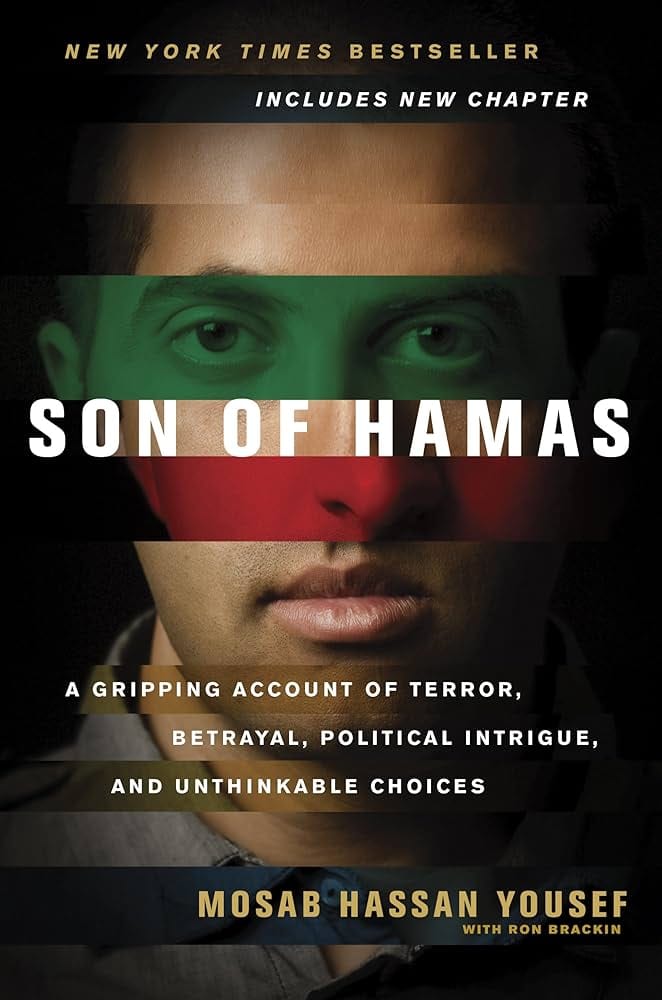

DESCRIPTION
Since he was a small boy, Mosab Hassan Yousef has had an inside view of the deadly terrorist group Hamas. The oldest son of Sheikh Hassan Yousef, a founding member of Hamas and its most popular leader, young Mosab assisted his father for years in his political activities while being groomed to assume his legacy, politics, status … and power. But everything changed when Mosab turned away from terror and violence, and embraced instead the teachings of another famous Middle East leader. In Son of Hamas, Mosab Yousef-now called “Joseph”-reveals new information about the world’s most dangerous terrorist organization and unveils the truth about his own role, his agonizing separation from family and homeland, the dangerous decision to make his newfound faith public, and his belief that the Christian mandate to “love your enemies” is the only way to peace in the Middle East.
My Summary
Main Ideas, Takeaways & Similarities
Questions
I. What is the problem?
A. How is this problem formulated?
B. Why is this problem important?
C. What is the history of this problem?
D. Which prominent personalities have been interested in this problem?
II. What solutions to the problem are there?
A. What are the conclusions reached?
B. By what argument(s) is the conclusion reached?
C. What facts or assumptions serve as premises?
D. When a prominent personality offers a solution, does he also argue for or against other prominent personalities? Does he raise objections to alternative solutions? Does he consider objections to his own solutions?
III. Evaluation
A. What are the advantages and disadvantages of the alternative formulations to the problem?
B. Has the importance or history of the problem ever been misrepresented?
C. Are the solutions logically related to the premises?
D. Are the facts true? Are the assumptions acceptable? Are the objections answerable?
AI Summary
Highlights
Mosab Hassan Yousef & Ron Brackin - Son of Hamas (2010, Tyndale House Publishers) - libgen.li - Notebook.html
Mosab Hassan Yousef
Preface
Highlight(yellow) - Page 13 · Location 133
The current conflict stretches all the way back to the animosity between Sarah and Hagar described in the first book of the Bible.
Highlight(yellow) - Page 13 · Location 135
aftermath of World War I.
Highlight(yellow) - Page 13 · Location 138
Encouraged by the British government, hundreds of thousands of Jewish immigrants, mostly from Eastern Europe, flooded into the Palestinian territories. Clashes between Arabs and Jews were inevitable.
Highlight(yellow) - Page 14 · Location 139
Israel became a state in 1948. However, the Palestinian territories remained just that—nonsovereign territories. Without a constitution to maintain some semblance of order, religious law becomes the highest authority. And when everyone is free to interpret and enforce the law as he sees fit, chaos ensues. To the outside world, the Middle Eastern conflict is simply a tug-of-war over a small stretch of land. But the real problem is that no one yet has understood the real problem.
Chapter Two: The Ladder of Faith
Highlight(yellow) - Page 20 · Location 218
Because values and traditions have always meant more to the Arab people than government constitutions and courts, men like my grandfather often became the highest level of authority. Especially in areas where secular leaders were weak or corrupt, the word of a religious leader was considered law.
Highlight(yellow) - Page 22 · Location 244
Under the Turks, Muslim villages throughout the Middle East were subject to persecution and crushing taxation. Istanbul was simply too far away for the caliph to protect the faithful from abuses by soldiers and local officials. By the twentieth century, many Muslims were becoming disillusioned and began to look for a different way of life. Some embraced the atheism of the recently arrived communists. Others buried their problems in liquor, gambling, and pornography, much of which was introduced by Westerners who were lured to the area by mineral wealth and growing industrialization.
Highlight(yellow) - Page 23 · Location 249
Hassan al-Banna wept for his countrymen who were poor, jobless, and godless. But he blamed the West, not the Turks, and he believed that the only hope for his people, especially the youth, was a return to the purity and simplicity of Islam.
Highlight(yellow) - Page 23 · Location 252
In March 1928, Hassan al-Banna founded the Society of the Muslim Brothers, popularly known as the Muslim Brotherhood.
Highlight(yellow) - Page 23 · Location 257
Many people in the West who stereotype all Muslims as terrorists don’t know about the side of Islam that reflects love and mercy. It cares for the poor, widows, and orphans. It facilitates education and welfare. It unites and strengthens. This is the side of Islam that motivated those early leaders of the Muslim Brotherhood. Of course, there is also the other side, the one that calls all Muslims to jihad, to struggle and contend with the world until they establish a global caliphate, led by one holy man who rules and speaks for Allah. This will be important for you to understand and to remember as we go along.
Highlight(yellow) - Page 24 · Location 262
In 1948, the Muslim Brotherhood attempted a coup against the Egyptian government, which the Brotherhood blamed for the nation’s growing secularism. The uprising was interrupted before it could get traction, however, when the British Mandate ended and Israel declared its independence as a Jewish state.
Highlight(yellow) - Page 25 · Location 275
When the now-armed members of the Muslim Brotherhood returned from the battlefield to Egypt, the suspended coup was on again. But news of the overthrow plan leaked out, and the Egyptian government banned the Brotherhood, confiscated its assets, and imprisoned many of its members. Those who escaped arrest assassinated Egypt’s prime minister a few weeks later.
Highlight(yellow) - Page 25 · Location 278
just twenty years, Hassan al-Banna had shaken Islam out of its dormancy and created a revolution with armed fighters.
Highlight(yellow) - Page 26 · Location 287
Islamic life is like a ladder, with prayer and praising Allah as the bottom rung. The higher rungs represent helping the poor and needy, establishing schools, and supporting charities. The highest rung is jihad.
Highlight(yellow) - Page 26 · Location 293
A moderate Muslim is actually more dangerous than a fundamentalist, however, because he appears to be harmless, and you can never tell when he has taken that next step toward the top. Most suicide bombers began as moderates.
Chapter Three: Muslim Brotherhood
Highlight(yellow) - Page 34 · Location 387
My father and the other West Bank leaders disagreed. They were not ready to repeat the mistakes of Egypt and Syria, where the Brotherhood had attempted coups and failed. In Jordan, they argued, our brothers do not fight. They participate in elections and have a strong influence on society. My father did not oppose violence, but he didn’t think his people were in any position to take on the Israeli military.
Highlight(yellow) - Page 34 · Location 391
Frustrated with the inaction of the Muslim Brotherhood, Fathi Shaqaqi had founded Palestinian Islamic Jihad in the late 1970s. But even so, the Muslim Brotherhood was able to maintain its nonviolent stance for another decade.
Highlight(yellow) - Page 35 · Location 399
The men who attended this meeting were finally ready to fight. They agreed to begin with simple civil disobedience—throwing stones and burning tires. Their objective was to awaken, unify, and mobilize the Palestinian people and make them understand their need for independence under the banner of Allah and Islam.
Chapter Four: Throwing Stones
Highlight(yellow) - Page 36 · Location 406
Hamas needed a move—any move—that could serve as a justification for an uprising. That move came in early December 1987, even though it was all a tragic misunderstanding. In Gaza, an Israeli plastics salesman named Shlomo Sakal was stabbed to death. Just a few days later, four people from Gaza’s Jabalia refugee camp were killed in a routine traffic accident. Word spread, however, that they had been killed by Israelis in revenge for Sakal’s murder. Riots broke out in Jabalia. A seventeen-year-old threw a Molotov cocktail and was shot dead by an Israeli soldier. In Gaza and the West Bank, everyone took to the streets. Hamas took the lead, fueling the riots that became a new style of fighting in Israel. Children threw stones at Israeli tanks, and their pictures appeared on the covers of magazines throughout the international community the same week.
Highlight(yellow) - Page 40 · Location 469
Because Israel controlled the borders, it was nearly impossible for Palestinians to get weapons in the First Intifada. I don’t ever remember seeing a Palestinian with a gun during this time—only stones and Molotov cocktails. Nevertheless, we had all heard the stories of the IDF firing into unarmed crowds and beating people with clubs. Some reports said that as many as thirty thousand Palestinian children were injured badly enough to require medical treatment. It just didn’t make sense to me.
Chapter Five: Survival
Highlight(yellow) - Page 45 · Location 519
The Israelis thought if they captured one of the leaders of Hamas, things would get better. But during the time my father was in prison, the intifada only became more violent. In late 1989, Amer Abu Sarhan of Ramallah had seen all the Palestinian deaths he could take. Since no one had guns, he grabbed a kitchen knife and stabbed three Israelis to death, in effect launching a revolution. This incident marked the start of a significant escalation of violence. Sarhan became a hero to the Palestinians who had lost friends or family members, whose land had been seized, or who had any other reason to want revenge. They were not terrorists by nature. They were just people who had run out of hope and options. Their backs were to the wall. They had nothing left and nothing to lose. They cared nothing for the world’s opinion or even their own lives.
Highlight(yellow) - Page 45 · Location 525
For us kids in those days, going to school became a real problem. It was not uncommon for me to walk out of school to find Israeli jeeps driving up and down the streets, announcing an immediate curfew through loudspeakers. Israeli soldiers took curfews very seriously. These were not like curfews in American cities, where authorities call a teenager’s parents if he’s caught driving around after 11 p.m. In Palestine, if a curfew had been declared and you were on the street for any reason, you were shot. No warning, no arrest. They just shot you.
Highlight(yellow) - Page 46 · Location 534
But curfews were just one change we dealt with as a result of the intifada. On many occasions, a masked man would show up at school and tell everybody that a strike had been called and to go home. The strikes, called by one of the Palestinian factions, were designed to hurt Israel financially by reducing the sales tax revenue the government collected from store owners. If the stores were not open, the owners would have to pay less tax. But the Israelis were not stupid. They just started arresting shopkeepers for tax evasion. So who was hurt by the strikes?
Highlight(yellow) - Page 46 · Location 539
Hamas was steadily growing in power and had begun to challenge the dominance of the Palestine Liberation Organization (PLO).
Highlight(yellow) - Page 47 · Location 548
I saw the PLO as corrupt and self-serving. Its leaders sent people, many of whom were just teenagers, to carry out one or two high-profile terrorist attacks a year in order to justify fund-raising for the struggle against Israel. The young feda’iyeen were little more than fuel to stoke the fires of anger and hatred and to keep the donations flowing into the personal bank accounts of PLO leaders.
Highlight(yellow) - Page 47 · Location 552
Hamas was largely animated by religious fervor and the theology of jihad, while the PLO was driven by nationalism and the ideology of power.
Highlight(yellow) - Page 51 · Location 603
was angry. I didn’t understand why our neighbors and family wouldn’t help us. And on top of that, they had the nerve to judge us for trying to help ourselves.
Chapter Six: A Hero’s Return
Highlight(yellow) - Page 52 · Location 619
The only law respected by Muslims is Islamic law, defined by fatwas, or religious rulings on a particular topic. Fatwas are intended to guide Muslims as they apply the Qur’an to daily living, but because there is no central unifying rule maker, different sheikhs often issue different fatwas about the same matter. As a result, everyone is living by a different set of rules, some much more strict than others.
Highlight(yellow) - Page 54 · Location 642
A sheikh has more authority than an imam and is more like a general than a priest.
Chapter Seven: Radical
Highlight(yellow) - Page 60 · Location 705
A few months after we moved, my father was arrested again. Often, he was not even charged with anything specific. Because we were under occupation, emergency laws allowed the Israeli government to arrest people merely because they were suspected of being involved with terrorism. As a religious—and by default, political—leader, my father was an easy target.
Highlight(yellow) - Page 60 · Location 709
Hamas was growing more violent and aggressive as the younger Hamas men pressured the leadership to push even harder.
Chapter Eight: Fanning the Flames
Highlight(yellow) - Page 64 · Location 767
The deportation also had another unintended but disastrous effect for Israel. The prisoners had used their time in exile to forge an unprecedented relationship between Hamas and Hezbollah, the main Islamic political and paramilitary organization in Lebanon.
Highlight(yellow) - Page 65 · Location 781
Other Hamas leaders, he explained, had their own reasons for opposing it, including the risk that a peace accord might actually stick! Peaceful coexistence would mean the end of Hamas.
Highlight(yellow) - Page 66 · Location 785
An Israeli man was stabbed to death on September 24 by a Hamas feda’iyeen in an orchard near Basra. • The Popular Front for the Liberation of Palestine and Islamic Jihad claimed responsibility for the deaths of two Israelis in the Judean desert two weeks later. • Two weeks after that, Hamas shot and killed two IDF soldiers outside a Jewish settlement in Gaza.
Highlight(yellow) - Page 66 · Location 788
Hebron massacre
Highlight(yellow) - Page 69 · Location 825
During the Gulf War, Yasser Arafat had supported Saddam Hussein’s invasion of Kuwait, which alienated him from both the United States and the Arab states that supported the American-led coalition. Because of that, those states then started shifting their financial support from the PLO to Hamas.
Highlight(yellow) - Page 70 · Location 836
some Palestinians conceded that at least the PA had gotten us Gaza and Jericho. What had Hamas gotten us? Had it freed even one little Palestinian village? Perhaps they had a point. But Hamas didn’t trust Arafat—mostly because he was ready to settle for a Palestinian state inside Israel instead of recovering the Palestinian territories that existed before Israel.
Highlight(yellow) - Page 71 · Location 852
And the Israelis, unable to find and arrest the violent young militants, continued to pursue soft targets like my father. I think they figured that since my father was a leader of Hamas, which was carrying out these attacks, his imprisonment would put a stop to them. But they never made an effort to find out who or what Hamas really was. And it would be many painful years before they would begin to understand that Hamas was not an organization as most people understood organizations, with rules and a hierarchy. It was a ghost. An idea. You can’t destroy an idea; you can only stimulate it. Hamas was like a flatworm. Cut off its head, and it just grew another.
Highlight(yellow) - Page 72 · Location 863
PLO nationalists had been simply a political problem in need of a political solution. Hamas, on the other hand, Islamized the Palestinian problem, making it a religious problem. And this problem could be resolved only with a religious solution, which meant that it could never be resolved because we believed that the land belonged to Allah. Period. End of discussion. Thus for Hamas, the ultimate problem was not Israel’s policies. It was the nation-state Israel’s very existence.
Chapter Thirteen: Trust No One
Highlight(yellow) - Page 111 · Location 1371
spent my days copying dossiers on prisoners. We were very careful to keep this information out of reach of the prison officials. We never used names, just code numbers. Written on the thinnest paper available, the files read like the worst kind of pornography. Guys confessed to having had sex with their mothers. One said he had had sex with a cow. Another had had sex with his daughter. Yet another had had sex with his neighbor, filmed it with a spy camera, and given the photographs to the Israelis. The Israelis, the report said, showed the pictures to the neighbor and threatened to send them to her family if she refused to work with their spy. So they kept having sex together and collecting information and having sex with others and filming it, until the entire village seemed to be working for the Israelis. And this was just the first file I was asked to copy.
Highlight(yellow) - Page 112 · Location 1383
And Akel had reason to be afraid. His parents were dead. His sister was the only family he had left. This made him extremely vulnerable because there was no one to take revenge for his torture.
Highlight(yellow) - Page 113 · Location 1389
It was only a two-hour drive to Megiddo. But because the buses had to stop at every checkpoint and all the passengers had to be searched at every stop, our families had to leave the house at four in the morning in order to reach the prison by noon.
Chapter Fifteen: Damascus Road
Highlight(yellow) - Page 134 · Location 1662
Then I read this: “You have heard that it was said, ‘Love your neighbor and hate your enemy.’ But I tell you: Love your enemies and pray for those who persecute you, that you may be sons of your Father in heaven” (Matthew 5: 43-45).
Highlight(yellow) - Page 134 · Location 1668
That meant I could love anyone. The only real enemy was the enemy inside me.
Highlight(yellow) - Page 135 · Location 1672
Jesus said, “Do not judge, or you too will be judged” (Matthew 7: 1). What a difference between him and Allah! Islam’s god was very judgmental, and Arab society followed Allah’s lead.
Chapter Sixteen: Second Intifada
Highlight(yellow) - Page 138 · Location 1714
Yasser Arafat had grown extraordinarily wealthy as the international symbol of victimhood. He wasn’t about to surrender that status and take on the responsibility of actually building a functioning society. So he insisted that all the refugees be permitted to return to the lands they had owned prior to 1967—a condition he was confident Israel would not accept.
Highlight(yellow) - Page 138 · Location 1722
Yasser Arafat made it clear that he wanted to be a hero who was written about in the history books. But as I watched him, I often thought, Yes, let him be remembered in our history books, not as a hero, but as a traitor who sold out his people for a ride on their shoulders. As a reverse Robin Hood, who plundered the poor and made himself rich. As a cheap ham, who bought his place in the limelight with Palestinian blood.
Highlight(yellow) - Page 141 · Location 1761
In the weeks prior to Sharon’s visit to the site, the Muslim Waqf—governing Islamic authority there—had closed off the Temple Mount entirely to any archaeological oversight by the Israel Antiquities Authority. Then in carrying out construction work on new underground mosques at the site, they brought in heavy earthmoving equipment. The evening news in Israel carried images of bulldozers, backhoes, and dump trucks working in and upon the site. Over the course of several weeks, dump trucks moved some thirteen thousand tons of rubble from the Temple Mount complex to city garbage dumps. News reports from the dumps showed archaeologists shaking their heads in disbelief as they held up remnants of artifacts retrieved from the rubble, some of them dating back to the First and Second Temple periods.
Highlight(yellow) - Page 142 · Location 1769
Sharon’s people had received assurances from Palestinian security chief Jibril Rajoub that his visit would not be a problem as long as he did not set foot in a mosque.
Highlight(yellow) - Page 142 · Location 1772
He came, he looked around, and he left. He said nothing. He never entered the mosque. It all seemed like a big nonevent to me. On the way back to Ramallah, I asked my father what the big deal had been. “What happened?” I said. “You didn’t start an intifada.” “Not yet,” he answered. “But I have called some activists in the Islamic student movement and asked them to meet me here for a protest.”
Chapter Seventeen: Undercover
Highlight(yellow) - Page 151 · Location 1893
first proof that the Al-Aqsa Martyrs Brigades was none other than Yasser Arafat’s own guards—funded directly by him with taxpayer money from America and international donors.
Highlight(yellow) - Page 156 · Location 1956
Yet these were the very Palestinian leaders who had led them and their children like goats to a slaughter and then ducked out of range to watch the carnage from a comfortable distance. That sickened me more than the gore.
Highlight(yellow) - Page 157 · Location 1964
The competing factions had been reduced to ridiculous bickering over the dead. And most of the time, the dead were people who had nothing at all to do with the movement. They were just people who had been swept up in the tide of emotion. Many others, like Shada, were just in the wrong place at the wrong time.
Chapter Eighteen: Most Wanted
Highlight(yellow) - Page 158 · Location 1976
Why were those children out there in the first place? Where were the parents? Why didn’t their mothers and fathers keep them inside? Those children should have been sitting at their desks in school, not running in the streets, throwing stones at armed soldiers.
Highlight(yellow) - Page 159 · Location 1992
The more I read the Bible, the more clearly I saw this single truth: Loving and forgiving one’s enemies is the only real way to stop the bloodshed.
Highlight(yellow) - Page 159 · Location 1996
But suddenly it seemed that anyone killed by the Israelis—whether a nominal Muslim, a communist, even an atheist—was being treated as a holy martyr. The imams and the sheikhs told the families of the dead, “Your loved one is in heaven.”
Highlight(yellow) - Page 163 · Location 2049
The chief water source for Israel and the occupied territories is the Sea of Galilee, also known as Gennesaret or Tiberias. It is the lowest freshwater lake on earth.
Highlight(yellow) - Page 163 · Location 2051
one of the outcomes of the Six-Day War in 1967 was that Israel took control of the Golan Heights from Syria. This gave Israel control of the entire Sea of Galilee, and with that came control of the Jordan River and every other spring and rivulet that flowed into and out of it. Violating international law, Israel diverted water from the Jordan away from the West Bank and Gaza Strip by means of its National Water Carrier, providing Israeli citizens and settlers with well over three-quarters of the water from West Bank aquifers. The United States has spent hundreds of millions of dollars digging wells and establishing independent sources of water for my people.
Chapter Nineteen: Shoes
Highlight(yellow) - Page 166 · Location 2084
No suicide bomber had ever killed so many people in a single attack. Hotari’s neighbors in the West Bank congratulated his father. “I hope that my other three sons will do the same,” Mr. Hotari told an interviewer. “I would like all members of my family, all the relatives, to die for my nation and my homeland.” 7
Highlight(yellow) - Page 171 · Location 2148
April 2006 alone, he collected one hundred million dollars from Iran and Qatar.
Chapter Twenty-One: The Game
Highlight(yellow) - Page 182 · Location 2300
Towers collapsing, white ash covering Church Street like a February blizzard. I felt a rush of shame when I saw the footage of Palestinian children celebrating in the streets of Gaza.
Highlight(yellow) - Page 186 · Location 2355
I was really trying to follow the ethical teachings of Jesus. Allah had no problem with murder; in fact, he insisted on it. But Jesus held me to a much higher standard. Now I found I couldn’t kill even a terrorist.
Chapter Twenty-Three: Supernatural Protection
Highlight(yellow) - Page 205 · Location 2579
I had been warned about the guard pigs (yes, I said guard pigs), but I didn’t encounter them, so it didn’t matter. The area between the outer and inner perimeters formed a run that, at any other military base in the world, would be patrolled by German shepherds or other highly trained attack dogs. Ironically, the kosher-conscious Israelis used pigs. It’s true.
Highlight(yellow) - Page 205 · Location 2581
It was thought that the presence of pigs and the threat of possible contact with them would serve as a psychological deterrent to any prospective terrorist who was a devout Muslim. Islam forbids contact with pigs as vehemently as does Orthodox Judaism. Perhaps even more so.
Highlight(yellow) - Page 207 · Location 2606
When things were relatively quiet, their special forces soldiers simply commandeered somebody’s house in order to grab a few hours of rest and maybe get something to eat. Sometimes during heavy fighting, they even broke into local homes and used the occupants as human shields—much like the feda’iyeen often did.
Chapter Twenty-Four: Protective Custody
Highlight(yellow) - Page 213 · Location 2684
Sometimes while he read the Qur’an to us, I just enjoyed looking at him and listening to his beautiful voice. I thought about how gentle he was when we were growing up. He never forced us to get out of bed for early morning prayers, but we all did it because we wanted to make him proud. He had given his life to Allah at a very early age and passed along that devotion to the rest of us by example.
Chapter Twenty-Five: Saleh
Highlight(yellow) - Page 229 · Location 2882
After all these years, I could not believe that control of Hamas had somehow, somewhere along the line, slipped into unknown hands. If I, who was born and raised in the heart of the movement, had no idea who pulled the strings, who knew?
Highlight(yellow) - Page 230 · Location 2896
“Kayed reminds me of three other guys,” I said to Loai. “Salah Hussein from Ramallah, Adib Zeyadeh from Jerusalem, and Najeh Madi from Salfeet. All three of these guys have advanced university degrees and were at one time very active in Hamas. But for whatever reason, they simply dropped out of sight about ten years ago. Now, they all live very normal lives, completely removed from political involvement. I always wondered why someone who was so passionate about the movement would just quit like that.”
Highlight(yellow) - Page 230 · Location 2903
We learned that these deadly thirtysomethings had gained total control of the money and were running the entire Hamas movement in the West Bank. They brought in millions of dollars from the outside, which they used to buy arms, manufacture explosives, recruit volunteers, support fugitives, provide logistic support, everything—all under the cover of one of Palestine’s numerous and seemingly innocuous research centers.
Chapter Twenty-Six: A Vision for Hamas
Highlight(yellow) - Page 239 · Location 3013
We learned later that the Hamas military guys in Gaza had been showing off, flaunting their hardware during the demonstration, when a Qassam missile in the back of a pickup truck exploded, killing fifteen people and wounding many more.
Highlight(yellow) - Page 240 · Location 3015
My father was shocked. But Hamas was not alone in its cover-up and self-serving deceptions. Despite what it displayed on its own news footage, Al-Jazeera continued to broadcast the lies. Then everything got worse. Much worse.
Highlight(yellow) - Page 240 · Location 3016
In retaliation for the phony attack on Gaza, Hamas fired nearly forty missiles at towns in southern Israel, the first major attack since Israel had completed its withdrawal from Gaza a week earlier. At home, my father and I watched the news along with the rest of the world. The next day, Loai warned me that the cabinet decided that Hamas had broken the truce.
Chapter Twenty-Seven: Good-Bye
Highlight(yellow) - Page 245 · Location 3079
“Nothing. I love you all. And I love intelligence work. I think I may even be addicted to the job. But we are not accomplishing anything. We’re fighting a war that can’t be won with arrests, interrogations, and assassinations. Our enemies are ideas, and ideas don’t care about incursions and curfews. We can’t blow up an idea with a Merkava. You are not our problem, and we are not yours. We’re all like rats trapped in a maze. I can’t do it anymore. My time is over.”
Highlight(yellow) - Postscript > Page 257 · Location 3226
was a prisoner of the Israelis when my eyes were opened to the fact that the Palestinian people were as oppressed by their own leaders as they were by Israel.
Highlight(yellow) - Postscript > Page 260 · Location 3257
Truth and forgiveness are the only solution for the Middle East. The challenge, especially between Israelis and Palestinians, is not to find the solution. The challenge is to be the first courageous enough to embrace it.