Attachment (file not included in this release)
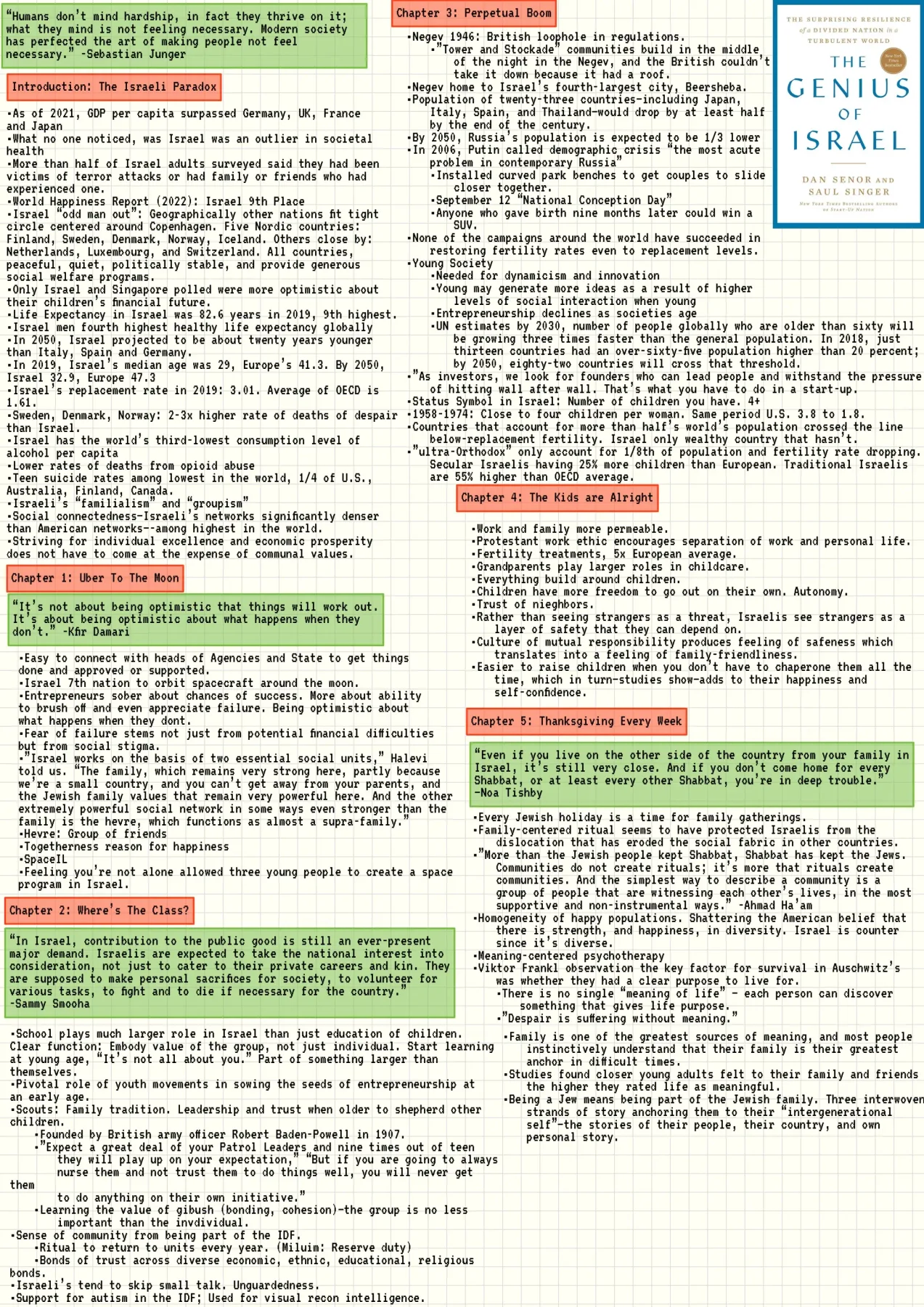
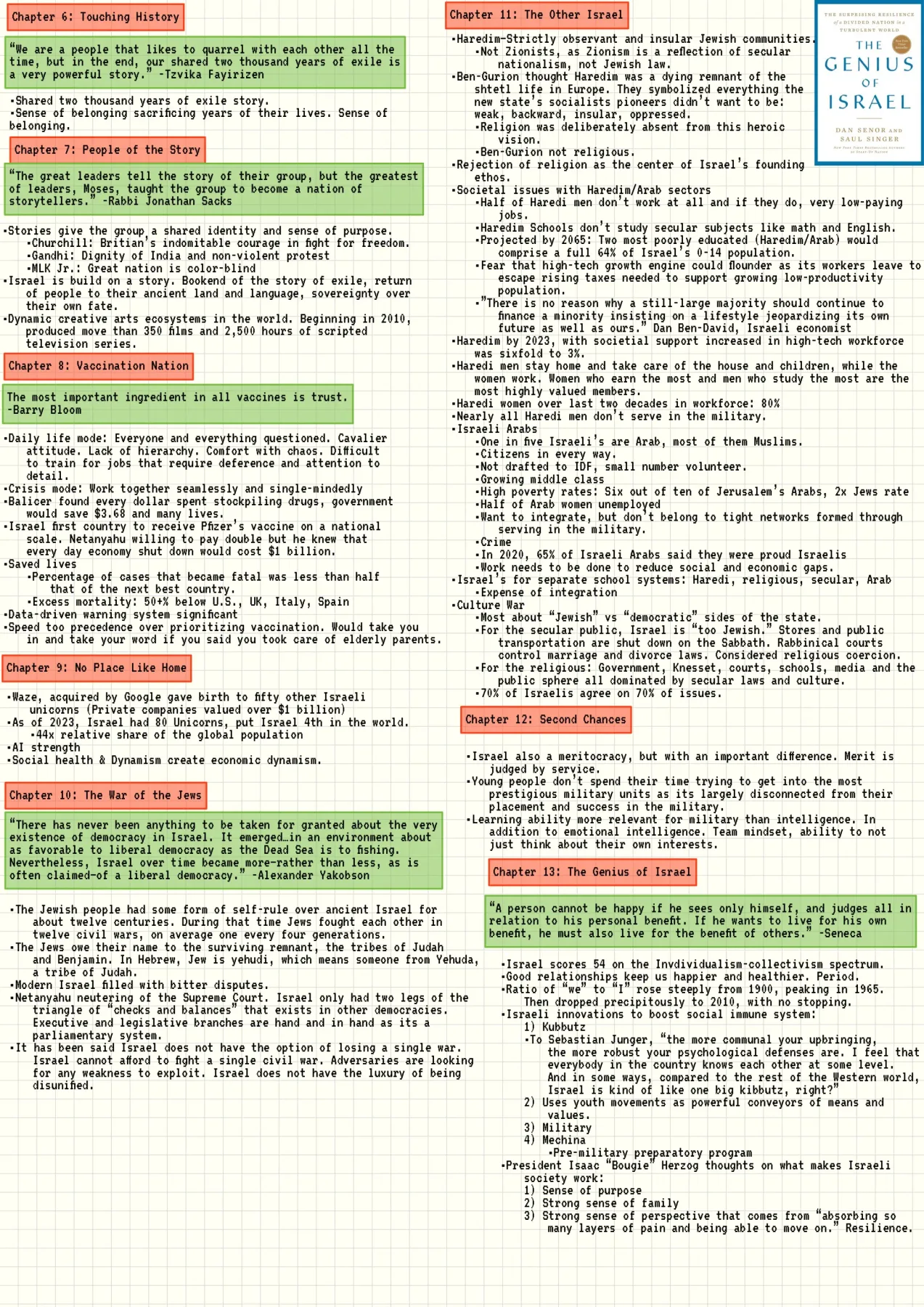
Description
Dan Senor and Saul Singer, authors of Start-Up Nation, argue that Israel’s most remarkable achievement is not its tech economy but its societal health: despite constant threat, high costs, and deep political division, Israelis rank near the top of the world in life satisfaction, optimism, longevity, and fertility, and near the bottom in deaths of despair. The book attributes this to a “social immune system” built from dense family ties, the peer bonds of hevre and gibush, youth movements, a people’s army that functions as a civic institution, a shared national story, and a culture of service. Its chapters move from case studies (the SpaceIL moon mission, soldiers with autism, Shabbat dinner, Israeli television, the COVID-19 vaccination campaign) to the economic payoff of this social fabric. The authors then test their thesis against Israel’s history of internal conflict, the 2023 judicial overhaul crisis, and the separate worlds of the Haredi and Arab minorities. They close by naming the kibbutz, youth movements, the military, and the pre-army mechina as social innovations other societies might learn from.
Vault PDF and source boundary
Attachment (file not included in this release)
Page links use the PDF viewer’s page count (the PDF has 317 pages; the Introduction begins on p. 9 and Chapter 13 ends on p. 245).
Evidence boundary: these notes reconstruct the authors’ argument from the supplied book. Statistics, interviews, and historical claims are the authors’; they have not been independently fact-checked. The book went to press in summer 2023, before the October 7 attack and the war that followed.
Chapter-by-Chapter Overview
Linked reading map
Use the entries below to jump to the full argument, analytical divisions, essential evidence, concepts, conclusion, and reflection questions for each part of the book.
- Authors' Note: Writing amid the 2023 judicial-reform protests, the authors argue that Israel’s solidarity survives political rupture and limit “Israelis” mainly to the two-thirds majority outside the Haredi and Arab communities. Attachment (file not included in this release)
- Introduction: Israel is a stressed, divided outlier that nonetheless leads wealthy democracies in happiness, optimism, longevity, fertility, and low despair, with dense social networks as the first clue. Attachment (file not included in this release)
- 1. Uber to the Moon: The SpaceIL moon mission shows that Israeli chutzpah works only because hevre, accessible institutions, and national purpose turn individual audacity into collective achievement. Attachment (file not included in this release)
- 2. Where's the Class?: Gibush, the value of group cohesion, is taught in classrooms and youth movements and extended by the army, as the integration of soldiers with autism shows. Attachment (file not included in this release)
- 3. Perpetual Boom: Israel alone among rich countries has kept fertility near three for decades across secular and religious groups, giving it the youthfulness linked to innovation. Attachment (file not included in this release)
- 4. The Kids Are Alright: Permeable workplaces, grandparents, and a culture of mutual responsibility that lets children roam make large families livable, at the cost of pressure on the childless. Attachment (file not included in this release)
- 5. Thanksgiving Every Week: The weekly Shabbat dinner binds generations and ethnic groups and anchors meaning, letting Israel combine modern autonomy with traditional family life. Attachment (file not included in this release)
- 6. Touching History: Israelis find meaning in a “small country with a big story” they can influence, rooted in the inherited story of exile and enacted in places like rocket-battered Sderot. Attachment (file not included in this release)
- 7. People of the Story: A first-person storytelling tradition and a messy, verbal society produce globally successful television and a grounded optimism born of living close to reality. Attachment (file not included in this release)
- 8. Vaccination Nation: The world-leading COVID-19 vaccination campaign shows Israelis switching from everyday distrust into crisis-mode trust, built on a century-old, data-rich, trusted health system. Attachment (file not included in this release)
- 9. No Place Like Home: Israel’s social health now drives its economy, as top founders and executives insist on staying home and multinationals come to them, though the 2023 crisis shows the flywheel’s fragility. Attachment (file not included in this release)
- 10. The Wars of the Jews: From ancient civil wars to the 2023 judicial overhaul protests, Jews have fought bitterly among themselves, yet Israeli society behaves like a rubber band that snaps back together. Attachment (file not included in this release)
- 11. The Other Israel: The Haredi and Arab minorities are the book’s “asterisk”; their growing integration, and Israel’s culture of balanced dispute, will decide whether its cohesion lasts. Attachment (file not included in this release)
- 12. Second Chances: A meritocracy of service rather than grades, radical inclusivity in the IDF, the mechina, and unhurried “odyssey years” spare Israelis the rat race. Attachment (file not included in this release)
- 13. The Genius of Israel: A layered “social immune system,” from the Jewish balance of individual and group to the kibbutz, youth movements, army, and mechina, explains why Israelis are happier and less despairing. Attachment (file not included in this release)
Review
Handwrite First
Use this section with the book and notes closed. Retrieval matters more than polished prose.
1. Before Reading
- Prediction:
- Question I want answered:
- What I already think about Israeli society and national cohesion:
- What I expect to disagree with:
2. Closed-Book Recall Dump
-
Main claims I remember:
-
Key evidence, stories, or contrasts:
-
People, cases, and concepts:
-
What feels fuzzy or incomplete:
3. Core Argument From Memory
- The book or chapter in one sentence:
- The paradox Senor and Singer are explaining:
-
The causal chain:
- Best evidence I remember:
- Most important qualification:
4. Feynman Check
Explain the argument in plain language to an intelligent reader who assumes a country under constant threat and deep political division must be miserable. Circle any term—societal health, deaths of despair, hevre, gibush, b’yachad, miluim, safeness versus safety, civil religion, the intergenerational self, “small country with a big story,” balagan versus crisis mode, the flywheel, the four tribes, merit of service, mechina, or the social immune system—that you cannot define without looking.
5. Pushback From Memory
- Strongest alternative explanation:
- Claim Senor and Singer may overstate:
- Evidence that would change my mind:
- What follows from the data, and what remains interpretation or anecdote:
Type Into Obsidian
After checking the chapter notes, correct the handwritten reconstruction.
1. Correction After Checking
- What I remembered accurately:
- What I distorted or omitted:
- Chapter or passage that corrected me:
2. Clean Core Argument
- Thesis:
- Reasoning:
- Essential evidence:
- Qualification:
- Connection to the book:
3. Connections
- Bowling Alone - Robert D Putnam — Senor and Singer use Putnam’s decline of American community as their foil; does Israel actually reverse Putnam’s mechanisms, or simply sit at an earlier point on the same curve?
- Man's Search for Meaning — the book borrows Frankl’s “despair is suffering without meaning”; does national purpose supply the kind of meaning Frankl had in mind, or a collective substitute for it?
- Israelis: The Jews Who Lived Through History - Haviv Rettig Gur — how does Gur’s account of Israeli identity as shaped by historical catastrophe compare with the authors’ “small country with a big story”?
- The Happiness Hypothesis — does Haidt’s account of happiness “between” self and group support the claim that Israeli belonging explains its life-satisfaction scores?
- New connection:
4. Flashcards / Atomic Recall
- Q: What is the “Israeli paradox” the book sets out to explain? A: Despite stress, threat, high costs, and deep divisions, Israel is an outlier among wealthy democracies in life satisfaction, optimism, life expectancy, fertility, and low deaths of despair.
- Q: What is gibush, and why did some Israeli teachers abandon a more effective teaching method for it? A: The deliberate building of group cohesion, held as a value in itself; they felt individualized instruction was costing them “the feel of the class.”
- Q: Why do the authors reject the Haredi explanation for Israel’s high fertility? A: Haredim are about one-eighth of the population and their fertility is falling, while secular Israelis have about 25 percent more children than European peers and “traditional” Israelis 55 percent more than the OECD average.
- Q: What distinction explains Israel’s COVID-19 vaccination success in Chapter 8? A: Balagan versus crisis mode: everyday distrust and disorder give way in a crisis to coordinated, trusting collective action, resting on a long-trusted health system.
- Q: What are the four Israeli social innovations the final chapter credits with strengthening the “social immune system”? A: The kibbutz, youth movements, the military (people’s army), and the mechina.
Retention Check
24 Hours Later
- Reconstruct the five indicators of Israeli societal health and the main explanation offered for them.
- Name one claim, one case study, and one qualification from the book.
1 Week Later
- Explain how hevre, gibush, military service, and national story connect into a single argument about belonging and purpose.
- State the strongest objection the book raises against itself (the Haredi and Arab “asterisk,” the 2023 crisis) and how the authors answer it.
1 Month Later
- Rebuild the book’s argument from “the Israeli paradox” to “the genius of Israel” without opening the note.
- Identify the strongest claim you accept, the strongest you resist, and the evidence needed to decide between them.
Notes
Book Argument and Reading Map
Senor and Singer set out to explain a puzzle they say they had missed while writing about Israel’s high-tech boom: Israel is “an outlier in societal health.” By the measures they collect, Israelis rank near the top of the world in life satisfaction and optimism, live long and healthy lives, have far more children than any other wealthy population, and suffer the lowest rate of deaths of despair in the OECD, all while living with war, terrorism, expensive housing, and fierce political conflict. The book’s thesis is that Israel possesses a stronger “social immune system” than other modern societies: a set of overlapping institutions and norms that sustain connection, belonging, and purpose against the individualism, loneliness, and pessimism spreading through the rich world.
The book is built as a sequence of case studies, each exposing one layer of that system. The early chapters move from peer bonds (hevre in the SpaceIL mission, gibush in classrooms, youth movements, and the army’s integration of soldiers with autism) to demography and the family (sustained high fertility, permeable workplaces, grandparents, free-range children, the weekly Shabbat dinner). The middle chapters turn to meaning: a national story small enough to influence and big enough to matter, a first-person storytelling culture visible in Israeli television, and the capacity, shown in the COVID-19 vaccination campaign, to switch from everyday distrust into crisis-mode trust. Chapter 9 connects the social argument back to the economy, arguing that social health now drives Israel’s tech dynamism.
The last third tests and generalizes the thesis. Chapter 10 confronts Israel’s long history of internal conflict and the 2023 judicial overhaul crisis, proposing that Israeli society behaves like a rubber band that stretches but pulls back together. Chapter 11 admits the book’s “asterisk”: its portrait of cohesion mostly describes the secular and national-religious majority, and the future depends on integrating the Haredi and Arab minorities. Chapter 12 argues that a meritocracy judged by service rather than grades spares Israelis the rat race, and Chapter 13 names the kibbutz, youth movements, the military, and the mechina as the innovations that built the social immune system.
The through-line across chapters is a single causal picture: belonging and purpose, built through family, peer groups, service, ritual, and shared story, protect against despair and generate the confidence that shows up in happiness, fertility, risk-taking, and economic dynamism. The book’s title names the result: a culture that lets Israelis be “ambitious individualists” while persistently teaching “that it’s not just about you.”
Interpretive guardrails
- “Israelis” and “Israeli society” usually mean the roughly two-thirds majority that is neither Haredi nor Arab; the authors say so in the Authors’ Note and return to it in Chapter 11. Generalizations about service, Shabbat dinner, and national story do not automatically apply to the whole population.
- The core evidence is cross-national correlation (happiness rankings, life expectancy, fertility, deaths of despair) plus interviews and case studies. The causal link from social institutions to these outcomes is argued by convergence and testimony, not demonstrated statistically.
- Many cases are success stories told by the founders, generals, and officials involved (SpaceIL, Mobileye, Roim Rachok, the vaccine campaign); they illustrate the thesis rather than test it.
- The authors are open admirers of Israel and coauthors of Start-Up Nation; the book acknowledges costs (pressure on the childless, Haredi nonservice, Arab poverty and crime, political rupture) but gives more space to strengths.
- The book was completed in summer 2023, during the judicial overhaul protests and before October 7; its judgments about cohesion and the “flywheel” predate those events.
Authors’ Note
Chapter Objective and Through Line
Written in August 2023, at the height of the mass protests over judicial reform, the note confronts a question that threatens the book before it begins: has the core theme, that one of Israeli society’s great strengths is its sense of solidarity, belonging, and caring for the country, been overtaken by events? Senor and Singer concede that Israel is not immune to the polarization visible across Western democracies, but argue that it differs in having “a reservoir of social solidarity that it can draw upon,” an ideal held across the political spectrum “even if sometimes honored in the breach.” Attachment (file not included in this release)
The note also sets a definitional boundary that governs the rest of the book. When the authors say “Israelis” or “Israeli society,” they usually mean the roughly two-thirds majority, diverse in ethnicity, religion, income, and ideology, but not including Haredi Jews or Israeli Arabs, who largely live in separate worlds (the subject of Chapter 11). The note thus frames the whole book as an account of what holds a divided society together and what pulls it apart, and insists that the unifying forces are fragile achievements: “miracles take a lot of work to maintain.” Attachment (file not included in this release)
Chapter Structure at a Glance
- The challenge: the 2023 judicial-reform crisis seems to contradict the book’s claim about solidarity.
- The comparative answer: polarization is global, but Israel’s sense of shared fate makes cross-partisan unity imaginable in a way it is not elsewhere.
- The mechanism: small size, large mixed families, shared neighborhoods, and military service force Israelis to engage across “tribal” lines.
- The scope limit: “Israeli society” in the book usually means the two-thirds majority, not the Haredi and Arab minorities.
- The emblem and the caution: the escalator handshake shows the underlying bond, but the unifying forces must not be taken for granted.
Section-by-Section Argument
Disagreement Inside a Shared Frame (analytical division)
The authors’ central move is to distinguish disagreement from the absence of solidarity. Citing the 2023 Edelman Trust Barometer, they note that fewer than a third of respondents across 28 countries would help someone in need with whom they strongly disagree politically. In Israel, they say, even asking the question would be strange, because “disagreeing—with gusto—is not only normal, but central.” Attachment (file not included in this release) Solidarity must rest on “something profound that is shared,” and for Jewish Israelis that is a common story and fate: if the common bond is shattered, “their country will cease to exist.” Attachment (file not included in this release)
- Structural crossings: families that contain religious and secular members, frequent Ashkenazi-Mizrahi intermarriage, opponents living in the same buildings and sitting at the same Shabbat table, and military service as “the most powerful melting pot of all.” Attachment (file not included in this release)
- The yearning for unity matters as much as its reality: “You can’t yearn for what you can’t imagine.” Solidarity sits “just beneath the surface, like a frame holding a mosaic together.” Attachment (file not included in this release)
Who Counts as “Israeli Society” (analytical division)
The note admits that the gaps are real: the majority, the ultra-Orthodox minority, and the Arab minority mostly live and study separately. The authors still claim the three worlds are more interconnected than they appear, pointing to Jews and Arabs saving one another’s lives daily in hospitals and emergency services.
The Escalator Scene and the Warning (analytical division)
On a night when rival rallies were held in Tel Aviv and Jerusalem, protesters on opposing escalators at the Jerusalem train station spontaneously reached across to shake hands; one protester shouted, “I love you, you don’t know how much I love you.” Attachment (file not included in this release) The authors present this as a culture “that celebrates disagreement and lionizes unity,” and close with Yossi Klein Halevi’s line that Israel is “a laboratory for democracy under extremity.”
Key Concepts and Distinctions
- Reservoir of solidarity: a shared ideal of mutual commitment that persists beneath political conflict.
- Significance: it is the book’s working explanation for why Israeli polarization has not produced the social breakdown seen elsewhere.
- The two-thirds majority: the authors’ default referent for “Israelis.”
- Significance: it limits the scope of later generalizations and flags the minorities as a separate problem.
- Shared fate: the sense that national survival depends on unity.
- Significance: it grounds solidarity in something more than tolerance for argument.
Essential Evidence and Examples
- Edelman Trust Barometer 2023: fewer than a third of respondents across 28 countries would help a political opponent in need; the authors use this as the comparative baseline for their claim that Israeli disagreement takes place inside a shared bond.
- The escalator handshakes: a single viral scene carries the note’s argument that Israelis can protest bitterly while still feeling bound to their opponents; it is illustration, not measurement.
Chapter Conclusion and Significance
The note concludes that the 2023 conflict tests but does not refute the book’s thesis; the unifying forces have “withstood so many tests,” yet are not self-sustaining. Its contribution is to set the terms of the book: solidarity is the explanandum, its sources are structural and narrative, and its limits (the minorities, the ever-present risk of internal rupture) are acknowledged from the start. The unresolved tension is that the evidence offered here is largely anecdotal and aspirational; the claim that Israel’s divisions are different in kind rests on a single emblematic scene and a contrast with survey data from other countries.
Questions for Reflection
- Is the willingness to help a political opponent a sound measure of solidarity, or does it measure something narrower, such as interpersonal decency?
- If “Israeli society” excludes roughly a third of citizens, how much weight can later claims about national happiness and cohesion bear?
- Does the escalator scene show a durable bond, or the kind of exceptional moment that tends to be remembered precisely because it is rare?
Introduction: The Israeli Paradox
Chapter Objective and Through Line
The introduction poses the puzzle the whole book sets out to explain: Israel looks like a stressed, divided, threatened, expensive country, yet on a range of measures of societal health it is an outlier among affluent democracies. Senor and Singer, who in Start-Up Nation explained Israel’s high-tech boom, say they had been “so dazzled by Israel’s high-tech scene” that they missed the evidence “that Israel was an outlier in societal health.” Attachment (file not included in this release) The chapter assembles that evidence in five stages: happiness and optimism, longevity, youth and fertility, low rates of despair, and dense social connection.
The method is cumulative. The authors begin with the softest measure (national happiness rankings), admit their doubts about it, and move toward what they consider harder data (life expectancy, demography, deaths of despair, teen suicide), each time ruling out obvious explanations such as health care, diet, or absence of stress. By the end, the pattern points toward one candidate explanation the rest of the book develops: the density of Israeli family and communal ties. The epigraph from Sebastian Junger states the guiding intuition: humans “don’t mind hardship,” what they mind “is not feeling necessary.” Attachment (file not included in this release)
The chapter closes by framing Israel as a counterexample to a story of inevitable decline in rich societies, and as a source of answers to three questions: whether societies can recover purpose, rebuild community amid hyper-individualism, and build “guardrails of commonality” against political division. Attachment (file not included in this release)
Chapter Structure at a Glance
- The lived paradox: outsiders observe Israelis who argue constantly yet stand as one during the memorial sirens and stay calm under rocket fire.
- The happiness anomaly: Israel ranks near the top of the World Happiness Report and is unusually optimistic about the next generation, despite stress and conflict.
- The longevity anomaly: Israelis live long and healthy lives, and the usual explanations do not account for it.
- The demographic anomaly: alone among wealthy countries, Israel is young and growing because its fertility is well above replacement.
- The despair test: Israel has the lowest rate of deaths of despair in the OECD and very low teen suicide, despite exposure to the same pressures blamed elsewhere.
- A first clue and the book’s question: dense family and communal networks may underlie these outcomes; the book asks what other societies can learn.
Section-by-Section Argument
Opening Vignettes: Unity Inside Disorder (analytical division)
Two newcomers frame the paradox. Tiffanie Wen, an American journalist in Tel Aviv, is astonished that during the Yom HaZikaron siren the whole country stops for two minutes, and that her boyfriend stands up even when alone in his apartment. Joe McCormack, a Scot who came to Israel through Facebook, is moved by the siren yet baffled by the shoving and shouting of the open-air market. The point is that Israeli unity and Israeli abrasiveness coexist.
- A motorcyclist bangs on a bus after being cut off, then asks the driver for directions and rides away; McCormack’s reaction, “What just happened?”, captures the outsider’s confusion. Attachment (file not included in this release)
- Wen’s supervisor’s advice during rocket sirens: “If you see Israelis panicking, that’s the time to panic. Just copy the Israelis.” The vignette introduces resilience as an observable social trait. Attachment (file not included in this release)
Why Are Israelis So Damn Happy?
The authors treat national happiness rankings with skepticism, then argue that the data are hard to dismiss. The World Happiness Report, based on Gallup polling, places Israel in the top decile every year; Israel rose to ninth in 2022 and fourth in 2023. Attachment (file not included in this release) What is measured is not smiling but life satisfaction, via the Cantril ladder (respondents rank their life from worst possible to best possible). The anomaly is sharpened by context: the other top countries cluster around Copenhagen and are “peaceful, quiet, politically stable,” with generous welfare states. Attachment (file not included in this release)
- Israel and Singapore were the only wealthy countries where more people expected children to be better off financially than their parents; Israelis were the least pessimistic of nineteen countries, and became more optimistic between 2019 and 2022 while others grew gloomier. Attachment (file not included in this release)
- The authors flag their own caution about comparing something “as culturally influenced as happiness” across countries, which is why they turn to harder metrics. Attachment (file not included in this release)
Living Longer
Life expectancy is presented as “the most comprehensive measure of health in a country.” Israel ranked ninth in the world in 2019 (82.6 years), and ranks high in healthy life expectancy. Demographer Alex Weinreb notes that the gains came during decades of war and mass immigration, not tranquility. The argument proceeds by elimination: Israel’s health care is good, but other countries’ are as good with lower life expectancy; obesity is average and diabetes relatively high; the Mediterranean diet is shared by others. The explanation is therefore “not obvious,” which pushes the search toward other anomalies. Attachment (file not included in this release)
Young and Growing
Against an aging, shrinking rich world, symbolized by Japan, where more adult than baby diapers are sold, Israel is the youngest affluent democracy, with a fertility rate of 3.01 in 2019 against an OECD average of 1.61. Attachment (file not included in this release) The authors stress the social, not only economic, meaning of this: Nicholas Eberstadt argues that below-replacement fertility “eats away at the heart of the extended family structure” and at “the foundation of the resilience of the society.” This links demography to the book’s emerging theme of social capital.
Don’t Despair
Because rising despair may be a better index of social health than happiness, the authors compare “deaths of despair” (suicide, drugs, alcohol) using the Global Burden of Disease study. Israel has the lowest rate in the OECD; Sweden, Denmark, and Norway have two to three times Israel’s rate. Attachment (file not included in this release) Israeli teen suicide is less than a third of the OECD average. The key inference is negative: smartphones, social media, climate anxiety, and political polarization are all present in Israel, and Israeli teens face more direct violence, yet the youth mental-health crisis seen in the US is largely absent.
- Daniel Kahneman’s remark, relayed by Gallup’s Jon Clifton, that “increasing happiness and reducing misery are very different things,” justifies the shift to the negative end. Attachment (file not included in this release)
- The first positive clue: studies point to Israeli “familialism” and “groupism,” and a Berkeley-Tel Aviv study found Israeli social networks “significantly denser” than Americans’, possibly “among the highest in the world.” Attachment (file not included in this release)
The Invisible Mountain (analytical division)
The authors compare this discovery to their earlier one of Israel’s innovation ecosystem: another “invisible mountain.” They contrast a rich world caught in a cycle of demographic collapse, aging, pessimism, and loneliness with an Israel whose citizens appear “engaged in shaping their future,” and claim that Israel shows “there is nothing inevitable about decline and despair.” Attachment (file not included in this release)
Key Concepts and Distinctions
- Societal health: a composite of life satisfaction, optimism, longevity, demographic vitality, and low despair.
- Significance: it replaces economic and military strength as the book’s object of explanation.
- Life satisfaction versus happiness: the Cantril ladder measures how people evaluate their lives, not how cheerful they feel.
- Significance: it explains how complaining, argumentative Israelis can still rank near the top.
- Replacement rate (2.1): the fertility threshold dividing growing, young populations from aging, shrinking ones.
- Significance: it places Israel on the opposite side of a line all other rich countries have crossed.
- Deaths of despair: Case and Deaton’s term for deaths from suicide, drugs, and alcohol.
- Significance: it serves as the book’s harder, negative-end test of social health.
- Familialism and groupism / network density: the interconnectedness of family and communal ties.
- Significance: it is the first candidate explanation and anticipates the “social immune system” argument of later chapters.
Essential Evidence and Examples
- World Happiness Report rankings: Israel’s rise to fourth in 2023 anchors the paradox, but the authors treat it as the weakest measure and seek harder data.
- Deaths of despair (Global Burden of Disease): the lowest rate in the OECD is the strongest evidence that Israel’s social health is real rather than a cultural quirk of survey answers.
- Berkeley-Tel Aviv network study: denser Israeli social networks provide the first positive pointer toward the book’s explanation.
Chapter Conclusion and Significance
The introduction concludes that “something extraordinary is happening in Israeli society” and that it cannot be explained by wealth, medicine, diet, or calm. Its argument is an inference from convergence: several independent indicators point the same way, and the one recurring factor is dense social connection. This sets up the book’s later chapters on family, the military, youth movements, national narrative, and the “social immune system.”
The main qualification is methodological. The authors themselves doubt cross-national happiness comparisons, and the chapter establishes correlations across countries rather than causes. The “Israel” being measured also includes populations (Haredi and Arab citizens) whose patterns differ, which the book addresses only later.
Questions for Reflection
- Does the convergence of happiness, longevity, fertility, and low despair strengthen the case for a single underlying cause, or could each have separate explanations (for example, religiosity driving fertility)?
- How persuasive is the elimination argument on longevity, given that it rules out explanations without directly testing the authors’ preferred one?
- If threat and hardship coexist with high life satisfaction, is shared adversity part of the explanation rather than an obstacle to be overcome, as Junger’s epigraph suggests?
Chapter 1: Uber to the Moon
Chapter Objective and Through Line
The first chapter uses the SpaceIL moon mission as a case study in how Israeli society turns individual audacity into collective achievement. Three engineers in their late twenties, with no money and no institution behind them, answer a Facebook post (“WHO WANTS TO GO TO THE MOON??”) and, after eight years and $100 million, put the first privately funded spacecraft into lunar orbit before it crashes during landing. The authors’ question is not how the engineering worked but what made the attempt thinkable: why three “random engineers” expected help, why senior figures gave it, and why a private project became a national one.
Their answer pairs two traits. Chutzpah, audacity combined with a tolerance for failure, explains why the founders tried. Hevre, the Israeli “supra-family” of peers united by common purpose, explains why they were not alone and why institutions helped rather than obstructed. A third element, a sense of contributing to the country, explains why the public adopted the project. The chapter’s closing claim states the thesis: “Without the power of hevre, of a desire to be part of something bigger and doing things together, chutzpah wouldn’t work.” Attachment (file not included in this release)
The chapter thus links the authors’ earlier subject (Israeli innovation) to the book’s new one (social cohesion). It ends by saying chutzpah and hevre “cannot be manufactured,” but emerge from “deeper forces” beginning in childhood, which the following chapters explore. Attachment (file not included in this release)
Chapter Structure at a Glance
- The Kennedy contrast: the American moonshot expressed a confident, communal, postwar nation; Israel’s moonshot began in a bar.
- Access and help: the founders reach the heads of the space agency, Weizmann Institute, and aerospace industry within weeks, and are taken in as hevre.
- Frugal ingenuity: a rideshare launch and a gravity-assisted slingshot trajectory make a $100 million mission possible.
- Motivation: the founders are driven by doing the impossible, by Zionism, and by family histories of the Holocaust; failure is not stigmatized.
- Hevre and belonging: the supra-family of peers explains why ambitious Israelis expect allies.
- National ownership: the mission is understood as done for Israel; in an individualist age, Israelis still ask what they can do for their country.
- Successful failure: the crash becomes a launching point for Beresheet 2, new ventures, and a cultural lesson.
Section-by-Section Argument
Opening: Kennedy’s Moonshot (analytical division)
The chapter opens with Kennedy’s 1961 search for a space goal so audacious it would prove American leadership. The authors stress that the Apollo program grew from an America marked not just by power but by “optimism, idealism, and belief in itself,” with soaring communal membership. Attachment (file not included in this release) The contrast frames the chapter: a superpower’s state project versus a small country’s volunteer effort, both rooted in national confidence.
Bar Shot
Yariv Bash’s idea began as a “useless” project for a creativity camp for IDF technology soldiers, then became an entry in the Google Lunar XPRIZE weeks before registration closed. The key claim is that the founders would not have tried without knowing “they would not be alone”: “most of Israel sometimes acts as one big family.” Attachment (file not included in this release)
- Access: a cold email produced a meeting with Isaac Ben-Israel, chairman of the Israel Space Agency, who predicted the craft would be “ten times bigger, cost ten times as much, and it will take ten years,” then joined their board. Attachment (file not included in this release) His likely word “guys” would have been hevre, signaling a move “from ‘you’ to ‘we.’”
- Institutional buy-in: the head of IAI’s space division, after shouting at their plans, said it was his “obligation to help”; later, “they couldn’t have done it without us, but we would never have had the audacity to do it without them.” Attachment (file not included in this release)
- Frugality: two failed designs and repeated funding rescues by backers such as Morris Kahn (eventually $47 million) preceded a working design in 2015. Cost was held down by a rideshare on a SpaceX Falcon 9 (cutting launch cost from $60 million to $20 million) and a slingshot trajectory that many NASA experts doubted. Attachment (file not included in this release)
- Public engagement: volunteers took the project into schools; the country followed the mission, culminating in a presidential pajama party for children on landing night.
Geography matters to the argument: because Israel’s eastern neighbors were hostile, Israel launches against the earth’s rotation, a cost that illustrates how the country’s constraints shape its improvisation.
Failing Forward
The authors ask why a communications engineer who “knew nothing about space” joined. Damari’s answer was “taking on a challenge that seemed impossible” and Zionism, tied to the pride of his grandfather, a Holocaust survivor who fought in 1948. Bash’s grandfather was a forced laborer on the V-1 rocket program run by Volkswagen; Bash later told Volkswagen executives about the moon mission, joking that “rocketry is our family business.” Attachment (file not included in this release)
The general point is that Israeli founders are “surprisingly sober about their chances of success.” What lets them take risks is not overconfidence but a lowered cost of failure, socially as well as financially: “no matter what happens, it will be okay.” Attachment (file not included in this release) Damari’s epigraph captures it: “It’s not about being optimistic that things will work out. It’s about being optimistic about what happens when they don’t.” Attachment (file not included in this release)
Hevre
Through Yossi Klein Halevi, the authors identify Israel’s two essential social units: the family and the hevre, which “functions as almost a supra-family.” Attachment (file not included in this release) Hevre accumulate through school, youth groups, army, university, and work, and are constantly renewed. Halevi’s example is his children’s peer groups during the terror wave of 2000-2004, who processed loss together in “impromptu therapy sessions” rather than with their parents. Israel, he says, is “a society created by youth movements.”
- The 2001 website Hevre, organized around group circles rather than individual profiles, was once among Israel’s five most popular sites. Attachment (file not included in this release)
- When asked why Israel ranks high in happiness, Israelis answer “You’re not alone,” or invoke b’yachad (togetherness). What is unusual is that small-community support “also exists at the societal level,” which is what gave the SpaceIL founders confidence they would find allies. Attachment (file not included in this release)
Ask Not
The authors next ask why a private project became national. Unlike the ventures of Musk, Bezos, and Branson, SpaceIL saw itself as acting “on behalf of their country.” The lander’s selfie, showing an Israeli flag with “Am Yisrael Chai” and “SMALL COUNTRY, BIG DREAMS,” drew “a cheer for Israel, not just for SpaceIL.” Attachment (file not included in this release) The authors connect this to military service, through which Israelis are entrusted with real responsibility for the country’s security, and contrast Kennedy’s “ask not” with a 2020 Massachusetts senator’s reversal: “it’s time to start asking what your country can do for you.” In an age of individualism, “doing something for your country feels like an increasingly alien concept. But not in Israel.” Attachment (file not included in this release)
Landings Are the Hardest and Successful Failure
After a seventeen-minute descent marred by lost telemetry and a main-engine shutdown, Beresheet crashed; an eight-year journey failed in its last minutes. Attachment (file not included in this release) The authors’ interest is in the reaction. Damari’s first feeling was “relief”; Winetraub stressed that the mission proved a $100 million moon shot is credible. Of thirty-three XPRIZE teams, only SpaceIL launched anything. The XPRIZE awarded a $1 million “Moonshot Award” on the spot, and Beresheet 2 was born with an educational mission opened to other countries. Attachment (file not included in this release)
- The pressure was national: “We had no Kennedy… We felt that we had the nation’s hopes on our shoulders.” Attachment (file not included in this release)
- The founders kept attempting the improbable: Bash founded the drone-delivery company Flytrex and continued after being paralyzed in a skiing accident (“I’m the same person, just half a meter shorter”); Winetraub runs a Stanford cancer-detection lab and pursues growing chickpeas on the moon. Attachment (file not included in this release)
Key Concepts and Distinctions
- Chutzpah: audacity to attempt the seemingly impossible.
- Significance: necessary but insufficient; the chapter argues it works only when paired with hevre.
- Hevre: a group of peers, from lifelong friends to strangers joined by a common purpose; a “supra-family.”
- Significance: it is the chapter’s main explanatory concept and recurs throughout the book as a source of belonging.
- B’yachad (togetherness): the felt sense of not being alone.
- Significance: offered as Israelis’ own explanation for their high life satisfaction.
- Destigmatized failure: risk-taking grounded not in optimism about success but in confidence that failure is survivable.
- Significance: it explains the persistence through failed designs and the response to the crash.
- Contribution to the country: the Kennedy-style ethic of national duty, reinforced by military service.
- Significance: it explains why private initiative is adopted as a national project.
Essential Evidence and Examples
- Ben-Israel’s three tens: his prediction (ten times bigger, costlier, longer) proved right, showing that senior figures backed the project knowing its odds rather than out of naivety.
- Thirty-three teams, one launch: among all XPRIZE competitors, only SpaceIL reached space, which supports the claim that persistence and broad support, not resources, were decisive.
- The lander’s flag and slogan: the public’s cheer “for Israel, not just for SpaceIL” is the chapter’s evidence that private initiative is experienced as national.
Chapter Conclusion and Significance
The authors conclude that SpaceIL’s real lesson is social rather than technical: audacity becomes common, and even national, only where people expect to be joined and helped. Access to senior figures, institutional willingness to back amateurs, public adoption of the mission, and a forgiving response to failure all reflect a dense, mission-oriented social fabric. The chapter adds to the book its first worked example of how belonging and purpose produce achievement, bridging Start-Up Nation’s innovation story to the book’s argument about societal health.
The tension is that the evidence is a single, unusually inspiring case. The chapter illustrates a cultural pattern rather than measuring it, and the claim that such a venture is “hard to imagine… in any other country” is asserted rather than shown.
Questions for Reflection
- Is hevre a cause of Israeli audacity, or could both be products of shared military and national experience?
- How much does the founders’ motivation depend on a specific national story (the Holocaust, Zionism), and could such motivation exist in societies without a comparable narrative?
- Does the warm reception of Beresheet’s failure show a healthy culture of risk, or does it reflect the special status of a national symbolic project that ordinary failed ventures would not enjoy?
Chapter 2: Where’s the Class?
Chapter Objective and Through Line
Chapter 2 identifies gibush, roughly “bonding” or “cohesiveness,” as a core Israeli value and traces how it is taught across a life stage sequence: the school classroom, the youth movement, and military service. Its central claim is that Israelis treat the group not as a vessel for individual achievement but as something with its own worth, to be nurtured “even at the expense of individual learning outcomes.” Attachment (file not included in this release) The epigraph from sociologist Sammy Smooha sets the frame: Israelis are expected to “take the national interest into consideration, not just to cater to their private careers and kin.” Attachment (file not included in this release)
The argument moves from small to national scale. It begins with two classroom stories: a Team Classroom method in which students succeed only when everyone succeeds, and teachers who abandon a more effective individualized method because “I felt I was losing the feel of the class.” It then shows youth movements as self-run engines of responsibility and gibush, and closes with the IDF, through the story of soldiers on the autism spectrum, as the institution that delivers “gibush on a national level.” Attachment (file not included in this release)
The chapter’s larger contribution is to explain where the hevre and sense of shared mission seen in Chapter 1 come from. It also introduces a recurring theme: military service in Israel is not only a duty but a right and a “membership card to Israeli society,” which makes inclusion in it a lever for social change. Attachment (file not included in this release)
Chapter Structure at a Glance
- The group makes individuals succeed: Israeli high schoolers complete online college courses at extraordinary rates when they learn as a team.
- Gibush as value: teachers, parents, and students rank class cohesion alongside or above test scores, a priority rooted in a collective founding story.
- Youth movements as self-government: teenage-run movements teach responsibility and gibush and, unlike scouting elsewhere, were designed to rebel and reshape society.
- The military’s hardest problem: an intelligence unit cannot complete a vast imagery-analysis task until cadets on the autism spectrum do it in four months.
- Service as a right: the Roim Rachok and Titkadmu programs extend military service, and thus membership in society, to young people with autism.
- National gibush and a global lesson: the army binds the population together, and the Israeli model points toward a solution for autism unemployment worldwide.
Section-by-Section Argument
Opening: Team Classroom (analytical division)
Massive Open Online Courses had completion rates of about one in ten, yet Daphne Koller found Israeli high school groups finishing at over 80 percent. The cause was not ability but method: students signaled green, yellow, or red for understanding, and the whole class worked until everyone could hold up green. “Rather than one against all, the students had to bring their classmates over the finish line.” Attachment (file not included in this release) The example shows the practical power of making the group responsible for each member.
The Power of Gibush
Researcher Tamar Katriel found that some of the best teachers abandoned personalized instruction that demonstrably raised scores, because it eroded the class as a unit. One teacher demanded, “Where is the class in all this? Where is the gibush?”; another rated his year “a total failure” for failing at gibush. Attachment (file not included in this release) The authors define gibush as “the act of bringing people together with the goal of deepening the bond uniting them,” a deeply held value rather than a process. Elsewhere, they say, the class is “a functional vessel”; in Israel it is treated as a living thing with its own character.
- One teacher’s justification: “if we give up the goal of gibush in the class, the State of Israel will unravel. We can’t afford that.” Attachment (file not included in this release)
- Daniel Gordis traces the ethos to the founding story: America’s myth is of individual frontiersmen, while the Jewish story is “six hundred thousand people at Mount Sinai, crossing the desert en masse,” suggesting “we’re a people who need community.” Attachment (file not included in this release)
The section ends by noting that group socialization happens “even more intensively outside the school walls,” leading to youth movements.
Not for Adults
Through Inbal Arieli’s account of a terse scouting notice, the authors draw out three features of Israeli youth movements: they are neighborhood-based, joining is assumed rather than sold, and fifteen-year-old counselors are trusted to lead younger children. The movements share Baden-Powell’s emphasis on youth responsibility but drop his principle of learning from adults, partly to maximize responsibility and partly because of different goals. Where scouting aimed at good, loyal citizens, Hashomer Hatzair sought “a person who rebels against his fate,” in “rebellion against the pale and meaningless society of adults… against the fate of the Jew in the diaspora.” Attachment (file not included in this release) Even the religious movement Bnei Akiva was founded over rabbinic objections that youth movements by nature rebel.
- Israeli youth movements are “a common stage in life integrated into the nation’s history,” not just a pastime, and they create intergenerational continuity as campers become counselors. Attachment (file not included in this release)
- The apparent chaos of summer camps, with “hardly an adult in sight,” embeds two lessons: responsibility for one another (often a first experience managing people and projects) and how to create lasting bonds. Attachment (file not included in this release)
On Their Own
The chapter then turns to the military with a planning scenario: Israeli paratroopers deep in Lebanon who must find food, fuel, and medicine locally, requiring detailed intelligence on which shops and stations are operating. Lt. Col. Avi Simon of imagery-intelligence Unit 9900 was ordered to scan 80 percent of northern Lebanon in a year and, after six months, had almost nothing; the task required a kind of sustained attention to tiny changes that regular analysts found “too boring and too difficult.” A new cohort finished it in four months. “All these cadets that solved the impossible had one thing in common: they were on the autism spectrum.” Attachment (file not included in this release)
The Right to Serve
The origin story illustrates how trust networks built in military service persist. At a shloshim (thirty-day memorial) in 2011, members of a 1970s reconnaissance unit, drawn from Yemenite, Russian, Indian, and other backgrounds, reunited. Reserve duty (miluim) had kept many of them bonded for decades, linking “a taxi driver and a business executive” across class and ethnic lines. Attachment (file not included in this release) When Boaz Keinan revealed that both his sons were autistic, Tal Vardi, who knew nothing about autism, agreed to run his foundation, which the authors say “speaks to a tremendous amount of trust.” Attachment (file not included in this release)
- Mossad director Tamir Pardo, prompted by his wife Omrit, a speech therapist, offered “a blank check.” Talpiot graduate Leora Sali, mother of an autistic son, proposed a study; Vardi replied, “Yalla. If it works, it works.” Attachment (file not included in this release)
- The project was built on handshakes with Ono Academic College; the authors note that slow bureaucracies “can move quickly if they get caught up in the atmosphere of innovation around a mission.” Attachment (file not included in this release)
The key premise is that in Israel “service is seen as a right, not just a requirement,” and exemption can be “a terrible blow.” Simon invokes Ben-Gurion’s vision of the IDF as “a melting pot of the diasporas… a school of civic education and a cradle of a renewed nation.” Attachment (file not included in this release) A participant, Noam, says exemption elsewhere would be a head start, “But in Israel, it’s the opposite… you don’t want to be left out of that national experience.”
- Integrated into regular units, Roim Rachok analysts proved their value; one used the movement of umbrellas at the Damascus Hilton pools to judge whether daily life was continuing during the Syrian civil war. Participants now serve in over thirty units. Attachment (file not included in this release)
- Because autistic teens were automatically exempted, Udi Heller, himself autistic, “started a war” against the “blind policy,” leading to Titkadmu, which in 2021 began drafting autistic soldiers as conscripts rather than volunteers; over three hundred served in its first two years. Attachment (file not included in this release)
National Gibush and the Global Problem (analytical division)
Simon argues that school and scouting begin the sense of a national project, but “it’s the army that’s the one last institution that shapes most of the population… and injects some of that special sauce that keeps society together.” The authors call this “gibush on a national level.” Attachment (file not included in this release) They then compare the global record: almost half of 25-year-old Americans with autism have never held a paying job, UK employment is 22 percent, and corporate autism-hiring programs reach only a few thousand workers. Heller’s point is that “excellence programs” place a few people at the top, while the real breakthrough is to treat “autism is the new normal” and open the door “for large numbers of autistic people to any profession.” Attachment (file not included in this release)
Key Concepts and Distinctions
- Gibush: the deliberate building of group cohesion, held as a value in itself.
- Significance: the chapter’s master concept; it explains classroom priorities, youth movements, and the army’s social role.
- Group as entity versus group as vessel: treating the class as having its own worth versus as a means to individual performance.
- Significance: this is the chapter’s key contrast between Israel and other countries.
- Youth movement versus scouting: self-governing, rebellious, nation-building movements versus adult-guided character training.
- Significance: it explains why Israeli youth movements are a formative national stage rather than a hobby.
- Miluim (reserve duty): recurring service that sustains cross-class bonds into middle age.
- Significance: it is the trust network that launches the autism program.
- Service as a right: military service as both obligation and entry ticket to society and careers.
- Significance: it turns inclusion of people with disabilities into a matter of social membership, not charity.
Essential Evidence and Examples
- Team Classroom completion rates: over 80 percent versus about 10 percent for solo MOOC learners is the chapter’s clearest measurable effect of group responsibility.
- Katriel’s teachers: their choice of cohesion over better test results shows gibush operating as a value that can override individual achievement.
- Titkadmu’s numbers: over three hundred autistic soldiers in two years, against corporate programs employing a few thousand worldwide, supports the claim that inclusion through service operates at a different scale.
Chapter Conclusion and Significance
The authors conclude that Israelis are socialized from childhood to value the group, and that this socialization culminates in an army that functions as a civic institution, not just a defense force. The autism programs make the argument concrete: they arose from bonds formed in military service, depended on institutions bending for a shared cause, and succeeded by extending gibush to people normally excluded. The chapter supplies the developmental account behind Chapter 1’s hevre and anticipates later chapters on the IDF and on groups outside the national consensus.
An unresolved tension is visible in the teachers’ choice: gibush is sometimes valued over measurable learning, and the chapter presents this approvingly without weighing what might be lost. The army-as-melting-pot claim also applies only to those who serve, which matters for the Haredi and Arab minorities discussed later.
Questions for Reflection
- Is the teachers’ choice of gibush over higher test scores a wise trade-off or a cost the chapter underplays?
- If military service is “a membership card to Israeli society,” what follows for citizens who do not or cannot serve, and does the autism story strengthen or complicate the authors’ view of the army?
- Can the Roim Rachok and Titkadmu model be transplanted to countries without universal conscription, or does its success depend on service already being a valued national rite?
Chapter 3: Perpetual Boom
Chapter Objective and Through Line
Chapter 3 develops the demographic anomaly introduced in the Introduction into an argument: Israel is the only wealthy country that has avoided below-replacement fertility, and this youthfulness is a structural advantage for its energy, optimism, and innovation. The authors open with the founding image of youth building the state, notably the overnight “Tower and Stockade” outposts that secured the Negev in 1946, and with Yossi Klein Halevi’s claim that army service gives Israeli parents and children a shared language, keeping the society youthful. Attachment (file not included in this release)
The argument then proceeds in three steps. First, the rest of the rich world faces shrinking, aging populations, and government campaigns to raise birth rates have failed. Second, the real cost of aging is not population size but composition: aging societies tend to be “less productive, less optimistic, less innovative, and less energetic,” and entrepreneurship falls as societies age. Attachment (file not included in this release) Third, Israel’s fertility history shows it has defied what the authors call “the iron law of demography” for seventy years, and not because of its ultra-Orthodox minority: secular and traditional Israelis also have markedly more children than their peers abroad. Attachment (file not included in this release)
The chapter fits into the book as the bridge between societal health and the family. It establishes that Israel’s difference is “not a difference in degree, but in direction,” and points to cultural norms (large families as status symbols) as the proximate cause, leaving deeper explanations for the following chapters. Attachment (file not included in this release)
Chapter Structure at a Glance
- Youth in the founding myth: pre-state youth built and defended the country, and army service keeps generations connected.
- The global bust: world population will peak and fall, and expensive or creative pro-natal campaigns have not restored replacement fertility.
- Why aging matters: the problem is the age structure, which raises dependency ratios and lowers dynamism.
- Youth and innovation: entrepreneurship depends on being young in a young society, as Japan’s stagnation and cross-national data suggest.
- Cultural divergence: in Israel, larger families are admired and even a status symbol among secular elites.
- The historical anomaly: Israel’s fertility stopped falling twice and has stayed near three for decades, across religious groups.
Section-by-Section Argument
Opening: A Society Built by Youth (analytical division)
The Tower and Stockade story makes youth a national protagonist: in one night, young pioneers built eleven outposts that, through a British regulatory loophole, could not be torn down once roofed, and so kept the Negev in Israel. Attachment (file not included in this release) The broader point, via Halevi, is that army service creates “an intergenerational common experience where parents know what their kids are going through,” which narrows the generation gap and sustains youthfulness.
A Shrinking World
Projections show world population peaking (around 2065 at 9.2 billion in the IHME study) and twenty-three countries halving by century’s end. Germany guarantees day care and spends $265 billion a year on family subsidies; Russia offered cash incentives, curved park benches, and a “National Conception Day” with an SUV prize; a Danish travel agency ran “Do It for Denmark.” None restored replacement fertility. Attachment (file not included in this release) The authors then answer why governments try so hard: the issue is composition, not size. Fewer young people mean higher dependency ratios, and “an aging society tends to be less productive, less optimistic, less innovative, and less energetic than a youthful one.” Attachment (file not included in this release)
The Young and the Innovative
Japan’s predicted overtaking of the US gave way to a “lost decade,” and the authors highlight an overlooked factor: aging. Scientific output usually peaks in the late thirties or early forties. A 2014 study by Liang, Wang, and Lazear found that half of the top ten US tech companies were founded after 1985 by founders averaging twenty-eight, while none of Japan’s top ten had been founded in the previous forty years. Attachment (file not included in this release)
- Older managers in Japan held onto senior posts, blocking younger workers from experience; hence “it’s not enough to be young to be dynamic and innovative; you need to be young in a young society.” Attachment (file not included in this release)
- Across 82 countries, young countries (median age 37 or below) had about double the entrepreneurship rate of old ones (41 or above); Israel’s median age is about 30, the EU’s over 44. Attachment (file not included in this release)
The authors note that the study’s suggested mechanisms (more social interaction, novel thinking, risk tolerance) are tentative; what matters is the correlation.
Morningburg vs. Twilight City
Megan McArdle’s thought experiment contrasts a town with a median age of 28, full of risk-taking ventures and young families, with one of 58, where “time horizons are shorter” and residents are “especially averse to risk.” Attachment (file not included in this release) The authors place Europe in Twilight City and project rapid aging worldwide; South Korea by 2040 will have 60 percent more people over seventy than under twenty, while Israel will have three times as many under-twenties as over-seventies. Attachment (file not included in this release)
Four Is the New Three
The story of Aya Peterburg, an intelligence-unit commander at twenty, later a Sequoia partner and cofounder of a venture fund, who had her fourth child while building the fund, illustrates the social norm. Her cofounder encouraged her to have “as many kids as you want”; among her peers, two children is seen as small and “four was becoming the new three.” Attachment (file not included in this release) She also voices maternal guilt, a qualification the authors retain.
- Sociologist Darya Maoz: “Today the status symbol in secular Israeli society is getting married early and having four kids.” A restaurant critic says that in Tel Aviv high-tech circles, success is shown not by yachts but by “the number of kids.” Attachment (file not included in this release)
- The authors stress Israelis’ unawareness of their anomaly and conclude that Israel and the rich world differ “not… in degree, but in direction.” Attachment (file not included in this release)
Above the Line
To locate the fork in the road, the authors compare Israel with the Western baby boom. US fertility peaked at 3.8 in 1957 and fell below replacement; Israel’s stayed near four from 1958 to 1974, then leveled off around 1990 at about three, where it remains. Attachment (file not included in this release) Israel thus “seems to be the only country in the world that has broken the iron law of demography” linking development to below-replacement fertility, despite doubling incomes and high female education and workforce participation; Israeli women with degrees have as many children as those without. Attachment (file not included in this release)
- The Haredi explanation is rejected: Haredim are about one-eighth of the population and their fertility (and Arab Israelis’) is falling. Secular Israelis have 25 percent more children than their European counterparts, and “traditional but not very observant” Israelis have a rate 55 percent above the OECD average. Attachment (file not included in this release)
Key Concepts and Distinctions
- Replacement-level fertility and the “iron law of demography”: the observed link between development and fertility below 2.1.
- Significance: Israel’s exception to this law is the chapter’s central fact.
- Age composition versus population size: what matters is the balance of young and old, not total numbers.
- Significance: it explains why aging, not shrinking, is the real threat to dynamism.
- Young in a young society: entrepreneurship depends on the age structure around a person, not just their own age.
- Significance: it links demography to Israel’s innovation economy.
- Direction versus degree: Israel’s family norms are moving toward more children while the rich world moves toward fewer.
- Significance: it frames Israel’s fertility as a cultural divergence, not a lag.
- Children as status symbol: large families as a marker of success among secular elites.
- Significance: it is the chapter’s proximate cultural explanation for sustained fertility.
Essential Evidence and Examples
- Aging and entrepreneurship data: young countries’ entrepreneurship rate of roughly double old countries’ is the main link between demography and Israel’s innovation economy.
- Fertility across groups: the higher-than-OECD fertility of secular and traditional Israelis is the decisive evidence against the Haredi explanation.
- Failed pro-natal campaigns: expensive and inventive incentives elsewhere (Germany, Russia, Denmark) did not restore replacement fertility, implying that Israel’s difference is cultural rather than policy-driven.
Chapter Conclusion and Significance
The chapter concludes that Israel’s “baby boom” has lasted seventy years, cuts across religious and secular groups, and coexists with rising wealth and female education, making Israel a genuine global outlier. Linking this to research on age and innovation, the authors argue that Israel’s youth gives it a growing competitive advantage in an aging world. The chapter adds a demographic foundation to the book’s case for Israeli vitality and sets up the next chapters on why Israelis want and can manage large families.
What remains unresolved is the deeper cause. The chapter documents the norm and rules out the Haredi explanation, but the “why” is deferred. The causal link between youth and innovation also rests on correlations and illustrative contrasts (Japan, Morningburg) rather than direct evidence about Israel.
Questions for Reflection
- If government incentives have failed elsewhere, what does Israel’s case suggest about whether fertility is driven more by culture and meaning than by economics?
- Does the “young in a young society” argument show that youth causes innovation, or could both reflect other factors such as openness to risk or immigration?
- How much of Israel’s fertility may be tied to existential considerations (security, historical loss) that the chapter does not discuss directly, and would that make the model harder to export?
Chapter 4: The Kids Are Alright
Chapter Objective and Through Line
Chapter 4 asks how Israelis manage to have large families while working hard and building careers. The authors argue that the greatest drag on fertility in rich countries is not the cost of child care but the felt conflict between career and family, borne mainly by women. Israel has the same pressures, but “perhaps uniquely among high-income countries,” its society “is much more accommodating to pursuing both tracks… simultaneously.” Attachment (file not included in this release)
The chapter identifies four supports for this accommodation: a workplace where family is not walled off, a culture that celebrates family in its many forms, heavy involvement of grandparents, and freedom for children to move about independently because strangers are trusted. The last of these is grounded in a broader social fact: Israelis feel a “safeness” that comes from mutual responsibility, summed up in the Talmudic saying that “All of Israel is responsible for one another.” Attachment (file not included in this release)
The chapter continues the demographic argument of Chapter 3 by moving from the fact of high fertility to the social conditions that make it livable. It also adds a qualification the authors take seriously: the same pro-family culture produces real social pressure on those who are childless or want fewer children.
Chapter Structure at a Glance
- The real constraint: the career-family conflict, not child-care costs, is the main obstacle to having children in rich countries.
- Mission-driven careers: Sarah Levy Schreier’s path from Talpiot to a start-up CTO shows Israeli careers shaped by military-style purpose.
- Permeable workplaces: in Israel, children at work and pregnancy at hiring are normal; work-life is integration, not balance.
- An inclusive pro-family culture, with costs: single mothers by choice are celebrated, but the childless face pressure.
- Practical and social support: grandparents’ help and a child-centered public life ease large families.
- Free-range children and “safeness”: trust in strangers lets children roam, rooted in a culture of mutual responsibility.
Section-by-Section Argument
Recruiting Sarah: A Mission-Driven Career (analytical division)
Yossi Pollak moved his start-up, Sight Diagnostics, to Tel Aviv partly to recruit Sarah Levy Schreier, his former superior in Talpiot. Her path illustrates how the military discovers talents draftees did not know they had (“I never knew I had a talent for physics”) and how it shapes later careers. As one of the first three women to train at the Mitkan Adam commando base, she completed the same regimen as men and finished first in her class. Attachment (file not included in this release) The authors highlight her matter-of-fact manner and her sense that innovation continues the military’s purpose: “it was obvious that we were doing something important, something big and difficult.” Attachment (file not included in this release)
Tolerating Toddlers
The central claim is that Israeli work is intense but “not a time-gobbling monster that throws the remaining scraps… to the family”; there is a distinction between work and family, “but it is not an impermeable wall.” Attachment (file not included in this release) Bringing children to work or leaving early to pick them up is simply the norm.
- When Schreier, three months pregnant, told Pollak she would need maternity leave, he replied, “It’s fine. It’s part of life here.” In her 130-person company, parental leave is “everywhere… It’s actually everywhere in the country.” Attachment (file not included in this release)
- Adam Grant contrasts Protestant-work-ethic cultures, where relationships are kept outside work, with cultures like India’s; Israel resembles the latter, and coworkers commonly know each other’s families. Attachment (file not included in this release)
The authors reframe “work-life balance,” which assumes perpetual conflict won by work, as something “more like a marriage,” and note that when a boss has three or four children, having the same is admired. Attachment (file not included in this release)
A Drop of Milk
Alexandra Benjamin, a single mother by choice, found her choice greeted with admiration, fertility treatment available to single women on equal terms, and Mother’s Day renamed Family Day to include nontraditional families. Israel’s use of fertility treatments is “over five times the European average.” Attachment (file not included in this release) The holiday’s date honors Henrietta Szold, founder of the Tipat Halav (Drop of Milk) infant clinics and head of Youth Aliyah, who had no children herself; for Benjamin, this shows “how central and expansive the idea of family was.” Attachment (file not included in this release)
The authors then state the flip side: social pressure on couples, especially women, to have children. Historian Sharon Geva asks whether any other country says “Only two children?” and a woman who runs a group for Israeli women who don’t want children describes “a straight path from kindergarten to high school to the army to marriage to children.” Attachment (file not included in this release) A small “child-free” trend is growing, but it is “socially harder” to be without children in Israel.
Free-Range Responsibility
Large families are easier partly because grandparents are close by and involved: 71 percent of Israeli mothers aged 25-39 receive grandparental help, 82 percent among native-born secular Jews. Attachment (file not included in this release) Journalist Shmuel Rosner adds that public life is built around children, so seeing families with three kids at restaurants makes the norm self-reinforcing.
The second support is children’s autonomy. In the US, the share walking to school fell from 86 percent to 10 percent in two generations, and parents have been arrested for letting children play alone, though stranger abductions are extremely rare; Lenore Skenazy says “we are depriving our children of the experiences they need.” Attachment (file not included in this release) In Israel, walking to school is normal.
- Psychologist Danny Hamiel distinguishes safety from safeness, a psychological state: “In Israel, I trust my neighbors… Although we are a crazy country… we feel safe. I think this is related to the culture of being together.” Attachment (file not included in this release)
- Ami Dror, watching a Tel Aviv park, explains that he would intervene with unknown children fighting without looking for their parents, “because I feel responsible for these kids… Why? I don’t know! But I do.” Attachment (file not included in this release)
The authors’ causal chain runs from mutual responsibility, to safeness, to family-friendliness, to easier parenting and more confident children. Strangers are seen not as threats but as “a layer of safety.” Peter Gray’s concept of “trustful parenting,” whose enemy is fear, describes the Israeli style; the authors note that the term “helicopter parent” was coined by the Israeli psychologist Haim Ginott. Attachment (file not included in this release)
Key Concepts and Distinctions
- Work-life integration versus work-life balance: a permeable boundary between work and family versus a zero-sum competition between them.
- Significance: it explains how Israelis combine demanding careers with large families.
- Pro-family culture and its pressure: social celebration of children, including nontraditional families, alongside stigma for the childless.
- Significance: it is both a cause of high fertility and the chapter’s main qualification.
- Safety versus safeness: objective risk versus the felt security of a trusted community.
- Significance: it explains Israeli parents’ willingness to give children autonomy despite real security threats.
- Mutual responsibility (“All of Israel is responsible for one another”): the expectation that strangers intervene to help.
- Significance: it is the deeper social fact underlying safeness and family-friendliness.
- Trustful parenting: confidence in children’s capacities, as opposed to fear-driven supervision.
- Significance: it links Israeli child-rearing to children’s self-confidence and happiness.
Essential Evidence and Examples
- Pregnant at the job interview: Pollak’s “It’s part of life here” shows the workplace norm at the moment it would most often break down elsewhere.
- Grandparental help statistics: 71 to 82 percent of young Israeli mothers receive help, a concrete support behind larger families.
- “Only two children?”: the testimony of Geva and of child-free Israelis is the evidence that the same norm imposes real costs.
Chapter Conclusion and Significance
The authors conclude that Israel’s family-friendliness is less a matter of policy than of social fabric: integrated workplaces, close grandparents, child-centered public spaces, and a community in which strangers are assumed to be helpers. These conditions make large families feasible without forcing a stark career-family choice. The chapter adds to the book the link between social trust and fertility, and points ahead to the next chapter’s weekly family ritual.
The chapter’s acknowledged tension is the pressure the norm places on those who do not or cannot have children. Its evidence also leans heavily on anecdotes from successful professionals, and the claims about Israeli workplaces and parenting are largely illustrated rather than measured.
Questions for Reflection
- Is “safeness” a cause of trust in strangers or an effect of it, and could it survive if Israeli society became less homogeneous or more urban?
- How should the costs of the pro-family norm for childless people be weighed against the benefits the authors describe?
- Does the workplace culture described here depend on a tight labor market for elite talent, or does it extend to ordinary jobs?
Chapter 5: Thanksgiving Every Week
Chapter Objective and Through Line
Chapter 5 argues that a weekly ritual, Friday night Shabbat dinner, functions as a “mini-Thanksgiving nearly every week” and is a key source of Israeli family cohesion, intergenerational connection, and meaning. Attachment (file not included in this release) Small size makes it possible (most Israelis live within an hour or two of their families), but proximity alone is insufficient: “Without the gravitational pull of a holiday tradition, it wouldn’t happen.” More than 70 percent of Jewish Israelis, most of them not religious, hold a Friday dinner each week. Attachment (file not included in this release)
The argument widens in stages. Shabbat dinner glues families together and protects against the decline of family togetherness Putnam documented in America; it is the bedrock of an Israeli “civil religion”; it brings generations together in ways rare elsewhere; and through food it bridges Israel’s ethnic diversity, possibly letting Israel combine diversity with the cohesion usually found in homogeneous happy countries. A new “Israeli Judaism” blending secular and religious culture reinforces this.
The chapter then connects family to the book’s central variable, meaning. Drawing on Frankl and on research linking belonging to meaning, the authors argue that Israel unusually combines modern autonomy with traditional family-centeredness, and that in a “post-family” era this gives it a societal advantage. It closes by introducing the “intergenerational self” and the role of story, preparing the next chapters on history and narrative.
Chapter Structure at a Glance
- The ritual: Shabbat dinner reverses the centrifugal pull of modern life and brings grown children home weekly.
- Ritual creates community: secular Israelis keep Shabbat dinner as civil religion; rituals glue people together.
- Generations and diversity: the dinner links old and young and, through food, bridges a mosaic of immigrant cultures.
- A hybrid Judaism: Jewish themes are spreading through secular culture, blurring religious-secular lines.
- Family as meaning: family is the chief source of meaning, and Israel combines family-centeredness with autonomy.
- The post-family world and the intergenerational self: where family recedes, Israel’s large, close families and shared stories confer resilience.
Section-by-Section Argument
The Weekly Thanksgiving (analytical division)
Most countries have one great annual family holiday; Israel adds a cycle of Jewish holidays and, above all, a weekly one. On Friday, “the natural centripetal force that sends grown children away reverses and brings them back for one evening.” Attachment (file not included in this release) Over half the population lives in a Jerusalem-Tel Aviv-Haifa triangle one-seventh the size of New Jersey, but the authors insist the tradition, not distance, is decisive.
- Micah Goodman: “humanity never invented a better technology for gluing people together” than ritual; “rituals create communities,” and a community is “a group of people that are witnessing each other’s lives, in the most supportive and non-instrumental ways.” Attachment (file not included in this release)
- Ahad Ha’am: “More than the Jewish People have kept Shabbat, Shabbat has kept the Jews.” Heschel called Shabbat “a palace in time,” holiness located in time rather than place. Attachment (file not included in this release)
- Putnam’s finding that “virtually all forms of family togetherness became less common” in America provides the contrast. Attachment (file not included in this release)
Civil Religion, Generations, and Food (analytical division)
The authors ask why secular Israelis observe Shabbat dinner while secular Diaspora Jews mostly do not, and answer that it has become the bedrock of Israel’s “civil religion,” akin to Thanksgiving turkey or the Super Bowl. Restaurant critic Amit Aronson defines his Jewishness as “all cultural” yet goes to his grandmother’s every Friday: “Three generations together, every Friday night.” Attachment (file not included in this release)
- Intergenerational contact: American studies show age segregation (nursing homes, age-segregated communities, teens talking mostly to each other) and shrinking confidant networks; only 6 percent of elderly Americans discuss serious matters with much younger non-relatives. Attachment (file not included in this release)
- Food as bridge: shared holiday constraints (no bread at Passover, fried food at Hanukkah, no cooking on Shabbat) give everyone common problems; Aronson’s image of a Ukrainian immigrant asking her Moroccan neighbor about her chamin shows how “you just open the lid of the pot and smell… And so began many relationships.” Attachment (file not included in this release)
This leads to a hypothesis about happiness. Ruut Veenhoven’s World Database of Happiness finds that some of the happiest countries are homogeneous. The authors suggest Israel may show that “a diverse population coupled with a robust civil calendar and cultural elements that bind people together could be the best of both worlds.” Attachment (file not included in this release) The claim is offered tentatively (“Maybe Israel shows”).
Israeli Judaism (analytical division)
Shmuel Rosner and Camil Fuchs describe an emerging “Israeli Judaism,” in which Friday dinner is in and synagogue attendance is less central, the reverse of Diaspora practice. Jewish content is growing in secular culture: young, tattooed crowds sing Psalms and Ibn Gabirol at concerts, and Ishay Ribo’s religious song “Cause of Causes” was the most played song on Israeli radio in 2021. Attachment (file not included in this release) The hybrid offers “meaning, community, and freedom,” letting Israelis enjoy modernity while keeping the belonging that ritual provides.
A Matter of Meaning
The authors turn to why family matters so much. Viktor Frankl observed that camp survivors were those with something to live for; William Breitbart’s meaning-centered psychotherapy reduces despair in cancer patients, and Frankl summarized: “Despair is suffering without meaning.” Attachment (file not included in this release) A 2017 Pew survey found that Americans cite family as a source of meaning twice as often as career (69 versus 34 percent), and studies show belonging is a “strong predictor” of meaning. Attachment (file not included in this release)
The chapter’s key synthesis follows: modernization usually replaces family-centered life with “more contingent relationships,” but Israel “combines the autonomous, liberal values of modernity with the family-centric values of more traditional cultures.” Families are larger, closer, and given higher priority relative to work, yet children retain freedom to find their own path. Attachment (file not included in this release)
After the Family
The authors describe an “unprecedented global experiment” in societies without families at the center: up to 30 percent of people in some Asian countries forgo children, extended ties weaken, and 60 percent of Stockholm households have no family connection. Attachment (file not included in this release) They grant that individuals can find meaning outside family (“Friends are the family you choose”) and that depending on one source of connection is risky, but argue that “the societal level is another story”: larger, closer families bring more meaning, less despair, more happiness, and longer lives. Attachment (file not included in this release)
- Bruce Feiler and psychologist Marshall Duke: children who know more about their family’s history have more control, self-esteem, and resilience, a “strong intergenerational self.” The most powerful stories involve hardship. Attachment (file not included in this release)
- Because to be Jewish is to be “a ‘member’ of the Jewish people,” joining a family and its ancient story rather than a creed, Jewish Israelis have three interwoven stories anchoring them: their people, their country, and their family, often including how parents or grandparents came to Israel. Attachment (file not included in this release)
Key Concepts and Distinctions
- Ritual as social technology: recurring shared practices that create and sustain community.
- Significance: it explains how a religious custom sustains family cohesion among secular Israelis.
- Civil religion: shared national customs that carry quasi-religious meaning.
- Significance: it accounts for secular observance of Shabbat dinner in Israel but not in the Diaspora.
- Diversity with binding culture: a varied population held together by a common calendar and practices.
- Significance: it is the authors’ tentative answer to why Israel is happy despite not being homogeneous.
- Meaning and belonging: the entwined human needs that family most reliably meets.
- Significance: it ties family structure to the book’s core measures of despair and well-being.
- Modern autonomy plus traditional family: Israel’s combination of individual freedom and family centrality.
- Significance: it is the chapter’s central explanation for Israel’s distinctiveness.
- Intergenerational self: a person’s sense of belonging to a family story across generations.
- Significance: it introduces narrative as a source of resilience, developed in the next two chapters.
Essential Evidence and Examples
- Over 70 percent hold Friday dinner: the survey figure establishes Shabbat dinner as a majority practice among largely secular Jewish Israelis.
- Confidant studies: shrinking American confidant networks and age segregation give the comparative contrast for Israel’s intergenerational contact.
- Pew on sources of meaning: family cited twice as often as career supports the chapter’s move from ritual to meaning.
Chapter Conclusion and Significance
The authors conclude that Shabbat dinner and the wider culture of family give Israelis a reliable source of meaning and belonging that many modern societies are losing. The ritual binds generations and ethnic groups, sustains a new hybrid Jewish culture, and nests personal family stories inside national and Jewish ones. This adds to the book a concrete institution behind the dense networks identified in the Introduction and a theory (meaning through belonging) of why such networks reduce despair.
The chapter carefully concedes that people without families can find meaning elsewhere and that the claim is about societies, not individuals. Still, it relies on a mix of survey data, mostly about Americans, and Israeli anecdote; the diversity-with-unity argument is presented as a “maybe,” and the experience of non-Jewish Israelis, for whom Shabbat is not a shared ritual, is outside its scope.
Questions for Reflection
- If rituals create communities, can secular societies deliberately design new rituals with similar power, or does the effect depend on inherited, quasi-sacred meaning?
- How does the chapter’s claim that family is a societal advantage sit with its concession that individuals can find equivalent meaning in chosen communities?
- Does the Jewish distinction between joining a faith and joining a family make Israeli cohesion harder to reproduce in nations built on shared creeds or civic identity?
Chapter 6: Touching History
Chapter Objective and Through Line
Chapter 6 argues that Israelis derive meaning from feeling that they live inside a historic story and can influence it. Micah Goodman’s formula organizes the chapter: meaning comes from feeling “there’s something bigger than you” and that “you have a role in that thing.” Big countries have stories too big to push; small countries have stories too small to matter; “Israel is a small country with a big story… big enough to give you meaning and small enough for you to have influence on it.” Attachment (file not included in this release)
The authors develop the claim at three levels. Politically, Israel’s debates concern “the essence of our lives” (borders, who is a Jew, conscription, Jewish-Arab coexistence) rather than tax reform, so citizens feel “necessary.” Attachment (file not included in this release) Personally, a retired general explains why sixteen-year-olds volunteer for combat: comradeship and battle heritage are not enough; the decisive layer is the inherited story of exile and the Holocaust, which tells young Israelis that this is “the only place that is theirs to nurture and protect.” Attachment (file not included in this release) Practically, the rocket-battered town of Sderot, where a new kind of community is being built within sight of Gaza, shows what “touching history” looks like on the ground.
The chapter fits into the book by connecting belonging and meaning (Chapter 5) to national narrative and contribution. It also directly challenges the universalist view that nationalism is the problem, arguing that for Israelis the nation is the concrete precondition of life and a source of purpose.
Chapter Structure at a Glance
- Small country, big story: meaning requires a story big enough to matter and small enough to influence.
- Existential politics: Israel’s unresolved founding questions make citizens feel their role is real.
- The social contract of service: the IDF protects the people, and the people give themselves to it.
- Three layers of willingness to fight: comradeship, battle heritage, and, most deeply, the story of exile and the Holocaust.
- Nation as vessel of belonging: against universalism, the nation provides belonging and purpose that are fundamental needs.
- Sderot: a town under rocket fire attracts residents and pilots a model of urban community, embodying “you don’t fight the darkness, you add light.”
Section-by-Section Argument
Small Country, Big Story (analytical division)
Goodman, a popular teacher of Jewish thought to secular audiences, argues that Israelis feel “history is happening and we can touch it, like we can push it a bit.” Attachment (file not included in this release) The biblical return from Babylon is a big story, but so is the daily newspaper: “we’re living in a drama in history of biblical proportions.” The authors add that Israel’s main political divide has historically been peace and security, and that founding controversies (Haredi exemption, a constitution, who is Jewish) remain open while economic issues are “barely debated.” Goodman’s conclusion links this to the book’s epigraphic theme from Junger: “People feel that they have a role to play, that they are necessary.” Attachment (file not included in this release)
Now It’s Your Turn
Brig. Gen. (ret.) Tzvika Fayirizen, a former F-15I navigator, commanded the IDF Education Corps and found no equivalent in other Western armies. He traced its rationale to a social contract: “you, the IDF, protect me, and in exchange I give you the whole people. We are yours.” Attachment (file not included in this release) His puzzle is why a sixteen-and-a-half-year-old, “taught to love life,” volunteers for combat. He offers three layers:
- Comrades-in-arms: willingness to die for one’s brothers; insufficient, since the teenager has not yet met them. Attachment (file not included in this release)
- Heritage of battle: veterans tell new soldiers on Mount Hermon where they lost a hand or a friend, with the message “It was my turn to protect the country so you could grow up here, now it’s your turn so that I can grow old here.” Also insufficient, since recruits do not yet know their unit. Attachment (file not included in this release)
- The historical story: at eighteen, Fayirizen’s grandfather, a Polish officer who survived a mass execution by dropping into the pit and later learned his first wife and son had been murdered, told him he had dreamed of many things but never imagined “that I would walk unbowed as a Jew in the State of Israel… Do me a favor. Make sure that it does not fall apart.” Attachment (file not included in this release)
Fayirizen generalizes: even families untouched by the Holocaust inherit “the story of two thousand years of exile,” so young people know “this is the only place that is theirs to nurture and protect.” Attachment (file not included in this release)
The authors then make their own argument. Where patriotism is seen as “quaint, primitive, even immoral” and universalism as the solution, Israelis experience the nation as “neither abstract nor assumed. Without it… there is no life.” Called on to sacrifice for it, they gain belonging to “a people and a project that is larger than themselves” and a shared purpose. Belonging and purpose “are not luxuries”; Israelis have “instinctively structured their society to meet these needs.” Attachment (file not included in this release)
Fifteen Seconds
The authors visit Sderot, founded in 1951 as an immigrant transit camp a mile from Gaza and populated successively by Iranian, Iraqi, Moroccan, Soviet, and Ethiopian immigrants, an emblem of a country where two of three people are immigrants or their descendants. Attachment (file not included in this release) After a decade of post-1967 cross-border mixing, the town became a rocket target: the first Qassam fell in 2001, over six thousand rockets fell within six months of Hamas’s 2007 takeover, and residents had ten to fifteen seconds to reach shelter. About a quarter of residents left. Attachment (file not included in this release)
Yet new neighborhoods are in demand. The mayor cites rising land values, good schools, and “a sense of community. People help each other.” Attachment (file not included in this release) Roni Flamer’s OR Movement, which has built seventy-four communities in Israel’s periphery, plans a pilot neighborhood designed for community among apartment dwellers, everything within “flip-flop reach,” an intensified version of the “fifteen-minute city.” Attachment (file not included in this release)
- Flamer: “Israelis are good at community because they think in terms of groups, not just individuals”; and “living with a shared threat does bring people together. And refusing to let that threat destroy a city gives people an added sense of contribution and meaning.” Attachment (file not included in this release)
- OR Movement was born when Flamer and his high-school hevre, on an Auschwitz trip they took for fun, vowed to “make Israel the best country in the world to live in”: “you don’t fight the darkness, you add light.” Attachment (file not included in this release)
The authors frame urban community as a global problem (the Cheers yearning for a place “where everybody knows your name”) and present Sderot as a metaphor for Israel: to “touch history” is to live at the edge of war and “decide not only to stay there but to build something innovative.” Attachment (file not included in this release)
Key Concepts and Distinctions
- Touching history: the felt ability to influence a large, meaningful national story.
- Significance: it is the chapter’s account of where Israeli meaning comes from.
- Small country with a big story: the scale at which national narrative both matters and is influenceable.
- Significance: it explains why Israel, unlike large or very small nations, offers individuals a sense of agency in history.
- Social contract of service: protection in exchange for the people’s participation.
- Significance: it explains why the IDF takes on civic education.
- Three layers of motivation: comradeship, heritage of battle, and the inherited story of exile.
- Significance: it locates the deepest motive for service in narrative rather than in military bonds.
- Nation versus universalism: the nation as a concrete source of belonging and purpose rather than a divisive construct.
- Significance: it is the chapter’s broadest and most contestable normative claim.
- Shared threat as cohesion: external danger, refused rather than fled, as a source of solidarity and meaning.
- Significance: it links Sderot to the book’s paradox of thriving under stress.
Essential Evidence and Examples
- Fayirizen’s grandfather: the request to “make sure that it does not fall apart” shows how an inherited family story becomes a personal obligation to serve.
- Sderot land values: land bought for 100,000 shekels selling for a million is evidence that people are moving toward, not away from, a town under fire.
- OR Movement’s seventy-four communities: a track record that makes the Sderot pilot more than an aspiration.
Chapter Conclusion and Significance
The authors conclude that Israelis’ sense that they “can, and must, push history” matters “far beyond the patch of dirt on the outskirts of rocket-battered Sderot.” The chapter shows the feeling operating in politics, military motivation, and community building, and argues that it meets the fundamental needs for belonging and purpose that the Introduction tied to low despair. It adds to the book a theory of national narrative as a source of meaning, setting up the next chapter on story.
The unresolved tension is that the same intensity that gives meaning is produced by existential threat and unresolved conflict. The chapter treats shared threat as a source of cohesion without asking what would happen if the threat diminished, and its defense of nationalism is asserted against a caricature of universalism rather than argued in detail. The Sderot pilot was also still a construction site when the authors visited.
Questions for Reflection
- Is Goodman’s “small country, big story” thesis testable, and do other small nations with large historical narratives show similar levels of meaning and cohesion?
- If the deepest motive for service is an inherited story of persecution, what happens to Israeli cohesion as that story becomes more distant for new generations?
- Does the chapter’s case against universalism depend on Israel’s specific circumstances, or does it imply a general argument for national belonging?
Chapter 7: People of the Story
Chapter Objective and Through Line
Chapter 7 argues that Israel is a story-saturated society and that its storytelling, rooted in a Jewish tradition of telling a collective story in the first person, supports both its cultural creativity and its happiness. The case study is Israeli television: shows such as Fauda, Hatufim, BeTipul, and Shtisel have turned a tiny Hebrew-language market into a global exporter. The authors attribute this success above all to “the tradition of storytelling” and to a culture that is open, verbal, conflict-ridden, and full of immigrant origin stories. Attachment (file not included in this release)
The argument has two movements. The first explains why Israel produces so many powerful stories: its founding narrative (Israel as “the bookend of the story of exile”), its origin-story families, its messy proximity, and its budget constraints, which push creators toward hyperlocal, personal, realistic drama. The second connects this realism to well-being. Tal Ben-Shahar’s facetious “three secrets to happiness” are “reality, re-ality, and reality”: Israelis, shaped early by military service, confront rather than escape reality, which builds confidence and reduces susceptibility to conspiracy thinking. Attachment (file not included in this release)
The chapter closes with a synthesis: “the Israeli way to stay close to reality is through stories,” and “grounded optimism is an important part of the Israeli secret to happiness.” Attachment (file not included in this release) It extends Chapter 6’s account of national narrative into culture and psychology.
Chapter Structure at a Glance
- Stories from life: Fauda grew from its creators’ own wounds and losses as undercover soldiers; “Every Israeli has a story.”
- A people of first-person story: Jewish tradition makes each person a teller and participant in the collective story.
- Why Israel is story-rich: a founding myth, immigrant origin stories, and a verbal, conflict-filled culture.
- The global breakout: Israeli TV rivals much larger industries in output and adaptations.
- Constraint as advantage: tiny budgets force creators to go “very, very deep” into real, local characters, with real social effects.
- Reality and happiness: living close to reality, through service and shared projects, produces grounded optimism and trust.
Section-by-Section Argument
Fauda: Stories Written in Blood (analytical division)
During reserve duty in 2010, former Duvdevan soldiers Lior Raz and Avi Issacharoff exchanged stories: Issacharoff had been shot in Hebron in 1994; Raz’s eighteen-year-old girlfriend, Iris Azulai, was stabbed to death in 1990 by a terrorist later freed in the 2011 Shalit prisoner exchange. Attachment (file not included in this release) From these conversations came Fauda, which became Israel’s most-watched series and a Netflix hit, including in Arab countries. Raz: “this show was written in blood… That’s what’s different about Israeli television.” Attachment (file not included in this release) Raised by immigrants from Arab countries, the creators spoke Arabic and could portray both sides convincingly.
The First-Person Story (analytical division)
The authors locate the roots of Israeli storytelling in the Jewish tradition. The first-fruits declaration (“My father was a wandering Aramean… the Egyptians made us suffer… the Lord brought us out of Egypt”) is told in the first person, and the Passover Seder requires that “each person must see themselves as if they personally left Egypt.” Attachment (file not included in this release) Rabbi Jonathan Sacks: great leaders tell the group’s story, but Moses “taught the group to become a nation of storytellers.” Attachment (file not included in this release)
- Israel is one of the few countries, like the US, with “an animating myth without which they would not exist”; it is impossible to be Israeli “without in some way absorbing the country’s story,” even in opposition to it. Attachment (file not included in this release)
- Two further sources: a nation of immigrants where “almost every family has its origin story,” and a culture Danna Stern describes as “very verbal. We overshare… no boundaries between work and home… a recipe for love and conflict.” Attachment (file not included in this release)
The Breakout of Israeli Television (analytical division)
Stern’s formula: “We don’t do science fiction. We do hyperlocal stories about our lives and the life of the nation,” which nonetheless carry universal themes. Attachment (file not included in this release) The results: Hatufim topped the New York Times list of the decade’s best international shows; The Band’s Visit won the “Big Six” Tonys; Israel is second only to the UK as a source of American adaptations. In the 2010s Israelis produced over 350 feature films and 2,500 hours of scripted TV for about two million homes, more per capita than the UK, Canada, Germany, or France. Attachment (file not included in this release)
Blockbusters on a Shoestring
The first season of Fauda cost $2.5 million, roughly one Netflix episode; army friends did the stunts. Constraint became method: Hagai Levi shot BeTipul in one room because “one room is cheap,” producing an innovative focus on the process of therapy. Attachment (file not included in this release) Gidi Raff: “What the most successful Israeli shows have done is to be extremely Israeli… very, very local… somehow there you find the universal themes.” Keren Margalit: “If you can’t go wider… you need to go inside. To go very, very deep and find real characters.” Attachment (file not included in this release)
- Israel skips pilots and focus groups; Shmulik Maoz’s Lebanon, shot entirely from inside a tank for $1.4 million, won the Golden Lion at Venice. Many creators “wound up in it because they had a story to tell.” Attachment (file not included in this release)
- Stories have social effects: Margalit’s Yellow Peppers, about a family with an autistic son, sparked a national conversation, and after On the Spectrum aired, tech-company applications to a foundation placing autistic workers rose by one thousand percent. Attachment (file not included in this release)
- Religious-themed shows (Srugim, Shtisel) reflect a two-way movement between religious and secular culture; Liel Leibovitz describes Judaism increasingly seen “as a rightful return to a tradition that continues to be an engine of creation.” Attachment (file not included in this release)
Reality as a Secret of Happiness (analytical division)
Against escapist global entertainment, Israel “specializes in producing slices of reality,” and the authors claim “a surprising relationship between closeness to reality and happiness.” Attachment (file not included in this release) Tal Ben-Shahar, whose Harvard positive-psychology course drew 855 students, learned as a squash champion that achievement does not deliver happiness. His answer for Israelis is reality: “when you face reality, you learn how to better deal with it… the army experience… puts life into perspective… It was tough but, look, you survived.” Attachment (file not included in this release)
- Micah Goodman adds that closeness to reality makes Israelis less prone to conspiracy theories: because of national service, “the government is not an abstraction,” and a “deep state” is less believable. Attachment (file not included in this release)
- The song “I Have No Other Country” captures a patriotism “not bombastic… often tinged with protest, sorrow, and hope,” whose “until” signals confidence that the country’s return to its better self is “a matter of when, not if.” Israelis view the country “as a continuing project,” and being part of a project “is a form of contact with reality.” Attachment (file not included in this release)
Key Concepts and Distinctions
- First-person collective story: the Jewish practice of telling the national story as one’s own.
- Significance: it explains why Israelis are both carriers and producers of story.
- Animating myth: a founding narrative without which the country would not exist.
- Significance: it makes absorbing the national story part of being Israeli, even for dissenters.
- Hyperlocal universality: the more specific and personal a story, the more universal its appeal.
- Significance: it is the creative principle behind Israeli TV’s export success.
- Constraint as creative advantage: small budgets forcing depth over spectacle.
- Significance: it parallels the frugal ingenuity of Chapter 1.
- Closeness to reality: direct, early experience of hard realities rather than escape from them.
- Significance: it is the chapter’s psychological link between Israeli experience and happiness.
- Grounded optimism: confidence, born of experience, that one can handle an unpredictable reality.
- Significance: it names the trait the authors see as part of the Israeli secret of happiness.
Essential Evidence and Examples
- Fauda’s origins: the creators’ own wounds and losses show how lived experience, rather than craft training, supplies Israeli stories.
- Output per capita: 350 films and 2,500 hours of scripted TV for two million homes supports the claim that Israel is unusually story-rich.
- On the Spectrum and job applications: the one-thousand-percent rise in tech-company applications to place autistic workers shows stories changing behavior, not just entertaining.
Chapter Conclusion and Significance
The authors conclude that storytelling is not just an export industry but a way Israelis make sense of a hard reality and stay connected to it. Personal stories feed a national story; stories drawn from real life prompt national conversations; and the experience of facing reality together produces grounded optimism and trust in shared institutions. The chapter adds to the book a cultural mechanism linking national narrative (Chapter 6) to the happiness data of the Introduction.
The tension is that the chapter’s evidence for the reality-happiness link is largely the testimony of individual experts and creators rather than data. The claim that Israelis are less prone to conspiracy theories and more trusting of the state is asserted rather than demonstrated, and sits awkwardly beside the deep political conflicts the authors acknowledge elsewhere.
Questions for Reflection
- Is there a genuine connection between Israel’s creative success and its happiness, or are they separate effects of the same small, intense, story-rich society?
- How does “closeness to reality” differ from simply having endured hardship, and could the same experiences produce trauma rather than grounded optimism?
- If a national story is something even dissenters must absorb, what happens to citizens, such as Arab Israelis, whose own story conflicts with it?
Chapter 8: Vaccination Nation
Chapter Objective and Through Line
Chapter 8 uses Israel’s world-leading COVID-19 vaccination campaign as a “natural experiment” in social trust. Its thesis is that Israel’s success rested less on size or efficiency than on a capacity to switch from the distrustful, improvisational balagan of daily life into a crisis mode in which Israelis “suspend their distrust of anyone who claims to be above them” and act together. Attachment (file not included in this release) The epigraph names the key resource: “The most important ingredient in all vaccines is trust.” Attachment (file not included in this release)
The chapter braids three stories. A young IDF epidemiologist, Ran Balicer, persuades the government in 2002 to stockpile antivirals for a pandemic and later builds Clalit’s predictive-medicine institute, whose COVID-19 risk models cut serious illness and deaths. Pfizer CEO Albert Bourla, son of Greek Holocaust survivors, needs a “poster country” to prove that vaccination can end a pandemic. Benjamin Netanyahu, through relentless personal lobbying, wins that role with a “vaccines for data” deal. The stories converge on the foundation that made the deal possible: a century-old, universal, community-based health system that Israelis trust with their data.
The chapter’s place in the book is to show the social immune system working under national stress. It closes with the claim that the pandemic revealed “a deep current of solidarity that allows Israelis to toggle between acting as individuals and as a collective.” Attachment (file not included in this release)
Chapter Structure at a Glance
- Two modes: Israelis are undisciplined in daily life but cohesive and trusting in crisis.
- Preparing for the unlikely: Balicer’s spreadsheet case for stockpiling antivirals rises from a training exercise to a cabinet decision.
- The vaccine and the trust problem: Pfizer’s vaccine works, but vaccine hesitancy means it needs a country to prove vaccination works.
- Winning the race: Netanyahu pitches Israel’s size, diversity, crisis capacity, and above all its health data.
- The data foundation: decades of electronic records and predictive models already saved lives during the pandemic.
- Why Israelis share: trusted, community-oriented, competitive health funds explain the willingness to share data and be vaccinated.
- The campaign: speed over rules, creative outreach, and Haredi rabbinic endorsement deliver unmatched coverage despite a polarizing leader.
Section-by-Section Argument
Balagan and Crisis Mode (analytical division)
The authors begin with Israel’s indiscipline: a cavalier attitude to rules, a large gray economy, and a culture where “everyone and everything is questioned,” so that a luxury hotel chain refused to hire Israelis with local hospitality experience. Attachment (file not included in this release) Yet in crisis Israelis display misimatiut (mission orientation) learned in the army. The key variable is trust: in daily life, “Why should I listen to you?”; in a crisis, people assume the official they disrespected “could be trusted because they shared the same mission.” Attachment (file not included in this release) During COVID-19, Israel switched on trust in its political leadership on top of existing trust in its health system and medicine, when trust in all three was scarce internationally.
Preparing for the Pandemic (analytical division)
In 2002, Balicer, a 25-year-old deputy in the medical corps’ epidemiology section, chose the forgotten 1997 Hong Kong avian flu as a training topic and worried it could become “1918 all over again.” Attachment (file not included in this release) Because in a pandemic “it would be the richest come first,” he argued for stockpiling antivirals, calculating that each dollar spent would save $3.68. Attachment (file not included in this release) An accepted BMJ editorial and a chain of superiors (“let’s take it to…”) carried the idea to Finance Minister Netanyahu, whose commando background and grasp of exponential growth made him receptive, and then to Ariel Sharon’s cabinet. Attachment (file not included in this release)
- Sharon, as general, responded to “national emergency”; as farmer, he asked how caged chickens could catch flu. Balicer’s answer, that half a billion migrating birds pass through Israel twice a year, settled it. A training exercise became a 300 million shekel ($67 million) program. Attachment (file not included in this release)
The episode illustrates two recurring themes: the accessibility of senior leaders to junior people with ideas, and a military culture of preparing for unlikely catastrophes.
RNA to the Rescue
Albert Bourla’s family history frames his stake in Israel: his father survived the deportation of Thessaloniki’s Jews by hiding in Athens; his mother was pulled from a firing squad line at dawn after her brother-in-law shamed a bribed Nazi official into keeping his word. Attachment (file not included in this release) As Pfizer’s CEO, Bourla demanded a vaccine by winter 2020; the $2 billion effort produced a 95 percent effective vaccine. Attachment (file not included in this release)
The authors then reframe the problem: “Vaccines don’t save lives. Vaccinations save lives.” Developing a vaccine was technical; getting people to take it was “a human problem,” and trust in institutions had eroded. Attachment (file not included in this release) Pfizer needed a country whose government was trusted enough to mobilize the public, with a fast, digitally savvy health system that could generate real-world data. Estonia and Iceland, small, digital, and homogeneous, were leading candidates. Attachment (file not included in this release)
It’s Bibi, Again
Netanyahu called Bourla some thirty times, mastering epidemiological detail and offering to pay double the EU price, reasoning that each day of lockdown cost about $1 billion. Attachment (file not included in this release) His pitch rested on Israel’s ideal size, its genetic diversity, four efficient health funds, and crisis cohesion (“When we are in crisis mode we all stand together”), and above all data: “millions of vaccinated people with their medical history going back over two decades.” Attachment (file not included in this release) Bourla was persuaded by the “obsession” of the prime minister and by Israelis’ “experience with times of crisis.” Pfizer supplied 8 million doses for $237 million in exchange for data. Even Netanyahu’s harshest critic at Haaretz conceded his “decisive role.” Attachment (file not included in this release)
The rollout began December 20, 2020, against a third wave driven by the more infectious UK variant and a young population a quarter of which was initially ineligible. Netanyahu called it “an arms race… between vaccination and mutation.” Attachment (file not included in this release)
Call the Data Crunchers
Balicer’s later career shows why the data existed. At Clalit, the HMO covering over half the population, he founded a research institute to replace “reactive medicine with predictive medicine”: “Either you get a really good crystal ball or you use data.” Attachment (file not included in this release) What took two years to model in 2009 took weeks in 2020. His March 2020 forecast of three escalating waves proved accurate, and a risk-ranking model that phoned the highest-risk patients cut serious cases in that category by almost half. Attachment (file not included in this release)
- An October 2020 comparison found Israel had the lowest case fatality rate in every age group among six countries; for ages 60-80 it was under half South Korea’s. Excess mortality was at least 50 percent below the US, UK, Italy, and Spain. Balicer called his system’s impact “significant” while noting that many factors contributed. Attachment (file not included in this release)
Poster Country
The “vaccines for data” agreement shared aggregated, not individual, data under privacy law, with results to be published. The authors stress how unusual this was: in a 2019 survey only 16 percent of Americans would share medical data with pharmaceutical companies and 9 percent with government. Attachment (file not included in this release) Israeli HMOs are among the country’s most trusted institutions, but the deal was struck by its least trusted kind of actor, a politician. In other democracies, campaigning on “I shared your data to get vaccines” would be “insane”; Netanyahu hoped to ride it to reelection. Attachment (file not included in this release)
Coming Together
Yonatan Adiri explains the trust through history: before statehood, the founders made health care universally accessible; by law everyone belongs to one of four nonprofit health funds that cannot deny coverage. A 1995 reform let members switch funds, forcing competition on quality; from 2012 the funds competed through excellent mobile apps. Attachment (file not included in this release) Funds are paid per member, so they profit by keeping people healthy, which aligns their incentives with patients’ and “helps build trust.” Attachment (file not included in this release) Decentralized, community-based care proved ideal for both treatment and vaccination. Balicer: “That trust cannot be produced at the last minute, it has to be built up over years.” Attachment (file not included in this release)
Operation “Give a Shoulder”
By January 15, 2021, over 80 percent of Israelis over sixty had a first dose. By March 1, Israel had given 87 doses per hundred people, against 32 in the US, 27 in the UK, and under 10 in Switzerland and Denmark, which refutes the idea that small size explains it. Attachment (file not included in this release)
- To reach younger adults, Tel Aviv offered pizza, hummus, and kanafeh, then “a shot for a shot” outside a bar. Attachment (file not included in this release)
- Balicer briefed Haredi doctors (“I’ve never sweated so much in a briefing”), leading top rabbis to rule that everyone should be vaccinated; Haredi rates rose to about the national average. Attachment (file not included in this release)
- Speed took precedence over prioritization: people were taken at their word, and leftover doses were offered to anyone. A Hadassah doctor: “It’s really being treated like a war… and Israel is experienced in battles.” Attachment (file not included in this release)
The puzzle the authors stress is that the campaign was led by “one of the most divisive leaders in Israeli politics,” with an untested mRNA technology, a rushed timeline, and Israel as the world’s “guinea pig.” Attachment (file not included in this release) Varda Shalev of Maccabi’s data center explains the underlying disposition: over half of members agree to give extra samples to the biobank with “no questions about who will profit… People here just want to help.” Attachment (file not included in this release)
Key Concepts and Distinctions
- Balagan versus crisis mode: everyday disorder and distrust versus coordinated, trusting collective action under threat.
- Significance: it is the chapter’s master distinction and explains how a polarized, rule-averse society vaccinated faster than any other.
- Vaccines versus vaccinations: a technical product versus a social achievement requiring trust.
- Significance: it relocates the pandemic problem from science to social cohesion.
- Predictive medicine: using longitudinal health data to anticipate disease.
- Significance: it explains both the data that won the Pfizer deal and Israel’s low COVID-19 fatality rate.
- Aligned incentives and community-based care: health funds paid per member and rooted in neighborhoods.
- Significance: the institutional source of the trust that made data sharing and vaccination acceptable.
- Trust built over years: confidence that cannot be manufactured in a crisis.
- Significance: it ties the campaign’s success to decades of institutional history rather than crisis management alone.
Essential Evidence and Examples
- Doses per hundred people by March 1, 2021: Israel’s 87 versus 32 (US), 27 (UK), and under 10 (Switzerland, Denmark) refutes the small-size explanation.
- Case fatality comparison: Israel’s lowest rate in every age group supports the value of the health funds’ data and predictive models.
- The Maccabi biobank: over half of members donating extra samples without asking about profit or privacy illustrates the trust that underlay the vaccines-for-data deal.
Chapter Conclusion and Significance
The authors conclude that the vaccination campaign revealed “a core strength: a deep current of solidarity that allows Israelis to toggle between acting as individuals and as a collective.” Attachment (file not included in this release) Leadership and luck mattered, but the decisive facts were a long-built, trusted, universal, data-rich health system and a social willingness to act together and share. The chapter adds the book’s most data-rich demonstration that Israeli cohesion has measurable, life-and-death consequences.
The chapter credits Netanyahu heavily while noting his divisiveness, and presents data sharing with a pharmaceutical company almost entirely as a virtue; privacy and consent concerns are mentioned mainly as obstacles other countries face. It also bundles several causes (leadership, health-system design, crisis culture, data) without separating their contributions.
Questions for Reflection
- Is the “toggle” between daily distrust and crisis trust a stable cultural trait or a product of repeated wars, and could it fail in a crisis that divides rather than unites, such as a political one?
- How should one weigh the benefits of the vaccines-for-data deal against the precedent of a government trading citizens’ health data, even aggregated, for priority access?
- Which ingredient was most essential: Netanyahu’s persistence, the health funds’ data, or public trust? Could any one of them have succeeded without the others?
Chapter 9: No Place Like Home
Chapter Objective and Through Line
Chapter 9 returns to Israel’s tech economy, the subject of the authors’ earlier book, but with a new argument: Israel’s social health is now a cause of its economic strength. The chapter traces a reversal in the “magnets” pulling Israeli talent. Where top entrepreneurs once felt drawn to live in their American markets, they increasingly insist on staying in, or returning to, Israel for its family life, community, and sense of purpose, and global companies are coming to them. The authors’ conclusion is that Israel “has flipped the typical model: social health and dynamism create economic dynamism,” producing a “flywheel effect.” Attachment (file not included in this release)
The argument proceeds through a series of executives and companies. Nadav Zafrir moves his family back from New York so his children will serve in the army. Michal Braverman-Blumenstyk persuades Microsoft to put its global cyber center in Israel. Waze’s founders make staying in Israel a condition of selling to Google, setting a precedent. Amnon Shashua builds Mobileye into Israel’s largest company in Jerusalem and extends Israeli AI through a cluster of companies, while Nvidia chooses Israel for a flagship supercomputer. These illustrate a shift to what Chemi Peres calls “the fourth decade of Israeli high tech,” in which Israeli companies aim to become global multinationals. Attachment (file not included in this release)
The chapter ends with a warning that ties the economic story back to cohesion: the 2023 judicial overhaul crisis led reservists to threaten to stop serving and some Israelis to seek foreign passports, showing that “the flywheel is not invulnerable.” Attachment (file not included in this release)
Chapter Structure at a Glance
- The reversed magnet: successful Israelis now return home for the social life and service ethic they want for their children.
- Multinationals come to Israel: executives refuse relocation and argue that Israel’s dense ecosystem is the better base; multinationals in Israel grow from under 150 to over 400.
- The Waze precedent: staying in Israel becomes a nonnegotiable condition of acquisitions and spurs ambition to build large companies.
- The fourth decade: Mobileye shows an Israeli company becoming a global leader while remaining in Jerusalem.
- AI and infrastructure: Shashua’s AI companies and Nvidia’s Israel-1 supercomputer position Israel in the AI era.
- The flywheel and its vulnerability: social health drives economic dynamism, but internal conflict threatens the “sacrificial elite.”
Section-by-Section Argument
The Pull of Home (analytical division)
Nadav Zafrir, former commander of Unit 8200 and founder of the IDF Cyber Command, built Team8, whose start-ups served dozens of Fortune 500 clients, and moved his family to New York. Four years later he moved back: “I want my children to serve in the army.” Otherwise, “they will have never truly served something larger than themselves.” Attachment (file not included in this release) The authors find it “hard to imagine a tech CEO from anywhere else” doing this and read it as evidence of commitment to a larger cause, the need to belong to a group, and a recognition that “there is something healthy about Israeli society.” Attachment (file not included in this release)
- Chemi Peres on his Silicon Valley years: “every night… I would stay awake thinking something didn’t feel right. I knew it was not home.” Attachment (file not included in this release)
- The pandemic strengthened the Israeli magnet and weakened the pull of foreign markets, including for senior executives at major corporations.
The Land of Multinationals
Michal Braverman-Blumenstyk, raised in working-class Tel Aviv by a father who pushed her to take risks, rose from start-ups to head RSA Israel. When Satya Nadella asked her to move to Redmond, she argued that Microsoft’s global cyber center belonged in Israel, where “in an area of ten square kilometers” multinationals, start-ups, and AI scientists “all know each other… All this interaction creates a unique sandbox.” Attachment (file not included in this release) Nadella relented. She also argued that Israel was a better place to raise families and built “family rooms” into Microsoft Israel’s headquarters. Attachment (file not included in this release)
- Multinationals with Israeli operations rose from fewer than 150 in 2009 to more than 400 in 2023, including automakers and consumer-goods firms. They come not for the tiny market but “to solve problems through unconventional technology-based innovation.” Attachment (file not included in this release)
- Executives who insist on living in Israel become “part of the magnet,” enlarging the ecosystem.
”Should I Stay or Should I Go?”
Waze, a crowdsourced navigation app, broke the Israeli pattern of selling buried technologies to big companies by selling directly to consumers. Its edge was social: users saw fellow “Wazers,” and the CEO’s wife said this made her feel “not alone.” Attachment (file not included in this release) Google bought it for over $1 billion in 2013 because, as the New York Times put it, “the mob is the map.” Attachment (file not included in this release)
The authors argue that Waze’s most important legacy was less understood: its executives insisted on staying in Israel (“Facebook balked, and Google committed”). Thereafter, “an increasing number of Israeli entrepreneurs began to draw a red line”: they would sell only if they could keep living in Israel, raise their families there, and have their children serve. Attachment (file not included in this release) Waze also raised ambitions from quick exits to large companies; by 2023 Israel had eighty unicorns, fourth in the world, forty-four times its population share, and nearly a dozen tech companies earning over $1 billion a year. Attachment (file not included in this release)
The Making of the Fourth Decade
Amnon Shashua’s story illustrates both Israeli traits and the new scale. As a teenager he figured out a bank’s punch-card algorithm; after commanding a tank company, he pushed past a university’s refusal by asking the department head, “Who is your boss?” (“The army trains you to always keep pushing through bureaucratic resistance”). Attachment (file not included in this release) He returned from MIT because his wife insisted. In 1998, asked by a Toyota engineer whether one camera could detect a vehicle, he replied, “Can’t you drive a car with just one eye?” With Ziv Aviram, a friend met through their wives, he founded Mobileye to do with one inexpensive camera what competitors attempted with two. Attachment (file not included in this release)
- Mobileye’s first product reached cars in 2007; it went public in 2014; Intel bought it in 2017 for $15.3 billion on condition that it stay in Jerusalem and that Intel’s autonomous-driving division come under Mobileye. Its chips are in 100 million cars, and it was valued at over $32 billion in 2023, with about 90 percent of 3,500 employees in Jerusalem. Attachment (file not included in this release)
Your Move, Humanity and Chatting Up a Storm
After a brief history of AI milestones (Deep Blue, AlphaGo), the authors present Shashua’s view that autonomous vehicles were among the first ways to turn AI into a large real-world business. He then founded OrCam (a clip-on reader for the visually impaired), One Zero (a digital bank), Mentee (a household humanoid robot), and AI21 Labs, which built a large language model rivaling GPT-3 for tens of millions rather than billions of dollars. Attachment (file not included in this release) Shashua: “AI is software,” and advanced software is “a sweet spot of the Israeli skill set.”
- Avi Hasson worried about Israel’s lack of computing infrastructure, but in 2023 Nvidia announced its flagship supercomputer, Israel-1, building on its acquisition of Mellanox. Mellanox cofounder Michael Kagan, now Nvidia’s CTO, stays in Zichron Yaakov: “It’s about ten milliseconds” to Santa Clara. Attachment (file not included in this release)
The Flywheel
The authors draw the chapter together. Other countries pursue economic dynamism through subsidies and regulatory ease, hoping social health will follow. Israel, not especially easy to do business in, has “flipped the typical model”: its “messy but infectious solidarity, energy, and confidence in the future” attract and retain talent, the economy grows, and this “feeds the feeling that it is a good place to live.” Attachment (file not included in this release) The 2023 crisis is the counterweight: reservists threatened to stop serving and foreign-passport applications rose. One reservist: “If… that agreement is broken, I can’t serve anymore.” Israel “cannot afford to drive away” Halevi’s “sacrificial elite,” the backbone of both the innovation economy and national defense. Attachment (file not included in this release)
Key Concepts and Distinctions
- The two magnets: the pull of foreign markets versus the pull of Israeli social life.
- Significance: the chapter’s frame for explaining why Israeli talent increasingly stays home.
- Staying as a condition of sale: the post-Waze norm of refusing to relocate after acquisition.
- Significance: it converts personal attachment to Israel into a structural feature of the tech economy.
- The fourth decade: Chemi Peres’s periodization, from selling technologies (1990s) to stand-alone businesses (2000s) to unicorns (2010s) to Israeli multinationals (2020s).
- Significance: it places the chapter’s examples in a developmental arc.
- The flywheel: social health attracting talent, driving economic growth, reinforcing social appeal.
- Significance: the chapter’s main thesis, reversing the usual economy-first model.
- Sacrificial elite: those who carry both the innovation economy and military defense.
- Significance: it names the group whose alienation would break the flywheel.
Essential Evidence and Examples
- Zafrir’s return: a CEO relocating so his children could serve is the chapter’s sharpest evidence that social life, not markets, now pulls Israelis home.
- Multinationals from 150 to 400: the growth in foreign R&D centers documents the economic side of the flywheel.
- Mobileye’s conditions of sale: keeping headquarters in Jerusalem and placing Intel’s unit under Mobileye shows staying in Israel becoming a negotiated, structural norm.
Chapter Conclusion and Significance
The chapter concludes that Israel’s economic dynamism is increasingly downstream of its social health. The decisions of Zafrir, Braverman-Blumenstyk, Waze, Shashua, and Kagan to anchor themselves in Israel show social and family life acting as competitive advantages, and the influx of multinationals and infrastructure follows. This connects the book’s societal-health argument back to the innovation story of Start-Up Nation and gives it practical stakes.
The tension, stated by the authors themselves, is fragility: the same people whose attachment drives the flywheel can be alienated by internal political conflict. The evidence is also drawn from a small elite of exceptionally successful founders, whose choices may not represent the wider workforce, and the economic data (unicorns, valuations) are acknowledged to fluctuate with markets.
Questions for Reflection
- Does the “flywheel” claim show that social health causes economic success, or could the causation run mostly the other way, with tech wealth making Israel more attractive?
- If Israel’s elite stays partly so its children can serve in the army, what happens to the flywheel as the share of non-serving citizens (Haredim and Arabs) grows?
- What does the 2023 reservist protest reveal about the conditions under which the “sacrificial elite” consider their commitment binding?
Chapter 10: The Wars of the Jews
Chapter Objective and Through Line
Chapter 10 confronts the strongest objection to the book’s thesis: Israel’s deep internal divisions, culminating in the 2023 crisis over judicial reform. The authors argue that internal conflict is a constant of Jewish and Israeli history, from twelve ancient civil wars to the bitter disputes of the modern state, but that Israel also shows a recurring ability to pull back together. Their governing image is a “very strong rubber band. However stretched it becomes, there are strong forces pulling it back together.” Attachment (file not included in this release)
The chapter is built in three movements. It opens with a pandemic episode in Bnei Brak, the world’s largest Haredi city, where a retired general and his former soldiers, invited by the mayor, organize relief and are “embraced like brothers and sisters,” before relations sour and Haredi defiance of COVID-19 rules deepens secular resentment. Attachment (file not included in this release) It then surveys “baseless hatred” through Jewish history: the civil strife that helped doom Jerusalem in 70 CE, the Altalena, the 1952 reparations riot, the Lebanon War protests, Rabin’s assassination, and the Gaza disengagement, alongside Israel’s unusual record of unity governments. Finally, it analyzes the 2023 judicial overhaul and the mass protests against it as a “constitutional convention” held in the streets. Attachment (file not included in this release)
The chapter fits into the book as a stress test. It concedes that the book’s portrait of cohesion has mostly described the secular and national-religious majority, and that the Haredi and Arab minorities “cannot be overlooked.” Attachment (file not included in this release) Its conclusion is that Israel “cannot afford to fight a single civil war,” and that how its centripetal and centrifugal forces play out depends partly on those minorities, the subject of Chapter 11. Attachment (file not included in this release)
Chapter Structure at a Glance
- A crisis bridge: in Bnei Brak, military crisis capacity and a Haredi community briefly connect across a deep divide.
- The limits of the honeymoon: separation, nonservice, and pandemic defiance feed resentment of the Haredim, who become central to the 2023 coalition.
- A history of internal war: from ancient civil wars to modern clashes, Jews have repeatedly fought one another, sometimes catastrophically.
- A history of unity: Israel also forms unity governments in existential and economic crises.
- The 2023 crisis: a fight over judicial review exposes Israel’s thin checks and balances and triggers unprecedented protests, including reservists’ refusals.
- The rubber band: division and unity coexist; the flag-waving protests show people fighting for, not against, their country.
Section-by-Section Argument
Bnei Brak in the Pandemic (analytical division)
On March 30, 2020, the mayor of Bnei Brak, a Haredi city of 210,000 with double the national infection rate, called retired Maj. Gen. Roni Numa at midnight. Numa had never set foot there. Attachment (file not included in this release) The authors highlight two Israeli traits: access (“In Israel, anyone can get to anyone”) and initiative from below, as Numa lobbied up the chain to bring in the military. His former officers simply appeared: “they knew what to do without me saying anything.” Attachment (file not included in this release)
- The intelligence problem, a contact in each of 4,500 buildings, was solved by repurposing Haredi parties’ get-out-the-vote networks (Haredi turnout is about 80 percent). Attachment (file not included in this release)
- Facing the pre-Passover bread burning, a potential super-spreader event, Numa proposed collecting chametz from 47,000 apartments for a single communal burning; rabbis doubted it, and paratroopers did it in an hour. Attachment (file not included in this release)
- Delivering food, soldiers were greeted with songs and blessings; Numa called it a scene “I won’t forget for the rest of my life.” Attachment (file not included in this release)
The authors then step back: the most affected towns had large Haredi and Arab populations, groups largely exempt from military service and living apart from the majority this book has described. During a second lockdown, Haredi leaders turned hostile, and open defiance by some groups (funerals, weddings, study halls) raised long-standing resentment of the Haredim “as neither contributing to the economy nor serving in the military” to new levels. The authors note Haredi counterarguments: density, small apartments, many children. Attachment (file not included in this release) Three years later, Haredi parties were pillars of the most right-wing coalition in Israel’s history, which launched the judicial overhaul.
Baseless Hatred
Amotz Asa-El counts twelve civil wars in twelve centuries of ancient Jewish self-rule, “one every four generations.” Attachment (file not included in this release) The worst came in 70 CE, when factions inside besieged Jerusalem burned one another’s food. The split of Solomon’s kingdom produced the “lost tribes,” and Jews take their name from the surviving tribe of Judah. The joke about the castaway with two synagogues (“this is the synagogue I would never set foot in”) captures a culture of strong community and constant argument. Attachment (file not included in this release)
The modern record follows:
- Zionism was opposed by many religious and secular Jews and split internally.
- In June 1948, during the War of Independence, Ben-Gurion ordered the Irgun arms ship Altalena sunk; nineteen died. Attachment (file not included in this release)
- In 1952, Begin’s incendiary speech against German reparations led rioters to stone the Knesset. Attachment (file not included in this release)
- The 1982 Lebanon War was the first war to split Israelis; about 350,000 protested in a country of four million, and a grenade killed protester Emil Grunzweig. Halevi: “If an external threat could no longer unite us, what would hold this fractious people together?” Attachment (file not included in this release)
- After the Oslo Accords, rabbis’ invocation of din rodef contributed to an atmosphere of incitement before Rabin’s assassination in 1995, after which the left blamed the right and religious Israelis broadly. Attachment (file not included in this release)
- The 2005 Gaza disengagement, ordered by Sharon, the settlers’ former champion, left settlers dragged from homes by sometimes weeping soldiers. Attachment (file not included in this release)
The countervailing record is unity governments, hard to imagine in the US or UK: in 1967, when Begin joined Eshkol’s government days before the Six-Day War; in 1984, when Peres and Shamir jointly ended hyperinflation of about 400 percent; and the ideologically diverse Bennett government of 2021-2022, the first to include an Arab party. Attachment (file not included in this release)
Constitution in the Streets
The authors explain the 2023 crisis even-handedly. The government’s original proposal would have effectively stripped the Supreme Court of judicial review. Israel has no constitution; in 1995 the Court began treating Basic Laws, passed piecemeal and sometimes by pluralities, as quasi-constitutional. Attachment (file not included in this release) Opponents argued that in a unicameral parliamentary system without federalism, the governing coalition controls the legislature, leaving the courts as “the only check.” Supporters saw a backlash against a Court that had accrued “wide powers” and was “ideologically and ethnically, unrepresentative.” Most of the public, the authors note, agreed reform was needed but by consensus, “not through a narrowly supported legislative blitz.” Attachment (file not included in this release)
- Protests reached over 200,000 in Tel Aviv and 150,000 elsewhere, proportionally like 13 million Americans weekly for months. The high-tech sector, often dismissed as post-Zionist, became a leading force (“SAVE OUR STARTUP NATION”), and business and labor federations joined. Attachment (file not included in this release)
- Some reservists refused volunteer reserve duty, “the doomsday weapon” of Israeli protest; 200 reservist pilots skipped a training flight. Attachment (file not included in this release)
The key symbol was the Israeli flag, carried by protesters largely from the left against a right-wing government. Both sides claimed to defend democracy and the meaning of a “Jewish and democratic” state. It was “as if Israel was… holding its constitutional convention… on the streets… seventy-five years late,” and the flags showed that protesters “felt they were fighting for their country.” Attachment (file not included in this release) David Grossman told protesters, “We did not realize how deeply we belong to this state… We ourselves did not imagine how much love was hidden inside us.” Attachment (file not included in this release)
The Rubber Band (analytical division)
The authors conclude that because external adversaries would exploit any weakness, Israel “does not have the luxury of being disunified. Everyone knows it.” This does not mean Israelis are unified, but that there is “a powerful desire for and belief in the necessity of unity,” a sense of “belonging, caring, and solidarity” that crosses ideological, ethnic, religious, and economic lines. Attachment (file not included in this release)
Key Concepts and Distinctions
- Baseless hatred: the tradition (and recurring reality) of destructive internal Jewish conflict.
- Significance: it situates the 2023 crisis in a long pattern rather than treating it as unprecedented.
- Crisis bridge versus everyday separation: temporary cooperation in emergencies alongside persistent separate lives.
- Significance: the Bnei Brak story shows both the reach and the limits of Israeli solidarity.
- Unity governments: coalitions of main rivals formed in existential or economic emergencies.
- Significance: institutional evidence of the pull back toward unity.
- The two-legged triangle: in Israel’s parliamentary, unicameral, unitary system, courts are the main check on the government.
- Significance: it explains why judicial review became an existential fight for opponents.
- Refusal to serve: withdrawal from reserve duty as the ultimate form of protest.
- Significance: it shows how the military’s centrality to citizenship makes it a lever in political conflict.
- The rubber band: division and cohesion as simultaneous forces.
- Significance: the chapter’s answer to whether 2023 refutes the book’s thesis.
Essential Evidence and Examples
- The chametz operation: paratroopers collecting bread from 47,000 apartments in an hour shows crisis-mode capacity reaching a community normally outside the army’s orbit.
- The Altalena and Rabin’s assassination: the two episodes where Jews killed Jews over national direction set the outer limit of the rubber-band metaphor.
- Protest scale in 2023: turnout proportional to 13 million Americans weekly, with the high-tech sector prominent, shows how deeply the crisis reached the book’s core population.
Chapter Conclusion and Significance
The authors conclude that the 2023 crisis was characterized by “painful division and inspiring unity,” and that the history of Israeli conflict demonstrates both forces. Their defense of the book’s thesis is that solidarity does not mean agreement: Israelis fight bitterly but within a shared sense that the country is theirs and that disunity is a luxury they cannot afford. The chapter adds to the book an explicit reckoning with division and a recognition that the book’s portrait of cohesion largely describes the majority.
Important tensions remain open. The chapter was written before the outcome of the 2023 crisis was known, so its optimism is a judgment rather than a finding. The “rubber band” image is a metaphor whose resilience is inferred from past recoveries, not guaranteed; and the chapter’s own history includes episodes (the Altalena, Rabin’s assassination) in which the band nearly broke. The role of the Haredi and Arab minorities is deferred.
Questions for Reflection
- Does Israel’s history of surviving internal crises show that the “rubber band” is strong, or only that past crises happened to resolve, with survivorship bias in the selection of examples?
- Is the claim that external threat forces unity consistent with the Lebanon War protests, where war itself divided Israelis?
- How should the protesters’ use of the national flag be read: as evidence of shared belonging across the divide, or as a contest over who owns the national story?
Chapter 11: The Other Israel
Chapter Objective and Through Line
Chapter 11 addresses the “unspoken asterisk” the authors admit has hung over the book: when they write of Israelis’ belonging, solidarity, and shared sacrifice, they often mean “except for Haredim and Arabs.” Attachment (file not included in this release) These two minorities, together about a third of the population, largely live in separate worlds, mostly do not serve in the military, and have high poverty and low participation in key parts of the economy. The chapter asks whether their growth threatens Israel’s future and whether they can become part of the national “we.”
The argument moves from problem to possibility. For the Haredim, the authors present the alarming projections of economist Dan Ben-David alongside demographer Alex Weinreb’s rebuttal that the community is dynamic and losing members, then describe grassroots “Israelification” through tech entrepreneurship, the internet, and Haredi women’s workforce participation. For Israeli Arabs, they set real problems (poverty, discrimination, a crime epidemic, the 2021 riots) beside rising pride in Israeli identity, strong workplace relations, and Mansour Abbas’s historic entry into a governing coalition. Finally, through Yedidia Stern, they reframe Israel’s divisions: “dispute is a feature, not a bug,” because no tribe can win everything and each gets much of what it needs. Attachment (file not included in this release)
The chapter concludes that “greater integration of Israel’s two largest minorities is essential to sustaining Israel’s societal success,” and imagines the next great wave of “immigration” into Israeli society coming “from the third of Israelis already living there.” Attachment (file not included in this release)
Chapter Structure at a Glance
- Tevye’s dream fulfilled: the Haredim, expected by Ben-Gurion to disappear, flourished as a state-supported “society of learners.”
- Overcome or overwhelm: pessimistic projections of Haredi and Arab growth versus evidence of dynamic exit and falling fertility.
- Grassroots Israelification: Haredi tech pioneers, the internet, and working women change the community from within, while resentment of non-service fuels 2023’s protests.
- The Arab minority: full citizenship but high poverty, separate schools, a crime crisis, and episodes of violence, alongside rising Israeli pride and close workplace ties.
- In the belly of the whale: Mansour Abbas’s pragmatic politics make an Arab party a coalition partner.
- The happiness of dispute: Israel’s four tribes are each partly satisfied, broadly agree on many issues, and know each other intimately.
Section-by-Section Argument
Tevye’s Dream (analytical division)
Through Fiddler on the Roof, the authors frame the Haredim as the community that reversed modernity’s erosion of tradition. In 1948 there were only a few thousand anti-Zionist Haredim; to win their support, Ben-Gurion’s “status quo” exempted full-time yeshiva students from military service, expecting them to fade as a “dying remnant.” Attachment (file not included in this release) Secularism was “the religion of Israel’s founding generation.” Instead, the Haredim “succeeded where Tevye failed,” and the state financed Tevye’s fantasy of studying “the holy book with learned men, several hours every day.” Attachment (file not included in this release)
Overcome or Overwhelm?
Dan Ben-David’s concern is not Haredi fertility (6.7 children per woman in 2021) as such but that about half of Haredi men do not work and most Haredi schools do not teach math or English. He projects that the two most poorly educated sectors, Haredim and Arabs, would rise from 44 to 64 percent of children by 2065, and Eugene Kandel warns that high-tech workers may leave to escape rising taxes. Attachment (file not included in this release) Ben-David: “There is no reason why a still-large majority should continue to finance a minority insisting on a lifestyle jeopardizing its own future as well as ours.”
Weinreb counters that official projections are “a static picture.” His study with Nachum Blass estimates a net 15 percent of Haredim leave the community by early adulthood, and he projects Haredim at 15-17 percent of the population in two decades, with fertility falling to about 4.4. It is “irresponsible for people in their Tel Aviv bubble to claim that the barbarians are at the gate.” Attachment (file not included in this release) The authors present both views without fully adjudicating.
Rabbi Yehoshua Pfeffer, editor of a Haredi journal that argues for the moral imperative of military service, adds a paradox: the Haredim are among Israel’s poorest yet have higher than average life expectancy, almost no violent crime or drug abuse, and the highest life satisfaction, because of “a rich sense of belonging that comes from strong families and deep community associations.” He agrees the economic situation is “unsustainable,” but argues that change is already happening from within. Attachment (file not included in this release)
Grassroots Israelification (analytical division)
Moshe Friedman, turned away at a tech conference by Yossi Vardi (“I’ve never seen a Haredi start-up entrepreneur”), was told his start-up was “nothing” but that “the idea of Haredim building tech start-ups—that’s a real start-up.” Attachment (file not included in this release) He founded KamaTech; at its first competition in 2013, Vardi made secular and Haredi attendees sit together: “We didn’t return to the Land of Israel after two thousand years of exile so that Haredim and secular Israelis will sit separately.” Attachment (file not included in this release) Applications rose from 20 teams to 224 in a year; Haredim grew from 0.5 to 3 percent of the tech workforce, and about a tenth of new tech graduates are Haredi.
- The internet is “much harder to filter out than television,” and COVID-19 accelerated its use. Attachment (file not included in this release)
- The marriage-matching (shidduch) market enforces norms but also reveals inversions: about 80 percent of Haredi women work, the most valued matches are high-earning women and men who study most, and many men handle child care. Attachment (file not included in this release)
Resentment remains acute. The 2023 protests were “a volcanic eruption of resentments,” with the chant “It’s over” signaling anger that non-Haredi Jews shoulder the economic and military burden. Micah Goodman describes “a clash of emotions”: one tribe fears Israel is becoming a place it won’t want to live in; the other feels that for seventy-five years Israel “wasn’t the country we should have lived in.” The deeper clash is “past versus future, frustration versus anxiety.” Attachment (file not included in this release)
In the Belly of the Whale
Israeli Arabs, just over one in five Israelis, have full political rights and access to the same health care; some sit on the Supreme Court. Daniel Gordis calls who is an Israeli Arab versus a Palestinian elsewhere “an accident of history” rooted in who stayed during the 1948 war. Attachment (file not included in this release) Yet problems are serious: six in ten Arab Jerusalemites live in poverty; Israel’s four separate school systems give “each community… what it wants, at the expense of integration”; Arab schools are generally weaker; and Arabs lack the military networks that bind non-Haredi Jews. Attachment (file not included in this release)
- Crime: in 2021 almost three-quarters of murders occurred in the Arab community, police solved only 20 percent, and a senior official admitted, “We have lost control over the street in Arab communities.” Few construction permits in Arab areas compound the problem. Attachment (file not included in this release)
- May 2021 riots in mixed cities marked a major deterioration, though daily relations largely recovered. Attachment (file not included in this release)
- Countervailing signs: 65 percent of Arab citizens said in 2020 they were proud to be Israeli, up from 31 percent in 2007; eight in ten want to be integral to Israeli society; “Ninety percent of Jews and Arabs who work together say that their interpersonal relations are great.” Arab and Haredi medics in United Hatzalah save each other’s communities: “We don’t even think about it.” Attachment (file not included in this release)
Mansour Abbas’s Ra’am party, with four seats, became kingmaker and joined the 2021 Bennett-Lapid coalition, the first Arab party in government. Earlier Arab parties had focused on challenging Israel’s legitimacy; Abbas set the Palestinian conflict aside to improve Arab citizens’ lives: “Israel was born as a Jewish state, and so it will remain… The question is… what the status of Arab citizens will be in it.” Attachment (file not included in this release) His mentor, Sheikh Abdullah Nimar Darwish, a former terrorism convict turned advocate of nonviolence, described Israeli Arabs as “in the belly of the whale”: they had not chosen a Jewish state, so their task was to fight for full rights within it. Attachment (file not included in this release) Abbas sees the main barrier as “a psychological one,” mutual fear, and is attacked by some Arabs as a “Zionist” and doubted by some Jews. The authors leave his legacy open. Attachment (file not included in this release)
The Happiness of Dispute
Yedidia Stern takes up President Rivlin’s 2015 description of four “tribes” (secular, religious, Haredi, Arab), each seeing the others’ visions as threats. He is optimistic but asks whether the situation is sustainable, and offers three lenses on the paradox of unity and division. Attachment (file not included in this release)
- Productive dissatisfaction: “If any one of these major groups is too happy, that’s a terrible thing. Because it would mean that one—or all—of the others had been defeated.” Secular Israelis find the state “too Jewish,” religious Israelis not Jewish enough, and Arabs feel excluded from a national narrative and anthem that express “only Jewish yearnings.” Yet “dispute is the solution for our national life… because we have irreconcilable goals.” Attachment (file not included in this release)
- Practical satisfaction: each tribe is “happy in practical terms and unhappy in ideological terms”: the Haredi way of life flourishes, secular Israel grows, religious Zionists hold top posts, an Arab party became pivotal, and over a fifth of the Technion’s incoming class is Arab. Attachment (file not included in this release)
- Underlying agreement: Bennett’s claim that “70 percent of Israelis agree on 70 percent of issues.” With the left-right peace debate collapsed (Goodman’s Catch-67) and the Abraham Accords widely supported, politics turned on one man, Netanyahu. Amotz Asa-El adds that Israelis “know each other well, intimately,” unlike Americans on the coasts or Britons who knew no Brexit voters: “It’s not an idyll. But they know each other a lot better.” Attachment (file not included in this release)
Key Concepts and Distinctions
- The asterisk: the book’s admission that its account of Israeli cohesion often excludes the Haredi and Arab minorities.
- Significance: it makes the minorities’ integration the test of the book’s thesis.
- Static versus dynamic projections: extrapolating current group shares versus accounting for exit, falling fertility, and change.
- Significance: it determines whether Haredi growth is an existential threat or a manageable challenge.
- Israelification: grassroots integration of Haredim and Arabs into work, technology, and national life.
- Significance: the chapter’s main source of optimism.
- “In the belly of the whale”: Darwish’s view that Israeli Arabs should seek full rights within a Jewish state rather than fight its existence.
- Significance: the ideological basis for Ra’am’s historic coalition participation.
- Four tribes: Rivlin’s division of Israeli society into secular, religious, Haredi, and Arab sectors.
- Significance: the frame for Stern’s argument about dispute.
- Dispute as feature: the claim that balanced dissatisfaction among tribes with irreconcilable goals prevents any one from dominating.
- Significance: it reinterprets Israeli division as a stabilizing condition.
Essential Evidence and Examples
- Weinreb’s exit estimate: a net 15 percent of Haredim leaving the community is the key evidence against static projections.
- Arab pride in Israeli identity: the rise from 31 percent in 2007 to 65 percent in 2020 supports the claim that integrative winds are blowing.
- Haredi share of tech workers: a sixfold increase in about a decade gives a measurable sign of Israelification.
Chapter Conclusion and Significance
The authors conclude that Israel’s shared sense of destiny “is powerful, but not invincible,” and that its future depends on whether the Haredi and Arab communities can become a “we” while preserving their identities. Both communities show strong integrative currents and real resistance, and the outcome will depend on internal struggles within them and on the mainstream’s policies and attitudes. The chapter adds the book’s most candid reckoning with its own limits and reframes Israel’s divisions as potentially sustainable.
Significant tensions remain. The Haredim display the very family and community strengths the book praises, yet those strengths coexist with nonservice and economic dependence, which unsettles the book’s equation of societal health with national contribution. The Arab sections acknowledge discrimination and a crime crisis but devote more space to signs of progress; the Palestinian national dimension is largely set aside. And Stern’s “dispute as feature” argument assumes that no tribe gains enough power to impose its vision, which is exactly what the 2023 crisis put in question.
Questions for Reflection
- If the Haredim have the highest life satisfaction despite poverty and nonservice, what does this imply about the book’s claim that national service and contribution are central to Israeli well-being?
- Can Arab citizens fully share in the “belonging, solidarity, and shared sacrifice” the book describes while the national story and symbols remain exclusively Jewish?
- Is Stern’s idea that every tribe should be somewhat unhappy a stable equilibrium, or does it depend on a balance of power that demographic change could upset?
Chapter 12: Second Chances
Chapter Objective and Through Line
Chapter 12 argues that Israel has an alternative form of meritocracy, judged by service rather than academic achievement, and that this explains why Israeli young adults experience less of the “rat race” that grips other wealthy countries. The epigraph from former IDF Chief of Staff Aviv Kohavi states the military’s ethos: because it gets its soldiers “for free,” it is committed to “giving them a second chance and sometimes a third chance to reach their human potential.” Attachment (file not included in this release)
The chapter develops three linked claims. First, the IDF practices “radical inclusivity,” reaching from at-risk youth to the gifted, and acts as “a greenhouse where many types of plants can grow,” discovering qualities school never measured. Attachment (file not included in this release), Attachment (file not included in this release) Second, unlike education-based meritocracies, which have become stressful “sorting machines” with a stark “diploma divide,” Israel’s “merit is judged by service”: the most esteemed are those chosen for the hardest service, which selects for teamwork and sacrifice rather than individual grades. Attachment (file not included in this release) Third, because school performance is largely disconnected from military placement and service delays university for years, Israelis experience “odyssey years” of service, travel, and exploration without the pressure to rush into careers. The pre-army mechina is presented as a new social invention that could be “one of the most important Israeli social inventions since the kibbutz.” Attachment (file not included in this release)
The chapter brings together the book’s threads on the army (Chapters 2 and 6), meaning and belonging (Chapter 5), and despair (the Introduction), arguing that Israel’s path through young adulthood is a structural source of its societal health.
Chapter Structure at a Glance
- Rules bent for potential: a recruit who met none of the criteria becomes a pilot, then the Mossad’s chief psychologist.
- Radical inclusivity: the IDF trains at-risk youth and others deemed unfit, offering them a route to become “equals in Israeli society.”
- A school of leadership: tens of thousands of young commanders gain responsibility far earlier than elsewhere.
- The tyranny of academic merit: elsewhere, education-based sorting creates a “diploma divide of death” and constant competition.
- The merit of service: Israel ranks people by challenging service, which rewards teamwork, EQ, and sacrifice and draws on a larger talent pool.
- The mechina and the odyssey years: pre-army leadership academies and long post-army exploration replace the rush into careers.
Section-by-Section Argument
Second and Third Chances (analytical division)
Glenn Cohen, an immigrant from New York, failed requirement after requirement for flight school (a lowered medical profile, excess height, insufficient years for security clearance) yet was repeatedly granted exceptions, became a helicopter pilot, and later served twenty-five years in the Mossad, ending as its chief psychologist. His lesson: the military “can sometimes see beyond how you look on paper.” Attachment (file not included in this release) The authors generalize: the IDF ideal, “while often falling far short,” is to maximize each soldier’s potential, and radical inclusivity is “integral to its core mission.” They contrast it with elite education funnels, calling the IDF “a truly merit-based system that is neither gamed by wealth and power nor socially engineered.” Attachment (file not included in this release)
Maya Shadmi illustrates the same ethos from the other side. Rejected twice on first impressions, for her service year and for a command course, she pushed for more interviews and got in each time. She chose to work with soldiers needing extra support, at Michve Alon (including Ethiopian-Israeli recruits and soldiers with mental-health issues) and then at Havat Hashomer, the base for youth with multiple criminal records or violent homes who would otherwise be rejected. Attachment (file not included in this release) Because “not being accepted for army service can be a stain for life,” the base commander told recruits they had a chance to “become equals in Israeli society.” One of her soldiers, homeless from age ten, became a tank crewman, won a college scholarship, and found a good job. Attachment (file not included in this release) At twenty-three she commanded 180 people.
A Greenhouse and a School of Leadership (analytical division)
Kohavi observed that many of the IDF’s best commanders were average students who “discover qualities in themselves… like creativity, courage, teamwork abilities, and leadership.” “The military is a greenhouse where many types of plants can grow.” Attachment (file not included in this release) Nadav Zafrir: Israel is “more impressive than Silicon Valley, except that you don’t have to go to Stanford… it’s much more inclusive.” Attachment (file not included in this release)
- At any time there are about 30,000 IDF commanders; nineteen-year-olds lead squads and company commanders are typically under twenty-five. An estimated 640,000 Israelis aged 25-65 have led soldiers. Kohavi: “The IDF is a school of leadership… a mission machine.” Attachment (file not included in this release)
- Compared with other conscription countries (South Korea, Singapore, Taiwan, Finland, Switzerland), Israeli service is longer, more likely to involve real security threats, and gives junior soldiers more responsibility. It therefore “profoundly changes the experience of growing up.” Attachment (file not included in this release)
Why Doesn’t Israel Have a Rat Race?
The authors trace the modern ideal of meritocracy from Jefferson’s “aristocracy of virtue and talent” to Blair and US presidents. In practice, academic credentials have become decisive: the US college wage premium nearly doubled between 1990 and 2021, and middle-aged men without degrees are three times more likely to die deaths of despair. Attachment (file not included in this release) Michael Sandel calls this the “diploma divide of death.” Peter Gray describes schooling as “a constant competition,” and Sandel notes that real service has been replaced by résumé-building “good deeds in distant lands.” Education systems have become “sorting machines,” most extremely in South Korea, where air traffic is diverted on exam day. Attachment (file not included in this release)
The Merit of Service
Israel’s difference is that “merit is judged by service”: “the most meritorious are those who seek and are chosen for the most challenging service.” Because “individuals don’t carry out missions; teams do,” selection rewards collaboration and willingness to sacrifice “for something larger than themselves.” Attachment (file not included in this release) Zafrir returned so his children would go to the army rather than an American university, “because I honestly think it’s a better education.”
The authors raise the obvious objection, that this may just swap one elite for another, and answer that a service-based system draws on a much larger talent pool and that the IDF, unlike selective universities, has “a strong incentive to maximize the human potential of every draftee.” They concede the process “is hardly perfect” and that “the boring jobs need filling, too.” Attachment (file not included in this release) Elsewhere, academic meritocracy has compounded: harder admissions, soaring costs, more individualism, smaller families, and work as the main source of meaning.
The Next Kibbutz
The mechina, a gap year in which about forty eighteen-year-olds live together to study, hike, and volunteer before the army, now has about one hundred independent programs. Limor Weissbart of Ein Prat explains that their aim is to replace individualism with belonging: “It’s not just about me. I belong to my family, my community, my profession, my people.” She ties loneliness to depression: in the US, “People are in the same place, but they are very lonely.” Attachment (file not included in this release) The ethos is hineni, “I am here,” the response of Abraham, Moses, and Samuel to God, meaning “fully attentive, focused, all in.”
- Programs combine progressively harder hikes (“They learn that they can do things they thought they couldn’t do”), study of philosophy, Jewish history, and Zionist debates, weekly volunteering (for example in the Bedouin town of Rahat), and study weeks on the Druze, Haredim, and Israeli Arabs. Attachment (file not included in this release)
- Founder Erez Eshel left a military career after Rabin’s assassination, concluding that “the real mission for the country was a social mission.” He reads Moses “went out to his brothers and saw their suffering” as the moment of stepping out of selfishness to take responsibility. Attachment (file not included in this release)
The Odyssey Years
Israelis often spend five or six years between high school and university, yet have among the OECD’s highest tertiary education rates. David Brooks’s “odyssey years” describe a new life phase of delayed adulthood elsewhere, but one filled with career pressure: eight in ten British students felt pressure to find a permanent job within six months of graduating. Attachment (file not included in this release) In Israel such pressure is rare; the long, unplanned post-army trip (with Hebrew signs in hostels from Nepal to Bolivia) is “a metaphor for the Israeli path through life.” The wealthy-world model is “like being shot from a bow”; the Israeli model is “an unplanned hike.” Israelis also tend to marry during these years. Attachment (file not included in this release)
Glenn Cohen, who designed IDF and Mossad selection methods, explains why school pressure is lower: for about 90 percent of units, including elite ones, academic achievement “is not a significant factor”; what matters is learning ability, teamwork, and emotional intelligence. “A team mindset, high EQ, learning ability, and ability to not just think about their own interests—that’s what this society values… I guess that’s why our young people don’t get caught up in a rat race.” Attachment (file not included in this release)
Key Concepts and Distinctions
- Radical inclusivity: the IDF’s aim to bring in and develop as many young people as possible, including those deemed unfit.
- Significance: it makes the army a vehicle of social mobility and membership.
- Academic meritocracy versus service meritocracy: ranking by individual credentials versus ranking by challenging, team-based service.
- Significance: the chapter’s central contrast, used to explain differences in pressure, inequality, and despair.
- Diploma divide: the life-outcome gap between those with and without college degrees.
- Significance: it ties the book’s despair data to the structure of meritocracy.
- The military as greenhouse and school of leadership: an institution that discovers nonacademic qualities and gives early responsibility.
- Significance: it explains the breadth of leadership experience in Israeli society.
- Mechina and hineni: a pre-army year building belonging and responsibility under the motto “I am here.”
- Significance: presented as a potentially exportable social invention.
- Odyssey years without a rat race: an extended, exploratory young adulthood without career pressure.
- Significance: a structural reason Israeli youth may be less stressed than peers abroad.
Essential Evidence and Examples
- Havat Hashomer’s graduates: the homeless teenager who became a tank soldier and college graduate shows inclusion through service changing a life trajectory.
- 640,000 Israelis with command experience: the figure supports the claim that leadership training reaches a broad swath of society.
- Cohen’s selection data: academic achievement mattering in only about 10 percent of units explains why school performance carries less pressure in Israel.
Chapter Conclusion and Significance
The authors conclude that Israel’s path through young adulthood, built around service rather than academic sorting, produces broader opportunity, earlier responsibility, a team-oriented value system, and less competitive pressure. This supplies a mechanism for several of the book’s findings: low youth despair, high life satisfaction, and a strong sense of belonging and purpose. The mechina adds a civilian, potentially transferable version of the same ethos.
The authors’ own qualifications matter: the IDF “often” falls short of its ideal, placement is imperfect, and some jobs are simply dull. The chapter’s portrait also rests on those who serve; the Haredi and Arab citizens largely outside the system (Chapter 11) do not share in this meritocracy, and the claim that the IDF is not “gamed by wealth and power” is asserted rather than documented.
Questions for Reflection
- Is a service-based meritocracy genuinely less stratifying than an academic one, or does it create a new hierarchy (elite units) with its own advantages and exclusions?
- Could the mechina deliver its benefits in countries without compulsory service, where a gap year may itself become a credential for the privileged?
- If military service is central to merit and belonging, what does that imply for the minorities who do not serve and for the society’s future as their share grows?
Chapter 13: The Genius of Israel
Chapter Objective and Through Line
The final chapter gathers the book’s evidence into a single explanation for the paradox posed in the Introduction: why Israelis are happier, more optimistic, and less prone to despair than citizens of other wealthy democracies. The authors’ answer is that Israel has a “healthier social immune system,” a layered set of institutions and norms that protect connection, belonging, and purpose against the individualism eroding other modern societies. Attachment (file not included in this release)
The chapter builds the case in three stages. It begins with a Jewish foundation: historian Paul Johnson’s observation that Judaism “managed the delicate balance” between individual rights and collective responsibility, reflected in Israel’s middling score on Hofstede’s individualism scale. Attachment (file not included in this release) It then turns to the IDF under Aviv Kohavi as a “people’s army” that produces not a melting pot but “unity” and a deep sense of belonging. It grounds the claim in research showing that relationships are the strongest predictor of happiness and health, from the Harvard Grant Study to Robin Dunbar and Putnam’s “we/I” curve. Finally, it names four Israeli social innovations (kibbutz, youth movement, military, mechina) and closes with testimonies about meaning.
The concluding sentence defines the title: Israel has found a way “to be ambitious individualists, achieve prosperity, and cradle a culture that persistently imprints that it’s not just about you… That is the genius of Israel.” Attachment (file not included in this release)
Chapter Structure at a Glance
- The Jewish balance: Judaism uniquely balances individual rights and collective responsibility; modern Israel sits midway on individualism.
- The people’s army as source of unity: the IDF builds belonging across differences without erasing identities, a free antidote to polarization.
- Why belonging matters: research shows relationships drive happiness and health, while modern societies are losing them.
- The social immune system: Israel is not immune to global trends but has stronger defenses, built in layers.
- Four innovations: the kibbutz, youth movements, the military, and the mechina, the last the most exportable.
- Testimonies of meaning: a president, a journalist, and a returning executive explain why life in Israel feels more meaningful.
Section-by-Section Argument
The Jewish Balance (analytical division)
Paul Johnson told Rabbi Sacks that some societies emphasize the individual and others the collective, but Judaism gave “equal weight to individual rights and collective responsibility,” a “very rare and difficult” achievement that helped Jews “keep their cohesion in the face of intolerable pressures.” Attachment (file not included in this release) Israel’s score of 54 on Hofstede’s individualism scale, about halfway between the highly individualistic US and collectivist societies, suggests the balance persists. Attachment (file not included in this release)
The People’s Army (analytical division)
Kohavi, a working-class paratrooper who rose to chief of staff and who as a young colonel warned generals about their “groupthink,” embodies an army that is “not a ‘them,’ it’s an ‘us.’” Attachment (file not included in this release) The authors claim the IDF “may be the only military in the world that sees its social role as such an integral part of its mission,” extending service to people with autism and reformed ex-prisoners.
- Kohavi revises Ben-Gurion: “We’re not talking about a melting pot, we’re talking about unity… I don’t want to melt anybody together”; soldiers keep their religious, ethnic, and sexual identities. Attachment (file not included in this release)
- On polarization: “In any other country, leaders have to look for some way to bring people together. Here we have it for free, for two years, three years, and sometimes thirty years.” Attachment (file not included in this release)
- Common experience produces something stronger, belonging: “Any soldier who has contributed to his or her country feels that this country belongs to them more than ever.” Attachment (file not included in this release)
The authors add that “being part of humanity is not enough” to anchor solidarity; it must be built around something. They then connect belonging to health, citing a Mayo Clinic statement linking its absence to depression, anxiety, and suicide, and Dunbar’s claim that lack of friends and community affects lifespan more than diet, alcohol, or exercise. Attachment (file not included in this release)
Why Are Israelis Happier (and Have Less Despair)?
The Harvard Grant Study, running for over eighty years, reached a simple conclusion, in Robert Waldinger’s words: “good relationships keep us happier and healthier. Period.” Attachment (file not included in this release) Waldinger asks why, if this is obvious, societies do not prioritize relationships. Putnam and Garrett’s The Upswing shows the ratio of “we” to “I” in books rising to a peak in 1965 and falling since, mirrored by communal membership, along with fewer close friends and more anxiety, depression, and loneliness. Attachment (file not included in this release)
The authors then state their thesis with a qualification: “Israel is not immune to the social trends besetting the rest of the world. But Israel does seem to have a healthier social immune system.” Even Israelis’ complaints about eroding solidarity “are evidence that there is solidarity to erode.” Attachment (file not included in this release) The immune system has layers: the Jewish balance of individual and group, plus “Israelihood.”
Four Innovations (analytical division)
- The kibbutz: unsustainable in pure form, but it produced much of Israel’s leadership; Amos Oz saw its heritage in “a certain directness, a certain lack of hierarchies, a latent anarchism.” Sebastian Junger cites findings that kibbutz-raised navy commandos withstood stress better and suggests “the entire country is benefiting from a sort of kibbutz effect.” Attachment (file not included in this release)
- Youth movements: shaped into “powerful conveyors” of values such as gibush.
- The military: with “the double duty of defending the country and bringing it together.”
- The mechina: the youngest and smallest (about 100 programs, 7,000 graduates a year), but with “the highest potential for adaptation to other countries.” Demand has exploded, with only one in five applicants admitted. It “aspires to counteract individualism itself” without devaluing the individual: personal development serves society. “It is a shot to the social immune system.” Attachment (file not included in this release)
Junger’s account of soldiers’ difficulty returning to civilian life, and of Londoners’ nostalgia for the Blitz, shows “the flip side” of Waldinger’s finding: modern society, in anthropologist Sharon Abramowitz’s words, is “an anti-human society” that prevents closeness. Attachment (file not included in this release) Israelis, by contrast, “triple down on relationships: large and tight families, multiple strong friendship networks, and a sense of national belonging and connection through shared sacrifice.” Attachment (file not included in this release)
Testimonies of Meaning (analytical division)
The authors close with three voices.
- President Isaac Herzog: three elements explain Israeli happiness, a deep sense of purpose (among Jews “but also among Arabs and among the Druze”), strong multigenerational families, and perspective from “absorbing so many layers of pain and being able to move on.” “Purpose. Family. Resilience.” Attachment (file not included in this release)
- Matti Friedman: “People here know how to live… Your life isn’t just your job. The country really forces you to understand that there are things bigger than yourself.” Attachment (file not included in this release)
- Idan Tendler, who left a comfortable California life, was shocked when his children, hearing a rocket siren, stood at attention thinking it was Memorial Day. Yet he concluded: “Israel has a sense of meaning… The kids feel they are part of history… In California there’s a better quality of life. But there was a lack of meaning.” Attachment (file not included in this release)
Key Concepts and Distinctions
- Balance of individual and collective: equal weight to rights and responsibilities.
- Significance: the Jewish foundation layer of the social immune system.
- Melting pot versus unity: assimilation into sameness versus shared belonging that preserves identities.
- Significance: Kohavi’s reframing of the army’s social role for a diverse society.
- Belonging through contribution: the sense that the country belongs to those who serve it.
- Significance: links service to the book’s well-being data.
- Social immune system: layered institutions and norms protecting connection and purpose.
- Significance: the book’s summary metaphor for its explanation of Israeli societal health.
- Israelihood: the distinctively Israeli layer of connection built on top of Jewish practice and peoplehood.
- Significance: distinguishes Israel from Diaspora Jewish communities.
- The mechina as exportable innovation: a civilian institution that counteracts individualism.
- Significance: the book’s main practical recommendation for other societies.
Essential Evidence and Examples
- The Grant Study: eighty years of data concluding that relationships drive happiness and health provide the book’s general mechanism.
- Putnam’s “we/I” curve: the decline since 1965 frames modern loneliness as the condition Israel resists.
- Kibbutz-raised navy commandos: greater stress resilience is offered, via Junger, as evidence of a communal upbringing effect, though it is reported secondhand.
Chapter Conclusion and Significance
The authors’ answer to “Why are Israelis happier?” is that “for all its day-to-day coarseness, divisions, and struggles, Israeli society provides more of what humans really need”: connection, belonging, and belief in the future. Israel combines what modern societies treat as opposites: modern and traditional, religious and secular, rapid technological change and tight intergenerational families, ambitious individualism and a culture of service “to the larger circles around you—the hevre, the country, and the world.” Attachment (file not included in this release) The chapter turns the book’s case studies into a general theory and offers the mechina as a model others might adopt.
The tensions identified in earlier chapters remain: the institutions credited with building belonging (army, youth movements, mechina) mainly reach the Jewish majority; the role of persistent external threat in generating solidarity is treated as an asset without asking whether it is a necessary condition; and the causal chain from these institutions to the happiness and despair data is argued by convergence and testimony rather than demonstrated.
Questions for Reflection
- If Israel’s social immune system depends on shared sacrifice under threat, can its “genius” be separated from conditions no other society would choose?
- Is the mechina truly exportable, or does its power depend on the military service and national story that follow it in Israel?
- Does the “social immune system” explain the data on happiness and despair better than simpler alternatives, such as religiosity, family size, or youth, and how could the claim be tested?
Highlights
Introduction THE ISRAELI PARADOX (Page 9)
Humans don’t mind hardship, in fact they thrive on it; what they mind is not feeling necessary. Modern society has perfected the art of making people not feel necessary. —Sebastian Junger (Page 9)
Israel looks like the modern and prosperous democracies of North America, Europe, and Asia. As of 2021, its GDP per capita has surpassed those (Page 12)
of Germany, the UK, France, and Japan, and its economy has been growing faster than the U.S. and EU. Tel Aviv, Jerusalem, and other cities are festooned with construction cranes building new office towers, hotels, and apartment buildings. Israel’s economic and military strengths are visible and known. What no one seemed to have noticed, including us and most Israelis, was the evidence that Israel was an outlier in societal health. (Page 13)
Why Are Israelis So Damn Happy? (Page 14)
Income inequality and the cost of living were rising. In 2021, the Economist ranked Tel Aviv as the most expensive city in the world. An average apartment costs about 150 times the average annual salary, more than double the figure in the United States. And all that’s before you get to the part about living under perpetual threat. During certain periods over the past twenty-five years, more than half of Israeli adults surveyed said they had been victims of terror attacks or had family or friends who had experienced one. (Page 14)
Israel is clearly the “odd man out” among the happiest nations. Geographically, the countries that ranked one through nine almost all fit in a tight circle centered (Page 15)
around Copenhagen. Five were Nordic countries: Finland, Sweden, Denmark, Norway, and Iceland. The other three were close by: the Netherlands, Luxembourg, and Switzerland. These countries are peaceful, quiet, politically stable, and provide generous social welfare benefits. (Page 16)
Another sign of Israeli societal health is related to, but not the same as, happiness: optimism. The Pew Research Center, a blue-chip global polling organization, has periodically asked this question to measure optimism: “When children in your country grow up, will they be financially better or worse off than their parents?” Of all the wealthy countries polled, Israel and Singapore were the only countries where more people were optimistic about their children’s financial future. (Page 16)
Living Longer (Page 17)
Bathing in stress would not seem to be a good recipe for a long life. Yet according to the World Health Organization, life expectancy in Israel was 82.6 years in 2019. This ranked Israel as the ninth highest in the world, slightly above France, Sweden, Canada, and New Zealand, and a full year above the UK, Germany, Finland, Belgium, and Denmark. On average, Israelis live more than four years longer than Americans and a decade longer than their wealthy neighbors in Persian Gulf countries like Saudi Arabia. (Page 17)
Another key metric is not how long people live (life span), but the average number of years they can expect to enjoy “full health” (health span). This measure is called “healthy life expectancy,” or HALE. Here, too, Israel’s ranking is extraordinary. Israeli men have the fourth highest healthy life expectancy globally, and Israeli women are in eighth place. (Page 17)
Young and Growing (Page 19)
In 2050 Israel is projected to be about twenty years younger than Italy, Spain, and Germany. (Page 19)
In 2019, Israel’s median age was 29, while Europe’s was 41.3—already a gap of over a decade. By 2050, Israel’s median age is projected to rise moderately to 32.9, while Europe’s jumps to 47.3—increasing the gap between Israel and Europe to over fourteen years. While the rest of the wealthy world will look increasingly like an oldage home, Israel will still be opening playgrounds and schools at a steady clip. Clearly, a country with more strollers than walkers has a different feel, energy, and excitement about the future. (Page 20)
At 3.01 in 2019, Israel’s fertility rate is well above replacement. The average among the Organisation for Economic Cooperation and Development (OECD) countries is 1.61. (Page 21)
Don’t Despair (Page 22)
In a 2015 study, the Princeton economists Anne Case and Angus Deaton examined a striking phenomenon. Since the year 2000, U.S. deaths from suicide, drugs, and other forms of substance abuse had turned upward, after having been flat from 1970 to 2000. By 2020 the number of these deaths in America had more than doubled. (Page 22)
Israel has been exposed to constant trauma. Yet countries often considered the most idyllic, like Sweden, Denmark, and Norway, suffer from two to three times higher rates of deaths of despair than Israel. Israel has the lowest rate of these deaths of all the wealthy nations in the OECD. Israel also has the world’s third-lowest consumption level of alcohol on a per capita basis and even lower rates of deaths from opioid abuse. One way to get a better idea of what is behind these data is to look at what is happening with mental health. (Page 23)
Israel’s teen suicide rates are among the lowest in the world—less than a third of the OECD average and less than a quarter that of the United States, Australia, Finland, and Canada. Israel and Greece are the countries with the lowest teen suicide rate in the OECD. (Page 24)
On the face of it, Israeli teens should be even more stressed than their peers in calmer countries. (Page 24)
Several studies point to Israeli “familialism” and “groupism” as key sources of social support. A joint UC Berkeley–Tel Aviv University study comparing social connectedness in the U.S. and Israel found “the Israelis’ networks were significantly denser—more interconnected—than the Americans’ networks.” The study also suggested, based on similar research in the UK, Canada, and China, that the Israeli density of communal ties and friendships “is clearly higher than that of the other nations and may be among the highest in the world.” (Page 25)
Israel shows that there is nothing inevitable about decline and despair. That striving for individual excellence and economic prosperity does not have to come at the expense of communal values. That there is a way to live with, and even thrive in, an age of rapid change and uncertainty. And that even a divided society can share something meaningful, and can argue and protest out of caring for the country, not just for one’s self. The story of how this happened is the story of the genius of Israel. (Page 26)
Chapter One UBER TO THE MOON (Page 27)
It’s not about being optimistic that things will work out. It’s about being optimistic about what happens when they don’t. —Kfir Damari, cofounder of SpaceIL (Page 27)
We emailed Isaac Ben-Israel, the chairman of the Israel Space Agency,” Bash said, “and luckily he took the meeting.” In Israel, everyone—no matter how important— responds to anyone, even to random cold emails and WhatsApp messages. Ben-Israel, a retired major general who had directed the Defense Research and Development program, was a two-time winner of the Defense Ministry’s highest award, a former member of the Knesset, and a professor at Tel Aviv University. “The fact that three young engineers—an MBA student, an aspiring entrepreneur, and a junior employee at an aerospace company—could so easily reach the head of the space program would (Page 31)
be hard to imagine in most countries,” Damari said. “Especially when our pitch was ‘We want to land a spacecraft the size of a Coke bottle on the moon in two years.’ ” (Page 32)
At this meeting Bash, Damari, and Winetraub began to focus on an immovable obstacle: geography. Satellites are generally launched eastward, to take advantage of the momentum provided by the earth’s rotation. But if you look at a map of the Middle East, you’ll see that nearly every country to the east of Israel did not have diplomatic relations with Israel, and most were in a cold war with the Jewish state that could turn hot from any accidental flash point. A crash landing or even a successful and peaceful launch could spark a geopolitical crisis. “That’s why Israel is the only country that sends up [satellite] rockets against the rotation of the Earth,” according to the journalist Armin Rosen. But launching against the natural force of the earth’s rotation requires extra fuel, which meant the spacecraft would have to be even larger than the SpaceIL team had sketched out at the bar. (Page 32)
After these tense minutes, the control room team could see that the maneuver worked. At that moment, Israel became the seventh nation, or group of nations— after the United States, the former Soviet Union, Japan, the European Space Agency, India, and China—to orbit a spacecraft around the moon. And in Israel’s case, it wasn’t even a national program, but a nonprofit started by three hevre in a bar. (Page 36)
It wasn’t really about space; it was about taking on a challenge that seemed impossible,” Damari said. “The other part of it was Zionism—that is, doing something important for the State of Israel. For me, it connected to another moment in my life—when I graduated officer school and went to show my grandfather my new ranks. I knew that he would be so proud. So it was these two things, doing the impossible and doing something that would make me and everyone around me proud.” Damari told us more about his grandfather, a Holocaust survivor from North Africa who had been imprisoned in a Nazi concentration camp in Tunisia. (Page 38)
Contrary to the stereotype of entrepreneurs, Israeli start-up founders tend to be surprisingly sober about their chances of success. It’s not naive overconfidence that allows them to take risks. It is more about their ability to brush off, and even appreciate, failure. As Damari put it, “It’s not about being optimistic that things will work out. It’s about being optimistic about what happens when they don’t.” (Page 39)
In many places, the fear of failure stems not just from potential financial difficulties but from social stigma. If the chances of success are low and the consequences of failure are catastrophic, it is no wonder that entrepreneurs are harder to find. But in Israel, as Damari explained, “no matter what happens, it will be okay. The realization that the worst that can happen is not so bad gives you a lot of confidence.” (Page 40)
Another critical advantage for the SpaceIL founders was that, as crazy as their idea was, and despite the fact that most people said so, there were enough people in senior leadership positions willing to give them a chance. Damari could not imagine any other country where three young engineers could launch a space program. “I think that this is probably the only place where there is such an accessible network of physical and scientific assets,” he told us. That they could reach the heads of the space agency and one of the top universities in a few days had an impact. “They were drawn to the same sense of doing something big for the country that we were, and they weren’t afraid to help us try.” (Page 40)
Israel works on the basis of two essential social units,” Halevi told us. “The family, which remains very strong here, partly because we’re a small country, and you can’t get away from your parents, and the Jewish family values that remain very powerful here. And the other extremely powerful social network in some ways even stronger than the family is the hevre, which functions as almost a supra-family.” (Page 41)
When you ask Israelis why their country scores so high in the international happiness rankings, they have to think for a moment, because they are not used to the idea of their country as happy. But they don’t reject the idea, either. And a common explanation they offer is “You’re not alone.” Or that there is a sense of belonging. Or a sense of b’yachad, which means “togetherness.” Hevre are an important part of the sense of b’yachad. (Page 42)
Behind the flag sign, Bash, Damari, and Winetraub had also inserted a minuscule complete edition of the Tanakh—the Hebrew Bible—engraved into a disk the size of a coin. As Armin Rosen wrote, it contained “each Hebrew letter as small as a microbe, and part of a time capsule with over 10 million pages of data.” (Page 43)
SpaceIL also opened new pathways for Israel to partner with countries once hostile to the Jewish state. The Falcon 9 rocket that carried Beresheet for the launch also carried a U.S. Air Force satellite and a satellite for an Indonesian telecom company. When stacked in the Falcon 9’s payload bay, waiting for takeoff, Beresheet looked like a small gold ornament on top of the massive green Indonesian communications satellite. Indonesia, home to the largest Muslim population in the world, does not recognize Israel. But the Indonesian executives involved in the launch were happy to spend time with Damari and Winetraub at Cape Canaveral. “When we saw them at the launch site we congratulated each other and had a little celebration!” (Page 47)
The ebullient chairman and founder of the XPRIZE Foundation, Peter Diamandis, explained the decision. He called SpaceIL’s feat of getting to the moon for just $100 million and engaging fewer than fifty engineers “a leap forward towards affordable and accessible space exploration.” Soon after, a British-American philanthropist contributed another $1 million to the new effort. (Page 48)
It is hard to imagine a few random engineers—without any university, company, government, or organization of any kind behind them—trying to launch a space program in any other country. What makes this audacity, or chutzpah, possible? Perhaps it is the feeling that you won’t be alone on the journey. That you will pick people up along the way, swept up by the craziness of the idea. And that even ponderous institutions, like large companies, universities, and government agencies, will become inspired and help rather than obstruct. (Page 49)
Chapter Two WHERE’S THE CLASS? (Page 51)
In Israel, contribution to the public good is still an ever-present major demand. Israelis are expected to take the national interest into consideration, not just to cater to their private careers and kin. They are supposed to make personal sacrifices for society, to volunteer for various tasks, to fight and to die if necessary for the country. —Sammy Smooha (Page 51)
school plays a much larger role in Israel than just the education of children. It has a clear function: to embody the value of the group, not just the individual, in Israeli society. Israelis start learning at an early age that “it’s not all about you.” They are part of something larger than themselves. And this group socialization doesn’t just happen in school. If anything, it happens even more intensively outside the school walls. (Page 54)
her book, Chutzpah: Why Israel Is a Hub of Innovation and Entrepreneurship, she writes about the pivotal role of youth movements in sowing the seeds of entrepreneurship at an early age. (Page 55)
First, scouts is a neighborhood thing. When there is more than one troop within walking distance, kids decide which to join based on where their friends are going or where their older siblings went. Sometimes it’s a family tradition—their parents went to the same troop. Second, the note made no attempt at persuasion. It is assumed that most kids will want to join. For most kids, part of reaching the age of nine or ten in Israel is joining the scouts or one of the many other youth movements. Third, though the unidentified counselors are probably all of fifteen or sixteen years old, parents are expected to trust them to shepherd their child, along with a couple dozen other kids, to their destination. There is no elaborate “first day of camp” sendoff. The signal is clear: We kids are in charge, trust us, your child is in our hands. (Page 55)
Giving children responsibility has been at the core of scouting since the founding of the movement by the British army officer Robert Baden-Powell in 1907. “Expect a (Page 55)
great deal of your Patrol Leaders and nine times out of ten they will play up to your expectation,” Baden-Powell wrote about the teenagers who were put in charge of about eight younger scouts. “But if you are going always to nurse them and not trust them to do things well, you will never get them to do anything on their own initiative.” To Baden-Powell, the character-building aims of scouting hinged on giving young people responsibility. “The patrol system is not one method in which Scouting for boys can be carried on. It is the only method.” (Page 56)
In many other countries, scouting is recognized as a nice youth activity, but not a common stage in life integrated into the nation’s history. Israelis recognize youth movements as not just good for building individual character, but for learning the value of gibush that is so central to the culture as a whole. As in the classroom, where the teachers thought that gibush was more important than learning different subjects, in scouts the key value is that the group is no less important than the individual. (Page 57)
Anyone watching these kids in the forest might think they were witnessing chaos, but they would be wrong. Embedded in these activities are deep and powerful socializing forces. The first is to instill in young people a sense of responsibility for one another. For many Israelis, becoming a youth movement counselor is their first experience managing projects and people. The second is to learn what gibush is and how to create bonds between people that can last a lifetime. (Page 58)
“Many of them had served together in miluim for decades, but as an officer, I was sent somewhere else,” he observed. Miluim, or reserve duty, is a uniquely Israeli institution. Due to Israel’s growing population and the changing nature of warfare, the need for Israelis to serve in miluim has gone down over the years, although 5 percent of Israelis continue to return to their units into their forties. In Vardi’s generation, it had a bigger impact. Back then, many Israelis would return to their units for weeks at a time to train and for active duty. This annual ritual would continue well into their forties. When miluim was still part of the fabric of daily life, it was not uncommon to look for someone in a company, ministry, or university and be told, “Oh, he’s in miluim.” And that was it; you had to wait until he returned. Miluim was born of necessity, but it also produced profound social benefits. It intensified and maintained bonds of trust across diverse economic, ethnic, educational, and religious divides. You could have a taxi driver and a business executive who had served in the same unit in their late teens still glued together through decades of their adult lives because of miluim. (Page 63)
Israelis tend to skip small talk. The typical Western sensitivity over not being too “intrusive,” “nosy,” or “prying” doesn’t exist in Israel. You talk about real life, (Page 63)
certainly with people you served with, even if you haven’t been in close touch for more than three decades. People expect you to ask and you expect to share. It’s natural. Not with everyone, of course, but this unguardedness is evident to newcomers to Israeli society. (Page 64)
“I got a call from my old friend Tamir Pardo, who was then the director of the Mossad,” Vardi told us, giving a hint as to where he had served within the intelligence community. Pardo wanted to know if Vardi was the person he had heard was working on autism. Seemingly out of nowhere, Pardo told Vardi that he would give his organization “a blank check” from the Mossad (Page 64)
Think about that for a moment: the military as a school of civic education for Israelis in their preparation for making the desert bloom. Simon saw the kids on the autism spectrum as part of this continuum: “That’s where we came up with the name for the unit, Roim Rachok (‘see into the future’). We were looking at it—from day one—as a holistic plan: from training, to enlistment, to becoming contributing citizens after their service.” (Page 67)
The Roim Rachok program was so successful that other imagery analysis units— in the air force, navy, special operations, and so on—started trying to persuade these analysts to come work for them. And a pattern began to emerge in which different IDF commanders began to come out of the shadows to recruit Roim Rachok analysts to serve in their respective units. Over time, the program’s participants have come to serve in over thirty military units. This range of occupations has been reflected as each cohort transitions out of the army into the workplace, including jobs in major technology companies. (Page 68)
Heller believes that the IDF today employs, on an absolute basis, more people with autism than any other organization in the world. He may be right, and this is just the beginning. “This project opens the doors for thousands,” Heller told the Jerusalem Post. “Parents write me that their child now has a future.” (Page 69)
Chapter Three PERPETUAL BOOM (Page 72)
The reaction of the Yishuv—the pre-state Zionist community in Palestine—to the British-American plan was swift and, as it turned out, decisive. On the night of October 5, 1946, a few hundred young people fanned out to eleven barren spots in the Negev and built “Tower and Stockade” development communities. According to a fortuitous loophole in British regulations, once a structure had a roof it couldn’t be torn down, even if it had received no building permit. So, under cover of darkness, a handful of these pioneers slapped together prefabricated pieces into a tower with a fence around it big enough to protect a few small houses. (Page 73)
The outposts had no road, water, electricity, or telephone, just a few people willing to stick it out there. But it was enough. By morning, there was nothing the British could do. If not for these and other Tower and Stockade outposts that popped up overnight, the Negev would likely not be part of Israel. Though still populated sparsely, today the Negev is home to Israel’s fourth-largest city, Beersheba, which has become leading cybersecurity cluster, combining multinational companies, start-ups, a major university, and the IDF’s technology units. the nation’s (Page 73)
On November 15, 2022, in a major milestone for humanity, the world’s population officially hit eight billion. Just before this, the United Nations issued a projection: the global population would peak at 10.4 billion around 2080 and start to decrease. But this may be too high an estimate. According to what is perhaps the most comprehensive population study to date, published by the Institute for Health Metrics and Evaluation (IHME) in the Lancet, the peak will arrive around 2065, at 9.2 billion, and drop to 8.8 billion by the end of the century. (Page 74)
the population of twenty-three countries—including Japan, Italy, Spain, and Thailand—would drop by at least half by the end of the century. (Page 74)
By 2050, Russia’s population is expected to be one-third lower than it was in 2020. In 2006, President Vladimir Putin called the demographic crisis “the most acute problem in contemporary Russia” and announced large cash incentives for families having more than one child. The government even installed curved park benches to get couples to slide closer together. (Page 74)
September 12 “National Conception Day.” On that day, couples could take half a day off work to do their patriotic duty. Anyone who gave birth nine months later could win a grand prize—an SUV. (Page 74)
None of the campaigns, no matter how expensive, offensive, or creative, have succeeded in restoring fertility rates even to replacement levels. (Page 75)
The real problem with lower birth rates is not that the population shrinks, but that it ages. The combination of shrinking and aging sets off fiscal alarm bells: fewer young people means a growing “dependency ratio,” the ratio of workingage people (eighteen to sixty-four) to non-working-age people (under eighteen and over sixty-five). (Page 75)
The upshot is that it’s not enough to be young to be dynamic and innovative; you need to be young in a young society. The same 2014 study analyzed surveys of 1.3 million people from over eighty-two countries and found that entrepreneurship is strongly correlated with age, both on the individual and societal levels. The authors suggest reasons for this correlation. “The young may generate more ideas as a result of higher levels of social interaction when young. They may be more able to think in novel ways and thereby break away from products and production methods of the (Page 76)
past. Alternatively, the young may be more willing to take risks, perhaps because they are less constrained by family expenses.” While it is hard to know the exact reasons, the authors argue that what matters is the finding that entrepreneurship declines as societies age. They found a clear “inverted U-shaped” relationship between age and entrepreneurship. Young countries (median age thirty-seven or below) had an entrepreneurship rate that was about double that of old countries (median age fortyone or above). Israel’s median age is about thirty and growing slowly, while the European Union’s median age is over forty-four and growing faster. (Page 77)
The United Nations estimates that by 2030, the number of people globally who are older than sixty will be growing three times faster than the general population. In 2018, just thirteen countries had an over-sixty-five population higher than 20 percent; by 2050, eighty-two countries will cross that threshold. (Page 79)
“As investors, we look for founders who can lead people and withstand the pressure of hitting wall after wall. That’s what you have to do in a start-up.” (Page 80)
According to the Israeli sociologist Darya Maoz, “Today the status symbol in secular Israeli society is getting married early and having four kids.” Amit Aronson, a well-known restaurant critic, told us that, among the secular crowd in Tel Aviv, “you know successful people in high-tech have ‘made it’ if they have a lot of children. They have four kids and are proud of the fact that they can afford it. Yachts, private planes, and fancy cars are not the symbol here…. It’s the number of kids.” (Page 81)
The “birth quake,” as the demographer Diane Macunovich called it, came out of the blue. During the 1930s, amid the Great Depression, birth rates plummeted, leading to dire warnings that the political and economic power of the West would decline. Then suddenly, starting during the war years and exploding afterward, birth rates nearly doubled within just a few years. This “totally unexpected, earthshattering, and groundbreaking event,” as Macunovich put it, happened not just in the United States but in the entire West throughout the 1950s and ’60s. (Page 82)
For more than a decade and a half, from 1958 to 1974, Israel’s fertility rate barely budged, remaining close to four children per woman. It was as if Israel had slammed on the brakes, halting the plunge in fertility happening in every other wealthy country and through much of the developing world as well. During this same period, the U.S. fertility rate plummeted from its baby boom high of 3.8 to 1.8, below the replacement rate. (Page 82)
It is hard to overstate how much of an outlier Israel is. Countries that account for more than half the world’s population have crossed the line to below-replacement fertility. Israel is the only wealthy country that has not fallen below replacement. Even much poorer countries, such as India, have fallen below replacement. Indeed, Israel seems to be the only country in the world that has broken the iron law of demography that links rising economic development with below-replacement fertility rates. (Page 83)
Some people assume that Israel’s high fertility rate must be explained by the fecundity of the “ultra-Orthodox” community, also called Haredim. This community is known for its extremely large families—on average more than six (Page 83)
children. But the Haredim constitute about one-eighth of the population and their fertility rate has been dropping (as has that of Arab Israelis, another community in Israel with historically high fertility rates)—so they cannot be the primary reason that the national fertility has stayed high. Secular Israelis—the ones in cafés with the laptops and tattoos—are having 25 percent more children than their counterparts in Europe and other wealthy countries. And the group categorized as “traditional but not very observant,” which is a large part of the Israeli mainstream, has a fertility rate 55 percent higher than the OECD average. (Page 84)
Chapter Four THE KIDS ARE ALRIGHT (Page 85)
Israel is not the only nation where the line between work and family is more permeable; countries range on this measure. According to the prominent organizational psychologist Adam Grant, “Countries with a Protestant work ethic have a very strong expectation that work should be task-focused, efficient, and professional, and relationships should be kept outside.” If you compare the United States with India, he told us, “we are much less likely to invite our coworkers over for dinner or go on vacation with them.” (Page 88)
Benjamin also found it striking that fertility treatments were available not only to couples with fertility problems but also to single women on the same terms. Israel is an extreme outlier in fertility treatments, over five times the European average. (Page 90)
It is perhaps no coincidence that two of the countries where grandparents play the largest roles in childcare are the Netherlands and Israel, compact countries where it is logistically simpler to do so. Parents can often rely on their own parents to take care of the kids at least one day a week. Raising three or four kids, while both parents have full-time jobs, as many Israelis do, is a challenge on all fronts—not least financially. Having grandparents taking a day on a weekly basis helps. In Israel, among all women aged 25–39 with at least one child, 71 percent receive grandparental assistance, while among native-born secular Jewish respondents, 82 percent report receiving help from their grandparents. (Page 92)
According to Shmuel Rosner, a prominent Israeli journalist, everything in Israel is built around the children. “In other countries, you don’t see many children in trendy restaurants. There are not as many playgrounds and fewer kids are in them. When you see lots of families with three kids around you on a Saturday night date at a nice restaurant, you are more likely to want to have three children yourself.” (Page 92)
There is another way that it’s just easier to raise kids in Israel: children have more freedom to go out on their own. When immigrants or temporary residents from the U.S. arrive in Israel, they are often gobsmacked by the difference. There is a much more open attitude toward autonomy for children in Israel. (Page 92)
What’s most peculiar is that while the incidence of kidnappings has been dropping for decades in the U.S., Canada, the UK, and elsewhere, the perception of “stranger danger” has been on the rise. “Statistically, kidnapping by a stranger is so rare in the United States that a child would have to stand alone at a bus stop for over a thousand years for it to happen,” Skenazy told us. “Meanwhile, we are depriving our children of the experiences they need to develop into confident, resilient, and independent adults.” (Page 93)
The Israeli psychologist Danny Hamiel described the dichotomy as the difference between safety and safeness. “Safeness is a feeling or a psychological state,” he pointed out, observing that Israeli parents give their children more freedom—as people in other countries did a generation ago—because they have this feeling of safeness. “In Israel, I trust my neighbors,” Hamiel continued, moving from the general to the personal. “I know they will help me. Although we are a crazy country—lots of wars, lots of things happening—we feel safe. I think this is related to the culture of being together.” (Page 93)
Rather than seeing strangers as a threat, Israelis see strangers as a layer of safety that they can depend on because everyone is part of the same community. It is not considered an intrusion to intervene if there is a child, or anyone, struggling. (Page 94)
A culture of mutual responsibility produces a feeling of safeness, which in turn translates into a feeling of family-friendliness. It’s also easier to raise children when you don’t have to chaperone them all the time, which in turn—studies show— adds to their happiness and self-confidence. (Page 94)
The psychologist Peter Gray studies the effects of giving children more freedom to take responsibility for their own lives. He calls this parenting style “trustful parenting, the most natural and least stressful form of parenting, for both parent and child.” Gray showed us his own research on young adults who were raised by this parenting style: “Trustful parents are not irrationally afraid for their children’s lives. Trustful parents have faith in their children’s capacities, and that faith becomes a self-fulfilling prophecy. The enemy of trustful parenting is fear, and, unfortunately, fear runs rampant in our society today.” In Israel, there are fewer “helicopter parents.” (Incidentally, the term “helicopter parent” was coined in 1969 by the Israeli clinical (Page 94)
psychologist and former schoolteacher Haim Ginott in his classic bestseller Between Parent and Teenager.) (Page 95)
Chapter Five THANKSGIVING EVERY WEEK (Page 96)
Even if you live on the other side of the country from your family in Israel, it’s still very close. And if you don’t come home for every Shabbat, or at least every other Shabbat, you’re in deep trouble. —Noa Tishby, Israeli actor and producer, In Treatment (Page 96)
Every Jewish holiday is a time for family gatherings, even among secular families. And every season has its holidays. There is Sukkot in the fall and Shavuot in the spring, both of which are national as well as religious holidays. The Jewish High Holidays of Rosh Hashanah and Yom Kippur come as summer departs. (Page 97)
This particular family-centered ritual seems to have protected Israelis from the dislocation that has eroded the social fabric in other countries. In his article (later expanded into an influential book) “Bowling Alone,” the Harvard political scientist Robert Putnam documented how Americans were participating less frequently and less actively in communal organizations than had been the case a generation or two earlier. He also found that they ate meals together with their families far less regularly, as well as watched TV together and went on family vacations less frequently. “Virtually all forms of family togetherness became less common over the last quarter of the twentieth century,” he wrote. This trend has only worsened in the twenty-first century. (Page 98)
The early twentieth-century Hebrew essayist Ahad Ha’am was not exaggerating when he said, “More than the Jewish People have kept Shabbat , Shabbat has kept the Jews.” According to Goodman, “communities do not create rituals; it’s more that rituals create communities. And the simplest way to describe a community is a group of people that are witnessing each other’s lives, in the most supportive and noninstrumental ways.” (Page 98)
The Globe’s reporting was based on a study in the American Sociological Review that found that, for most Americans, family and genuine friendship networks consist of only two confidants. As recently as the late 1990s, the average was three confidants. Even more worrisome, the number of Americans who do not have any confidants has tripled. And Americans over sixty years old reported that only 25 percent of the people they discussed “important matters” with were younger than thirty-six. When the study removed relatives from the count, only 6 percent of elderly Americans discuss serious matters with much younger people. One government has gone so far as to offer financial incentives for young families to live within four kilometers of their grandparents. (Page 100)
During his visit, Weiner stumbles upon a “secret” of happiness research: the homogeneity of happy populations. According to Veenhoven, the “happiest places don’t necessarily fit our preconceived notions. Some of the happiest countries in the world—Iceland, and Denmark, for instance—are homogenous, shattering the American belief that there is strength, and happiness, in diversity.” (Page 102)
If homogeneity makes a country happier, what about Israel? Maybe Israel shows that a diverse population coupled with a robust civil calendar and cultural elements that bind people together could be the best of both worlds. If variety is the spice of life, eliminating it cannot be good for happiness. But without something in common, those same differences can be a recipe for strife and polarization. (Page 102)
William Breitbart is the founder and director of the Psychotherapy Laboratory at the Memorial Sloan Kettering Cancer Center in New York. Breitbart’s lab developed a counseling program called meaning-centered psychotherapy (MCP) to address the profound loss of meaning that cancer patients often experience. This technique was inspired by the famed Viennese psychiatrist Viktor Frankl, author of the classic book Man’s Search for Meaning, based in part on his own experiences in the Auschwitz concentration camp. Frankl observed that those who survived were not necessarily the prisoners who were young and strong. The key factor, he claimed, was whether they had a clear purpose to live for, such as reuniting with a spouse. In his own case, he wanted to finish a book that he had been working on before the war. The one possession he had tried to save was the only copy of the manuscript, but it was confiscated. Frankl argued that there is no single “meaning of life”; each person can discover something that gives life purpose. Breitbart and his colleagues developed a series of readings and exercises designed to tease out what mattered most to the patients. The researchers then studied the effectiveness of MCP in four separate studies, and showed that MCP “reduces despair, enhances meaning, and as a result reduces hopelessness, depression, desire for hastened death, physical symptom distress and improves quality of life” of cancer patients, as Breitbart wrote. As Frankl himself succinctly put it: “Despair is suffering without meaning.” Family is one of our greatest sources of meaning, and most people instinctively understand that their family is their strongest anchor in difficult times. In September 2017, the Pew Research Center asked 4,867 U.S. adults, “What about your life do …
…you currently find meaningful, fulfilling or satisfying? What keeps you going, and why?” The result could not have been more clear: family came in first by a wide margin (69 percent), mentioned twice as often as career (34 percent), the secondplace answer. (Page 104)
The studies also found that the closer these young adults felt to their family and friends, the higher they rated life as meaningful. Other studies have shown that a sense of belonging is a “strong predictor” of meaning in life, and that family is often (Page 104)
the core source of that feeling. As human beings, we crave meaning and belonging, and the two are entwined. Evolution has made us crave social connection almost as much as we need water and food. And just as thirst and hunger impel us to find sustenance, loneliness and depression impel us to find social connection. (Page 105)
Over a traditional Friday night dinner, Duke unpacked his research on how a child’s knowledge of the story of one’s family can be a predictor of emotional health. “The more children knew about their family’s history, the stronger their sense of control over their lives, the higher their self-esteem, and the more successfully they believed their families functioned,” Feiler recounts in one of his bestsellers. “Children who have the most balance and self-confidence in their lives do so because of what… [Duke] called a strong intergenerational self.” (Page 107)
There are plenty of occasions for the ritual of storytelling: Thanksgiving, Christmas, annual family vacations, the Fourth of July, “or any other ritualized activity that brings different generations together,” Feiler added. (Page 108)
By contrast, to be a Jew is to be a “member” of the Jewish people, which means being part of the Jewish family. Anyone can become Jewish. The difference is that, with other religions, the convert is joining a faith, while in Judaism they are joining a family and becoming part of that family’s ancient story. (Page 108)
This means that Jewish Israelis have three interwoven strands of story anchoring them to their “intergenerational self”—the stories of their people, their country, and their own personal family. And for most Jewish Israelis, their family story includes the intergenerational story of how their parents or grandparents came from near or far to bind their fates to Israel. (Page 108)
Chapter Six TOUCHING HISTORY (Page 109)
We are a people that likes to quarrel with each other all the time, but in the end, our shared two thousand years of exile is a very powerful story. —Tzvika Fayirizen (Page 109)
Fayirizen then laid out three possible answers. “The first is the classic answer: they become comrades-in-arms. I am willing to give my life for my brother and I know he will give his life for me,” Fayirizen continued. “But that teenager hasn’t gone in the army yet, he has yet to meet the people for whom he will be willing to die. So that can’t be the whole answer.” Fayirizen then pointed to the power of sharing a connection to recent military history: “The second layer is what we call the ‘heritage of battle.’ My four sons all served in the Golani Infantry Brigade. The youngest is serving now. They all go up to the Hermon, Israel’s highest mountain, right on the border with Syria and Lebanon. The soldiers who fought there tell the new ones, ‘Here, behind this rock, I lost my hand; behind this rock I lost my friend.’ ” Fayirizen summed up the impact of what he called the second layer: “Their message of these stories is clear: ‘It was my turn to protect the country so you could grow up here, now it’s your turn so that I can grow old here.’ Every brigade has its place where it fought and where the new soldiers come to learn that it is their turn to protect the country. But again,” Fayirizen said, “all this doesn’t lead a teenager to choose a combat role,” because they don’t know what unit they will be in when they are filling out their registration form. (Page 113)
And then Fayirizen put the third layer in the context of the larger sweep of Jewish history: “We are a people that likes to quarrel with each other all the time, but in the end, our shared two thousand years of exile is a very powerful story. Even if their family has not personally experienced the Holocaust, they have experienced the story of two thousand years of exile. They know, even at a young age, that this is the only place that is theirs to nurture and protect, that their home is here. Deep down, this is what best explains why a sixteen-and-a-half-year-old would say that he is ready to fight for his country.” (Page 114)
To Israelis, the nation is neither abstract nor assumed. Without it, as has been tragically proven throughout history and in the present, there is no life. Israelis are socialized to understand this because they will be called upon to sacrifice years of their lives, if not more, as their turn comes to protect the palpable vessel that they personally must continue to build. And in doing so, they gain a sense of belonging not only to a people and a project that is larger than themselves, but to a shared purpose. (Page 114)
Chapter Seven PEOPLE OF THE STORY (Page 121)
The great leaders tell the story of the group, but the greatest of leaders, Moses, taught the group to become a nation of storytellers. —Rabbi Jonathan Sacks (Page 121)
Stories give the group a shared identity and sense of purpose,” said Jonathan Sacks, the late Chief Rabbi of the UK. “Churchill told the story of Britain’s indomitable courage in the fight for freedom. Gandhi spoke about the dignity of India and non-violent protest. Martin Luther King Jr. told of how a great nation is color-blind.” But there is a difference, he went on: “The great leaders tell the story of the group, but the greatest of leaders, Moses, taught the group to become a nation of storytellers.” (Page 125)
Israel is a country built on a story. It is the bookend of the story of exile, of the return of a people to their ancient land and language, and to sovereignty over their own fate. Every country has its story, but only a few have an animating myth without which they would not exist. (Page 125)
By any metric, Israel is home to one of the most dynamic creative arts ecosystems in the world. In the decade beginning in 2010, Israelis produced more than 350 feature films and 2,500 hours of original scripted television series. Most of this content is in Hebrew, for a market of only two million homes. (Page 126)
Chapter Eight VACCINATION NATION (Page 134)
The most important ingredient in all vaccines is trust. —Barry Bloom, Harvard T.H. Chan School of Public Health (Page 134)
Israel is not a disciplined place. This can be seen on the roads, in the supermarkets, and even in government offices. There is a somewhat cavalier attitude toward peacetime rules. High income and sales taxes make for a large “gray” economy where many transactions are made with cash, without receipts. The culture bristles against the idea that some people can tell others what to do. Everyone and everything is questioned. The combination of a lack of hierarchy, an inclination to improvise, and a comfort with chaos means that Israelis are difficult to train for jobs that require deference and attention to detail, like hospitality service in fine hotels and restaurants. An international luxury hotel chain opening in Israel went so far as refusing to hire any Israeli who had worked in the local hospitality sector, preferring instead to train its staff from scratch. (Page 134)
A key difference between daily-life mode and crisis mode is the level of trust. In daily-life mode, the attitude is “Why should I listen to you? Who says you know best and not me?” This works when the stakes are low, but not in a crisis, when you need concerted action. Israelis learn that to succeed in a crisis, they must act together, and that teamwork inherently requires trust in leaders and in each other. (Page 134)
Crunching the numbers, Balicer found that for every dollar spent stockpiling drugs, the Israeli government would save $3.68 and many lives. And this calculus was just considering the costs of lost workdays and to the health system, not the value of the lost lives themselves. If you added the cost of shuttering the economy during a lockdown, the numbers would be staggering. Indeed, when the COVID-19 pandemic hit almost two decades later, Israel’s economic growth shrank by about 6 percent. (Page 136)
But the intense barrage of calls had been in the months before, when Netanyahu sought to convince Bourla that Israel should be the first country to receive Pfizer’s vaccine on a national scale. “We want to buy enough vaccines to protect our entire population,” he had said on his first call. “We will pay double the price the European Union is paying, up front.” Netanyahu knew that he would be criticized for overpaying. But by his lights it was worth it. The size of Israel’s economy was about $400 billion. This meant that every day the economy was shut down would cost the country about $1 billion in lost economic activity, he roughly calculated. The vaccine, even at an inflated price, would cost a few hundred million dollars, total. A bargain if it meant he could get Israel’s economy opened sooner. (Page 144)
Even Netanyahu’s most scathing critics acknowledged that he deserved credit for doing something that no other world leader had been able to do. Gideon Levy, a columnist for the Israeli newspaper Haaretz, credited Netanyahu with playing “a decisive role in obtaining vaccines” and wrote that the prime minister’s opponents “need to put in a kind word—even Satan occasionally does something that’s praiseworthy, and he must be told so.” (Page 145)
This achievement saved lives. An October 2020 study comparing case fatality rates (CFRs—the percentage of cases that become fatal) in Italy, Spain, South Korea, Israel, Sweden, and Canada found that Israel had the lowest in every age category. The difference was particularly pronounced in the sixty-to-eighty age group: Israel’s CFR was less than half that of the next best country, South Korea, and less than onequarter the rate of the worst performers, Sweden and Italy. In terms of overall “excess mortality,” which measures deaths compared to the previous year, Israel’s rate was at least 50 percent below that of the United States, the UK, Italy, and Spain. While (Page 148)
many factors likely contributed to Israel’s lower case fatality rate, Balicer said that the impact of his team’s data-driven warning system was “significant.” (Page 149)
In other countries, vaccination campaigns became tied up in knots by complex rules determining who would get vaccinated first. In Israel, speed took precedence over prioritizing. Vaccinations were open to health care workers, those with a highrisk condition, and anyone over sixty. But it was fine if you showed up and said you were taking care of your elderly parents. They would take your word for it and wave you in. (Page 155)
Chapter Nine NO PLACE LIKE HOME (Page 157)
Seven years after the 2013 exit, during a global pandemic, Waze cofounder Uri Levine claimed that “Google’s acquisition of Waze gave birth to fifty other Israeli unicorns.” (“Unicorn” is start-up slang for privately held companies valued over $1 billion.) In the popular imagination, Waze was the first Israeli start-up to make the leap above the $1 billion valuation bar. Actually, there had been others before Waze, but they were companies with technologies deeply embedded in large companies, not something that millions of people used every day. Levine was arguing that Waze had inspired other start-ups to aim higher. (Page 165)
As of 2023, Israel had eighty unicorns, which put Israel fourth in the world, behind only the U.S., China, and India. Israel has about five percent share of the world’s unicorns, which is forty-four times its relative share of the global population. (Page 165)
Amnon Shashua’s suite of companies—Mobileye, OrCam, oneZero, Mentee, and AI21 Labs—all of which revolve around AI, are part of a wider Israeli strength in this sector. We asked Shashua how he thought Israel’s start-up ecosystem fit into the global AI landscape. Would Israel be a significant competitor in this field? “What is Israel’s strength in computer science?” he said, answering a question with a question. “AI is software.” (Page 175)
According to Hasson, “While cyber has been a big part of Israel’s tech story, the reality is that there are even more Israeli start-ups addressing challenges in climate, health care, food security, and agriculture. But underlying many of these companies is AI, which is becoming a utility, and that’s where I was excited and concerned for Israel.” (Page 175)
Israel does not stand out as a place that is easy to do business in, such as Singapore or Dubai. More in practice than by design, Israel has flipped the typical model: social health and dynamism create economic dynamism. Israel’s messy but infectious solidarity, energy, and confidence in the future are increasingly rare. Being a better place to raise families and to innovate has created a flywheel effect. The more attractive Israeli society is, the more the economy grows, and this in turn feeds the feeling that it is a good place to live. (Page 177)
Chapter Ten THE WARS OF THE JEWS (Page 179)
There has never been anything to be taken for granted about the very existence of democracy in Israel. It emerged… in an environment about as favorable to liberal democracy as the Dead Sea is to fishing. Nevertheless, Israel over time became more—rather than less, as is often claimed—of a liberal democracy. —Alexander Yakobson, Israeli historian (Page 179)
The Jewish people had some form of self-rule over ancient Israel for about twelve centuries. During that time Jews fought each other in twelve civil wars, on average one every four generations,” Amotz Asa-El told us. Asa-El is a veteran journalist and the author of The Jewish March of Folly, a book tracing Jewish political leadership back to ancient times. He chooses his words carefully and punctuates them with the intensity of someone who has made an important discovery and is on a mission to make the world understand it. (Page 185)
The Jews owe their name to the surviving remnant, the tribes of Judah and Benjamin. In Hebrew, Jew is yehudi, which means someone from Yehuda, the tribe of Judah. (Page 186)
Over two millennia of exile, the Jews were known for having strong communities, while, at the same time, always arguing. There is the old Jewish joke about a religious Jew who became a castaway on a deserted island. His rescuers were surprised to find that he had built three buildings for himself. “Why three?” they asked. “Well, this one is my house, this is my synagogue, and this is the synagogue I would never set foot in.” (Page 186)
But the road to modern Israel was filled with bitter disputes. The Zionist movement, founded by Theodor Herzl at the first Zionist Congress in 1897, barely survived because so few Jews supported the idea. Zionism was opposed from both sides: by many religious Jews who believed that only God could return the Jewish people to its land, and by many secular Jews who feared that the nationalist movement would jeopardize their already precarious position in their home countries. And even the Zionists were divided into various factions with different visions and tactics. (Page 186)
Yet the new Netanyahu-led government’s determination to neuter the Court’s power of judicial review was still considered egregious by a large number of Israelis. Opponents of the judicial overhaul pointed out that, like other governments that rest on parliamentary majorities, Israel only had two legs of the triangle of “checks and balances” that exists in other democratic countries, such as the United States and France. (Page 191)
In many democracies the executive and legislative branches counterbalance each other. In parliamentary systems like Israel’s, the governing coalition by definition has a majority in the legislature (otherwise the government would fall). This means that the legislature acts as more of an arm of the government than a check against it, leaving the courts as the only check against the combined power of the executive and legislative branches. The situation is compounded by the fact that Israel’s parliament is unicameral, not bicameral like the U.S. Congress (House and Senate) or the National Assembly and Senate in France. There also are no state or provincial governments, only a national government. (Page 191)
Both sides claimed that they were defending democracy. The protesters said that taking away the court’s power would lead Israel down a path to dictatorship, with no protections for minorities. The governing coalition said it was taking power from the Court to give it to the people’s elected representatives. (Page 193)
It has been said that Israel does not have the option of losing a single war. The same could be said about Israeli society: Israel cannot afford to fight a single civil war, let alone lose one. Because Israel has external adversaries who would take advantage of any weakness, Israel does not have the luxury of being disunified. Everyone knows it. This does not mean that Israelis are always unified; far from it. (Page 194)
Chapter Eleven THE OTHER ISRAEL (Page 195)
When modern Israel was born in 1948, there were only a few thousand local Haredim—the Hebrew word for these tight-knit, most strictly observant and insular Jewish communities in Israel—out of a local Jewish population of six hundred thousand. The Haredim were not Zionists—they believe that only God can bring the (Page 195)
Jewish people back to their land. Zionism was for them anathema because it was a reflection of secular nationalism, not Jewish law. (Page 196)
Ben-Gurion thought the Haredim were a dying remnant of the shtetl life in Europe. They symbolized everything that the new state’s socialist pioneers didn’t want to be: weak, backward, insular, and oppressed. In the new state of Israel, Jews would re-create themselves as tanned fighters and farmers. They would drain the swamps and make the desert green. (Page 196)
Religion was deliberately absent from this heroic vision. Ben-Gurion himself had no mezuzah on the doorpost of his own home and his marriage was not solemnized according to Jewish law. Today, it would be hard to find a Jewish home, even among secular Israelis, without a mezuzah (a small decorative case attached to a doorway and containing a parchment scroll on which is written part of the Shema, a central Jewish prayer). (Page 196)
The pioneers were passionately engaged in creating a “new Jew,” who would, as they saw it, be free from the oppressions of both Judaism and hostile rulers. The rejection of religion was not just a by-product of state-building; it was at the center of Israel’s founding ethos, and persisted so long as Ben-Gurion’s Labor Party had control of the levers of the state. Secularism was the religion of Israel’s founding generation and was central to their identity. (Page 196)
Dan Ben-David is a prominent Israeli economist and the founder of the Shoresh Institution for Socioeconomic Research, one of the country’s most-cited think tanks. It is not the extremely high fertility rate of the Haredim—6.7 children per woman in 2021—that concerns Ben-David per se. It is that about half of Haredi men don’t work at all, and many of the rest work in very low-paying jobs. (Page 198)
While the scores in the Arab sector are abysmal, almost none of the Haredi schools study secular subjects such as math and English, and don’t take the standardized tests. Together, the Haredi and Arab sectors made up 44 percent of the 0–14 population in 2015. According to the projections cited by Ben-David, by 2065, if present trends continue, the two most poorly educated sectors will together comprise a full 64 percent of Israel’s 0–14 population. The economic contribution of these sectors is further reduced by the low workforce participation of Haredi men and Arab women. (Page 198)
Eugene Kandel, a former chairman of the Israeli government’s National Economic Council, warns that the economy’s high-tech growth engine could flounder as its workers leave to escape the rising taxes needed to support a growing low-productivity population. (Page 198)
Ben-David writes that it is the responsibility of non-Haredi Jews to “save Israel’s future.” “We need to wake up while we can still do something about it. There is no reason why a still-large majority should continue to finance a minority insisting on a lifestyle jeopardizing its own future as well as ours.” (Page 198)
According to Friedman, about a decade ago, Haredim were only 0.5 percent of the high-tech workforce. By 2023, that number increased sixfold, to 3 percent. Furthermore, out of the ten thousand or so aspiring tech workers graduating out of universities, colleges, training programs, and high-tech units in the military, about one-tenth are Haredim. As for Amnon Shashua, his company Mobileye now employs over fifty Haredim and expects to hire more. (Page 202)
The stereotype of the Haredi world is that it epitomizes traditional gender roles. Women take care of the home to free up the men for more prestigious pursuits, whether it is being the principal breadwinner or, in the Haredi world, studying in yeshiva full-time. The reality is the opposite: in many homes, the women go off to the office to support the family, while the men—who have more flexible schedules—take the kids to school, bring them home, and cook for them. In effect, Haredi men are way ahead of secular men in shouldering their share of the childcare burden. (Page 203)
Women who earn the most and men who study the most are the most highly valued matches. (Page 204)
The number of Haredi women in the workforce has risen rapidly over the last two decades to close to 80 percent, which is about equal to the employment rate of nonHaredi Jewish women. But, as mentioned, only about half of Haredi men work, and nearly all Haredi men do not serve in the military. At the same time, the Haredi population is increasing rapidly, increasing the cost to non-Haredi Israelis of subsidizing the Haredim through welfare and other payments. (Page 204)
While the main chant of the protesters was “Democracy!” another common theme was “It’s over.” The “it” was understood without saying: the sense of unfairness of non-Haredi Jews that they were shouldering the economic and military burden of the nation and the Haredim were not. (Page 204)
The Haredim are not the only significant minority in Israel. There is another that is almost twice their number: Israeli Arabs. As of 2022, just over one in five Israelis were Arab, most of them Muslims. The status of this large community, while improving, is far from ideal and still could deteriorate. (Page 205)
Israeli Arabs are Israeli citizens in every way (except for Arab residents of East Jerusalem, unless they apply for citizenship). They have the right to vote in elections (with a high participation rate); they can run for public office (serving as mayors and city council members across the country, and with a major presence in Israel’s national parliament); some serve as justices on the Supreme Court; others are in senior positions in business, medicine, creative arts, journalism, and academia. They have access to the same health care as Israeli Jews. They are not drafted into the Israeli military, but may volunteer, and a small number do so. (Page 205)
The history of how Israel came to have a large Arab minority goes back to before the founding of the state. According to Israeli author Daniel Gordis, “Who’s an Israeli Arab and who’s a Palestinian on the West Bank or in Gaza, or in Southern Lebanon or Syria or Jordan or wherever, is really an accident of history.” Haifa had large Jewish and Arab populations in 1948, and still does today—it’s Israel’s thirdlargest city. During the 1948 war, “the local Arabs were worried that the rumors that Jews were winning might be true, and many of them decided, ‘Let’s get out of here. We’ll come back when the war is over,’ ” Gordis said. (Page 205)
While Israeli Arabs have equal political rights and a growing middle class, this demographic also has high poverty rates. According to the Jerusalem Institute for Policy Research, six out of ten of Jerusalem’s Arab population live in poverty, more (Page 205)
than twice the rate of their Jewish counterparts. At an age when young Israelis are serving in the military and starting their careers, about one-third of Arab men and half of Arab women are unemployed. (Page 206)
Israel has four separate school systems: Haredi, religious (non-Haredi, modern Orthodox), secular, and Arab. Each has its own curriculum to fit the demands of each community. Most Haredi schools, particularly for boys, teach only religious subjects above the lower grades. Both the (modern Orthodox) religious and secular school systems combine religious and secular studies, but, naturally, there is a lot more religious content in the religious school system. The result is that each community gets what it wants, at the expense of integration across the communities. (Page 206)
A large majority of Israeli Arabs want to be more integrated in Israeli society, but they don’t belong to the tight networks formed among non-Haredi Jews through the military. In addition, there is the biggest hot-button issue for Israeli Arabs: crime. (Page 206)
In 2021, almost three-quarters of all murders in the country were in the Arab community, which is only one-fifth of the population. (Page 206)
In 2020, a full 65 percent of Israeli Arabs said they were proud to be Israelis. This level was a record high since the question was first surveyed in 2003, and more than double the low mark of 31 percent in 2007. A 2020 poll conducted by the Israel Democracy Institute (IDI) found that eight out of ten Arab citizens want to be an integral part of Israeli society. (Page 207)
Nasreen Haddad Haj-Yahya is the director of the Arab Society in Israel program at IDI. She has a doctorate in history from Tel Aviv University and speaks fluent Hebrew with a slight Arabic accent. “There’s one area where Jews and Arabs are in agreement: that Israeli Arabs are discriminated against and the state must make every effort to reduce social and economic gaps.” (Page 207)
But even in light of Rivlin’s description of a divided society, Stern remained optimistic. “Israel is in a much better place than most of the relevant countries in Europe, America, and elsewhere,” he said, adding, “The question is whether it is sustainable.” He went on: “When you look at the major disputes in society over the last generation, you will see that nobody is satisfied…. If any one of these major groups is too happy, that’s a terrible thing. Because it would mean that one—or all—of the others had been defeated.” So is it best for everyone to be unhappy? This sounded like a Jewish joke. But Stern was serious. (Page 212)
Much of the culture war is over the balance between the “Jewish” and “democratic” sides of the state. For the secular public, Israel is “too Jewish.” Stores and public transportation are shut down on the Sabbath. Rabbinical courts control marriage and divorce laws. Much of the secular public considers all this to be religious coercion. At the same time, many religious Jews, and essentially all the Haredim, believe that the state is not Jewish enough. The Haredim feel that they are a small island in a sea of secularism. The government, Knesset, courts, schools, media, and the public sphere are all dominated by secular laws and culture. Immodesty, to say the least, abounds. Tel Aviv, to them, feels about as heathen as Berlin, Amsterdam, Ibiza, or South Beach, with values to match. (Page 213)
Naftali Bennett, who led Israel’s most ideologically diverse coalition to date, liked to say that 70 percent of Israelis agree on 70 percent of issues. (Page 214)
According to Goodman, the razor-thin margin between the pro- and antiNetanyahu blocs hides the high level of agreement on the issues across a wide swath of centrist parties. Whether such a coalition materializes is another matter. But even the possibility of such governments separates Israeli-style polarization and what is happening in other countries. (Page 215)
Chapter Twelve SECOND CHANCES (Page 217)
The new world, starting with the United States, would be something different: a meritocracy. Expressing the ethos of America’s founding, Thomas Jefferson called for “an aristocracy of virtue and talent, which nature has wisely… scattered with equal hand through all its conditions.” Jefferson’s ideal has become deeply ingrained throughout the modern world. The “pursuit of happiness” rested on the principle that everyone should be able to rise as far as their talents and hard work will take them. (Page 225)
Young adults without a college degree are almost four times as likely to live in poverty as college graduates. And a substantial majority of Americans—62 percent— still do not have a college degree. Well-educated white men on average live thirteen years longer than their less-educated counterparts. In the United States, if you are a middle-aged man without a college degree you are three times more likely to die from suicide, alcohol abuse, or a drug overdose—the “deaths of despair” mentioned earlier. (Page 225)
In his book The Tyranny of Merit, the Harvard philosopher Michael Sandel calls this bright line between those with and without a college degree the “diploma divide of death.” This is echoed by the journalist Paul Tough in his book The Years That Matter Most: How College Makes or Breaks Us: “It sometimes felt as though the country was splitting into two separate and unequal nations, with a college diploma the boundary that divided them.” (Page 226)
Israel also has a meritocracy, but with an important difference. Merit is judged by service. In most meritocracies, the criterion to reach the pinnacle of merit is individual academic excellence. In Israel, the most meritorious are those who seek and are chosen for the most challenging service. (Page 227)
In other countries, many young people spend much of their first eighteen years of life trying to get into the best universities. The tremendous and stressful effort made before, during, and after the time spent in university becomes part of one seamless career trajectory. Israelis, by contrast, generally don’t spend their school years trying to get into the most prestigious military units, because school performance is seen to be largely disconnected from their placement and success in the military. (Page 233)
Learning ability is more relevant for us than intelligence as measured by high school grades. They are not the same. We look very carefully at learning ability,” (Page 233)
Having high “EQ”—emotional intelligence—is not a priority for university admission departments. High EQ, by contrast, is critical for elite military units and (Page 233)
command positions. “A team mindset, high EQ, learning ability, and ability to not just think about their own interests—that’s what this society values,” Cohen observed. Israeli life is less individualistic. “I guess that’s why our young people don’t get caught up in a rat race.” (Page 234)
Chapter Thirteen THE GENIUS OF ISRAEL (Page 235)
A person cannot be happy if he sees only himself, and judges all in relation to his personal benefit. If he wants to live for his own benefit, lhe must also live for the benefit of others. —Seneca (Page 235)
The Dutch social psychologist Geert Hofstede created a widely used methodology for categorizing countries along an individualism-collectivism spectrum. In Hofstede’s model, Israel scores 54 on Individualism on a scale of 0 to 100, about halfway between the U.S., a highly individualistic society, and more collectivist ones. (Page 236)
The clearest message that we get from this seventy-five-year study is this”—he pauses dramatically—“good relationships keep us happier and healthier. Period.” (Page 240)
The people who end up not just the happiest but the healthiest are the people who have more social connections and warmer social connections,” Waldinger said in a 2022 interview. “Connections of all kinds—not just intimate partners, but friends and work colleagues and casual relationships. All of that adds up to a happier and healthier life as you get older.” (Page 240)
In their 2020 book The Upswing, Robert Putnam and Shaylyn Romney Garrett documented something uncanny. Using the Google Books Ngram Viewer, they looked at the relative frequency of the words “we” and “I” in millions of books published from 1900 to 2010. The resulting graph looked like a mountain. The ratio of “we” to “I” mentions rose steeply from 1900, peaking in 1965. Then it dropped precipitously to 2010, with no sign of stopping. (Page 240)
Were these results a linguistic curiosity? It seemed not. When Putnam and Garrett graphed membership in communal organizations, it matched the “we/I” mountain almost exactly. The authors also pointed to data showing that, since the mid-1960s, people have fewer close friends and higher rates of anxiety, depression, social isolation, and loneliness—particularly among younger generations. Putnam and Garrett argue that these trends have made it harder for people to find meaningful human connections and a sense of purpose and belonging in their lives. (Page 240)
In this book, we have seen four Israeli innovations, all of which are designed to boost the social immune system. The first and most famous was the kibbutz. Even though the kibbutz in its pure form proved unsustainable, before it collapsed it produced much of Israel’s leadership and inspired many as a social ideal. Israel’s most famous writer, the late Amos Oz, lived on Kibbutz Hulda for over thirty years. Decades after he left Hulda, after the kibbutz movement had dismantled much of its radically collectivist model of living, Oz was asked whether there are any kibbutz genes still in Israeli society. He said, “There is a certain directness, a certain lack of hierarchies, a latent anarchism in Israeli society which I regard as the heritage of the kibbutz, and I think it’s a good heritage. I like it.” (Page 241)
To Junger, this indicated that “the more communal your upbringing, the more robust your psychological defenses are. I feel that everybody in the country knows (Page 241)
each other at some level. And in some ways, compared to the rest of the Western world, Israel is kind of like one big kibbutz, right?” Junger observed. “So it may be that the entire country is benefiting from a sort of kibbutz effect.” (Page 242)
Second, while Israel did not invent youth movements, it shaped them into powerful conveyors of the means and values—such as gibush—at the core of the social immune system. Third is the military, with the double duty of defending the country and bringing it together. (Page 242)
The fourth, while only a few decades old and still small, has the greatest room for growth, and—while very Israeli —the highest potential for adaptation to other countries and cultures. That innovation is the mechina. Today, there are only about one hundred mechinot, producing about seven thousand graduates a year. But in just the last five years, demand for spots has exploded. (Page 242)
Junger explains why it is so hard for soldiers to reintegrate into civilian life. “Most higher primates, including humans, are intensely social, and there are few examples of individuals surviving outside of a group,” he observes. “A modern soldier returning from combat goes from the kind of close-knit situation that humans evolved for into a society where most people work outside the home, children are educated by (Page 242)
strangers, families are isolated from wider communities, and personal gain almost completely eclipses collective good.” (Page 243)
Relationships are what makes people happy. Without human connection, people and societies become sick. As Sharon Abramowitz, an anthropologist Junger interviews, put it, “We are an anti-human society. Our fundamental desire, as human beings, is to be close to others, and our society does not allow for that.” (Page 243)
President Isaac “Bougie” Herzog has thought a lot about what makes Israeli society work. As president, which in the Israeli system is the post designed to be above politics, his job is to represent all parts of society, including the Haredi community and Israeli Arabs. He has a strong view about why Israel ranks so high in national happiness. “The first element is a sense of purpose, which runs really deep,” Herzog told us. “Definitely in the Jewish sector, but also among Arabs and among the Druze, there is a strong sense of identity and moving forward. “The second element is a strong sense of family, which keeps the inner structure of society standing on a solid foundation. Many families are diversified across ethnic and religious lines, and multigenerational. It’s a small country, so families can gather every Friday night. Both Jewish and non-Jewish families are really strong,” Herzog continued. The third element is a strong sense of perspective that comes from “absorbing so many layers of pain and being able to move on.” Purpose. Family. Resilience. According to Herzog, these are the elements that make Israeli society “very impressive.” (Page 243)