DESCRIPTION
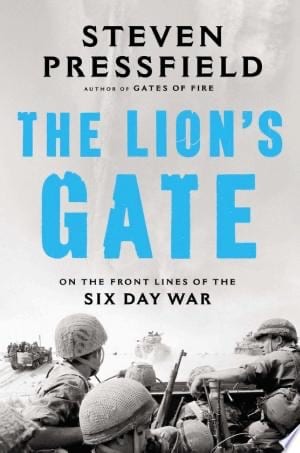
“A brilliant look into the psyche of combat. Where he once took us into the Spartan line of battle at Thermopylae, Steven Pressfield now takes us into the sands of the Sinai, the alleys of Old Jerusalem, and into the hearts and souls of soldiers winning a spectacularly improbable victory against daunting odds.” —General Stanley McChrystal, U.S. Army, ret.; author of My Share of the Task June 5, 1967. The nineteen-year-old state of Israel is surrounded by enemies who want nothing less than her utter extinction. The Soviet-equipped Egyptian Army has massed a thousand tanks on the nation’s southern border. Syrian heavy guns are shelling her from the north. To the east, Jordan and Iraq are moving mechanized brigades and fighter squadrons into position to attack. Egypt’s President Nasser has declared that the Arab force’s objective is “the destruction of Israel.” The rest of the world turns a blind eye to the new nation’s desperate peril. June 10, 1967. The Arab armies have been routed, ground divisions wiped out, air forces totally destroyed. Israel’s citizen-soldiers have seized the Gaza Strip and the Sinai Peninsula from Egypt, the Golan Heights from Syria, East Jerusalem and the West Bank from Jordan. The land under Israeli control has tripled. Her charismatic defense minister, Moshe Dayan, has entered the Lion’s Gate of the Old City of Jerusalem to stand with the paratroopers who have liberated Judaism’s holiest site—the Western Wall, part of the ruins of Solomon’s temple, which has not been in Jewish hands for nineteen hundred years. It is one of the most unlikely and astonishing military victories in history. Drawing on hundreds of hours of interviews with veterans of the war—fighter and helicopter pilots, tank commanders and Recon soldiers, paratroopers, as well as women soldiers, wives, and others—bestselling author Steven Pressfield tells the story of the Six Day War as you’ve never experienced it before: in the voices of the young men and women who battled not only for their lives but for the survival of a Jewish state, and for the dreams of their ancestors. By turns inspiring, thrilling, and heartbreaking, The Lion’s Gate is both a true tale of military courage under fire and a journey into the heart of what it means to fight for one’s people.
Highlights
When the state was founded in 1948, the army of Jordan won the battle for Jerusalem. The Arab Legion drove our forces out of the Old City, burned over fifty synagogues, killed every Jew they could find. (Location 139)
The state of Israel is the size of New Jersey. The combined landmass of its twenty Arab enemy states is more than a million square miles larger than the rest of the United States. (Location 168)
Jews, the Arab people have decided to rid Palestine of your presence. Therefore pack your bags and flee before death overtakes you. Tel Aviv will be a ruin. Our bombs will hit their targets. Where will you run to, Zionists? (Location 178)
Voice of Thunder quoted Azzam Pasha of the Arab League from 1948: This will be a war of extermination and a momentous massacre, which will be spoken of like the Mongolian massacres and the Crusades. (Location 183)
Nasser’s vision was pan-Arabism: one state stretching from Central Asia across the Middle East and Africa to the Atlantic. He wanted a modern Arab world, secular, socialist, armed with the latest weapons and equipped with the newest technology. To that end, Egypt and Syria had allied themselves with the Soviet Union, which was then at the peak of its wealth and power. (Location 187)
Egyptian armor consisted of roughly 1,200 tanks, including 300 new Soviet T-54s and 200 of the even newer T-55s. These were the same tanks the Russian Army used. Syria possessed 550 more Soviet tanks, and Iraq added 630, for a total of 2,400, not counting Lebanon’s pledged 130 and 100 more from Saudi Arabia. Against this, Israel’s armored brigades could put into the field only 800 tanks—250 British Centurions, 200 American M48 Pattons, plus 150 light AMX-13s and 200 Super Shermans, World War II tanks up-gunned and reconfigured for desert fighting. (Location 195)
Into Sinai over the past month Nasser had poured 950 tanks, 1,100 armored personnel carriers, 1,000 artillery pieces, and 100,000 troops. The Egyptian and Syrian air forces were trained by Soviet instructors. Air defense radar was Soviet built and Soviet installed; in many cases it was Soviet manned. Egypt’s ground defenses in Sinai—minefields, artillery “boxes,” and bunker emplacements—were built by and designed by Soviet engineers according to the latest Soviet military doctrine. (Location 199)
Arab Command, a military entity pledged to eradicate “the Zionist entity.” The word “Israel” appeared on no Arab maps. (Location 204)
We are being bullied, my father said, and the only way to handle a bully is to punch him in the face. “What would you do?” I asked. “Strike now. As soon as possible. Meet the enemy straight-up and destroy him. There is no other way.” (Location 291)
If you had screwed up, you admitted it and took your medicine. Ego meant nothing. Improvement was everything. (Location 345)
Israel’s frontiers are not borders, recognized by her neighbors and by the international community, but armistice lines, which may be declared null and void and overthrown arbitrarily at any hour. (Location 540)
A strategy of defense-in-depth is not possible in a nation that is only nine miles wide at its waist and whose commercial concentrations and population centers lie within artillery range of its enemies. Offense is the only effective posture. War, if war comes, must be fought on the enemy’s territory, not our own. (Location 547)
expense of deterrence, which is the only true basis for security for a nation of 2.7 million surrounded by enemies whose numbers are greater than 120 million. (Location 578)
Throughout the waiting period, we listened to Kol Ha’Raam, the Voice of Thunder, out of Cairo. The station’s leading announcer, respected throughout the Arab world, was Ali Ahmad Said. Said did not rant or bluster. His broadcasts were more frightening because they were delivered in a reasonable and unemotional tone. He spoke as if he were reporting the news. “Your time is over, Jews. The experiment in nationhood that the Zionist entity has managed to sustain for nineteen years is due to expire.” (Location 598)
was clear to me that Nasser spoke not only for Egypt but for the entire Arab world. His broadcasts were greeted with as much enthusiasm in Damascus and Baghdad as they were in Cairo and Alexandria. (Location 609)
The qadis of Egypt’s mosques had been ordered to declare jihad—holy war—against the Jews. Radio Damascus’s number one song was “Cut Their Throats!” Mobs marched in the streets; thousands chanted for Israel’s destruction. (Location 610)
Nasser preached the concentric community of the Arab world, with Egypt and himself at its epicenter. His voice called 122 million Arabs to unity and summoned them to loose their rage upon our two and a half million Jews. (Location 612)
Either Eshkol had to go or he must cede the defense portfolio to someone else. After two interminable weeks of crisis, it was clear to all that the nation’s political leadership remained paralyzed by indecision and irresolution. (Location 646)
No one would hire a Jew. Passengers on Pan Am or TWA didn’t want to hear, “This is your captain, Coleman Goldstein, speaking.” (Location 663)
how the British, who were in the final days of their occupation of Palestine under a mandate from the United Nations, were giving the Arabs weapons, planes, and bombs while they were putting Jews against the wall for carrying so much as a pistol. (Location 668)
The British had given the Egyptians fifty brand-new Spitfires. With fifty Spitfires, I could have conquered Eastern Europe. The English had been training and arming Arab armies since the days of Lawrence of Arabia. Iraq was a primary source of England’s oil; the Anglo-French Sykes-Picot Agreement of 1916 had drawn the boundaries for the place, along with the borders of Syria, Lebanon, Transjordan, and Palestine. King Abdullah of Jordan had been hand-carried onto the throne in 1921 by British decree. His army, the Arab Legion, was British-trained and British-officered. Even now, in ’48, the Legion’s commander-in-chief was an English lieutenant general and its field commander an English brigadier. (Location 679)
But nobody would sell the Jews anything, so it was this or die. There’s a phrase in Hebrew, en brera—“no alternative.” That was us and that was Israel. (Location 734)
That was Schwimmer’s operation, creating an air force for Israel out of thin air. He was a genius and a visionary. (Location 759)
This was May 9, 1948, five days before the British Mandate was due to expire. Five Arab armies were massing on Israel’s borders, ready to invade the minute the Tommies pulled out. And Israel had no fighter aircraft. Nothing that could attack the enemy. Nothing. At the last second, six of us got sent to Czechoslovakia to pick up these bastardized Messerschmitts. The route was Cyprus-Rome-Geneva, then by train to Zurich, and finally on a Czech Airlines DC-3 to Prague, where we were stuck in a hotel for two days before we at last reached the training base. The Arab invasion was two days away. (Location 762)
Ze’ev Jabotinsky was an officer in the Russian Army in World War I. His friend Joseph Trumpeldor fought at Gallipoli. There’s a town in the north of Israel called Kiryat Shmona, “City of the Eight.” It was named for the eight Jews who died defending Tel Chai in 1920. Trumpeldor was their leader. This was the first time bullets had flown between Arabs and Jews over the issue of land. (Location 845)
“Lou, collective punishment is against the Geneva Convention.” (Location 951)
Rabin was an idealist. That’s what was wrong with Israel then and it’s what’s wrong with Israel today. The founders had suffered pogroms and persecution for so many centuries in Russia and Eastern Europe that it had become a point of honor with them that if they ever got their own country, they would not treat others with the same cruelty that they’d been treated with. You have to admire that. It’s honorable. It’s noble. But in war it’s bullshit. “Would Alexander hesitate to burn this village? Would Caesar?” “Would Stalin?” said Rabin. “Would Hitler?” He put his hand on my shoulder. “We cannot do it, Lou. If we take such actions, we abandon every principle we are fighting for.” What could I say? Israel was Rabin’s country. I was a foreigner. I couldn’t force my way. (Location 956)
This speech by Nasser on Radio Cairo: “If we have succeeded in restoring the situation to what it was before 1956, there is no doubt that we shall restore the situation to what it was before 1948.” Before 1948 means: no Israel. (Location 1003)
The Soviets are sending shipments of arms to Egypt and Syria, while our own allies, Britain and the United States, stall on deliveries of weapons we have already paid for. (Location 1949)
Behind Nasser now stand Syria, Iraq, Kuwait, Jordan, Lebanon, Libya, Sudan, Algeria, and Yemen. King Hassan II of Morocco has dispatched a special envoy with pledges of assistance; President Habib Bourguiba has promised that an Algerian army will be permitted passage through Tunisia to fight the Zionists. Even Nasser’s worst enemy, King Faisal of Saudi Arabia, has declared: Every Arab who does not participate in this conflict will seal his fate. He will not be worthy of being called an Arab. while Iraqi president Abdul Rahman Arif has been quoted by the BBC: Our goal is clear—to wipe Israel off the face of the map. We shall, God willing, meet in Tel Aviv and Haifa. (Location 1951)
Who is the Arab? No man makes a better friend than he. None will stand his ground with greater courage. To the Arab, honor is all. He will drain his blood for the clan and the tribe, and for the stranger he has taken in at the gate. No one laughs like an Arab, or loves his children with such tenderness; no one dances like him or worships God with greater devotion, and none is more compassionate to the weak and the helpless. The modern world, in which the sons of Ishmael have fallen behind and become a backward people, is a nightmare of shame from which the proud Arab cannot awaken. This is the source of his violent and inextinguishable rage. (Location 1985)
The Arab intellectual is the loneliest man on earth, for he is trapped in the void between reason and faith. (Location 1995)
when an Arab says to me, “I am a Palestinian,” I tell him, “I am a Palestinian, too—and from six hundred years before the birth of Muhammad!” (Location 2134)
Give Ezer Weizman credit. In the face of massive political resistance, of doubt and scorn and disbelief, he rammed through the purchase from Dassault France of seventy-two Mirage IIICs, without which the IAF could not have dreamed of this hour. It was Ezer who charged Yak Nevo and me with developing this plan for total war. (Location 2320)
Improvisation is not a wild scramble at the last minute. You are not pulling plans out of thin air. Improvisation is the payoff of scrupulous preparation and drill. (Location 3302)
The farther you advance under fire, I am beginning to learn, the more items you lose. First you lose your equipment and your bedding. It falls off or gets shot up or burned up. You lose your ammo next. You shoot it up or hand it off to others who need it more. You lose your bearings. You lose communication, you lose vision, you lose hearing. You lose parts of your own body. You lose your men. You lose your connection to reality, you lose your composure, you lose your sanity. The one thing you must never lose is your will to complete the mission. (Location 3492)
I hate the sending of troops to Jerusalem. The act is the issue of the recklessness of one man: Jordan’s King Hussein. I know Hussein well. He is not a rash leader, nor as a rule imprudent or irresponsible. But his throne rides upon the tiger’s back. To preserve it he has had to put his head into the tiger’s mouth. The tiger is not Egypt. It is the anti-Israel fervor of Hussein’s own people. Two-thirds of Jordan’s population are Palestinian Arabs, displaced from their homes during the War of Independence in 1948. Nasser’s general Riad now commands Jordan’s armed forces. Hussein has ceded this power to him. He has had to, to quell his own mob. When Hussein returned from Cairo six days ago, having concluded with Egypt an alliance of war, the crowd swamped his limousine in joy and lifted the vehicle physically off the ground. (Location 3814)
I must manage the war, yes. But beyond that and indivisible from it, my task is to see beyond the curvature of the earth. My charge is to discern and to direct for the nation’s advantage, so much as this is possible, the momentum of events. (Location 3837)