Distilled Knowledge
Source contribution
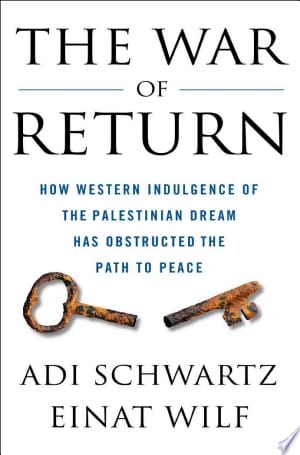
Schwartz and Wilf argue that the Palestinian refugee issue became not only a humanitarian problem but a continuing national strategy: “return” to Israel preserves a demographic route to undo Jewish sovereignty and therefore conflicts with a two-state endgame.
- The book distinguishes compensation/resettlement from mass descendant return into Israel.
- It treats UNRWA’s institutional structure and political meaning as central to perpetuation.
- The strongest counterquestions concern refugee law, responsibility for 1948 displacement, the diversity of Palestinian views, and whether symbolic recognition can be separated from demographic implementation.
Routes: Narrative Recognition and Material Compromise · Peace Offers ·
Evidence boundary
This is an attributed Israeli thesis, not the vault’s settled verdict. Verify legal propositions, refugee counts, historical responsibility, UNRWA comparisons, and Palestinian opinion with primary and opposing sources.
DESCRIPTION
Two prominent Israeli liberals argue that for the conflict between Israel and the Palestinians to end with peace, Palestinians must come to terms with the fact that there will be no “right of return.” In 1948, seven hundred thousand Palestinians were forced out of their homes by the first Arab-Israeli War. More than seventy years later, most of their houses are long gone, but millions of their descendants are still registered as refugees, with many living in refugee camps. This group—unlike countless others that were displaced in the aftermath of World War II and other conflicts—has remained unsettled, demanding to settle in the state of Israel. Their belief in a “right of return” is one of the largest obstacles to successful diplomacy and lasting peace in the region. In The War of Return, Adi Schwartz and Einat Wilf—both liberal Israelis supportive of a two-state solution—reveal the origins of the idea of a right of return, and explain how UNRWA - the very agency charged with finding a solution for the refugees - gave in to Palestinian, Arab and international political pressure to create a permanent “refugee” problem. They argue that this Palestinian demand for a “right of return” has no legal or moral basis and make an impassioned plea for the US, the UN, and the EU to recognize this fact, for the good of Israelis and Palestinians alike. A runaway bestseller in Israel, the first English translation of The War of Return is certain to spark lively debate throughout America and abroad.
Attachment (file not included in this release)
TIMELINE OF KEY EVENTS (1947–1949)
| Date | Event |
|---|---|
| 1920–1947 | Arab opposition to Jewish immigration and Zionism under British Mandate intensifies. |
| February 1947 | British Foreign Secretary Ernest Bevin admits UK cannot reconcile Arab rejection of Jewish sovereignty. |
| Nov 29, 1947 | UN General Assembly adopts Partition Plan to create separate Jewish and Arab states. Jews accept it; Arabs reject it and prepare for war. |
| Dec 1947 – May 1948 | First phase of the war: Arab militias and Palestinian bands attack Jewish areas. Approximately 100,000 Palestinians flee, mainly elites. |
| March 1948 | U.S. withdraws support for partition; Yishuv (Jewish community) moves from defense to offense. |
| April 1948 | Plan Dalet is launched to secure areas allotted to Jews under partition. Focus on hostile villages. |
| April 8, 1948 | Abd al-Qadir al-Husseini, Arab militia leader, dies at Castel. Symbol of resistance. |
| April 13, 1948 | Hadassah Convoy Massacre: 77 Jews, including doctors and scientists, are killed. |
| May 12, 1948 | Kfar Etzion defenders surrender and are massacred by Arab forces. |
| May 14, 1948 | State of Israel is declared. Arab armies invade immediately. |
| July 1948 | 100,000 Palestinians leave, half during IDF’s conquest of Lod and Ramla. |
| Oct–Nov 1948 | Operations Hiram and Yoav lead to another 200,000 Palestinians fleeing. |
| By 1949 | Estimated 726,000 Palestinian refugees; two-thirds remain in West Bank/Gaza, one-third flee to Arab states. |
SUMMARY OF AUTHOR’S EXPLANATION
Core Argument
The Palestinian refugee crisis was not the result of a deliberate Zionist expulsion plan, but rather the direct and avoidable consequence of the Arab world’s violent rejection of Jewish sovereignty and the UN partition plan. The refugees fled during a war started by Arab forces, with varying causes for flight, including battle conditions, leadership collapse, propaganda, and sometimes expulsions.
Key Themes & Explanations
1. Rejection of Partition and War Initiation
- Arabs viewed Jewish sovereignty as inherently illegitimate.
- Arab leaders—including Hajj Amin al-Husseini and Azzam Pasha—openly called for war, not compromise.
- The 1947 UN Partition Plan was accepted by Jews but violently rejected by Arabs, who vowed to prevent any Jewish state “by force.”
2. Arab Responsibility for War and Refugees
- The Arabs launched aggressive actions immediately after the UN vote, triggering civil war-like conditions.
- Refugees were a direct consequence of war, not premeditated expulsion.
- Arab threats, atrocities, and propaganda exacerbated flight; Arab volunteers often abused local populations.
3. Plan Dalet and Jewish Military Strategy
- Plan Dalet, implemented in April 1948, was a defensive military plan—not a blueprint for ethnic cleansing.
- It allowed non-hostile Arabs to remain but targeted hostile villages aiding militias.
- Many Palestinians fled voluntarily out of fear or misinformation, some were expelled in battle zones.
4. Atrocities and Escalation
- Jews suffered severe losses and mutilations (e.g., Kfar Etzion, Hadassah Convoy).
- These atrocities hardened Jewish attitudes and made coexistence seem impossible.
5. Numbers and Definitions of Refugees
- Roughly 726,000 Arabs fled or were displaced. Many weren’t permanent residents or “genuine” refugees.
- UNRWA adopted an unusually broad definition of refugees, later expanded to include descendants.
- Aid distribution was based on operational need, not legal refugee status.
6. No Preplanned Expulsion
- Israeli leaders, including Ben-Gurion and Sharett, had not planned expulsion. Many were surprised by the Arab flight.
- The Jews had accepted a state with a large Arab minority and issued calls for Arabs to stay.
7. Comparative Historical Context
- Population exchanges and expulsions were common in the 20th century (e.g., Germans from Eastern Europe, India-Pakistan partition).
- Jewish expulsions from Arab countries occurred simultaneously, but those Jews were integrated and did not remain refugees.
8. Conclusion of Chapter
- The authors argue the refugee issue wasn’t unique, exceptional, or inevitable—it was the result of a war launched by the Arab world.
- They insist that had Arabs accepted partition, the refugee crisis would never have occurred.
Highlight summary
1. Introduction: The Peace Process and the Unsolved Core Issue
- The authors, former peace advocates from Israel’s political left, describe their disillusionment after witnessing repeated Palestinian rejections of generous peace offers in 2000 (Camp David) and 2008 (Olmert’s offer).
- Despite these proposals including a state in the West Bank and Gaza with a capital in East Jerusalem, Palestinian leaders walked away, followed by the violent Second Intifada.
- This led the authors to question the conventional narrative and focus on the overlooked issue: the Palestinian demand for a “right of return.”
2. Origins of the Refugee Problem (1947–1949)
Zionism and Arab Opposition:
- Arab rejection of Zionism predated the 1948 war. They saw Jewish sovereignty not as a national movement but as an imperialist crime.
- Even moderate Jewish offers of partition were refused. The 1947 UN Partition Plan (which the Jews accepted) was violently rejected by the Arabs.
War of 1948:
- Arab forces initiated the war, hoping to destroy the nascent Jewish state.
- Jewish forces went from defense to offense in April 1948 following repeated Arab attacks and blockades.
- Expulsions occurred during battles, but many Palestinians fled due to fear, collapse of leadership, or Arab-instigated psychological warfare.
- The Jewish community did not pre-plan an expulsion; the decision not to allow mass return was made during the heat of battle due to fears of a fifth column.
Arab Attacks on Jews:
- In areas conquered by Arabs, Jewish populations were completely expelled, massacred, or taken captive (e.g., Kfar Etzion).
- Arab rhetoric and actions indicated an intent to annihilate the Jewish presence.
3. The Refugee Count and UNRWA’s Role
- Estimated 726,000 Palestinians fled or were displaced.
- Around two-thirds remained in the former British Mandate territory (now West Bank and Gaza), the rest in Arab states.
- UNRWA’s definition of a refugee was unusually broad—only two years of residency required—and included descendants, creating a self-replicating refugee population.
- No other refugee group from that era (e.g., Germans, Indians, Greeks) has maintained such status for generations.
4. Refugee Return as a Political Weapon
Arab Leaders’ Goals:
- Return was framed not as a humanitarian gesture but as a strategy to reverse Israel’s existence and erase its military victory.
- The demand for return was often explicitly tied to the liquidation of the Israeli state, not peaceful coexistence.
Palestinian Position:
- Leaders like Rashid Khalidi and Walid Khalidi viewed return as a political tool to undermine Israel.
- Even those who recognized it might never happen insisted on keeping the claim alive as a form of resistance.
Rejection of Resettlement:
- Arab leaders consistently rejected resettlement of Palestinians in Arab countries.
- Jordan, the only state to recognize Israel, did not push for return—highlighting the link between recognition and refugee policy.
5. International Complicity and UN Resolution 194
- Count Bernadotte’s mediation gave the first international platform to the demand for mass return, despite its clear risks.
- UN Resolution 194 is often cited as the legal basis for return, but it was non-binding and politically motivated to appease Arab states.
- The Arabs selectively cited paragraph 11 (on return) while ignoring the resolution’s broader peace framework.
6. Refugee Exceptionalism and the Obstacle to Peace
- The authors compare the Palestinian refugees to other 20th-century refugee crises where displaced populations were resettled and integrated.
- Arab and UN policy toward Palestinians has created an ever-growing, politically mobilized, and intentionally unresolved refugee population.
- This “right of return” demand is the primary reason no peace agreement has been reached—it effectively calls for the demographic destruction of Israel.
7. Conclusion: Return as Perpetual War
- The authors argue that the right of return is not just a policy but a war strategy dressed up as a humanitarian claim.
- It reflects a refusal to accept Israel’s legitimacy, keeping the conflict alive.
- True peace can only emerge when the fantasy of return is relinquished and Palestinians accept that their state, like Israel’s, must be built without erasing the other.
Forward
Summary: Foreword of The War of Return
Authors’ Background and Shift in Perspective:
- Adi Schwartz and Einat Wilf, both originally from the Israeli political left, supported the two-state solution and believed peace could be achieved through territorial compromise.
- Einat was a Labor Party Knesset member and advisor to peace leaders like Shimon Peres and Yossi Beilin (architect of the Oslo Accords).
- Adi was a journalist with Haaretz, a prominent left-leaning Israeli newspaper.
- Both authors supported the 1990s Oslo peace process and were hopeful after the election of Yitzhak Rabin and the 1993 Oslo Accords.
Disillusionment and Reassessment:
- Despite Israel offering Palestinians generous peace terms in 2000 (Camp David) and 2008, the Palestinians rejected both, planting seeds of doubt in the authors.
- The outbreak of the Second Intifada immediately after Camp David—marked by brutal suicide bombings—further disillusioned them.
- These events led the authors to question key assumptions: that the conflict was merely territorial and could be solved by partition and Israeli withdrawal.
Neglected Core Issue—The Refugee “Right of Return”:
- Their research led to the central thesis of the book: the Palestinian refugee issue, particularly the demand for a “right of return,” is the most fundamental barrier to peace.
- While other issues like settlements and occupation receive global attention, the refugee issue has been strategically ignored or sidelined.
- They argue the Palestinian self-conception as “refugees”, and their unwavering insistence on a right to return to sovereign Israel, reveals an enduring rejection of Israel’s legitimacy.
Critique of International Policy and UNRWA:
- The United Nations Relief and Works Agency (UNRWA), designed to provide humanitarian aid to Palestinian refugees, is instead perpetuating the refugee problem, due to its unique mandate that allows refugee status to be inherited indefinitely.
- The authors argue that Western support and funding of UNRWA has entrenched a growing, permanent refugee population, undermining peace efforts.
- They call for dismantling and replacing UNRWA with a new framework that delivers social services without politicizing the refugee issue or fostering illusions of return.
Call for a New Diplomatic Approach:
- Traditional diplomacy, focused on shuttle diplomacy and forcing concessions, has failed because it ignores root causes—chief among them the refugee issue.
- The authors argue for a deeper analytical and strategic approach, targeting the ideological and institutional sources that sustain the conflict.
- Peace negotiations must begin with recognizing and confronting the refugee narrative as a deliberate political tool, not merely a humanitarian issue.
Personal Stakes and Historical Context:
- As Israeli citizens and parents, Schwartz and Wilf emphasize that their interest in peace is not academic but existential.
- They introduce the book’s structure: starting with the 1948 war, the birth of Israel and the Palestinian refugee crisis, and comparing the fate of Jewish and Palestinian refugees.
- While Jewish refugees were integrated into new societies (notably Israel), Palestinian refugees were deliberately left in limbo.
Key Questions the Book Seeks to Answer:
- Why does the Palestinian refugee status persist after 70+ years?
- What are the ideological motives behind preserving their refugee identity?
- Is the “right of return” a real demand or a political tactic?
- How can peace be possible if this demand remains non-negotiable?
Chapter 1: Waging War
I. Origins of Conflict: Rejection Before Refugees
The chapter begins with a key assertion: the Palestinian refugee problem did not arise from the 1948 war—it preceded it in cause, though not in effect. Arab opposition to Jewish statehood predated the war and was its primary cause. The war, the authors argue, was not a clash of two legitimate national movements fighting over land, but rather a war launched to prevent one nation’s independence.
The Palestinian leadership, exemplified by figures such as Abd al-Qadir al-Husseini and Hajj Amin al-Husseini, viewed any form of Jewish sovereignty in the land as illegitimate. In a poignant letter before his death in 1948, Abd al-Qadir wrote to his son Faisal:
“The Jews have no right to this land. How can I sleep while the enemy rules it? Something burns in my heart. My homeland beckons.”
Despite divisions among Palestinians—urban vs rural, Husseini vs Nashashibi clans—there was near total political unity in rejecting partition or Jewish independence.
British Foreign Secretary Ernest Bevin acknowledged this fundamental asymmetry in 1947:
“For the Jews the essential point of principle is the creation of a sovereign Jewish State. For the Arabs, the essential point of principle is to resist to the last the establishment of Jewish sovereignty in any part of Palestine.”
II. Partition and the Road to War
🗓️ November 29, 1947 – UN General Assembly votes for partition
- Recommended dividing Mandatory Palestine into a Jewish and an Arab state.
- Jerusalem would be a UN-administered international city.
- The proposed Jewish state (55% of land) included desert areas and vulnerable borders and was to include a large Arab minority (about 47%).
Jewish Reaction: Jubilant. David Ben-Gurion called it the greatest Jewish achievement since ancient times. Celebrations erupted across Tel Aviv and Jerusalem.
Arab Reaction: Total rejection. Arab leaders warned of war:“The blood will flow like rivers…” – Jamal al-Husseini
“This will be a war of extermination and momentous massacre…” – Azzam Pasha, Arab League Secretary-General
Abba Eban recalled his failed diplomatic meeting with Azzam, where Azzam declared:
“It is a question of historic pride… There will have to be a decision, and the decision will have to be by force.”
The Arabs refused to even engage with the UN committee overseeing partition implementation. They chose war to prevent any Jewish state.
III. The 1948 War and the Palestinian Exodus
📍 Two Phases of the War
1. Civil War Phase
🗓️ Nov 1947 – May 14, 1948
- Clashes began immediately after the UN vote.
- Initial violence was between Jewish militias (Haganah, Irgun) and Palestinian irregulars, backed by volunteers from neighboring Arab states.
- Palestinian strategy: isolate and choke off Jewish settlements, especially in Galilee, the Negev, and Jerusalem.
~100,000 Palestinians fled in this period, mostly: - Urban middle and upper class (lawyers, doctors, teachers).
- Their departure devastated morale and left the Palestinian masses leaderless.
- By March 1948, most of the Arab Higher Committee had fled Palestine.
The Jewish Yishuv, meanwhile, was under siege: - The Negev, western Galilee, and Jewish Jerusalem were isolated.
- A March 27 convoy to Kibbutz Yehiam was ambushed; 47 Jews were killed.
- Hunger set in across Jewish Jerusalem. Ben-Gurion declared:
“If Jerusalem falls, the rest is meaningless.”
The U.S., seeing Jewish weakness, proposed trusteeship over partition, reversing its earlier position.
2. Invasion by Arab States
🗓️ May 15, 1948 – 1949
- On May 14, 1948, Israel declared independence.
- The next day, armies from Egypt, Jordan, Syria, Iraq, and Lebanon invaded.
- War escalated into inter-state conflict, with intense urban and rural battles.
- Jewish strategy turned offensive: the goal was to secure territory allocated under the UN plan and establish military contiguity.
⚔️ Plan Dalet (Plan D) – April 1948
- Misrepresented as a plan for ethnic cleansing, it was in fact a military strategy.
- Aimed at securing roads, villages, and strategic points ahead of the Arab invasion.
- Differentiated between hostile and non-hostile Arab populations.
- Non-hostile Arabs were permitted to stay (e.g., Abu Ghosh).
- Hostile villages that aided militias were to be evacuated.
The result:
- Jewish forces began to take Haifa, Tiberias, Safed, Jaffa, and villages in Galilee and the coastal plain.
- 200,000–300,000 more Palestinians left during April–July 1948.
- Some departures were panic-driven, others forced during fighting.
IV. Massacres and Brutalization
Several events intensified Jewish-Arab hostilities, eroding restraint on both sides:
- The “Convoy of 35” to Jerusalem was ambushed; fighters were mutilated.
- Hadassah Hospital convoy (April 13, 1948): 77 Jewish doctors, nurses, and students were massacred.
- Kfar Etzion (May 12): 133 Jews surrendered, were photographed, then executed en masse.
- Arab media celebrated mutilation, selling photos of dead Jews in Jerusalem.
Yoram Kaniuk, Israeli soldier and author, wrote of witnessing atrocities:“One of ours… was hanging from a tree, his body cut to ribbons… his penis stuck in his mouth.”
These events hardened Jewish attitudes and led to broader assumptions of Arab hostility.
V. Final Stages and Refugee Numbers
- Operations Hiram and Yoav (Oct–Nov 1948): another 200,000 Palestinians fled.
- Total refugees by 1949: 500,000–900,000, with UN estimating 726,000.
Where they went: - ⅔ remained within former Mandate territory (West Bank, Gaza).
- ⅓ fled to Lebanon, Syria, Egypt, and Jordan.
VI. Who Was a “Refugee”? UNRWA and Inflation of Numbers
- Aid agencies (Red Cross, UNRPR) initially distributed help based on need, not status.
- UNRWA, established in 1950, adopted an extremely loose definition:
- Two years’ residence in Palestine was enough.
- No legal vetting for “habitual residence” or even presence in conflict zones.
Widespread fraud:
- Double registrations
- False birth records
- Non-refugees registering for benefits
- UN found ~20% of recipients were not refugees.
VII. Alternative Historical Comparisons
Schwartz and Wilf argue that the Palestinian refugee crisis was not exceptional. Comparable or worse displacements occurred globally in the 20th century:
- 12 million Germans expelled from Eastern Europe (Czech Republic, Poland, etc.).
- 1.8 million Greeks and Turks exchanged in 1920s.
- 14 million Hindus and Muslims displaced in the India-Pakistan partition.
- 850,000 Jews expelled or forced out of Arab countries post-1947.
- These Jewish refugees were absorbed into Israel and never remained refugees.
They note that many of these expulsions were far more violent, and none became permanent refugee populations.
- These Jewish refugees were absorbed into Israel and never remained refugees.
VIII. Final Analysis: Refugee Status Was Not Inevitable
- No Zionist “plan” to expel Arabs existed before the war.
- Ben-Gurion, Sharett, and Golda Meir expressed surprise and dismay at the Arab flight.
- Many Arabs fled out of fear, rumors, or discipline breakdown—not always due to Israeli expulsion.
- Had Arab leaders accepted partition, they could have established a state and avoided displacement.
“The departure of the Arabs was a result of the war and only of the war.”
“If the Arabs had reconciled themselves with the UN partition decision… [they] would have constituted an organic part of the state.” – Moshe Sharett
Conclusion:
This chapter asserts that the Palestinian refugee crisis was not born of exceptional injustice, but of Arab rejectionism, wartime chaos, and later, institutional entrenchment by organizations like UNRWA. The chapter challenges the view of Palestinians as uniquely victimized, placing their experience within the broader—and often more severe—context of global refugee flows during the 20th century.
Chapter 2: Demanding Return (1949)
Here is an extensive, structured summary of The War of Return by Adi Schwartz and Einat Wilf, covering pages 38–85. This digest includes major events, arguments, historical context, quotes, and a timeline of the 1948 war and refugee issue, retaining the original narrative logic and political framing by the authors.
I. Background and Framing
The authors argue that the Palestinian demand for the “right of return” is not a humanitarian plea but a political weapon intended to undermine Israel’s existence. They assert this demand emerged after the war and that it was strategically designed as a continuation of warfare through demographic means, cloaked in legal and humanitarian rhetoric.
“The demand to return immediately after the war was hardly innocent or based on specific humanitarian or legal requirements. On the contrary: it was precisely designed and crafted as an alternative to continuing the war on the battlefield.”
II. Timeline of the 1948 Arab-Israeli War and Palestinian Exodus
Stage 1: November 1947 – March 1948
- Following the UN partition vote (Nov 29, 1947), fighting erupted between the Jewish Yishuv and Palestinian militias.
- The goal of the Arab side was to prevent the implementation of the partition and eliminate the Jewish presence.
- Approx. 100,000 Palestinians left during this stage, mostly middle/upper-class urban elites, often voluntarily, fearing violence and instability.
Stage 2: April – May 14, 1948
- Yishuv, under pressure from mounting casualties and isolation of Jewish settlements, switched from defense to offense.
- Operations launched to lift sieges and secure vital roads. In some cases, this involved expulsions (e.g., Lod and Ramla).
- Example: In mid-July, 100,000 Arabs fled; half were expelled, half fled out of fear (e.g., Nazareth).
Stage 3: May 15, 1948 – Early 1949
- Upon Israel’s declaration of independence, Arab armies invaded.
- Fighting continued in areas like the Galilee and Negev.
- Another 200,000 Arabs left during this stage, especially during Operations Hiram and Yoav (Oct–Nov 1948).
“Estimates of the total number of Palestinians who fled or were expelled during the war range from 500,000 to 900,000. In 1949 the UN estimated 726,000.”
III. Reasons for the Arab Exodus
The book challenges the narrative of pre-planned Zionist expulsion, instead offering a multi-causal explanation:
- Voluntary Flight from War Zones: Fear of violence and psychological warfare led to mass departures.
- Orders from Arab Leadership: In some areas, Arabs were told to evacuate until an Arab victory was secured.
- Combat-Driven Expulsions: In militarily strategic towns like Lod and Ramla, the IDF expelled residents.
- Propaganda & Atrocity Reports: The Deir Yassin massacre was exaggerated by Arab leaders, causing mass panic.
- Breakdown of Arab Leadership: Many elites fled early, leaving the masses disoriented.
- Criminal Behavior of Arab Militias: Reports of rape, looting, and abuse by Arab irregulars demoralized civilians.
- Arab Intent to Exterminate Jews: Arab leaders openly declared genocidal aims. Hajj Amin al-Husseini declared a goal to “eliminate the Zionists”.
IV. Postwar Arab Rejectionism
Even after losing the war, Arab leaders refused to accept Israel’s existence:
- In 1949, Syria’s ambassador to the UN declared, “The [next] war with Zionism is approaching.”
- Egypt’s foreign minister stated peace was impossible because Israel could not be recognized “in principle.”
- An Arab consensus soon emerged that all refugees must return before any peace discussions—effectively a nonstarter.
- Palestinian refugees themselves rejected peaceful return under Israeli sovereignty, instead envisioning return as conquest.
“We do not want to return with the flag of Israel flying on a single square metre of our country… not a return that will make us citizens in the State of Israel.” — Nasir al-Din Nashashibi
V. UN Mediation and Resolution 194
Count Folke Bernadotte’s Plan
- Bernadotte proposed a redrawing of Israel’s borders (removing the Negev) and refugee repatriation, siding with Arab demands.
- His logic was primarily political: appease Arabs to stabilize the region for Western interests (especially to block Soviet influence).
- He declared it would be an “offense against the principles of elemental justice” to deny return.
- Bernadotte was assassinated by Lehi (a Jewish paramilitary group) the day after completing his plan.
UN Resolution 194 (Dec 1948)
- Adopted after Bernadotte’s death; non-binding General Assembly resolution.
- Paragraph 11 stated that refugees “wishing to live in peace with their neighbors should be permitted to return.”
- The Arab states initially opposed the resolution because it implied recognition of Israel. Later, they embraced only Paragraph 11, ignoring its broader context and peace provisions.
“The refugees had been, and remained, a political problem.” — Benny Morris
VI. Edward Said and the Reframing of the Narrative
- Edward Said’s The Question of Palestine declared: “The reason for the flight of the Palestinians is finally irrelevant. What matters is that they are entitled to return.”
- The authors criticize this as an attempt to erase causality and accountability.
- Said’s own refugee claims were later shown to be exaggerated—his family lived between Cairo and Jerusalem.
VII. The U.S., Britain, and Geopolitics
- The U.S. pressured Israel on refugee return out of fear that Arab instability could drive countries into the Soviet camp.
- American diplomats saw the refugee issue as a geopolitical challenge—not primarily a humanitarian one.
- Britain hoped to reverse partition and maintain Arab client states (Jordan, Egypt), even suggesting Israel cede the Negev.
VIII. Strategic Use of the Refugees
The refugee issue was deliberately turned into a long-term political weapon:
- Arab newspapers and leaders called the refugees a potential “fifth column” within Israel to subvert it from within.
- The demand for return became inseparable from the demand to destroy Israel demographically and politically.
- The Palestinian historian Rashid Khalidi acknowledged this strategy: “The demand for return was clearly premised on the liberation of Palestine, i.e., the dissolution of Israel.”
Conclusion
Schwartz and Wilf argue that the Palestinian refugee crisis was the result of a war launched by the Arab side, and that the refusal to resettle the refugees and the insistence on return has served to perpetuate conflict. They stress that return was weaponized to achieve by demographic means what failed through military force, and that this framing—legalistic and humanitarian in rhetoric but strategic in intent—has become entrenched in Western discourse due to political miscalculations and moral confusion by figures like Bernadotte and intellectuals like Said.
Would you like a visual timeline or map to accompany this summary?
Chapter 3: Rejecting Integration (1950-1959)
Here is an extensive, structured, and annotated digest of pages 86–132 of The War of Return by Adi Schwartz and Einat Wilf. This section primarily addresses the decade following the 1948 war, focusing on the failed efforts to rehabilitate Palestinian refugees and the political decisions—by Arab leaders and international actors—that entrenched the notion of return and rejected integration.
Chapter Overview: “Rejecting Integration (1950–1959)“
Main Argument:
The decade following the 1948 war presented a real opportunity to resettle Palestinian refugees and help them integrate into neighboring Arab states. However, this opportunity was deliberately sabotaged by Arab leaders and the refugees themselves. The primary reason was not humanitarian but political: preserving the demand for the “right of return” as a weapon against Israel.
Major Narrative Arcs:
1. Musa Alami and the Experimental Refugee Farm
-
Context & Vision: Musa Alami, a Palestinian aristocrat and former member of the Arab Higher Committee, initiated a personal project in 1949 to rehabilitate refugees by building agricultural settlements near Jericho. He hoped that productive work and self-sufficiency would restore Palestinian dignity.
-
Project Details:
- Secured 20,000 dunams (nearly 5,000 acres) from King Abdullah of Jordan.
- Dug wells by hand; found water, making the area arable.
- Built a large-scale farm: 10,000 banana trees, 16,000 vines, 400 dunams of cotton and vegetables, 12,000 trees, and even a swimming pool and orphan housing.
- Struck a supply deal with Aramco for Saudi Arabian produce needs.
-
Success: At its peak, employed thousands of refugees, offered schooling and medical care, and matched the model that UNRWA was supposed to pursue .
“The New York Times described him as ‘the Arab Moses.’”
-
Demise: In 1955, the farm was attacked and destroyed by thousands of Palestinian refugees from nearby camps. They accused Alami of treason and collaboration with Zionists because his project implied accepting the permanence of the refugee situation outside of Israel.
- Children were beaten, dorms looted and burned, and Alami’s office ransacked.
- Only the arrival of Jordanian police prevented further atrocities.
“The lesson from the attack was that if the refugees were capable of harming their own kind, then UNRWA had no chance of rehabilitating them” .
2. UNRWA and the International Shift to Rehabilitation
- Initial Intent: UNRWA was created not just for relief, but for economic reintegration—to implement the findings of the 1949 Economic Survey Mission led by Gordon Clapp.
- US Vision: The U.S., alarmed by the communist threat, believed economic rehabilitation would stabilize the region. UNRWA’s directors (all Americans) pushed for large-scale projects and presented a $200 million plan in 1951, meant to remove refugees from dependency.
- Outcome: By 1955, only $7 million (3.5%) was used for resettlement. Aid dependency grew instead of shrinking .
3. Arab State Reactions: Political Rejection of Integration
- Lebanon: Feared that 100,000+ Sunni Muslim refugees would shift its Christian-Muslim balance; blocked all projects .
- Syria: Negotiated with UNRWA in 1952 but backed out fearing political backlash.
- Egypt: Controlled Gaza Strip but avoided responsibility for its 200,000 refugees. Cancelled plans to resettle them east of the Suez.
- Jordan: Initially cooperative but faced internal backlash. Parliament and public opinion rejected permanent resettlement, demanding continued advocacy for the right of return.
“[Arab leaders] saw [the refugees] as a political means of pressure to get Israel wiped off the map or to get the greatest possible number of concessions.” — Golda Meir, 1957
4. Palestinian Refugee Resistance to Rehabilitation
-
UNRWA’s own 1951 report admitted: refugees saw any employment or new life in Arab countries as betrayal of the right of return.
- Permanent housing projects were destroyed.
- Schools faced strikes.
- Refugees attacked UNRWA offices in Sidon, Nablus, and Damascus .
“The desire to go back to their homes is general among all classes… many refugees are ceasing to believe in a possible return, yet this does not prevent them from insisting on it.” — UNRWA First Report
- This behavior stemmed from a collective belief that accepting any alternative to return meant accepting Israel’s legitimacy.
5. The Collapse of the Rehabilitation Effort (1959)
-
In 1959, UNRWA formally shifted from rehabilitation to vocational training and schooling, abandoning integration goals.
-
This change was political, not humanitarian.
- Arab leaders made it clear at the UN: UNRWA must not be reformed or closed, as that would threaten the refugee weapon.
- U.S. frustration was immense, but Washington backed down to maintain relations with the Arab world.
“The Americans wanted to dismantle the agency but were not prepared to pay the price of a rift in their relations with the Arab world.”
- The 1959 UN resolution marked the final shift: UNRWA became a permanent agency, its core mandate gutted, existing as a political symbol of the “return” demand.
Timeline of Key Events (1949–1959)
| Year | Event |
|---|---|
| 1949 | Musa Alami begins building refugee rehabilitation farm near Jericho |
| 1950 | UNRWA established; US policy shifts from return to economic integration |
| 1951 | UN General Assembly approves $200M rehabilitation plan |
| 1952 | Syria negotiates with UNRWA but backs out; Alami’s farm grows; first refugee opposition |
| 1955 | Refugees destroy Alami’s farm in violent riot; symbolic collapse of rehabilitation hopes |
| 1957 | Golda Meir: Arabs keep refugees as a political tool |
| 1958 | US considers dismantling UNRWA; Saudis demand it remain |
| 1959 | UN votes to extend UNRWA; mandate drops integration goal, focuses on schooling/training |
Core Themes & Conclusions
- Refugees as Political Tools: Arab states and Palestinian leadership prioritized political confrontation over humanitarian concern. Integration was rejected to preserve the refugee weapon against Israel.
- UNRWA as a Perpetual Agency: Originally created to end aid dependency, it was converted into a permanent system sustaining the illusion of return.
- Deliberate Strategy of Failure: UNRWA failed because success—resettling refugees—was seen as undermining the struggle against Israel.
- West’s Complicity: The U.S. and U.K. backed down from reforms to protect broader strategic interests in the Arab world.
“This was the decisive turning point in the history of UNRWA… a political marriage of convenience between the United States and the Arab states.”
Chapter 4: Welding Terror (1960-1987)
Here is an extensive, structured summary of pages 133–175 of The War of Return by Adi Schwartz and Einat Wilf. This section, titled “Wielding Terror (1960–1987)”, presents a detailed and disturbing narrative of how the Palestinian refugee camps transformed into hubs of radical nationalism and terrorism, with UNRWA (United Nations Relief and Works Agency) playing a central role. The authors argue that the persistence of the refugee status and the propagation of the “right of return” ideology directly fueled terrorism, conflict, and rejectionism.
I. The Birth of a Militant Identity in Refugee Camps
Refugee Camps as Ideological Incubators
-
The refugee camps became isolated and ideologically homogenous zones, cut off from integration into Arab host societies.
-
Palestinians, born after 1948, were educated on the mythology of a stolen homeland and were raised to believe that their personal and national honor demanded violent “return.”
-
Jamal al-Gashey, a terrorist involved in the 1972 Munich Massacre, is used as a case study. Raised in Lebanon’s Shatila Camp, he absorbed a narrative of loss, betrayal, and revenge.
“When I received my handgun, I felt proud… my existence and my life had a meaning.”
The “Right of Return” as a Theology of Violence
-
The concept of return was not symbolic but militaristic. It became a religious-like belief for many refugees—central to identity, pride, and meaning.
-
Even though many refugees had never seen Palestine, they were raised with vivid, romanticized, and often violent imagery of “homecoming.”
-
Education and indoctrination through UNRWA schools sustained and inflamed this sentiment:
“The gun and the Return are one for us.” (Epigraph from John le Carré’s The Little Drummer Girl)
II. The Role of UNRWA in Radicalization
Transformation from Humanitarian Relief to Political Arm
-
Originally intended as a temporary humanitarian agency, UNRWA evolved into a pseudo-state apparatus that perpetuated refugee status indefinitely.
-
Instead of resettlement or integration, UNRWA expanded definitions of “refugee” to include children, grandchildren, and future generations.
-
Budgetary priorities shifted:
- Aid dropped from 62% of budget in 1960 to 12% in 1984.
- Education rose from 23% to 66%—funding a massive system of ideological schooling.
UNRWA Education: Nationalism over Neutrality
-
UNRWA schools became instruments for teaching anti-Israel ideology and cultivating Palestinian nationalism.
-
Children were taught slogans like:
“Palestine is our country. Our aim is to return. Death does not frighten us.”
-
Textbooks glorified violence and martyrdom, erased Israel from maps, and portrayed Jews in stereotypical, hostile terms.
-
A 1969 UN-commissioned report found that 79 of 127 textbooks failed to meet educational standards and were deeply politicized.
III. Refugee Camps as Military Recruitment Bases
The Rise of Armed Terror from the Camps
-
Refugee camps became breeding grounds for terrorist organizations like Black September and Fatah.
-
The Munich Massacre (1972) was carried out by men raised in these camps, many of whom were educated in UNRWA schools.
- Nine Israeli athletes were murdered, some mutilated, including coach Moshe Weinberg and wrestler Yossef Romano.
- The operation was seen by perpetrators as a “100% success” for putting Palestine in the global spotlight.
Integration Failure and Host Country Discrimination
- Most Arab countries (except Jordan) denied Palestinians citizenship, employment, and property rights.
- This deliberate discrimination helped reinforce the notion that Palestinians were only temporarily displaced and must one day “return.”
- Hostility in Lebanon, Syria, and Egypt forced refugees to remain in camps, further entrenching their separate identity.
IV. UNRWA’s Institutional Failures and Corruption
Mass Fraud and Population Inflation
- By the 1970s, there were significant discrepancies between registered refugees and actual camp populations.
- Food rations were sold on black markets. Dead or emigrated individuals remained on rolls.
- By 1966, it was estimated that 200,000 of 450,000 food cards in Jordan were in the hands of profiteers.
Emigration to the Gulf Ignored by UNRWA
- Hundreds of thousands of Palestinians migrated for work to the Gulf states, but were not removed from UNRWA’s rolls.
- By 1990, over 400,000 Palestinians lived in Kuwait alone.
- Despite economic success, they retained “refugee” status for political purposes.
V. UNRWA and the PLO: From Aid to Alliance
Symbiosis Between UNRWA and Palestinian Militancy
-
UNRWA employees participated in the founding of the PLO (1964).
-
By 1966, it was estimated that 15,000 PLO fighters in the camps were receiving UN aid.
-
Senator Ted Kennedy investigated the issue, denouncing UNRWA for indirectly supporting terror:
“It is incompatible… to supply aid in any way to members of any army whose announced purpose is the destruction of a member nation of the United Nations.”
UNRWA as a Political Actor
- UNRWA became not just a relief agency but a driver of Palestinian nationhood.
- It provided jobs, training, and political space for the development of nationalist leadership.
- Camps became extraterritorial zones, immune to host country interference, where the PLO conducted military and political activity freely.
VI. Refugee Camps Fuel Civil Wars and Global Terror
Black September (1970) in Jordan
- Palestinian guerrillas tried to take over Jordan, declaring northern regions as liberated zones.
- King Hussein responded with military force, killing ~3,000 Palestinians and expelling the PLO to Lebanon.
Lebanese Civil War (1975–1990)
- PLO established near-total control of southern Lebanon, further inflaming sectarian tensions.
- The war led to over 100,000 deaths and multiple massacres, with camps as militarized epicenters.
Intifada (1987)
- Began in Gaza’s Jabalia camp; spread to other camps in the West Bank.
- “Shock forces” and “popular committees” fueled the uprising, mostly organized by youth raised in the camps.
VII. The UN’s Shift Toward the Palestinian Narrative
Radicalization of UN Policy
- With the rise of the Non-Aligned Movement and Soviet influence, UN became increasingly hostile to Israel.
- In 1974, PLO was recognized as the legitimate representative of Palestinians and given observer status.
- Resolution 3236 established the “right of return” as “inalienable,” without acknowledging its implications for Israeli sovereignty.
Zionism = Racism (1975)
- The infamous UN resolution declaring Zionism a form of racism marked the peak of anti-Israel sentiment.
- The UN’s Division for Palestinian Rights (1977) institutionalized this stance within the Secretariat.
“If Algeria introduced a resolution declaring that the Earth was flat and Israel had flattened it, it would pass by a vote of 164 to 13 with 26 abstentions.” —Abba Eban
VIII. Legacy and Consequences
- The refugee camps became not transitional shelters but the very basis of Palestinian political identity.
- Indoctrination, militarization, and a singular focus on return made peace more difficult, not less.
- Figures like Gashey, Yasser Arafat, Ghassan Kanafani, and Ahmed Yassin all emerged from this ecosystem.
- The authors argue that the perpetuation of refugee status through UNRWA created a self-fulfilling cycle of grievance and violence that continues to destabilize the region.
Chapter 5: Negotiating Peace (1988-Present)
Here is an extensive, structured summary of the final chapters of The War of Return by Adi Schwartz and Einat Wilf (pages 176–261). This section centers on the final-status negotiations at Camp David, the Clinton Parameters, and the deeper Palestinian rationale for rejecting every compromise involving the right of return. The authors explore the political, ideological, and cultural persistence of the refugee issue, arguing that Palestinian leaders and society have consistently refused to relinquish their claim to Israel itself, regardless of opportunities to build a Palestinian state elsewhere.
Camp David Summit and Clinton Parameters (2000)
Background:
- Israeli negotiators, along with President Bill Clinton, believed that the peace process was nearing resolution. The expectation was that Israel would accept the creation of a Palestinian state and make territorial concessions, while the Palestinians would relinquish the right of return in exchange.
- Daniel Reisner, a lead Israeli legal negotiator, had worked for years assuming the Palestinians saw return as a bargaining chip, not a core, non-negotiable demand.
The Reality at Camp David:
-
Once inside the summit, Reisner and the Israeli team were shocked by how irreconcilable the Palestinian positions were, particularly on refugees. “Houston, we have a problem,” Reisner recalled thinking.
-
The Israeli offer included:
- Partial acknowledgment of responsibility for refugee creation.
- A symbolic admission of a limited number of refugees into Israel.
- Massive investment in refugee compensation and resettlement in Arab states or the future Palestinian state.
-
Crucially, Israel wanted the PLO to agree that all refugee claims were settled and no further claims would be made. This was understood to be a core requirement for final peace.
Clinton’s Proposal (December 23, 2000):
-
Clinton’s Parameters proposed:
- A Palestinian state in the West Bank and Gaza.
- Limited refugee resettlement in Israel, at Israel’s discretion.
- Full right of return only to the new Palestinian state.
- He emphasized two homelands: “Palestine for the Palestinian people” and “Israel for the Jewish people”.
Palestinian Response:
- Israel accepted the Clinton Parameters.
- Palestinians rejected them outright. Arafat refused to surrender the mass “right of return,” especially for refugees in Lebanon.
- Barak later said the gap between the two sides “was like a gaping chasm”.
- An internal Palestinian memo outlined the reasons for rejection:
- Claimed “no historical precedent for a people abandoning their fundamental right to return.”
- Rejected replacing “homes” with “homeland,” insisting on return to Israel, not to a new Palestinian state.
- Declared that calling Palestine the “homeland of the Palestinian people” would “nullify the right of return”.
- Concluded that recognition of the right of return and individual refugee choice was prerequisite for ending the conflict.
Fatah’s Position and Popular Sentiment (2001 Onward)
-
Fatah’s official magazine in January 2001 confirmed:
- The right of return is “sacred and nonnegotiable.”
- The refugee issue is “the core of the Arab-Israeli conflict.”
- Even one million Jews from the former USSR having been absorbed by Israel was used as a precedent for absorbing Palestinians.
- Rejected any solution that didn’t guarantee mass return, not symbolic.
- Claimed return would “help Jews get rid of racist Zionism” and end Israel’s identity as a Jewish state.
Summary of this Palestinian Position:
“If the price of having a Palestinian state in part of the land was to forgo their demand for the entirety of the land, their choice… was to reject it”.
2008 Negotiations and the Olmert Proposal
-
Another opportunity came in 2008 under Prime Minister Ehud Olmert and Palestinian President Mahmoud Abbas.
-
Offer included:
- A Palestinian state on nearly 100% of the West Bank and Gaza.
- Capital in East Jerusalem.
- No settlements in the Palestinian state.
- 5,000 refugees allowed into Israel over 5 years.
-
Abbas rejected it. He told Condoleezza Rice:
“I can’t tell four million Palestinians that only five thousand of them can go home”
The Palestine Papers (2011 Leak)
-
Al Jazeera published 1,700 internal Palestinian Authority documents (the “Palestine Papers”) that documented over a decade of peace talks.
-
The documents revealed:
- Palestinian leadership consistently viewed the right of return as individual and non-negotiable.
- Any agreement had to guarantee refugees a choice of returning to Israel, Palestine, or third countries.
- A demographic study was even commissioned to “prove” Israel could absorb millions of refugees while retaining a Jewish majority—implying that mass return was indeed the goal.
- PLO negotiators used vague phrases like “agreed solution” as political cover to preserve full return ambitions.
Western Misunderstanding and Strategic Deception
-
Western leaders continued to “Westplain” Palestinian actions as pragmatic or strategic.
-
Meanwhile, Palestinian media, negotiators, and public sentiment made clear:
- Any compromise on return would be seen as betrayal.
- Abbas would face assassination threats if he relinquished the right of return.
-
A 2014 International Crisis Group (ICG) study found:
- A majority of Palestinians would reject any deal without full return.
- “Even with large concessions from Israel, Palestinians will not accept an agreement that does not provide refugees with the choice of where to relocate, including to Israel”.
Conclusion and Author’s Argument
- The authors conclude that Palestinian leaders have not prepared their people for peace or compromise.
- Every chance to form a state was rejected due to the overriding demand for return.
- The refugee issue is not ancillary; it is the core of the conflict, weaponized to delegitimize Israel’s right to exist as a Jewish state.
- The “right of return” is portrayed not as a humanitarian goal but as a political and demographic tool to reverse 1948.
- As long as the international community supports this claim—through language, funding of UNRWA, and diplomatic ambiguity—the path to peace remains blocked.
Would you like a companion timeline table that lays out key dates and negotiation breakdowns visually?
TIMELINE
| Date | Event | Summary |
|---|---|---|
| 1917-01-01 | Balfour Declaration | British government supports a Jewish homeland in Palestine, fueling Arab opposition. |
| 1920-07-01 | British Mandate Begins | Britain officially assumes administration of Palestine under League of Nations mandate, laying groundwork for future conflict. |
| 1936–1939 | Arab Revolt in Palestine | Violent uprising against British rule and Jewish immigration; suppressed by British but deepens Jewish-Arab divisions. |
| 1947-11-29 | UN Partition Plan | UN proposes division of Palestine into Jewish and Arab states. Jews accept, Arabs reject and launch hostilities. |
| 1947-12-01 | Civil War in Mandatory Palestine | Arab militias and Jewish forces begin fighting after the UN partition vote, marking the start of the 1947–1949 war. |
| 1948-05-14 | Israeli Independence Declared | Israel declares independence; five Arab nations invade, starting the first Arab-Israeli war. |
| 1948–1949 | Palestinian Exodus | Approx. 700,000 Palestinians flee or are expelled during the war; Israel survives but the refugee crisis is born. |
| 1949-07-20 | Armistice Agreements Signed | Israel signs armistice with Egypt, Lebanon, Jordan, and Syria; new borders drawn but no peace agreements reached. |
| 1949-01-01 | UNRWA Founded | UN creates a special agency for Palestinian refugees, cementing their unique status and perpetuating dependency. |
| 1950 | Jordan Annexes West Bank | Jordan unilaterally annexes the West Bank, granting citizenship to Palestinians, further complicating refugee claims. |
| 1955 | Destruction of Musa Alami’s Farm | Palestinian refugees attack a successful rehabilitation farm, symbolizing their rejection of integration. |
| 1959 | UNRWA Ends Rehabilitation Goal | UNRWA officially stops trying to integrate refugees; focuses on education and aid within camps. |
| 1960s–1980s | Militarization of Refugee Camps | Camps become bases for Palestinian militancy and terror; education becomes radicalized through UNRWA. |
| 1967-06-05 | Six-Day War | Israel captures West Bank, Gaza, Sinai, and Golan Heights; creates new wave of Palestinian displacement. |
| 1970 | Black September | Jordan expels PLO after attempted takeover; refugees and PLO shift operations to Lebanon. |
| 1973-10-06 | Yom Kippur War | Egypt and Syria launch surprise attack on Israel; leads to eventual Camp David Accords but hardens refugee rhetoric. |
| 1975–1990 | Lebanese Civil War | PLO presence in Lebanon contributes to sectarian violence and deepens refugee crisis. |
| 1987 | First Intifada Begins | Palestinian uprising against Israeli control starts in refugee camps, particularly Jabalia. |
| 1993-09-13 | Oslo Accords Signed | Israel and the PLO mutually recognize each other; framework laid for peace process but refugee issue unresolved. |
| 1994-10-26 | Israel–Jordan Peace Treaty | Israel and Jordan sign peace treaty, but Jordan reaffirms commitment to refugees’ right of return. |
| 2000 | Camp David Summit | Peace talks collapse as Arafat refuses to give up the right of return, even in exchange for a Palestinian state. |
| 2001 | Clinton Parameters Rejected | Israel accepts a compromise proposal; Palestinians reject it over refugee demands. |
| 2008 | Olmert Offer Rejected | Palestinians again reject a near-total Israeli withdrawal over refusal to concede on right of return. |
| 2011 | Palestine Papers Leak | Documents reveal Palestinians never intended to concede the right of return in peace talks. |
| 2014 | ICG Report Confirms Palestinian Sentiment | Majority of Palestinians would reject any deal that excludes a full right of return to Israel. |
Highlights
FOREWORD (Page 6)
To us and to many Israelis, especially of the political left, the 1990s were years marked by great hope. These were the Oslo years and the beginning of the peace process. In 1992, in the first election in which we were eligible to vote, we welcomed the Labor-led the establishment of government under Yitzhak Rabin. This was the government that entered into the Oslo Accords in 1993 with the Palestine Liberation Organization (PLO) and signed a peace agreement with Jordan in 1994. Despite the horrific suicide attacks perpetrated by Palestinians on Israeli civilians following the signing of Oslo, and the assassination of Rabin, Israelis kept hoping for peace. Those were the Israelis who gave Ehud Barak a landslide victory over Benjamin Netanyahu in 1999. Like them, we followed Prime Minister Barak with anticipation as he went to Camp David in the summer of 2000 to carry out his election promise to sign a final peace agreement with the Palestinians. (Page 7)
But like many on the Israeli political left we became increasingly baffled as repeated efforts at reaching an agreement between Israelis and Palestinians kept failing, even though the proposals presented to the Palestinians were in line with what they said they were seeking. The fact that the Palestinians walked away from two concrete and recent opportunities—in 2000 and 2008—to establish their own state, free of settlements, in the West Bank and Gaza Strip, with a capital in East Jerusalem, started to plant serious seeds of doubt in both of our minds. We assumed that a people who seek independence and a state of their own would seize the opportunity when it presents itself. (Page 7)
But not only had the Palestinians not taken either of these two opportunities to make peace with Israel and have a state of their own, what followed, starting almost immediately after Yasser Arafat walked out of the Camp David peace summit in the summer of 2000, was the Second Intifada: a series of sustained and brutal massacres committed by suicide bombers all over Israel in buses, cafes, and streets. (Page 8)
The issue of Palestinian refugees, and the Arab and Palestinian demand that those refugees be allowed to exercise what they call a “right of return,” attracts scant attention. (Page 8)
The Palestinian conception of themselves as “refugees from Palestine,” and their demand to exercise a so-called right of return, reflect the Palestinians’ most profound beliefs about their relationship with the land and their willingness or lack thereof to share any part of it with Jews. And the UN structural support and Western financial support for these Palestinian beliefs has led to the creation of a permanent and ever-growing population of Palestinian refugees, and what is by now a nearly insurmountable obstacle to peace. (Page 9)
that each and every Palestinian refugee, Why are there still Palestinian “refugees” from a war that ended seventy years ago? Why do the Palestinians insist for generations into perpetuity, has an individual and in fact “sacred” right to return to the sovereign state of Israel, despite there being no actual legal basis for it? (Page 10)
1: WAGING WAR (1948) (Page 13)
Abd alQadir al-Husseini found time to write his son Faisal a poetic letter. “This land of the brave,” wrote the commander of the local Palestinian militia forces in the Jerusalem area during Israel’s War of Independence, “is the land of our forefathers. The Jews have no right to this land. How can I sleep while the enemy rules it? Something burns in my heart. My homeland beckons.”1 (Page 13)
belief that Zionism was an outrageous injustice predated the war and caused the Arabs to violently oppose the Jewish national liberation movement many decades earlier. Before even a single Palestinian had fled his home in the Mandate territory, there prevailed the notion in the Arab world that Jewish sovereignty in the region was a crime against justice. It was this Arab view of Zionism as an inherent injustice that led to the war of 1947–49 and to the creation of the Palestinian refugee problem in the first place. (Page 14)
Husseini clan and of the rival Nashashibi clan. (Page 14)
During the years of the Mandate, which was given to Britain in 1920 by the newly created League of Nations to govern the territory in order to establish a national home for the Jewish people the Arabs had never stopped opposing this goal, seeing the whole land as Arab, and compromise as impermissible (Page 14)
The violent intercommunal struggle between Jews and Arabs, which started almost at the outset of British rule in the 1920s, eventually exhausted Britain, which decided to (Page 14)
refer the question of Palestine to the United Nations after WWII. (Page 15)
In a speech in Parliament on February 18, 1947, British foreign secretary Ernest Bevin—known for his hostile attitude to Zionism and the Jewish pre-state community (Yishuv)—explained his country’s decision: “His Majesty’s Government have thus been faced with an irreconcilable conflict of principles … For the Jews the essential point of principle is the creation of a sovereign Jewish State. For the Arabs, the essential point of principle is to resist to the last the establishment of Jewish sovereignty in any part of Palestine” (our emphasis). Bevin understood that this was not a conflict between two national movements, each seeking first and foremost its own independence, but rather about one group (the Arabs) seeking first and foremost to foil the independence of another (the Jews) (Page 15)
On November 29, 1947, after the UN Special Committee on Palestine (UNSCOP) recommended the partition of Mandatory Palestine, the UN General Assembly voted to partition the land into two states, one Jewish and one Arab (Page 15)
The Jewish state was supposed to span 55 percent of the territory of Mandatory Palestine, encompassing most of the Negev Desert, the coastal plain between Rehovot and Haifa, eastern Galilee, the Jezreel Valley, and the northern portion (Page 15)
of the Jordan Valley (including the Galilee Panhandle). (Page 16)
The Jewish state was supposed to contain a large Arab minority of 450,000 people, which constituted some 47 percent of the population at that given moment. This minority would become a much smaller proportion of the total population as soon as a newly established sovereign state of Israel would finally be able to open the doors to hundreds of thousands of Holocaust survivors: some were waiting in displaced persons camps across Europe, and others were waiting in British internment camps in Cyprus, after the British yielded to Arab pressure and denied entry of the survivors into the land. (Page 16)
The Jewish side responded with enthusiasm. David BenGurion (who would Israel’s first prime later become minister) declared the plan to be the Jewish people’s greatest achievement, and Moshe Dayan later recalled that his heart pounded with excitement with every ambassador who said “yes” at the UN vote. (Page 16)
The Zionist movement had initially demanded the whole of Mandatory Palestine (claiming even more at the end of the First World War); but from the mid-1930s, it had begun (Page 16)
to consistently express openness to territorial compromise and partition, because its objective was sovereignty. As such, Jewish leaders saw the partition plan as a tremendous achievement that fulfilled the foremost purpose of Zionism: political independence, even if only in part of the Land of Israel. “Our aspirations have been reduced, our territory has been shrunk, and the borders are politically and militarily bad,” said Ben-Gurion on December 3, 1947, “but there has never been a greater achievement than this. We have received most of the coastal plain, most of the valleys, most of the water sources in the north, most of the empty spaces, two seas, and recognition of our independence from most of the world.”11 (Page 17)
By contrast, the Arab world completely rejected partition. (Page 17)
From the beginning of the Mandate, they had tried to prevent Jewish immigration to the Land of Israel through violence, consistently rejecting any possibility of compromise (including the Peel Commission proposal of 1937, the first partition plan) In their minds, the Jews had no political or collective rights in the land, because they were not a nation At most, they were eligible for the status Islam accords non-Muslims of monotheistic religions: the status of protected persons (dhimmis), who may live and retain their property and faith, but must be reconciled to their social and political inferiority to Muslims. (Page 17)
partition would have meant that out of the 11.5 million square kilometers encompassed by Arab states at the time, many of which were also set in the territory of the Ottoman Empire, some fifteen thousand square kilometers (one one-thousandth) would be allocated to the Jewish people, who were also an indigenous people. (Page 17)
The Arab Higher Committee, which led the Palestinians before and during the 1948 war, informed the UN Special Committee on Palestine on its 1947 visit that “all of Palestine must be Arab.” Arab Higher Committee member Hussein al-Khalidi told the delegation that the Jews had always enjoyed comfortable lives in Arab countries until they began demanding their own sovereign state. He rejected the possibility of territorial partition and called for a single state with an Arab majority (Page 18)
Jamal al-Husseini, vowed that “the blood will flow like rivers in the Middle East.” (Page 18)
Arab League secretarygeneral Azzam Pasha after Eban offered to try to reach an understanding on the eve of the partition resolution. In their meeting at London’s Savoy Hotel, Azzam told Eban: If you win the war, you will get your state. If you do not win the war, then you will not get it … If you establish your state the Arabs might one day have to accept it, although even that is not certain. But do you really think that we have the option of not trying to prevent you from achieving something that violates our emotion and our interest? It is a question of historic pride. There is no shame in being compelled by force to accept an unjust and unwanted situation. What would be shameful would be to accept this without attempting to prevent it. No, there will have to be a decision, and the decision will have to be by force (Page 19)
In its special report to the UN Security Council in February 1948, the committee wrote of inside and outside Palestine, “strong Arab elements (Page 19)
the [determined] Assembly’s plan of partition and to thwart its objectives by threats and acts of violence.” implementation of to prevent the (Page 20)
Violence broke out almost immediately following the passage of the partition resolution. The Arab Higher Committee called for a general strike across the land. The following day, a bus carrying Jewish passengers was attacked near Kfar Sirkin. Two days later, a Palestinian mob stormed the Jewish commercial center near Jerusalem’s Jaffa Gate. The war had started. In the end, the young Jewish state was left standing, but at a heavy price: six thousand Jews (1 percent of the Jewish population) were killed, and thousands more were injured and left permanently disabled. The Palestinians also paid a heavy price: they did not establish their own state next to Israel. Thousands were killed; hundreds of thousands were forced to leave their homes. But the fact is that none would have been uprooted if not for the war that the Arabs themselves insisted on waging, and if not for the Arabs’ belief, in the spirit of Abd al-Qadir al-Husseini, that “the Jews have no right to this land.”20 (Page 20)
The Israeli historian Benny Morris, a leading expert on the 1948 war and widely respected by both sides for his studies on the creation of the Palestinian refugee crisis, separates the flight of Palestinians from their homes into several stages In the first stage, from November 1947, following the passage of the UN partition plan, until March 1948, some 100,000 Palestinians left their homes. During this stage, the fighting took place primarily on the roads and in mixed Arab/Jewish towns, and largely at the Palestinians’ initiative. Their objective was to isolate and conquer outlying Jewish towns. The response of the Jewish fighting force, the Haganah, was limited to repelling these attacks and preserving contact with the outlying towns. No Palestinian Arab areas or villages were conquered at this point, and Palestinians who left their homes did so mostly driven by their fear of being caught up in violent clashes, but without being expelled. Most of those leaving were upper-middle-class Palestinian families—doctors, lawyers, community notables, and teachers—whose departure seriously harmed Palestinian morale and paved the way for later departures. The masses were left effectively leaderless: by March 1948, almost all the members of the Arab Higher Committee had already left the country. (Page 21)
The second stage took place in April 1948 to May, following a decision by the leaders of the Yishuv to change strategy. Until that point the Arab militias had gained the upper hand and succeeded in cutting off the entire Negev— (Page 21)
the southern part of the country that was allotted to the Jews by the UN—from the coastal plain, as well as most of Jerusalem area. They also western Galilee and the succeeded in isolating many of the Jewish towns within these regions from one another. (Page 22)
Understanding the dramatic implications, in April 1948 the Jews in the Yishuv decided to move from defense to offense. (Page 22)
prepare for the inevitable impending invasion of Arab armies (Page 22)
The Arab revolts were officially against British rule, but included extremely violent attacks against the local Jews. These attacks led the Yishuv leaders, and mainly Ben-Gurion, that peaceful coexistence with the Arabs was highly unlikely and that Jewish independence would require serious preparations for military defense. to conclude (Page 23)
the plan instructed the local commanders to differentiate between hostile and non-hostile Arabs. Since the considerations were military, the Arabs were not assumed hostile a priori. Those who were not hostile and did not endanger the Jewish fighting forces could remain in place, according to the plan, and many did. (Page 23)
Villages that proved hostile and were either involved in the fighting or provided aid to the Arab militias were to be surrounded, their arms confiscated, the militias destroyed, and the local population sent beyond the border (Page 23)
Many decades later, Plan Dalet is repeatedly mentioned by anti-Israel activists as providing a blueprint for the ethnic cleansing of the Arabs from the country But it was no such (Page 23)
thing. The plan, which is readily available for anyone to read, was very clear in its military purpose, and the differentiating factor was not whether the people were Arabs or not, but whether they were hostile or not. (Page 24)
The success of the Jewish forces was greater than expected: the local Palestinian fighting forces were defeated within weeks, and almost all the areas designated for the Jewish state were secured. At this stage, between 200,000 and 300,000 Palestinians abandoned their homes, including the Arab populations of Galilee; the Arab towns overlooking the narrow strip of land connecting Tel Aviv through the hills up to Jerusalem; and the mixed towns of Tiberias, Safed, and Jaffa. While the flight of many Arabs did not involve expulsions, and unfolded when the bombs began to fall, or when the Haganah forces drew near, there were also some forced expulsions. Arab Palestinian militia were mixed in with the non-fighting populations of many of these towns and, in the heat of battle, the Jewish forces had neither the time nor the ability to distinguish between the two. (Page 24)
On May 12 in Kfar Etzion, a few miles south of Jerusalem, more than one hundred Jewish defenders of the village surrendered to Arab forces, carrying white flags with them and emerging from their bunkers and trenches. The bulk of them assembled in an open area at the center of town. Arab soldiers “ordered [us] to sit and then stand and raise our hands,” recounted one of the Jewish soldiers. “Then a photographer with a kaffiya arrived and took photographs of us … When the photographer stopped taking pictures fire was opened up on us from all directions.” Almost all the men and women defenders of the village, 133 of them, were murdered or killed that day (Page 26)
In 1949 the UN Economic Survey Mission for the Middle East estimated the number at 726,000.39 Of these, some two-thirds remained within the borders of Mandatory Palestine, in what became either the Jordanian-occupied West Bank or Egyptianoccupied Gaza Strip. One-third, probably around 250,000 people, left Palestine for neighboring Arab countries, namely Lebanon, Syria, Transjordan, and Egypt. (Page 27)
it is not at all clear what proportion of the Arabs who were in the country on the eve of the war and then fled were habitual or permanent residents of the land. (Page 27)
gain material assistance (Page 28)
Another UN agency estimated in 1949 that roughly one-fifth of the names on the lists of ration receivers were not refugees. (Page 28)
Over time, UNRWA formulated a working definition for “registered Palestine refugees,” even if they were not bona fide refugees in the conventional legal sense of the term, as it was understood and applied then (or now). According to UNRWA’s definition, which underwent a series of rewordings in the first few years, it was sufficient for an Arab to have been a resident of Palestine for only two years before the war started to be considered a refugee. There was certainly no malicious intent here. This was only ad hoc activity in the heat of war and in its messy aftermath, where the primary considerations were operational and budgetary. The agencies that dispensed aid, including UNRWA, provided assistance to anyone they deemed in need. Nobody imagined that this temporary, nonbinding working definition or use of the term “refugee” would form the basis for the Palestinians’ attempts rights—for themselves and their descendants—seventy years later. to demand legal (Page 29)
I couldn’t understand,” wrote David Ben-Gurion in his diary, visiting Jaffa a few days after tens of thousands of Arabs had fled. “Why did the inhabitants leave?” (Page 29)
Foreign Minister Moshe Sharett attested at the end of the war, for example, that if the Arabs had reconciled themselves with the UN partition decision, “the State of Israel would have arisen with a large Arab minority, which would have left its impress on the state, on its manner of governance, and on its economic life, and [this Arab minority] would have constituted an organic part of the state.”46 (Page 30)
the At the height of the war, when Israel’s victory was far from assured and battles were raging with maximum ferocity across the Declaration of Independence in Tel Aviv, calling on the Arabs “to participate in the upbuilding of the State on the basis of full and equal citizenship.” Indeed, some 150,000 Arabs, then a fifth of the young state’s population, remained within Israel’s borders and became its citizens. land, Ben-Gurion read out (Page 30)
In some places, Palestinians obeyed the orders of the Arab leadership to leave as part of the overall fighting; in others, such as the Galilee Panhandle, the Yishuv’s psychological warfare campaign was key in causing the Arabs to flee their homes. (Page 31)
false reports in Arabic media of alleged atrocities by Jews. The story of Deir Yassin stands out in this context. (Page 31)
But there were also cases—most notably in Haifa—where the leaders of the Jewish Yishuv implored the Arabs to remain, but they opted to flee out of fear or lest they be considered traitors. (Page 31)
In a telegram to the Arab League at the start of the hostilities, Ismail Safwat, who was in charge of coordination between the different Arab forces, described the war’s objectives, starting with “to eliminate the Jews of Palestine, and to completely cleanse the country of them.” (Page 32)
In March 1948, Hajj Amin al-Husseini, the leader of the Palestinians, declared that the Arabs would “continue to fight until the Zionists are eliminated, and the whole of Palestine is a purely Arab state.” (Page 32)
Indeed, not a single Jew remained in the areas conquered by Arab forces. The Palestinian fighters sought to expel the Jews and destroy their communities, as in Gush Etzion, on the southern outskirts of Jerusalem, and in the Jewish Quarter of the Old City of Jerusalem, where Jews had lived for millennia. All twelve Jewish towns and villages captured by the Arab armies were completely leveled, and their inhabitants had either fled, were murdered, or fell into captivity. (Page 32)
The leader of Ahdut HaAvoda (a socialist Zionist faction), Yitzhak Tabenkin, (Page 32)
described this feeling well in October 1948 in saying, “We argued amongst ourselves whether to expel [the Arabs] or not. The Arabs never even asked those of ours they captured and brutally killed [whether or not to expel them] … If we are faced with the choice: the expulsion [of Arabs] or murder [of Jews], everyone would choose expulsion.” (Page 33)
is, at least, a the very to prevent The Palestinians argue that the war inflicted a terrible tragedy on them and that they suffered an exceptional thoroughly injustice. This disingenuous claim. Those who wage war to eliminate another people, and their achieving independence, cannot legitimately complain that “they suffered an exceptional injustice” when they lose and flee the land. (Page 33)
Expulsions and population exchanges, both voluntary and forced, were actually quite common throughout the twentieth century. Until the end of the Cold War, not only were population exchanges considered legitimate under international law, but the separation of warring parties, in order to minimize the presence of national minorities, was considered key to peacemaking between different ethnic groups. In the Greco–Bulgarian peace treaty of 1919, for example, it was agreed to transfer 46,000 ethnic Greek citizens of Bulgaria to Greece, while 96,000 ethnic Bulgarian (Page 33)
citizens of Greece would move to Bulgaria. Four years later, when Greece and Turkey signed a peace treaty, they agreed on a forced population exchange of 1.2 million ethnic Greek citizens of Turkey for 600,000 ethnic Turkish citizens of Greece (Page 34)
No fewer than twelve million Germans fled or were expelled Poland, Czechoslovakia, Hungary, Ukraine, Romania, Yugoslavia, and the Baltic states. They were not treated as individuals but as a collective ethnic group. Three hundred thousand Italians were forced out of Yugoslavia. became western what from (Page 34)
these population exchanges resulted from border changes: this is why half a million Poles left western Ukraine and western Belarus when these areas were annexed to the Soviet Union after the war. Western leaders supported expulsions in the framework of the Potsdam Agreement of August 1945. President Franklin D. Roosevelt creation of ethnically the had earlier homogeneous states, and British prime minister Winston Churchill had said that the “expulsion [of the Germans] is the method which … will be the most satisfactory and lasting” for the creation of peace. supported (Page 35)
Asia also witnessed mass expulsions and population exchanges: toward the end of British rule in the Indian subcontinent, with the establishment of India and Pakistan, religiously mixed areas of the subcontinent were caught up in a wave of violence, with an estimated 3.5 million people killed, and some fourteen million people fleeing their homes and becoming refugees. Muslims fled India to Pakistan; Hindus and Sikhs made the opposite journey. (Page 35)
All tens of millions of these refugees, in (Page 35)
both Europe and Asia, were ultimately rehoused in the countries they reached. (Page 36)
crucially important to remember in the Arab– Jewish context that hundreds of thousands of Jews were forced to leave their homes in Arab countries during and after the war (Page 36)
The Palestinian defeat exacted a human toll, but it was neither necessary nor exceptional. Had the Arabs of (Page 36)
Palestine accepted the UN proposal for partition of the land with the Jews of Palestine, they would have been celebrating decades of independence in a state of their own, and there would have been no displacement to recount. In rejecting that proposal and violently opposing its implementation, they suffered displacement, but nothing in the conditions of the war and the displacement—whether in intensity of violence or numbers—was exceptional. (Page 37)
2: DEMANDING RETURN (1949) (Page 38)
When the war was over, Bilby tried to investigate whether there was a possibility of peace between Israel and the Arab states. In order to gauge the mood in the Arab world, he traveled for several weeks around Jordan, Syria, Lebanon, and the West Bank, speaking to officials, diplomats, and journalists, as well as ordinary people. Bilby’s impression was that Israel’s neighbors were consumed by a sense of humiliation and thirst for revenge, with no desire for a new era of neighborly relations. From his travels, Bilby assessed that the Arab world had not accepted the new reality created with Israel’s independence and that it was preparing for a second round of war. As far as they were concerned, he concluded, Israel was a foreign implant poisoning the Arab world, which they were ready to do anything to uproot completely. “No treaty, no scrap of paper,” prophesied the American journalist, “will be able to dry up the vast reservoir of animosity and suspicion in the Middle East.” (Page 39)
In The Question of Palestine, Said writes, “The reason for the flight of the Palestinians is finally irrelevant. What matters is that they are entitled to return.”6 (Page 41)
This argument sidesteps the Palestinians’ rejection of the partition plan and ignores the declared choice of the Arab world to fight the state of Israel, thereby absolving them of responsibility for the creation of the problem. It also relies on legal rights that simply did not exist. The Palestinians argue that all that had to happen, and still has to happen, was to enable the refugees to return to Israel. According to the Palestinians, it was not the war that caused the refugee problem—but Israel’s prohibition of a massive refugees’ return thereafter. (Page 42)
A few days later, the major Damascus newspaper al-Ayyam called the armistice agreement “a stigma in the history of the Arabs,” which would remain “so long as that abominable state that is (Page 42)
called Israel remains in existence, in the very heart of the Arab world.”8 (Page 43)
One of the leading Arab intellectual figures of the time, Constantine Zurayk, who coined the term Nakba for the Arab defeat in the war, wrote already in 1948, amid the war and the Palestinians’ collapse, that “the aim of Zionist imperialism … is to exchange one country for another and to annihilate one people … This is imperialism, naked and fearful, in its truest color and worst form.”13 According to him, the Arab defeat was “only one battle in a long war. If we have lost this battle,” he continued, “that does not mean that we have lost the whole war or that we have been finally routed with no possibility of a later revival. This battle is decisive … for on it depends the establishment or extinction of the Zionist state.” (Page 44)
Zurayk described the looming struggle against Zionism as an existential battle, a zero-sum game, in which the Arab world must mobilize and be willing to sacrifice everything. “The Zionist danger is the greatest danger to the being of the Arabs,” he wrote. “This danger threatens the very center of Arab being, its entirety, the foundation of its existence … This fact is what must be placed before the Arab people … [This is] what we must teach our children and the students of our schools day and night. The departments of propaganda in our governments must first devote themselves to this, employing the press, the radio, and every other means of publicity, in order to intensify in the souls of all Arabs an awareness of the danger—of the greatest, the unique danger—so that every thought which we have and every action which we perform will be influenced by this feeling and will issue from it … let us face the danger with all the will that we have and with all the forces that we can muster.” (Page 46)
Arab states avoided using the word Israel. Their maps depicted Israeli territory as a blank mark or called it Palestine. They sealed their borders to all movement in and out of Israel, voted in unison against Israel at international forums, and refused to (Page 46)
establish any cultural or sporting ties with Israel. Arab League resolutions in 1949–1950 imposed a comprehensive economic boycott on Israel, including the closure of the Suez Canal and the Straits of Tiran to all Israeli shipping, and forbade all commercial ties with companies that traded with Israel. (Page 47)
Arab negotiators at the time demanded to relieve Israel of its territorial assets—Egypt, for example, demanded that Israel relinquish the Negev (more than half of its territory), and Syria demanded Israel cede half of the Sea of Galilee, the lake that was Israel’s primary source of water. All of this was in exchange for extremely vague often promises disappeared as quickly as they came. non-belligerency—promises that of (Page 47)
Official Arab envoys were candid on this matter. “Why do we need peace now?” Egyptian diplomat Abdul Monem Mustafa wondered aloud to an Israeli diplomat in spring 1949. “Peace would only allow you to grow economically and entrench yourselves.” This belief—that the Arab world (Page 47)
would derive no benefit from an agreement with Israel—was also expressed by Azzam Pasha to Abba Eban: We have a secret weapon which we can use better than guns, and this is time. As long as we don’t make peace with the Zionists, the war is not over [our emphasis] and as long as the war is not over, there is neither victor nor vanquished. As soon as we recognize the existence of Israel, we shall have admitted by this very act that we are vanquished (Page 48)
A Baghdad radio broadcast in June 1949 said, “The Arabs will never cease to regard Israel as a hostile country. The Jews are our enemies irrespective of the degree of appeasement (Page 48)
they may display toward us and of how peace-seeking their intentions may be [our emphasis]. We do not pause for a for the day of in our preparations single moment vengeance.” (Page 49)
The outlier among Arab states in its attitude to Israel was Jordan, whose King Abdullah had been the exception in his consistently conciliatory stance ever since the 1920s. Even before the war, Abdullah offered the Yishuv leaders Jewish autonomy or even limited independence under his control, wanting to rule the entire region, including Syria and Lebanon. After the war, Abdullah was the only Arab ruler to want reconciliation with Israel, even holding several rounds of negotiations to this end. These talks, however, failed to ripen, and Abdullah was murdered in East Jerusalem by a Palestinian assassin in 1951, in part because of his relatively conciliatory approach to Israel. (Page 49)
In September 1948, the All-Palestine Government was established in Gaza, consisting mainly of relatives and followers of the mufti, but also of other members of the Palestinian ruling class. As its name suggests, it claimed sovereignty over the whole of the territory of the former Mandate, stressing that it absolutely rejected the principle of territorial partition. (Page 51)
All-Palestine National Counci (Page 51)
In his travels around the Arab world immediately after the war, Kenneth Bilby encountered thousands of Arab refugees who had just fled the war in Israel, walking on the roadside, carrying their possessions in their hands, and cramming into tent encampments on the outskirts of the major cities. He (Page 52)
witnessed the human suffering of the refugees, and he understood the phenomenon at once in its proper political context, as a consequence of the war: the presence of the refugees, he wrote, “constitutes a symbol of defeat by a despised minority,” meaning the Jews, adding that the refugees “rankle … hurt … [and] humiliate; they give the lie to all communiqués which told of glorious victories and conquests … They have become the legacy of a war which undermined the authority and popular foundation of [Arab] governments and dealt a shattering blow to collective Arab pride.” (Page 53)
In the same spirit, another Arab Higher Committee official, Emil Ghury, rejected any possibility of returning the refugees home, since this would “serve as the first step towards Arab recognition of the State of Israel and of partition.” The solution, in his words, “was only possible through the renewed conquest of the territory that was captured by the Jews and the return of its inhabitants.” He explicitly warned against abandoning the struggle against Israel and seeing the problem through too small a lens, as if (Page 53)
it were a purely humanitarian question of people uprooted from their homes: “They have turned a matter of jihad into a problem of refugees,” he said. Looking to the future, Ghury was even clearer, resolving: “We are concerned to return and turn the question into a question of jihad. We are concerned to harvest hatred of the Jews in the heart of every Arab.” (Page 54)
The Palestinian leadership signaled that it preferred extending the war over the possibility of return that would involve recognizing Israel. (Page 54)
Return was not only about physically moving from one place to another but about reversing all prior events. Since the refugees were a symbol of the Arabs’ defeat and Israel’s victory, as Bilby discerned, their return was seen as a means of erasing that defeat and that victory. (Page 54)
The Palestinian historian Walid Khalidi elaborated in the 1950s that return was not an end in itself: “It is sometimes suggested that the way to solve the Palestine problem is to approach it in a piecemeal fashion … Settle the refugees (Page 54)
and the biggest obstacle to the solution will be removed. But the Palestine problem will remain as acute as ever with every Palestine refugee settled. The refugees may be the outward evidence of the crime which must be tidied out of sight but nothing will remove the scar of Palestine from Arab hearts … The solution to the Palestine problem cannot be found in the settlement of the refugees.”40 This admission is the heart of the matter: instead of being a legal or humanitarian issue, then and now, the refugee problem is first and foremost a political problem, reflecting the desire to dominate the entire land. (Page 55)
If at first Palestinian leaders objected to the refugees’ return because they saw it as entailing recognition of the postwar status quo, they soon realized that a return could actually upset that status quo and undermine the existence of the state of Israel. (Page 55)
The demand for return, wrote Palestinian historian Rashid Khalidi in analyzing the Arab mood of the time, “was clearly premised on the liberation of Palestine, i.e., the dissolution of Israel.” (Page 55)
In October 1949, for example, Egyptian foreign minister Muhammad Salah al-Din said, “It is well known and understood that the Arabs, in demanding the return of the refugees to Palestine, mean their return as masters of the Homeland and not as its slaves. With greater clarity, they mean the liquidation of the State of Israel.” (Page 56)
An article in the Lebanese weekly newspaper Al-Sayyad declared in February 1949, as the war ended: “We are unable to return [the refugees] honourably. Let us therefore try to make them a fifth column in the struggle yet before us. Up to now they [the Jews] argued that there was a state of war between us and could not ask them to accept soldiers, enemies, into their midst. But at present, if we shall appear in the guise of peace-seekers, they will have no (Page 56)
argument.” (Page 57)
One year later, an article in the same newspaper claimed that the Palestinians’ return would “create a large Arab majority that would serve as the most effective means of reviving the Arab character to Palestine while forming a powerful fifth column for the day of revenge and reckoning.” (Page 57)
The Palestinian refugees, then, were not interested in returning peacefully to a sovereign and recognized state of Israel but rather in subverting the very foundations of that state’s existence. Their strategic purpose was to restore the land to the Arabs and not just the Arabs to the land. (Page 57)
As Benny Morris wrote, “the refugees had been, and remained, a political problem,” and that the Arab states reasoned that their return to Israel “could help undermine the Jewish State, to whose continued existence they objected.” (Page 57)
King Abdullah was explicit that the problem should be solved through the resettlement of the refugees in Arab countries. (Page 58)
the only Arab country willing to recognize Israel was also the only one not to demand the return of the refugees, making the link between (non)recognition of Israel and the demand that all refugees return there even more explicit. Those who were willing to reconcile with Israel did not demand that the refugees return there, while those who demanded their return had no desire for reconciliation, and considered return one of the most effective means for keeping the war from being concluded. (Page 58)
The flight of hundreds of thousands of Palestinians from Israel during the war came as a complete surprise to the Jews. Whereas it was later alleged that the Yishuv had preplanned the transfer of the Palestinians, there is no evidence of any preparations by the Israeli leadership to expel the Palestinians from the country. Not only were plans not made in advance, but nobody asked what should be (Page 58)
done if the refugees wished to return. The decision not to allow them to return was made in stages in the heat of battle. In the first stage, as early as May 1948, where the confusion is still evident, the Yishuv leadership decided not to call on the Arabs who were leaving the country to return, but also not to take steps in order to prevent them from doing so. (Page 59)
Meir announced that “no extraordinary arrangements should be made to bring the Arabs back,” saying, “We won’t go to Acre or Nazareth to bring back the Arabs, but at the same time, our behavior should be such that if, because of it, they come back—[then] let them come back. We shouldn’t behave badly with the Arabs [who have remained] so that others [who fled] won’t return.” David Ben-Gurion expressed a similar sentiment, explaining that while every Arab remaining in Haifa had to be treated with civil and human equality, “it is not our job to worry about the return of [those who had fled].” (Page 59)
Ben-Gurion explained the Israeli position clearly in a cabinet meeting in mid-June 1948, during the first lull in fighting: “If the war is resumed,” he said, “it will be a war of life or death for us, not for them. If we win, we won’t annihilate the Egyptian people or the Syrian people, but if we fail and lose—they’ll exterminate us.” That was why, he explained, Israel would not allow the refugees to return to the places they had left: War is war; we are not the ones who wanted it. [The Jewish city of] Tel Aviv did not make war on [the Arab city of] Jaffa. Jaffa made war on Tel Aviv. This must never happen again. We won’t be righteous fools. There is no piety in returning the Arabs to Jaffa, only folly. Those who make war against us will shoulder the responsibility for it when they lose. If the Arabs return to [the Arab towns of] Abu Kabir and Jaffa, and the war starts again, the chances of ending the war as we want will be diminished (Page 60)
The decision not to allow the refugees to return was made at the peak of the war. One month after the declaration of independence, in June 1948, IDF forces were “worn out and seriously exhausted,” as Moshe Sharett reported. “They are barely holding onto many vital positions.” Ben-Gurion’s stance was accepted on account of a genuine fear that letting the Arabs return during the fighting would weaken Israel, prolong the war, and increase the number of Israeli casualties. Military intelligence had warned Ben-Gurion that if the Arabs returned to villages that had fallen to the IDF, “There is a serious danger [that returning villagers] will fortify themselves in their villages behind our front lines, and with the resumption of warfare, will constitute at least a [potential] Fifth Column, if not (Page 60)
active hostile concentrations.” The IDF also warned that unless the Palestinians’ return to their conquered villages were prevented, it would have to “set aside considerable forces again to clean up the rear and the lines of communication.” (Page 61)
Note that Israel’s objection was to the principle of the mass return of refugees as an ethnic group, not to the return of individual refugees out of special humanitarian considerations. Israel was not blind to special circumstances and offered a small number of Palestinian refugees the family opportunity reunification. Indeed, starting in summer 1948, a few thousand Arabs who had left Israel during the war did return framework of return the to in (Page 63)
Immediately after the Second World War, there was a massive return of Polish refugees to Poland: some 600,000 came back to their homeland between 1945 and 1947, mostly from Germany. A few years later, in the wave of decolonization that engulfed Africa and Asia, many refugees returned to their countries after their liberation from foreign rule. Some 200,000 Algerians who had fled during their war for independence from France, for example, returned in 1962 from neighboring Tunisia and Morocco. In 1972, Bangladesh experienced the largest post-WWII return of refugees: some ten million Bengalis, who had escaped to neighboring India during the Liberation War from Pakistan, came back in the space of under a year In each of these cases, the returning refugees were members of the majority group, had not been at war with the majority population, and there was no ethnic conflict between the returning and receiving sides. The sovereign state that enabled their return and had made them citizens, therefore, made the sovereign choice to enable these refugees to return, knowing that they were safe in making that choice. This was the international norm in which Israel had operated. (Page 64)
What Bernadotte did, as the representative of the Western powers’ interests, was to grant a seal of approval to the Arab ambition to eliminate the state of Israel. The Swedish mediator entrenched the matter as an international question with a moral and legal character, upon which the Palestinians have been relying ever since. Bernadotte’s approach greatly diverged from the more generally accepted way of dealing with refugee problems at the time, and remains into the present day one of the biggest obstacles to achieving a peace deal. (Page 66)
The day after Bernadotte finished writing the plan, the Swedish count was assassinated by members of Lehi (a breakaway pre-state paramilitary organization) in Jerusalem due to his anti-Israeli stance. His plan was still submitted by his deputy, Ralph Bunche, but it was never put into action. The Arab League in Cairo rejected the proposal, restating that it would neither recognize Israel nor accept its Israel also in any boundaries whatsoever existence objected to the plan because of its sweeping territorial demands. (Page 69)
Although the plan was shelved, Bernadotte still set a number of precedents regarding the Arab refugees, which would continue to haunt, and even fuel, the Arab–Israeli conflict. He was the first to decide that responsibility for the stateless Palestinian the refugees international community via the United Nations: the Arabs the were international community to Britain as a mandate, judged, so they understandably expected Bernadotte tangible assistance from the United Nations In that, the Palestinian Arabs’ own Bernadotte overlooked territory entrusted by inhabitants of fall on should the (Page 69)
responsibility for their fate and their choice not to establish their own state as offered by the international community, which would have given them territory, citizenship, and statehood. (Page 70)
Bernadotte’s position was exceptional, first in his insistence on the return of a refugee population against the wishes of a sovereign state, and then in ignoring the real danger of perpetuating the war (in contradiction to the essence of his role as peace mediator) when he heard himself from Arab League secretary-general Azzam Pasha that it would be possible to recruit from among the refugees “an irregular army that would be in a position to cause a great deal of inconvenience to the Jews by acts of sabotage.” (Page 70)
UN General Assembly passed Resolution 194, which was based on his plan. Even though this was a General Assembly resolution, which by definition cannot confer a “right,” the Palestinians continue to cite to this day this resolution as one of the central pillars for their claim that they possess a (Page 72)
right of return into the sovereign state of Israel. The resolution, headlined Progress Report of the United Nations Mediator, calls for the peaceful resolution of all disputes between Israel and the Arabs, and encompasses fifteen paragraphs. Paragraph 6, for the sides, and comprehensive negotiations between paragraph 10 calls on regional governments to facilitate the economic development of the former Mandate territory. instance, calls for (Page 73)
In contrast to how the resolution is interpreted today, Resolution 194 was not a reflection of the international community’s judgment of the moral and just way to solve the Arab refugee problem. Instead, it was a reflection of the political and colonial aspirations of the West to maintain its influence in the Middle East and to keep the Arab world under its patronage. It was also an act of balancing out the damage caused to the West in the Arab world for their support of the partition plan. The resolution was steered by Britain and the United States, which was why the entire Communist bloc, headed by the Soviet Union, opposed it, trying to sabotage the West’s, and particularly Britain’s, imperial interests. (Page 73)
A few weeks later, however, Arab leaders decided to enthusiastically endorse the resolution. Rather than accept the entire resolution in the context of moving to peace with Israel, they rallied around one clause and took it out of context of the entire resolution—clause 11.87 As they brandished paragraph 11, the Arabs systematically violated, for example, the above-mentioned paragraph 10 and, Israel’s economic development, instead of imposed a comprehensive boycott on it. The Arab states rejected the spirit of the resolution—the peaceful resolution of the Arab–Israeli conflict—as they held steadfast to one single clause that they knew, if fully enacted, would cancel the fundamental intent of the entire resolution. facilitating (Page 74)
interpretation, the Arabs persist In subjecting paragraph 11 to this extreme and decontextualized in recalling Resolution 194 as if it gave them a full, immediate, return. The inalienable, and unconditional Palestinian leadership consistently cites this resolution in peace talks with Israel as a code name for what it considers a guarantee of the right of return, and Palestinians in refugee camps adhere to the resolution as supporting their purportedly absolute right to return to Israel right of (Page 75)
First, it changed some of Bernadotte’s wording in favor of a more practical approach. Whereas Bernadotte made reference to a “right of return” in his plan, Resolution 194 does not speak of a “right” at all. The resolution states that refugees “should be”—not “must be”—permitted to return. Abba Eban noted in his memoirs that this phrasing, which effectively left the final decision in the hands of the sovereign authority (namely Israel), was a result of his efforts and agreed to by the United States (Page 75)
The reality was that many Palestinian refugees were either allied with or part of the militia that fought the Jews during the war. Many others were sympathetic to the cause. The Arab states and the refugees repeatedly made it clear that they did not accept Israel’s legitimacy. Distinguishing Palestinian refugees who had made their peace with the existence of a Jewish state and wished now to return and live in peace within it from Palestinian refugees who wished to return and then pick up arms against Jews within the state was an utterly impossible task. It would have therefore been essentially suicidal for the nascent Jewish state to blindly accept a mass influx of these Palestinian refugees In sum, the intent of Resolution 194 was never of a superior and unconditional right that overrules and violates Israel’s sovereignty, as the Arabs describe it to this day (Page 76)
rooted chiefly Internationally, Truman headed the pro-Israel camp, even rushing to recognize the state of Israel eleven minutes after its declaration of independence. Marshall, however, joined most of the defense and diplomatic establishments in opposing the creation of the state of Israel. While antiSemitism may have played a role, this opposition to Israel was in geopolitical considerations of Realpolitik, including the reliance on Arab oil and the assessment that the regional balance of power favored the Arabs. (Page 78)
Clark Clifford’s papers for a coauthored memoir—an internal conversation from 1948 was recounted, which described the position of the military establishment. “There are thirty million Arabs on one side and about 600,000 Jews on the other,” said US secretary of defense James Forrestal to Clark Clifford, one of Truman’s only advisors who favored recognizing face up to the realities?”99 Israel. “Why don’t you (Page 78)
As late as the eve of Israel’s establishment, the Pentagon was still warning that American aid to the new country would damage US interests. Helping the Jews, argued State Department officials, would embolden the Arabs’ hostility and destabilize the whole region. They feared the Soviet Union could “readily exploit” the situation to send armed forces to the Middle East in order to topple pro-Western Arab governments and replace them with pro-Soviet regimes. (Page 78)
The Arabs’ hatred of Zionism was liable to translate into hatred of the West, so went the argument, and the United States would experience its own wave of anti-Semitism as the American public would conclude that supporting the creation of a Jewish state was “to the detriment of overall US security interests.” (Page 79)
It is in this context that one must understand the pressure that the US administration began to exert on Israel over the Palestinian refugee problem. Washington feared that the hundreds of thousands of homeless and jobless Palestinians who had taken refuge in neighboring Arab states would provoke political instability and the collapse of already unstable Arab regimes, and might even provide fertile ground for social ferment and communist revolutions. The last thing that US leaders wanted was to push the Arab nations away and see a communist post established in the heart of the Middle East. (Page 79)
the Americans, the main lens through which they considered the issue of the Arab refugees and the desired solution remained primarily geopolitical, rather than legal or humanitarian. For (Page 80)
In a parliamentary debate in early 1949, British foreign secretary Ernest Bevin accused Israel of uprooting half a million Arab refugees. Jewish extremism, he argued, was responsible for a large part of the Arab–Israeli conflict. Given American interests in the early Cold War and faced with a choice between Israel and Britain, Truman ultimately chose to side with the interests of the most US-friendly world power (Page 80)
US State Department settled on the position that the key to initiating a peace process in the Middle East was the mass return of refugees to Israel. While the Americans believed that the Arabs had to step back from their demand for the complete return of the refugees, they reasoned that Israel had to accept the principle of return and offer a generous gesture to placate the Arabs. It seemed that Washington, conscious of its own inability to influence the Arab world, decided to pressure whomever it could. Dean Acheson, who had replaced George Marshall as secretary of state in January 1949, told Moshe Sharett in April 1949, “Repatriation of all of these refugees is not a practical solution, nevertheless we anticipate that a considerable number must be repatriated if a solution is to be found.”105 (Page 81)
The longer the failure of US diplomats and UN officials to bring about talks between Israel and the Arabs continued, the more Washington sharpened its tone toward BenGurion’s government in an attempt to twist its arm. This was reflected in a May 27, 1949, memorandum from acting secretary of state James Webb to President Truman. Webb wrote: “This Government has recently made representations (Page 81)
the its agreement Israeli Government urging to to repatriation of a substantial number of refugees and the immediate commencement of repatriation of some portion thereof … the State Department believes that the time has come to make a basic decision concerning our attitude toward Israel … The United States has given generous support to the foundation of the Jewish State, since we believed in the justice of this aspiration … It is now essential to inform the Israeli Government forcefully that, if it continues this Government has offered … [the United States] will be forced with regret to revise its attitude toward Israel.” friendly advice which reject the to (Page 82)
McDonald handed the telegram to Sharett, who read it aloud. When Sharett had finished, Ben-Gurion turned to McDonald and asked him, “How can we permit potential enemies to come back so long as Arab States openly threaten a new war of destruction? To whom should we turn if Israel were again attacked? Would the U.S. send arms or troops?” After a short pause Ben-Gurion added, “We can be crushed, but we will not commit suicide.” (Page 83)
A short while thereafter, Israel articulated another idea: the 100,000 Proposal, offering to absorb 100,000 Arab refugees into Israel in the context of a peace treaty. The Israeli ambassador in Washington, Eliahu Elath, stated explicitly that the Israeli government intended thereby “to demonstrate [its] cooperation with the US” and that the purpose was for Israel to do its part in solving the refugee problem. President Truman sounded satisfied with the plan, and one of his advisors noted that the president was “extremely pleased … [and] thinks [the] 100,000 offer may break [the] deadlock.” But the Arabs rejected this proposal, too. (Page 84)
American diplomats at the Lausanne Conference received the impression that the Egyptians demonstrated the] Gaza “complete refugees.”114 A senior representative of UNRWA stated in this context that “Arab leaders don’t give a damn whether the [Palestinian] refugees live or die.” indifference the] fate [to [of (Page 85)
Now and then, the Arab diplomats openly admitted to the Israelis that they had only placed the refugee question at the top of their agenda as a ruse. An Egyptian official told his Israeli counterpart that in the previous year, thousands of his countrymen had been killed in a cholera epidemic, and the government in Cairo had not batted an eyelid. “Why should we care for the refugees now?” the man wondered By rejecting both Israeli plans, the Arabs were sending a message that the issue of the refugees was examined only in the context of its service to the political cause of undermining Israel (Page 85)
3: REJECTING INTEGRATION (1950–1959) (Page 86)
Alami lost a large portion of his property in the war, and a few of the houses he owned were left in Israeli territory. But he decided not to wallow in the pain of the Arab defeat and instead harnessed his personal talents and wealth to help his people. In his mind’s eye, he imagined founding new villages on both banks of the Jordan River, where Palestinian peasants could rebuild their lives, and make a dignified living from agriculture. (Page 88)
He succeeded: a few months after Alami and his team started digging, they found fresh water deep underground. “Now you may die,” one of the refugees told him. They quickly dug some fifteen wells, each over forty meters deep. The first vegetable harvests were of exceptional quality, thanks to the high potassium concentrations in the soil. Alami’s dream of building a model Palestinian village, an experimental farm for the rehabilitation of refugees to serve as a source of inspiration and model for imitation, began to take shape (Page 88)
President Truman had threatened to reevaluate relations with Israel if it refused to absorb refugees. But US policy toward the refugees took a (Page 90)
turn in the fall of 1949 away from insisting on return into Israel and toward resettlement in Arab countries (Page 91)
that would examine how While Musa Alami and his colleagues were looking for water in Jericho, President Truman invited Gordon Clapp for a meeting at the White House. He wanted to give him a mission: to depart for the Middle East at the head of an to economic commission rehabilitate the Palestinian refugees in Arab countries. Here, too, water was the name of the game. The man behind Clapp’s appointment, US State Department official George McGhee, later testified that he had nominated Clapp for the mission “because he symbolized dams and water, which were key to the Middle East[’s] development.” Truman thought that Clapp was the right man at the right time and the right place (Page 92)
The US administration instructed the Economic Survey Mission to make concrete proposals for the permanent resettlement of the refugees and not content itself with temporary relief programs or emergency works, which would not benefit the long-term reintegration of the refugees in the economies of the Arab states. The US National Security Council also recommended that the American economic support be conditioned on the presentation of a comprehensive plan for the rehabilitation of the refugees—a clear threat to the United Nations’ operations, because the United States and its Western allies were supposed to have borne the brunt of financing development and relief programs in the Middle East (Page 94)
The resettlement of a significant number of refugees in Arab countries would have relieved Israel of one of the most potent threats to its existence and deprived the Arab states of a key political and diplomatic weapon in their struggle against Israel. At this point the refugees were the only visible evidence of a conflict between Israel and the Arabs. Their rehabilitation would have left the Arab states without grounds for complaint. Rehabilitation in the Arab states would have healed the wounds of the 1948 war, but not by rewinding the clocks and abolishing Israel as the Arab countries had hoped. The rehabilitation of the refugees in Arab countries would have meant the end of the war, but that was not what the Arabs wanted. There was a way to solve the problem by creating a new status quo in the Middle East, but the Arabs were determined to use the problem to destabilize exactly that status quo. (Page 95)
This compromise reflected the complex interests of the Arab states. Arab public opinion viewed any possibility of rehabilitating the refugees outside Israel with hostility and would have treated Arab agreement on this matter as betrayal. Return to Israel was considered the only way to erase the humiliation of the military defeat, as it signified the destruction of the Jewish state. In the autumn of 1949, the US ambassador in Lebanon assessed that the Arab public objected so forcefully to abandoning the principle of return that “contemplation by governments of settling them elsewhere would likely make governments shaky.” (Page 96)
“The opportunity to work,” the mission wrote in its interim report on November 16, 1949, “will increase the practical alternatives available to refugees, and thereby encourage a more realistic view of the kind of future they want and the kind they can achieve.”24 In other words, if the refugees found work and a livelihood in Arab countries, they would draw the definitive conclusion that this was where their future lay. (Page 98)
the refugees, Economic In order to launch its rehabilitation plan and deliver aid to needy Survey Mission recommended establishing a new UN agency. This agency would operate for a limited time period, and one of its roles would be to enable the Arab states to prepare for the for the eventual discontinuation of refugees. international aid (Page 99)
The Americans were happy with the Clapp report, which greatly suited their approach, and they began writing a draft resolution in this vein for approval by the UN General Assembly. The Arabs, true to their strategic position of accepting aid with one hand while exploiting it for their political interests with the other, sought to insert a few important amendments to the impending resolution. (Page 99)
The first addition that the Arabs asked to make to the draft resolution was a reference to paragraph 11 of Resolution 194, (Page 99)
The second revision that the Arab states sought was to enhance their own influence over the determination of the new agency’s policy and to commit the management of the agency to consult them. (Page 99)
the original draft intended to set an end date— after a single year of operation—but the Arabs asked to insert the proviso “unless otherwise determined by the General Assembly” (Page 99)
The fourth and final change concerned the name of the new agency: the original American draft spoke of a “Near East (Page 99)
Relief and Works Agency” (NERWA), whereas the Arabs proposed calling it the “United Nations Relief and Works Agency”—UNRWA. (Page 100)
The Arabs also demanded the addition of the initials “UN” to the agency’s name, reflecting the Arab creed that the international community was responsible for the creation of the refugee problem, given support for the partition plan of 1947. (Page 100)
The Arabs had secured continued from the international community to deal with the refugees, while also incorporating paragraph 11 of Resolution 194 to keep the solution of return alive. This success enabled them to for the continue presenting themselves as speaking interests of the refugees and as fighting without fear for the sake of the Palestinians. funding (Page 101)
When the Arab states understood that the new body would not make repatriation or return its focus, and would not consider the principle of return an absolute and inalienable right of refugees, they demanded to exclude the Palestinians from its mandate and leave them under UNRWA. This demand set the stage for guaranteeing the perpetuation of the Palestinian refugee problem for the next decades. (Page 101)
refugees was not Azkoul also explained the need for differentiation between the Arab refugees and all other refugees: “The question of invariably a purely humanitarian matter,” he said. “It often had important political aspects.” (Page 102)
Throughout the 1950s, Israel made its position clear at several opportunities. The refugee problem, Jerusalem’s leaders recalled, was created by nothing other than Arab aggression in the 1948 war. “If there had been no war against Israel,” Abba Eban noted in a speech to the United Nations, “there would be no problem of Arab refugees today.” Israel reasoned that, naturally, the party responsible for the problem was also required to solve it. Israel rejected international the position that the United Nations or (Page 103)
community was responsible for a solution, reminding them that it was not the General Assembly’s partition plan that created the refugee problem, but the Arabs’ attempts to foil that resolution’s implementation. (Page 104)
Israel could draw encouragement from international precedents and conventional practice in the world at the time, which treated rehabilitation in the host countries as the most appropriate means of solving refugee problems, especially when there was cultural affinity between the refugees and their receiving countries. Indeed, since the Second World War and until the end of the Cold War in 1989, UN agencies that handled refugees devoted most of their resources to such solutions. (Page 104)
Throughout the world, in the 1940s and 1950s, millions and millions of refugees were rehabilitated in the countries that had given them shelter: some 600,000 Chinese fled China after the communist victory in 1949, finding shelter in British Hong Kong; nearly a million refugees from North Vietnam were rehabilitated in South Vietnam in the 1950s; some fourteen million Hindu and Muslim refugees found shelter in India and Pakistan, respectively, following the partition of the Indian subcontinent in 1947; more than ten million ethnic Germans, who were brutally and savagely expelled from Eastern Europe long after WWII was over and Germany surrendered, found shelter in West Germany; and hundreds of thousands of Jews, who were forced to leave Arab lands despite never raising their hands against Arab societies, were rehabilitated in Israel. In each of these situations, the refugees were assimilated in countries with people who were linguistically and culturally similar to them (Page 105)
At the end of the war, the United Nations activated UNKRA, a special agency to rehabilitate South Korea by aiding people displaced in the war and working to absorb the 3.1 million refugees from North Korea. (Page 106)
refugee had been By 1958, the agency completed its work after every rehabilitated and North Korean naturalized by the South Korean government. Seoul cooperated fully with the agency in its rehabilitation efforts These efforts bore substantial fruit: registering impressive economic growth in the early 1960s, South Korea (Page 106)
went from one of the world’s poorest countries, with a similar GDP per capita to impoverished African nations, to one of the world’s strongest economies. (Page 107)
Immediately after their expulsions, the ethnic German refugees set up their own political parties, newspapers, and organizations. They held demonstrations and public meetings, and published articles in the press. They saw their expulsion as a terrible crime and the root of all evil in postwar Europe. Their representatives declared that they would never recognize Germany’s new border with Poland along the Oder and Neisse rivers—which was created by transferring the eastern territories of Germany, from which they were expelled, to Poland. Their declared aim was for Germany to return to rule the areas on its eastern border so that the expellees could return home. in German) as an They spoke of their right of return to their birthplaces (Heimkehr inalienable right. They announced that they would not return to live as a minority under foreign (i.e., Polish) rule, meaning that they hoped for Germany to once again rule the territories forcefully ceded to Poland at the end of the war as part of Germany’s unconditional surrender. One refugee leader said in 1953 that their objective was that “the whole east and southeast (Page 107)
Europe region, i.e., all the areas where Germans used to live, will again be opened to us.”41 In effect, these refugees, just like the Palestinians, wanted to turn the clocks back—to return to the “Greater Germany” that existed before the Second World War and the defeat of the Nazis. (Page 108)
This process of naturalization, economic rehabilitation, and especially the societal maturation of the West German society finally paved the way for a German leader to officially declare that the eastern territories were lost forever. Two and a half decades after the end of the war, in 1970, the Social Democratic chancellor, Willy Brandt, announced that the border with Poland drawn up by the allies along the Oder–Neisse rivers was the final eastern border of Germany. The problem of the WWII expellees was considered moot, and whoever continued to raise the issue was considered a warmongering extremist. This peaceful solution was endorsed in the unification of Germany in 1990, when the Allied occupation of Germany officially ended (Page 109)
Alami’s experimental farm was the biggest rehabilitation project of the 1950s for Palestinian refugees. It effectively amounted to the practical realization of UNRWA’s vision, but the UN agency was not involved in its establishment. The farm incorporated the construction of permanent housing, agricultural livelihoods, and the integration of refugee communities into the local economy: everything the UN General Assembly had instructed UNRWA to do. (Page 111)
to that reported the United Nations But none of these big plans came to fruition. In 1952, the UNRWA rehabilitation plans were proceeding at a slow pace. A year later, the British Foreign Office found that progress on the resettlement plans had been “very disappointing,” citing poor cooperation by the Arabs as the main reason for the failure. From 1951 to 1955, UNRWA made use of $7 million out of the $200 million earmarked by the international community for refugee rehabilitation—a mere 3.5 percent. This sum had helped to remove ten thousand refugees from the list of aid recipients, while the dependent population had risen by twenty-five thousand people a year (Page 113)
On the declaratory level, the Arab League welcomed a series of UN resolutions that supported UNRWA’s work while deliberately pursuing a policy of foot-dragging and noncooperation with UNRWA’s proposed projects, prompting the ultimate collapse of the rehabilitation plans. (Page 113)
Lebanon, for instance, vigorously opposed any project to rehabilitate refugees because its Christian leaders feared that this would upset the country’s delicate sectarian balance: roughly half (Page 113)
of Lebanon’s population was Christian, and the resettlement of more than 100,000 Sunni Muslim Palestinian refugees would have undermined the sociopolitical status quo and eaten away at the Christians’ power. Indeed, UNRWA’s yearly reports in the 1950s noted that there were no rehabilitation projects there because Beirut “has not seen its way clear to authorize” them (Page 114)
In a speech at the United Nations in 1957, then Israeli foreign minister Golda Meir quoted a report of the Research Group for European Migration Problems, according to which the Arab states had prevented any form of integration or acclimatization by the refugees because they saw them “as a political means of pressure to get Israel wiped off the map or to get the greatest possible number of concessions.” (Page 115)
Arab public opinion saw rehabilitation of the refugees as nothing less than treason. Arab statesmen, assessed the US ambassador in Cairo in 1951, “do not dare to admit such a possibility and the very word ‘resettlement’ would be ruinous to their careers.” Arab League secretary-general Azzam Pasha rebuffed the West’s requests to convince the refugees to resettle, saying, “The League would be regarded as sold to the Jews and blown sky-high.” (Page 115)
The report noted that the refugees were probably in a better situation than those in the poorer sections of Arab society, and that the services they received were often better than what they had enjoyed before the 1948 war This reality contradicts that informed and still informs the Western powers—that the problem was the Palestinians’ living conditions. On the contrary: it was the refugees’ sense of injustice and affront to their honor, observed the report, that led them to reject cooperation with the agency and even engage in physical assaults on its staff the common worldview (Page 116)
They did not see UNRWA’s aid efforts as an act of charity by the West but as its obligation. “Individual efforts to explain the situation to them are usually in vain,” UNRWA’s first report noted. “The refugee will listen politely, but in the end, remains convinced both of the bitter injustice done to him, and the fact that little or nothing is being done to rectify it.”63 (Page 117)
UNRWA quickly became the target of verbal and physical attacks by Arab refugees. From their point of view, UNRWA was failing at its primary task—to return the refugees to their homes. A few days after the agency was founded in early 1950, the head of UNRWA’s branch in the city of Nablus was attacked by refugees, his car stoned, and his driver beaten. A few months later, bombs were thrown at the UNRWA headquarters in Damascus. UNRWA’s offices in (Page 117)
Sidon were the site of persistent attacks by refugees for years; in June 1951, its windows were smashed with stones and explosive devices were hurled inside. Such attacks by refugees on UNRWA facilities and staff were commonplace. (Page 118)
In reality, the attitude of the refugees themselves was the primary reason for the collapse of UNRWA’s efforts. For the Palestinians, all international community efforts rested on the assumption that the refugees were not going to live in Israel. Western diplomats occasionally complained that the Palestinians were acting irrationally in their failure to grasp that the overwhelming majority would never return to Israel and that it was time to rebuild their lives in their host countries. But the Palestinians’ position was actually highly coherent. Their supreme concern—above any humanitarian considerations—was not to recognize the state of Israel. They subordinated their own living conditions to the wider struggle against the state of Israel. They saw the living conditions of hundreds of thousands, and later millions, of their people as less important than this political objective. (Page 118)
So was sealed the fate of Alami’s flagship project. From the very first moment, Alami was accused of treason and collaboration with the Zionists and Western imperialism. His rehabilitation project was seen as a blow to Arab efforts to guarantee the return of the refugees to Israeli territory. His aristocratic pedigree and record of clear anti-Zionist activism were of no help. No matter how often Alami stressed that his activity was purely humanitarian, and that (Page 118)
he was not giving up on the demand for return, his very act of enabling some refugees to move from a refugee camp and a life of welfare to permanent housing and a life of economic self-sufficiency was seen as unforgivable perfidy. (Page 119)
Matters reached a head in December 1955, when thousands of Palestinian refugees from the camps around Jericho attacked the farm and leveled it. The clan chiefs in the camps fomented the masses against the “gang of traitors” headed by arch-traitor Musa Alami, calling on anyone who could to take up arms and head for the farm. One group of refugees advanced on Alami’s home to kill him. Searching for him, the rioters pushed over a woman who was in labor. Alami himself was in Beirut at the time, so was saved. (Page 119)
One column of refugees advanced on the dormitories of the orphans, the oldest of whom were thirteen years old. They stripped the children, beat them, spoiled their bedclothes, and burned everything in their path. One orphan, with a leg in a cast, was thrown off his bed, breaking his other leg. The children returned fire by throwing stones and managed to save a teacher, who had lost consciousness from the blows he had sustained in the attack. (Page 119)
clearest and most brutal evidence to date of the Arab attitude that any attempt at rehabilitation and integration into the economy and normal life was grave treachery. (Page 120)
The lesson from the attack was that if the refugees were capable of harming their own kind, then UNRWA had no chance of rehabilitating them. If even a leading nationalist like Alami could not help the refugees, the whole rehabilitation project was clearly doomed to failure. The refugees were fully conscious in the choice they made: no to the state of Israel, even at the cost of staying in the camps forever (Page 120)
The Americans had indeed concluded that it was time to close UNRWA. After nearly a decade of massive US funding, which had not contributed one jot to solving the refugee problem, ever more voices could be heard in the hallways of power in Washington arguing that the agency’s mandate (Page 121)
should not be renewed. The Americans’ frustration with UNRWA’s work was particularly conspicuous given the impressive successes of US rehabilitation efforts in Korea and Europe, which had borne fruit in a matter of years. The only difference in the case of the Middle East, leading to the complete failure of rehabilitation efforts there, was the lack of cooperation by the Arab states and the Palestinians. (Page 122)
But the Arabs were doing none of this, said the US chargé. Despite pretenses of support for the refugee rehabilitation efforts, the basic policy of the Arab League was to frustrate them. “The purpose of this policy,” concluded Fritzlan, “[is] simply to keep the Palestine problem alive in the hope of bringing about the downfall of Israel.”71 (Page 122)
In Cairo, Dulles promised President Gamal Abdel Nasser that Eisenhower’s Republican administration was not politically like Truman’s Democratic beholden administration. Dulles saw the previous White House as too pro-Zionist, having elicited anger in the Arab world that the Soviets were now exploiting. That same year, the US administration suspended to Israel its economic assistance Jews the to (Page 124)
Eisenhower and Dulles’s pro-Arab orientation was rooted in their perception that the only way to confront Soviet influence in the Middle East was to shift decisively away from Israel. This effort to court the Arabs defined the decade’s foreign policy, perhaps reaching its peak during the 1956 Sinai War. In order to get Israel to consent to a ceasefire and later force it to withdraw from the Sinai Peninsula, the Eisenhower administration threatened Israel with severe sanctions and expulsion from the United Nations, no less. Washington even threatened to block private donations to Israel, such as from American Jews. At the same time, the United States tried to seduce Nasser away from Soviet influence with large weapons contracts; Israel’s requests for advanced weapons systems during the 1950s were rejected on the spot. (Page 124)
This effort did not succeed. The architects of US foreign policy believed that Israel was the main obstacle to positive relations with the Arab world, which they hoped would block Soviet expansion in the region, but, by the end of the decade, the Americans could credit themselves with few achievements. The anti-Western drift in the Middle East accelerated, Nasser was still receiving large weapons shipments from the Soviet Union, and Washington had failed to procure any new friendships in the region. (Page 125)
In the autumn of 1958, disappointment with UNRWA reached its peak, and the Americans sought to take dramatic measures. A report submitted to Congress by a Special Study Commission to the Near East and Africa, dispatched by the House Committee on Foreign Affairs, leveled scathing criticism at the Arab states. “If local governments are unwilling to tackle the problem except on their own terms,” it said, “there is little incentive for outside governments to continue financial support [to UNRWA]. [The] original humanitarian impulse which led to the creation and perpetuation of UNRWA is gradually being perverted into a political weapon.” (Page 126)
This was the first instance of many Western plans to follow that completely ignored repeated UNRWA warnings and other reports about the insistence of the Palestinian refugees that “justice” required their return to the state of Israel. In the 1958 plan, the Americans made the naive and misplaced assumption that the Palestinian refugees did not really want or expect return, and would somehow willingly accept permanent settlement elsewhere. Refusing to take the refugees at their own word, US diplomats then and now demonstrated an inability to realize that precisely the same Palestinian refugee attitude that frustrated UNRWA’s efforts was the one that would ensure the alternative American plan would fail as well. (Page 127)
The United States thereby signaled that it was willing to continue investing money in refugee rehabilitation and was not intending to drop its support for them. But at the same time, Washington made clear that it saw UNRWA as an ineffective agency that was doing nothing but perpetuating and indefinitely prolonging the refugee problem. In this context, Washington had no rational reason to continue propping up the organization. (Page 128)
The longer the Arab states continued arm-twisting the international community, the more the West’s (particularly Britain and the United States) political limitations became apparent, just as the US chargé in Jordan had predicted seven years earlier. While the US administration saw no point in UNRWA’s existence as it was, its closure was no trivial matter because it raised the danger of a tangible deterioration in Washington’s relations with the Arab world. In light of the Eisenhower Doctrine, a more practical approach to UNRWA was trumped by what were perceived as broader strategic considerations. (Page 129)
The United States ultimately gave in to the Arabs’ demand and left UNRWA in place. (Page 129)
The die was cast: after a decade of attempts at rehabilitation and discussions to that end, UNRWA stopped trying to execute the task for which it was founded. The West was compelled to continue propping up UNRWA, not because it believed in its ability to achieve any clear goal, but because of Arab political pressure. (Page 129)
The Arabs had succeeded in frustrating American intentions. The United States, which had financed and led the effort to rehabilitate the refugees, was compelled to lay down its arms in order to not hurt its interests with the Arab world. (Page 130)
Israel could only observe these developments from afar. Washington started seeing UNRWA as a bone in its throat, which it could neither swallow nor spit out, and its existence as ruining all attempts at solving the refugee problem. At the same time, they tried to console themselves with the thought that even though UNRWA was not providing any real benefits, it was not causing much active damage, either. After all, it was a UN agency. That assessment would soon be proved dead wrong. (Page 132)
4: WIELDING TERROR (1960–1987) (Page 133)
In school, they sang songs about returning to Palestine; throughout the camp, they saw graffiti on the walls of houses, with bombastic and heroic descriptions of the day when they would return home to embrace their olive trees and kiss their soil For all of them, this coveted return, always described in violent terms, became a kind of obsession, without which there was no meaning to life (Page 134)
Edward Said described this mood well later, writing, “The Palestinians have endured decades of dispossession and raw agonies rarely visited on other peoples.” (Page 134)
Six of the eight terrorists in the Munich Massacre were sons of the refugee camps like Gashey. Some lived next door to each other in the Shatila Camp and played football together. “We were all alike, children of the refugee camps,” Gashey recalled, “with a shared cause and a shared aim.”9 Abu Iyad, Arafat’s deputy in Fatah and the commander of Black September, recalled how the young men behind the massacre were deliberately chosen from the refugee camps in Lebanon, Syria, and Jordan. They were his most faithful soldiers: “[They] all burned with impatience to be among the lucky ones chosen,” he recounted (Page 136)
The hatred of Israel and the anger toward it turned such terror attacks, in which innocent civilians were brutally murdered, into justified acts of heroism in the eyes of the Palestinians and the whole Arab world. The mother of one of the terrorists killed during the Munich rescue attempt said that she felt proud when informed of the outcome of the attack. Tens of thousands of people marched in the massive funeral procession behind the terrorists’ bodies, which had been flown in from Germany and brought for burial in Libya. The “Voice of Palestine” radio station broadcast the wills that the terrorists had supposedly left behind, in which they called on the youth of the Arab world “to search for death so that life is given to them, their countries, and their people.” “Each drop of blood spilled from you and from us,” read the text, “will be oil to kindle this nation with flames of victory and liberation.” (Page 136)
The high proportion of refugee camp children among the perpetrators of the Munich Massacre was no coincidence: many of the foot soldiers who joined Palestinian terror groups in the 1960s and 1970s were too. They were born after 1948, educated in UNRWA schools, and had never set foot in Palestine. Nevertheless, their blind loyalty to the idea of a violent return to Palestine was absolute. (Page 137)
The Americans thought that by (Page 137)
to fund UNRWA they could prevent the continuing radicalization of the refugees and block Soviet influence. But this, in fact, was precisely what happened: under the watchful eye and supervision of the United Nations, there became entrenched in the refugee camps a distinct Palestinian national identity focused on a violent and uncompromising demand for return and the complete rejection of the state of Israel. The Palestinian refugee camps became a state within a state, a closed territory in which poisonous, hate-filled rhetoric sprouted and from which it spread. (Page 138)
UNRWA provided the physical and social infrastructure for the construction of this identity; in hindsight, it is difficult to overstate the importance of the refugee camp culture in the Palestinians’ radicalization at the time. In the womb of an agency established to meet humanitarian needs, and in the framework of the United Nations organization, founded to protect world peace, there grew Palestinian terrorist groups that acted against every principle that the United Nations sought to affirm, who soon began blowing up airliners and murdering civilians. The decision to prolong UNRWA’s existence in 1959 not only failed to freeze the refugee problem but facilitated its deterioration: UNRWA was turned into the hothouse that cultivated the seeds of disaster, which soon poisoned the whole Middle East, sowing devastation throughout. (Page 138)
The appearance of the refugee camps also completely changed. Transforming from tent cities exposed to the wind and rain, the camps became neighborhoods of permanent housing on the outskirts of cities. Given the provision of universal free education and quality health care, the residents enjoyed a higher quality of life than refugees elsewhere, such as India, Pakistan, or Hong Kong, and greater than the poorer strata of Arab countries as well. The camps no longer appeared quite so temporary, and the sense of urgency that defined UNRWA’s first days was gone. (Page 139)
The reality of the Palestinian refugee camps grew further and further away from the conventional image of refugee camps around the world—vast tent cities, with thousands of people waiting for a small helping of food. The roads in the Palestinian refugee camps were dusty, but the houses and their contents were better in working-class neighborhoods around the Arab world. In almost every respect, from the 1960s onward, most of the refugee camps were neighborhoods of the Arab towns next to which they were built. than (Page 140)
During this period, in 1965, UNRWA made a decision that would have dramatic consequences into the future: the agency’s commissioner-general decided to extend eligibility to the children of persons who were themselves born after May 14, 1948—that is, to the grandchildren of the actual refugees Seventeen years later, in 1982, the United Nations General Assembly passed a resolution further extending eligibility to all descendants of the original Palestinian refugees as “Palestine refugees.”16 This decision effectively determined that all future generations, into perpetuity, would be considered “Palestine refugees.” These decisions were determinant in guaranteeing that the number of refugees would keep on growing forever. (Page 140)
to Thanks this extensive internationally financed education system, the Palestinians became one of the besteducated groups in the Arab world: the literacy rate, especially among girls, was higher than in the Arab host countries. The young generation of refugee children grew more sophisticated and ideologically opinionated than their parents. They were more inclined to political activity and especially radicalism than other Arabs of the same age. While members of the previous generation possessed a concrete loyalty to their homes, fields, and clans, the younger generation was instilled with an ideological loyalty to their nation, land, and the greater collective. In many senses this was a new nation, vastly different from that of the Palestinian villages abandoned in 1948; and it was created in the refugee camps. (Page 141)
On the one hand, the Arab League promised to treat the Palestinian refugees just like their own citizens, while keeping their “registered refugee” status in anticipation of their eventual return. This position was officially approved in the Casablanca Protocol of 1965.18 On the other hand, however, the refugees experienced blatant and harsh in employment, housing, and higher discrimination (Page 141)
education. This discrimination heightened the Palestinians’ sense of estrangement and unique national identity. (Page 142)
The country that took the toughest stance against the Palestinian refugees was Lebanon. It treated them and their descendants as “foreigners,” thereby forcing them to undertake unskilled jobs in agriculture and construction. Others worked low wages. Palestinians were not allowed to benefit from national insurance. Lebanon also tightly restricted the refugees’ ability to purchase property and bequeath it to their descendants in the black market for (Page 142)
Syria, too, denied citizenship to the Palestinian refugees. They were barred from participating in elections and acquiring agricultural land, or owning more than one home. They were forbidden from engaging in political activity or effectively any form of organization. Egypt refrained from annexing the Gaza Strip and gave the Palestinians only temporary documents, which did not grant them the right to regulations leave or enter marginalized the Palestinians and reduced them also to the status of foreigners, meaning they faced discrimination in the labor market and elsewhere. the country. Egyptian (Page 142)
Deprived of citizenship in every Arab state except Jordan (Page 142)
Ironically and tragically, there was a moment that to have successfully UNRWA could have claimed rehabilitated the Palestinian refugees in their host countries. (Page 142)
integrate economically With the exception of the special case of Lebanon, the Palestinian refugees were generally managing, thanks to in their UNRWA’s services, to surrounding societies But at the very moment when most refugees no longer needed relief or any other international into an aid, UNRWA had been already transformed organization with the primary purpose of continuing to legitimize the Palestinian claim that despite their economic integration, they were still waiting to return. (Page 143)
The refugee camps were no longer the places where aid recipients received limited-time assistance, but the places where a new Palestinian identity was forged, and the places where the Palestinian demand for return could fester and grow. It was no longer the refugees’ humanitarian needs that dictated the temporary provision of services, but rather the political desire to prolong the politicized status of “refugees” that dictated the provision of services. (Page 143)
The leap in the refugees’ economic standing quickly led them to develop a real estate market in the camps (Page 143)
The sellers were mostly moving up the property ladder, with an economic status that enabled them to leave the camps for the adjoining towns. The buyers came from outside the camps and had to pay a full price for UNRWA’s (Page 143)
basic housing as well as extensions and renovations performed over time. Not a single cent was transferred to the management of the camps, apart from small bribes demanded intermittently for the silence of the camps’ bureaucrats (Page 144)
UNRWA subsequently lost track of the identities of the camps’ residents, who were joined by a constant flow of newcomers. In some camps, these new residents soon amounted to half of the total population. They were mostly Palestinians who used to live in the towns but whose personal circumstances had taken a turn for the worse. The unemployed, the elderly, and the infirm moved to the camps because of their many advantages, especially the in the camps did not food rations; while residency automatically guarantee food rations, the disorder meant that whoever lived there generally received this benefit. Benefits also included free access to health clinics, water, and sanitation facilities, as well as an exemption from municipal taxes. Population figures from the West Bank from 1948 to 1968 attest to this phenomenon of an influx of new arrivals to the refugee camps quite clearly: while the total population grew by only 13 percent, the population of the camps grew by 53 percent. (Page 144)
There was also no connection between the number of in refugees registered with UNRWA and the number practice. Families did not report the deaths of the elderly or relatives who had emigrated, lest they lose their food allowances. Every year, UNRWA noted in its reports that the number of registered refugees did “not necessarily reflect the actual refugee population owing to … unreported deaths and undetected false registrations. (Page 145)
The most glaring phenomenon in this regard was the emigration of hundreds of thousands of young Palestinians from the refugee camps to Persian Gulf states in the 1960s and 1970s, which did not result in the subtraction of a single refugee from the numbers UNRWA reported. The Gulf emirates, which had just won independence, were clamoring for skilled labor, which duly arrived from the refugee camps in the Gaza Strip, Lebanon, Syria, and Jordan. Palestinian researchers estimate that one in three Palestinians left the refugee camps in this period; by accepted estimates, by the summer of 1967 at least 100,000 refugees had left the West (Page 145)
Bank and Gaza Strip alone Thus the Palestinian population of Kuwait, presumably a large share of whom were UNRWAregistered refugees, grew from 35,000 in 1961 to roughly 140,000 in 1970, and to approximately 400,000 in 1990 on the eve of Saddam Hussein’s invasion (Page 146)
In 1981, half a million Palestinians lived in the Gulf (Saudi Arabia, Kuwait, Qatar, and the United Arab Emirates)—more than in the Gaza Strip (Page 146)
Nevertheless, none of these successful migrant workers stopped being refugees: they were still “Palestine refugees” in the registers of UNRWA, which treated them at most as (Page 146)
temporary absentees. UNRWA’s annual figures of registered refugees include no mention of these dramatic mass migrations: in every year between 1960 and 1979, the number of registered refugees grew—for a total increase during the period from 1.1 million to 1.8 million. (Page 147)
What arose here, therefore, was a unique type of refugee: one who existed primarily on paper—who lived in a refugee camp but sold real estate, traded in food and UN rations cards, or left for work in a foreign country. In the 1960s and 1970s, the Palestinian refugee experience had truly begun to shed most of the typical characteristics of refugee crises around the world. UNRWA, though, was still invaluable for the Palestinians, but for political rather than humanitarian reasons. (Page 147)
Meanwhile, in early January 1959, American economics professor John Davis was appointed commissioner-general of UNRWA. (Page 147)
chose to present what was essentially the Arab narrative about the conflict (Page 148)
These were the first hints of UNRWA’s general change of trajectory. The director-general’s annual reports to the UN General Assembly were completely overhauled. If in the 1950s the reports presented the Palestinians as individuals in need, from the 1960s onward they expressed more of the in Palestinians’ national and political demands, and particular their demand to return to Israel. Despite UNRWA’s protestations of neutrality, it had effectively been politicized and could no longer easily extricate itself from its service to the Palestinian cause (Page 148)
that he had betrayed even Davis openly said that the problem was political inasmuch as the Arabs were not prepared to accept Israel. He was speaking on the basis of countless conversations and meetings in Arab capitals, and it was clear from his remarks the slightest appearance of neutrality and adopted the Arab position that the establishment of the state of Israel had been a mistake. (Page 149)
Davis outlined his thinking on the Middle East, explaining that even if the refugee problem were solved, “the resistance and opposition of Arab peoples to Israel as a state would continue virtually unabated.” (Page 149)
Deeper than the refugee problem, he argued, was the Arabs’ opposition to Israel’s existence, because they saw Israel not as a legitimate state but as a colonial project rendered possible only through the intervention of foreign powers. (Page 149)
In 1970, The New York Times printed a letter in which Davis justified the killing of civilians by Palestinian terror organizations because they were acting, he said, for the just cause of restoring their usurped rights. If the Palestinians were forced to injure civilians, he wrote, it was but a response to the unjust war that compelled them to leave their homes in 1948. (Page 149)
When Western nations abandoned their intentions to rehabilitate the refugees in the late 1950s, a vacuum was created at the heart of UNRWA. Since the agency had been emptied of any clear objective or substance, the Palestinians—led by the PLO—were able to fill it with their own agenda. Thus UNRWA was transformed from being a failed agency for refugee rehabilitation to a very successful organization for the development of a Palestinian national identity and consciousness. The problem was that in the Palestinian case, this national consciousness was being built exclusively on the negation of the aspirations of the Jewish people to national self-determination in the land. This formulation of a national consciousness was specific (Page 151)
tragically unnecessary, as both peoples could have achieved self-determination in the land, side by side. (Page 152)
To borrow from the history of the Zionist movement, one could say that just as the Jewish Agency was the necessary infrastructure for the establishment of the Jewish state, so, too, was UNRWA for the creation of the Palestinian national movement and the PLO. (Page 152)
UNRWA fulfilled this role in several ways. First, and most critically, the refugee camps preserved the Palestinian social order that existed before the 1948 war, including the clan structure. Had UNRWA not maintained the refugee camps, the Palestinians would have had to be rehabilitated as individuals or in nuclear families in their host societies, and their social cohesiveness would have been eroded; they would have been unable to rely on their clans, which were preserved unchanged in the camps. They would have had to start caring for themselves, looking for jobs, and worrying about their daily lives—individually. (Page 152)
Palestinians also rose to key management positions; in effect, UNRWA became the largest and most important organization run by Palestinians since their defeat in the 1948 war. (Page 153)
It was UNRWA’s education system that gathered the refugees’ children under one roof. Studies have found substantial differences between the national consciousness of Palestinians educated in UNRWA schools and that of those educated in private or public schools in the Arab world. In one study, Palestinian children in Jordan and Egypt were asked about their family history and Palestinian military leaders who had fought Israel in 1948. While few of the (Page 154)
children educated in private or public schools in their host countries could answer these questions, the children in the refugee camps could recite the names of the villages and leaders by rote (Page 155)
In addition to learning facts, such as the country’s geography, the students were primarily indoctrinated with claims of exclusive Palestinian rights over the entire land, the illegitimacy of the Jewish state, and the unprecedented injustice that befell them. (Page 155)
The teachers in (Page 155)
in the cultivation of turn noted that UNRWA’s curriculum was the number one factor their pupils’ political consciousness. One teacher perfectly summed up the importance of the refugee camps. They were “a place of exile,” he said, “a temporary state; a pre-1948 village; and a place of political resistance.”48 (Page 156)
UNRWA’s schools repeatedly emphasized the idea of a violent return to the territory of the state of Israel. Here, for example, is the oath that schoolchildren recited every morning in the beginning of the 1960s in UNRWA schools in the Gaza Strip—funded and supported by Western states. Standing in a line and facing the direction of Israel, the pupils used to recite these words: (Page 156)
Palestine is our country, Our aim is to return. Death does not frighten us, Palestine is ours. We will never forget her. Another homeland we will never accept! Our Palestine, witness, O God and History: We promise to shed our blood for you!49 (Page 156)
All the maps of Palestine used in the schools showed the whole of Israel painted black. In one corner there was a picture of the Dome of the Rock and other historical sites; the other corners showed illustrations of refugees in tents and in caves. The whole area of the Negev, from Aqaba to Beersheba, was superimposed with the words “Verily We Are Really Returning,” with infantry, tanks, and airplanes in the background (Page 158)
UNRWA’s education system effectively became an instrument for the mobilization of the population of the camps for the Palestinian armed struggle. “We hope to mobilize forces that will be much stronger than the armies put in the field in 1948 by the Arab League,” recounted one teacher from a refugee camp. These educational institutions funded and operated by the international community started to be renamed “fedayeen” (after the armed Palestinian men who used to infiltrate Jewish villages and kill civilians). All of this was to exalt, glorify, and praise the its “Palestinian revolution,” which publicly proclaimed intentions as the conquest of Israel by force. (Page 158)
UNRWA schools may have managed to raise a generation educated beyond parallel in the Arab world, but it was also an embittered, angry, and frustrated generation, raised on myths about ethnic cleansing by the Jews, the perfidy of Arab leaders, a sense of victimhood, and a refusal to take responsibility for the results of the Palestinians’ actions in the years and months before Israel’s birth and thereafter. The Palestinians were never encouraged to come to terms with reality and to move on with their lives. Nowhere was there any space for the rights of the Jews or the possibility of coexistence in a shared land—an obvious prerequisite to peace. Instead of preserving its own neutrality, UNRWA promoted an uncompromising stance among the Palestinian refugees and enabled its deep entrenchment. UNRWA pupils, such as Gashey, the Munich Massacre terrorist, drew the necessary conclusions. (Page 159)
After a months-long examination, in its report of April 1969, the committee noted that: Apart from passages in which there is a more or less open call to violence, there are cases where the use of such terms as liberation (tahrir), return (‘awda), and even purification (tathir) may not at first sight seem to involve any real appeal to violence. But as they often provide the subject matter for much less ambiguous exercises or comments, their use in such conditions can be considered as likely to imply, suppose, justify or advocate an appeal to violence (Page 160)
The committee therefore concluded that most of the books (79 of 127) ought to be banned or their content modified. (Page 160)
Some of the history textbooks presented the Arabs as victims of the Crusaders, Mongols, and Ottomans in the distant past, and of Western imperialism and Zionism in the recent past and (Page 160)
present. The committee wondered whether from a strictly educational perspective, “it would not be better to avoid bringing up a whole generation in so acute an atmosphere of despair, frustration and antagonism.” (Page 161)
Religion textbooks gave “excessive” importance to the problematic relations between the Prophet Muhammad and the Jews of Arabia (in the seventh century) in a way that was likely to persuade the children that the Jews always had been, and always would be, the “irreconcilable enemy” of the Muslims. (Page 161)
The committee discovered terms in the textbooks that denigrated and degraded Jews, including “liars,” “cheats,” “moneylenders,” and “idiots.” (Page 161)
But the committee’s recommendations changed nothing. Jordan was the only country to agree to make any changes to UNRWA’s textbooks; Syria, in contrast, denounced the report as a violation of its sovereignty. In any case, Palestinian teachers in the classes—even in Jordan—made no changes to their teaching plans and continued teaching the refugee children about the “lost paradise” that had been unjustly usurped from them by the Jews. (Page 161)
The children raised and educated in the refugee camps went on to become the most politically conscious group in both Palestinian and wider Arab society. The camps produced many figures who would grow to prominence in the Palestinian movement, including Hamas leader Ahmed Yassin, Fatah number-two Abu Jihad, the writer and Popular (Page 162)
Front for the Liberation of Palestine (PFLP) spokesman Ghassan Kanafani, Fatah-affiliated poet Ahmad Dahbour, and caricaturist Naji al-Ali. (Page 163)
These anti-Israel views did not infiltrate UNRWA in a vacuum. At the same time, the United Nations was undergoing some far-reaching changes that had a dramatic influence on the international climate and on UNRWA’s working environment. In the 1950s, the world began to undergo a process of decolonization, which meant a substantial growth in the number of UN member states in a very short time—from 51 at its foundation in 1945 to 144 by 1975. These were nations in Africa and Asia that had just won their independence after liberation from the yoke of colonial rule, mostly by France and Britain. Many disliked the Western states because they had just been their despotic colonial masters, and the Non-Aligned they Movement (NAM) in 1961, declaring that they identified neither with the capitalist West nor the communist East (although in practice they were mostly inclined toward the Eastern bloc). formed (Page 163)
The Soviet Union could now pass almost any resolution it wanted at the United Nations thanks to the combined support of the states of Eastern Europe, the Arab world, and the Non-Aligned Movement. Every condemnation of Israel, no matter how strong and no matter how biased, received an almost automatic majority at the UN General Assembly. Witnessing these changes firsthand, initially as Israel’s ambassador to the United Nations and later as its (Page 163)
foreign minister, Abba Eban was quoted as saying that “if Algeria introduced a resolution declaring that the earth was flat and that Israel had flattened it, it would pass by a vote of 164 to 13 with 26 abstentions.” (Page 164)
Arabs’ defeat in the Six-Day War. This was when the “Palestine Problem” or the “Question of Palestine” began to assume an increasingly central place on the United Nations’ agenda. (Page 164)
In 1970, the UN recognized the Palestinians’ right to selfdetermination without specifying territorial limits. In so doing, the UN General Assembly raised the definitive question, which remains unanswered to the present day— when the Palestinians speak of return, where precisely do they intend to return to, and how can this demand be reconciled with Israel’s own right to self-determination? (Page 165)
A virtual anti-Israel mania gripped the glass-and-concrete building on New York’s East River. The “Question of Palestine” was added in 1974 to the General Assembly’s official agenda, where it remains to this day. The same year, the United Nations recognized the PLO—an organization responsible for a multitude of brutal terror attacks and (Page 165)
for Israel’s annihilation—as massacres of entire families and schoolchildren, which was still publicly calling the representative of the Palestinian people, and accorded it observer status. Also that same year, the UN General Assembly passed Resolution 3236, its most detailed resolution on the matter of Palestinian rights, in which it reiterated and referred even more clearly to “the inalienable right of the Palestinians to return to their homes.”66 And, in 1975, the United Nations established its Committee on the Exercise of the Inalienable Rights of the Palestinian People (CEIRPP). (Page 166)
In the deliberations over Resolution 3236, the opposing states—mostly from the West—objected to the fact that the resolution Israel’s sovereign rights. The Barbados envoy noted that while his country recognized the rights of the Palestinian people, in order to support the resolution it needed first to understand where exactly Palestine, to which the refugees intended to return, was. If “Palestine” meant the state of Israel, then this ignored the principle of protecting (Page 166)
would be a violation of Israel’s very right to exist. His remarks pointed to the inherently problematic nature of the Palestinians’ demand to “return to their homes.” What was true then remains as true now. (Page 167)
The most disturbing, and in many ways seminal, episode for the United Nations’ unrestrained assault on Israel came a year later, on November 10, 1975, when the General Assembly passed its now-infamous resolution declaring that Zionism is racism. The vote shocked many, especially in the United States. This resolution is rightly considered the peak of the Soviet Union’s diplomatic campaign against Israel with its Arab allies. The resolution completely ignored that Zionism was a national movement, which was not seeking less colonial, exclusive, or racist any special, much privileges for the Jewish people, but merely their right to self-determination just like every other people. Instead, as with other resolutions and declarations at the time, the United Nations adopted a sharp and aggressive anti-Israel stance (Page 167)
Still (Page 167)
today, the Palestinians are the only group in the world with a whole division at the UN Secretariat dedicated to protecting their rights. Even the victims of genocide in Cambodia, Darfur, and Rwanda never received such support (Page 168)
A straight line connects the perpetuation of UNRWA for political reasons to the emergence of such figures as the terrorist Jamal al-Gashey. (Page 168)
This meeting also approved the first version of the Palestinian National Charter, which said that the Arabs had an exclusive right over the whole land and that the establishment of the state of Israel had been illegal From the outset, the principle of return was one of the PLO’s most important ideological elements. A year later, a PLO branch was founded in Gaza, and a mandatory conscription law required every Palestinian male ages 18–30 to enlist in the Palestine Liberation Army. (Page 169)
Senator Kennedy set out is incompatible with United States policy and with the fundamental concept of the United Nations,” he said in 1966, “to supply aid in any way to members of any army whose announced purpose is the destruction of a member nation of two investigators to the refugee camps in Syria and the Gaza Strip and discovered that the ties between UNRWA and the PLO were real: refugees supported by the United Nations were going through military training. the United Nations.” He dispatched investigate. “It to (Page 169)
The episode bore the strong scent of the Cold War. At the same time, Ahmad Shukeiri, the first chairman of the PLO, met the North Vietnamese ambassador in Cairo and promised to send Palestinian fighters to Vietnam to help them fight the Americans (the Palestine Liberation Army was receiving arms and ammunition from the Soviets and Chinese). Thus it happened that the US government was not only indirectly aiding attempts to destroy Israel, but was even contributing to the efforts of its own greatest global rivals (Page 170)
The PLO’s grip on the refugee camps only tightened. After the Six-Day War, the camps basically became military outposts for the PLO and the main source of conscripted manpower for the various terror organizations. The PLO conducted military exercises the camps and established armed militias in Jordan, Gaza, Syria, and Lebanon. The residents of the camps, for their part, rushed en masse to join the new terror groups, which began sprouting like mushrooms: it’s estimated that by 1970, no fewer than 50,000 Palestinians had undergone military inside (Page 170)
training for guerrilla warfare in Jordan alone One of them, as noted before, was Jamal al-Gashey. (Page 171)
A New York Times editorial in 1972 described with astonishment how an armed PLO man had stopped one of its reporters from entering. The offices of the PLO camp registrars displayed the typical posters of the organization’s leaders in guerrilla fatigues. “It is intolerable that this humanitarian endeavor, for which the Secretary General only recently issued a new funding appeal, should be so cynically abused,” argued the editorial. Contributors to UNRWA, including the United States, it continued, had a right to insist that “UNRWA funds be withheld from camps that remain under extremist control.” (Page 172)
the This was also time when Palestinian terror organizations started grabbing headlines because of their terror attacks and plane hijackings around the world, which forever changed airline security and sowed fear in the hearts of anyone entering an airport arrivals or departures hall. What began as a humanitarian attempt to rehabilitate war refugees had ended with the bloodbaths at Lod Airport (Page 172)
and the massacre and mutilation of unarmed athletes at the Munich Olympic Village. (Page 173)
After the Six-Day War, Palestinian guerrilla groups fomented political unrest in Jordan, where Fatah had its base of operations. (Page 173)
The PLO managed to form a state within a state in Lebanon, too; armed Palestinian men gained almost total control in a broad area encompassing the cities of Tyre and Sidon in the south of the country. (Page 173)
It also caused an escalation in the Lebanese Civil War of 1975 to 1990, which claimed the lives of more than (Page 173)
100,000 people. Palestinian, Shiite, Druze, and Maronite militias wrestled for control in one of the most brutal sectarian conflicts the Middle East has experienced. (Page 174)
The refugee camps and the PLO played a central role in the outbreak of the fighting: (Page 174)
Twelve years later, clashes broke out in Palestinian refugee camps elsewhere in the Middle East. On the morning of December 8, 1987, an Israeli truck hit two pickup trucks transporting laborers from the Jabalia refugee camp in the Gaza Strip. Four Palestinians were killed. A rumor quickly spread that the accident had been intentional. (Page 174)
First Intifada had begun: within half a year, there were more than 42,000 violent incidents recorded between Palestinians and IDF soldiers. (Page 174)
5: NEGOTIATING PEACE (1988–PRESENT) (Page 176)
Yasser Arafat was waiting in the foyer. It was April 1988, and behind the door was the first secretary of the Soviet Communist Party. Moscow had been giving the PLO tremendous support for years by then, including money, weapons, and military training in the Communist bloc. The PLO chairman was used to being greeted with warm smiles and kisses on the cheek by Communist Party leaders in Moscow; in the 1970s, he had even been invited by Leonid Brezhnev to observe the May Day parade in Red Square from the VIP box. (Page 176)
The new winds blowing from the Kremlin were keenly felt in the Arab world, which had enjoyed massive Soviet assistance in the form of arms, weapons, and diplomatic support since the mid-1950s. For the Palestinians, this swift and unexpected U-turn in Soviet policy provoked an acute (Page 177)
crisis. The PLO had always known that it could count on Soviet support in international forums such as the United Nations and on a constant flow of weapons and ammunition. The end of the Cold War sparked panic in the PLO, requiring it to examine how to continue the Palestinian struggle with neither a clear patron nor international support. “We must admit we do not have all the time in the world,” acknowledged Abu Iyad, Arafat’s deputy, at the end of the 1980s. “We are not capable of war … We need an initiative to prove to our people that we exist on the political map, so that there will be a goal for the continuation of revolution and struggle. (Page 178)
Arafat’s solution was to pursue the friendship of the only remaining superpower: the United States of America. (Page 178)
This was not the first time that the PLO chairman had had to make a policy U-turn. In the fifteen years since the Yom Kippur War, Arafat had tried several times to shake off the image of a terrorist for the trappings of a political leader who was only trying to free his people. The Arabs’ defeat in 1973 had made it clear that total war to annihilate Israel and turn back the clock was not feasible, prompting a change in tone in the Arab world. Arafat understood that his dream of “liberating Palestine” with Egyptian and Syrian tanks and aircrafts would no longer come true; he needed another path. (Page 178)
As a general tactic, Arafat increasingly employed vague and ambiguous language that was designed to sound moderate to Western ears while never actually stepping away from the demand for the return of all refugees to Israeli territory and the consequent total liberation of Palestine. This was in stark contrast to the language employed by PLO leaders in their first decade of activity, when they made clear and unambiguous statements about the physical annihilation of the state of Israel. The Palestinian National Charter of 1968, for example, explicitly stated that the struggle against Israel had to be of a military nature But after the final defeat of the Arab armies in 1973, Arafat spoke more and more of the need for a political solution. (Page 179)
The PLO’s growing weakness and need to adapt to geopolitical realities merely forced a change of tactics but did not lead to a genuine, deep-seated coming to terms with Jewish sovereignty. Arafat remained adamant in his denial of the equal rights of the Jewish people to self-determination, in even part of the land. And so, Arafat started talking in the 1970s of a single “secular and democratic” Palestine. The idea of using the phrase “democratic country” was intended to placate Western publics and persuade them that Palestine, singularly in the Arab world, would manage to be a robust democracy where Jews could live securely. As much as this vision contradicted all evidence of the complete democratic deficit in the Arab world, and its record of treatment of ethnic minorities, especially Jews, it appealed (and continues to appeal) to Western ears. The fact that this vision was very much designed to annul the Jewish people’s right to self-determination—that the country’s character would be determined by its Arab majority, as a result of which the Jews would return to being a lowly minority under Muslim rule, the only role they ever had in Arab countries— was brushed aside as grumpy paranoia. But the fact remained that as much as he adopted a less militant (Page 180)
rhetoric, Arafat was still talking about the establishment of an Arab state on the ruins of the state of Israel. (Page 181)
Arafat’s growing emphasis on to selfdetermination was necessary for his image makeover from to arch-terrorist independence. But contrary to the Western interpretation, leading his people to statesman right the (Page 181)
the emphasis on Palestinian self-determination did not mean relinquishing the demand for return. (Page 182)
The refugee question remained (and remains to this day) the most important litmus test for understanding the true and ultimate Palestinian position, because the demand for the mass return of refugees cannot be reconciled with the right of the Jewish people to self-determination in their own state. (Page 182)
History records 1988 as the year in which the PLO abandoned the path of armed struggle, recognized Israel, and made the historic compromise of accepting partition Formal recognition by the United States certainly marked the high point of the PLO’s process of legitimization, giving expression to the sentiment that Arafat and his organization were indeed partners for peace. But this claim requires reexamination. Since the perception of Arafat as a peace partner determined the course of events over the following three decades, this claim should be re-evaluated in fine detail. (Page 184)
Alongside statements about the Palestinian people’s longstanding quest for peace, the declaration included severe expressions of hatred for Israel. It contains long and convoluted sentences that serve to conceal the fact that its pragmatism was in practice mere lip service. (Page 185)
The Palestinian historian Rashid Khalidi made a similar point, implying that the change had been cosmetic rather than substantive. (Page 185)
while the document was about Palestinian independence and demanded recognition of the Arabs’ right to self-determination, it still insisted on the “return” of the Arab refugees into Israeli territory. This demand for a right of return appeared in multiple places in their Declaration of Independence, often appended to the phrase “inalienable right.”25 The borders of the Palestinian state were not defined, and were certainly not restricted to the West Bank and Gaza Strip alone. Erekat’s claim that the Declaration of Independence entailed recognition of Israel in the 1967 borders is therefore incorrect (Page 186)
State in the region” without explicitly mentioning Israel. While “the Zionist entity” appeared in a few places, this polity was described in exceptionally scathing language: as a “colonialist, racist, Fascist State based on the seizure of Palestinian land [and] extermination of the Palestinian people.” (Page 186)
It referred to “the Israeli occupation and its racist Fascist practices” and to Israel’s “official military Fascist terrorism.” It is hard to see how an ordinary Palestinian, listening to this declaration, was supposed to discern a message of peace: if Israel were responsible for the annihilation of the Palestinian people, there could not have been any logic to reconciliation (Page 186)
the mention of Resolution 181 was intended only to establish the Palestinian Arab people’s right to independence without recognizing the parallel right of the Jewish people (Page 187)
The Palestinian Declaration of Independence of 1988 may have stated that the PLO wanted to achieve a political solution to the conflict and that such a solution ought to be within the framework of “the Charter of the United Nations, the principles and provisions of international legitimacy, the rules of international law, [and] the resolutions of the United Nations,” but it also said that a solution should be achieved “in a manner that ensures the right of the Palestinian Arab people to return” (our emphasis). In other words, this was not a sign of the PLO accepting principles of international law, but rather cherry-picking those resolutions that could be interpreted as supporting the return of the refugees (Page 187)
The next morning The New York Times called the Palestinian National Council’s meeting in Algiers a “wasted opportunity,” reporting that its final communiqué “amounted to the same old fudge” that Arafat had been offering for years (Page 188)
Arafat’s goal in declaring independence was to convince the Americans that it was time to establish formal relations. But the State Department in Washington was unimpressed and sought more committed statements against terrorism. For a whole month, till December 14, 1988, Arafat made several attempts to placate the Americans, making convoluted and ambiguous statements, until he finally told the Americans what they wanted to hear at a press conference in Geneva. “Our desire for peace is a strategy and not an interim tactic,” said Arafat, recognizing the right of every country in the region, “including … Israel” to “exist in peace and security.” (Page 188)
Despite Arafat’s public commitment to abandon terrorism, PLO terror attacks continued unabated, including the 1990 bombing of Jerusalem’s Mahane Yehuda Market and an attempted attack on the beach in Tel Aviv a month later (Page 189)
What matters is that Arafat never accepted the principle of Jewish sovereignty over any part of the land, and did nothing to lead his people toward the the historic compromise necessary attainment of a true two-state solution that equally respects the rights of both peoples to self-determination for (Page 189)
In 1990, Arafat allied with Saddam Hussein in his power play for the leadership of the Arab world. Hussein promised to conquer Israel for Arafat, who in turn praised the Iraqi dictator as a great hero. (Page 190)
When Iraq attacked Israel in 1991 during the Gulf War, Palestinians took to the rooftops in the West Bank to cheer the sight of Scud missiles flying overhead toward the Tel Aviv area (Page 190)
For years, adopting the Western interpretation of Arafat’s transformation, Israeli negotiators had bought into the reigning assumption that the Palestinians would concede the right of return in negotiations. The Israelis were genuinely convinced that the Palestinians were using the right of return as a bargaining chip and would ultimately relinquish this demand. In every draft agreement prepared before the summit, Reisner had made an effort to give the Palestinians an honorable way out without permitting a return. A symbolic return to Israel on humanitarian grounds, the Israelis thought, would enable the Palestinians to climb down from the broad principle of return. (Page 191)
Israel’s position was that, as part of a peace settlement creating a Palestinian state, Israel would agree to admit partial responsibility for the creation of the refugee problem and contribute toward the necessary economic efforts to compensate and resettle the refugees. The solution for the refugees, under the Israeli plan, was supposed to lie in the future Palestinian state, in the Arab states where they resided at the time, or in third countries. (Page 191)
This belief that the refugee problem had a solution, which was likely to be found relatively easily in final-status talks, was characteristic of both the international community and the Israeli negotiators in the 1990s (Page 192)
moment that they were waiting for seemed to arrive in the early 1990s with the Oslo peace process. (Page 193)
But, in this mood of great optimism and enthusiasm to secure a peace treaty, and in their belief that the Palestinians had reconciled with Israel’s existence, the architects of the Oslo Accords failed to recognize the depth (Page 194)
of the refugee problem and the need to take it seriously. By this stage there were already more than three million refugees, most of whom were actually descendants of the original ones, but Israel failed to prepare diplomatically, legally, or strategically for the possibility that the issue would rear its head. (Page 195)
Successive Israeli governments in the 1990s, together with the whole international community, were completely blind to the Palestinian refugee problem and its utter centrality for the Palestinian side. For the Israelis who led and supported these negotiations, it seemed obvious that if the question of borders were solved, and if the Palestinians were to gain sovereignty, they would be satisfied and the refugee problem would take care of itself. UNRWA, which was still officially a temporary agency, was set to vanish naturally once a permanent peace agreement was signed. Therefore, the Israelis believed, there was no reason to make special preparations or to deliberate on the agency’s status. Since the refugee problem was not a real problem, they reasoned UNRWA could not be a real problem, either. (Page 195)
The Palestinians chose that time to establish a long line of nongovernmental organizations with the singular objective of putting the refugee problem center stage and signaling to negotiators on both sides that they would not accept a peace treaty that did not guarantee the refugees’ return to Israel. The most prominent of these NGOs was BADIL, established in 1998 to rally world opinion in favor of the interests of the refugees. It was joined by others: Aidoun in Lebanon and Syria, refugee (“We Shall Return”) committees in Jordan, and the Palestinian Refugee and Diaspora Center (SHAML) in Jerusalem. In 1999, the proPalestinian grassroots movement Al-Awda (“Return”) was created in North America and Europe, setting up the Palestine Right to Return Coalition, which started organizing protests in September 2000. (Page 196)
The media also began expressing a growing interest in the refugee problem. In the mid-1990s, The New York Times ran two or three articles a year on the right of return. In 1996, that number rose to four. In 2000, the newspaper published thirty-six articles on the right of return a number that continued to rise after the outbreak of the Second Intifada. (Page 196)
The tragic climax of this trajectory was the Palestinian rejection of President Bill Clinton’s proposed principles for solving the conflict (the Clinton Parameters), offered in December 23, 2000, after the collapse of the Camp David Summit that summer. Clinton proposed that the refugees be permitted to return to the territory of the Palestinian state that would be established in the West Bank and Gaza Strip, and that Israel could absorb a limited number of refugees, but only if it chose to do so. “The solution will have to be consistent with the two-state approach,” wrote Clinton, clarifying that this meant “the state of Palestine as the homeland of the Palestinian people and the state of Israel as the homeland of to accommodate the Palestinians’ desires, Clinton explained, the right of return would apply to “historic Palestine” or to their the Palestinian “homeland.” The refugees and descendants could therefore exercise their “right of return” in Ramallah and Nablus but not the state of Israel. Jewish people.” In order the (Page 197)
Israel accepted the Clinton Parameters. The Palestinians did not Daniel Reisner, the attorney from the Camp David negotiations, recalled that it was only then that he understood that the Palestinians were insistent on the “right of return” and genuinely wanted the mass return of refugees (Page 197)
to Israel. “We had no idea of the Palestinians’ [true] desires, their perception of the right of return, and the significance of the whole refugee problem,” he says. At one point in the talks, Arafat demanded that the refugees in Lebanon, together with hundreds of thousands of their descendants, be allowed to return to Israel. “Members of the Israeli delegation asked themselves: is he serious? Those who hate us the most, in the camps of Sabra and Shatila—these are the people he wants us to return? Does he really think this is on the table?” Ehud Barak later compared the distance between the two sides’ positions to a gaping chasm above a vast canyon: a short distance, but an extremely deep gulf. Barak recalled that when Arafat understood that he would have to relinquish the right of return in the form he had been promoting for years, he flatly refused. (Page 198)
The memo also stated that the Palestinians were demanding to return to “their homes,” and not “their homeland”—clarifying beyond doubt that the Palestinian demand was to return to Israel and not to the proposed Palestinian state. (Page 198)
This instructive admission ran counter to the peace efforts supported by the whole international community, which were based on the principle of two states for two peoples. The Palestinians explained in the clearest possible terms that they would not limit the territory in which they would exercise their right of return, making it unmistakable, as they did in 1947, that they did not recognize the principle of territorial partition. (Page 199)
At the same time, in the first week of January 2001, Fatah’s official magazine published a detailed explanation of the rejection of the Clinton Parameters: the Palestinians had already compromised over territory, but the right of return was sacred and nonnegotiable. “The issue of the refugees is the core of the Arab–Israeli conflict,” (Page 199)
To avoid any doubt, the article in the official magazine explained that a failure to recognize the right of return would mean continuing the struggle indefinitely and precluding any possibility of coexistence between Israelis and Palestinians. In a rather revealing sentence, the article also stated that the mass return of refugees would “help Jews get rid of the racist Zionism that wants to impose their permanent isolation from the rest of the world.” The Palestinians were making it clear that the exercise of the right of return would change Israel’s character, terminating its nature as the nation-state of the Jewish people In that, the Palestinians were presenting themselves as the kind doctors offering euthanasia for a patient who wishes to live. (Page 200)
That which the Palestinians claimed to have wanted—to end Israel’s military occupation of the West Bank and Gaza and have a state of their own—was now within their grasp. Yet, they walked away from that opportunity, exhibiting no remorse, with no op-eds lamenting the lost opportunity, no Palestinians challenging Arafat’s decision, and no NGOs established to ensure that such an opportunity would not be missed again. The Palestinians, fully and consciously, made it clear that if a right of return to Israel would not be granted to each and every person of the millions who claimed that right, there would be no deal. (Page 200)
At the core of the article, Arafat laid out two central demands—the establishment of a Palestinian state and the return of the refugees to Israel. The status of Jerusalem was mentioned in just one sentence. (Page 201)
Arafat said, the refugee problem would destabilize any permanent Israeli–Palestinian settlement: how could anyone explain to the Palestinian refugees that they would not be given the option of “returning,” when Afghans, Kosovars, and East Timorese had been afforded this choice? Arafat ignored the fact that these returns were not made in opposition to the will of the receiving country, and that these were not a result of any legal obligation. (Page 202)
Arafat also claimed that the return of the refugees was a right guaranteed by international law (which it is not) and Resolution 194 (which it is not). With a sleight of hand, Arafat then said that the Palestinians understood Israel’s “demographic concerns” and knew that this return “must be implemented in a way that takes into account such concerns.” The Palestinians, he explained, had to be realistic with respect to Israel’s demographic desires. (Page 202)
This op-ed yet again perfectly exemplifies Arafat’s and the Palestinians’ strategy of using terms and phrases that imply moderation to Western ears, while not actually moderating their position. Many took the phrase “takes into account [Israel’s demographic] concerns” as Palestinians essentially understanding that there would be no mass return. Others claimed that Palestinian discourse was unmistakably mollified on the right of return, and that whereas it used to be comprehensive and absolute, it now sounded considerably more qualified (Page 202)
Consider first the term “just.” The renowned Middle East expert Yehoshafat Harkabi has demonstrated that this term has a special meaning in the Arab lexicon and that the phrase “just solution” has an ancient pedigree. When Soviet leader Nikita Khrushchev visited Port Said in the 1960s and spoke of a “just solution for the Palestine question,” for example, an Egyptian newspaper interpreted his remarks as such: “The people of Port Said are well aware that a just solution to the problem of Palestine means the restoration of Palestine to the Arabs and the resettlement of all the refugees in their plundered homeland.” When foreigners use the term “just solution,” Arabs generally understand it as support for a stance that rejects Israel’s existence. (Page 203)
Egypt’s President Nasser also used to speak of his desire for “a peace based on justice”—of the kind that would reign after Israel disappeared. In this context, a “just solution” means the opposite of a solution based on a status quo that keeps Israel in place. Recall that, in Arab eyes, the state of Israel’s establishment is considered an unparalleled injustice and a crime, which can only properly be remedied through Israel’s elimination. So when an eighty-year-old refugee from the Ain al-Hilweh camp in Lebanon heard Arab leaders such as Arafat talking about a “just solution to the refugee problem” (our emphasis), she understood this as meaning the return of the refugees and the establishment of an Arab state in lieu of Israel. (Page 203)
PLO chairman Mahmoud Abbas has said as much on numerous occasions. In November 2012, he said in an Israeli television interview that he did not personally want to return to Safed, but he clarified a few days later that this did not prejudice the rights of other refugees. “This is a personal decision,” he explained. “Nobody can concede the Palestinians’ right of return in their name.”63 (Page 204)
As soon as one designates return as an “inalienable right,” Israel’s sovereignty is permanently jeopardized and the conflict could never come to a close. But those wishing to believe— despite Arafat’s clear insistence that there is a right of return for millions of “refugees,” and that it should be recognized as such in any agreement—that peace was still possible, chose to ignore this obvious contradiction. (Page 205)
In 2008, after intensive rounds of negotiations, the Palestinians, this time led by President Mahmoud Abbas, again walked away from the chance to establish a Palestinian state. They were in a position to end the occupation and have a Palestinian state on effectively 100 percent of the territory of the West Bank and Gaza, with no settlements at all in the Palestinian state; a capital in East Jerusalem; and five thousand refugees who, over five years, would be allowed to settle inside the sovereign state of (Page 205)
Israel The deal breaker was again the right of return. Indeed, when Secretary of State Condoleezza Rice sketched out the details of Israeli prime minister Ehud Olmert’s proposal to Abbas in May 2008, his response was: “I can’t tell four million Palestinians that only five thousand of them can go home.” (Page 206)
While all of these positions were clearly available to all who followed the statements of the Palestinian leaders and did not attempt to “Westplain” them away, the fact that even during the negotiations the Palestinians did not have the intention, even for one moment, to reach a true compromise was revealed in one major leak to the media a few years ago, which exposed the secret thoughts of PLO officials. (Page 206)
In early 2011, some 1,700 original documents were leaked from the office of chief Palestinian negotiator Saeb Erekat and published online by Al Jazeera. It was truly explosive material. The documents, known as the Palestine Papers, were internal, primarily English-language Palestinian Authority (PA) memos and other papers, which document a decade of peace negotiations with Israel. Many of the documents were written by members of the Palestinian Negotiations Support Unit, which provided political and legal advice to the Palestinian negotiators, and worked on (Page 206)
formulating the Palestinians’ official positions. Palestinian officials have never disputed the authenticity of the documents, nor have they tried to claim that they are forged or fabricated (Page 207)
actual documents revealed that the reverse was true and that the Palestinian leadership considers the issue of refugee rights as central to the resolution of the conflict with Israel (Page 207)
The Palestine Papers state over and over again that “the solution should dispense individual justice” based on the refugees’ free choice. A memo prepared ahead of a meeting with Israeli negotiator Tal Becker in 2008 says that “the PLO will pursue the recognition of all refugees’ rights and their (Page 207)
satisfaction with particular care, especially since these are individual rights” (our emphasis). The same year, a Palestinian proposal on the refugee issue stated that the refugees should be resettled “in their chosen destination (Israel, Palestine, third countries)” (our emphasis). (Page 208)
The major significance of the study, reported here for the first time, is that it presents a highly detailed assessment of the Palestinians’ true feelings about the return of refugees to Israel and that the large-scale return the Palestinians want is very large indeed: the two-million figure is the Palestinians’ assessment of the number of refugees who would want to return to Israel if they are given the choice. The papers also reveal that the assessments in the study were the basis for the Arab demands in negotiations with Israel (Page 209)
The study thereby elucidates the seemingly innocuous phrase “takes account of such concerns.” Coined by Yasser Arafat in his New York Times op-ed, it has been interpreted as meaning that the Palestinians would be satisfied with a symbolic gesture from Israel, such as the return of a few is not the case: when thousand refugees. But that Palestinians use this phrase, they mean the return of (Page 209)
hundreds of thousands or millions. Another memo from 2008 suggests that the Palestinians demand the return of one million refugees. (Page 210)
Palestinians are also demanding that after this period, it should still be possible to continue a process of return with both sides’ consent. The Palestinians, that is, do not see the first stage of return as the end of the matter and intend to demand from Israel a further return in stage two. (Page 210)
They depict the term “two states for two peoples” as a threat to the realization of their demand to return and the concession over their right to self-determination within the borders of the state of Israel. (Page 211)
In this, the Palestinian Negotiations Support Unit acknowledged that its refusal to accept the formulation of “two states for two peoples” was because the PLO itself rejected this principle and was not prepared to make do with just one Arab state between the river and the sea. Members of the negotiating team proposed to Saeb Erekat to replace the phrase “two states for two peoples” with the phrase “two states living side-by-side in peace.” From monitoring Palestinian statements, we can see that this is indeed their favored expression. While this formulation may sound innocuous and even peace-loving to foreign observers, in reality it attests to the extent of the Palestinians’ opposition to the existence of a Jewish state. (Page 212)
The Palestine Papers also show that the Palestinians read both the UN General Assembly Resolution 194 and the Arab Peace Initiative as affirming their right of return. Members of the Palestinian Negotiations Support Unit wrote to Saeb Erekat in March 2008 that “if Israelis oppose an explicit reference to the right of return in the peace agreement, reference to … Resolution 194 could be used as an indirect mention of the right of return. This resolution is in fact an affirmation of Palestinian refugees’ right of return.” (Page 212)
meaning of the expression “an agreed solution to the refugee issue.” “Only specify the formula by which an it agreed solution will be achieved recommends. “This approach is obviously the best political strategic option for the Palestinians, as it does not require relinquishing for millions of Palestinians. in the Treaty,” the option of return (Page 213)
An International Crisis Group (ICG) field study in the West Bank and Gaza Strip in 2014, for that an absolute majority of example, discovered Palestinians in the territories would reject any accord that did not guarantee the right of the refugees and their (Page 213)
millions of descendants to decide whether they wanted to return to Israel. An advisor to Mahmoud Abbas told the report’s authors that “even with large concessions from Israel, Palestinians will not accept an agreement that does not provide refugees with the choice of where to relocate, including to Israel. (Page 214)
In July 2010, for example, The New York Times published an indepth report on the Gaza Strip. The reporters wrote: “Ask Gazans how to solve the Palestinian-Israeli conflict—two states? One state?—and the answer is mostly a reflexive call to drive Israel out.” “All the land is ours,” says Ramzi, a schoolteacher from Rafah, expressing a very common view: “We should turn the Jews into refugees and then let the international community take care of them.” (Page 214)
After all, when Egyptian president Anwar Sadat gave his speech in the Knesset in 1977 stating clearly and in no uncertain terms his desire to make peace with Israel, peace was negotiated within two years, and the Sinai Peninsula was handed over within (Page 215)
another two years, without the settlements, which were forcefully evacuated. (Page 216)
The answer is simple: peace has not yet been achieved because the Palestinians have yet to renounce their demand for an exclusive Arab Palestine “from the River to the Sea”— a demand most evident in their continued refusal to agree to any language, any formulation, and certainly any agreement that would undermine and foreclose the Palestinian demand for return to the sovereign state of Israel. A true Palestinian reckoning with the notion that the Jewish people, as a people and a nation, possess a right, no less than them, to self-determination in the land that both peoples call home, is yet to take place. (Page 216)
CONCLUSION: MOVING FORWARD (Page 217)
The Palestinians’ commitment to the idea that they are still refugees and also possess a right of return to the state of Israel is deeply embedded in the Palestinian identity and its collective ethos. It is an issue on which no Palestinian political opposition or dissent exists. There are no op-eds, no speeches, no NGOs in Palestinian society taking a position against the Palestinian ethos of return. While Palestinians do differ as to the best way to achieve that goal—one state with return, two states with return, or an armed struggle for return—there are no Palestinians calling upon their own people to move on from that demand. None are telling their people to do what hundreds of millions of refugees all over the world have done, even after vicious wars and displacements—move on to build new lives. (Page 218)
to engage in “Westplaining,” which, much To claim that Palestinians “know” they are not returning like is “mansplaining,” demonstrates a paternalistic, even neocolonial, attitude that refuses to take Palestinians at their word. Westplaining is about failing to treat the Palestinians as active agents who know full well what they are fighting for. Moreover, Palestinians are actually quite rational in their continued demand for return. Their demands are not necessarily delusions or fantasies. They live in a region, which, ever since the successful Arab conquests of the seventh century, is Arab and almost exclusively Muslim. Palestinians need take only one look at the demographic map, observing several million Jews struggling to survive in the midst of hundreds of millions Arabs and over a billion Muslims, the vast majority of whom remain hostile to Israel, to conclude that Jewish sovereignty is deeply vulnerable. From the Palestinian perspective, full return might take another generation, even two or more, but there is no need to compromise in the interim. With sufficient patience, Palestinians, as a collective, expect to outlive the “temporary Zionist experiment” and reclaim the land, which to them is exclusively theirs. (Page 219)
The refugee problem was deliberately allowed to balloon for several decades in the service of continuing this long war. It was not by chance that after the war ended in 1949, the only option that the Arab states would countenance was the full return of the refugees. It was not by chance that in the 1950s the Arab states and the refugees themselves violently rejected any possibility of rehabilitation. Nor was it by chance that in the 1960s (even before the 1967 war and Israel’s military occupation of the territories) the refugee camps developed a culture of violent struggle against Israel for the complete liberation of Palestine from the Jordan River to the Mediterranean Sea. And it was not by chance that during what Western negotiators thought were serious peace talks, the Palestinians walked away from the chance for a negotiated two-state solution because it did not contain the principle of return. (Page 220)
At no stage in the Israeli–Palestinian conflict has the problem been lack of creativity or goodwill from Western states. Neither was the problem—beginning with the 1947 partition plan through Camp David and the Clinton Parameters up to the Olmert proposal—a refusal on Israel’s part to support compromise and partition. Even today, after years of Palestinians walking away from repeated peace offers and years of brutal terrorism, if the Jewish citizens of Israel sensed that a two-state solution and real peace that ended the conflict once and for all were possible, a majority of them would be convinced to support it. (Page 220)
It is completely misguided to believe inasmuch as concerns the refugee problem, a that, permanent creative formulations to allow the Palestinians to “climb down from the tree,” as if they had climbed up the tree unconsciously or by accident. settlement hinges on finding (Page 221)
If Western countries and leaders think the land should be exclusively Arab and that Jews should just go back to their former status as a minority that “knows its place,” it would be very unfortunate for the Jews, but at least Jews, Israelis, and their supporters would know where they stand. But if (Page 222)
Western countries do genuinely support, as they claim to do, a sovereign state for the Jewish people in part of the land and seek to end the long war and attain peace, then they need to take serious, sustained steps to counter the Palestinian demand for all of the land. (Page 223)
NO RIGHT OF RETURN (Page 223)
There is no international law that requires Israel to allow Palestinian refugees and their descendants to return to Israel In addition, no treaties or binding UN resolutions were violated by Israel’s expulsion of Palestinians during the 1948 conflict and none provide a right of return for Palestinian refugees (Page 224)
Refugee status in itself does not entail a right to return to one’s original country. The major treaty on refugees, the Refugee Convention of 1951, and its 1967 UN Protocol Relating to the Status of Refugees, does not even address the issue of repatriation It is primarily concerned with preventing the forced return of refugees to their state of origin (refoulement) and guaranteeing their rights in the state to which they fled. The convention promised its signatories the right to decide which refugees, if any, would be allowed to settle in their territories. (Page 224)
Perhaps realizing the weakness of their claims under international law, proponents of a Palestinian right of return increasingly rely on so-called “soft law,” such as nonbinding political statements in international forums—primarily the UN General Assembly—or on the pronouncements of international commissions or conferences. However, these sources do not constitute binding law. Such an example is the Universal Declaration of Human Rights from 1948, whose nonbinding, nonlegal nature was stressed repeatedly in the UN debates prior to voting Another example is the reliance on General Assembly Resolution 194, which is a nonbinding resolution by its nature. (Page 225)
Arab and Muslim states, which are some of the chief proponents of the theory that international law does require the return of Palestinian refugees to Israel, have at the same time refused to agree to minimal international standards regarding the general treatment of refugees, and have denied Palestinian refugees who reside in their countries some of the most basic human rights. Their talk in diplomatic forums, contradicted by their actual behavior when their own interests are at stake, certainly cannot create binding law on other states (Page 225)
One way of doing so would be for a UN Security Council member to propose a UNSC resolution that would mirror Resolution 2334 (2016) with respect to Palestinian return Resolution 2334 denied the validity of Jewish claims east of pre-1967 lines and declared that the settlements had “no legal validity” and were “a flagrant violation under international law.” It called on UN member states to “distinguish … between the territory of the State of Israel and the territories occupied since 1967.” A proposed mirror UNSC resolution regarding Palestinian claims west of the pre-1967 lines would affirm that Palestinian demands to return to Israel within the pre1967 lines have “no legal validity” and are a “flagrant violation under international law.” Using the exact language of UNSC Resolution 2334, it would resolve that organizations promoting these demands must (as with settlements) “immediately and completely cease all activities,” and call on UN member states to distinguish between legitimate Palestinian aspirations east of the pre-1967 cease-fire line and illegitimate and illegal Palestinian demands to return to the territory west of that line. (Page 226)
No peace (Page 227)
agreement is possible if either side is deemed to possess a right that is designed to override and invalidate the other side’s sovereignty. (Page 228)
The international community should make it clear that any peace agreement must include the complete rejection of the Palestinians’ demand for return. Given that the consequences of implementation of Palestinian return would be drastic—the obliteration of a Jewish state—there is no room for beliefs or assumptions rooted in wishful thinking. There should be no further use of terms like “symbolic number,” “on a humanitarian basis,” “recognition in principle,” or any phrase that could be interpreted by the Palestinians as an opening for return. When Palestinians complain state means relinquishing the right of return, the response should be, “Yes, that is exactly what it means.” It is time for terms to be clearly defined and without any room for fuzzy terms like “agreed,” “just,” “fair,” or “reasonable,” which remain open to interpretation. recognizing a Jewish that (Page 228)
Constructive ambiguity” has to be abandoned as an approach to making peace and replaced with “constructive specificity.” (Page 228)
ABANDONING UNRWA’S SYSTEM OF REFUGEE REGISTRATION (Page 229)
UNRWA currently registers 5.5 million refugees in its areas of operations (West Bank, Gaza, Jordan, Syria, and Lebanon). Palestinians claim there are as many as eight million Both are vastly inflated numbers. But the numbers are vastly inflated precisely to serve as an ever-increasing obstacle to reaching any agreement in which Jewish sovereignty is allowed to stand. (Page 229)
the Decades after temporary purposes, it was created for operational and ostensibly term “registered refugee” remains UNRWA’s unique invention. Not only does it underpin UNRWA’s entire registration system, enabling it to escape international standards and practices, but it also enables Palestinians to leverage the image of refugees in the popular imagination as having just fled a conflict zone, suffering and in dire need of help, even when reality has long ago divorced from that image. One does not normally imagine refugees as middle-class individuals who have never fled their homes, live in permanent housing, work in white-collar professions, and enjoy the citizenship of a functioning state. But this description matches that of many more Palestinians than people might imagine just from the fact that they are still registered as refugees by UNRWA. (Page 231)
The vast majority of those registered by UNRWA have never fled their homes. They are the descendants, by now into the fifth generation, of the original refugees. In 1965, UNRWA changed the eligibility requirements to be a Palestinian refugee to include third-generation descendants, and in 1982, it extended it again, to include all descendants legally adopted of Palestine refugee males, children The result of this was the creation of a permanent and perpetually growing population of Palestinian refugees. This is one of the main reasons how a war that ended in 1949 with several hundreds of thousands of refugees can now be said to have produced more than five million. including (Page 231)
UNRWA refuses to divulge how many registered refugees meet its own original definition of having lived in Mandatory Palestine between June 1946 and May 1948 and “lost both their homes and means of livelihood as a result of the 1948 Arab–Israeli conflict,” but a calculation based on life expectancy produces an estimate that only a few tens of thousands, and at most 100,000, of the millions currently the war. The refugees actually fled registered as overwhelming majority of the 5.5 million registered UNRWA refugees are the descendants of the original refugees. (Page 232)
overwhelming majority of the 2.2 million registered refugees in Jordan, who are its citizens, are descendants and were born in Jordan as its citizens (Page 233)
A different but also highly problematic situation regarding UNRWA’s registration system exists with respect to the West Bank and Gaza. There, the Palestinian registered refugees live in territories governed by either the Palestinian Authority (800,000 in the West Bank, not including East Jerusalem) or Hamas (1.4 million in the Gaza Strip) and consider themselves to be living in Palestine. They engage in efforts, many of which are successful, to have Palestine recognized as an existing state, either in international forums, or bilaterally. This means that 2.2 million people who are registered as Palestinian refugees are actually living in what they themselves claim, and seek recognition of, as Palestine. (Page 233)
For UNRWA to register Palestinians in the West Bank and Gaza as refugees, and for the West to sustain that, means in effect accepting the Palestinian claim that not only the West Bank and Gaza are Palestine but that the state of Israel should be Palestine (Page 235)
In addition to the 2.2 million citizen refugees of Jordan and the 2.2 million Palestinian refugees in Palestine— together already more than 80 percent of the total number registered by UNRWA as refugees—another million remain registered in Lebanon and Syria. UNRWA’s registration of that million, about half in Syria and half in Lebanon, is also marked by unique practices with no parallel in other refugee situations. Not only does this million include, as it does in Jordan and the West Bank and Gaza, mostly descendants, most of them do not even reside in Syria and Lebanon anymore. (Page 235)
As a result of this unique policy, UNRWA continues to report a million refugees in Syria and Lebanon, even though the majority of them are long gone, and many of them might already be citizens of other countries. For example, a recent census conducted by the government of Lebanon revealed that only a third of those registered by UNRWA as refugees in Lebanon are actually in Lebanon Given the devastating war in Syria, the numbers of refugees still residing there are probably even lower. But UNRWA does not track them or ascertain their situation. So not only does UNRWA refuse to actively pursue policies that would end the refugee situation of Palestinians in Syria and Lebanon by means other than return, but when individual Palestinians succeed in building new and better lives for themselves in other countries, UNRWA takes no steps to account for that, and keeps them as refugees registered on its books. (Page 236)
For the purposes of return it does not matter whether one thinks that Israel’s annexation of East Jerusalem and the surrounding villages is legitimate or not. The refugees who have become residents of Israel have acquired in practice the ability to return. Given this, UNRWA could have announced that it had no more business within the new Jerusalem and refused to register the boundaries of refugees living in East Jerusalem and their tens of thousands of descendants as refugees. Yet UNRWA made no such announcement, and the inhabitants of Shuafat refugee camp, who for the most part were born after the 1948 War of Independence and after the 1967 annexation of Jerusalem, remain registered Palestinian refugees. (Page 237)
When all of UNRWA’s unique and inflationary practices of refugee registration are reviewed and placed aside, it emerges that probably fewer than 5 percent (250,000 out of 5.5 million) of those currently registered by UNRWA as refugees could be seriously considered refugees. The other 95 percent are either citizens of a functioning state (in Jordan), or living in the Palestine they seek recognition of in the West Bank and Gaza, or pursuing new lives elsewhere. (Page 238)
South Korea would still be the wasteland it was after the Korean War, rather than an Asian economic tiger. On both sides of the India–Pakistan border, tens of millions of refugees would sit seething, generation after generation, continuing to claim the other country as their own. The United States would be deprived of much of its energy and become a country of refugees who refuse to build a future in it while constantly looking back to their mythologized previous lives, or actually to those of their great-grandparents. Hundreds of millions of refugees in Africa and Europe would sit in camps, nurturing resentments and fantasies of revenge, and no single nation’s borders would be settled. Had the people in the rest of the world been registered as refugees in the same manner as UNRWA does for Palestinians, the long (relative) peace that has marked much of the world since the end of WWII would have been replaced by constant war. (Page 239)
DISMANTLING UNRWA: WHY (Page 239)
Even the Swiss foreign minister, Ignazio Cassis, who thought that UNRWA “worked as a solution for a long time,” pointed out after visiting a refugee camp in the West Bank in May 2018 that “today it has become part of the problem.” Cassis added that UNRWA “provides ammunition to continue the conflict” and that “by supporting UNRWA we are keeping the conflict alive.” (Page 240)
For the Arab states, it was obvious that if the Palestinian refugees were treated similarly to other refugees at the time, they would not remain refugees for long. The Arab states therefore took pains to carve out an exception, designed for the Palestinians, from the Refugee Convention and the UNHCR mandate. (Page 240)
UNRWA’s annual budget for standing costs and special projects, which has stood at around $1.2 billion in recent years, comes largely from the West. For decades the United States contributed almost one-third of the total (some $370 million annually in recent years). It did so until its 2018 decision to defund UNRWA. (Page 241)
This means the West has been supporting UNRWA financially for seventy years, contributing tens of billions of dollars not toward solving the refugee problem, but toward perpetuating it. (Page 242)
UNRWA is the Palestinians’ single biggest employer after the Palestinian Authority. (Page 244)
For comparison’s sake: in 2019, UNHCR dealt with approximately 20 million refugees using a staff of nearly 17,000 employees, who were not refugees but agency personnel UNRWA registered 5.5 million refugees serviced by a staff of over 30,000, nearly all of whom are Palestinian. This means that the ratio of staff to registered refugees at UNRWA is seven times higher than in UNHCR. For all intents and purposes, UNRWA is a Palestinian organization under the international cover of the United Nations. (Page 244)
DISMANTLING UNRWA: HOW (Page 245)
The manner in which the US defunded UNRWA and the resulting European response became a tragically lost opportunity. There are far better and more effective policies that would dismantle UNRWA in a manner that would further the cause of peace and well-being for both Israelis and Palestinians. (Page 247)
The obvious place to begin the process of dismantling is the territory governed by the Palestinian UNRWA Authority. UNRWA’s operations should be merged into those of the Palestinian Authority. Donor states could divert all financial support earmarked for running UNRWA schools and hospitals toward the Palestinian Authority. (Page 249)
Just like the refugees living in camps in the West Bank, these Palestinians have lived their entire lives believing that their home—where they, their parents, and many of their grandparents were born—is not their real home but a temporary abode, a way station while they await a return to their real home (inside the state of Israel). This is a major reason why Palestinians in Gaza continue to use the cement provided by foreign aid not to build permanent houses to alleviate the crisis, but to dig terror-attack tunnels leading into Israel Sustained by UNRWA in their vision that they are refugees from the land beyond the border between Gaza and Israel, and that the state of Israel stands between them and what they view as their just and fundamental right of return to their real homeland, they feel justified in taking up any and all forms of armed resistance against Israel. (Page 252)
Palestinians cannot be prevented from dreaming of a time before the birth of the state of Israel nor of return to a mythical Palestine. But it is certainly possible to detach this dream from its sources of fuel and international support. The road to peace can only be cleared if the Palestinians understand that their claims over the whole of Palestine from the river to the sea have no international support, just as Israel has no international support for its claims to territory beyond the 1967 line. Palestinians would probably continue dreaming of having Jaffa and Haifa, just as Jews would continue dreaming of having Hebron and Judea—but both these dreams would remain precisely that. They would be dreams, not claims, and certainly not claims enjoying even tacit international support. While Palestinians, even without the seal of a UN refugee agency, might still come to the negotiating table with demands for a mass return, it would be much less likely, and at the very least they would no longer be able to argue that they have international support in favor of such demands. (Page 260)