⬅️ Hub: Sources, Books & Media

DESCRIPTION
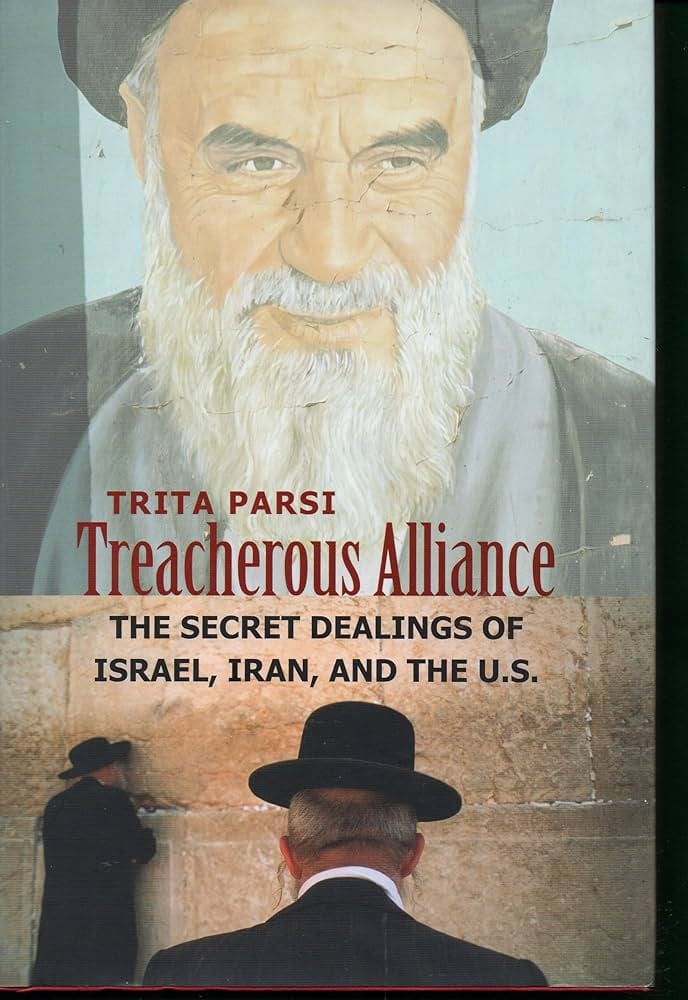
This award-winning study traces the shifting relations between Israel, Iran, and the U.S. since 1948—including secret alliances and treacherous acts. Vitriolic exchanges between the leaders of Iran and Israel are a disturbingly common feature of the news cycle. But the real roots of their enmity mystify Washington policymakers, leaving no promising pathways to stability. In Treacherous Alliance, U.S. foreign policy expert Trita Parsi untangles to complex and often duplicitous relationship among Israel, Iran, and the United States from 1948 to the present. In the process, he reveals shocking details of unsavory political maneuverings that have undermined Middle Eastern peace and disrupted U.S. foreign policy initiatives in the region. Parsi draws on his unique access to senior American, Iranian, and Israeli decision makers to present behind-the-scenes revelations that will surprise even the most knowledgeable readers: Iran’s prime minister asks Israel to assassinate Khomeini; Israel reaches out to Saddam Hussein after the Gulf War; the United States foils Iran’s plan to withdraw support from Hamas and Hezbollah; and more. Treacherous Alliance not only revises our understanding of the recent past, it also spells out a course for the future. An Arthur Ross Book Award Silver Medal Winner A Choice Magazine Outstanding Academic Title
My Summary
Main Ideas, Takeaways & Similarities
Questions
I. What is the problem?
A. How is this problem formulated?
B. Why is this problem important?
C. What is the history of this problem?
D. Which prominent personalities have been interested in this problem?
II. What solutions to the problem are there?
A. What are the conclusions reached?
B. By what argument(s) is the conclusion reached?
C. What facts or assumptions serve as premises?
D. When a prominent personality offers a solution, does he also argue for or against other prominent personalities? Does he raise objections to alternative solutions? Does he consider objections to his own solutions?
III. Evaluation
A. What are the advantages and disadvantages of the alternative formulations to the problem?
B. Has the importance or history of the problem ever been misrepresented?
C. Are the solutions logically related to the premises?
D. Are the facts true? Are the assumptions acceptable? Are the objections answerable?
AI Summary
Highlights
Attachment (file not included in this release)
Yes, that is a key component of the argument Trita Parsi makes in his book “Treacherous Alliance: The Secret Dealings of Israel, Iran, and the United States.”
Parsi’s thesis suggests that:
- The End of the Cold War Created a Void: With the collapse of the Soviet Union, a primary justification for the strong U.S.-Israel strategic alliance (countering Soviet influence in the Middle East) diminished.
- The Peace Process Shifted Dynamics: The Oslo Accords and the ongoing peace process with the Palestinians also led some in Israel to fear a potential decrease in Israel’s perceived strategic importance to the United States. If peace with Arab neighbors was achievable, the traditional “besieged state” narrative would hold less sway.
- “Islamic Fundamentalism” as a New Unifying Threat: Parsi argues that certain Israeli leaders and policymakers, notably from the Likud party under Yitzhak Shamir and later Benjamin Netanyahu, began to emphasize the threat of “Islamic fundamentalism” (with Iran often portrayed as its leading state sponsor) as a new common enemy for both Israel and the West, particularly the United States.
- New “Glue” for the Alliance: By highlighting this threat, Israel could present itself as an indispensable partner to the U.S. in combating a new global menace, thereby ensuring continued strong diplomatic, military, and financial support from Washington. This new framing would serve as the “new glue” to maintain and strengthen the alliance in the post-Cold War era.
Parsi details how this shift in Israeli strategic communication occurred, moving away from the Arab-Israeli conflict as the primary focus towards the threat posed by Iran and radical Islamist groups. He contends that this was a conscious strategic choice to redefine the terms of the U.S.-Israel relationship and secure its continuity.
Therefore, the idea that “Israel decided that they would use Islamic fundamentalism as the excuse for the alliance as new glue for the alliance between Israel and the U.S.” is an accurate representation of one of the central arguments presented in Trita Parsi’s “Treacherous Alliance.”
Counter Narrative:
Trita Parsi’s “Treacherous Alliance” presents a compelling narrative, but like any significant historical or geopolitical argument, it has faced counter-arguments and alternative interpretations. Here are some of the main lines of critique or differing perspectives:
-
Underestimation of Iranian Ideology and Genuine Threat:
- Counter-argument: Critics argue that Parsi downplays the role of the Islamic Republic’s revolutionary ideology, its deeply ingrained anti-Western and anti-Israeli stances, and its genuine commitment to exporting its revolution and supporting militant groups. They contend that Israel’s concerns were (and are) based on tangible threats, including:
- Iran’s hostile rhetoric (e.g., calls for Israel’s destruction)
- Active support for groups like Hezbollah and Hamas, which directly target Israel
- Iran’s pursuit of a nuclear program, which many in Israel and elsewhere view as an existential threat, regardless of strategic calculations
- They suggest Parsi overemphasizes a purely rationalist, geopolitical explanation, minimizing the ideological drivers of Iranian foreign policy.
- Counter-argument: Critics argue that Parsi downplays the role of the Islamic Republic’s revolutionary ideology, its deeply ingrained anti-Western and anti-Israeli stances, and its genuine commitment to exporting its revolution and supporting militant groups. They contend that Israel’s concerns were (and are) based on tangible threats, including:
-
Oversimplification of Israeli Motivations:
- Counter-argument: Some argue that Parsi’s thesis presents Israeli motivations as overly cynical and singular (i.e., solely focused on maintaining U.S. support). They contend that Israel’s foreign policy is complex and driven by a range of factors, including:
- Legitimate national security concerns in a volatile region.
- Historical experiences (including the Holocaust) that shape its threat perception, making it particularly sensitive to existential threats
- The genuine fear of a nuclear-armed Iran with a hostile ideology.
- Domestic political considerations and public opinion within Israel.
- Counter-argument: Some argue that Parsi’s thesis presents Israeli motivations as overly cynical and singular (i.e., solely focused on maintaining U.S. support). They contend that Israel’s foreign policy is complex and driven by a range of factors, including:
-
Alternative Explanations for Shifting Alliances:
- Counter-argument: The shift in the regional landscape was not solely an Israeli construct. Other factors contributed to the changing dynamics:
- Iran’s own actions and ambitions: Iran’s efforts to expand its influence, its support for Shia militias, and its challenges to the regional status quo naturally created friction with Israel and other U.S. allies.
- The end of the Iran-Iraq War: This removed a common enemy for both Israel and Iran (in some respects) and allowed their own rivalries to come to the fore.
- The First Gulf War (1991): The defeat of Saddam Hussein significantly altered the regional balance of power, leading to new strategic calculations by all actors, including Israel and Iran.
- Counter-argument: The shift in the regional landscape was not solely an Israeli construct. Other factors contributed to the changing dynamics:
-
The Role of the United States:
- Counter-argument: While Parsi focuses on Israel’s influence on U.S. policy, other perspectives highlight U.S. strategic interests as a primary driver. The U.S. had its own reasons for viewing Iran as a threat, including:
- The 1979 hostage crisis and the rupture in U.S.-Iran relations.
- Iran’s opposition to U.S. influence in the Middle East.
- Concerns about Iran’s nuclear program and its potential to destabilize the region and trigger proliferation
- Iran’s support for terrorism
- This view suggests that U.S. policy towards Iran was not merely a product of Israeli lobbying but also of independent American assessments and interests.
- Counter-argument: While Parsi focuses on Israel’s influence on U.S. policy, other perspectives highlight U.S. strategic interests as a primary driver. The U.S. had its own reasons for viewing Iran as a threat, including:
-
Methodological Criticisms:
- Counter-argument: Some critiques of Parsi’s work, like that from the Middle East Forum, point to a reliance on interviews that might be selective or difficult to verify, and suggest that Parsi’s own perspectives might influence his interpretation of events. They might also argue he downplays or misinterprets certain evidence, such as the nature of Iranian offers or the translation of inflammatory statements.
-
The “Chicken and Egg” Dilemma:
- Counter-argument: It’s difficult to definitively prove causality. Did Israel’s highlighting of the Iranian threat create the U.S. perception, or did Israel effectively articulate a threat that was already emerging and genuinely concerning to both nations for a variety of reasons? The relationship is likely complex and interactive.
In summary, counter-arguments often revolve around the idea that Parsi gives too much weight to Israel’s strategic manipulation and not enough to the genuine ideological motivations and threatening actions of Iran, the complexity of Israeli security concerns, and the independent strategic calculations of the United States. Critics suggest a more multi-causal explanation for the evolution of the Israel-Iran-U.S. dynamic.