Core idea
Deterrence may persuade an adversary that eliminating the other side is infeasible, creating a reason to negotiate. It cannot by itself determine a legitimate settlement, produce mutual recognition, solve distributional disputes, or prevent temporary force from becoming permanent domination.
Pinker’s supplement — why deterrence can stabilize and still remain brittle
Pinker calls the mutual-preemption problem the Hobbesian trap or security dilemma: even two actors that would prefer peace may each strike first if both fear the other will do so. Deterrence can reduce that incentive when each side credibly commits not to initiate and can survive long enough to retaliate. Yet the arrangement remains fragile because peace is being purchased through a threat of violence; perceived weakness, ambiguous defensive preparations, or a slight to reputation can trigger demonstrations of resolve and reciprocal escalation.
This strengthens the distinction in this note: deterrence may alter the expected payoff of attack, but it neither supplies agreed political terms nor makes the enforcer impartial. Application boundary: Pinker offers a general strategic model, not evidence that it explains every Israeli, Palestinian, or regional decision; any case application still requires actor-specific chronology and evidence. Chapter 2 synthesis · Hobbesian trap and deterrence, PDF pp. 66–68 (file not included in this release)
Pinker’s Chapter 10 supplement — deterrence changes one cell, while durable peace changes the game
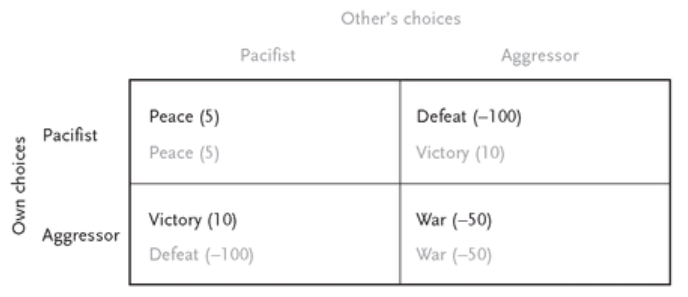
Figure 10-1 — The Pacifist’s Dilemma. Deterrence can raise the cost of attack and make unilateral aggression less attractive, but it leaves peace brittle when each side still fears the catastrophic “sucker” outcome of restraining itself alone. Pinker’s wider synthesis identifies additional changes: a trusted third party can adjudicate and penalize aggression; commerce can create gains that depend on the other side’s continued welfare; wider concern can give weight to the other’s losses; and impartial reasoning can build institutions that offer more choices than domination, retaliation, or capitulation.
Applied to Israel–Palestine, the framework sharpens this note’s distinction. An “iron wall” may affect whether victory by force appears possible, but it cannot by itself supply a legitimate border, reciprocal security, political agency, narrative recognition, or a credible institution for enforcing the bargain. Nor may a partisan sovereign simply be labeled the neutral Leviathan. Application boundary: Pinker calls the matrix a heuristic with arbitrary numbers, not a fitted model; this is a checklist of missing mechanisms, not proof of any actor’s motives or of a particular settlement. Chapter 10 synthesis · Pacifist’s Dilemma and model boundary, PDF pp. 929–931 (file not included in this release) · Leviathan and calibrated third-party power, PDF pp. 931–933 (file not included in this release) · Commerce, empathy, and reason, PDF pp. 934–945 (file not included in this release)
Jabotinsky’s mechanism
The 1923 iron-wall argument begins from a non-romantic premise: Palestinian Arabs were a native population and could not be expected voluntarily to accept Zionist majority-building. Jabotinsky proposed sufficient independent force to remove the expectation that resistance could stop the project; only then, he argued, could moderates negotiate practical guarantees.
The doctrine therefore contains both an entry condition and an intended exit condition:
- entry: rejection persists while victory remains plausible;
- wall: coercive capacity blocks that expected victory;
- exit: negotiation begins once permanent defeat is recognized;
- settlement: political rights and material terms still have to be agreed.
Why the transition can fail
- Each side can interpret defensive measures as proof of offensive intent.
- Leaders may prefer territorial, ideological, or domestic gains to the bargain deterrence supposedly enables.
- “Not yet a partner” can become an unfalsifiable reason to postpone compromise.
- Force changes facts and constituencies, sometimes making the eventual bargain harder.
- Formal equality inside one side’s preferred sovereignty may not answer the other side’s national claim.
Diagnostic questions
- What observable change would show that deterrence has succeeded?
- Which concessions become possible after success that were impossible before it?
- Is force preserving a negotiating position or expanding the desired end state?
- Can the other side obtain security, dignity, political agency, and a credible horizon through the proposed bargain?
- Which institution prevents emergency powers or territorial control from becoming permanent?
Interpretive boundary
This concept reconstructs a mechanism found in Jabotinsky and later historical arguments. It does not prove that every Israeli government followed one doctrine, that force was the only available strategy, or that later agreements validate the whole causal story.
Routes
- Primary argument and objections: The Iron Wall (Jabotinsky, 1923)
- Historical extension: The Iron Wall - Israel and the Arab World
- Negotiation record: Prophets without Honor · Peace Offers
- Writing: Peace Requires More Than an Iron Wall