Audience Reaction
- must gauge audience reaction to the original presentation of your opponent’s case
- If your opponent has been unsuccessful, the first thing you must do is pinpoint precisely those spots in his presentation that were the weakest and least successful with the audience. Then, concentrate most of your fire on these spots, thereby reinforcing in the minds of the audience the weakness of his position and your brilliance in sharing their perceptiveness. Here, you are combining a critique of the opposition with flattery of the audience. Next, when you feel that the audience is with you, you may proceed to employ the techniques and rules to be discussed below, and you may do so with humor and ridicule. Please note: humor and ridicule are effective against an opponent only if you know yourself to be preeminent in the eyes of the present audience. Otherwise you will offend all concerned.
- If Opponent is Unsuccessful:
Ad Hominem
- There are two occasions during a discussion when you may use it:
- either after you have demolished the argument by independent means or
- in those cases where your opponent’s argument has been so unsuccessful with the audience that it is not worth demolishing.
- If you can win without using a technique, do not use it. You may distract both yourself and the audience.
Genetic Fallacy
- most sophisticated form of ad hominem is a special counterargument itself
- To explain genetically is to describe the origin of an event, a process, a thing, or what have you. It is a kind of historical account of how things got that way
- useful in undermining an opponent
- Examples:
- The contempt of the business world for the academic world is explained as the awareness that “those who can, do; those who cannot, teach.”
- We come now to the second possibility, namely, where the audience is still undecided. Here you should avoid using most of the techniques mentioned above. Instead you should once more try to discover which points in your opponent’s presentation were strongest and which were weakest. If you can combat the strong ones, then do so; if not, simply act as if they were never mentioned. In any case, the weak points should be exploited.
- The third possibility is what to do if your opponent has been successful. To begin with, moral posturing calculated to shame your opponent and audience is very effective when you are the obvious underdog in a dispute. Now, if your opponent’s success is owing to his use of techniques of deception, such as those we are discussing, you can probably win points by exposing this fact and accusing him (more or less gently) of being a trickster.
- Most audiences immediately dislike someone who seems impressed with his ability to argue, so avoid looking oppressively flashy or pleased with your incisiveness or wit. Strive to look like a slightly wounded, unjustly used underdog, but again, don’t overdo it. Know your audience!
Anatomy of Refutation
Open: Screenshot 2024-07-22 at 7.45.30 PM.png
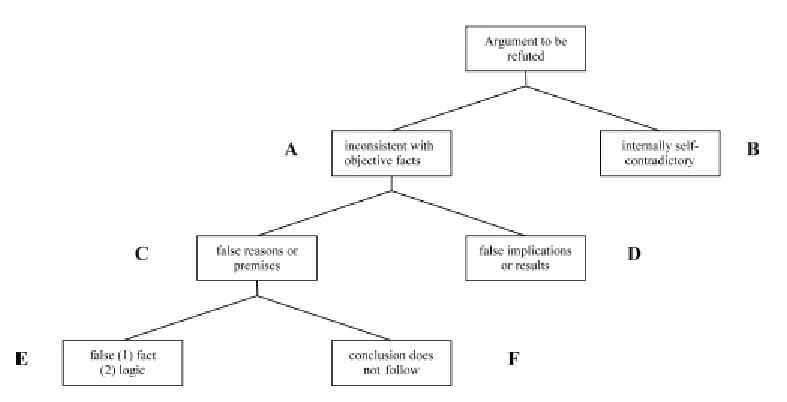
- When attacking an argument, we are claiming one of two things or perhaps both: an argument is defective (1) when the evidence contradicts the conclusion or (2) when the evidence is simply false or inadequate.
- A: An argument may be inconsistent with objective fact when either the premises or reasons appealed to are simply false (C ) or the implications or results of the conclusion would be considered false(D ).
- C: Reasons or premises are false or unacceptable either when the conclusion does not follow (F ) or when we can simply show the premises to be false (E ). In the case of F, we say the argument is a non sequitur. This differs from the case of B because in B we have a contradiction, whereas in the case of F, there is no connection at all.
- E: A reason or premise can be seen to be false in either a direct or an indirect way. In a direct way, if someone claims that it is raining, we might directly show that he is wrong by looking outside. A reason or promise may be shown to be false indirectly in a number of ways.
- The first way of attacking this premise is (1) to add another premise that is known to be true and (2) then derive a false conclusion.
- The second way of attacking this premise is to derive another conclusion that would be inconsistent with the given conclusion or some other conclusion that your opponent may draw
- F : A third general method of attacking this premise is to show that it is a generalization with known exceptions, hence it is unacceptable.
- We overlook facts when we fail to note that there are exceptions to certain rules, when we use one rule in a situation in which another rule is more applicable, when we engage in sweeping generalizations (and claim that what is true in some cases is true in all cases), when we make hasty generalizations (insufficient basis for a generalization), or when we insufficiently bifurcate an issue.
- We evade facts in our assumptions when we beg the question (i.e., reasserting our original position instead of supplying additional support), when we engage in special pleading, or when we are guilty of the fallacy of the complex question (i.e., argue a different issue).
- We distort facts in our assumptions when we use false and misleading analogies (“register all matches and prevent forest fires”), when we identify false causes (e.g., all wars between 1901 and 1980 fought by the United States were under Democratic administrations), or when we propose an irrelevant thesis as a red herring
Refutation of Pity Appeals
- refutation follows one of two patterns: either we invoke a higher order appeal of the same nature, or we attempt to turn the tables.
- If your opponent has appealed to pity, then you should act as if his example of pity is a general premise. Then add some premise of your own that you think would be accepted by the audience and derive a conclusion that is inconsistent with that of your opponent.
- Examples:
- suppose your opponent has argued that we should destroy all atomic weapons, and has begun his argument with a detailed survey of the consequences of Hiroshima. Further, we suppose the appeal to pity to have been an effective one. The audience obviously feels pity for those who suffer. The only way to counter this appeal is to point out that if America had not possessed or used atomic weapons on Japan (as your opponent argues), and if the war had had to be concluded by an invasion of the Japanese islands, then (adding the supplementary premise) by the best estimates, the casualties on both sides, including military and civilian, would have been astronomical. Now add: How many Japanese and American children and their parents and grandparents are alive because of that courageous decision to drop the bomb? The use of atomic weapons actually minimized suffering
Refutation of Authority
- either by an ad hominem attack on his specific authorities, or by providing counter-authorities. Further, there are at least six kinds of ad hominem attacks upon an authority
- If a man is quoted as an authority and at the same time is known to have opinions that are inconsistent with the appeals to pity, ad populum, or precedent used by your opponent, then you should pounce upon this inconsistency
- if the alleged expert belongs to a group or espouses a cause to which you know the audience is opposed or hostile, then undermine the authority by the use of guilt by association
- an expert may be undermined by pointing out the distinction between theory and practice
- any authority who deals with extreme abstractions can be undermined by stressing the distinction between theory and fact
- last-ditch tactic against any expert, y ou should engage in a general attack on all expertise
- First, if you feel that you have been successful in undermining the audience’s confidence in your opponent’s experts, then introduce your own experts who will support your case. Second, if you had to use the fifth method outlined above—a general critique of all authority and expertise—then introduce counterexperts not necessarily as supports for your case but simply for effect. Surely if all these experts disagree, what is the use of using experts at all! Ridicule is the final weapon here
Refutation of Ad Populum
- Ad populum appeals by definition are meant to be popular
- The major ploy against them is to invoke another ad populum claim that supports your case and/or goes against the case of your opponent, one that you think might have an even greater appeal
- A second way of attacking your opponent’s use of the ad populum appeal, which should be used only if you cannot think of an effective counter ad populum appeal, is engage in a general attack on ad populum appeals. You must point out to your audience the extent to which what most people accept is wrong. You can drive this point home by giving examples, such as the fact that many people once believed that the earth was flat, and surely the majority opinion here was wrong.
Refutation of Precedent
- invoke and extend a counterprecedent
- show that it does not apply to the case at hand because of the presence of extenuating circumstances or significant differences.
- show what happens when a precedent is extended to its extreme
Refutation of Statistics
- claim that it is not a random sample (i.e., that the sample is biased or unrepresentative)
- The trick to use here is to declare, no matter what, that your opponent’s statistics are not based upon a random sample. Find a factor, any factor, and claim that the factor is crucial and has been overlooked. Here a little ingenuity will be required on your part. Keep searching until you find some factor that has been overlooked, regardless of whether it is really important, and keep harping on it.
- Is the sample representative in time? space? economically? geographically? sex? age?
- In short, an infinite number of possibilities might be relevant and, therefore, might be exploited. Needless to add, if you are aware of some factor that has been ignored and to which you know your audience is sympathetic, then pounce on that one.
- present a different set of statistics, one that controverts the original set
- An especially important kind of counterstatistic is not one that contradicts the original set (your poll shows Smith is leading, your opponent’s poll shows that Jones is leading) but one that supplements the original set in such a way that a different conclusion must be drawn
- When presenting counterstatistics, you may be able to supplement them by an ad hominem argument as well. For example, if your opponent did not know about the existence of the counterstatistics, then you may imply that he is a fool who has not carefully researched his case. This tends to undermine the confidence of the audience in the rest of his argument as well. If your opponent is aware of the counterstatistics and he did not mention them, then you may imply that he is a scoundrel (or worse, a liar) who is deceiving the audience by suppressing relevant information. Since nobody can present every piece of information, you can always use this technique. If you are sure that the audience is with you, keep asking as a rhetorical question, “Why wasn’t this information mentioned?”
- If you cannot find a flaw in your opponent’s statistics and if you cannot present counterstatistics, then you must engage in a general attack on the use of statistics itself. You can do this by first mentioning to your audience that every sophisticated person knows that statistical information may be misused. This is true. You then exemplify some cases of how statistics are misused.
Refutation of Theoretical Constructs
- Most people distrust abstractions
- you must first point out that such abstractions exist.
- For example, if your opponent analyzes the behavior or motivation of someone in terms of the Freudian unconscious or subconscious, you must point out that these are abstract terms. Second, no abstract term, by definition, can refer to one or more things that are directly observable. This is where audience distrust is to be exploited. Point out how impossible it is to identify the unconscious, thereby giving the impression that the thing really does not exist.
Refutation of Classification
- find an exception
- Exceptions are of two kinds: something that does not fit at all or something that fits in more than one place
Refutation of Definition
- First, you should point out that the definition he used is nonstandard. If your audience is annoyed by nonstandard definitions, then engage in a supplementary ad hominem at once. Either he is a fool who does not know what words mean, or he is a scoundrel trying to put one over on everybody.
- If mere exposure does not work, then try a second kind of attack. Usually an odd definition is an attempt to make something true by definition. If this is so, then expose your opponent as offering a circular argument or petitio principii.
Refutation of Analogies
- Literal Analogy
- one argues that similarities in several crucial respects imply similarity in some other respect. Since all analogies can be only partial, the refutation of a literal analogy depends upon finding one or more features that differ between the two things being compared and to press the point that this difference, or these differences, become crucial.
- Show your opponent either that there are grave dissimilarities
- or that there are weaknesses in the similarities. It is more difficult to do the latter
Attacking the Conclusion
- make your audience realize that you have exposed cracks in the brittle structure offered by your opponent. So you should begin by offering a general characterization of your opponent’s argument.
- Summarize what you take to be the case of your opponent, but in order to clarify the case for the audience, you should engage in a little translation so as to put that case in as bad a light as possible
- you should be as picayune as possible by picking on his actual words rather than his meaning.
- in offering a general characterization of someone else’s argument, you should dismiss it or categorize it emotively in terms of some generally known position that is rejected by your audience. Thus, with some audiences, an entire position might be dismissed as Marxist malarkey, outmoded idealism, old-fashioned liberalism, racist, or irrelevant.
- After a general characterization of the argument, you should attack the route taken by your opponent to his conclusion. Here, you are criticizing the means he used to go from the evidence to the conclusion. Whether or not he is guilty of them, you can accuse him of certain traditional formal fallacies.
Hasty Generalization
- If your opponent has used statistical information or particular facts of any kind to arrive at a generalization, then you should claim that the generalization was too hasty.
- Either you provide evidence of an exception to his generalization, or you argue that he did not examine enough cases, even if you cannot think of a counterinstance.
Composition
- The fallacy of composition is another instance of an error of arguing from individual cases to a general case or to a whole.
- You may accuse your opponent of the fallacy of composition whenever he implies that a whole has (or does not have) a property because the parts have (or do not have) it.
Division
- The fallacy of division is that of believing some property of a whole to be automatically a property of every part of that whole.
Accident
- one mistakenly applies a general principle to a specific case without realizing that the circumstances (accidents) of the individual case make the general principle inapplicable
- When accusing someone of the fallacy of accident, one could argue that what he is really saying is that one general principle takes precedence over another general principle. Thus he is accusing his opponent of not clearly seeing the real problem at hand.
Characterizing the Conclusion (Dilemma)
- The only test of a conclusion or principle is to extend it to the extreme in order to see how well it works. Thus whenever your opponent gives his conclusion, assume that he means it to be a general principle
- criticize it for not achieving some other function or goal
- directly is to treat your opponent’s conclusion as contrary and not as contradictory.
- One of the best ways of concluding a refutation of someone else’s argument is to offer a dilemma.
- If…S1…, then…S2…; and If…S3…, then…S4… S1 or S3 Therefore, S2 or S4.
- If men are good, then gun-control laws are not necessary, and if men are bad, gun-control laws will not be effective. Men are either good or bad. Therefore, gun-control laws are either not necessary or not effective.
- The dilemma is an effective weapon because it leaves the impression that your opponent’s case leads only to undesirable consequences. Since the dilemma has a standard pattern, there is no challenge in constructing it. However, it is always the case that some dilemmas are better than others. The most effective ones are built from points you have already made
- in the structure, you should try to argue the relationship between S1 and S2 or the relationship between S3 and S4 in the earlier part of your attack. If they seem to be successful, then you may use them in the dilemma. This technique has a way of reinforcing your whole argument in the minds of the audience. Moreover, S1 and S3 should form a dichotomy that you think your audience will accept.
- If…S1…, then…S2…; and If…S3…, then…S4… S1 or S3 Therefore, S2 or S4.
Nonverbal Devices
- divert the audience’s attention from your opponent while he is presenting his case
Face-To-Face Debate
Questioning
- major aim is to elicit a contradiction.
- The next-best thing is to point out, if possible, a contradiction or inconsistency between the spoken word and behavior
- If you cannot elicit the contradiction in a formal or an informal way, proceed next to try to get your opponent to become angry
- Another way of obtaining an answer you want is to ask a loaded or complex question, a question so phrased that any answer given is incriminating. Actually, a complex question is really several questions in one.
Answering
- Just as the major objective of the person asking the questions is to expose a contradiction, so the major objective of the person answering the questions is to avoid a contradiction
- If you discover the ultimate contradiction toward which your opponent is leading you, quickly change the subject or try to move on a tangent and thus lead the discussion away from that issue
- If the discussion turns on some crucial matter of fact, which if answered will lead to a contradiction, then instead of denying its truth (which might prove embarrassing if you are wrong), you may do better simply to declare that you are an incompetent judge on that subject and refrain from expressing an opinion. Usually it is not good form to admit ignorance, but in such cases it is often more important to avoid stepping into a contradiction.
- When confronted by the charge of a lack of clarity, you should reply along the following lines: “Please excuse me (ironic politeness), but with your great intellect, it should be easy to understand anything. It must be my poor judgment of the issue.”