
⬅️ Hub: Argumentation

DESCRIPTION
“In our current political climate, it seems impossible to have a reasonable conversation with anyone who has a different opinion. Whether you’re online, in a classroom, an office, a town hall — or just hoping to get through a family dinner with a stubborn relative — dialogue shuts down when perspectives clash. Heated debates often lead to insults and shaming, blocking any possibility of productive discourse. Everyone seems to be on a hair trigger. In How to Have Impossible Conversations, Peter Boghossian and James Lindsay guide you through the straightforward, practical, conversational techniques necessary for every successful conversation — whether the issue is climate change, religious faith, gender identity, race, poverty, immigration, or gun control. Boghossian and Lindsay teach the subtle art of instilling doubts and opening minds. They cover everything from learning the fundamentals for good conversations to achieving expert-level techniques to deal with hardliners and extremists. This book is the manual everyone needs to foster a climate of civility, connection, and empathy.”—provided by Amazon.com.
Attachment (file not included in this release)
Chapter 1 — When Conversations Seem Impossible (Summary)
- What the book is trying to solve: The authors frame the book as a practical guide for communicating with people who hold radically different beliefs in a polarized era where people increasingly avoid frank discussion—leading to fear of speaking honestly, inability to solve shared problems, and damaged relationships.
- Opening vignette (a failure case): Boghossian recounts a heated argument about affirmative action with a colleague (“SDL”) that deteriorates because he’s more focused on winning than understanding—interrupting, shifting topics, not answering questions, and implicitly trying to embarrass her. The chapter uses this as a cautionary example of how a conversation can be “lost” even when the other person is initially willing to engage.
- Why these conversations feel harder now: The authors argue that today’s conversational environment is more fractured and hostile than it was even decades ago, with ideological camps treating opponents as existential threats and everyday settings (family dinners, social media) becoming battlegrounds—prompting many people to avoid contentious topics as a coping strategy.
- What an “impossible conversation” is (and isn’t): “Impossible” doesn’t mean literally impossible. It means a discussion that feels futile because of a seemingly unbridgeable gulf in beliefs or values. They distinguish this from situations where someone refuses to speak or is violent/threatening—cases where there is no conversation to have (and which they say are rare).
- The core obstacle: The problem is often not getting someone to talk, but that they “talk at you” rather than with you—treating you as a container to fill or an enemy to defeat, which makes real give-and-take seem hopeless.
- Why bother having these conversations: Beliefs drive behavior and politics; people act (and vote) based on what they believe, even when those beliefs are mistaken. So changing how we talk about beliefs matters socially and personally.
- Conversation vs. force: The authors argue beliefs can change, and conversation is one of the best tools for change, while force is both morally bad and practically ineffective (they emphasize that violence doesn’t persuade people). They also describe conversation as inherently collaborative—something done with someone—which can create room for reconsideration on both sides.
- Their proposed response: Treat “impossible conversations” as a learnable skill and habit: speak up, don’t fear disagreement, ask questions, and aim to engage in ways that reduce defensiveness and loosen people’s grip on their beliefs—using “proven, evidence-based techniques.”
- What the rest of the book will deliver and how to use it: They preview a toolkit of 36 techniques drawn from applied epistemology, negotiation, cult-exiting, psychology, and related areas, organized by difficulty (fundamentals → master). The book includes streamlined templates and real conversation vignettes, and they recommend reading sequentially and practicing techniques in real conversations rather than skimming ahead.
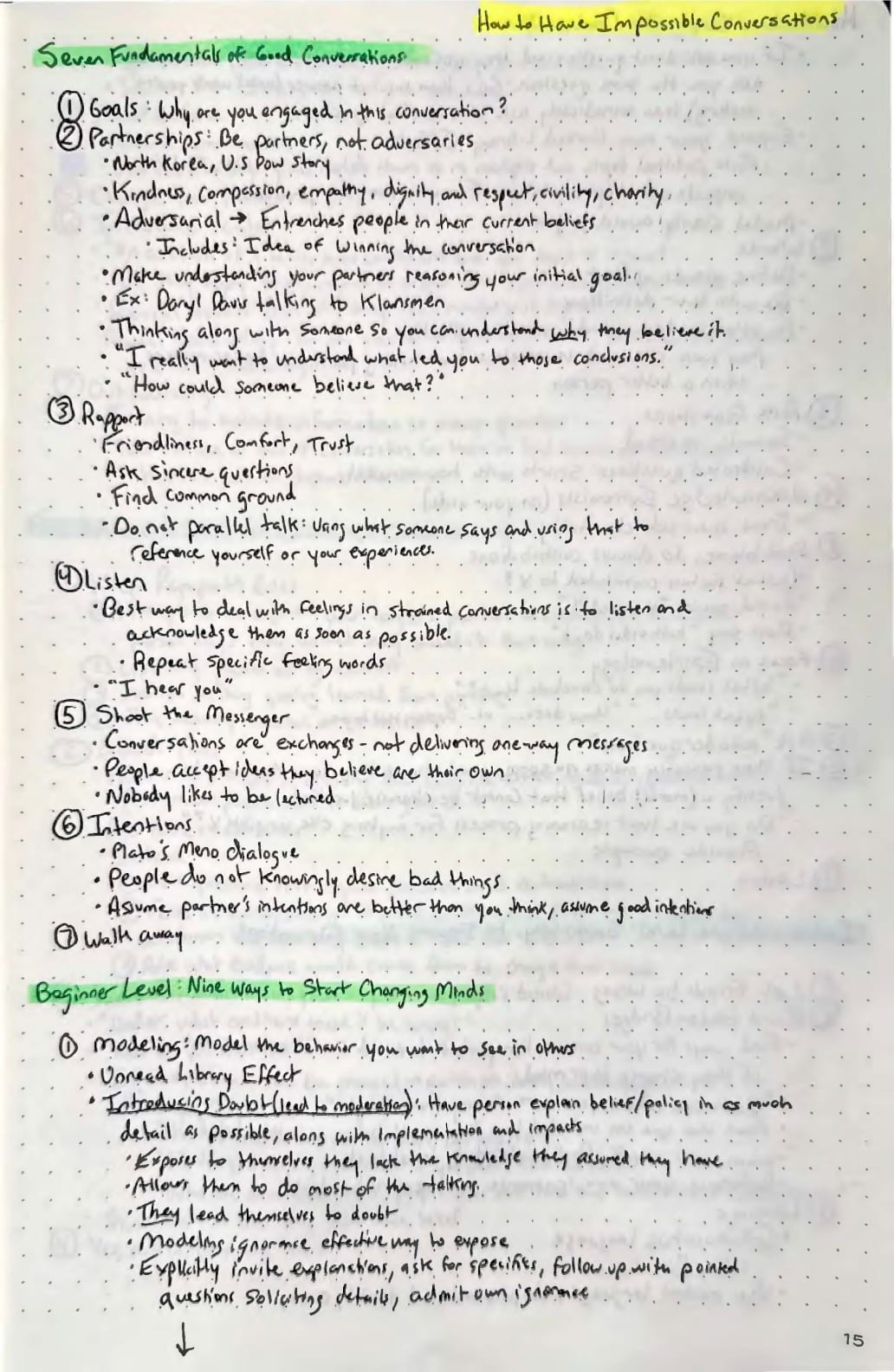
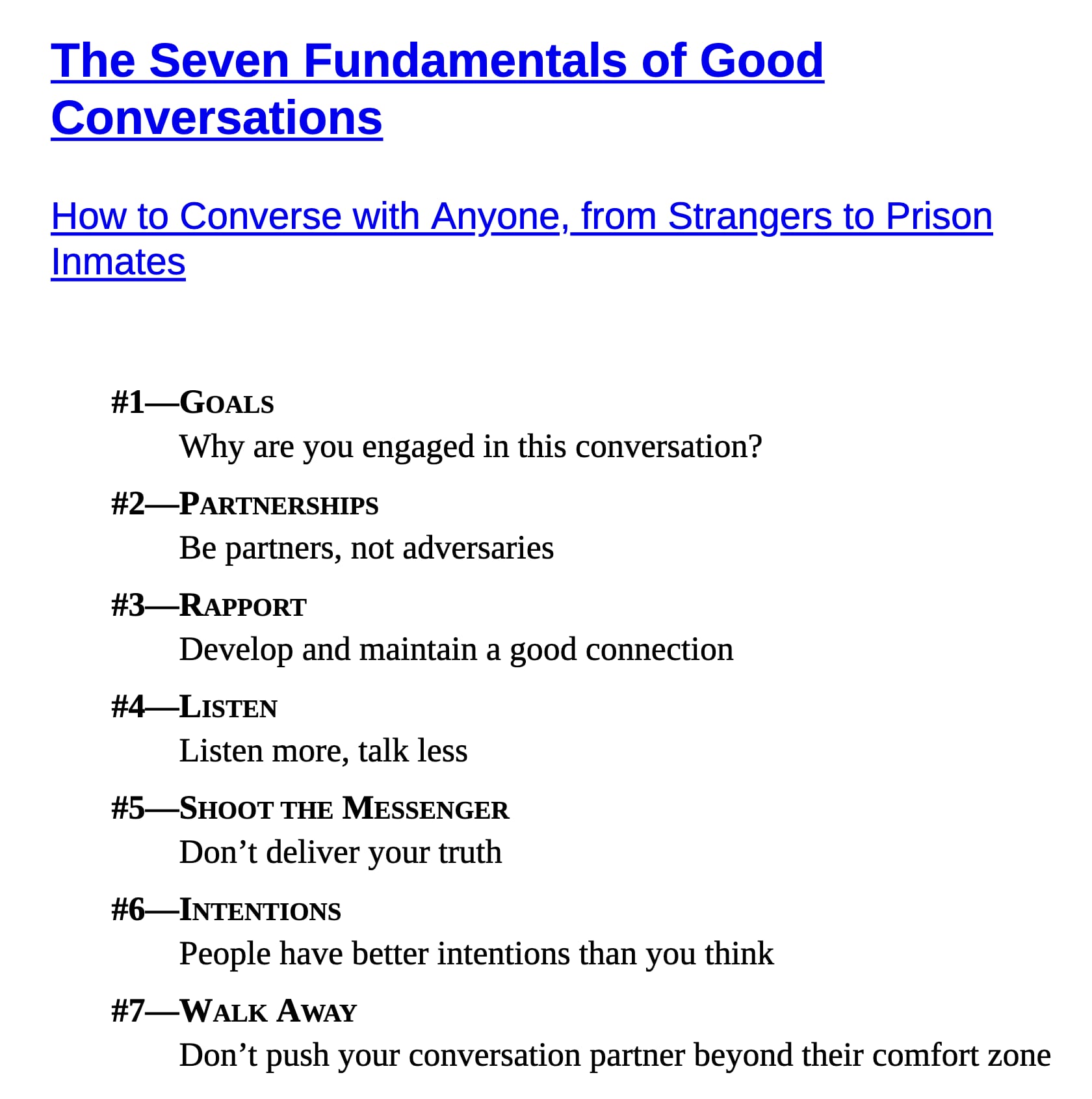
Chapter 2 — The Seven Fundamentals of Good Conversations (Summary)
Chapter 2 argues that productive, civil conversations are a learnable skill, and that virtually all “hard” discussions improve dramatically if you master a set of fundamentals first. The unifying theme is simple: treat the other person as a partner rather than an adversary; everything else in the toolkit works better once that partnership mindset is in place.
1) Goals — Know why you’re talking
People enter conversations for different purposes: mutual understanding, learning how someone arrived at a view, finding truth, intervening to change a belief, impressing an audience, or even talking under social pressure. The authors’ advice is to identify your goal(s) early (“Why am I having this discussion?”) and choose your approach accordingly, including being willing to shift goals midstream if needed.
2) Partnerships — Shift from “winning” to “understanding”
The chapter’s centerpiece is that mind-changing and relationship-preserving conversations are built on kindness, empathy, respect, and psychological safety—not adversarial tactics. They illustrate this with a POW research story: prisoners trained to see captors as “barbarians” were more likely to defect when shown kindness, because kindness destabilized the hostile narrative they’d been given. Practically, the authors say the key move is to abandon the goal of winning and make understanding the other person’s reasoning your initial aim.
They emphasize that treating someone as a partner does not mean endorsing their conclusions; it means understanding how they got there, creating space where either person might revise their thinking. They also stress that you can only control your side of the interaction—so you may need to initiate partnership behavior even if the other person doesn’t.
Concrete partnership practices include: stating your collaborative intent out loud, giving the other person permission to decline or stop, and asking yourself “How could someone believe that?” with genuine curiosity rather than contempt.
3) Rapport — Build friendliness and trust before substance
Rapport is described as the friendly connection that makes people less defensive and more open. The chapter uses a short Street Epistemology example (Anthony Magnabosco chatting with “Kari”) to show how a couple minutes of warm, ordinary interaction can create enough comfort to discuss personal beliefs. The authors advise starting with sincere, everyday questions; finding common ground; and remembering that maintaining rapport—especially with friends—should outrank scoring points.
They list practical rapport rules: don’t begin with controversy, avoid “parallel talk” (turning their story into yours), don’t “hit and run” serious topics if you don’t have time, be ready to change the subject, avoid harsh call-outs except for serious abuse, and default to courtesy (please/thank you; appreciate disagreement).
4) Listen — Make understanding possible
Listening is presented as the keystone skill: without it, you can’t understand, and without understanding there is no real conversation. They give best practices like yielding conversational “right of way,” facing the person and showing attention, not finishing sentences, allowing pauses, placing the burden of understanding on yourself (“I’m not sure I understand—can you explain?”), mirroring emotion-words to acknowledge feelings, and avoiding your phone.
5) Shoot the messenger — Don’t “deliver your truth”
A major warning: message-delivery (lecturing) tends to fail, even when the content is good. They cite classic social-science work (Kurt Lewin): housewives who self-generated reasons to cook organ meats during WWII adopted the behavior far more than those who were lectured—suggesting people resist being “told” and accept ideas they experience as their own. So the chapter urges you to notice when you’re slipping into “If they just understood this…” mode, avoid trading lectures, and return to questions and collaboration. Share your view only when explicitly invited, keep it brief, then hand the floor back.
6) Intentions — Assume better motives than you think
Drawing on Plato’s Meno, the authors argue people generally pursue what they believe is good, given the information and framework they have. In disagreements, we often assume the other side is malicious (racist, unpatriotic, indifferent to suffering, etc.), but those assumptions are usually wrong and poison listening. The practical rule: if you must assume something, assume their intentions are better than you think; shift to curiosity; and when motives become a sticking point, redirect to reasoning (“I don’t want to be wrong any longer than I have to be—tell me what’s wrong with my reasoning”). They note trolls/psychopaths as exceptions.
7) Walk away — End before you push past comfort
Finally, the chapter stresses that knowing when to stop is a skill: pushing past someone’s comfort threshold makes them defensive and can damage rapport, even when the conversation started well. They illustrate with an anecdote about trying to convert a Lakers fan—instilling doubt worked briefly, but pushing for a new allegiance triggered doubling-down. Their guidance: end if frustration becomes your dominant emotion, slow down and breathe first, respect requests to stop, and consider it a good time to end when you’ve sparked doubt—because people need space to reflect without you filling that vulnerability with your own beliefs. Always try to close on a positive, courteous note.
Chapter takeaway: If you only learn these seven fundamentals—clear goals, partnership posture, rapport, real listening, avoiding lecture-mode, charitable assumptions about intentions, and graceful exits—you’ll dramatically improve most conversations and build the foundation for the more advanced techniques later in the book.
Chapter 3 — Beginner Level: Nine Ways to Start Changing Minds
What this chapter is trying to do
Chapter 3 introduces “interventions”—ways to intercede in how someone forms beliefs so they become less confident, which is where real mind-changing starts. The authors argue that delivering your own message + “compelling facts” often backfires, hardening the other person’s confidence instead of loosening it, so the better tools are subtler and oriented toward helping the other person generate doubt from within.
The chapter then lays out nine beginner techniques: Modeling, Words, Ask Questions, Acknowledge Extremists, Social Media, Contributions (not blame), Epistemology, Learn (learning frame), and Reverse Applications (what not to do).
1) Modeling (model the behavior you want)
The core idea: people mirror conversational behavior. If you want direct answers, answer directly; if you want listening, listen first; if you want openness, show openness to revising your own view; if you want civility, be civil.
The authors illustrate this with a live exchange where one party keeps deflecting a direct moral question (“Should women be stoned to death for adultery?”). Boghossian forces clarity by modeling: “Ask me that question,” answers plainly, then repeats the question—creating a standard of directness the other person must match.
A related theme is that modeling includes admitting “I don’t know” when you don’t know, which is tied to the chapter’s emphasis on intellectual humility.
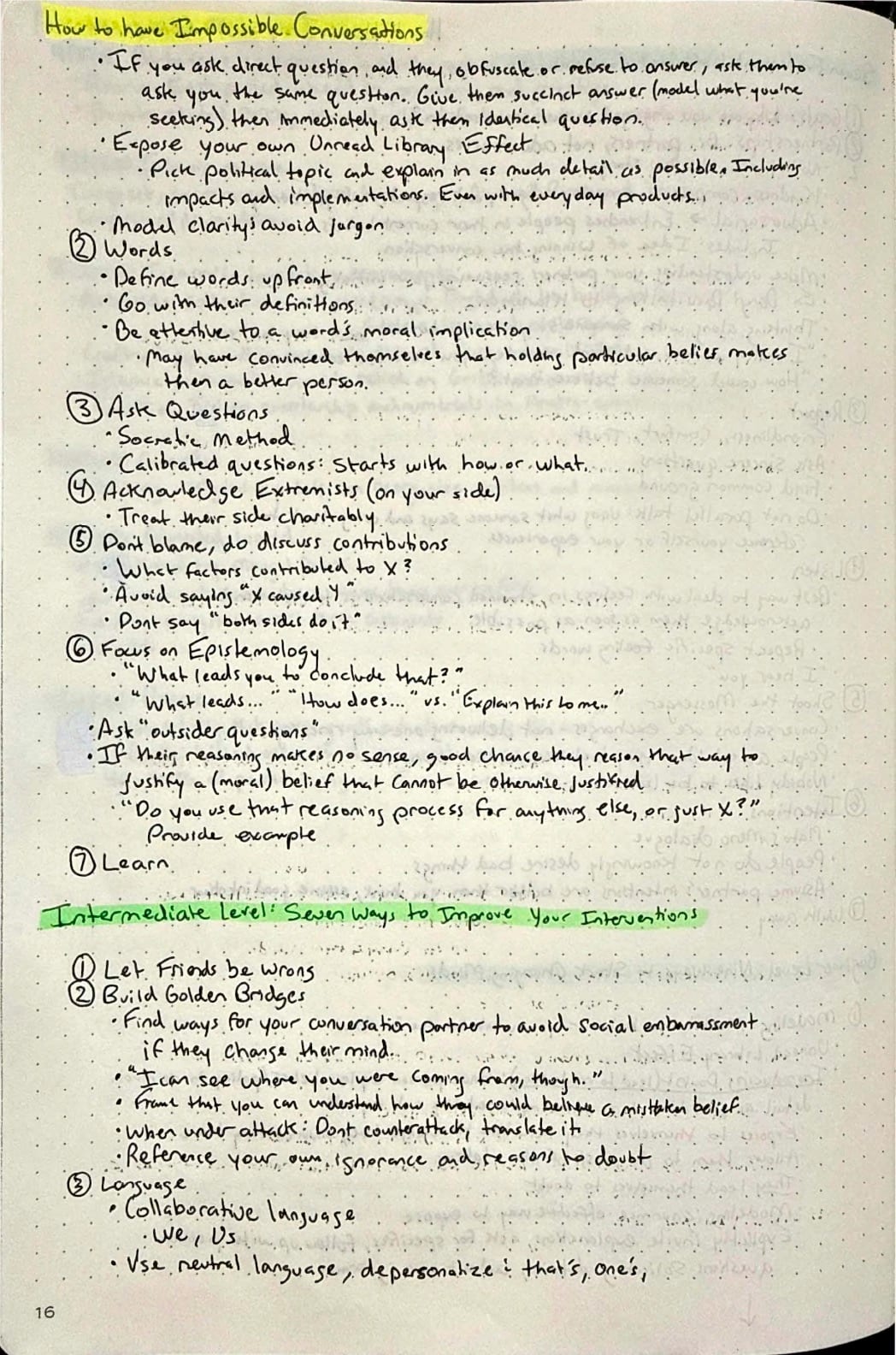
2) Words (define terms up front)
The authors treat many disagreements as word problems: people talk past each other because they attach different meanings and moral weight to the same terms. They argue that beliefs are “made out of words,” and unless you align on meaning you’ll fight shadows.
Key moves:
- Define terms early and treat “what do you mean by X?” as a normal step, not a derailment.
- Notice that definitions often carry moral implication, and that’s where heat comes from.
- They use the example of terms like “diversity” and “inclusion” becoming flashpoints where people assume hidden intent; the remedy is to slow down and clarify meaning rather than immediately litigating motives.
3) Ask questions (focus on one specific question)
This chapter pushes you away from speeches and toward question-driven exploration—keeping the conversation anchored to a single, clear question rather than bouncing between claims.
A highlighted tool is “calibrated questions”—open-ended how/what questions (developed in negotiation contexts) that invite explanation rather than yes/no defense.
They also recommend “outsider” style questions that gently probe reasoning without sounding accusatory—questions that create space for the other person to articulate their chain of thought.
4) Acknowledge extremists (build camaraderie by disavowing your side’s worst)
A major beginner move for cross-tribal conversations: if the other person thinks you represent a hated “side,” you can reduce defensiveness by explicitly acknowledging bad actors or bad behavior on “your side.”
The chapter includes a concrete “How to Disavow” pattern: you state clearly that you disavow bigotry and conspiratorial blame, and you do it in plain language that signals “I’m not here to excuse monsters.”
Purpose: not moral grandstanding, but rapport—making it possible for the other person to stop treating you as an avatar of their enemy and start treating you as a person.
5) Navigating social media (don’t vent; don’t turn yourself into a caricature)
The authors argue that social platforms are structurally bad for high-stakes moral/political disagreement and recommend minimizing engagement—especially on platforms where engagement is publicly broadcast.
They give blunt “pressure-release” advice: if you truly cannot control the urge to rage-post, do it anonymously into the void rather than escalating public conflict with tags and pile-ons.
(Their broader point is: public venting makes you look extreme, invites performative retaliation, and poisons future offline conversations.)
6) Don’t blame; discuss contributions (shift from accusation to shared causal analysis)
Blame, they argue, is a conversation-killer: it ends goodwill, triggers defensiveness, and invites “whataboutery” and retaliation.
Their alternative is to invite people to collaboratively look for contributing factors rather than assigning single-cause guilt.
They use the 2016 U.S. election as an example: people rushed to blame everyone else; the result was not insight or bridge-building but deeper tribal entrenchment. The “contributions” framing pushes people toward multi-causal thinking and away from moral prosecution.
7) Focus on epistemology (how they know what they claim to know)
This is the chapter’s centerpiece: to change minds, you have to understand the process that generated the belief—what counts as evidence, how conclusions were reached, what would move the person.
They define epistemology in this practical sense as the methods a person uses to justify beliefs and recommend repeatedly asking questions like “How do you know that?” or “How did you arrive at that conclusion?”
8) Learn (shift into a “learning frame” when persuasion is failing)
When civility or productivity is breaking down, the authors recommend an explicit switch: stop trying to persuade and try to learn—especially learn the other person’s epistemology.
They call learning an “emergency exit” for situations like tense family gatherings: you adopt the mindset that you’re studying how someone forms beliefs and you ask sincere questions to understand assumptions, experiences, and methods.
They even give simple “learning-frame” scripts like saying “I want to learn” and asking what more the person can tell you, with the warning that it only works if it’s genuine.
9) What not to do (reverse applications)
The chapter closes with a blunt list of behaviors that reliably wreck conversations—basically a checklist of how to sabotage rapport and truth-seeking.
Examples include:
- Being uncivil, angry, or talking over people
- Ridicule, blame, and attacking the person rather than the belief
- Pretending you know what you don’t know; failing to say “I don’t know”
- Focusing on conclusions rather than how the conclusion is known (epistemology)
- Obfuscating, “delivering messages,” interrupting, bullying, checking your phone, name-dropping, bragging
Conclusion of the chapter
The authors state explicitly that the most important skill here is learning how people know what they claim to know; the other techniques mainly serve to make that epistemic investigation possible. When things fail, switch to learning mode, be explicit, and use calibrated questions to ask for help understanding their “how.”
Chapter 4 — Intermediate Level: Seven Ways to Improve Your Interventions (pp. 76–98)
Chapter 4 argues that changing minds (including your own) requires more finesse than basic “good conversation” skills: you have to manage emotions (your impulse to correct, defend, gloat, or retaliate) while also exercising judgment about how to move a discussion forward. These “intervention techniques” are meant to help you safely nudge someone’s cognition toward doubt, revision, or clearer thinking, and they work best when integrated with earlier fundamentals (especially listening and focusing on epistemology).
1) Let friends be wrong
The authors’ first principle is: don’t make relationships hinge on agreement. They argue that deep relationships are built more on dependability, kindness, honesty, empathy, mutual goodwill, and shared life than on political/religious alignment—and that “being right” is rarely worth the relational damage. They use Peter Boghossian’s friendship with Phil Vischer (VeggieTales creator) to illustrate that close relationships can survive even profound worldview differences.
Key idea: Differences of opinion (even moral ones) aren’t automatically moral failings; people arrive at beliefs through culture, experience, ignorance, or reasoning errors—so correcting them aggressively often misfires and corrodes trust.
Practical guidance:
- Lead with listening: “I hear you,” and let them speak without interruption—especially on contentious topics—because it lowers tension and builds trust.
- If you don’t understand, put it on yourself: “I don’t understand,” rather than “you’re not making sense.”
- If a belief truly is a deal-breaker, address it privately and sincerely, motivated by concern rather than winning; be kind even if it ends the relationship.
- Remember the counseling line: “You can be right or you can be married.” In many cases, choose relationship over victory.
2) Build “Golden Bridges” (help them change without humiliation)
A Golden Bridge is an “exit ramp” that lets someone revise a belief without social embarrassment—because many people won’t admit error if humiliation is the price.
The chapter stresses this is especially crucial when a belief is tied to moral identity (“I’m a good person”)—for example, conceding error about vaccines can feel like admitting reckless parenting, so the psychological cost is high.
How Golden Bridges look in practice:
- Normalize fallibility (“Everyone makes mistakes,” “This is complicated,” “No worries”) so changing one’s mind feels safe rather than shameful.
- Don’t charge a toll: if they cross the bridge, don’t punish them with “I told you so” or “It’s about time.”
- Do not shame (the chapter compares shaming to a “hand grenade” that destroys bridges, citing the Harvard Negotiation Project).
- When personally attacked, translate the attack into shared concerns and pivot to problem-solving (example: reframing a gun-control accusation into mutual concern for children’s safety, then asking how to solve it).
- Use agreement strategically (“We have more in common than we thought”) to shift from adversarial posture to collaboration.
- Sometimes a Golden Bridge is simply making room for uncertainty: “No one is expected to know everything; that’s why we can appeal to experts,” which can open the door to outsourcing later.
- You can also offer face-saving by referencing your own revisions (“I used to believe X… then I learned A… and changed my mind”), but the chapter warns it can sound like a slight if delivered poorly.
3) Language: depersonalize and collaborate
This section draws on hostage negotiation examples (Justin P. Borowsky) to show how language can create a sense of “we’re working together” even under tension—e.g., aligning negotiator + hostage-taker against “them” (superiors) to keep negotiation alive.
Core technique: avoid making the conversation about the person (which triggers defensiveness).
- Depersonalize: say “that” not “you”—“that belief/statement” instead of “your belief/statement.”
- Use collaborative language (“we,” “us,” “let’s”) because it signals mutuality and interdependence.
- If collaboration feels awkward, switch to neutral/third-person framing (“How could one figure that out?”).
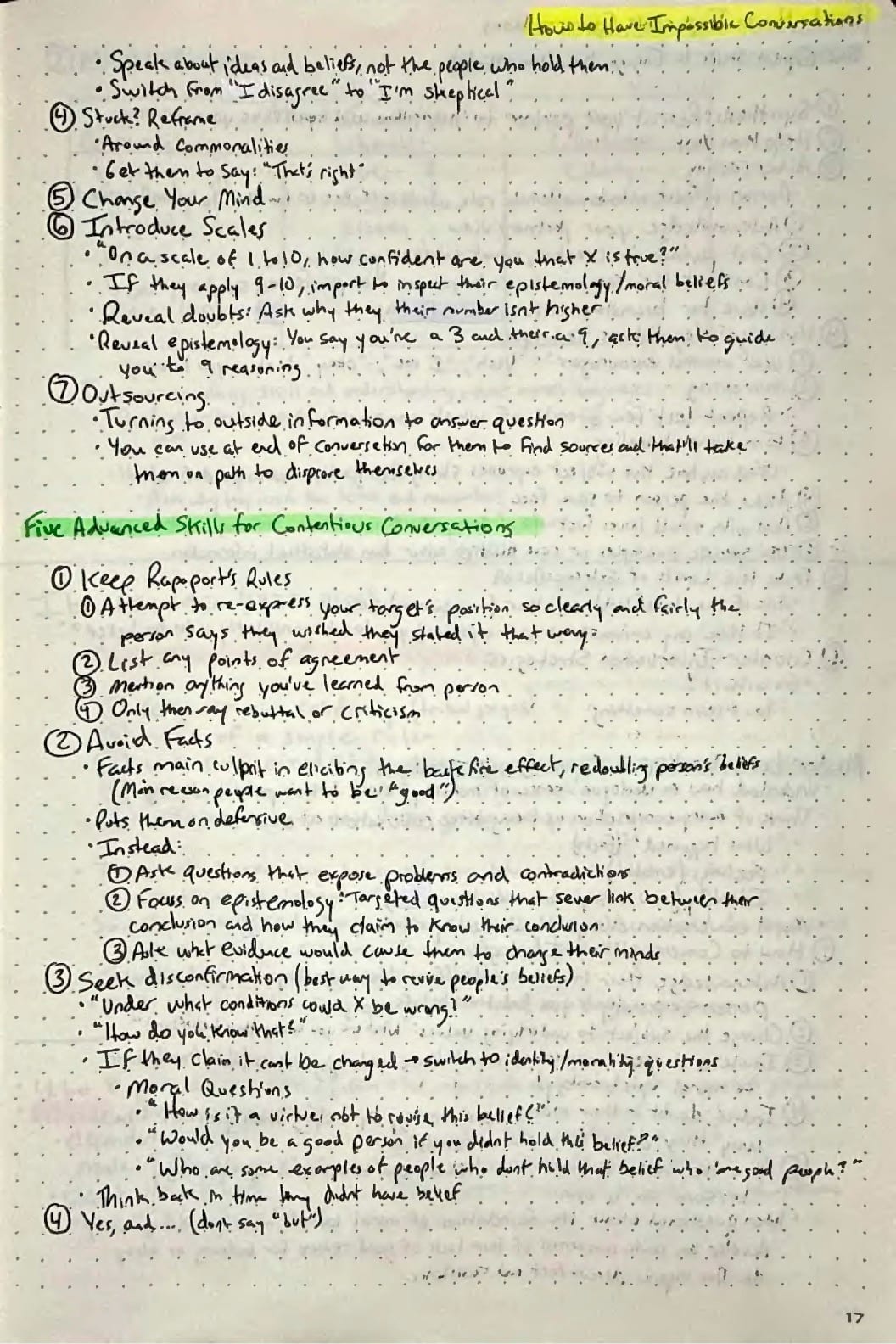
- Talk about beliefs rather than labeling people (“Bill believes X” instead of “Bill is a socialist”).
- Replace “I disagree” with “I’m skeptical” to signal openness rather than opposition.
4) Stuck? Reframe
Reframing means changing the terms/perspective so the issue becomes discussable again—without “spinning.”
Illustrative example: Boghossian offers to take his daughter along “to run errands,” and his wife reframes it from duty/chore to privilege: “Who gets to spend time with her?” That shift improves the child’s receptiveness and also changes the speaker’s own mindset.
Common reframing moves:
- Shift from politicized surface conflict to underlying interests (e.g., gun control → balancing safety, security, and rights).
- Invoke superordinate identities (shared identities like “parent,” “American,” or “human”) to lower tribal heat—example: framing gun concerns as one parent asking another parent how they manage risk.
- Aim for “That’s right,” not “You’re right”: the former signals they own the clarified understanding rather than merely conceding to you.
5) Change your mind (publicly, on the spot)
The chapter treats real-time belief revision as both rare and powerful: when you sincerely say “I’ve changed my mind”, it models intellectual humility, builds rapport, and can reset the tone of the relationship.
Example: someone argues motorcycle helmet choices affect taxpayers via increased Medicaid costs; if that changes your view, say so openly (“I need to rethink my belief”).
6) Introduce scales (measure confidence and add nuance)
“On a scale from 1 to 10…” is presented as a tool that:
- tracks whether your intervention moved confidence, and
- forces nuance when someone speaks in absolutes.
How it’s used:
- At the start: “How confident are you that X is true (1–10)?” Repeat at the end to see movement.
- For polarized claims (“The U.S. is a patriarchy!” / “Our government is tyrannical!”), comparative scales break binary thinking—e.g., benchmark against Saudi Arabia for patriarchy or Mao’s China for tyranny to clarify degree rather than yes/no.
- If someone reports high confidence (9–10), the chapter says you’ll likely need deeper work on how they know(epistemology) because identity may be involved.
- To surface doubt, ask: if they say “8,” follow with “Why not 9?” (pulling out reservations rather than directly attacking).
- An advanced move: state your own lower number and ask them to walk you through how they reach theirs; this makes them articulate their epistemology step-by-step and can reveal gaps (or teach you something).
- Keep a log of what lowers confidence and refine your approach over time.
7) Outsourcing (use outside info to answer “How do you know?”)
Outsourcing is turning to external information to resolve empirical, testable questions, especially when people have stronger opinions than their expertise warrants.
Illustrative example: someone misunderstands tax brackets (thinking earning more can reduce disposable income overall). Rather than declaring them wrong and triggering “Yes it is/No it isn’t,” outsourcing invites agreement on where to look for the answer.
Best practices:
- Use outsourcing near the end: “If I could be shown reliable data, I’m open to changing my mind—bring it next time.” This avoids the backfire effect of dumping counter-evidence midstream.
- Ask meta-questions about trust: “How would a neutral observer decide what source to trust?”
- Good phrasing includes: “What evidence could settle this?” “What would persuade an independent observer?” and “What’s the best counterargument?”
- Combine with Golden Bridges: “Let’s set this aside and come back when we have more information,” so they can process without pressure.
- If someone says no evidence could change their mind, the chapter concludes the belief isn’t evidence-based—so outsourcing won’t work.
- Outsourcing does not work for moral questions (no “moral experts” shortcut); if your partner appeals to moral authorities, the chapter suggests redirecting to how competing authorities conflict and how to decide.
- Ask for credible opposing experts (“Who are the three best experts who disagree?”) to puncture overconfidence and expose shallow understanding.
Conclusion: the highest “intervention” is revising yourself
The chapter closes with a Socratic theme (from Plato’s Gorgias): it’s better to be refuted than to refute, because shedding a false belief is a genuine gain. The authors frame this as the best outcome of all: in trying to change someone else’s mind, you might end up correcting your own—so embrace that when it happens.
At the same time, the chapter is realistic: many people resist, get upset, or lash out. In those cases, Golden Bridges, cooperative language, and judgment about when to disengage matter—sometimes the best move is simply to listen, let someone be wrong, and move on.
Chapter 5 — Five Advanced Skills for Contentious Conversations (pp. 99–134)
Chapter 5 introduces five “advanced” techniques that feel counterintuitive because they require you to override common conversational habits (correcting people with facts, rebutting quickly, defensiveness, “yes, but…,” and anger escalation). The chapter’s core claim is that productive disagreement depends less on what you know and more on how you structure the interaction, especially around humility, disconfirmation, and emotional control.
1) Keep Rapoport’s Rules (disagree only after proving you understood)
Before you criticize, you must:
- Re-express your partner’s view so clearly and fairly they feel accurately represented.
- List points of agreement (especially non-obvious ones).
- Say what you learned from them.
- Only then offer rebuttal or critique.
The purpose is to prevent caricature, preserve collaboration, and force genuine listening. It also “models” mutual respect (so your partner is more likely to reciprocate) and acts as a safeguard against careless, heated refutation.
2) Avoid facts (facts often entrench, especially when identity or morality is involved)
The chapter argues that introducing facts usually backfires when a belief is tied to identity, morality, community status, or social belonging. In those cases, “evidence” doesn’t function as a neutral input; it functions as a threat that triggers defensive reasoning and selective counter-evidence.
Key ideas:
- Many people don’t form beliefs primarily by evidence or argument; they form beliefs for social/moral reasons and then search for confirming support.
- Facts can trigger the backfire effect: conflicting evidence increases a person’s certainty rather than reducing it.
- Therefore, if your goal is to instill doubt, turning the conversation into a debate by “fact-dumping” often gives your partner incentives to rehearse defenses and become more entrenched.
What to do instead: - Ask questions that surface contradictions.
- Focus on epistemology (how they know).
- Use disconfirming questions (“What would change your mind?”).
- Bring facts only when your partner explicitly requests them—and even then, present them with humility (“I could be wrong, but my understanding is…”) and invite independent verification.
3) Seek disconfirmation (the most effective doubt-installer)
The chapter treats disconfirmation as the single most powerful intervention:
“Under what conditions could this belief be wrong?”
Why it works:
- “How do you know that?” often just invites people to repeat their favored supporting reasons—strengthening commitment.
- Disconfirmation forces the mind to search for potential falsifiers, which is the opposite of the usual confirmation bias.
The chapter sorts beliefs into three practical categories and suggests different moves for each:
A) Not disconfirmable (“I can’t be wrong”)
If someone claims there are no conditions that could make the belief false, the belief is “sealed.” The chapter recommends: - Don’t bring counterevidence (that just creates a fight).
- Offer hypothetical alternative states of affairs as questions to see if you can open a crack (“What if…?”).
- If they still refuse, shift away from epistemology into identity and moral meaning: what it would mean to abandon the belief, whether “good people” revise beliefs, how they judge those who disagree, etc.
B) Disconfirmable only under wildly implausible conditions
Example pattern: someone sets a “falsifier” they know can’t realistically happen (a face-saving performance of openness). The chapter argues this is usually driven by moral/identity needs (“belief in belief”) rather than evidence. Suggested moves: - Ask why the disconfirmation bar is set so high and why simpler criteria don’t count.
- Compare standards across domains (“Why is your standard here stricter than elsewhere?”).
- Use outsider pivots (switch to a different religion/ideology) to reduce rehearsed defenses.
- If needed, explicitly explore the underlying value/identity payoff of the belief.
C) Genuinely disconfirmable (“Here’s what it would take…”)
If they can name reasonable conditions, you: - Clarify the criteria precisely (what sources, how many confirmations, how strong the evidence).
- Then “outsource” jointly: where would a neutral observer look, which sources count, how to validate credibility.
- Crucially: don’t switch into sermon mode the moment they become vulnerable; the chapter calls exploiting that opening to push your “gospel” ethically bad and strategically self-defeating.
The chapter also gives practical templates for adding disconfirmation to conversations (e.g., using confidence scales, asking “Why not 10?” to elicit doubts, and a “think back ten years” routine to loosen absolute certainty).
4) “Yes, and…” (remove “but” to reduce defensiveness)
Borrowing from improv and negotiation, the chapter recommends eliminating “but” because it often negates whatever came before and triggers defense. Replace it with “and” to keep flow and collaboration:
- “Yes, and…” signals addition and exploration.
- If you disagree, use “Interesting, and…” or “I hear you, and…” to keep the other person explaining rather than defending.
- The aim is to present your view as an extension or new angle, not as a direct contradiction that forces a fight.
5) Dealing with anger (anger escalates; manage it early or exit)
The chapter treats anger as one of the most common conversation-destroyers and emphasizes that anger is contagiousand tends to spiral.
Core framework:
- Anger often arises from frustration (blocked goals) or offense (perceived violation).
- Anger narrows cognition, seeks self-justification, and comes with a refractory period (a window where your nervous system biases your thinking and you can’t simply “logic your way out”).
Don’ts: - Don’t match anger with anger.
- Don’t blame (“you’re getting angry”)—that inflames and humiliates.
- Don’t assume you know why they’re angry.
- Don’t stay if you feel unsafe; leave.
Do (in the moment): - Monitor early signs; de-escalate or walk away.
- Pause and let silence break the emotion-action link.
- Listen intensely; acknowledge their perspective without conceding.
- Use empathy statements and, when appropriate, apologize for your share.
- Slow the pace; shift topics or reframe to cool things down.
Do (beforehand): - Identify your triggers; practice recognizing your early bodily cues.
- Respect the refractory period; don’t continue while hijacked by emotion.
- Avoid topics you can’t discuss without rage.
- When naming the dynamic, prefer “frustrating” over “angry” to avoid sounding accusatory.
Chapter’s bottom line
These five skills are designed to help you create conditions where doubt is possible: you demonstrate understanding before rebutting, avoid triggering defensive entrenchment with facts, push cognition toward falsifiability, keep your language collaborative, and prevent anger from hijacking the exchange. Mastering them marks the transition from “basic technique” to “expert-level” difficult conversations.
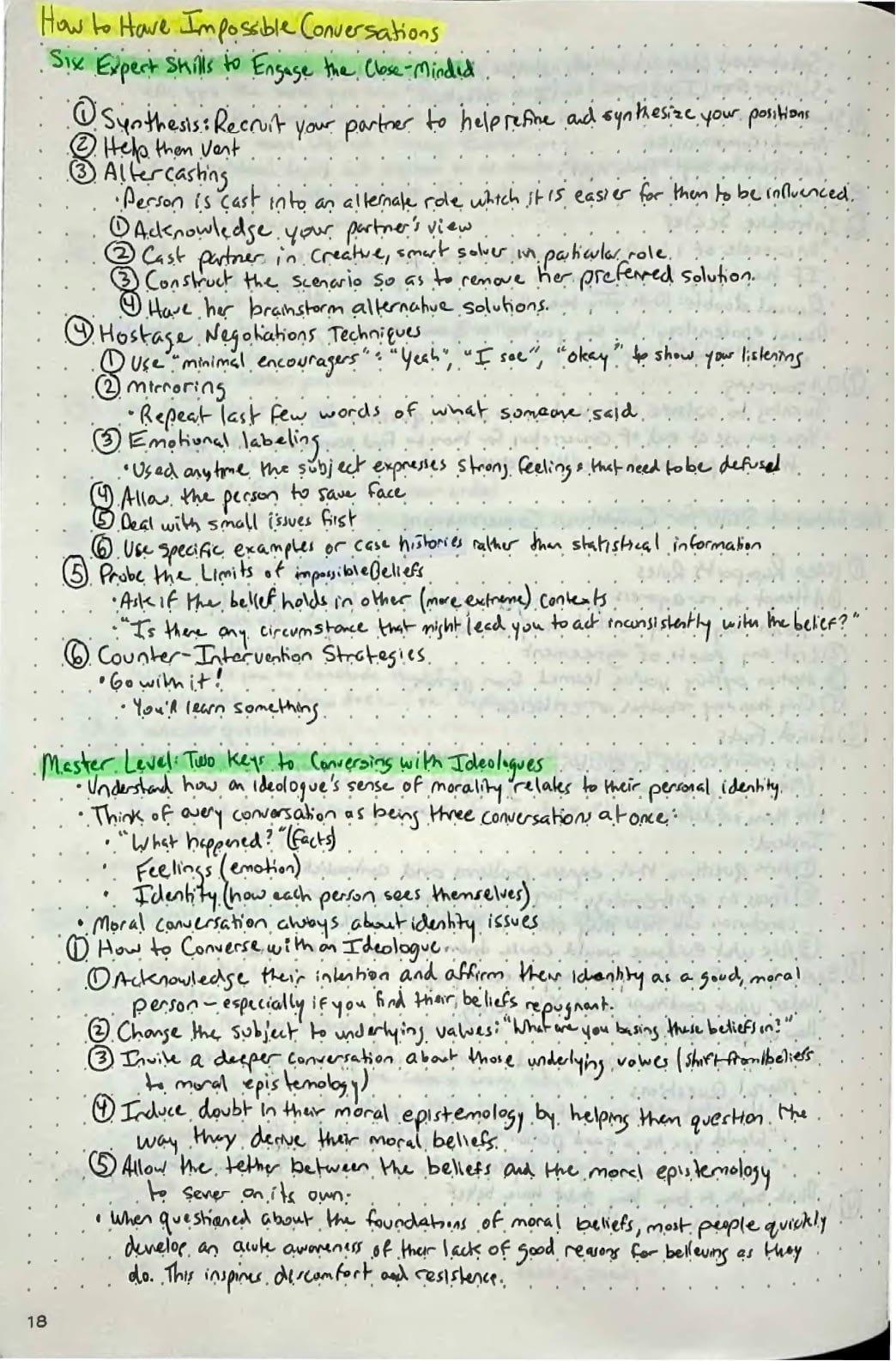
Chapter 6 — Six Expert Skills to Engage the Close-Minded (pp. 135–159)
This chapter is aimed at conversations with people who are closed or rigid in their thinking and treats the tools here as “expert-level,” meant to be layered on top of the earlier chapters’ basics (listening, rapport, Rapoport’s Rules, Golden Bridges, calibrated questions, seeking disconfirmation, etc.). It lays out six higher-skill “barrier breakers”: Synthesis, strategic venting, altercasting, hostage-negotiation techniques, probing the limits of unlivable beliefs, and counter-intervention strategies.
1) Synthesis — collaborate to refine beliefs (not “win”)
Core idea: Synthesis is Rapoport’s Rules plus seeking disconfirmation—a cooperative “dialectic” where you and your partner use each other’s objections to clarify, stress-test, and strengthen your views. The point is better, truer beliefs—not agreement.
When it works best: It’s most useful when both people are not highly “wedded” to their beliefs (e.g., both under about an 8/10 confidence, or explicitly exploring positions “for the sake of argument”). One practical tactic is to argue the side you’re normally inclined against, to force yourself into charitable, rigorous understanding.
Five-step loop (the engine of Synthesis):
- Present an idea.
- Invite and listen to counterarguments.
- Turn those counterarguments into disconfirmation conditions (ways your belief could be false).
- Refine your position using what you learned.
- Repeat with the newly refined view.
Practical guidance: Pick beliefs likely shaped by identity/morals/partisanship, because those hide epistemic blind spots. Do not move forward until you can re-express your partner’s criticism accurately and they confirm you understood it; then collaborate on specific “if X happens, my view is wrong” tests.
2) Help Vent Steam — remove emotional blockages before “content” discussion
Why venting matters: Sometimes you can’t have a substantive conversation because emotion is flooding the channel. In those cases, the chapter recommends strategic venting (especially with friends/intimates): you let the person unload while you listen, build Golden Bridges, don’t interrupt, and don’t pick fights over their claims.
When to use it: Signs include repeated harsh judgments, accusations, blame, visible irritation/discomfort, or overconfident “solutions” that feel like emotional leakage rather than reasoning. The opener is a calibrated question like: “How has this situation made you feel?” Then you listen without rebutting.
How to run it (key moves):
- Use conversation deepeners/extenders like “Tell me more,” and keep listening.
- After they’ve fully vented, transition to only the first three of Rapoport’s Rules (re-express, list agreement/sympathy, say what you learned). Do not rebut afterward; treat it as extended rapport-building.
- Mirror emotional words back (“frustrating,” “outrageous”), pause before responding, and let silence do work.
- Encourage describing feelings with more nuance, end with a sincere offer to help, and don’t force the original topic immediately afterward.
The chapter also warns not to “play therapist” if you’re not trained, and to be prepared for anger.
3) Altercasting — nudge behavior by assigning a role
What it is: A persuasion technique (Weinstein & Deutschberger) where you cast someone into a role with implicit expectations—e.g., “a fair-minded teacher,” “a good problem solver,” “a civil communicator”—and they’re more likely to act consistently with that role.
Examples used:
- Nursing example: instead of ordering a patient back to bed, frame them as “a person with your physical condition,” where staying in bed is part of that role.
- Gentrification teacher: he praises her as fair and committed to critical thinking and asks if she’ll teach other perspectives; she agrees—despite not having said those virtues herself.
Ethics and limitations: It can be manipulative, can be used negatively, and can backfire if the role’s “duties” mean something different to them than to you.
To reduce ethical issues, the chapter suggests restricting it to two “cleaner” uses: (1) take their favorite solution off the table, and (2) altercast conversational virtues (civility/fairness/open-mindedness).
Technique 1: Remove the go-to solution (immigration example): Cast your partner as a senator/problem-solver whose preferred option (deportation) is unavailable, and ask them to generate the best alternative. The logic is: acknowledge them, give them a respected role, constrain the scenario, then invite brainstorming—so they “self-generate” moderated options.
Technique 2: Altercast civility: Establish rapport, cast them as someone good at productive/civil dialogue, then proceed. This can also be used mid-tension (“you seem good at keeping your cool—how do you do it?”).
4) Hostage Negotiations — borrow de-escalation techniques for high-friction talks
The chapter distills research from professional hostage negotiation into six conversation techniques, meant for your hardest interactions.
- Minimal encouragers (“Yeah,” “I see,” “Okay”) to signal listening in tense moments.
- Mirroring: repeat the last few words as a question (“Get their way?”) to keep them talking and revealing more. The chapter contrasts helpful mirroring with an accusatory variant and warns not to overuse it.
- Emotional labeling: name the emotion to defuse intensity and show understanding (example: “You sound pretty hurt… It doesn’t seem fair”), with a warning that repeated mislabeling can backfire.
- Let them save face: build Golden Bridges so changing their mind doesn’t feel humiliating.
- Solve small issues first: create a “climate of success” by breaking big problems into smaller ones; use specific sub-questions.
- Prefer case histories over statistics: vivid examples stick and influence behavior more than isolated facts.
5) Probe the Limits — unmask beliefs people can’t actually live by
Problem type: Someone professes an extreme belief that seems impossible to practice (example used: “I wouldn’t believe a straight white male who says 2 + 2 = 4”). The chapter argues productive conversation is still possible by testing whether their lived behavior matches their stated belief.
Unmasking Formula (chronological):
- Apply Rapoport Rule 1: re-express the belief fairly and clearly.
- Confirm you understood correctly (giving them room to soften/back down); optionally ask permission to inquire if you’re in the targeted group, and ask how/why they came to the view and whether others share it.
- Test practical limits with more extreme contexts (ER surgeon, electrician installing lights, etc.).
- Ask for circumstances that would lead them to act inconsistently; if they deny any, keep pressing with concrete scenarios (pilot/aircraft examples) and ask how they operationalize the belief in real life (“How do you figure out the pilot’s race?”).
- If you show the belief can’t be acted on consistently, return to epistemology: how do they decide when to apply the rule and when to make exceptions?
If you can’t demonstrate impracticability, the chapter says you may be facing deception/delusion—or you were mistaken and they truly do live it.
6) Counter-intervention strategies — what if someone uses these tools on you?
If you suspect someone is trying to instill doubt in your beliefs, the chapter says you have three options: go with it, refuse to play, or counter-intervene—and it explicitly recommends “go with it” because you’re likely to learn something (about your belief, their technique, or yourself).
Refuse to play (“Stonewalling Socrates”): Interventions require your engagement. Silence, or short closed-ended answers, can prevent the intervention from working.
Counter-interventions (effective but dishonest): The book lists six ways to derail an intervention—while stressing it doesn’t encourage their use. Examples include: give a much lower (or opposite) confidence number; pretend early that you changed your mind; shift attention to “doubts about your doubt”; say you believe X but wish you didn’t; slow down rapid-fire questioning with deliberate pauses; and reverse the intervention by questioning their motives and confidence that you should change.
It also lists even more ethically suspect derailments (e.g., equivocation, implausible disconfirmation conditions, feigned ignorance) and then reiterates the recommendation to simply “go with it.”
Closing emphasis
The chapter frames these as advanced tools for engaging close-mindedness and breaking conversational barriers, with a recurring theme: don’t treat the conversation as combat; treat it as a structured way to reduce heat, increase understanding, and move beliefs (yours or theirs) closer to something defensible.
Chapter 7 — Master Level: Two Keys to Conversing with Ideologues (pp. 160–180)
Chapter 7 defines an ideologue as someone “unwilling or unable to revise their (moral) beliefs,” and argues that “impossible conversations” with such people fail because they look like arguments about facts but are really battles over morality and identity—what it means to be a good person, and which community someone belongs to.
The chapter’s two “master keys” are:
- Switch to moral epistemology (how they know their moral beliefs are true and how those beliefs serve identity).
- Moral reframing (learn to speak other “moral dialects” so your point can even be heard).
Key 1: How to Converse with an Ideologue (switch to moral epistemology)
Why ideologues are different
The chapter says ideologues commonly:
- Can’t provide realistic disconfirmation criteria (or deny any exist)
- Interpret disagreement as your moral failure (e.g., “you don’t care about dead children”)
- Show traits like righteousness, hyper-defensiveness, anger, accusations, vilifying language, and message-delivery rather than give-and-take.
Because moral belief is tied to identity, challenging it can feel like danger, so you must treat the exchange as simultaneously about facts, emotions, and identity—with identity often the real driver.
The “template” for engaging an ideologue
After someone can’t or won’t say what would change their mind, the chapter recommends shifting the entire conversation:
- Acknowledge their intention and affirm their identity as a good moral person (“It’s clear being a good person matters to you”). This lowers defenses and makes later inquiry possible.
- Change the subject to underlying values (“That belief seems important—what value informs it?”).
- Invite a deeper conversation about those values, using identity-focused questions about what makes someone good, what traits define good people, and how this belief connects to moral status.
- Induce doubt in their moral epistemology—not by fact-fighting, but by probing whether their process for arriving at moral certainty is reliable. The chapter claims most people’s moral epistemology is “brittle,” which is the main entry point for belief change.
- Let the tether sever on its own later. Your goal is to plant small “micro-razors” or “cognitive wedges” between the moral conclusion and the process that produced it. You then back off, give time, build Golden Bridges, and avoid pushing during vulnerability.
Warnings: “identity quakes” and slow change
The chapter emphasizes that disrupting identity-linked moral certainty can cause “identity quakes” (defensiveness, anger, distrust, even relationship loss). Moral attitudes usually change glacially, so success is often measured in small reductions in certainty rather than immediate reversal.
Quick checklist: what “success” looks like
It restates the approach as: identify ideologue markers (10/10 certainty + no realistic disconfirmation), secure their self-worth, shift to values, explore values/identity, then question the reliability of their moral belief-forming process; if needed, shift to superordinate identities (“we’re both Americans / human”), build Golden Bridges, and walk away if unsafe.
It also turns the lens inward: you should test whether you are the ideologue by writing down disconfirmation criteria for your cherished beliefs and checking if they’re implausible—because the easiest person to fool is yourself.
Key 2: Moral Reframing (learn to speak moral dialects)
What moral reframing is
Moral reframing means translating your point into moral terms that resonate with your partner’s moral intuitions, reducing defensiveness and increasing comprehension—like learning a second language.
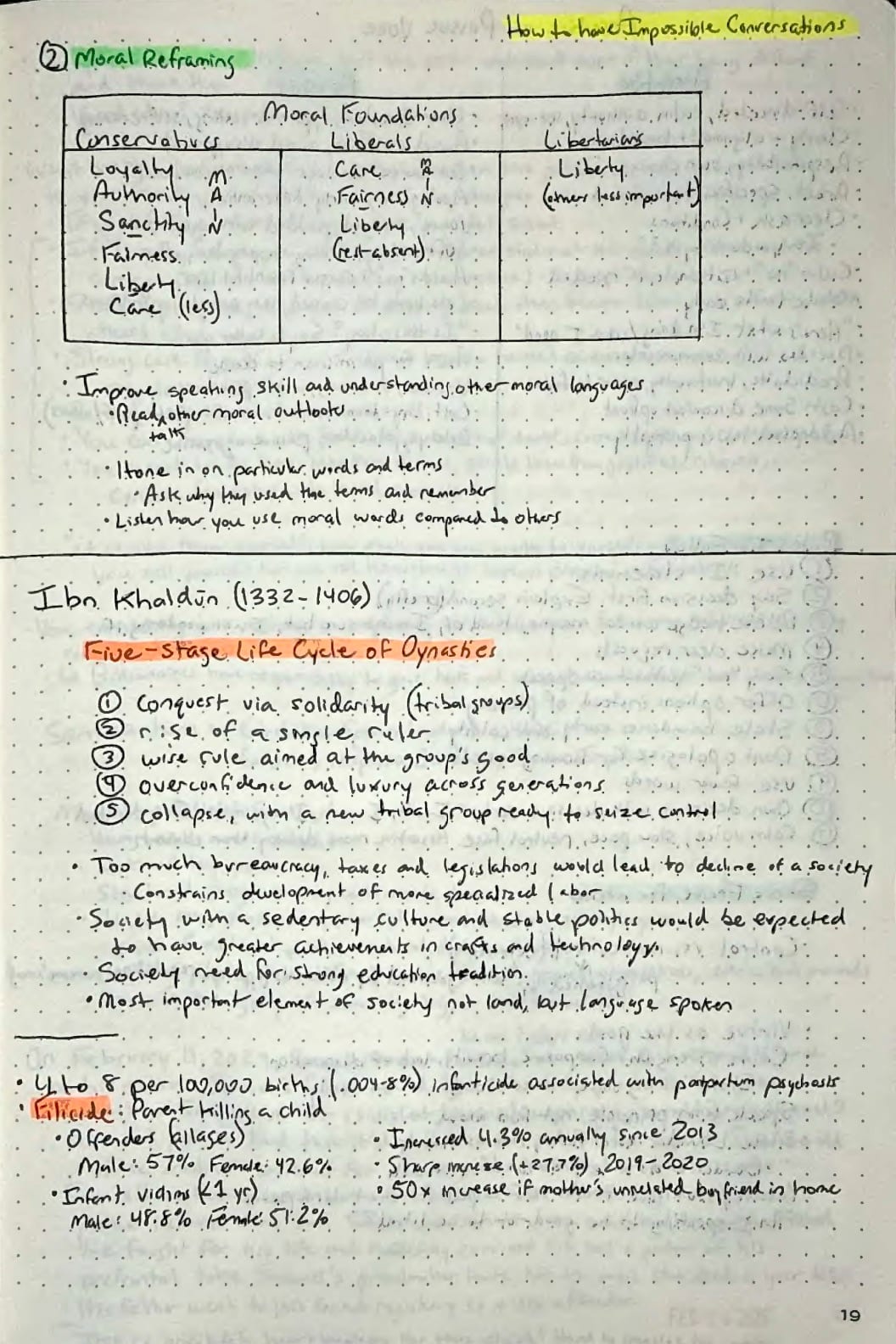
The chapter uses Jonathan Haidt’s moral foundations framework and notes that effective moral messaging often “hits” multiple foundations at once (example discussed: a public message appealing to sanctity, loyalty, authority, and care).
Haidt’s moral foundations (six)
- Care vs harm
- Fairness vs cheating
- Loyalty vs betrayal
- Authority vs subversion
- Sanctity vs degradation
- Liberty vs oppression
The chapter claims different political temperaments weight these differently: conservatives tend to respond to all six (especially loyalty/authority/sanctity), liberals emphasize care/fairness (and liberty), and libertarians emphasize a particular notion of liberty. The result is that people talk past each other because they’re speaking different “moral dialects.”
How to get better at speaking other moral dialects
Recommended practices:
- Expose yourself to opposing moral viewpoints and “native speakers,” ideally face-to-face.
- Study moral language use: ask why they chose one word rather than another (equity vs equality; faith vs trust/hope).
- Listen to your own dialect like an outsider: notice semantic gaps and when worldviews may be incommensurable (e.g., equity-first vs liberty-first).
- Read Haidt (The Righteous Mind) to understand moral intuitions across divides.
- Stay on the same “identity page” by using culturally correct terms and superordinate identity cues when useful.
Practical reframing moves
- Use moral keywords tuned to the other person’s moral priorities (e.g., conservatives: leadership/freedom/family/responsibility; liberals: disadvantaged/harm/victims).
- Ask the synonym test: “Can you swap X for Y without changing meaning? If not, why did you choose X?”—a way to destabilize a moral frame by questioning word choice.
- Treat incommensurable disputes as an opportunity to learn the other moral language—especially if they’re 10/10 and offer no disconfirmation criteria; focus on how their words form a moral worldview.
Chapter conclusion
The chapter’s final synthesis is that “impossible” moral arguments usually fail because they’re conducted at the factslevel while the real engine is identity and moral certainty reinforced by community. The way through is to (1) shift from debating conclusions to probing moral epistemology, and (2) learn to reframe morally so you can communicate across different value systems without immediate defensive shutdown.