
DESCRIPTION
Explores how we justify our beliefs - and try to influence those of others - both soundly and effectively.
The Practice of Argumentation- Effective Reasoning in — 2019 (Annotated).pdf (file not included in this release)
Main Ideas, Takeaways & Similarities
Here’s a summary of the main ideas from The Practice of Argumentation: Effective Reasoning by David Zarefsky:
1. Argumentation as Reasoning in Uncertainty
- Argumentation is not about proving absolute truths but justifying claims where certainty is unavailable.
- It is deeply rooted in logic, dialectic, and rhetoric, with influences from ancient Greek democratic practices.
- Argumentation seeks audience assent through reasoning, not coercion.
2. Key Concepts and Terminology
- Argument: A claim backed by reasons.
- Arguing: The activity of offering and responding to reasons.
- Argumentation: A cooperative process of making and assessing claims under uncertainty.
3. Preconditions for Argumentation
- Real, non-trivial disagreement.
- Mutual desire for freely-given agreement.
- No simpler method (e.g., authority or precedent) available.
- Willingness to take intellectual risks, including being proven wrong.
4. Argument Structures and Diagrams
- Simple arguments involve a claim, evidence, and a warrant (e.g., Toulmin model).
- Complex arguments may be:
- Multiple: Independent reasons each support the claim.
- Coordinative: Reasons must work together.
- Subordinative: Reasons build upon each other in a chain.
- Diagrams help visualize argument structure but can oversimplify real discourse.
5. The Nature and Role of Controversy
- Arguments arise from controversies, which are sustained, unresolved disagreements.
- Components include:
- Issues: Questions to be settled.
- Claims: Assertions made.
- Resolutions: Main claims to be accepted.
- Topoi: Commonplaces or typical lines of reasoning.
- Stasis, presumption, and burden of proof are crucial in framing disputes.
6. Use and Evaluation of Evidence
- Types include:
- Objective Data: Statistics, documents, physical evidence.
- Social Consensus: Common values, shared understandings.
- Testimony: Expert or eyewitness statements.
- Evaluation Criteria: Accessibility, credibility, consistency, recency, relevance, adequacy, accuracy, context, appropriateness.
7. Argument Schemes
- Common reasoning patterns:
- From Example
- From Analogy
- From Sign
- From Cause
- From Testimony
- From Form (logical structure)
- These help determine how evidence supports claims and are tested for validity and soundness.
8. Fallacies
- Fallacies are defective arguments, not merely wrong ones.
- Types:
- Warrant-specific (e.g., hasty generalization, false analogy).
- Clarity-related (e.g., vagueness, ambiguity).
- Relevance-related (e.g., ad hominem, red herring).
- Vacuous reasoning (e.g., circular arguments).
- Context-sensitive frameworks like pragma-dialectics and informal logic explore fallacies in real dialogue.
9. Case Construction
- A case includes subsidiary claims and supporting evidence organized to affirm or negate a resolution.
- Strategic choices include:
- Selection of claims and evidence.
- Structuring arguments (multiple, coordinative, subordinative).
- Order of presentation and use of briefs/outlines.
10. Strategies for Attack and Defense
- Argumentation is dynamic: sides must attack weaknesses and defend their reasoning.
- Effective strategy includes:
- Identifying structural vulnerabilities.
- Refuting evidence, claims, or warrants.
- Recontextualizing or turning arguments.
- Using techniques like reductio ad absurdum or dilemma framing.
11. Language and Style
- Language shapes argument effectiveness:
- Consistency in definitions and terms.
- Strategic ambiguity or imprecision may be useful.
- Linguistic intensity and stylistic devices impact audience perception.
- Definitions and dissociation (splitting concepts) are crucial tools.
12. Contexts and Spheres of Argument
- Argument occurs in three spheres:
- Personal: Informal, focused on agreement.
- Technical: Among experts, rule-governed.
- Public: Open forums, politically or socially significant.
- Arguments can migrate between spheres, influenced by public attention or strategic framing.
13. Learning Through Debate
- Debate is a structured method for practicing argumentation.
- Involves:
- Building affirmative and negative cases.
- Adhering to formats, rules, and time limits.
- Learning to argue both sides promotes open-mindedness and critical thinking.
Would you like a visual chart of these ideas or a shortened version for easy reference (e.g., for Anki flashcards or a blog)?
Questions
I. What is the problem?
A. How is this problem formulated?
B. Why is this problem important?
C. What is the history of this problem?
D. Which prominent personalities have been interested in this problem?
II. What solutions to the problem are there?
A. What are the conclusions reached?
B. By what argument(s) is the conclusion reached?
C. What facts or assumptions serve as premises?
D. When a prominent personality offers a solution, does he also argue for or against other prominent personalities? Does he raise objections to alternative solutions? Does he consider objections to his own solutions?
III. Evaluation
A. What are the advantages and disadvantages of the alternative formulations to the problem?
B. Has the importance or history of the problem ever been misrepresented?
C. Are the solutions logically related to the premises?
D. Are the facts true? Are the assumptions acceptable? Are the objections answerable?
AI Summary
Chapter 1: The Argumentative Perspective
Introduction to Argumentation
The chapter begins by addressing common misconceptions about argumentation, often seen negatively as bickering or quarrelsomeness. However, the book focuses on argumentation as a form of reasoning and intellectual exercise, tracing its roots back to ancient Greece where it was essential for democratic processes.
Argumentation as Reasoning
Argumentation is defined as the practice of justifying claims under conditions of uncertainty. It is an activity involving giving reasons for claims to persuade others. Unlike proving something with certainty, argumentation deals with justifying beliefs to an audience, often in contexts where empirical evidence is insufficient.
Key Definitions and Concepts
- Arguing: The process of producing, exchanging, and testing reasons for or against claims.
- Arguments: The products of arguing, consisting of claims and supporting reasons.
- Argumentation: A perspective on human interaction focusing on reasoning and the exchange of reasons.
Historical Context and Importance
The study of argumentation is linked to critical thinking, effective reasoning, and rhetoric, all essential components of a liberal arts education. It prepares individuals for professional and civic life by equipping them with skills to justify their beliefs and decisions.
Preconditions for Argumentation
Argumentation is appropriate under specific conditions:
- Genuine Controversy: There must be a real, non-trivial disagreement.
- Desire for Agreement: The parties seek the other’s agreement, but only if it is freely given.
- No Simpler Resolution: There must be no easier way to resolve the disagreement.
Underlying Assumptions
Engaging in argumentation reveals several assumptions:
- Audience Influence: The assent of the audience is the ultimate test of an argument’s strength.
- Nature of Uncertainty: Argumentation involves uncertainty and the possibility of being wrong.
- Justification Process: Justifying a claim involves reasoning and offering good reasons to persuade others.
- Cooperative Nature: Despite seeming adversarial, argumentation is fundamentally cooperative, aiming for a well-reasoned decision.
- Acceptance of Risk: Arguers accept the risk of being shown wrong and the need to modify their beliefs.
Ethics of Argumentation
Argumentation involves ethical considerations, as it is an effort to influence others. Ethical argumentation respects the audience’s capacity for critical thinking and does not rely on coercion or manipulation.
Genres of Argumentation
The chapter identifies three main genres of argumentation:
- Deliberation: Joint problem-solving among friends or small groups.
- Debate: Adversarial presentation of opposing views, with a third party making a decision.
- Public Address: Presenting arguments to a broader audience, often through speeches, writings, or media.
Conclusion
The chapter emphasizes that argumentation is a valuable skill for making sound decisions in an uncertain world. It involves constructing and justifying claims, understanding audience influence, and recognizing the cooperative and ethical dimensions of reasoning. The goal is effective reasoning in communication, leading to well-justified beliefs and decisions.
Chapter 2: What Arguments Look Like
The chapter “What Arguments Look Like” from the book The Practice of Argumentation explores the structure and representation of arguments, focusing on how to diagram them effectively. Here is a detailed summary:
Overview
The chapter delves into identifying and diagramming arguments, emphasizing that arguments are sets of statements aimed at influencing beliefs or actions. These statements are often embedded in various forms of communication, such as conversations, speeches, and writings.
Formal Logic Model
The chapter begins by discussing the traditional model of argumentation, the categorical syllogism, which involves statements about categories and their relationships. Using Venn diagrams, the text illustrates how to represent these relationships visually. However, it points out the limitations of this model, such as its lack of sensitivity to context and its inability to handle degrees of probability and strength.
Diagramming Simple Arguments
The chapter introduces the basic components of a simple argument: claim, evidence, and warrant. A claim is an assertion that the arguer wants the audience to accept. Evidence supports the claim, while the warrant justifies the inference from the evidence to the claim. The text explains how to diagram these components using the Toulmin model, which visually represents the links among claim, evidence, and warrant.
Example
An example involving a political discussion is used to illustrate this process. When someone claims, “The president’s position is weakening,” and supports it with evidence from a poll showing a decline in approval ratings, the warrant is the implicit statement that “Poll ratings are a sign of one’s political position.”
Diagramming Complex Arguments
Complex arguments involve multiple claims and levels of support. The chapter explains three structural patterns for complex arguments:
- Multiple Structure: Independent subsidiary claims each support the main claim.
- Coordinative Structure: Independent subsidiary claims collectively support the main claim.
- Subordinative Structure: Subsidiary claims depend on each other in a chain to support the main claim.
Example
A newspaper editorial advocating for a carbon tax is used as an example of a complex argument. The main claim, “Immediate adoption of a carbon tax is the only way to slow the effects of climate change before it is too late,” requires several subsidiary claims to be established, such as the significance of climate change and the effectiveness of a carbon tax.
Combining Argument Structures
The chapter highlights that real-world arguments often combine different structures. For instance, the argument for a carbon tax might involve a coordinative structure for the main claim and a subordinative structure for one of the subsidiary claims.
Further Thoughts about Diagrams
The chapter acknowledges the limitations of argument diagrams, such as their inability to capture nonverbal elements and the oversimplification of real-world discourse. Despite these limitations, diagrams are valuable for clarifying the structure of arguments and preparing for their evaluation.
Conclusion
The chapter concludes by emphasizing the importance of understanding the structure of arguments and using diagrams to illustrate them. It prepares readers to examine how controversies emerge and develop, setting the stage for more advanced discussions in subsequent chapters.
In summary, this chapter provides a comprehensive guide to identifying, diagramming, and understanding both simple and complex arguments, highlighting the strengths and limitations of different models and structures.
Chapter 3: The Emergence of Controversy
Introduction
Chapter 3 of The Practice of Argumentation focuses on understanding how controversies emerge and their role in argumentation. Unlike isolated arguments, real-life arguments develop within a context of controversy, influenced by what others have said or are saying about the matter at hand.
Definition and Characteristics of Controversy
A controversy is characterized by five features:
- Recognition of Disagreement: Parties involved recognize that they have a disagreement, which could be about the truth, meaning, importance, or discussability of a statement.
- Non-Trivial Disagreement: The disagreement matters to the participants and often to a broader community.
- Desire for Assent: Each party desires the assent of the others, aiming to influence their beliefs or actions.
- Freely Given Assent: Assent is desired only if it is freely given, without coercion.
- No Easier Resolution: There is no simpler way to resolve the dispute, necessitating argumentation.
Communicative Clues to Controversy
Certain statements can indicate the presence of a controversy:
- Statements of fact that can be easily verified do not prompt controversy.
- Value judgments, such as preferences or evaluations, can lead to controversy if they matter to the parties involved.
- Statements with broader implications (e.g., political or social judgments) are more likely to be controversial.
Issues, Claims, Resolutions, and Topoi
- Issues: Subsidiary questions that must be answered to resolve the main controversy.
- Claims: Statements that the arguer makes and hopes the audience will accept. These can be of fact, definition, value, or policy.
- Resolutions: The main claim in a controversy, often inferred from the arguers’ statements.
- Topoi: General categories or patterns of issues that help identify what must be proven in an argument.
Stasis, Presumption, and Burden of Proof
- Stasis: The point at which opposing arguments meet, identifying the central question that must be settled to resolve the dispute. It can be in conjecture (whether an act occurred), definition (what to call the act), quality (whether the act is justified), or place (jurisdictional questions).
- Presumption: The position that is presumed correct unless proven otherwise. It determines who must initiate the dispute and provides a minimal standard of proof.
- Burden of Proof: The responsibility to show that a statement is true. It lies with the party without presumption and does not shift during the dispute.
Conclusion
Understanding controversies is crucial for effective argumentation. Controversies highlight the complexities of the world, opening up new ways of thinking and reminding us that what we consider true might be otherwise. The chapter emphasizes that argumentation is a means to justify beliefs and influence others, ultimately aiming for a cooperative resolution of disagreements.
Chapter 4: Evidence in Argumentation
The chapter “Evidence in Argumentation” from David Zarefsky’s The Practice of Argumentation delves into the crucial role that evidence plays in supporting claims within arguments. The chapter outlines various types of evidence and the standards by which they should be evaluated to ensure their reliability and effectiveness in argumentation.
Key Points
Role of Evidence
- Foundation of Argumentation: Evidence is essential for supporting claims in arguments. It helps to persuade the audience by providing a basis for the claims made.
- Agreement on Truth: For evidence to be effective, all parties in the argument must agree on its truthfulness, even if they disagree on its implications or relevance.
Types of Evidence
-
Objective Data
- Examples: Specific instances that illustrate a broader claim. They can be brief allusions or detailed illustrations.
- Statistics: Quantitative data, including raw numbers, percentages, ratios, index numbers, measures of central tendency (mean, median, mode), rates of change, and probability statements.
- Tangible Objects and Documents: Physical items or documents that can be directly examined, such as historical documents, videos, or physical evidence in trials.
- Direct Observation: Empirical data gathered through direct observation, such as traffic studies or eyewitness accounts.
-
Social Consensus
- Commonplaces: Widely accepted beliefs that are treated as self-evident truths.
- Shared Value Judgments: Universal or near-universal value judgments that serve as evidence without needing further proof.
- Shared Historical Understandings: Common interpretations of historical events that are widely accepted.
- Previously Established Claims: Claims that have already been proven and can be used as evidence for new claims.
- Stipulations: Agreements between parties to accept certain statements as true to simplify the argument.
-
Testimony
- Eyewitness Testimony: First-hand accounts from individuals who directly experienced an event.
- Expert Testimony: Statements from individuals with expertise in a particular field, whose credibility is based on their knowledge and experience.
Finding Evidence
- Traditional Methods: Libraries and physical sources such as books, periodicals, and government documents.
- Internet Searches: Using search engines and specialized databases to find relevant information. The chapter emphasizes the importance of using credible sources and being cautious of the quality of online information.
Evaluating Evidence
- General Standards: Proposed by James A. Herrick, these include accessibility, credibility, internal consistency, external consistency, recency, relevance, and adequacy.
- Accuracy and Context: Ensuring that evidence is accurately represented and considered within its proper context.
- Appropriateness: Using the right type of evidence for the argument’s purpose.
Challenges with Evidence
- Fake News and Misinterpretation: The chapter discusses the prevalence of fake news and the importance of critically evaluating evidence to avoid being misled.
- Case Study: The chapter references Colin Powell’s 2003 presentation to the UN, highlighting how flawed evidence can lead to significant consequences.
Conclusion
The chapter concludes by emphasizing the importance of critical evaluation of evidence in argumentation. It provides guidelines and tests to help ensure that evidence is reliable and effectively supports the claims being made. This thorough approach to understanding and utilizing evidence is crucial for constructing convincing arguments and engaging in meaningful discourse.
Chapter 5: Argument Schemes
This chapter delves into the relationship between evidence and claims in argumentation, focusing on the concept of validity and the different types of argument schemes. Here’s a detailed summary:
Concept of Validity
- Definition: Validity is a test for the quality of an argument that is independent of the content of the evidence or claim. It checks if the claim would be true if the evidence is true.
- Formal Deductive Logic: In deductive logic, the claim is guaranteed by the evidence. If the evidence is true, the claim must be true. This is known as entailment.
- Ordinary Argumentation: Unlike formal deductive logic, ordinary argumentation involves inductive reasoning where the claim is not guaranteed by the evidence but is supported by it.
Argument Schemes
Argument schemes are patterns of reasoning that connect evidence to claims. The chapter identifies six primary argument schemes:
1. Argument from Example
- Types: Generalization (specific to general) and Illustration (general to specific).
- Tests: Includes checking the number of examples, representativeness, ambiguity, and avoiding fallacies of composition and division.
2. Argument from Analogy
- Types: Literal analogy (direct comparison of similar items) and Figurative analogy (comparison of relationships between different types of items).
- Tests: Consideration of all relevant characteristics and weighing similarities against differences.
3. Argument from Sign
- Types: Physical observation, measurement, and institutional regularity.
- Tests: Ensuring the sign reliably indicates the presence of the thing signified, checking for patterns, and considering alternative explanations.
4. Argument from Cause
- Types: Explanations (retrospective hypothesis, resolution of paradox, causal generalization) and Predictions (means-end prediction, slippery slope).
- Tests: Avoiding mistaking correlation for causation, checking for post hoc fallacies, identifying common causes, and considering multiple causes or effects.
5. Argument from Testimony
- Types: Expert vs. lay testimony and quoted vs. paraphrased testimony.
- Tests: Ensuring the source is an authority on the topic, has a basis for statements, is unbiased, and the testimony is up-to-date.
6. Argument from Form
- Types: Quasi-mathematical arguments, quasi-logical arguments, and narrative arguments.
- Tests: Appropriateness of the form, correctness of its use, coherence of the argument, and resonance with the audience.
Conclusion
The chapter concludes by emphasizing the importance of warrants in everyday argumentation. Properly warranted arguments are considered valid if their evidence supports the claims, while unwarranted arguments are fallacious. The next chapter will explore fallacies in more detail.
Chapter 6: Fallacies
The chapter on fallacies from The Practice of Argumentation provides a comprehensive analysis of invalid arguments, known as fallacies, which occur when the relationship among statements in an argument is deficient, irrespective of the truth or falsity of those statements. It categorizes fallacies into four main groups and discusses their nature and implications in argumentation.
Understanding Fallacies
- Definition: Fallacies are arguments where the inference from evidence to claim is not warranted.
- Nature: In deductive reasoning, fallacies are errors in the form of the argument, while in ordinary argumentation, content, context, and form are intertwined.
- Common Misconceptions: Fallacies are often mistaken for anything wrong with an argument, but they specifically refer to deficiencies in the relationship among statements.
Categories of Fallacies
Fallacies of Specific Warrants
These fallacies arise from improper inferences based on specific types of warrants:
- Example: Hasty generalization, fallacy of composition, and fallacy of division.
- Analogy: False analogy.
- Sign: Misinterpreting correlations as causations.
- Cause: Post hoc ergo propter hoc, reverse causation, and multiple causes/effects.
- Testimony: Unreliable authority or irrelevant testimony.
- Form: Errors in formal logic patterns like affirming the consequent and denying the antecedent.
Fallacies of Clarity
These result from the inherent inexactness of language:
- Vagueness: Terms with many possible referents.
- Ambiguity: Terms with multiple, finite meanings.
- Amphiboly: Unclear meaning of phrases or sentences.
- Equivocation: Changing the sense of a word during the argument.
- Heaps and Slippery Slopes: Issues in determining when a difference in degree becomes a difference in kind.
Fallacies of Relevance
These involve introducing irrelevant elements into an argument:
- Ad Hominem: Personal attacks or bias allegations.
- Ad Verecundiam: Irrelevant appeal to authority.
- Ad Populum: Appeal to popular opinion.
- Ad Baculum: Appeal to threat.
- Ad Misericordiam: Appeal to pity.
- Ad Ignorantium: Appeal to ignorance.
Fallacies of Vacuity
These are arguments that are essentially empty or circular:
- Circular Reasoning: Repeating the grounds in different terms.
- Begging the Question: Assuming the truth of a controversial claim.
- Ignoring the Question: Diverting to an unrelated topic.
- Non Sequitur: Statements that do not logically follow from each other.
- Straw Man: Misrepresenting an opponent’s position.
- Self-Sealing Arguments: Arguments that cannot be proven false.
Advanced Study
The chapter also explores two major alternative approaches to understanding fallacies:
- Douglas Walton’s Informal Logic: Focuses on the misuse of argumentation techniques in dialogue contexts.
- Pragma-Dialectics by Frans van Eemeren and Rob Grootendorst: Emphasizes rules of critical discussion and identifies fallacies as violations of these rules.
These approaches highlight that the attribution of fallaciousness is context-dependent and not absolute.
Chapter 7: Case Construction
The chapter “Case Construction” from The Practice of Argumentation focuses on how to build effective cases in argumentation, particularly in the context of affirming or negating a resolution. Here is a detailed summary of the key points discussed in the chapter:
Introduction to Case Construction
- Definition of a Case: A case is a structured set of subsidiary claims and evidence aimed at supporting or opposing a resolution. An affirmative case supports the resolution, while a negative case opposes it.
- Burden of Proof: The affirmative side typically carries the burden of proof, meaning they must develop a prima facie case that would convince a reasonable person of the resolution’s merit if unchallenged.
The Case and the Issues
- Prima Facie Case: A prima facie case is one that, on first hearing and in the absence of rebuttal, would be sufficient to convince a reasonable person.
- Determining Issues: Issues can be identified by:
- Quizzing the terms in the resolution.
- Examining the contemporary context of the subject matter.
- Applying the concept of topoi (commonplaces or typical arguments) for the type of claim being made (fact, value, or policy).
Constraints and Choices in Case Construction
- Creative Art: Case construction is seen as a creative process where the advocate has considerable latitude in selecting and arranging arguments and evidence.
- Strategic Considerations: Choices should be made to increase the odds of prevailing, addressing contested issues effectively.
Selection of Claims
- Amplitude: Refers to the number or range of supporting arguments. While more arguments can increase amplitude, it is not always strategically beneficial due to time constraints, audience patience, and potential for weaker arguments to undermine stronger ones.
- Strength of Claims: Claims should be selected based on how easily they can be established and how much they advance the main claim.
Selection of Supporting Evidence
- Criteria for Evidence: Evidence should be accurate, relevant, replicable, and credible. Other factors include the evidence’s underlying reasoning, source credibility, track record, timeliness, and conciseness.
Arrangement of Arguments and Evidence
- Structures of Arguments:
- Multiple: Independent arguments each supporting the main claim.
- Coordinative: Multiple arguments collectively supporting the main claim.
- Subordinative: Arguments that depend on each other in a chain-like structure.
- Order of Presentation: Strategic decisions include whether to present the strongest argument first or last, and whether to start with familiar or unfamiliar arguments.
- Common Organizational Patterns: These include chronological, spatial, topical, causal, problem-solution, and residues.
Executing Case Construction Decisions
- Brief and Case Outline: Tools like the brief (a comprehensive list of potential arguments and evidence) and the case outline (an organized presentation plan) help in making strategic choices and ensuring all necessary points are covered.
Exercises and Extensions
- Exercises: The chapter includes exercises to practice determining prima facie cases, defining key terms, and constructing cases on various controversies.
- Advanced Study: Readers are encouraged to analyze historical documents like the US Declaration of Independence to understand strategic choices in case construction.
This chapter provides a thorough guide on constructing effective arguments, emphasizing strategic selection and arrangement of claims and evidence to persuade an audience.
Chapter 8: Attack and Defense
The chapter “Attack and Defense” from The Practice of Argumentation delves into the dynamics of argumentation, focusing on the strategies and processes involved in attacking and defending arguments. Here are the key points:
Overview
- Prima Facie Case: An argument that appears persuasive at first glance but requires further defense against counterarguments.
- Burden of Rejoinder: The obligation to respond to an opponent’s arguments, leading to a back-and-forth exchange until one side prevails or a neutral party decides.
Goals and Processes
- Attack: Aimed at undermining the opponent’s case.
- Defense: Focused on strengthening and reviving one’s own case.
- Interrelation: Attacking an opponent’s arguments can also serve to defend one’s own, and vice versa.
Selection Choices in Attack
- Which Arguments to Attack:
- Subordinative Structure: Defeating one argument can collapse the entire case.
- Multiple Structure: All arguments must be defeated for the case to fall.
- Coordinative Structure: Defeating at least one element can weaken the case.
- Practical Considerations: Avoid attacking irrelevant or weak arguments, which can waste time or even strengthen the opponent’s case.
Which Step in the Argument to Attack
- Claim: Directly deny or counter the claim.
- Evidence: Undermine the evidence supporting the claim.
- Warrant: Challenge the general principle linking evidence to the claim.
- Underlying Context: Attack the implicit assumptions of the argument.
Types of Attacks
- Asking Questions: Elicit missing information but should be used sparingly.
- Identifying Internal Deficiencies: Point out flaws in the argument’s logic or evidence.
- Pointing Out Inconsistencies: Highlight logical or pragmatic contradictions.
- Labeling the Opposing Argument’s Strategy: Expose flawed rhetorical strategies.
- Counter-argument: Present a competing argument.
- Recontextualizing the Argument: Challenge the underlying assumptions by changing the context.
Arrangement Choices in Attack
- Order of Presentation: Decide whether to follow the opponent’s structure or create a new one.
- Completeness: Balance thoroughness with brevity to avoid wasting time.
Options for the Defense
- Basic Strategic Options:
- Show the attack is inapplicable, trivial, inadequately established, or in error.
- Selection and Arrangement Choices: Decide whether to follow the original case structure or the attack’s structure.
- Preemptive Moves: Anticipate and address potential attacks within the initial argument.
General Means of Refutation
- Reductio ad Absurdum: Show that the opponent’s argument leads to absurd consequences.
- Turning the Tables: Demonstrate that the argument supports the opposite conclusion.
- Dilemmas: Force the opponent to choose between two unacceptable alternatives.
- Argument a Fortiori: Use a stronger case to support a weaker one.
- Argument from Residues: Eliminate all other possibilities to support the remaining one.
- Contradictions and Inconsistencies: Highlight logical or pragmatic contradictions in the opponent’s positions.
Exercises
The chapter concludes with exercises to practice strategic choices in attacking and defending arguments in various scenarios, encouraging the application of the discussed principles.
This summary encapsulates the chapter’s exploration of the strategic choices and methodologies in the processes of attacking and defending arguments within the context of structured argumentation.
Chapter 9: Language, Style, and Presentation
This chapter from The Practice of Argumentation explores the intricate relationship between language and argumentation, emphasizing that language is not merely decorative but integral to the substance and impact of arguments. The chapter covers several key aspects:
Linguistic Consistency
- Language is inherently inexact, and words often have multiple meanings.
- Arguers must strive for linguistic consistency to avoid fallacies such as ambiguity, amphiboly, vagueness, and equivocation.
- Consistency ensures that the same meaning of words and phrases is maintained throughout an argument.
Definitions
- Definitions are not neutral; they shape the argument and can be used strategically.
- Types of definitions:
- Clarifying Definitions: Make vague terms more precise.
- Stipulative Definitions: Agreed upon for the sake of argument.
- Persuasive Definitions: Alter the connotation of a term while keeping its denotation constant to influence the argument.
- Definitions can shape the scope and direction of a debate, as seen in political and ethical discussions.
Dissociation
- Dissociation involves redefining a term by separating it into two contrasting concepts, often using philosophical pairs like appearance/reality or theory/practice.
- This technique shifts the ground of an argument by changing the perceived meaning of a term.
- Recognizing dissociation involves looking for tautologies, oxymorons, and unusual negations.
Stylistic Devices
- Style affects both the perception and impact of an argument.
- Figures of Speech: Include similes, metaphors, and synecdoche, which make arguments more vivid and impactful.
- Types of Statements: Analytic, contradictory, and synthetic statements play different roles in argumentation.
- Sentence Structure: Simple, compound, and complex sentences convey different levels of nuance and complexity.
Strategic Imprecision
- Sometimes, imprecision is beneficial to keep options open or to build consensus among parties with divergent views.
- Techniques include euphemisms, ambiguity, equivocation, and vagueness.
- Precision is desirable to avoid purely verbal disputes and to ensure clarity.
Linguistic Intensity
- The intensity of language can convey the arguer’s passion and seriousness but must be balanced to avoid alienating the audience.
- High intensity can strengthen commitment or weaken it, depending on the audience’s existing feelings.
Argument Presentation
- Effective argumentation culminates in presentation, which can be written, oral, or visual.
- Written Argumentation: Focus on clarity, structure, and strategic presentation of evidence.
- Oral Argumentation: Emphasize simplicity, repetition, informal expressions, and signposting.
- Visual Argumentation: Use images and visual aids to convey arguments intuitively and emotionally.
Exercises
- The chapter concludes with exercises to practice distinguishing connotations, defining situations, recognizing dissociation, and analyzing arguments.
This comprehensive exploration of language, style, and presentation underscores the importance of strategic language use in crafting effective arguments and influencing audiences.
Chapter 10: Where and Why We Argue
Contexts and Spheres of Argumentation
The chapter explores the importance of context in argumentation, noting that arguments occur in different contexts, which affect how they are conducted and evaluated. The concept of context is discussed through various terminologies used by scholars like Stephen Toulmin (fields), Frans van Eemeren (contexts), and G. Thomas Goodnight (spheres). Goodnight’s structure, which divides argumentation into personal, technical, and public spheres, is primarily followed in this chapter.
Spheres of Argumentation
-
Personal Sphere
- Involves arguments between individuals who share a personal relationship, such as friends, family, or partners.
- The goal is mutual agreement, and the arguments are evaluated by the participants themselves.
- The discourse is conversational and influenced by relationship goals, with a strong preference for maintaining harmony and agreement.
-
Technical Sphere
- Involves arguments among experts within a specific field or domain, such as law, science, or business.
- Participation requires specialized knowledge and training.
- The goal is to advance field knowledge, and arguments are evaluated based on field-specific norms and conventions.
-
Public Sphere
- Involves arguments that affect the public and are open to public participation.
- The goal is to address issues of public concern, and arguments are evaluated by the broader public or its representatives.
- The discourse includes a variety of venues, from legislative bodies to media platforms, and often involves strategic presentation to appeal to diverse audiences.
Migration of Arguments Among Spheres
Arguments can migrate between spheres, often influenced by strategic interests. For example, issues initially considered private can become public concerns, such as child abuse or sexual harassment. Conversely, technical matters, like economic policy, can be framed as public issues to involve broader participation.
Argumentation in Specific Fields
-
Legal Argumentation
- Involves reasoning with rules and applying them to facts to derive conclusions.
- Norms include standards for evidence, use of precedent, and structured reasoning.
-
Business Argumentation
- Focuses on policy proposals aimed at improving organizational performance.
- Relies on data-oriented evidence and pragmatic arguments, often employing a process called satisficing to reach decisions efficiently.
-
Scientific Argumentation
- Aims to describe, explain, and predict phenomena through hypotheses and experimentation.
- Involves both normal science (applying existing theories) and revolutionary science (challenging and replacing theories).
-
Ethical and Religious Argumentation
- Centers on determining what is right, often involving comparative judgments.
- Strongly relies on arguments from authority, with older sources typically carrying more weight.
Argumentation in the Public Sphere
- Addresses issues of general importance, accessible to everyone, and affects the community at large.
- Warrants come from social and political beliefs, maxims, commonplaces, and naïve theories.
- Successful arguments often appeal to competing values and use strategic presentation, such as condensation symbols and persuasive definitions.
Social Functions of Argumentation
The chapter concludes by reflecting on why people argue, emphasizing the role of argumentation in improving public decision-making and sustaining democratic freedom. Argumentation allows for the careful examination of opposing claims, akin to the scientific method, and fosters a public philosophy that prioritizes the common good over individual self-interest.
Chapter 11: Learning Argumentation through Debate
The chapter “Learning Argumentation through Debate” from the book The Practice of Argumentation provides a comprehensive overview of debate as a method for learning and practicing argumentation skills. Below are the key points covered in the chapter:
The Debate Resolution
- Definition: The resolution is the central claim or proposition in a debate.
- Selection: At academic levels, resolutions are selected through elaborate procedures and are broad enough to cover various aspects.
- Types: Resolutions are typically policy claims or value claims with policy implications.
- Neutrality: Resolutions are worded to avoid favoring either side, ensuring a fair competition based on debaters’ skills.
Sides and Duties
- Affirmative and Negative: Debates have two sides—affirmative (supports the resolution) and negative (opposes the resolution).
- Burden of Proof: The affirmative side carries the burden of proof, while the negative side aims to cast doubt on the resolution.
- Debating Both Sides: It is common for students to debate both sides to understand strong arguments for and against the resolution, fostering tolerance and critical thinking.
The Debate Format
- Common Features: Academic debates have predetermined time limits, equal time allocation for each side, and structured speech types (constructive speeches, rebuttals, cross-examinations).
- Team Structure: Typically involves two-person teams, but variations exist.
- Speech Responsibilities: Each participant has specific roles, and there is room for creativity in how arguments are presented and defended.
Preparing to Debate
- Analytical Process: Preparation involves analyzing the resolution, conducting research, organizing the case, and anticipating counter-arguments.
- Framework: The process follows principles and frameworks discussed in earlier chapters of the book, making debate a practical application of theoretical knowledge.
Judging Debate
- Role of Judges: Judges act as arbiters, evaluating the argumentation skills rather than their personal beliefs about the resolution.
- Criteria: Judges may focus on specific skills like analysis and reasoning or decide based on the arguments presented.
- Adaptability: Debaters must adapt to different types of judges, whether they are experts or laypersons.
The chapter emphasizes that debate serves as a practical laboratory for applying the principles of argumentation, enhancing students’ skills in constructing and deconstructing arguments, and fostering a deeper understanding of controversial issues.
Highlights
Preface (Page 8)
Argumentation has emerged as an interdisciplinary field with roots primarily in the traditions of logic, dialectic, and rhetoric. Although scholars recognize and respect the comprehensiveness of their subject, within any given discipline they naturally will be most familiar with their own discipline’s insight and perspective. (Page 8)
Chapter 1: The Argumentative Perspective (Page 12)
Argumentation as Reasoning (Page 13)
Its heritage goes back at least , years, to the establishment of democracy in ancient Greece. Citizens whose property had been seized by the prior tyrannical regime wanted it back. They needed to convince newly established courts that the property in question really belonged to them. This required that they assemble and present strong arguments. Then, if not before, the study of argumentation as we will pursue it here was born. Under various headings – including critical thinking, effective reasoning, logos, analysis, rhetoric, and the most general term, argumentation – it has been studied and taught from then until now as a valuable component of a liberal arts education, offering people essential mental equipment for their professional and civic life. (Page 13)
A Definition of Argumentation (Page 14)
Argumentation is the practice of justifying claims under conditions of uncertainty (Page 14)
Uncertain matters cannot be made certain through argumentation. No matter how confident we are, for instance, that “wage and price controls are bad for the economy,” no matter how carefully we have evaluated the reasons offered for and against that claim, subjecting them to tests of evidence and reasoning to be considered in this book, still we might be wrong. There might be some unknown flaw in our reasoning, or new evidence might change our judgment. Argumentation is always a risky method of justifying claims, so if more certain means are available, we use them. (Page 15)
We have seen, then, how the key terms practice, justifying, claims, and uncertainty help to shape our understanding of what argumentation is. The goal we seek through argumentation is stated in the subtitle of this book: effective reasoning in communication. (Page 16)
Logic, Dialectic, and Rhetoric: Three Roots of Argumentation (Page 17)
Argumentation derives from three ancient disciplines, each of which – like argumentation itself – sometimes is misunderstood. Logic is concerned with the relationships among the statements in an argument. Sometimes it is equated only with formal or mathematical reasoning, of the sort, “All As are Bs; all Bs are Cs; therefore, all As are Cs.” This conclusion is sound no matter what the As, Bs, and Cs are; it is correct purely as a matter of form. If the first two statements (the premises) are true, then the third statement (the conclusion) must be true; otherwise the argument would contradict itself. We will learn later that this type of reasoning is called deduction and that it characterizes mathematical and purely formal reasoning. (Page 17)
Dialectic, the second disciplinary root of argumentation, is also sometimes misunderstood. It is equated with the broad sweep of historical forces that was imagined by Karl Marx – capitalism vs. communism, liberalism vs. communitarianism, naturalism vs. spiritualism, and so on. This view sees history as the advancing of a position (thesis), its being countered by a contrary position (antithesis), and the clash between them resulting in a new position (synthesis), which over time becomes a thesis itself, beginning the process all over again. Actually, though, the term dialectic has an older and simpler meaning. It is the process of discovering and testing knowledge through questions and answers. The model of dialectic is the dialogues of Plato. (Page 17)
This view sees history as the advancing of a position (thesis), its being countered by a contrary position (antithesis), and the clash between them resulting in a new position (synthesis), which over time becomes a thesis itself, beginning the process all over again. (Page 17)
If logic emphasizes form, dialectic emphasizes the interaction between people. It is the give-and-take between them that propels the argument to its conclusion. (Page 18)
No less misunderstood than logic and dialectic is the third disciplinary root, rhetoric. This term has largely unfavorable connotations in everyday use. It is sometimes seen as opposed to reality, when people make charges such as “That’s not really true; it is just rhetoric.” Sometimes it is equated with ornamentation, figures of speech or stylistic devices that somehow are “added on” to the substance of a discourse. (Page 18)
rhetoric is what creates our understanding of reality. (Page 18)
rhetoric is the study of how symbols influence people. (Page 18)
Another, equally useful definition of rhetoric was offered centuries ago by Aristotle, who regarded rhetoric as the faculty for discovering, in the given case, the available means of persuasion. Whereas the contemporary definition focuses on the study of rhetoric, Aristotle’s definition focuses on the creation of rhetoric. He emphasizes that it is a faculty – a skill that can be learned. (Page 18)
Whether we focus on the contemporary or the Aristotelian definition of rhetoric, what this field contributes to argumentation is its concern for audience. It regards the approval by an audience – especially by an audience of critical thinkers, as we shall see – as the ultimate test of an argument’s soundness and as the goal an arguer wishes to achieve. Aristotle explained this goal by saying that “persuasive” means “persuasive to a person.” (Page 19)
Preconditions for Argumentation (Page 19)
First, the arguers must perceive that there is a genuine controversy between them. (Page 19)
the arguers must maintain what they believe to be incompatible claims. They seek to resolve this incompatibility either by having one of their claims prevail over the other or by coming to agree on a third claim. (Page 19)
Second, the controversy between the arguers must be real and non-trivial. (Page 20)
Third, agreement of the other party (whether a single individual or a group) is sought. (Page 20)
Fourth, agreement of the other party is desired, but only on the condition that it is freely given (Page 20)
Finally, we engage in argumentation when there is no simpler means for resolving the disagreement. (Page 21)
Sometimes easier means are available. We might follow precedent; we might defer to the judgment of an expert; we might accept the opinion of an authority figure; we might take turns; we might try to split the difference. These are decision-making guides called heuristics. Their purpose is to tell us how to resolve the controversy easily. We use them in situations in which we need a “good enough” answer without necessarily settling all points of disagreement to everyone’s satisfaction. The psychologist Daniel Kahneman explains that it is necessary for us, in many aspects of our lives, to make decisions in just this way. Otherwise we would get so bogged down in the time and energy required for argumentation that we would be unable to make any good decisions. (Page 21)
Underlying Assumptions of Argumentation (Page 22)
The Audience (Page 22)
We already have observed that the assent of the audience is the ultimate test of an argument’s strength. It is necessary, therefore, to reason with the audience in mind. (Page 22)
The Federalist as a treatise on philosophy, the fact is that it was written for the specific purpose of convincing the people of New York to support the proposed US Constitution. Knowing that there was widespread suspicion of the additional power that the proposed government would assume, and widespread concern that this power would undermine the liberty of (Page 22)
the people, the drafters of The Federalist addressed themselves to these audience beliefs. They maintained that the additional power to be assumed by the new government was carefully limited, and they suggested paradoxically that the additional power they envisioned would actually enhance liberty by checking the exercise of other powers. (Page 23)
There is a danger in this position, however, which we would do well to recognize. Reasoning with an audience in mind is not the same thing as pandering to an audience, telling the audience whatever it wants to hear regardless of whether one believes it, whether the available evidence supports it, or whether the audience accepts the claim as the outcome of careful reasoning or as a substitute for careful reasoning. Otherwise, one could merely find a particular audience that is known to hold a given belief, assert that belief, and rest in the delusion that the audience’s assent had validated the claim. As the literary and rhetorical theorist Wayne Booth wrote, by this perversion of audience-centered reasoning, fanatics are always able to talk their chosen disciples into accepting a predetermined conclusion, but this is not argumentation as we are describing it. (Page 23)
The way to avoid this danger is by critically testing one’s claims, seeking agreement not only of the immediately present audience but also of a hypothetical audience of critical thinkers. The twentieth-century Belgian legal philosopher and rhetorical theorist Chaim Perelman referred to this as the “universal audience,” which he defines as an audience of all reasonable people. (Page 23)
Uncertainty (Page 24)
Similarly, controversies can be either unmixed or mixed. An unmixed controversy is one in which only one arguer is committed to a position; the other arguer raises doubts or objections to that position but does not commit to any alternative. A mixed controversy, in contrast, is one in which each of the arguers commits to a specific claim. (Page 25)
It is easy to see what is amiss when we dissect the argumentation in this way, but very often we get into controversies like this. It seems at times as though everything relates to everything else, because many elements in our lives are interrelated. Moreover, we don’t stop in the midst of a dispute to map out exactly where the dispute lies. That too is implicit, and whether the controversy is single or multiple has to be figured out from the choices arguers make. Yet doing so may be essential to figuring out whether the controversy can be resolved, and if so, how. (Page 26)
Restrained Partisanship (Page 27)
A third underlying assumption is seemingly counterintuitive: arguers play the part of restrained partisans. It is easy enough to see how they are partisans. They believe that the claim they are advancing is right, and they want to influence their audience to come to the same conclusion. Whatever the disagreement is that has produced the argument, they want for it to be resolved in their favor. (Page 27)
Cooperativeness (Page 28)
A fourth underlying assumption follows from the third: despite its seemingly adversarial nature, argumentation is fundamentally a cooperative enterprise. (Page 28)
arguers share values such as modesty, respect for the audience, willingness to listen and possibly be convinced, and the importance of freely given assent. The competitive elements of argumentation are undergirded by these common values. (Page 29)
Risk (Page 29)
Why, then, would anyone run the risks that engaging in argumentation entails? As we have seen, when easier methods of decision-making are available we usually will rely on them instead. But sometimes we have no easier alternative. And sometimes, even when we do, we will rely on argumentation despite its inherent risks. (Page 30)
Argumentation and Ethics (Page 31)
Attempts to change other people’s minds invariably invite considerations of ethics. To some, any effort to influence other persons by any means seems like manipulating them and doing violence to their individuality as human beings. On this view, argumentation, like any effort at persuasion, should be judged unethical. (Page 31)
There is another concern, however, that must be taken more seriously. Does rendering most of our beliefs susceptible to argumentation mean that we have no firm convictions about anything, that any value or belief – even something as central to our identity as family solidarity or religious conviction – can be dislodged by argumentation? And if everything is subject to argument, how can we have any standards of ethics or morality at all? This argument is sometimes advanced against the practice of having students debate both sides of a question in school contests. The charge is that educators, even with the best of intentions, are raising generations of amoral relativists. This belief gains support when prominent figures in business and politics who commit ethical transgressions are found to have studied argumentation in school. It also gains support when claims that most people would regard as immoral – such as that nuclear war is good or that the Holocaust was justified – are advanced in the public square. (Page 32)
Although this is a serious concern, it ultimately should be no cause for alarm. Just as it is virtually impossible for a persuader to implant a belief in another person against his or her will, so it is equally difficult to argue a person out of his or her core beliefs by exposure to counter-argument alone. Moreover, people differ far more often in the hierarchy of their beliefs than in the content of the beliefs themselves. (Page 32)
Even if one’s basic beliefs sometimes are called into question by an opposing argument, that is not necessarily a bad thing if it motivates the person to defend those beliefs by marshaling arguments for them. In fact, it is the beliefs that we accept unthinkingly and unquestioningly, that we are never called upon to defend, that are more likely to be undermined by a strong opposing argument, simply because we never have developed the experience of speaking in their behalf. A strong challenge to our values every now and then is more likely to strengthen our adherence to them than it is to lead to a stance of complete relativism. In this as in other matters, the remedy for exposure to messages that challenge our belief is more speech, not enforced silence. (Page 33)
Genres of Argumentation (Page 33)
argumentation has three dominant genres: deliberation, debate, and public address. (Page 33)
Conclusion (Page 37)
Argumentation is the practice of justifying claims under conditions of uncertainty. People argue by constructing and justifying arguments. Justification establishes that a particular audience has a warrant to believe a particular claim. When people engage in argumentation they make basic underlying assumptions about the influence of the audience, the nature of uncertainty, the process of justification, the fundamentally cooperative nature of what may seem like an adversarial exercise, and the assumption of risk. (Page 37)
It was Aristotle who noted that if it would be a disgrace for a person to be unable to defend himself or herself in a bodily way, it would be at least as much a disgrace to be unable to defend oneself with reason. (Page 37)
Chapter 2: What Arguments Look Like (Page 40)
The Formal Logic Model (Page 40)
categorical syllogism, a series of statements about categories and their relationships to one another (Page 40)
Our categorical statements had to be about all, some, or none. There were no gradations within “some.” But usually we will say something differently depending on the degree of “someness.” (Page 43)
formal logic model had no concern for whether the statements were true; it was focused only on form – on the relationship among the statements. This is a great strength of the model, because it enabled us to say that, if the premises (Page 43)
were true, the claim would follow with certainty. But most of the subjects we argue about do not involve certainty but deal with degrees of plausibility, likelihood, significance, or force. We need to represent these nuances in the diagram of the argument. (Page 44)
Diagramming Simple Arguments (Page 44)
simple argument – one in which only one assertion is advanced with only one instance of support and a single warrant authorizing the assertion on the basis of the evidence. (Page 44)
three basic key terms – claims, evidence, and warrant. (Page 44)
It is called a claim because you are making a claim on your audience’s beliefs. (Page 44)
When you made your statement about the polls, you were making an unstated but implicit inference from the poll measures to the president’s political position. What authorized you to make that inference was an equally implicit warrant for it. The warrant in this case was the statement, “Poll ratings are a sign of one’s political position.” This statement says that, given evidence of increase or decrease in poll ratings, you can infer strengthening or weakening of political position. Unlike formal reasoning, it does not entail or guarantee the claim. Rather, it is like a train ticket or a driver’s license authorizing you to travel from the evidence to the claim. The warrant tells you that, even though the link between evidence and claim is not guaranteed, you are allowed to assert it because it is ordinarily there and is correct with a high degree of probability. (Page 46)
Diagramming Complex Arguments (Page 49)
establishing the main claim requires establishing one or (usually) more subsidiary claims. To diagram such an argument, one must start by being clear about which is the main claim and which are the subsidiary claims. The main claim (also called the resolution) is the statement that you want an audience to accept; it is your answer to the question posed by the controversy. The subsidiary claims can be derived from the main claim. They are the statements that you need to establish along the way to establishing the main claim. (Page 49)
Organizing Complex Arguments (Page 50)
When the subsidiary claims are not dependent on one another and each by itself establishes the main claim, the structure of argument is called multiple. (Page 51)
From the standpoint of an advocate advancing the main claim, a multiple structure is especially advantageous, so long as the subsidiary claims are strong. The reason is precisely the fact that there are multiple paths to success. (Page 51)
Indeed, what seems to give this claim its strength is the accumulation of complaints about airlines. It is the fact that they all come together in a pattern of unpleasantness. It is the pattern, not any one specific problem, that establishes the claim. When subsidiary claims are independent of one another, yet establish the main claim together rather than separately, the structure of the argument is called coordinative. (Page 52)
So where to draw the line? This ultimately is not a logical judgment but a rhetorical one. There is a line, somewhere, beyond which the main claim will seem credible and below which it will seem like whining. There is no hard-and-fast way to determine where this line is; it is a judgment call. Since the power of this argument comes from its cumulation, then presumably some degree of cumulation – say, at least three or four of the subsidiary claims – will probably be necessary. Once the cumulative force is established, citing additional subsidiary claims may be piling on more claims than are needed. (Page 53)
Arguments that look like Fig. . are called subordinative structures, because each step is subordinate to the steps that follow it. (As in the previous examples, “subordinative” is the term used by van Eemeren, Grootendorst, and Snoeck Henkemans. Some other writers use the term “series,” to suggest that the structure is analogous to a series circuit in electricity, in which if one point of connection is extinguished, the entire circuit will go out.) (Page 54)
Multiple (cid:129) (cid:129)
- Subsidiary claims are independent of each other.
- Subsidiary claims individually establish the main claim.
Coordinative (cid:129) (cid:129) - Subsidiary claims are independent of each other.
- Subsidiary claims, taken together, establish the main claim.
Subordinative (cid:129) (cid:129) - Subsidiary claims are not independent of each other.
- Subsidiary claims, taken together, establish the main claim. (Page 55)
Combining the Argument Structures (Page 55)
What makes a complex argument complex is not just that the evidence for the main claim is also a subsidiary claim. It is also the fact that the same argument can contain different structures. The connection between the subsidiary claims and the main claim may be of one kind, while the connections between the subsidiary claims and the evidence supporting them may be of different kinds. It is not uncommon to find multiple, coordinative, and subordinative structures within the same argument. (Page 55)
Further Thoughts about Diagrams (Page 60)
To begin with, diagrams are reconstructions of argument. Put simply, people do not talk in argument diagrams. The diagrams are adapted from conversations, speeches, essays, negotiations, and other forms of discourse. The discourse does not proceed in linear fashion. Steps are omitted; unrelated material is included; there are diversions and digressions; people take things for granted and then circle back and reexamine their assumptions later, and so on. (Page 60)
Conclusion (Page 62)
We can distinguish between simple and complex arguments. Simple arguments are characterized not by their subject matter but by the fact that they put forward a single claim and provide a single level of supporting argumentation. For these arguments we followed suggestions developed by Stephen Toulmin, focusing on the claim that is made on another’s belief, the evidence offered in its support, and the warrant that legitimizes making the inference that the evidence counts as evidence for the particular claim. If either the evidence or the warrant is contested, then the argumentation continues as additional support is brought forward. (Page 62)
In contrast, the complex argument is characterized by the fact that there will be one or more subsidiary claims, each of which also functions as evidence for the main claim; that these subsidiary claims have supporting statements that also can serve as claims in their own right; and so on. The argument may have a number of supports at each level of analysis. They are connected to the next level in one of three ways: multiple, in which claims are independent of one another and bear independently on the next higher claim; coordinative, in which individual claims are independent of one another but support the next higher claim only when taken together; and subordinative, in which individual claims depend on one another and support the next higher claim only when taken together. There are strategic advantages and drawbacks to each of these possible connections. (Page 62)
Chapter 3: The Emergence of Controversy (Page 67)
The Appearance of Controversy (Page 67)
A Definition of Controversy (Page 67)
A controversy is a context for communication that is characterized by the following five features: (Page 67)
- People recognize that they have a disagreement. (Page 67)
- The disagreement is not trivial. (Page 68)
- Each person desires the assent of the others. (Page 68)
- Assent is desired only under the condition that it is freely given. (Page 68)
- There is no easier way to resolve the dispute. (Page 69)
Issues, Claims, Resolutions, and Topoi (Page 73)
The controversy can be stated in the form of a question: Should we accept the truth of x? What do we mean by x? Why should we believe x? What should we do about x? As you may have noticed, each of these questions implies subsidiary questions that must be answered in order to be able to answer the main question of the controversy. (Page 73)
The Issues (Page 73)
Issues are those questions that inhere in the controversy and are vital to an advocate’s success. (Page 74)
Claims and Resolutions (Page 74)
As we saw in Chapter , claims are statements that the arguer makes and that the audience is asked to accept. They are assertions that, ordinarily, the arguer believes to be true and hopes that the audience will believe them to be true as well (Page 74)
Types of Claims (Page 75)
There are four basic types of claims (and, similarly, four types of resolutions): fact, definition, value, and policy. They do different kinds of work. Claims of fact involve description of reality. They assert that something is the case. In theory, they can be verified independently of the arguers. If there is a controversy about whether or not something is the case, there presumably is a way to find out that goes beyond the argumentation itself. (Page 75)
claims of future fact are just like claims of definition, value, and policy: it is the strength of the argument, not some independent means of verification, that will determine whether we should accept them as true. (Page 76)
second type of claim: a claim of definition, which concerns meaning or interpretation. (Page 76)
The third type of claim is the claim of value involving judgment. Judgment involves an appraisal or evaluation. Among the objects for judgment are people, things, activities, and situations, ranging from the trivial to the highly consequential. The earlier statement, “The red tie is better than the blue one,” is a claim of judgment, but one that most people would not consider very important. (Page 77)
Claims of value can be further divided across two main dimensions. First, they can be either absolute or comparative. Absolute value claims assert that something is good or bad in itself. “Racism is deplorable” is a simple example of an absolute value claim. But often controversies are not about whether something is good or bad in the abstract, but whether it is better or worse than something else. Opposing values may both be desirable and yet we may be forced to choose between them. The statement “It is better to light a candle than to curse the darkness,” is an example of a comparative value claim. (Page 77)
value claims can be terminal or instrumental. Terminal value claims are about ends; instrumental value claims are about means to other ends. “Energy independence is a valuable objective” would be an example of a terminal value claim, whereas “Energy independence is better than interdependence as a means to promote world peace” would be an example of an instrumental value claim. (The fact that the former claim is also absolute whereas the latter is comparative is coincidental.) (Page 77)
final category we will discuss, claims of policy. These are claims about action; they are statements about what should or should not be done. They are characteristic of formal deliberative bodies such as Congress or the state legislature, but they also emerge in discussions among informal groups of people trying to reach decisions about what the group should do, or even an individual deliberating with himself or herself. (Page 77)
Topoi (Page 78)
Why, you might wonder, is it important to distinguish types of claims in the manner we have just described? The answer is that different types of claims give rise to different types or patterns of issues, so that if we know what type of claim we are dealing with, we will have gone a long way toward determining what sorts of statements we must prove in order to establish it. (Page 78)
Types or patterns of issues are called topoi, a Greek term which means “places” (the singular is topos, place). The places are not literal but metaphorical: they are “places in the mind” to which one might imagine going in order to find the issues for the given claim. They might be thought of as an aid to discovery, in the same way that a mnemonic device is an aid to memory. Also, topoi are not the particular issues themselves; they are general categories or patterns of issues. (Page 78)
Table Topoi for each type of claim (Page 79)
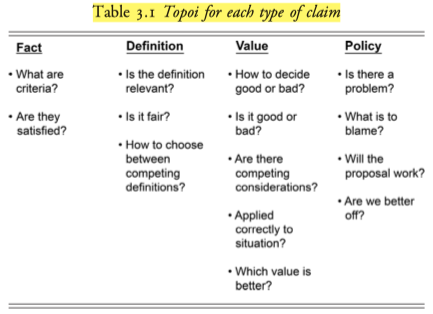
The concept of topoi serves two principal purposes, in sum. First, it is like a shortcut to identifying the issues on a given claim. It is an aid to what the ancients called “invention,” by which they meant identifying the available means of persuasion and selecting among them. The knowledge that topoi correspond to types of claims is a significant help in this regard. Second, referring to the topoi enables us to check whether we have a complete understanding of the relevant issues. If, for example, we know that one of the topoi on a policy claim is “Is there a solution?” and we know we are dealing with a policy claim, but we have not yet come up with any issue related to determining a possible solution, that set of circumstances will tell us that we still have more analytical work to do. (Page 79)
Stasis, Presumption, and Burden of Proof (Page 79)
When two opposing forces meet, similarly, there is just a moment of calm before the explosive impact is felt. So it is with two opposing arguments, where the imagined moment of calm identifies the fulcrum point on which the ensuing argument will balance. Identifying this point precisely will enable us to know the question that must be settled in order to end the dispute. It will tell us precisely what the controversy is. (Page 80)
Presumption and Burden of Proof (Page 83)
The concept of presumption performs several functions in argumentation theory. First, it determines who must initiate a dispute – the party who does not enjoy presumption. (Page 83)
Possibly the most controversial candidate for the status of natural presumption is the statement by the nineteenth-century archbishop Rich ard Whately that there is a presumption in favor of existing institutions. His reason was that “since change is not a good in itself, he who favors change must show cause for it.” In other words, Whately asserted that people were naturally conservative, not inclined to change unless they were given good reason to do so. (Page 85)
The burden of rejoinder is analogous to the production burden in law, the responsibility to produce evidence in response to the opposition. The production burden shifts back and forth as the competing lawyers advance their cases. In ordinary argumentation, the party enjoying presumption (the antagonist) meets this responsibility by challenging the justification that has been put forward on at least one of the issues, and the party with the burden of proof (the protagonist) meets this responsibility by offering justification for each of the issues that has been challenged. (Page 88)
Chapter 4: Evidence in Argumentation (Page 95)
Although argumentation is most centrally about claims, evidence is the basic building block advocates use to support their claims. For the argument to be successful, all parties to the dispute must accept the truth of the evidence. They may disagree about why it matters or what it means; they may dispute whether it really functions to support the claim or not; but on the basic question of whether the statement of the evidence is true the disputants need to agree. That is why, when one party does not accept the truth of the evidence, the other must provide additional evidence to back it up. Figure . shows the structure of an argument in which additional backing is needed for the evidence put forward. (Page 95)
major types of evidence – objective data, social consensus, and source credibility (Page 96)
General Standards for Evaluation (Page 107)
Contemporary argumentation theorist James A. Herrick has proposed seven general tests for the evaluation of evidence. These are critical questions which can be asked of evidence of virtually any type. (Page 107)
-
Accessibility. Is the evidence open and available for inspection by others? If evidence is kept in secret, it is impossible to know what it might say, whether it has been used in context, whether it can be replicated, and so on. Evidence that cannot be checked out should be automatically suspect. .
-
Credibility. Is the source of the evidence reliable? We have discussed the importance of credibility above with respect to testimony. But the tests apply to other kinds of evidence as well. For example, can the accuracy of statistics be trusted? Was there bias in the selection of examples to be used? (Page 107)
-
Internal consistency. Does the evidence contradict itself? The quality of evidence will be seriously weakened if it appears to undermine the claim it is intended to support. Even Abraham Lincoln fell victim to this problem early in his career when he finished a speech about reason by passionately calling out, “Glorious consummation! Hail fall of Fury! Reign of reason, all hail.” These and similar statements were not calm or reasonable; his tone and message were at odds. .
-
External consistency. Does the evidence contradict the best available evidence from other sources? We will have less confidence in a piece of evidence if it seems to work at cross-purposes from other things we know to be true. Evidence of massive voter fraud in a particular state, for example, will seem strange in the face of much other evidence that nationwide the problem of voter fraud is statistically insignificant. .
-
Recency. Has the evidence been superseded by more timely evidence? During the US presidential election, a major concern was that the unemployment rate had remained above percent for more than forty months. Citing this evidence would not be likely to do an advocate much good when the unemployment rate almost immediately after dropped below percent and continued a steady decline until Election Day and even after. Of course, recency is not always a relevant consideration. There are timeless questions that do not change and that may have been stated just as effectively by Aristotle , years ago as by one of his descendants today. But when timeliness of evidence does matter, than recency is an important consideration when evaluating the quality of the evidence. .
-
Relevance. Does the evidence bear on the conclusion? This might seem to be self-evident, but it is not uncommon for tangential or irrelevant evidence to be drawn on because, in its own context, it is evidence of high quality. But evidence is not valued for its own sake. Its value comes from its ability to help in establishing a claim. If the evidence really does not speak directly to the question at hand, it will not do that. Evidence about President Trump’s business dealings with Russia, in the aftermath of the US election, may have called into question the new president’s ability to be impartial, but it did not relate to the question of what US foreign policy with regard to Russia ought to be. (Page 108)
-
. Adequacy. This last test asks whether the evidence, if satisfactory in other respects, is enough to support the claim in whose behalf it is put forward, or whether still other evidence is required to do the job. Proving that there are major needs for infrastructure programs, for example, is necessary to establish that infrastructure spending would stimulate the economy, but it is not sufficient. Among other things, one would need also to establish that laborers with the necessary skills are available and ready to work in the places where they would be needed. (Page 109)
In addition, a few additional criteria should be noted: (Page 109)
- Accuracy. Does the evidence say what it purports to? In introducing the evidence, the arguer will characterize it a certain way. For example, she might say that it establishes that in the gross domestic product grew in all the major industrial nations of the world. Is that what the evidence actually says? Does it in fact refer to all the major industrial nations? Does it mean the same thing as the arguer does by such terms as “grew” and “major”? Were all of the supporting data really from ? .
- Context. Evidence does not exist in a vacuum; it gets its meaning from the context in which it is embedded. But if we are not careful, we can ignore or – worse – misrepresent that context by stating accurately what it is in the evidence but changing its intended meaning. This is even more likely if we paraphrase the evidence rather than quote it directly. Creative additions and deletions can worsen the problem. In advertisements for movies, for example, a few key words from critics’ reviews are taken as if they were reliable guides to the overall context. Thus “the most interesting movie to cure insomnia that has ever been made” can become “the most interesting movie … ever made.” .
- Appropriateness to the purpose. Some types of evidence are more appropriate than others for certain purposes. If the number of cases of a communicable disease can be counted, for example, then measurement is probably better for the purpose than the statement of a politician who says, “I believe it is a disaster for the current administration.” Factual evidence is more appropriate for a factual claim than is testimonial evidence. Conversely, a statement like “The health care system is a patchwork that is coming apart,” is more appropriate as an expression of a judgment than would be, say, a chart showing rising medical costs over time. To say that something abstract like “the health care system” is “coming apart” is a judgment, not an empirical statement, so the important consideration would be the credentials of the source, not the fact that testimony rather than empirical measurement is being employed. (Page 110)
Chapter 5: Argument Schemes (Page 115)
relationship between the evidence and the claim. Together with the truth and quality of the evidence, discussed in Chapter , this is the major consideration affecting the strength of an argument. The question is what enables the evidence to count as evidence for the particular claim. (Page 115)
formal deductive logic, the claim is entailed (or guaranteed) by the evidence. Another way to say this is that if the evidence is true, the claim must be true: to have true evidence but a false claim would be contradictory. What determines validity, then, is entirely a matter of form, and validity is understood as correctness of form. (Page 115)
In Chapter we looked at a simple diagram of an argument, reproduced here as Fig. .. Notice first that we have connected the evidence to the claim with an arrow pointing from the evidence to the claim. The arrow indicates an inference from the former to the latter. This suggests that the strength of the evidence is expected to strengthen the claim. Another way to say this is that the claim is stronger on the basis of the evidence than it is as an assertion alone. (Page 117)
Just as we saw that there are several types of evidence, it is also true that there are several types of inferences and warrants. (For purposes of categorization, we can use the terms “inferences” and “warrants” interchangeably at the moment, since an inference of type X will be authorized by a warrant of type X.) For any given type of inference, there will be patterns within that type, there will be critical questions to ask in order to decide whether the inference is reasonable in the given case, and there will be situations in which one should be extremely cautious about making the inference. What counts as valid will vary with the pattern of inference. These different patterns of inference are called argument schemes. (Page 118)
Argument from Example (Page 119)
Arguments based on example are arguments that relate parts to wholes. The underlying warrant is that the whole is basically like the part, or the part is basically like the whole – depending on the direction in which we are proceeding. (Page 119)
two types of example-based warrants: generalization and illustration. (Page 119)
Generalization proceeds from specific to general; illustration, from general to specific. (Page 119)
There are two major patterns of inductive generalization: statistical and anecdotal generalizations. (Page 120)
Tests for Example-Based Warrants (Page 121)
- Are there enough examples? If the number of examples is very small (especially if you are considering a statistical generalization), you may not be able to infer anything about the category as a whole. The reason is that you very well may have left out significant features of the population as a whole. If your university is doing an outstanding job of teaching argumentation, you still probably want to refrain from saying, “Today’s colleges are doing an outstanding job of teaching argumentation.” Your university may be an atypical case and you do not have enough examples to know. .
- Do the examples represent all the important dimensions of the category? A famous example from the s involved a poll that sampled only owners of telephones. Remember that this was during the Depression, when telephone ownership was not divided equally among the population. The poll confidently predicted that President Franklin D. Roosevelt would be defeated for reelection. Imagine the pollsters’ surprise when they realized that they had not considered a representative sample of the population. .
- Are the examples ambiguous? Sometimes the same example could support different, even conflicting, interpretations. Suppose that percent of a company’s employees indicate that they are dissatisfied with new computer systems that have been adopted recently. Does that mean that a significant majority of the employees want to get rid of the new system, or does it mean that they are eager for more training so that they can use it effectively? The example by itself will not tell you.
- (for generalization) Does the argument commit the fallacy of composition? Fallacies, as we will see in Chapter , are defined by some scholars as inferences that appear to be valid but actually contain some significant flaw. The fallacy of composition results from assuming that what is true of the part is automatically true of the whole, when in fact the part and the whole are two different levels of analysis. Sometimes the whole is more or less than the sum of the parts. For example, each individual athletic fan can improve his or her chances of getting a good seat by trying to buy a ticket as soon as they go on sale. But if everyone followed that practice, no one would be better off, because the supply of good seats is fixed.
- (for classification) Does the argument commit the fallacy of division? The fallacy of division is just the opposite of the fallacy of composition: assuming that what is true of the whole will automatically be true of each part. A real estate investor is trying to buy a plot of land for $ million in order to build a shopping center. The owner of one-quarter of that land cannot necessarily assume that his land is worth $, (one-quarter of the total). The land may be worth $ million only if the investor can get the whole plot. (Page 122)
Argument from Analogy (Page 122)
A second pattern of inferences and warrants is analogy. If example-based warrants are about the relationship between parts and wholes, analogical warrants are about similarities. The model analogical warrant is that things that are alike in most respects are probably alike in the respect at hand. (Page 122)
other main type of analogy is figurative. (Page 123)
figurative analogies are used to make abstract or unfamiliar concepts more concrete and easier to grasp, by showing that they are essentially like other concepts that already are accepted. (Page 124)
Argument from Sign (Page 126)
A third argument scheme is based on inferences (or warrants) about signs. Sometimes this is referred to as argument from symptom or symptomatic argument, but these terms all are referring to the same thing. The basic pattern of this inference is that the presence of the sign enables us to infer the presence of the thing signified. The key relationship is coexistence of the two. If two events or things habitually occur together, and we notice one of them, it is a reasonable inference that the other is present as well – not a guaranteed inference, but a reasonable one. It is important to be clear at the outset that a sign inference does not establish any influence of one thing on the other, but merely that they coexist. Perhaps the simplest example of a sign relationship is the barnyard adage that the crowing of the rooster in the morning is a sign of the rising of the sun. (Page 126)
Aristotle distinguished between fallible and infallible signs. An infallible sign is one that always and necessarily coexists with the thing signified. Such a sign would be a deductive warrant because the presence of the sign would guarantee the presence of whatever the sign stood for. The claim would repeat what already was present, at least implicitly, in the subsidiary claims, and there would be no new information. (Page 128)
Argument from Cause (Page 130)
where the inference is about influence of one factor on another. It is complex because influence usually is unobservable and is inferred by residues – by the failure of any other factor to substitute for the influence that is asserted. Some examples may make this clear. (Page 131)
During the nineteenth century, the philosopher John Stuart Mill iden tified several approaches to establishing causality. One was called the method of difference. Take two things that are different, Mill proposed. Hypothesize what causes the difference. Then systematically hold the two things constant with respect to every other factor. If the only factor in which they are different is the one that you hypothesized, and they are nonetheless different in the end, then the cause of that difference must be the factor that you hypothesized – for the simple reason that the things are alike in every other respect. By residues, the cause of the difference must be the factor that you identified. (Page 131)
Mill’s second approach, the method of similarity, is just the reverse. Take two things that are similar to each other. Hypothesize what causes them to be similar. Then isolate every factor that you can, other than the one you hypothesized, and make sure that the two things are different with regard to every one of those other factors. Then, since the items are similar in the end, the cause of the similarity must be the one factor that you held constant – because none of the other factors, being different, could have produced similarity. (Page 131)
In everyday argumentation, then, we must be prepared to establish justify them. causal warrants by supporting arguments that (Page 131)
Types of Cause-Based Warrants (Page 132)
One subtype of explanations is the retrospective hypothesis, which seeks to answer the question, “Why did x happen?” (Page 132)
second subtype of explanations is the resolution of paradox. (Page 132)
A final subtype of causal explanations is the causal generalization. These statements are sometimes called “covering laws.” They are general statements about what causes what, which can be used to make causal statements in a particular case. (Page 133)
The framework for this argument is () E (the effect) occurs; () C ➔ E (the causal generalization); therefore () C is the cause. (Page 133)
Tests for Cause-Based Warrants (Page 134)
- Has a sign relationship been mistaken for a causal relationship? Sometimes what is really a correlation can be wrongly claimed to be a cause. For example, the early studies on smoking and health suggested that cigarette smoking was correlated with higher rates of lung cancer. Those opposed to regulating tobacco responded that there was no reason to believe that there was a causal relationship. (Subsequent research weakened this response by effectively eliminating other possible causes and furnishing an explanation of how tobacco use led to lung cancer.)
- Is there a post hoc fallacy? The Latin phrase post hoc means “after this.” While it is true that a cause must precede its effect, the fact that something comes after something else does not necessarily mean that what came later is an effect of what came before. Republicans note that the Cold War ended while President Reagan was in office and maintain that he was the cause; Democrats note that the economy enjoyed sustained growth while President Clinton was in office and maintain that he was the cause. Both claims are dubious. In the absence of good reason to believe the causal link, they are likely both self-serving cases of the post hoc fallacy.
- Is there a common cause? Sometimes one thing may be asserted to be the cause of another, when in reality both are effects of a third is the cause of both. For example, some advocates factor that suggest that widespread alcohol use on college campuses, compared with earlier years, leads to an increase in suicides among college students. There may indeed be a causal influence of alcohol after holding other factors constant. But there is also a strong argument that an increase in various personality disorders among students entering college is what leads both to increased alcohol use and to increased rates of suicide, without either alcohol use or suicides directly affecting the other.
- Is there a plausible alternative cause? Sometimes what appears to be the cause really is not. For several years beginning in there were prominent cases of unarmed African Americans who were killed by police in the course of their investigations. Some suggested that the cause was that African Americans were more likely to live in highcrime areas and thus to encounter the police in ambiguous situations, but others suggested that the more plausible causal explanation was racial discrimination on the part of many police officers.
- Are there significant multiple causes or effects? These questions come into play especially when cause-based inferences are used to justify policy positions. The world is complex; causes have both intended and unintended consequences; and effects seldom have only one cause. Suppose that a problem – differences in educational achievement between urban and suburban schools, for example – has many causes, including differences in budgets, teachers’ preference to work in suburban schools, differences in transiency of the school populations, difference in parental commitments to education, and so on. In such a case, addressing one of the causes – spending more on urban schools, for example – may not make a huge contribution to solving the problem unless it is part of a coordinated strategy that addresses the whole complex of causes. Likewise, a single cause may have multiple effects. Some may be undesirable, while others are desirable. Getting rid of the cause could diminish or eliminate the desirable as well as the harmful effects; the popular expression for this is “throwing the baby out with the bath water.” Attempts to limit global trade in order to protect domestic jobs, for example, might also harm the telecommunications and shipping industries, raise domestic prices, and invite retaliation by other nations – effects that could be argued to be far more substantial than the protection of domestic jobs. (Page 136)
Argument from Testimony (Page 136)
The basic pattern is: () X asserts a claim; () X is a reliable authority concerning that claim; () therefore, the claim is probably true. Our willingness to act on the basis of testimony reflects the fact that none of us can claim authority over every subject affecting our lives, so we have to rely on the judgment of those who can be considered authoritative in any given case. The inference, then, is about the credibility of the source. (Page 136)
Tests for Testimony-Based Warrants (Page 137)
- Is the source an authority on the particular topic? It is not enough that the source be generally well qualified; he or she should be an expert on the particular subject. Celebrities are usually not expert on the merits of different consumer products, just as a nuclear physicist is probably not an expert on popular culture.
- Is there a basis for the source’s statements? If the source is offering judgments, it should be clear that he or she has a basis for them. Without such a basis, the source is pontificating – making statements with no support other than the source’s say-so. One clue that a source may be pontificating is the use of hyperbolic statements such as “Governor Smith is the worst governor our state has ever had.” Such statements deserve little weight. When we accept a claim on the basis of what an authority has said, we assume that the authority has some reason for the statements made. . (Page 137)
- Is the source reasonably unbiased? No one is completely free from bias or susceptibility to a particular viewpoint. An inference from testimony is more likely to be suspect if the source has a personal selfinterest in the testimony or stands to gain financially from it. For example, a real estate developer is probably not the most impartial person to testify about whether a development in which he or she is involved is likely to be environmentally safe. The fact that an expert stands to gain from testimony does not necessarily make the testimony wrong, but it does suggest that healthy skepticism should be in order. This is the same reason that, as noted in Chapter , reluctant testimony generally is preferred over eager testimony.
- Is the testimony up-to-date? Some subjects are timeless: moral principles stated centuries ago are usually just as valuable now as they were then. But on most matters, especially when statistics or empirical data are involved, recent testimony may be of greater value than older testimony. (Page 138)
One way to hedge one’s bets against these tests is to offer testimony from multiple sources. If a claim depends on the testimony of a single source, it can be weakened if that source cannot satisfy all of these tests. But if you can establish a strong consensus among multiple sources with different backgrounds and interests, it is less likely (though still possible) that they all will suffer from these problems. (Page 138)
Conclusion (Page 140)
Warrants, and the argument schemes built from them, are especially important in understanding everyday argumentation. While they are not absolutely certain, they are not arbitrary or capricious either. They furnish licenses for making claims on the basis of the evidence that has been advanced. In this chapter we have examined six basic argument schemes and their underlying warrants: example, based on the warrant of representativeness; analogy, based on the warrant of similarity; sign, based on the influence; warrant of predictiveness; cause, based on the warrant of (Page 140)
testimony, based on the warrant of credibility; and form, based on the warrant of expectation. We have suggested that properly warranted arguments can be considered valid: if their evidence is correct, their claims should be acceptable. This is the everyday equivalent of validity in formal deductive logic. Everyday arguments do not assert that the claims follow absolutely from the evidence, but rather that the claims are justified – sufficient reason has been given for reasonable people to accept them. Conversely, unwarranted or improperly warranted arguments can be said to be fallacious: the claim is not justified even if the evidence is true. The factors making for fallacious arguments are the subject of Chapter . (Page 141)
Chapter 6: Fallacies (Page 148)
Fallacies are invalid arguments. Even if the statements they offer as evidence were all true, those statements would not warrant an inference to the claim. Another way to say this is to say that the relationship among the statements and the claim is not right. (Page 148)
In deductive reasoning, fallacies are errors in the form of the argument. The content of the argument is irrelevant to fallaciousness; substantive content could be replaced by symbols or letters of the alphabet and judgments of validity or fallaciousness would be the same. (Page 148)
It is true that many fallacies have a superficial resemblance to valid arguments and it may be necessary to think critically in order to spot the deficiency. But that is not the defining condition. In fact, many of the examples commonly used to teach fallacies have deficiencies that are quite obvious even to the untrained observer; that is why they make such good illustrations for teaching. Besides, such a definition fails to answer to whom the argument “seems valid” and, furthermore, how any person to whom it truly seems valid would recognize it as fallacious. Training in argumentation can make a person better able to identify fallacies, but a person so trained will also be less likely to think that fallacious arguments “seem valid” in the first place. It is better to avoid all these confusions by ignoring any question about how an argument seems, focusing instead on what a fallacy is: a deficiency in the relationship among the statements in an argument, setting aside their truth or falsity. (Page 149)
What makes the relationship deficient is that the warrant, if properly understood, does not authorize the inference from evidence to claim. It may authorize some other inference entirely, or – even more often – we cannot know from the argument what, if anything, it will authorize or where it will lead. It might lead to the claim, but it might just as likely lead to one or more alternative claims; there is no way to know. (Page 149)
Common fallacies are grouped under four general headings: fallacies of specific warrants, fallacies of clarity, fallacies of relevance, and fallacies of vacuity (Page 149)
unlike in deductive reasoning, none of these patterns is inherently fallacious. At least for most of them, one can imagine situations in which they are perfectly reasonable arguments (Page 149)
Fallacies of Specific Warrants (Page 150)
Example (Page 150)
Warrants from example, you will recall, justify inferences that relate parts to wholes, by showing either that a specific instance is an example of a generalization or that a generalization applies to a specific instance. (Page 150)
Three principal fallacies associated with this warrant are hasty generalization (sometimes called by the Latin term secundum quid), the fallacy of composition, and the fallacy of division. (Page 150)
Hasty generalization results when a generalization is made from too few or from unrepresentative examples. (Page 150)
The fallacy of composition assumes that what is true of the part is true of the whole, in a situation in which the whole is more or less than just the sum of the parts. (Page 150)
And the fallacy of division is just the reverse, assuming that what is true of the whole is necessarily true of the part. (Page 150)
Analogy (Page 151)
Warrants from analogy justify inferences about comparison, suggesting that items alike in most respects probably are alike in the respect being discussed. The major fallacy of this warrant is false analogy. The two items being compared may be similar, but remember that they are not identical. They might differ in some essential feature directly relevant to the comparison. It is always necessary to ask whether the essential points of similarity outweigh the essential points of difference. If the answer is No but you proceed as if the answer were Yes, there is greater risk of invoking a false analogy – wrongly assuming a similarity in one respect merely because there are other respects in which the two items are alike. (Page 151)
Sign (Page 151)
Warrants from sign are used in arguments about representations, justifying inferences that relate unknowable essences to their observable properties. They enable us to make predictions about the underlying condition or abstraction from the presence of the tangible representation. If we accept that one thing is a sign of another, then the presence of the first thing should enable us to infer the presence of the second. But the relationship between the sign and the thing signified could turn out to be nothing more than coincidence, or the same sign could herald more than one underlying condition – even underlying conditions that are inconsistent and work at cross-purposes. And another difficulty with sign inferences is that they tell us nothing about why the essential feature and the external property go together. In particular, we do not know that either condition exerts any influence on the other, so making judgments about what we should do in the future based on a sign relationship can be fallacious. Suppose we know that inflation tends to be low when presidents of the Republicrat party are in office. Since we don’t know why this relationship exists, it does not follow that if we elect the Republicrat candidate in the next election, low inflation would ensue. We need to remember that sign warrants justify inferences based on correlation, not causal links. (Page 151)
Cause (Page 151)
Warrants from cause, in contrast, go beyond correlations. They not only assert that one thing represents another; they account for the relationship by maintaining that one thing exerts influence over another. They are used to (Page 151)
justify inferences that predict the consequences of our actions, to explain the reasons for a given condition or circumstance, or to relate means to ends (“if you want to bring about X, you should do Y”). The difficulty is that causal influence is not observable, and, as we saw in the “Extensions” section of Chapter , there are differences among philosophers about what it means. Whichever view of the nature of causality one accepts, other inferences that may even resemble causal inferences will turn out to be fallacious. (Page 152)
For example, a cause must precede its effect, but just because one event comes first does not mean that it causes the one that comes second. To assume otherwise is to commit the fallacy known by the Latin term post hoc ergo propter hoc (after this, therefore because of this). It is the wrongful attribution of causality to what is merely a temporal sequence. Or the causal relationship might be the reverse of what it looks like: the alleged cause is really the effect, and vice versa. Or the factors that look like cause and effect may actually both be effects of a common cause. Violence on the border between two nations, for example, may be thought to cause political disruptions when in fact it is political disruptions that lead to the border violence. (Page 152)
Testimony (Page 152)
Warrants from testimony justify inferences on the basis of assertions by a credible source. We are led to accept a claim (“p is true”) because of trust in X (“X is a reliable authority concerning p”). Trust in X is what enables us to get from “X says p” to “p is true.” But these arguments can go astray if the connection is unwarranted. This can happen if X is not really a reliable authority, if X is not really speaking about p, if X has no possible way to know about p, or if X has not thought about p and is merely pontificating. (Page 152)
Form (Page 152)
Warrants from form justify inferences from the sense of anticipation or completion that characterizes formal systems such as mathematics or deductive logic. (Page 152)
A good example is hypothetical reasoning (if X, then Y; X; therefore Y). The two fallacies associated with this pattern are affirming the consequent and denying the antecedent. Affirming the consequent (Y in the example above) tells us nothing about the presence or absence of X, because even though X would bring about Y, Y could also occur for reasons entirely independent of X. In the same way, denying the antecedent (asserting “not-X”) tells us nothing about the presence or absence of the consequent, because Y could have occurred for reasons unrelated to X. These two fallacies can be found not only in formal deduction but also in everyday argumentation. (Page 153)
Another example of a fallacy of form occurs in categorical reasoning, which is reasoning about the relationship between categories. A classic example of categorical reasoning is: all dogs are mammals; all mammals are living beings; so all dogs are living beings. This all happens to be true, but that is not the point. It is a valid argument because the members of the first category are placed within a second category which in turn fits entirely within a third; so necessarily all the members of the first category will fit within the third. (Page 153)
An easier way to remember this fallacy is to say that two things can both be related to a third thing without necessarily being related to each other at all. (Page 153)
A third example of a fallacy of form is the confusion between the exclusive and the nonexclusive sense of the term “either/or.” (Page 153)
The final example of a fallacy of form involves narrative reasoning. Because we find a coherent story satisfying, we do not always notice when story elements are missing, and we may assume their existence without a foundation for doing so. When we do that, we are more likely to make fallacious inferences, such as imaginary plots and conspiracies, where none exist. Or we may assume that people’s motivations are so strong and allconsuming that they overwhelm contrary tendencies and lead to unbalances and unrealistic accounts of actions. We also are more prepared to believe that good things happen to us because of our own actions and that bad things happen to us because of events beyond our control than we are to believe the opposites of those claims (Page 154)
Fallacies of Clarity (Page 155)
Vagueness (Page 155)
An obvious example of such a fallacy is vagueness. This is a situation in which a term could have many possible referents and we have no way to determine which is meant. (Page 155)
Ambiguity (Page 155)
Closely related is the fallacy of ambiguity. In this case a term has multiple, but finite, meanings, and it is not clear which meaning is intended in the argument. (Page 155)
Amphiboly (Page 156)
While ambiguity refers to a term with multiple meanings, the same condition applied to a phrase or sentence as a whole is called amphiboly. (Page 156)
Equivocation (Page 156)
Another closely related fallacy is equivocation. This fallacy is committed when a word can be used in multiple senses and the sense in which it is used changes during the course of the argument. Instead of two arguers using the same term but with different meanings, the same arguer uses the same term differently during the same argument. (Page 156)
Heaps and Slippery Slopes (Page 157)
imprecision of language. They both relate to difficulties in determining when a difference in degree becomes a difference in kind. They may be easier to grasp with examples than with definitions. Here are examples of the fallacy of the heap. A man in his early s decides to grow a beard. As it comes in, its color is dark. When the man turns , he notices a few white hairs in his beard, but there aren’t enough of them to notice much difference in the color of the beard; it is still dark. At there are a few more, at a few more, and so on every year or two. But never do enough hairs change color to change the overall color of the beard. How, then, does it happen that at age the man’s beard is solid white? We have just shown that there was no point at which the beard changed color! You probably can see why this fallacy is called the heap. It says that since the addition of one grain of sand does not make any appreciable difference to what was there before, we are never able to pile up the sand into a heap. (Page 157)
The fallacy of the slippery slope is the reverse of that of the heap. It consists of the assumption that any difference of degree will become a difference in kind, because once we start on a particular path, events will push us along on a course that we can neither reverse nor change. The fallacious claim is that we should not take a particular action now, because if we do, there will be no opportunity to reverse or change course later. Inevitably we will continue along that path until a difference in degree has become a difference in kind. (Page 158)
Fallacies of Relevance (Page 158)
irrelevant element is introduced and appealed to, disrupting the relationship between the evidence and the claim. (Page 158)
The fallacies in this group often are identified by their Latin names, and many begin with the word ad, meaning “to” and referring to the irrelevant element on which the arguer fallaciously is relying. Here are some common examples of fallacies of relevance. (Page 158)
Ad Hominem (Page 159)
personal attack that diverts from the substance of the argument, but that is only one type of ad hominem argument, and as we saw earlier is better identified as ad personam. (Page 159)
Another kind of ad hominem argument is the bias type, which alleges that an arguer’s claim should not be taken seriously because it is swayed by self-interest or some other form of bias. (Page 159)
There is a third type of ad hominem argument that is almost never fallacious, though sometimes it is treated as if it were. This is the circumstantial ad hominem argument, which suggests that a particular person cannot advance a specific claim because it is inconsistent with other commitments that person has made in the argument, or with the person’s own behavior. (Page 159)
Ad Verecundiam (Page 160)
Appeal to authority (ad verecundiam) is a fallacy if the authority being appealed to is unrelated to the argument at hand. (Page 160)
Ad Populum (Page 161)
Appeal to popular opinion (ad populum) is a fallacy if the argument is not about what public opinion is – in which case it would be directly relevant – but rather about the truth or falsity of some other claim. (Page 161)
Ad Baculum (Page 161)
Appeal to threat (ad baculum) asks someone to support a claim not because of its own strength but because of the threat of harm if he or she does not. (Page 161)
Ad Misericordiam (Page 161)
Appeal to pity (ad misericordiam) asks for support for an argument based on sympathy for those who have suffered harm or loss, rather than on the merits of the action itself. (Page 161)
Ad Ignorantium (Page 162)
Appeals to ignorance (ad ignorantium) consist of treating ignorance regarding a claim as if it were positive proof of its falsity. (Page 162)
Fallacies of Vacuity (Page 162)
The last category of fallacies that we will consider are those of vacuity, or emptiness. They are so named because, while they may look like arguments, the arguments really do not go anywhere. (Page 162)
Circular Reasoning (Page 162)
Circular reasoning is a fallacy in which the claim merely repeats the grounds in slightly different terms. (Page 162)
Begging the Question (Page 163)
Begging the question (sometimes called the fallacy of many questions) occurs when a claim treats as a settled matter some other claim that itself is controversial and needs to be proved. It assumes to be true something that must be proved to be true. The standard example is “Have you stopped beating your spouse?” (Page 163)
Ignoring the Question (Page 163)
Ignoring the question is the result of a digression or a focus on a matter extraneous to the subject at hand. It occurs especially in dialogues in which one party finds a topic uncomfortable and would like to divert the conversation to a different topic. (Page 163)
Non Sequitur (Page 164)
The fallacy of non sequitur (“it does not follow”) may sound like a catchall term for all fallacies, because what they have in common is that the claim does not follow from the grounds since the inference is not warranted. But this fallacy has a more specific referent. It occurs when an arguer makes two or more statements, one of which is assumed to be the claim, and the other(s) the grounds, when in fact the statements have nothing to do with each other and there is no basis for connecting them (Page 164)
Straw Man (Page 164)
The fallacy of the straw man consists of erroneously characterizing another person’s position, making it weaker than it really is, and then responding to this weakened characterization. (Page 164)
Self-Sealing Arguments (Page 165)
self-sealing argument is a fallacy because there is no way one possibly could prove it false. (Page 165)
Indeed, in formal deduction a self-sealing argument would be valid, because the conclusion follows absolutely from the premise. But this occurs not because the argument is “perfect” but because it is designed to adjust its shape to envelop any challenge. If there is no possible way to prove it false, there is no way to know whether it is really true. (Page 165)
Chapter 7: Case Construction (Page 172)
The structure of subsidiary claims and evidence to support or oppose a resolution is called a case. If the case supports the resolution, it is called an affirmative case (because it affirms) and if it opposes the resolution, it is referred to as a negative case (because it negates). (Page 172)
The Case and the Issues (Page 172)
The first responsibility of an advocate is to present a prima facie case. The Latin term prima facie means “first face” and refers to a case that, on first reading or hearing and in the absence of attack, would be sufficient to convince a reasonable person of the merit of the resolution. (Page 172)
How, then, do you assemble a prima facie case? (Page 173)
- The issues can be determined by quizzing the terms in the resolution. For example, if the resolution in dispute is “Mixed marriages seldom succeed,” you will need to answer the questions, “What is a ‘mixed marriage’?” “What counts as ‘succeed’?” “What do we mean by ‘seldom’?” and “Are these conditions satisfied?” These will be the issues on that particular resolution. Now, not all of these issues will prove controversial. For instance, although in the s “mixed marriages” was used to refer to marriages between Christians of different religious denominations, there may be general agreement that the term currently refers to interracial marriages. If so, then the answer to that question may be stipulated and not controversial. In that case it would be removed from the list of issues that must be answered in order to affirm the resolution. So after quizzing the terms of the resolution, the issues would be those questions that remain contested between the parties. .
- A second way to discover the issues is by examining the contemporary context of the subject matter. For example, one of the recurring controversies of the past forty years has been what the ideological composition of the US Supreme Court should be. If you examine the discourse of this controversy, you will discover that there is fairly widespread agreement that Supreme Court Justices should not “make law from the bench.” But what that phrase means is neither clear nor consistently maintained. When the Supreme Court intervened to effectively decide the presidential election, their ruling was decried as “judicial activism” by many of the same people who applauded an activist Court in other contexts, and it was celebrated by those who often had condemned judicial activism in other rulings. You will quickly discover that the ideological disposition of the Court cannot be stated in such broad terms but is related to specific contexts. So if you wanted to argue that there should be more conservative Justices on the Court, you will need to examine such things as the principles of the Federalist Society in order to determine what counts as conservative in the current context. Again, not every potential issue will actually be contested – for example, it may be the case that virtually all jurists calling themselves conservative believe that there is an individual right to own guns. That could be stipulated as one of the characteristics of conservative judges. The issues are those contextual questions that are contested, after removing from the list those that are stipulated or agreed to by the parties to the dispute. .
- A third way to determine the issues is by applying the concept of topoi that we discussed in Chapter . If you can determine, for instance, that the resolution that the United States should adopt a single-payer system for financing health care is a policy resolution, then you can refer to the topoi for claims of policy, and you will know that you need in some fashion to speak to the questions, “Is there a problem in financing health care?” “Will the problem persist in the absence of a single-payer system?” “Will a single-payer system solve this problem?” and “On balance, will a single-payer system be desirable or undesirable?” Now, once again, although all of those questions are potential issues, not all will be contested in any given case. It may be the case that virtually everyone agrees that there is a problem in financing health care (whether because costs increase at a rate outstripping inflation, because significant numbers of people are left without insurance, because the health care consumer lacks the incentive to try actively to control his or her costs, because people have an incentive to overconsume, or for whatever reason). If that is so, then whether there is a problem is no longer an issue, because it can be stipulated that there is. As with the other methods of determining the issues, the actual issues in a controversy are what remain after deleting the matters agreed to from the list of potential issues. (Page 174)
Selection of Claims (Page 176)
One way to prepare for this argumentation is to imagine all the arguments that could be used to establish each of the issues. (Page 176)
The process of generating a list of possible arguments is referred to as preparing a brief. This is a misnomer because the resulting list usually is not brief at all! (Page 176)
How Many Claims? (Page 177)
But why not include both the difficult and the easy to prove? There are two main reasons. First, time is limited. Even if there are no formal time limits (in oral discourse) or space limits (in written discourse), there are limits to an audience’s attention and patience. Since time and space are scarce resources, better to employ them in the service of arguments that are easier to prove. And second, audience doubt is contagious. An argument that a listener or reader judges to be not credible is likely to impair the credibility of the rest of the arguments as well. (Page 177)
This leads to a second consideration that may lead us to reduce amplitude. Some arguments are simply not credible to most people, even if an arguer could establish that they might be true. (Page 178)
Another consideration is that some arguments may be functionally equivalent – they say the same thing, or close enough to the same thing that little is gained by offering both. (Page 178)
Yet another factor to consider is whether presenting a supporting argument will do us any good. (Page 178)
Yet another risk is that some of the statements may rest on assumptions that themselves cannot be well supported if challenged (Page 178)
Finally, whenever we present a large number of arguments, there is the danger that some of the arguments counteract one another. This can happen in either of two ways. The arguments could be contradictory, meaning that one denies the other so that they cannot both be true. Or they could be contrary, meaning that they work at cross-purposes. Logically they might both be true, yet they are in tension with each other. (Page 179)
For all these reasons, it is not always or necessarily a good idea to try to achieve the greatest possible amplitude. Claims are not decided by counting up the number of supporting arguments for and against, but by making a judgment about whether the supporting arguments, taken together, establish the claim. (Page 179)
Which Claims? (Page 180)
The judgment of how many claims to present is closely related to the judgment of which claims to present. The objective is to present the strongest arguments from among those that are available. The strength of an argument is a function of two considerations: How easy will it be for you to establish the claim? And if you establish it, how much will it advance your case by contributing to the main claim (resolution) you are trying to establish? (Page 180)
In considering the first of these questions, it is important to consider for whom you are seeking to establish the truth of the supporting argument. (Page 180)
recognition of the audience’s starting point is a way of recognizing what Aristotle observed long ago, that arguments are not persuasive in the abstract; they are persuasive to a person. (Page 181)
Another aspect of determining how easy it is to establish a claim is deciding how well it will withstand attack. (Page 181)
The initial construction of the case should consider what possible responses it might attract. The advice here is to be your own worst critic. Don’t just imagine simple attacks that could be dispatched easily. Ask yourself instead what an opponent might say that would cause your argument the greatest trouble, and then consider how easily you could rebuild the argument in response to this attack. This is what philosopher Ralph Johnson calls meeting your dialectical obligations in the construction of your case. (Page 181)
The second component of strength, as noted above, is how much good the supporting argument will do in helping you to advance the main claim that you are trying to establish. (Page 181)
Selection of Supporting Evidence (Page 182)
Once an arguer has decided which claims to advance in order to support the main claim, there will be the further choice among pieces of evidence to establish the supporting claim itself. (Page 182)
If you have many pieces of supporting evidence and present them all, it may seem like overkill. You may run out of time or exhaust the patience or attention span of your audience. (Page 182)
In some cases it may be worth these risks because of the potency of that evidence, but in most cases a single piece of evidence will seem too little, just as a barrage of evidence might seem too much. (Page 182)
The following are some additional criteria when you are choosing among different pieces of evidence. (Page 183)
Relevance (Page 183)
Replicability (Page 183)
Underlying reasoning. (Page 183)
Source credibility (Page 184)
Track record. (Page 185)
Timeliness (Page 185)
Conciseness (Page 186)
they will satisfy the tests for inclusion of arguments (or evidence) by answering affirmatively these four questions: () Are they simply stated? () Are they discrete rather than repetitive? () Are they coherent, making sense in their own right? () Are they complete, so that taken together they speak to all the issues? (Page 187)
Arrangement (Page 187)
You may be wondering why, in light of this constraint, one would ever choose to employ a subordinative argument structure. The answer is that this structure develops a sense of momentum. (Page 188)
If you have a coordinative or multiple argument structure, however, you have additional decisions about the order in which to present the supporting arguments. Because these arguments are independent of one another, it is logically a matter of indifference in which order they come. This means that considerations other than logical sequence can come into play. (Page 188)
Should the strongest argument be presented first or last? (Page 189)
Some studies support placing the strongest argument first, in order to make a powerful first impression on the listener, which in turn will enhance the perception of the remaining arguments – a sort of “halo effect” in which the glow from the strongest argument will shine on all the others. Other research has suggested just the opposite – that the strongest argument should be presented last, in order to make a strong final impression that will remain with the listener even after the entire presentation is over. The point on which the research seems to agree, however, is that the weakest argument should be placed in the middle – that both the first impression and the final impression are more important than the impression made by the arguments that come in between. (Page 189)
How should listeners’ familiarity with different arguments affect the order of presentation? (Page 189)
The more complex or counterintuitive the new argument, the more it makes sense to proceed from the familiar to the unfamiliar. On the other hand, if the new argument – though unfamiliar – is easily grasped and can be said to be a matter of common sense, it might be better to do the work of presenting the unfamiliar argument at the start. (Page 190)
In what order should different topics be taken up? (Page 190)
starting off with aspects of the topic that may not be salient to the audience may lead listeners to think that you are dodging the question or arguing about trivial or inconsequential sidelights. (Page 190)
Should you include anticipatory refutation? (Page 190)
The findings indicated that the “two-sided” message was more effective under either of two conditions: the audience was highly educated or the audience was known to be predisposed against the speaker’s view. The reasons were that a highly educated audience would likely be engaged in critical thinking and would likely realize that the subject was complex and that not all of the supporting arguments were on one side. (Page 191)
Should you employ one of the common organizational patterns? (Page 191)
Among them are () chronological order, moving either from past to present (and possibly to future) or the reverse; () spatial order, proceeding from near to far, far to near, or along a directional arrow (east to west, north to south, etc.); () topical order, identifying a common pattern of topics such as economic, military, and political; () causal order, either proceeding from cause to effect or from effect to cause; () problem– solution order, first identifying a problem and then offering and defending the candidate solution; and () residues, a pattern that identifies and eliminates all possible options save one, which then becomes the preferred choice almost by default. Although these standard patterns sometimes may be thought to lack originality, their very familiarity presents arguers with an advantage. (Page 191)
common organizational pattern will reduce the mental effort required of listeners to understand and follow a complex argument. (Page 192)
nonetheless important for being rhetorical considerations, and the pattern in which an argument is cast affects perceptions of the argument itself; form and content are intertwined. For these reasons, considerations of strategic maneuvering should be taken seriously when choices are available. (Page 192)
Executing Case Construction Decisions (Page 192)
Two common tools are available to help in executing decisions about selection and arrangement of arguments and evidence: the brief and the case outline. (Page 192)
The brief is a comprehensive outline of all the possible arguments you can imagine for and against the resolution at issue, and all the evidence you are aware of that will support these various arguments. It is an exhaustive catalog of your options. Its advantage is that it forces you to make selection and arrangement choices consciously, because you cannot include everything. Thinking strategically about which arguments and evidence are the strongest, you can make your selections from among the options identified in the brief. (Page 192)
The case outline, as the term suggests, is an arrangement in outline form of the arguments and evidence you have chosen to use, arranged in the order in which you have chosen to present them. (Page 192)
you can test the case outline by asking some key questions. First, does it address the topoi on which you must prevail in order to establish the case? If not, you will need to modify the case outline by adding more material until it does. Second, does the case outline display the strongest strategic choices? Compare the selections you have made for the case outline against others on the brief that you rejected. (Page 192)
Third, is there too much on the case outline? (Page 193)
Chapter 8: Attack and Defense (Page 197)
The case represents what its advocate believes are the strongest arguments for the claim (usually an explicit or implicit resolution) that the advocate has undertaken to defend. (Page 197)
The goal of attack is to undermine the case; the goal of defense is to revive and strengthen it. Sometimes the term refutation is used as a synonym for attack and rebuttal is used as a synonym for defense, but in fact both refutation and rebuttal are employed in both attack and defense. Furthermore, these processes themselves are interrelated. Attacking one’s opponent’s arguments is also a means of defending one’s own, and vice versa (Page 197)
First, the competition that takes place is not between people but between ideas and arguments. Second, the adversarial elements of argumentation serve a larger cooperative purpose: rigorously testing arguments so that the strongest will emerge. (Page 198)
Selection Choices in Attack (Page 198)
Which Arguments to Attack? (Page 198)
If the case was composed entirely of arguments within a subordinative structure, then only one need be defeated for the entire case to fall. Undermining one of the steps in the claim would defeat the opponent’s position on one of the issues, questions that are vital to the opponent’s case. The rest of the case might be entirely true and yet the loss of the critical link would demonstrate that the resolution has not been supported. (Page 198)
If the case was composed entirely of arguments within a multiple structure, then it would be necessary to defeat all the arguments in order for the case to fall (assuming that the arguments really are different and are not restatements of the same point). This is true because multiple arguments independently establish the resolution. If one of the supporting arguments were to fall, the remaining supports would still provide reason for the resolution. There is a practical (Page 198)
consideration, however. If all the strong arguments in a multiple structure were defeated and only weak ones were to remain, an impartial observer might conclude that the remaining weak arguments are not weighty enough to establish a prima facie case. (Page 199)
If the case was composed entirely of arguments within a coordinative structure, then it is necessary to defeat at least one of the coordinative elements linking to the resolution. Suppose, for instance, that an advocate has argued that a hostile adversary poses a significant military threat because it has the means, motive, and opportunity to develop nuclear weapons. What makes it a threat is the combination of means, motive, and opportunity. For instance, if it had the motive but lacked the means to develop nuclear weapons, then presumably it would not pose a threat. (Page 199)
These general guidelines, however, are overly simplistic in two main respects. First, cases almost never will be composed entirely of arguments of one structural type. They will contain combinations of multiple, coordinative, and subordinative structures. As a result, the process of selecting what needs to be attacked will be more complex and intricate. (Page 199)
advocates usually are advised to attack more arguments than the absolute minimum they need in order to prevail, as a means of hedging one’s bets. (Page 199)
it usually is not necessary to attack every argument in the opponent’s case, and there may be good reasons not to do so. Several examples suggest circumstances in which attacking an argument may be unwise: (Page 199)
- Doing so may waste the attacker’s time on arguments that are extraneous to the case. (Page 199)
- Attacking some arguments might do you little good even if you prevail. Remember that the purpose of attacking an argument is to defeat it, not merely to have something to say about it. . (Page 200)
- Attacking every argument might involve you in internal inconsistencies, weakening the credibility of the attack. (Page 200)
If you choose not to attack an argument, you have two other principal options: acknowledging it or ignoring it. The first of these is sometimes referred to as “admitting” the argument, but that has connotations of being caught in a trap. In fact, acknowledging the argument is often accompanied by a statement trivializing the argument or its significance, such as “Everybody knows that,” “The argument doesn’t matter,” or (in an ironic tone) “What a surprise!” The other choice is simply to say nothing about the argument, rather than calling attention to the fact that you are letting it pass. (Page 201)
Which Step in the Argument to Attack? (Page 201)
When we drill down to the core of an argument, we will find the basic components of claim, evidence, and warrant, as described in Chapter . (Page 201)
The claim. One option is to attack the claim directly, either by denying it outright or by developing a counter-claim. Denial locates the stasis (see Chapter ) at conjecture, whereas a counter-claim picks one of the other available stases. (Page 201)
The evidence. Another approach is to attack the evidence on which the claim relies. Undermining evidence does not establish that the claim is clearly false, but rather that it has not been proved to be true. (Page 202)
The warrant. We saw in Chapter that evidence is connected to claim by an inference and an explicit or implicit warrant licensing that inference. The warrant is a general statement that, on the basis of information like that in the evidence, one is justified in drawing a conclusion like that contained in the claim. There are several ways in which one might focus an attack on the warrant and thereby demonstrate that the argument has not been proved. (Page 203)
- One approach is to deny the warrant explicitly . (Page 203)
- A second approach to attacking the warrant is to maintain that the case at hand is an exception to a warrant that may be generally applicable. To understand this, we need to review the discussion from Chapter about warrants. They are general statements, identifying relationships that hold ordinarily or as a general rule. But they are not absolute statements that permit no exceptions. That, after all, is what distinguishes them from the premises of formal, deductive logic. If one were going to attack the warrant in this way, one would indicate that the warrant, while it might be correct generally, does not apply to the situation at hand because of some atypical or exceptional characteristic. For example, the warrant might be that items alike in most respects will be alike in the respects in question – the basic warrant for an argument of analogy. (Page 203)
- Yet another way to attack the warrant of an argument is to invoke a balance of considerations. This approach suggests that the warrant is fine so far as it goes, but that there is another competing or counteracting warrant that moves the argument in the opposite direction. Therefore, the original warrant – even if correct – cannot license the claim by itself; it must be weighed against the counteracting warrant to determine, on balance, which has the greater force. (Page 204)
The underlying context. Finally, in addition to the claim, evidence, and warrant, an argument can be attacked at the level of its underlying context and assumptions. All arguments are embedded in such a context, although (Page 204)
it usually is left implicit. (Page 205)
How Many Attacks? (Page 205)
Present too many attacks and many of them may be inadequately developed, casting doubt on the attackers’ credibility and risking inconsistency among those arguments. But present too few and your attack may seem thin and uninformed, not up to the considered judgment the subject required. (Page 205)
Types of Attacks (Page 205)
Asking a Question (Page 205)
Sometimes an argument will seem to be missing essential information, which the attacker might try to elicit by asking a question. (Page 205)
Of course, it is not enough just to ask the question. It is necessary to explain why the answer matters to the argument, and hence, why the case will be damaged if its advocate cannot present and defend an answer. Otherwise, raising questions will seem like nit-picking. Even when the rationale for the question is provided, moreover, asking questions is usually a weak strategy. (Page 206)
There is one exception to that generalization: the question that is naturally suggested by the opponent’s argument but that is unanswerable. Probably the clearest use of an unanswerable question has to do with things allegedly being done in secret. (Page 206)
Identifying Internal Deficiencies (Page 206)
A second kind of attack is to identify internal deficiencies in the argument. The evidence might be outdated or the warrant might commit the post hoc fallacy (the assumption that one thing causes another because the first precedes the second), for example. As with asking questions, it is critical that the attack not only point out a deficiency but also explain how it (Page 206)
imperils the case. (Page 207)
Pointing Out Inconsistencies (Page 207)
A third approach to attacking an argument or a case is to identify inconsistencies among parts of the argument or among arguments in a case. There are two basic kinds of inconsistencies: logical and pragmatic. Logical inconsistencies are contradictions, arguments that cannot both be true. (Page 207)
Pragmatic inconsistencies, in contrast, are not literally contradictory but they work at cross-purposes with each other. (Page 207)
Identifying inconsistencies of either the logical or the pragmatic kind has two major psychological benefits as a type of attack. One benefit is that when confronted with inconsistency, audiences often tend to discredit both of the inconsistent positions. Logically, there is no reason to do so, since an inconsistency means only that both positions cannot be true, not that both are false. But perhaps unsure which of the positions should be maintained and which jettisoned, audiences often will be dubious about both. The second is that an arguer who presents an inconsistency is likely to find that the audience, in addition to discrediting both positions, will doubt the sincerity or credibility of the arguer too. (Page 207)
Labeling the Opposing Argument’s Strategy (Page 208)
Sometimes labeling the strategy of the opposing argument will be sufficient to defeat it. An arguer might say, “You’re relying on loaded language when you define capital punishment as murder,” “You are making a hasty generalization,” or “You’re creating a false dilemma.” The idea here is that the strategic success of the opponent’s argument depends on the strategy being concealed. Unmasking the strategy makes apparent that something is deficient about the argument, and identifying the deficiency will be sufficient for the argument to fall. It may not be necessary to explain the deficiency, as in the example above, because the connotation of a term like “hasty generalization” suggests that something is amiss. On the other hand, it is a mistake to assume that audiences will be familiar with technical terms. Rather than saying merely, “That is a post hoc fallacy,” and leaving it at that, it is better to explain what the fallacy is in the case at hand. (Page 208)
Counter-argument (Page 208)
The attack might be a straightforward denial of the claim, or it may advance an alternative claim that is incompatible with it. Either way, the evaluator is presented with two discrete claims that cannot both be correct, and he or she will need to decide which is the better reasoned and supported. (Page 208)
Recontextualizing the Argument (Page 208)
attack then casts the argument in a different context in order to challenge its underlying assumptions. (Page 208)
Arrangement Choices Involving Attack (Page 209)
Some of the choices attackers face in organizing their attacks are identical to those related to case construction, especially where to put the strongest attacks (first or last) when the attack is structured as multiple argumentation. But there is one choice that uniquely belongs to the attack: Should one follow the same sequence as the original case did, or should one organize the attacks in a different order? There is no universally right answer to this question, but it needs to be answered based on the specifics of the case and the nature of the attack. (Page 209)
On the one hand, using the same structure may make the dispute easier for an audience to follow. If they have outlined the original case, for example, audience members can note whether the attack responds to each of the case arguments. They will be able to keep track of which arguments were answered, which agreed to, and which ignored. (Page 209)
The drawback of always following the opponent’s structure is that it puts the attacker on the proponent’s grounds. Arguers presumably organize their cases as they do because they perceive that doing so is a strategic advantage, especially if they can draw their opponents to it. (Page 209)
There is no clear rule to guide the choice. Sometimes it makes more sense to follow the structure of the case in developing the attacks, while at other times it makes more sense to proceed out of order or to group several elements of the case and attack them jointly. Factors to consider include whether there is a common attack for multiple elements in the case and whether the case depends significantly on unstated assumptions that render it vulnerable. The possible benefits of diverting an opponent from his or her own case structure need to be weighed against the potential for confusing the audience by having more than one organizational plan on the table at the same time. (Page 210)
A second arrangement choice is how completely to develop the attack. The question is what is needed in order to make clear the clash between the argument and the attack. A fully developed attack has four key parts. First, the argument that is going to be attacked should be stated clearly, and it should be stated in a way that the opponent would recognize and acknowledge. The danger of restating the argument in other terms or of using overly loaded language is that you can commit the fallacy of the straw man – attacking an argument that was not the one your opponent presented. Second, the attack itself should be stated and its importance explained. An example would be to say, “I’m going to show you that airline mishaps are not the cause of your troubles, which means that you are ignoring the real culprit and going after an innocent party.” Third, the attack is developed, with whatever supporting evidence and reasoning are appropriate. And fourth, the attacker explains what has been accomplished by the attack. For example, one might say, “Since the case identified the wrong culprit, its basic premise is faulty. And without a sound basic premise, the case really has nothing to stand on.” (Page 210)
Just like presenting arguments, attacking them involves opportunity costs: time and effort spent on one task cannot be spent on another. (Page 211)
Options for the Defense (Page 211)
options available when defending an argument that has been attacked are quite limited. (Page 211)
Basic Strategic Options (Page 211)
Four basic strategic options are available to the defense, and these involve different ways of contextualizing the attack. (Page 211)
First, one can show that the attack is inapplicable to the case. Suppose that in a discussion of Social Security, an advocate maintains that the Social Security trust fund will be depleted by , so that full payments cannot be guaranteed beyond that date. Upholding the health of the trust fund, the attacker might observe (Page 211)
that it is large now and has been growing since the early s. The defender might note that the attack is inapplicable to the case, which is concerned not with the present but with what will happen in the future after all the baby boomers have retired. (Page 212)
Second, one can show that the attack is trivial – that even granting the attack will do little or no damage to the case. (Page 212)
Third, the defense can show that the attack has been inadequately established. (Page 212)
Fourth, the defense can show that the attack is in error, that the case has been attacked on a faulty basis. (Page 212)
Selection and Arrangement Choices (Page 213)
In a sense, defenses of an argument are also attacks on the attacks made in response to the original argument. In that sense, the defense has exactly the same range of choices regarding the attacks as the attacker had with respect to the case. Keeping this observation in mind will be especially helpful to the defense on those occasions when the attacker does not directly engage the case but instead presents a largely alternative case. (Page 213)
The basic arrangement choice is whether the structure of the original case or the structure of the attack (assuming it to be different) will be the dominant organizational choice for the defense. Each approach has benefits and drawbacks. Returning to the original focus of the case will remind audiences of the way the case proponent wanted to lay out the argument. It can also highlight elements of the case that the attacker has ignored, which the defender can regard as having implicitly been conceded. But in returning to the original case structure, the danger is that you will merely repeat the original argument without extending it to answer the attack that has been made on it. You might be tempted, for example, to repeat that airport congestion leads to delayed flights which cause economic losses, forgetting to answer the opponent’s claim that the problem of congestioncaused delays is statistically insignificant. (Page 213)
Preemptive Moves (Page 214)
If the same persons who presented the case in the first place are responsible for its defense, there is a wider range of options. They involve incorporating into the original argument the responses to attacks you can anticipate. (Page 214)
General Means of Refutation (Page 215)
Reductio ad absurdum. This phrase means “reduction to absurdity.” But it does not refer to making fun of the opposing argument or ridiculing it. Rather, it is a claim that the opposing argument should be rejected because the consequences of adopting it would be unacceptable, even unreasonable. (Page 215)
Turning the tables. This refutation strategy consists in showing that an argument will have the opposite results from those claimed in its behalf. Something claimed to be a reason to avoid a certain action might be shown actually to be a reason in favor of the action. A proposal argued to benefit the attacker of a case might be shown actually to benefit the defender instead. The power of this means of refutation is that the attack or defense retains all of its force and strength, but the benefit of it goes to the opposite party from the one who first introduced the argument. (Page 215)
Dilemmas. A dilemma is a situation in which the opposing arguer is forced to choose between unacceptable alternatives. The possible options are limited, ideally to two, and each possible outcome is shown to be unacceptable. The choice cannot be avoided, so whatever one does, the result will be unacceptable. The arguer claiming the existence of a dilemma does not need to predict which option will be chosen, but rather to say that whatever is chosen, the results will be unfortunate. A person charged with facing a dilemma will naturally seek to escape it, by arguing that there really are additional options that do not have such dire consequences, by maintaining that one of the possible options is clearly of greater benefit than the others, or by turning the tables and supporting that the alleged harm is really a benefit. (Page 215)
Argument a fortiori. A fortiori arguments are about more and less. Depending on the context, they suggest that what is true (or false) about (Page 215)
the greater therefore must be true (or false) of the lesser, or vice versa (Page 216)
Argument from residues. When one’s adversary resists taking a clear and fair position, this may be a way to maneuver him or her into a position by excluding all other possibilities. (Page 216)
Contradictions and inconsistencies. A powerful means of refutation is to claim that two or more of the opponent’s positions are logically contradictory or pragmatically inconsistent. (Page 216)
Chapter 9: Language, Style, and Presentation (Page 220)
Definitions (Page 221)
The types and uses of definitions discussed so far are relatively uncontroversial; their primary objective is to clarify usage or to facilitate discussion. There is another category of definitions, however, that has a much greater argumentative impact. The philosopher Charles L. Stevenson called these persuasive definitions. To understand what they are, recall that words have (at least) two dimensions of meaning: denotation and connotation. Denotation identifies what a term refers to. The denotation of “chair,” for example, (Page 221)
would be something like “an object with four legs and a surface on which a person sits.” For terms to be widely understood, there must be a very high level of agreement and acceptance of the denotation. Connotation refers to the positive or negative feelings or values that are associated with the term and that are conjured up by people when the term is used. The connotation of “chair” is relatively neutral, unless we are thinking of, say, Grandma’s favorite chair or some other particular chair. But suppose we were to refer to the same object as a throne. That might evoke positive connotations of awe or reverence in the context of chairs occupied by a ruling monarch. On the other hand, “throne” would evoke negative connotations of cynicism or ridicule if the chair in question were a beat-up old stool or, as is sometimes meant, a toilet seat. In either case, the connotation would not be neutral! Our interpretation and assessment of the thing referred to would be different depending on the connotation evoked. (Page 222)
A persuasive definition is one that alters the “meaning” of a term by associating it with clearly positive or negative connotations. The denotation is held constant but the connotative meaning is changed. (Alternatively, we could hold the connotation constant but change the denotation to which it applies. A term with positive connotations, such as “win-win,” might be argued to belong to one denotation rather than another.) (Page 222)
definition as a strategy of argumentation can also be applied to an entire discussion, and, for that matter, to the context or situation in which the discourse is found. This activity is called definition of the situation, and the same concepts of persuasive definition apply. (Framing sometimes is used as a synonym for “defining the situation.”) The way in which a situation is defined affects our view of it and our reaction to it. (Page 223)
Dissociation (Page 224)
Imagine that the topic for discussion is diversity in college enrollment and that a lively discussion is underway. At some point, a participant asserts, “You are looking at only surface kinds of diversity. What’s really important is diversity of viewpoints, and we need to attract more conservative faculty to our campus.” If this participant succeeds, then the term “diversity” will have been redefined as an ideological matter rather than a demographic one. (Page 225)
Stylistic Devices (Page 228)
Figures of Speech (Page 228)
Common examples are the simile, which describes one thing as being like another; metaphor, in which a word or phrase denoting one thing is used in place of another; and synecdoche, which describes a part as (Page 228)
if it were the whole. (Page 229)
metaphors (Page 229)
altering the order of words in a sentence. (Page 230)
reversing the normal order of words in a sentence, while not changing its denotative meaning, will heighten the significance of what is normally deemphasized. (Page 230)
antithesis – the pairing and contrast of opposites (Page 230)
This is a figure that emphasizes making a choice, (Page 230)
rejecting one alternative and embracing another. (Page 231)
But the form of the sentence makes the decision: the event will be seen not in one way but in another. (Page 231)
Chiasmus is another figure of speech at the sentence level. It emphasizes balance or symmetry. It is found usually in a progression from a starting point up to some fulcrum, and then down from the fulcrum to an endpoint that is the natural counter to the starting point. A simple chiasmus can be found in Kennedy’s Inaugural Address when the new president urges, “Let us never negotiate out of fear. But let us never fear to negotiate.” The progression is clear: negotiate ➔ fear, then fear ➔ negotiate. (Page 231)
The final example of a sentence-level alteration is parallel structure, whether that is achieved by following the same pattern of words or phrases or by repetition of a key word or phrase. (Page 232)
Types of Statements (Page 232)
Analytic statements are true by definition, such as “Whatever will be, will be.” Contradictory statements are false by definition, such as “A bachelor is a married male.” Neither of these types of statements requires any reference to the external world. Their truth or falsity is a matter of self-evidence. (Page 232)
synthetic statements are neither true nor false by definition; they require reference to the external world for verification. They might turn out to be either true or false, depending on the match between the statement and our understanding of external realities. A statement such as “The temperature outside is degrees Fahrenheit in January,” is not likely to be true if uttered in Chicago and more likely to be true in Miami, but in neither case is it anything about the statement itself that determines its truth or falsity. Advocates generally will prefer to build their cases with synthetic statements because they can be examined in a noncircular fashion. (Page 233)
Two mistakes are quite common: treating a synthetic statement as if it were analytic and treating an analytic statement as if it were synthetic. (Page 233)
In addition to characterizing statements as analytic, contradictory, or synthetic, we can classify them as simple, compound, and complex sentences. You probably are familiar with these categories from studies of grammar and composition (Page 233)
Writing: The Argumentative Essay (Page 237)
Here are some specific suggestions for writing the argumentative essay.
- Make sure you write on a topic that is important to your audience and that is controversial. .
- Formulate your main claim so that it can be addressed satisfactorily . within the space you have available.
- Identify the key issues in your main claim, indicate what your position is on the issues, and outline how you will develop your case. .
- Produce the strongest evidence you can to support your claims. Then imagine yourself as your own critic and consider how you might challenge them. Ask yourself whether you could defend and rebuild your position in the face of such a challenge. .
- Consider whether to acknowledge and respond in your essay to attacks on your position, or whether to depend on a challenger to raise these criticisms later. .
- When choices are available, plan strategically the order in which to present your arguments and evidence. When the structure of your argument requires a particular order, then of course you should follow that order. .
- Review a draft of your essay and check to be sure that you have spoken to all the serious issues and that you have presented a prima facie case. .
- After you have outlined the body of the essay, arrange the introduction and conclusion so that audience members understand well where you are going and are positively disposed toward you and your message. (Page 238)
Speaking: The Argumentative Speech (Page 238)
- Keep the style simple. Use shorter and more common words than you would in writing. As much as you can, use short, simple sentences to convey your idea. You don’t need to “dumb down” your argument or to be condescending to your listeners, but you should make your message easy to understand. .
- Use repetition and parallel structure effectively. Repeating your key ideas will add emphasis and will make it less likely that listeners will forget them. It serves the same purpose as italics or boldface type in print. And when all your main or supporting claims have the same structure, listeners not only will recognize and remember the pattern but may be able to anticipate what is coming next.
- Use informal expressions when appropriate. People do not speak in complete sentences or observe all the grammar rules of standard English when they talk; indeed, it will sound stilted if you try to do so. Feel free to use contractions, colloquialisms (such as “gonna” for “going to”), and slang when they are appropriate, but be sure to avoid epithets, especially those with racial or sexual overtones.
- Refer to yourself and the situation when appropriate. Such reflexive references are more common in speech than in writing, where people still may be expected to limit the use of “I” and other personal terms (although this expectation is relaxing). These references are used especially in forecasting speakers’ organizational patterns (“I will develop three main ideas”) and in summaries (“So let me review what I have shown you”).
- Use signposting to remind the audience where you are in your argument. Identify supporting arguments by number (“my second reason”) or by shorthand title (“the proliferation argument”). Do this when introducing the arguments and when summarizing them as well.
- Use terms indicating the relationship among your claims. Terms such as “therefore” make clear that you are coming to the conclusion of an argument. “Because” or “consequently” suggest a causal relationship. “Furthermore” or “additionally” make clear that you are presenting a multiple argument structure. “For example” indicates that you will be presenting a specific instance of a general claim. “It does not follow” or “there is no link” signals that you are challenging the connection between grounds and a claim. Using argument terms like these helps audiences to understand (and be influenced by) the argumentative moves you are making.
- Finally, try to eliminate verbal clutter – vocalized pauses (umm, ah, er), pointless repetition (as opposed to repetition for effect), digressions in midsentence, and distracting words (“right,” “you know,” “okay,” “like”). These characterize oral discourse because we are thinking on our feet and our thinking rate and speaking rate can get out of line with each other. To fill the gap, we utter unrelated and unplanned sounds. The problem is that these expressions call attention to themselves, and in an extreme case audiences might find themselves counting the “umms” rather than listening carefully to the argument. Because most people are not aware of their verbal clutter, it may take recording and listening to yourself in order to see whether it is a problem. If it is, conscious attention may help you to reduce your verbal clutter. Being thoroughly familiar with your main ideas and overall structure of the speech will help to reduce the number of times that thought and speech are out of sync, and remaining silent for a few seconds will be perfectly acceptable when it does happen. Inevitably, the silence will be much shorter than it feels to you. (Page 240)