
DESCRIPTION
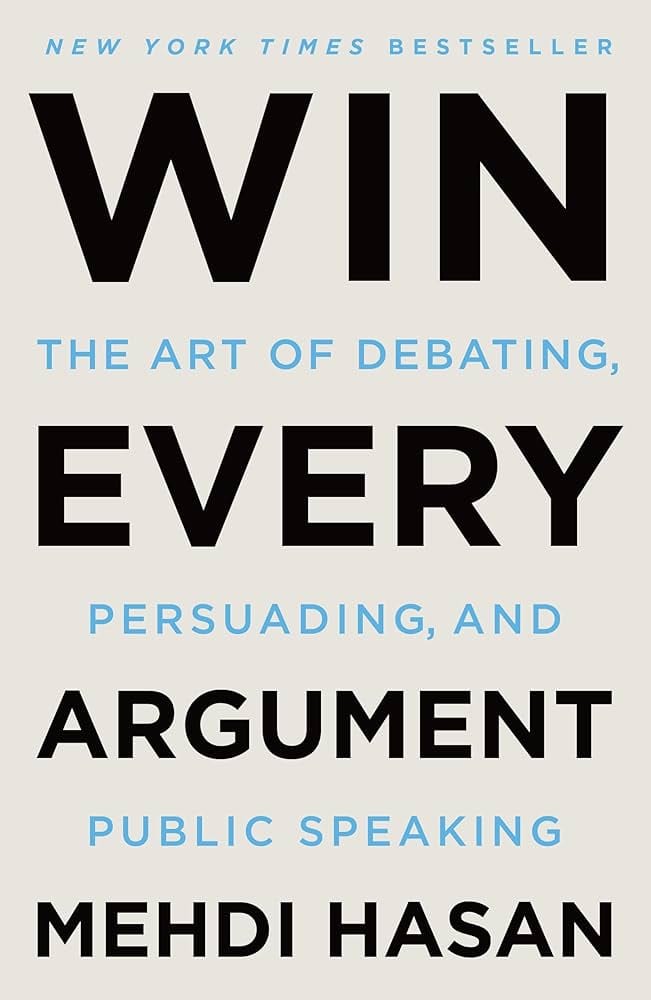
NEW YORK TIMES BESTSELLER Audie Award Finalist An Amazon best business and leadership book of 2023 Win Every Argument shows how anyone can communicate with confidence, rise above the tit for tats on social media, and triumph in a successful and productive debate in the real world. MSNBC’s Mehdi Hasan isn’t one to avoid arguments. He relishes them as the lifeblood of democracy and the only surefire way to establish the truth. Arguments help us solve problems, uncover new ideas we might not have considered, and nudge our disagreements toward mutual understanding. A good argument, made in good faith, has intrinsic value—and can also simply be fun. Arguments are everywhere—and especially given the fierce debates we’re all embroiled in today, everyone wants to win. In this riveting guide to the art of argument and rhetoric, Hasan shows you how. As a journalist, anchor, and interviewer who has clashed with politicians, generals, spy chiefs, and celebrities from across the world, Hasan reveals his tricks of the trade for the first time. Whether you are making a presentation at work or debating current political issues with a friend, Mehdi Hasan will teach you how to sharpen your speaking skills to make the winning case.
My Summary
Main Ideas, Takeaways & Similarities
Questions
I. What is the problem?
A. How is this problem formulated?
B. Why is this problem important?
C. What is the history of this problem?
D. Which prominent personalities have been interested in this problem?
II. What solutions to the problem are there?
A. What are the conclusions reached?
B. By what argument(s) is the conclusion reached?
C. What facts or assumptions serve as premises?
D. When a prominent personality offers a solution, does he also argue for or against other prominent personalities? Does he raise objections to alternative solutions? Does he consider objections to his own solutions?
III. Evaluation
A. What are the advantages and disadvantages of the alternative formulations to the problem?
B. Has the importance or history of the problem ever been misrepresented?
C. Are the solutions logically related to the premises?
D. Are the facts true? Are the assumptions acceptable? Are the objections answerable?
AI Summary
Highlights
Win Every Argument — Mehdi Hasan.pdf (file not included in this release)
Summary
Here’s a summary of the main ideas from Win Every Argument by Mehdi Hasan:
🔹 Part One: The Fundamentals
-
Know and Engage Your Audience
- Always tailor your language, tone, and content based on your audience’s demographics and values.
- Use a strong opening (a provocative line, question, or story) to grab attention quickly.
- Build rapport through eye contact, personal stories, and compliments.
-
Lead with Emotion (Pathos)
- Emotions influence more than facts do. Tap into fear, joy, anger, empathy.
- Tell personal or emotional stories to persuade and connect deeply.
- Use vivid, emotionally charged language to make messages stick.
-
Support with Facts (Logos)
- Emotions are persuasive, but facts solidify your credibility.
- Collect and deploy “receipts” (evidence) at the right moment to catch opponents off-guard.
- Contradictions, hypocrisy, or previous statements from your opponent make powerful receipts.
-
Strategic Ad Hominem
- Ethos (credibility) matters—challenging someone’s character, bias, or hypocrisy can be valid and effective.
- Use ad hominem carefully to discredit when their ethos is central to their argument.
-
Listen Actively
- Use critical listening to catch flaws and contradictions in your opponent’s logic.
- Use empathetic listening to connect with your audience emotionally and appear thoughtful.
-
Use Humor
- Humor relaxes the audience and builds connection.
- Self-deprecating humor or well-timed zingers can deflate opponents and increase likeability.
- Avoid being offensive or excessive.
🔹 Part Two: Tricks of the Trade
-
The Rule of Three
- People remember ideas in threes. Use this to structure arguments (intro-body-conclusion, 3 points, etc.).
- Rhythmic triads also prompt applause and enhance clarity.
-
Rhetorical Judo Moves
- Concede strategically to appear reasonable and gain ground for stronger arguments.
- Preempt by addressing opponents’ arguments before they do.
- Reframe issues to your advantage, challenge assumptions, or redefine terms.
-
Craft Sharp Zingers
- Prepare and memorize effective comebacks.
- Keep them short and deliver them at the right moment for maximum impact.
-
Set Booby Traps
- Use opponents’ own words or contradictions against them.
- Pose questions they can’t answer to disarm or expose weaknesses.
-
Counter Gish Gallop
- Don’t try to rebut every point. Pick the weakest or most absurd one and dismantle it.
- Call out the tactic to the audience explicitly.
🔹 Part Three: Behind the Scenes
- Build and Fake Confidence
- Visualize success, take risks, surround yourself with positive people.
- Use posture, voice projection, and eye contact to look confident even if you’re not.
- Stay Calm
- Use breathing, laughter, and third-person self-talk to manage nerves.
- You’re in control—practice grounding techniques to stay centered.
- Practice Makes Perfect
- Rehearse thoroughly, record and review yourself, refine timing and delivery.
- Even short speeches need lots of prep. Don’t wing it.
- Do Your Homework
- Research both sides (including steelmanning the opposition).
- Dig deeper than Wikipedia or page one of Google—be thorough and curious.
🔹 Part Four: In Conclusion
- Finish Strong (Peroration)
- End with passion, emotion, and a clear summary.
- Use quotes, stories, or calls to action to leave a lasting impact.
- Signal the end clearly and deliver your final line with confidence.
Let me know if you want this distilled further, turned into flashcards, or formatted for Notion or a blog post!
Part One: The Fundamentals
1 WINNING OVER AN AUDIENCE (Page 16)
knew that particular audience would value and cherish—namely, British tradition, British history. (Page 17)
Remember: anytime an audience is present, you cannot, cannot, afford to ignore them or take them for granted. The audience is the key. Even if you’re in a one-on-one debate, they are the people who have been described as “judge and jury.” They are who you’re trying to convince, persuade, and bring on board with your arguments. (Page 18)
KNOW YOUR AUDIENCE (Page 19)
First, find out who is going to be in the audience. These are the kind of questions I ask the organizers of every event that I’m invited to speak at:
How big is the audience?
What kind of people constitute the audience?
What’s the rough demographic? Are they young or old? Students or professionals? Political or apolitical? Male or female? White, Black, or Brown? (Page 19)
The key benefit of knowing your audience is that it grants you the ability to modify the language you use to make your case. (Page 20)
Everything from varying tone and volume, to varying content and emphasis, matters. (Page 20)
By changing your approach, and finding a common language, you immediately make the issue much more palatable. (Page 21)
GRAB THEIR ATTENTION (Page 23)
according to a study conducted by researchers at Microsoft, the average human loses “concentration after eight seconds.” You have very, very little time to capture an audience’s attention before they tune you out and start thinking about what they’re going to have for dinner or, more likely, scrolling through Instagram. (Page 23)
As a group of comms experts point out, you want to avoid rote remarks, empty platitudes, and tired clichés. (Page 23)
- Start with a strong opening line (Page 24)
Something unexpected, provocative, contrary even. (Page 24)
- Start with a question (Page 24)
Ideally, a “provocative” question, say those comms experts. “Starting with a question creates a knowledge gap: a gap between what the listeners know and what they don’t know,” adds Akash Karia in his book How to Deliver a Great TED Talk. “This gap creates curiosity because people are hardwired with a desire to fill knowledge gaps.” (Page 24)
- Start with a story (Page 25)
Ideally, a personal anecdote. You get bonus points if it’s funny, able to get people laughing and relaxed—and paying attention—from the get-go. Storytelling helps with instant engagement because everyone loves a great yarn. Plus, our brains are built to fall in love with a good story—one that taps into imagination and empathy from the very beginning. (Page 25)
CONNECT WITH THEM (Page 26)
Remember, the goal is to get your audience on your side, especially in a debate. The point is to change not your opponent’s mind but the minds of those watching and listening in the audience. This is especially true if you are participating in a competitive debate in which the audience will decide the outcome—but it applies to any forum, be it a TV talk show or a Thanksgiving dinner table. (Page 26)
- Make eye contact (Page 26)
you want to make sure you’ve prepared enough beforehand that you can avoid reading your slides, so you can feel comfortable enough to look out at your audience without going into panic mode. (Page 27)
- Heap praise (Page 27)
You make them feel special. (Page 27)
- Get personal (Page 28)
The harsh reality is that people won’t bond with your arguments in a vacuum, but they will, says speech coach Bas van den Beld, “bond with you”—the person making those arguments. By sharing a revealing story or a personal flaw, you allow audience members a way to identify with you. You show how you are no different to them. (Page 29)
2 FEELINGS, NOT (JUST) FACTS (Page 32)
Sure, facts might not care about any of those feelings, but consider this: our feelings rarely care about the facts. (Page 36)
PATHOS ALL THE WAY (Page 36)
Aristotle was ahead of the curve on much of this. In his landmark treatise Rhetoric, published more than two millennia ago, the ancient Greek philosopher developed what he believed were the three main ways that a speaker can engage an audience. He called these his three proofs or “modes” of persuasion: ethos, pathos, and logos. An appeal to ethos relies on the “character” and “credibility” of the speaker. The word ethics, as online speech coach Gini Beqiri has noted, is derived from ethos. In this realm, Aristotle writes, “persuasion is achieved by the speaker’s personal character when the speech is so spoken as to make us think him credible.” When a professional such as a physician appeals to her expertise—“ You should get vaccinated. I’m a doctor who’s been studying this for years, and I know it’s safe.”—this is an argument centered on ethos. (Page 36)
An appeal to pathos relies on our human emotions and feelings: fear, anger, joy, and the rest. The words empathy and sympathy, notes Beqiri, derive from pathos. Aristotle says that in pathos-based arguments, “persuasion may come through the hearers, when the speech stirs their emotions. Our judgements when we are pleased and friendly are not the same as when we are pained and hostile.” (Page 37)
this is where I differ from the great Aristotle. He tended to give equal treatment to all three of his modes of persuasion. But the reality is that pathos beats logos almost every time. (Page 37)
even when you have your facts locked down, they won’t have any impact unless you incorporate feelings as well. Pathos not only beats logos when it comes to influencing your audience, but pathos is also perhaps the best way to deliver logos to your audience. It is the perfect vehicle for it. Study after study shows that if you can tap into your audience’s emotions, you are more likely to win over their minds. (Page 38)
THE SCIENCE OF PERSUASION (Page 38)
- Tell a story (Page 40)
65 percent of our daily conversations consist of sharing gossip! (Page 41)
In a 2007 study, Wharton professor of marketing and psychology Deborah Small and her two coauthors found that people ended up giving more money to charity upon hearing and seeing a story about a single “identifiable victim,” as opposed to one that described numerous “statistical victims” in the same plight. A story about a single child, with a name and a face, in need of help, has a much bigger and more direct impact on our level of empathy than a story about millions of nameless and faceless people in need. That’s pathos over logos in a nutshell. (Page 41)
So next time you want to persuade an audience, tell them emotion-filled stories about specific individuals. (Page 42)
It is difficult for me to overstate to you the power of simply sharing stories with your audience. (Page 44)
You can really connect with someone listening to you, on a deep emotional level, if they feel like they can understand what you have been through—if they can be encouraged to imagine themselves in your shoes. (Page 46)
what is the first rule for connecting with other people on an emotional level? Tell them a compelling story. Maybe even your own. Keep it simple: focus on your experience and what you felt. And your listeners will feel it, too. (Page 46)
- Choose words carefully (Page 46)
We don’t always give such consideration to the individual words we choose, but they have immense power. When you’re building an argument, seek out words that invoke pathos and feeling. This is what many world leaders have done time and again throughout history—rallying nations in support of life, liberty, freedom, equality, truth, justice, and the like. (Page 47)
- Show, don’t just tell (Page 48)
The orator, wrote a young Winston Churchill in his 1897 essay “The Scaffolding of Rhetoric,” “is the embodiment of the passions of the multitude. Before he can inspire them with any emotion he must be swayed by it himself. When he would rouse their indignation his heart is filled with anger. Before he can move their tears his own must flow. To convince them he must himself believe.” (Page 48)
you’re particularly passionate about an argument, it’s okay to show your own enthusiasm: to raise your voice a little, to use your hands, to smile or laugh. If it’s a more somber subject, do feel free to show regret or sorrow: a sadder or quieter tone of voice, longer pauses and deeper breaths. (Page 49)
do it wherever you think an emotional appeal feels genuine. (Page 50)
Start with emotion and end with emotion. (Page 50)
As the veteran Republican pollster and strategist Frank Luntz wrote in a now-notorious 2002 memo, outlining how conservatives should address (dodge?) the issue of climate change: “a compelling story, even if factually inaccurate, can be more emotionally compelling than a dry recitation of the truth.” (Page 51)
Pathos is a crucial part of the equation. You need it, if you’re going to win your argument. But it’s still only part of the winning recipe. Ultimately, a compelling story that’s backed up by facts is much more powerful than a threadbare sob story. (Page 51)
3 SHOW YOUR RECEIPTS (Page 53)
if you want to pin down your opponent, if you want to prove that you’re right and they’re wrong, you have to be prepared. You have to show your evidence. Your proof. Your receipts. (Page 53)
FACTS ARE STUBBORN THINGS (Page 53)
Confidence, charisma, eloquence, storytelling … they only go so far. Pathos often can trump logos, as we’ve seen, but emotions are quixotic. You need to have a solid factual base for what you’re arguing—or you’re going to get trounced by someone who can connect emotions and evidence. To win the argument, you’ll need both: feelings and facts. (Page 55)
To bring it back to Aristotle, pathos is not enough. “Think of pathos, logos, and ethos as three wheels on a tricycle,” explains corporate communications consultant Paul Jones. You need all three in order to influence and move people. Pathos, in particular, writes Jones, “gets you in the door. But once inside, if you don’t convince them, you’ll be shown the door.” (Page 56)
- Find receipts (Page 57)
- Create your own receipts (Page 61)
As you prepare for an argument, you’ll want to gather plenty of receipts in advance. But your opportunities don’t end when the debate begins. You can also create your own receipts in the midst of that argument. (Page 61)
Listen for contradictions in their argument, and highlight any inconsistencies on their part. Doing so in real time can put them on the defensive. (Page 61)
- Time the receipts (Page 64)
Notice how I delivered this receipt. First, I simply quoted him, without an exact source. When he then questioned the quote, I followed up with his exact words and the page number on which they appeared! This is an ideal pattern—sparking your opponent’s doubt or curiosity, then following up with undeniable evidence. That becomes “the right moment.” (Page 64)
Receipts can boost your confidence while reducing your opponent’s. When you are citing hard facts at your opponent, and you have the sources to back you up, there’s no need for passion or anger, no need for a raised voice or animated tone. The facts speak for themselves. The receipts do the heavy lifting. (Page 68)
4 PLAY THE BALL … AND THE MAN (Page 72)
Only an idiot would dismiss ad hominem arguments.—Tom Whyman, philosopher (Page 72)
Look, yes, in theory, you should attack the merits of the argument itself and not the person making it. But, in the real world, playing the ball and the man can prove to be a rather effective, and often necessary, tactic. It can discredit your opponent and their argument at the same time. It can win over a skeptical crowd and give you the upper hand. And—I’ll let you into a well-kept secret—it’s not necessarily a fallacious argument either. (Page 74)
GO AFTER THEIR ETHOS (Page 75)
To anyone who says “play the ball, not the man,” Aristotle might as well be sending a shot across the bow. If one’s character and reputation are “the most effective means of persuasion,” then it’s dangerous to ignore them altogether. If you’re unwilling to critique your opponent’s credibility, you’re giving them an advantage right out of the starting gate. (Page 75)
Even Michael Austin, who wrote a bestselling introductory textbook on rhetoric, quietly agrees: I don’t usually muddy these waters in freshman composition, but the fact is that ad hominem arguments are very often the best and most logical responses to another person’s claims. This is true because most arguers place their own character, expertise, or credibility at issue when they make a claim. If somebody supports an argument with a pro hominem argument (which we normally call an “appeal to authority”) then the ad hominem argument becomes both a necessary and a proper response. (Page 75)
Here are the three most common forms of the ad hominem. (Page 76)
- Ad hominem: abusive (Page 76)
abusive ad hominem is all about the reputation of your opponent. It’s all about their ethos. If an opponent is not a good or honest person, if they’ve been unreliable or fallacious in the past, that should affect how an audience considers their present argument. So, say that! (Page 77)
- Ad hominem: circumstantial (Page 77)
This type of argument attacks your opponent by saying that their claim is driven by their own circumstances or personal situation—by some hidden bias or conflict of interest, perhaps. (Page 77)
In 2018, a study coauthored by Montana State University psychologist Ralph Barnes concluded that “allegations of conflict of interest may be just as influential as allegations of outright fraud” when it comes to whether or not people are willing to believe claims made by scientists. (Page 78)
- Ad hominem: tu quoque (Page 78)
This type of argument is all about hypocrisy. Tu quoque literally means “you also.” A tu quoque argument attacks your opponent by zeroing in on any of their past words or actions that contradict or cast doubt on their current claims. It highlights how they might advocate a view or position that they don’t or can’t adhere to themselves. (Page 78)
Put away your logic textbook. We have to treat the argumentum ad hominem, as the philosopher Alan Brinton has argued, “as primarily a rhetorical phenomenon rather than as primarily a logical one.” Rhetoric is the art of persuasion, and we should view the utility of ad hominem arguments through that lens, rather than to “focus so narrowly on the relationships between premises and conclusions.” (Page 79)
If you use an ad hominem to dismiss the conclusion of an argument out of hand then it is, indeed, a fallacy. Instead, you can make them part and parcel to your larger case. If you use an ad hominem argument to question your opponent’s credibility, to raise the issue of bias, or to put your opponent on the defensive, then these are legitimate and appropriate rhetorical moves that go back centuries to Ancient Greece and Rome. They’re far from fallacies. (Page 80)
Even top philosophers say abusive, circumstantial, and tu quoque ad hominem arguments are fine, as long as they are used in the correct way: not to go after the logos of an argument, but to challenge the ethos. Credibility is an asset in any argument, and if your opponent’s isn’t warranted, don’t let it stand unchallenged. And don’t let anyone tell you otherwise. (Notice my pro hominem argument there?) (Page 80)
PLAN OF ATTACK (Page 80)
For a start, in order to make an argument “to the person,” you need to know everything you can about that person. You have to be willing to examine and research your opponent’s background, biography, and résumé. You need to be familiar with their past statements and actions, and especially any scandals or controversies they may have been involved in. (Page 81)
The best plan, in my view, is to challenge your opponent’s three Cs—their character, their credentials, and their claims. If all three crumble, they’re going down. (Page 81)
- Challenge their character (Page 81)
Sometimes you have to “expose”—to your audience!—the bad person behind the perhaps good argument. Sometimes, as Versfeld points out, it is the person who is the problem, and therefore the argument should be against the person. (Page 82)
Don’t be afraid to identify who your opponent really is. Don’t be afraid to define who your opponent is. Don’t be afraid to characterize the arguer, and not just the argument. (Page 82)
- Challenge their credentials (Page 83)
Whether we like it or not, audiences almost always connect a speaker’s credibility to their credentials. (Page 84)
You can make these objections politely, too. No need to even name-call or belittle. Pose a string of questions to establish, in front of your audience, that your opponent shouldn’t be taken seriously: What exactly do you know about this issue? When did you become an expert on this topic? What actual qualifications do you have to pass judgment on it? If they can’t answer them, then your audience will start to doubt the real merit behind all those credentials. (Page 84)
- Challenge their claims (Page 85)
challenging their record of past claims. (Page 85)
use your opponent’s past claims against them. They have a past, a record, a history—which shows how their judgment stands up to reality. If it’s a record full of failures and misjudgments—of one abysmal prediction or contention after the next—then call them out! (Page 87)
BEWARE THE COUNTERATTACK (Page 89)
There are multiple ways you can address an attack on your own character or record. First, you can appeal to the old conventional wisdom and point out that your opponent is using an ad hominem argument! (Page 89)
Second, you can own it. You can own whatever attack on your character or record that comes your way. (Page 90)
Third, you can attack back with your own ad hominem argument, and call it self-defense. That’s what Cicero used to do: frame his invective against his opponents as a reluctant retaliation against an unfair attack. The master orator knew all too well: attack is the best form of defense. (Page 90)
To conclude: the ad hominem argument is a high-risk/ high-reward argument. Get it wrong and your attack could backfire on you. Get it right and your opponent will be on the ropes—maybe even on the mat. The power of the ad hominem attack—and one of the main reasons why it annoys and angers so many people!—is that it is difficult to come back from. (Page 90)
5 LISTEN, DON’T (JUST) SPEAK (Page 92)
When people talk, listen completely. Most people never listen.—Ernest Hemingway (Page 92)
CAN YOU HEAR THE DIFFERENCE? (Page 96)
Listening requires absorbing, processing, and comprehending what you’ve just heard. You’re consciously and actively engaged in the process. (Page 96)
In a crisis, we listen, we react, we pay attention. But when it comes to communicating with people in ordinary settings, many of us phone it in. We aren’t good listeners. We prefer to be the ones doing the talking. This might even be more true when it comes to debates. We’re not listening to what the other side has to say, we’re simply waiting for our turn to speak. That’s what we’ve prepared for, after all, the opportunity to make our argument, uninterrupted and unimpeded. (Page 96)
CRITICAL LISTENING (Page 97)
critical listening and empathetic listening. (Page 97)
There are three core missteps you should look out for—three ways in which critical listening will help you win an argument: (Page 98)
- False claims: (Page 98)
- Fallacious arguments: (Page 99)
- Concessions: (Page 99)
then throw them off-balance with what I’ll explain later in the book is a “judo move”: concede that point. (Page 99)
- Keep an open mind (Page 100)
- Clear your mind (Page 100)
- Take notes (Page 101)
EMPATHETIC LISTENING (Page 103)
Critical listening is what you should be doing when your opponent is speaking. But empathetic listening is what you should be doing when an audience member is speaking. (Page 103)
And to be clear: it’s not just about looking like you’re paying attention. You really do have to try and empathize with the person who’s speaking to, or questioning, you. They want to see that you understand their concerns and emotions—and that you’re likable and relatable. And you want to fully understand what they’re telling you, not just in their words but also in their tone, delivery, and body language. (Page 104)
- “Stay present”: (Page 107)
“Quiet your inner monologue, set your device aside, and draw your attention to the other person,” says Ximena Vengoechea, author of Listen Like You Mean It: Reclaiming the Lost Art of True Connection. Make sure your attention is 100 percent not on yourself. (Page 107)
- Make eye contact: (Page 107)
- Ask the right questions: (Page 107)
Pose questions to your interlocutors that allow them to “drive the conversation,” and then ask follow-up questions that show you were listening to their answers. (Page 107)
PERSUADE WITH YOUR EARS (Page 108)
6 MAKE THEM LAUGH (Page 110)
Once you get people laughing, they’re listening and you can tell them almost anything.—Herb Gardner, playwright (Page 110)
THE PSYCHOLOGY OF LAUGHTER (Page 112)
Then there’s the science on the benefits of laughter, writes speech coach John Zimmer, which range from “improved memory and cognitive function” to increased attention and engagement. Stanford lecturer (and professionally trained comedian) Naomi Bagdonas, coauthor of Humor, Seriously: Why Humor Is a Secret Weapon in Business and Life, told podcaster Matt Abrahams that laughter helps with engagement because, when we laugh, “the reward center of our brains is flooded with the neurotransmitter dopamine,” which “engenders deeper focus and better long-term retention.” According to Bagdonas, “using humor not only can make our content more engaging in the moment, but it also makes it more memorable after the fact.” (Page 112)
shared laughter brings people together—in ways that can help you as the person making them laugh. (Page 113)
THE ANCIENTS DID IT BETTER (Page 114)
The point of being funny is not just to entertain or to pass the time—it’s to get your audience’s attention, to keep them on board with your remarks, and to surprise them at just the right moment. Plus, as a bonus, if you’re in a formal debate setting, humor can be used to get the upper hand on your opponent, to get laughs at their expense (or at least at the expense of their arguments). (Page 114)
As Cambridge University classicist Mary Beard has written, “Ridicule was a standard weapon in the ancient courtroom, as it is only rarely in our own. Cicero, antiquity’s greatest orator, was also by repute its greatest joker; far too funny for his own good, some sober citizens thought.” But Cicero knew what he was doing. He himself said that “by making our enemy small, inferior, despicable, or comic, we achieve in a roundabout way the enjoyment of overcoming him.” (Page 114)
- Punch lines build rapport (Page 115)
A laughing audience—whether it’s a few people or a few hundred people—is also a relaxed audience. It’s an audience that’s not just paying attention but much more willing to hear you out and also take your side. Think about it: if they’re laughing and enjoying what you’re saying, they can’t also be annoyed by you and disagreeing with what you’re saying. (Page 115)
- Levity lightens the mood (Page 116)
One of my favorite quotes, often attributed to Oscar Wilde, says: “If you want to tell people the truth, make them laugh, otherwise they’ll kill you.” (Page 116)
Laughter can help deflect or disarm tough questions from your opponent—and even from the crowd. And, yes, it can help you get your (very serious) argument across in a way that really resonates. (Page 116)
- Laughter hurts like nothing else (Page 118)
To be clear: you have to be careful in such situations. You must be absolutely sure that your joke at the other person’s expense will be effective. If it isn’t, then you are the one who could end up looking ridiculous! (Page 119)
To sum things up, these are the three ways in which humor can help you: to build a rapport with the audience, to tackle a serious subject, and to take down an opponent. (Page 120)
the ancient Roman rhetorician and educator Quintilian once put it, “Humor is risky, since wit is so close to twit.” (Page 120)
THE DOS OF DEBATE HUMOR (Page 120)
- Do be self-deprecating (Page 120)
Make fun of yourself. It always goes down well. You won’t come across as some grand, or distant, or boring figure; instead you’ll come across as relatable, says Hrideep Barot. (Page 120)
- Do be spontaneous (Page 121)
It’s great if you have some preprepared one-liners, or a few funny stories you tried out on friends or colleagues beforehand. But it’s even better if you can react in real time to what’s been said or done—to think and joke “on your feet,” says TJ Walker. (Page 121)
- Do be expressive (Page 122)
So use this as license to act out your humor, your gag, your funny anecdote. (Page 122)
THE DON’TS OF DEBATE HUMOR (Page 123)
- Don’t be offensive (Page 123)
- Don’t go over the top (Page 124)
Don’t tell lots of jokes, back to back. You are not supposed to be a stand-up comedian. That is not what people are expecting to see or hear from you and … let’s be honest with each other here … this is a safe space, right?… it’s probably not what you’re good at either. Go for a gag here, a one-liner there. But less is more. (Page 124)
- Don’t be wooden (Page 124)
agree with media trainer TJ Walker: Do not ever start a sentence with the words “I’m gonna tell you a funny story now.” Do. Not. Do. That. (Page 124)
There is no need for a wooden or awkward introductory line. That’s where comedy goes to die. If you have what you think is a funny story, just tell it and let the audience decide if it’s funny. You’ll know pretty fast if they don’t think it is. (Page 124)
Practice your jokes and go-to stories. Know them inside and out. (Page 124)
Part Two TRICKS OF THE TRADE (Page 126)
7 THE RULE OF THREE (Page 127)
There’s an old Latin phrase: Omne trium perfectum. Everything that comes in threes is perfect. (Page 128)
LISTEN TO THE KING (Page 128)
HERE COMES THE SCIENCE BIT (Page 131)
Multiple studies of our working memory “converge on the notion that, reliably, people can remember up to three basic units or chunks or ideas at once,” Cowan told me. “Three is a good rule of thumb.” (Page 132)
CLAPTRAPS (Page 133)
it makes the audience clap at the end of the triad. It actually primes them to want to applaud. (Page 133)
How does it work? You hit a crowd with your three words, three lines, three phrases: boom, boom, boom. The feelings rise with each part of the sequence, and they’re ready to hit you back at the climax … with applause. (Page 133)
BEGINNING, MIDDLE, END (Page 134)
The Rule of Three is much more than a rhetorical device. It is also an organizing principle for our thoughts—and our arguments. According to Cowan, the cognitive psychologist, three gives you a “stable structure”; it gives you “a beginning, a middle, and an end.” (Page 135)
“Use one for power,” Clark says. “Use two for comparison, contrast. Use three for completeness, wholeness, roundness.” (Page 135)
Make sure that you know, so that they leave with the message you intend. The worst thing you can do when you’re presenting your arguments in public is to lack a structure, to ramble, or to be all over the place. Who wants to listen to someone who’s rambling? Would you want to listen to that person? Of course not. So don’t be that person. (Page 135)
Here’s what you should do, say the experts. Separate your speech, presentation, or argument into: 1. Introduction
- Body
- Conclusion (Page 135)
In the Body, make sure you present three main arguments. In the Conclusion, make sure you summarize and repeat those three main arguments. (Page 136)
Andrew Dlugan, the founder and editor of the public speaking and presentation skills website Six Minutes, has usefully summarized a variety of ways in which the Rule of Three can be deployed to structure your speech or argument.
There’s the most basic approach, which I mentioned: Introduction, Body, Conclusion.
Or: Three Main Points.
Or: Three Stories.
Or: Pros, Cons, Recommendation.
Or there’s my own personal favorite: making a Political, an Economic, and a Moral argument for or against something. In my experience, that always seems to hit the spot. (Page 136)
8 JUDO MOVES (Page 138)
- Concession (Page 140)
You can use their energy against them by actually conceding one or more of their points, says Jay Heinrichs, author of Thank You for Arguing. Llano suggests that you can concede an argument here or there, and then say “there’s one argument here that just doesn’t make much sense to me and I want to attack that.” Don’t be afraid to say to your audience, “Here’s where my opponent is right,” because that then gives you the opening to say: “And here’s where they’re wrong.” (Page 140)
You’ll diffuse their passion and energy with your curveball concession. To an audience, you then come across as more reasonable and rational, which is how you want to present yourself prior to making your own bespoke counterarguments (and counterattacks!). (Page 141)
We often see making a concession as a sign of weakness. It isn’t. It is a sign of strength and confidence. It shows your audience how open-minded you are. It reveals to them that you’re not an inflexible ideologue. (Page 141)
technical Greek term for this rhetorical technique: synchoresis. The Collins English Dictionary defines it as “the act or an instance of conceding an argument in order to make a stronger one.” (Page 141)
- Preemption (Page 143)
In fact, in any debate or argument involving multiple speakers, I often prefer to go first and not last. That’s not to say it isn’t important to leave a lasting impression on both your opponent and your audience, but going first allows you both to set the terms of debate and to unbalance your opponent before they even start speaking. (Page 143)
Preempting your opponent’s arguments is one of the most powerful moves you can make in a debate. You should also consider this flexible technique whenever or wherever you plan on giving a speech or presentation in which you are trying to convince people to agree with you. (Page 143)
if this technique is not used both sparingly and carefully, it may “throw the orator on the defensive and undermine his credibility, especially if he seems to acknowledge strong arguments against him and does not answer them with absolute conviction.” (Page 144)
- Reframing (Page 144)
Humans don’t make decisions, or conclusions, based on facts alone. We interpret those facts, and doing so requires context and background; our conclusions depend on how we “frame” a particular situation. Frames, say experts, are the “filters” our brains use to try and process and interpret information in any given setting. (Page 145)
the motion does not work in your favor, you should try and reframe it, “redefine” it, broaden its meaning and message. (Page 145)
On the other side, you can also question the premise behind a motion. (Page 146)
dodge my questions by questioning the premise behind them. It can be a very effective tactic for those who want to reframe an argument they’re losing. (Page 146)
DON’T OVERDO IT (Page 148)
I agree with author Jay Heinrichs: Throwing your opponent off-balance is one of the most effective ways of winning an argument. (Page 148)
Nevertheless, whether it is conceding, preempting, or reframing, all of these rhetorical judo moves should be used conservatively. Don’t overdo them, and don’t force them, or they become obvious and they lose value. (Page 148)
To quote Kanō Jigorō: “Resisting a more powerful opponent will result in your defeat, whilst adjusting to and evading your opponent’s attack will cause him to lose his balance, his power will be reduced, and you will defeat him.” (Page 149)
9 THE ART OF THE ZINGER (Page 150)
Pauline Bickford-Duane wrote a book on the subject—The Little Book of Zingers: History’s Finest One-Liners, Comebacks, Jests, and Mic-Droppers— (Page 152)
THE ANCIENTS DID IT BEST (Page 153)
- Be prepared (Page 155)
To quote Winston Churchill, who was renowned for his own caustic wit and scathing put-downs: “All the best off-the-cuff remarks are prepared days beforehand.” (Page 156)
Check out websites like BrainyQuote or ThinkExist, which collate one-liners and put-downs from across history and across the globe. You can create your own “commonplace books”—that is, take a blank notebook, divide it into sections and topics, and start jotting down—and then messing around with—any fun or famous quotes you come across. These notebooks trace back to the era of Cicero, Quintilian, and Seneca, who used the analogy of a bee in one of his Epistles to drive home the point about borrowing, aggregating, and synthesizing from others: (Page 156)
- Keep ’em short (Page 158)
What do these debate zingers all have in common? They’re short, pithy, and to the point. (Page 159)
- Pick your moment (Page 160)
When it comes to zingers, preparation is good but spontaneity is great. Even a line you’ve prepared needs to be delivered in a way that sounds perfectly spontaneous, and this is not always easy. Getting it right requires searching for moments, in real time, in the midst of a heated argument, to interject your verbal beatdown. (Page 160)
That’s what makes the one-liner an art form. It’s important to work on your zingers and to be prepared when you enter a debate. As you do so, you’ll want to keep them brief and draw on the masters of the craft. But, then, when the arguments start flying, you need to let yourself slip into the moment. That might mean identifying the perfect moment to deploy your polished zinger—or it might mean changing course, and responding to the gaffes and remarks that your opponent is making in the moment. (Page 163)
10 SETTING BOOBY TRAPS (Page 165)
Knowing where the trap is—that’s the first step in evading it.—Duke Leto Atreides, in Frank Herbert’s Dune (Page 165)
set rhetorical booby traps for your opponents, then sit back and wait until they race toward the spikes. (Page 166)
The point of this chapter is to show you how to set pitfalls using seemingly harmless questions or comments—traps that make your opponent look daft, foolish, and—ideally—lost for words. (Page 166)
What makes a booby trap so unique, and so uniquely dangerous, is that the victim of the trap unwittingly triggers it themselves. In the context of a debate or argument, the effect can be unforgettable, as someone who’s spent hours preparing (or hours talking nonstop) suddenly finds themselves sputtering. (Page 166)
- Trap them with their own words (Page 166)
But the way to use your opponent’s words as a booby trap is to bring them into the conversation without identifying them as your opponent’s words. (Page 166)
There’s almost nothing more gratifying than watching an opponent fail to recognize their own words quoted back to them. Except, perhaps, for the moment that comes just afterward—the embarrassed realization that dawns on their face when you make the big reveal. It’s not something your opponent will be prepared for, and if you can plan out how to introduce your opponent’s quote without them recognizing it, you will create a showstopper moment. (Page 168)
- Trap them with a contradiction (Page 169)
- Trap them with a question (Page 173)
sticking your opponent with the straightforward question that turns out to be a trap. (Page 173)
How do you set a trap with just a question? It’s simple. You ask your opponent a question that you know, from your preparation, they cannot or will not be able to answer. The value is not so much in the answer—or nonanswer for that matter!—but often in getting them to consider the question itself. Once they’re offtrack and out of rhythm, the trap is sprung. (Page 173)
But the point of the booby trap was not to get him to agree with me but to expose the fact that he had no answer of his own. In fact, I wanted him to disagree with me so that I could set the trap: “Okay, you tell me, how many Tibetans have been killed since 1950?” Once that question landed in his lap, he was stuck. (Page 176)
Use traps that your opponents don’t see coming. Deploy the element of surprise. Dangle a phrase, a quote, or a question that looks harmless. Until—snap. The trap is sprung and the floor is yours. (Page 177)
11 BEWARE OF THE GISH GALLOPER (Page 178)
The amount of energy needed to refute bullshit is an order of magnitude larger than is needed to produce it.—Alberto Brandolini, computer programmer (Page 178)
Gish Gallop. This is a speaking method that involves, to quote the Urban Dictionary, “spewing so much bullshit in such a short span that your opponent can’t address let alone counter all of it.” It has one aim: to bury your adversary in a torrent of incorrect, irrelevant, or idiotic arguments. (Page 181)
The Gish Galloper, argues Carl Alviani in Quartz, knows full well that it takes more time and energy to “disprove” a “false claim” than to make one—time and energy that you almost certainly don’t have. They then try to claim victory when you’re unable to rebut all their points—hence the relentless barrage of falsehoods that they level in your direction to begin with. Often, by the time you’ve begun preparing your rebuttal of the Galloper’s first lie, they’ve rattled off another dozen. It’s what’s become known as proof by verbosity—or, as another saying goes, being baffled by bullshit. (Page 182)
MEET THE GISH BEHIND THE GALLOP (Page 182)
This is the key point that you need to take away from this chapter: the “nonsense” is a feature, not a bug, of the Gish Gallop. (Page 184)
- Pick your battle (Page 186)
By mocking and debunking that particular claim, I poured doubt on the rest of them—and made her look foolish in the process. That’s one way to start: find the weak links in the chain. (Page 188)
Engaging in a “single flaw” or “worst-point” rebuttal isn’t always going to work, and I don’t recommend it when your opponent has woven a strong, cohesive argument. (Page 188)
When facing a Gish Galloper, you need to be able to quickly point out the weakness of their fire hose strategy rather than attempting a point-by-point rebuttal. (Page 189)
Pick on that. Highlight and mock it, and present it as representative of their overall strategy. Doing so will put them on the defensive. (Page 189)
- Don’t budge (Page 189)
The best defense against this tactic is to make sure you stop them midstream. And then don’t budge. Don’t let them move on to the next falsehood. “Hammer away,” says one writer, with a well-chosen, well-prepared rebuttal until they cannot help but concede. (Page 189)
- Call them out (Page 193)
The Gish Gallop is an undeniable problem—and challenge. There is no simple solution to the opponent who captivates an audience with a stream of rapid-fire, impressive-sounding claims—no matter how nonsensical or fact-free they might turn out to be upon closer examination. Especially if there is no time for closer examination! (Page 193)
Point out to the audience exactly what your opponent is doing— (Page 193)
If your job in an argument with a Gish Galloper is to “put raincoats” on your audience, that begins by making your audience aware of what they’re being subjected to. Point out the speed at which your opponent is speaking, and the laundry list of lies that they’ve just recited aloud in record time. You can even point out that your opponent is using a propagandistic move straight out of the Kremlin playbook. Or point out that your opponent is behaving in a Trumpian manner. (Page 194)
Part Three BEHIND THE SCENES (Page 198)
12 CONFIDENCE IS EVERYTHING (Page 199)
There are two types of speakers: those that are nervous and those that are liars.—Mark Twain (Page 199)
BUILDING CONFIDENCE (Page 202)
- Visualize success (Page 202)
“close your eyes and visualize yourself giving your speech.” Imagine yourself standing there in front of your audience, speaking loudly and confidently. “See yourself” delivering every line to perfection, covering every relevant argument crisply and coherently. (Page 203)
“Be as detailed as possible”: pay attention to the size of the room, the type of flooring, the number of seats. Bring the scene to life: visualize your friends or colleagues laughing at your jokes, imagine the smiles on their faces. Even try to hear the “sounds of their applause” at the end. (Page 203)
- Take risks (Page 205)
“You gain strength, courage, and confidence by every experience in which you really stop to look fear in the face,” wrote the legendary former First Lady Eleanor Roosevelt in her book You Learn by Living. “You are able to say to yourself, ‘I have lived through this horror. I can take the next thing that comes along’ … You must do the thing you think you cannot do.” (Page 205)
How can we apply that to building confidence when it comes to public speaking and communicating? (Page 206)
Volunteer to speak in front of crowds. (Page 206)
Challenge a friend or colleague to an argument. (Page 206)
Ask for a pay raise or promotion at work. (Page 206)
- Keep good company (Page 208)
the challenge is to surround yourself with the kind of people who end up boosting your confidence, rather than those who chip away at it. There’s a saying often (mis) attributed to Albert Einstein: “Stay away from negative people. They have a problem for every solution.” (Page 208)
FAKING CONFIDENCE (Page 210)
- Fix your body language (Page 211)
Do “keep your chin and head up”—because confident people, says Glass, look up, not down. Don’t cross your arms—you want to avoid adopting a defensive or “closed off” posture. Do “stand up straight” and keep your shoulders squared—it makes you appear both confident and in control. Don’t slouch or shrug—it can convey laziness, untrustworthiness, and a lack of self-confidence. Do “gesture with your palms” open and up—it shows you have nothing to hide. Don’t fidget—you’ll come across as “nervous,” says Gallo, anxious, and even insecure. (Page 212)
- Project your voice (Page 213)
Do “speak from your diaphragm”—that is, breathe calmly and deeply, as if into your belly, and use that breath to propel your words with much more vigor and energy. Don’t mumble or murmur. You’ll come across as hesitant or fearful. Do “stand straight” when you’re speaking. It will help get more air into your lungs and make your voice resonate better. Don’t speak too fast—something I’m often guilty of! Your audience needs time to take onboard your arguments, and you don’t want to come across as nervous. Do smile when you talk—not all the time, obviously, but when it’s appropriate. You can “hear” a smile in someone’s voice even over the phone, right? Don’t be afraid to pause. Volume is important, but moments of silence accentuate the power of what you’re saying. They can be a powerful tool to build drama and to convey self-confidence. (Page 214)
One final trick comes from communications coach Aquino: When speaking to people at a distance, try to speak past them when you do it. (Page 214)
- Make eye contact (Page 215)
Remember: whether or not you feel confident, making eye contact is one of the quickest and simplest ways of exhibiting confidence. It can undoubtedly be uncomfortable, especially around new people or with big crowds. But it works. And, as it works, you’re on your way to building that lasting sense of self-confidence. (Page 216)
“Confidence is like respect,” writes comedian and actor Mindy Kaling in her book Why Not Me? “You have to earn it.” Of course, even then, like Rihanna, or Cicero, or anyone in the millennia between, you’ll have to fake it sometimes. (Page 217)
13 KEEP CALM AND CARRY ON (Page 218)
COOL, CALM, COLLECTED (Page 219)
- Breathing (Page 221)
You could try the 4–7–8 technique, also known as “relaxed breathing,” which involves switching up your inhaling and exhaling via periods of four, seven, and eight seconds. You could try the SKY method, or Sudarshan Kriya Yoga, which is based on a sequence of five different breathing exercises. You could try “pursed lip breathing,” which is all about taking slower and more efficient breaths, and requires much more regulation. Try them out, look up the various options, and figure out what works for you. (Page 222)
- Laughing (Page 223)
Laughter can work as a technique to calm the mind and body. (Page 224)
Abraham Lincoln was a leader and a speaker who understood this aspect of humor. On September 22, 1862, the president gathered his cabinet together. In the midst of the brutal Civil War, he wanted their approval for his preliminary Emancipation Proclamation, which aimed to free millions of enslaved people across the Confederacy. The meeting came five days after the bloody Battle of Antietam, the deadliest one-day battle in American history, and Lincoln knew that his cabinet secretaries were on edge. The president needed to calm their nerves and lighten the mood in the room, prior to raising the very serious issue of the proclamation. So Lincoln began the meeting by reading aloud from a book of humorous stories, writes historian Merrill D. Peterson, pausing to laugh loudly at the end. Then, he put the book to one side and asked the members of his cabinet: “Gentlemen, why don’t you laugh? With the fearful strain that is upon me night and day, if I did not laugh I should die, and you need this medicine as much as I do.” (Page 224)
- Self-talking (Page 225)
Get rid of the “I.” Instead of silently talking to ourselves in the first person, it’s more effective to do so in the third person, by using our own names. (Page 225)
“that third-person self-talk leads people to think about the self similar to how they think about others,” which allows them the “psychological distance” to keep their own emotions under control. (Page 226)
WHAT YOU CAN CONTROL (Page 226)
The key to staying calm in any situation is to remind yourself that you are in control. These are your emotions—and you can master them. (Page 226)
… AND CARRY ON (Page 228)
14 PRACTICE MAKES PERFECT (Page 230)
You want it to seem natural—which requires a great deal of work. Still, that’s good news for you. Because it means you can learn how to get it right—over the long term, like Demosthenes, and also in the run-up to a speech you have on the horizon. This is one of the most important pieces of advice I can give you when it comes to public speaking: Do. Not. Wing. It. (Page 232)
IT WASN’T JUST DEMOSTHENES (Page 233)
- “Fight on the beaches” (Page 233)
Churchill wrote out his speeches in full; he would even write out every planned pause. But he did not read them out. In fact, as another of his biographers, William Manchester, has pointed out, Churchill put so much time into rehearsing his speeches that when he did deliver them, he took only the odd glance at his notes—and his audiences were none the wiser. (Page 234)
- “I have a dream” (Page 235)
“What’s not as well known is that he had been working with much of the content of that speech in other addresses he gave months and years before the March on Washington. He took the time and opportunity to get very comfortable with his content and experimented with what worked and didn’t work in venues that weren’t as prominent as the National Mall.” (Page 235)
Think about it: the greatest of orators, people like Demosthenes and MLK, had to work on their oratorical skills, they had to practice and prepare their speeches—their style, content, tone, delivery, and the rest. So guess what? So do you. So. Do. You. (Page 236)
- Practice how you “look” (Page 237)
Stand in front of a mirror. It might sound weird but you need to try having a conversation with yourself. See how you look and how you come across as you speak in front of your own reflection. (Page 237)
Film yourself speaking aloud. (Page 237)
- Practice how you “sound” (Page 238)
how you sound changes how people listen—or even whether they’re willing to listen. As the German philosopher Friedrich Nietzsche is said to have observed, “We often refuse to accept an idea merely because the tone of voice in which it has been expressed is unsympathetic to us.” (Page 239)
This is where pitch and pause come into play. What words are you emphasizing and in what way? What tone are you using, and are you varying it from sentence to sentence? Are you pausing at the right spots, for dramatic or even comic effect? A strategic pause can give you a chance to take a breath—and your audience a chance to “digest,” as the old saying goes, what you’ve just told them. (Page 240)
However, be careful of what are known as “vocalized pauses”—those useless filler words between sentences like umm, uhh, like, y’know, and the rest. These verbal tics can be highly off-putting for an audience, so the first thing to do if you want to banish filler words from your speech is to be conscious that you are relying on them! (Did I mention that you should record yourself speaking?) (Page 240)
Pay close attention to how you enunciate words, too, and whether or not you are mumbling. This is a big problem for a lot of public speakers. There was a time when I used to swallow my own words live on-air, which I had no idea I was doing until one of my own producers pointed it out to me. It’s something I still have to grapple with because, as you may have noticed if you’ve watched my debates or TV shows, I’m someone who tends to speak pretty damn quickly. (Page 241)
Which brings us to pace, my own Achilles’ heel. There is a time to “speed up”—to generate excitement among your listeners, says von Dadelszen, and to keep them rapt. And there is time to slow down—to ensure they’re following and processing the argument you’re making. Every good orator learns how to alternate between the two. Doing so not only helps listeners absorb your points, but it also keeps the act of listening more interesting and engaging. (Page 241)
By recording yourself speaking you’ll be able to hear how others hear you—and that’s key. (Page 241)
Professional communications coach Helen von Dadelszen agrees: “Reading a child’s story, out loud, provides you with a fabulous opportunity to explore the range of your voice and bring more variety into it … It provides an opportunity for you to play!” Even if you don’t have kids, pick out a book you like and try vocalizing the dialogue—changing up your tone of voice, using different emotions for the different characters. It’s an eye-opening experience, showing just how much you can accomplish with your voice. (Page 242)
- Practice your timing (Page 242)
So this is my final practical piece of advice for honing your delivery: time yourself speaking. Do it again and again until you can deliver your argument, in your sleep, to time. (Page 242)
- The bold move: Write out your speech in full, then time yourself giving it, and then memorize the entire thing. (Page 243)
- The safer option: You might say that memorizing your remarks is a high-risk/ high-return strategy, just as a young Churchill learned the hard way. My advice, if you decide to go down this road, is to learn from old Churchill and keep a printout of the full speech within arm’s reach … just in case. (Page 243)
- The freewheeling route: Instead of writing out your speech in full, you can also deliver your remarks in note form. (Page 244)
key to succeeding with all of these methods is rehearsal. (Page 244)
One question I often receive is: How much do you need to practice? Some people assume that a short, quick presentation or speech requires only a little practice or preparation time. But nothing could be further from the truth. There is a rather apt quote, which has been ascribed to everyone from Mark Twain to Woodrow Wilson to Winston Churchill, that says: “If you want me to give you a two-hour presentation, I am ready today. If you want only a five-minute speech, it will take me two weeks to prepare.” (Page 245)
15 DO YOUR HOMEWORK (Page 248)
The inconvenient truth is that it doesn’t matter how clever, passionate, or eloquent you are—you cannot win an argument without putting in the work. (Page 250)
THE BRAINSTORM (Page 252)
- Quantity not quality (Page 253)
“The best way to have good ideas is to have lots of ideas and throw away the bad ones,” said the Nobel Prize–winning chemist Linus Pauling. (Page 253)
When beginning a brainstorming session, throw as many ideas onto the page as possible—whether good or bad, magnificent or mediocre. By prioritizing quantity over quality, you give yourself more choices, more options, more possibilities. Once lots of ideas are on the page, you can decide which ones to keep and develop, and which ones to get rid of. In a brainstorm, as the saying goes, no idea should be considered too crazy. Your most absurd ideas might inspire truly clever ones, and in the end, what happens to the bad ideas? You just toss them away. (Page 253)
- Past is prologue (Page 254)
“Every amazing creative thing you’ve ever seen or idea you’ve ever heard can be broken down into smaller ideas that existed before,” writes author Scott Berkun in his book The Myths of Innovation. Forget about a “eureka” or “aha” moment, or a “bolt from the blue.” You don’t need to wait, Isaac Newton–style, for an apple to fall on your head, argue tech writers David Kelley and Tom Kelley. The best ideas are often formed via “small steps,” not giant leaps. (Page 254)
- Get in your zone (Page 255)
Switch off from work. Stop checking your email. Let your mind wander. “The greatest geniuses sometimes accomplish more when they work less,” Leonardo da Vinci is reported to have declared. (Page 255)
RESEARCH, RESEARCH, RESEARCH (Page 256)
I watch their interviews and speeches, read and study their books, and research their careers. I look for what they have said about the topics on which they’re experts. And I find out what others have said about them, both the good and the bad. Then I piece together all these different bits of information until I find a through line. (Page 256)
it’s all about finding the new and undiscovered angle. “Research,” according to the Hungarian Nobel Prize–winning biochemist Albert Szent-Györgyi, “is to see what everybody else has seen and think what nobody has thought.” (Page 257)
- Google beyond page one (Page 258)
Too often, we don’t go far enough in our googling. We tend to lazily limit our research to page one of our Google search results, and if nothing interesting pops up, we move on. You have to learn to go beyond that. You have to be willing to do a deep dive into your subject—and into Google itself. (Page 258)
As Sam Leith writes in his book Words Like Loaded Pistols, “Many of the things that Aristotle talked about when discussing argument—the use of proofs and witnesses, the appeal to commonplaces, and the adducing of evidence—are easier rather than harder in the online age. With the digital equivalent of the Great Library of Alexandria at your fingertips—and the means not only to quote from but to link to it—your resources for serious argument are far greater than they were.” (Page 259)
- Start, don’t end, with Wikipedia (Page 259)
- Check your sources (Page 260)
PLAY THE ROLE (Page 262)
- Find a Partner (Page 263)
Jonathan would throw questions at us from The Document and we would have to deliver what we expected Sunday’s guest might say in response. (Page 263)
- Prepare for the worst (Page 265)
The only solution is to know both sides of the argument—not just the viewpoint you may personally favor. Even at the research stage, you’ll want to develop an understanding of your opponent’s arguments as you’re honing your own. The reason to do that is a simple matter of perspective. As philosopher John Stuart Mill pointed out in On Liberty, you cannot know your own side of the argument without also knowing the other side—and the other side in its “most plausible and persuasive” form. (Page 265)
To get it right requires what is called “steelmanning”—an exercise in constructing the strongest version of your opponent’s argument. Steelmanning, as many have pointed out, is the total opposite of the infamous “strawman” argument, which involves dumbing down your opponent’s position as a way of undermining them. Instead, if you can steelman your opponent’s arguments in advance of that debate—if you can develop an understanding of the smartest and strongest approach to their position—you’ll be ready for anything they might throw at you in the debate itself. (Page 266)
So how do you go about the steelmanning process? I’d recommend asking the following questions: What is your opponent’s best argument?
What is their best evidence for that argument?
Who is the best advocate for that argument?
What is their best critique of your argument? (Page 266)
Part Four IN CONCLUSION (Page 269)
16 THE GRAND FINALE (Page 270)
Every good speech deserves a grand finale. Once you’ve done your research and structured your argument; once you’ve added one part logic, one part emotion, one part humor, and a healthy sprinkling of judo moves; once you’ve practiced it all until it’s perfect—you still need to have a rousing finish. You need your audience to remember all the work you put in, and to leave energized. (Page 272)
The ending of a speech or argument is so important that rhetoricians even have a special name for it: peroration. Like the word oration, peroration is “ultimately derived,” says Merriam-Webster, from the Latin orare, meaning to “plead” or “pray.” Your peroration is the grand finale of any argument—your final plea to your audience. William Safire, who served as speechwriter for President Richard Nixon, cautioned that “a well-prepared, well-delivered speech without a peroration dribbles off and leaves an audience unsatisfied.” (Page 272)
For Aristotle, an ideal peroration is “composed of four things”:
- It seeks to draw the audience in, “getting the hearer favorable to oneself, and ill-disposed toward the adversary.”
- It drives home the stakes of the argument, by what he calls “amplification and extenuation.”
- It makes one final appeal to pathos, “placing the hearer under the influence of the passions.”
- It summarizes the key points of your argument, thereby “awakening [the hearer’s] recollection.” (Page 273)
There is a great degree of consensus among speechwriters and rhetoricians that the peroration, the concluding plea, is the perfect place for pathos. (Page 273)
USE A PILE DRIVER (Page 274)
There’s an old saying that sums up the sheer importance of driving your message home, across the course of your address: Tell them what you are going to tell them. Tell them. Then, tell them what you just told them. Are you with me? Let speech coach Andrew Dlugan explain: Tell them what you are going to tell them. That’s your introduction. Tell them. That’s the middle of your speech; the body of it. Then, tell them what you just told them. That is your conclusion. (Page 274)
That conclusion is where you restate, reiterate, repeat. (Page 274)
Churchill the honors: “If you have an important point to make, don’t try to be subtle or clever. Use a pile driver. Hit the point once. Then come back and hit it again. Then hit it a third time—a tremendous whack.” (Page 275)
- End with a quote (Page 278)
- End with an anecdote (Page 279)
Barack Obama is a masterly orator because he is also a masterly storyteller. (Page 281)
- End with a call to action (Page 281)
If so, end your argument, or conclude your remarks, with a call to action. Something concrete. Something simple. Something singular. Something memorable. (Page 282)
Here are my own brief dos and don’ts, based on my own experiences, as well as the work of top speech coaches.
- Do think about how you’ll want to be speaking when you write out your lines. Add an “exclamation point,” suggests motivational speaker Brian Tracy, to your most important closing lines when they warrant it. Those sentences you deliver at the end have to pack a rhetorical punch!
- Don’t bring in a new argument or point right at the end that you have not mentioned before. That can be both distracting and confusing. The ending is for summarizing. New complications are a no-no.
- Do signal to your audience that the speech is coming to a close, that “the end is nigh.” It’ll force those who have tuned out, gotten bored, or pulled out their phones to snap “back to attention.” You can signal this with your own pace and tone—slowing down, taking a pause, raising your voice to a crescendo. Or you can do it with language, using phrases like, “In conclusion…,” or “Let me finish by saying this…,” or another variant that’s authentically you.
- Don’t just come to an abrupt halt. Don’t be like the Philadelphia preacher Dr. James Wilson, who would preach for exactly one hour, “no more, no less”. When he saw sixty minutes had passed on his watch, he would stop midsentence, no matter where he was in his sermon, and say: “Brethren, the hour is up. Let us pray.” Don’t do that! Make sure your very last sentence is planned out and—at the very least—sounds like a fully formed final thought.
- Do try to come up with a “memorable” and ideally pithy phrase of your own at the end. As speech coach Dom Barnard reminds us, the late Steve Jobs of Apple used just four words to end his famous Stanford commencement speech in 2005: “Stay hungry. Stay foolish.”
- Don’t go on too long. If abruptness is bad, tardiness is worse. Set a time to finish, and preplan an ending that allows you to wrap up on time without the need to rush. And if you do go over your time, per one speech coach, do not then end your speech by apologizing (“ Sorry for taking up so much of your time…”). Please do not do that! It’s totally unnecessary and takes up time that you could otherwise spend on a meaningful, confident conclusion. (Page 284)