The Tools of Skepticism
2. The Tools of Skepticism
To navigate a world full of claims, Shermer introduces several foundational principles used by scientists and skeptics:
- ECREE Principle (Sagan’s Principle): “Extraordinary Claims Require Extraordinary Evidence.”1
- Hitchens’ Dictum: “What can be asserted without evidence can also be dismissed without evidence.”
- Sagan’s Dragon: A thought experiment illustrating that if a claim (like a dragon in a garage) is made unfalsifiable through “hand-waving” (it’s invisible, it floats, it’s cold), it is indistinguishable from a non-existent dragon
- The Null Hypothesis: The default position that a claim is not true until proven otherwise. The burden of proof rests on the person making the claim, not the skeptic.
Pinker’s Chapter 4 supplement — epistemic safeguards can be violence safeguards
Pinker uses witch trials, blood libel, and religious persecution to show that standards of evidence have moral consequences. Hidden supernatural agency explains every outcome and therefore no outcome; torture converts pain tolerance into apparent guilt; and mutually incompatible sects can each interpret certainty as a license to eliminate dissent. Once an allegation is unfalsifiable, enemies cannot clear themselves and every new coerced confession can recruit more suspects.
Two compact tests in the chapter belong in a skepticism toolkit. Shakespeare’s Hotspur answers a boast about calling spirits by asking whether they actually come. Francis Bacon points to the missing denominator in a shrine’s pictures of sailors saved after making vows: where are the pictures of those who made vows and still drowned? The broader lesson is not that empirical reasoning automatically produces tolerance, but that falsifiability, comparison groups, public evidence, and acknowledged uncertainty remove important permission structures for persecution. Chapter 4 synthesis · Hidden agency and unfalsifiable accusation, PDF pp. 204–208 (file not included in this release) · Fragile faith and coercive certainty, PDF pp. 208–214 (file not included in this release) · Fallibilism, Hotspur, and Bacon’s missing denominator, PDF pp. 214–215 (file not included in this release)
Link to original
Signal Detection Theory (SDT)
3. Signal Detection Theory (SDT)
Shermer introduces the 2x2 Matrix as a tool for decision-making under uncertainty. This theory helps determine if a “signal” (like a missile or cancer) is real or just “noise” (like birds or a benign blob).
Decision Signal Present Signal Absent ”Yes” (I see it) Hit False Alarm (Type I Error) “No” (I don’t) Miss (Type II Error) Correct Rejection Real-World Applications:
- Nuclear War: Stanislav Petrov avoided a global catastrophe in 1983 by correctly identifying a radar blip as a “False Alarm” rather than an incoming U.S. missile
- Criminal Justice: The system is weighted toward Correct Rejections (acquitting the innocent). Shermer cites Blackstone’s Ratio: “It is better that ten guilty persons escape than that one innocent suffer.”3
- Covid-19: Public officials had to choose between the risk of a “Miss” (letting a deadly virus spread) vs. a “False Alarm” (shutting down society for a less-lethal threat). Both carry significant human and economic costs.
Signal Detection Theory (SDT) is a framework used to explain how we make decisions when we aren’t 100% sure what we are seeing or hearing. It helps us understand how we distinguish a Signal (the thing you are looking for) from Noise (background distractions).
Think of it as a way to measure not just how good your “eyesight” or “hearing” is, but how you decide to act on what you perceive.
1. The Four Possible Outcomes
Whenever you try to detect something, there are only four things that can happen. Imagine you are listening for your phone to ring while you are in a noisy shower:
Your Decision Is the Phone Actually Ringing? Outcome Name You think “Yes” Yes, it is ringing. Hit (Success!) You think “Yes” No, it’s just the water. False Alarm (Mistake) You think “No” Yes, it was ringing! Miss (Mistake) You think “No” No, it isn’t ringing. Correct Rejection (Success!)
2. The Two Main Factors
SDT says your performance depends on two independent things:
- Sensitivity (d′): This is how clear the signal is compared to the noise. If your phone has a very loud, distinct ringtone, your sensitivity is high (d′ is a large number), and it’s easy to tell the difference. If the ringtone sounds like running water, your sensitivity is low.
- Criterion (Bias): This is your personal “threshold” for saying yes.
- Liberal Bias: You are expecting a very important call, so you jump out of the shower at the slightest sound. You get more Hits, but you also get a lot of False Alarms.
- Conservative Bias: You don’t want to get cold for no reason, so you only get out if you are 100% sure. You avoid False Alarms, but you will probably Miss some real calls.
3. Real-World Examples
- Medical Screening: A radiologist looking at an X-ray for a tiny tumor. A Miss is dangerous (cancer goes untreated), so the system is often designed to be “Liberal,” accepting more False Alarms (biopsies that turn out fine) to ensure they get every Hit.
- Military Radar: An operator seeing a blip. Is it an enemy plane (Signal) or a flock of birds (Noise)? During wartime, the Criterion shifts to be more sensitive to threats.
- Jury Duty: “Beyond a reasonable doubt” is a Conservative Criterion. The law would rather have a Miss(letting a guilty person go) than a False Alarm (sending an innocent person to prison).
Link to original
Cause and Effect
Cause and Effect
In this fourth lecture, Michael Shermer shifts the focus from how thinking goes wrong to how thinking goes rightthrough the scientific method. He focuses on the mechanics of Causality, the difference between Correlation and Causation, and the power of Bayesian Reasoning.
1. The Logic of Causality
Shermer revisits David Hume to define how we perceive cause and effect.
- Constant Conjunction: When X happens, then Y happens (e.g., fire then heat). We naturally infer a causal connection.
- The Evolutionary Bias: Using the example of “Lucy” (an early hominid), Shermer argues we are evolutionarily wired to make Type I errors (False Positives).
- If you assume the wind is a predator, you stay skittish but survive.
- If you assume a predator is just the wind, you die.
- Result: Humans are “pattern-seeking animals” who often see causal connections where none exist.
- Counterfactual Causation: Hume’s refinement—if X had not happened, would Y still have occurred? (e.g., “Chanticleer the Rooster” believed his crowing caused the sun to rise. If he stays silent and the sun still rises, the causal link is broken).
2. Correlation vs. Causation
Shermer warns against the “Biography Bias” and “Survivorship Bias,” where we look at successful people (like Steve Jobs) and assume their specific actions caused their success, ignoring the thousands who did the same and failed.
The Math of Connection
- Correlation Coefficient (): A value between (no relationship) and (perfect relationship).
- Coefficient of Determination (): By squaring the correlation, we find the proportion of variation explained.
- Example: Height and Weight have an . Squaring it () tells us that roughly 50% of weight is explained by height. The other 50% comes from “confounding variables” like diet, genes, and exercise.
3. The Gold Standard: How to Prove X Causes Y
To move from simple association to proof, scientists use specific structures:
- Randomized Controlled Trials (RCT): Randomly assigning subjects to groups to eliminate self-selection bias. (Difficult in social sciences/nutrition).
- Natural Experiments: Studying events that happen anyway.
- North vs. South Korea: A perfect natural experiment. Same people, same geography, but different political/economic systems. The result is visible from space (lights) and in biology (South Koreans are 4-6cm taller due to diet).
- Blue Zones: Studying why people in specific areas (Loma Linda, Okinawa) live decades longer by looking at their shared “confounding variables” (community, exercise, diet).
4. Bayesian Reasoning: Updating the Mind
Shermer introduces Bayes’ Theorem as a way to assign probabilities to claims rather than just “Yes” or “No.”
- Priors: Your initial belief/knowledge before seeing new evidence.
- Credence: Your confidence in a belief (e.g., “I am 90% sure this is true”).
- Cromwell’s Rule: Never assign a probability of or to anything. Leave room for the possibility that you are mistaken.
The Breast Cancer Paradox (Base Rate Neglect)
Shermer presents a classic problem given to medical students to show how we fail at Bayesian thinking:
- Base Rate: 1% of women have breast cancer.
- Sensitivity: The test is 90% accurate if you have it.
- False Positive: The test is wrong 9% of the time if you don’t.
- The Question: If a woman tests positive, what is the chance she has cancer?
- The Intuition: 80-90%.
- The Bayesian Reality: 9%. (Because the disease is so rare, the number of false positives in the 99% of healthy women far outweighs the true positives in the 1% of sick women).
5. Case Study: UFOs and UAPs
Applying Bayesian reasoning to the alien visitation claim:
- Ordinary Terrestrial (95%): Balloons, swamp gas, lens flares. (High Base Rate).
- Extraordinary Terrestrial: Secret Russian/Chinese drones. (Low likelihood—we would see them in current wars).
- Extraordinary Extraterrestrial: Alien visitors. (Extremely low Prior—no verified base rate).
“Before you say something is out of this world, first make sure that it’s not in this world.”
Link to original
Mistakes Our Brains Make
Mistakes Our Brains Make
In this fifth lecture, Michael Shermer explores the “dark side” of cognition: the specific ways our brains are hardwired to make mistakes. He argues that most “irrational” beliefs stem from adaptive mental shortcuts (heuristics) and flaws in how we perceive statistics and memory.
1. Cognitive Heuristics: Mental Shortcuts
Shermer demonstrates three powerful biases that distort our judgment:
- The Anchoring Effect: Our tendency to rely too heavily on the first piece of information offered (the “anchor”).
- Experiment: Groups primed with the number 100 estimated there are 48 countries in Africa; those primed with 10 estimated only 30. (The actual number is 54).
- The Availability Heuristic: We judge the probability of an event by how easily examples come to mind, usually driven by news media.
- Reality Check: People fear plane crashes and terrorism, even though car accidents and lightning strikes are statistically far more deadly.
- The Representativeness Heuristic: Judging the probability of an event based on how well it matches a stereotype or prototype.
2. The Conjunction Fallacy
This is the logical error of assuming that specific conditions are more probable than a single general one.
The Linda Problem
Subjects are told Linda is a bright, outspoken philosophy major concerned with social justice. They are asked what is more probable:
- Linda is a bank teller.
- Linda is a bank teller and is active in the feminist movement.
The Math:
The probability of two events occurring in conjunction () is always less than or equal to the probability of either event occurring alone ().
Despite the math, most people choose option 2 because it “sounds” more like Linda.
3. Memory is a Construction, Not a Recording
Shermer highlights the work of Elizabeth Loftus, proving that memory is highly fallible and easily manipulated.
- False Memories: In the “Lost in a Mall” experiment, subjects were convinced they had a traumatic childhood event that never actually happened simply through leading questions.
- The Recovered Memory Movement: In the 1990s, therapists accidentally “planted” memories of abuse in patients using leading techniques, leading to tragic, false convictions.
- Facilitated Maps & Genre/Communication: A “moral panic” where facilitators unknowingly moved the hands of autistic children (the ideomotor response), creating messages the children didn’t actually write.
4. Statistical Innumeracy
Shermer identifies several ways we fail to understand randomness and probability:
- The Monty Hall Problem: In the game show Let’s Make a Deal, you should always switch doors. Your initial choice has a chance, but the remaining door has a chance of holding the prize.
- The Law of Truly Large Numbers: With billions of people and billions of events, “miracles” and “death dreams” are statistically inevitable.
- Regression to the Mean: Exceptional performances (like a Sports Illustrated cover) are usually followed by a return to the average, not because of a “curse,” but because of basic statistics.
- Confirmation Bias: We “notice the hits and forget the misses.”
- Example: The “Paul is Dead” urban legend or the “Bible Code”—finding patterns in noise because you are specifically looking for them (Anomaly Hunting).
5. Summary Table: Why We Are “Irrational”
Bias Definition Real-World Example Anchoring Relying on the first number heard. Higher bids for wine after seeing high SSN digits. Availability Fearing what is “dramatic” in the news. Fearing sharks more than deer collisions. Conjunction Fallacy Thinking a “story” is more likely than a fact. 9/11 “controlled demolition” theories. Ideomotor Effect Unconscious muscle movements. Ouija boards and Dowsing rods.
Skeptical Thinking Cheat Sheet
1. The Anchoring Effect
The tendency to rely on the first piece of information encountered.
- The Trap: Your brain uses a random number or price as a “hook” to judge everything that follows.
- Skeptical Question: “If I hadn’t seen that first price/number, what would I independently calculate this to be worth?”
- Action: Look for the “second-best” or “middle” option first to reset your internal scale.
2. The Availability Heuristic
Judging probability based on how easily a memory comes to mind (usually via news/media).
- The Trap: Dramatic, scary events (shark attacks, plane crashes) feel more likely than common, boring ones (car accidents, heart disease).
- Skeptical Question: “Am I afraid because this is statistically dangerous, or because it’s a high-definition memory from the news?”
- Action: Check the Base Rate. Look for the “boring” statistics before making a safety decision.
3. The Conjunction Fallacy
Thinking a specific “story” is more likely than a simple fact.
- The Trap: Adding details to a claim makes it feel more plausible (the “Linda Problem”), but mathematically, every detail added lowers the probability.
- Skeptical Question: “Does adding this detail actually make the event more likely, or does it just make the story sound better?”
- Action: Apply the Null Hypothesis. Strip the story down to its simplest components.
4. Representativeness Heuristic
Stereotyping a person or event based on a “prototype.”
- The Trap: Thinking a person must be a certain thing because they look or act like your mental image of that category.
- Skeptical Question: “Am I looking at the actual data of this individual, or am I just matching them against a mental stereotype?“
5. Regression to the Mean
Exceptional events are usually followed by average ones.
- The Trap: Thinking a “curse” happened because an athlete performed worse after a great game, or thinking a medicine worked because you felt better after being at your “sickest.”
- Skeptical Question: “Was that peak performance/sickness just an extreme outlier that was naturally going to return to normal anyway?“
6. The Confirmation Bias
Noticing the “hits” and forgetting the “misses.”
- The Trap: Remembering the one time your “death dream” came true but forgetting the 1,000 times it didn’t.
- Skeptical Question: “What would it take to change my mind? Am I actively looking for evidence that proves me wrong?”
- Action: Conduct a “Red Team” Review. Try to argue the opposite side as strongly as possible.
Link to original
1. The Priority of Clarity
Most disagreements are not substantial conflicts but rather linguistic muddles. Critical thinking begins with stripping away vague terminology to ensure all parties are “mapping” the same territory.
- Clarifying Questions: Asking “What do you mean by X?” serves as both a tool for understanding and a passive method of critique.
- The Socratic Insight: Often, a position falls apart simply by trying to define its terms clearly.
- Good Faith: Clarification should be used to reach the truth, not as a “leading question” to trap or embarrass an opponent.
2. Reasons and the “Web of Beliefs”
Beliefs do not exist in isolation; they are part of an interconnected Web of Beliefs (Quine’s concept).
- Central vs. Peripheral: Core beliefs (like logic) are harder to change because their removal would collapse the entire web. Peripheral beliefs are more easily revised.
- The Source of Conflict: Real disagreement usually happens one or two levels deeper than the surface topic.
- Argument from Storytelling: We often invent a narrative about why someone holds a belief (e.g., “They’re just biased”) instead of engaging with their actual reasons.
3. Biases and the “Historian’s Lens”
Bias is a natural consistency heuristic, but it becomes dogmatism when we refuse to lower our “credence” (certainty) in the face of evidence. To evaluate sources, use the Historian’s Lens:
- Access: Did they have the information and the ability to evaluate it?
- Interests: What is in their best interest to believe?
- Context: What is the intent behind the communication? (Diary vs. Speech).
- Corroboration: How does it align with other reliable sources?
4. Epistemic Virtues
Critical thinking is an act of character and habit, not just logic.
- Virtuous Motivation: Entering an inquiry with open curiosity rather than looking for a specific result.
- Consistency: Applying the same rigor to information you like as you do to information you dislike.
- Epistemic Humility: The skill of knowing how much you don’t know.
- The 20% Rule: A practical exercise: commit to pretending you know 20% less about a topic than you think you do. This forces you to ask more (and better) questions.
5. The “Myth” of Abstract Thinking
Critical thinking is not a single “on/off” switch. It is an amalgam of skills and is highly domain-specific.
- Material Knowledge: You cannot think critically about a subject (like chemistry or economics) without first having a foundation of material facts in that area.
- Curiosity over Ego: The ultimate goal is to maximize true beliefs and minimize false ones, which requires prioritizing curiosity over “looking clever.”
Pinker’s Chapter 5 supplement — one datapoint does not choose its own story
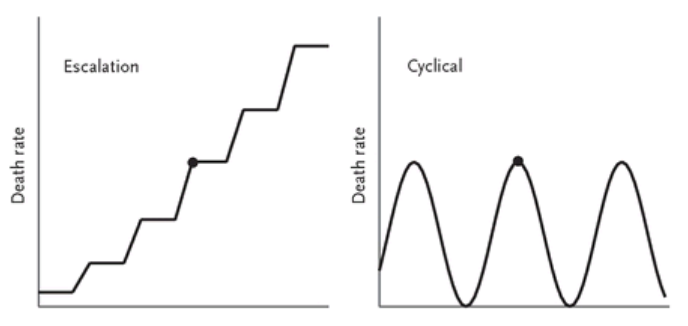
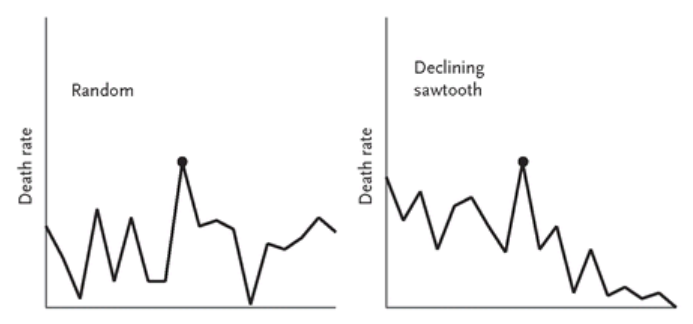
Pinker opens the chapter by fitting the same observation—World War II and the postwar interval—into four incompatible shapes: an escalating trend, a recurring cycle, a random outlier, or the last large spike in a long decline. The exercise is a compact warning against argument by curve-shaped storytelling. A finite sequence never tells you by itself which extrapolation is warranted; the choice needs independent mechanisms, longer comparisons, base rates, and tests against rival models.
Figures 5-1 and 5-2 — Two pessimistic and two less-pessimistic readings of the same historical sequence. These are schematic possibilities, not measured trend lines. Pinker ultimately argues for a mixture of randomness and changing probabilities, but the critical-thinking lesson survives independently of his conclusion: a vivid event cannot select the narrative that explains it. Chapter 5 synthesis · Statistics versus narrative, PDF pp. 275–277 (file not included in this release) · Figures 5-1 and 5-2, PDF pp. 277–278 (file not included in this release)
Pinker’s Chapter 6 supplement — casualty estimates are measurement systems, not interchangeable numbers
Pinker distinguishes battle-related deaths in state-based or nonstate fighting, one-sided killing of civilians, other direct wartime deaths, and indirect or excess deaths from disease, hunger, and collapsed services. He traces the familiar claim that civilians rose from roughly 10% to 90% of war deaths to comparisons that changed definitions, conflicts, denominators, and time windows along the way. That critique is a warning about category drift—not proof that civilian suffering or indirect mortality is small.
His discussions of the Iraq household survey and Congo mortality estimates likewise concern sampling, extrapolation, and the counterfactual baseline used to define “excess.” They do not by themselves settle either death toll. A defensible audit asks: what is included, over what period and population, with which sampling frame, against what baseline, and with what uncertainty—and are like categories being compared? The chapter is a 2011 synthesis and its conflict datasets generally end in the 2000s. Chapter 6 synthesis · Conflict categories and battle-death measurement, PDF pp. 420–423 (file not included in this release) · Civilian and indirect-death estimates, PDF pp. 446–450 (file not included in this release)
The Paul-Elder Framework (The “Gold Standard”)
Below is the Paul–Elder Critical Thinking Framework in a way you can actually run like a checklist. It has three core pieces:
- Elements of Thought (what’s in any piece of reasoning)
- Intellectual Standards (how you judge the quality of that reasoning)
- Intellectual Virtues (the character traits you’re training by applying the standards consistently)
If you learn to (a) map a claim using the Elements and then (b) interrogate each Element with the Standards, you can do this step-by-step on basically anything: an article, argument, decision, tweet, podcast, business plan, personal conflict.
Part 1 — The 8 Elements of Thought (your “argument map”)
Any time someone reasons, they are doing all (or most) of these, whether they admit it or not:
- Purpose
- What are we trying to accomplish? What’s the goal?
- Hidden purposes matter (persuasion, status, fundraising, self-justification).
- Question at issue
- What exact question are we answering?
- A lot of arguments are “wrong” because they answer a different question than the one that matters.
- Information
- What data, evidence, experiences, facts, or testimony are being used?
- What’s missing? What would change the conclusion?
- Interpretation & Inference
- What conclusion is being drawn from the information?
- What reasoning steps connect the evidence to the conclusion?
- Concepts
- What key ideas, theories, or definitions are in play? (justice, freedom, racism, risk, “market,” “harm,” “rights,” etc.)
- Many disputes are really concept disputes.
- Assumptions
- What is being taken for granted?
- What must be true for this reasoning to work?
- Implications & Consequences
- If we accept this, what follows? What are the likely results?
- “Even if it’s true, what does it commit us to?”
- Point of View
- From what perspective is this being seen?
- What alternative perspectives might interpret the same facts differently?
Use these as your “skeleton” for reconstructing any argument or decision.
Part 2 — The Intellectual Standards (your “quality control”)
These are the tests you apply to the Elements. In practice, you use them as questions.
Common Paul–Elder standards:
- Clarity: Could you elaborate? Give an example? Define terms?
- Accuracy: Is it true? How do we know? Are sources reliable?
- Precision: Can we be more specific? What exactly do you mean?
- Relevance: Does this actually bear on the question? Or is it a distraction?
- Depth: Does it deal with complexities, or oversimplify?
- Breadth: Does it consider other viewpoints or alternatives?
- Logic: Do the reasons support the conclusion? Any contradictions? Non sequiturs?
- Significance: Are we focusing on what matters most?
- Fairness: Is it even-handed, or selectively framed to “win”?
Think of Elements as “parts of the machine” and Standards as “inspection tools.”
Part 3 — The Intellectual Virtues (what you develop by doing this)
When you apply the standards to your own thinking (not just opponents), you train:
- Intellectual humility (recognize what you don’t know)
- Intellectual courage (face uncomfortable evidence)
- Intellectual empathy (steelman other viewpoints)
- Intellectual integrity (same standards for self and others)
- Intellectual perseverance (work through complexity)
- Confidence in reason (trust good process over impulse)
- Intellectual autonomy (think for yourself)
- Fair-mindedness (seek truth, not victory)
Virtues aren’t separate from the framework—they’re the “behavioral output” of using it honestly.
The same job done under time pressure → The Art of Clear Thinking - Hasard Lee
Paul-Elder above is built for analysis you have time to do. Lee’s ACE Helix — Assess → Choose → Execute — is the fighter-pilot version, designed for decisions where the clock is the binding constraint, and it’s a useful contrast rather than a competitor.
- Assess — build a fast, accurate model that isolates the few factors actually driving the outcome. His cross-check (scan all instruments in a fixed rhythm so no single cue monopolises attention) is a direct countermeasure to the “soda-straw” tunnel vision that Paul-Elder’s Point of View element names but doesn’t give you a drill for.
- Identify power laws and tipping points — look for nonlinear drivers, then ask “what small change could break this?” That’s a sharper prompt than the Standards’ generic “Significance.”
- Choose — highest expected value, not highest certainty.
- Execute — the step Paul-Elder omits entirely, because it isn’t a reasoning framework.
Where they genuinely conflict: Step 0 below tells you to take one unit of reasoning at a time. Lee’s cross-check says the opposite — scan everything on a rhythm, because in his domain the failure mode is fixating on one unit. Worth knowing which situation you’re in before picking.
The Step-by-Step Procedure (do this in order)
Step 0 — Choose the “unit of reasoning”
Pick one of these:
- A single claim (“X caused Y”)
- A decision (“Should I do A or B?”)
- A policy (“We should ban/mandate…”)
- An argument thread (premises → conclusion)
Don’t try to analyze ten claims at once. One unit.
Step 1 — Write the conclusion in one sentence (Inference)
Force the argument into a single, testable statement.
Example templates:
- “Therefore, we should ___.”
- “Therefore, X is true/false.”
- “Therefore, X is the main cause of Y.”
- “Therefore, person/group ___ is responsible.”
If you can’t do this, you don’t yet understand what’s being argued.
Step 2 — Identify the Question at Issue
Ask: “What question is this conclusion answering?”
Then tighten it:
- Too vague: “Is immigration bad?”
- Better: “What is the net fiscal impact of immigration on US federal finances over 20 years?”
- Better still: specify place/time/population/mechanism.
If the question is ill-formed, the thinking downstream will be sloppy.
Step 3 — Clarify the Purpose
What is the speaker/author (or you) trying to accomplish?
- Inform? persuade? provoke? justify? sell? recruit? vent?
Purpose shapes what gets selected as “relevant.”
Step 4 — Lay out the Information (evidence inventory)
Make two lists:
A. What evidence is actually offered?
- stats, anecdotes, expert claims, citations, examples, historical cases
B. What evidence would we need to evaluate it properly? - base rates, counterexamples, comparisons, time windows, confounders, definitions, primary sources
This step alone catches a ton of bad arguments: they run on vibes, not information.
Step 5 — Uncover Assumptions
Ask: “What must be true for this to be convincing?”
Common assumption types:
- Causal assumptions: “If A happened before B, A caused B.”
- Moral assumptions: “If it’s unfair, it should be illegal.”
- Measurement assumptions: “This metric represents the thing we care about.”
- Group assumptions: “This group is basically homogeneous.”
- Default assumptions: “The status quo is fine unless proven otherwise.”
Write 3–7 assumptions explicitly.
Step 6 — Identify Concepts and define the key ones
Pick the 3–5 most important terms and define them as used here.
Disputes often vanish once definitions are made explicit, or they intensify in a productive way because you locate the real disagreement.
Step 7 — Map the logic (reasons → conclusion)
Write the reasoning as a simple chain:
- Premise 1:
- Premise 2:
- Premise 3:
- Therefore:
- (Optional sub-conclusions)
Then test whether the premises actually support the conclusion, or whether a hidden premise is doing the real work.
Step 8 — Consider Point of View and add Breadth
List 2–4 credible alternative perspectives.
Then steelman one:
- “If I were trying to refute this, the strongest objection would be…”
- “If I were trying to defend this, the strongest support would be…”
This is where you escape echo-chamber thinking.
Step 9 — Trace implications and consequences
Split into:
- Logical implications: what else must be true if this is true?
- Practical consequences: what likely happens if we act on it?
Good thinking is not just “is it true?” but “what does it lead to?”
Now apply the Standards (the real engine)
Do a “standards sweep” across what you produced. Use these prompts:
Clarity
- Can I restate the argument so the other side would say “yes, that’s it”?
- What does each key term mean?
Accuracy
- Which claims are empirical? Which are moral?
- For empirical claims: what’s the best available evidence?
Precision
- Where is it vague? (“many,” “a lot,” “dangerous,” “better”)
- Can I specify quantities, time frames, and mechanisms?
Relevance
- Which points are rhetorical but don’t affect the conclusion?
- Which evidence directly bears on the question?
Depth
- What complexities are ignored? Confounders? tradeoffs? second-order effects?
Breadth
- What alternative explanations fit the same facts?
- What would someone from another viewpoint say?
Logic
- Any contradictions?
- Any non sequiturs?
- Does the conclusion overreach the premises?
Significance
- Are we focusing on the central driver, or a side issue?
- What’s the “load-bearing” premise?
Fairness
- Is the framing selective?
- Am I applying the same standards to my side?
A copy-and-paste “worksheet” you can use
Use this whenever you want to run the framework:
1) Conclusion (1 sentence):
2) Question at issue (tightened):
3) Purpose:
4) Point of view:
5) Key concepts (define):
- Concept 1:
- Concept 2:
- Concept 3:
6) Information offered (evidence):
7) Information needed (missing):
8) Assumptions (3–7):
9) Reasoning chain (premises → conclusion):
10) Alternative viewpoints (2–4):
11) Implications (logical):
12) Consequences (practical):
Standards check: - Clarity:
- Accuracy:
- Precision:
- Relevance:
- Depth:
- Breadth:
- Logic:
- Significance:
- Fairness:
Final evaluation: - Strongest part of the argument:
- Weakest/load-bearing vulnerability:
- What would change my mind:
How to use it fast vs. deep
2-minute version (triage)
- What’s the conclusion?
- What’s the best evidence offered?
- What assumption is carrying the argument?
- What’s a plausible alternative explanation?
- What would change your mind?
Deep version (serious analysis)
Run the full 12-item worksheet, then the standards sweep.
If you give me a specific claim (a paragraph, tweet, or argument), I can run the framework on it once as a worked example, and you can reuse the structure.
The RED Model (Professional Application)
Often used in business and leadership, the RED Model simplifies the critical thinking process into three actionable steps:
- Recognize Assumptions: Distinguish between facts and opinions. Identify what is being “taken for granted” without evidence.
- Evaluate Arguments: Analyze information objectively. Look for logical fallacies and judge the quality of the evidence provided.
- Draw Conclusions: Synthesize the analysis to reach a balanced decision. Ensure the conclusion is supported by the preceding evidence.
Key Techniques and Methods
Beyond frameworks, specific techniques help you apply critical thinking in real-time:
- Socratic Questioning: A systematic method of asking questions to probe underlying beliefs and identify weaknesses in an argument. Questions include: “What do you mean by that?” or “What would happen if we assumed the opposite?”
- The Scientific Method: Applying a cycle of observation, hypothesis, testing, and analysis. This removes “gut feeling” and replaces it with empirical data.
- First Principles Thinking: Breaking down a complex problem into its most basic, foundational truths and building up a solution from scratch rather than reasoning by analogy.
- Steelmaning: The opposite of “strawmaning.” It involves building the strongest possible version of your opponent’s argument to see if your own position can still withstand it.
4. Avoiding Barriers (Biases and Fallacies)
A critical thinker must actively guard against “mental shortcuts” that distort reality:
| Category | Examples | Summary |
|---|---|---|
| Cognitive Biases | Confirmation Bias, Anchoring, Dunning-Kruger | Psychological tendencies to favor certain information over others based on past experience or ego. |
| Logical Fallacies | Ad Hominem, Straw Man, Slippery Slope | Errors in the structure of an argument that make the reasoning invalid. |
| Egocentrism | — | The tendency to view everything in relationship to oneself and ignore the perspectives of others. |
5. The Process of Application
To apply these ideas in your daily life, follow this iterative process:
- Define the Goal: Clearly state what you are trying to solve or understand.
- Gather Information: Seek out diverse sources, especially those that challenge your current view.
- Question Assumptions: Ask, “Why do I believe this to be true?”
- Analyze the Logic: Check the evidence against the Intellectual Standards (Clarity, Accuracy, etc.).
- Synthesize & Decide: Formulate a conclusion while acknowledging its limitations.
- Reflect: After the decision, review the outcome. What did you miss? How can you improve your process next time?
The Critical Reading Checklist
Phase 1: Identifying the Foundation
- Purpose: What is the author’s primary goal? (To persuade, to inform, to entertain, or to provoke action?)
- The “Big Question”: What is the specific problem or issue the author is trying to solve?
- Point of View: What is the author’s professional or ideological background? How might this frame their perspective?
Phase 2: Evaluating the Evidence
- Information Quality: What data, facts, or experiences are being used to support the claims? Are the sources cited, and are they reputable?
- Assumptions: What is the author taking for granted? (e.g., “The author assumes that economic growth is always the primary goal.”)
- Omissions: What information or perspectives are missing? Is the author “cherry-picking” data to suit their narrative?
Phase 3: Analyzing the Logic
- Clarity and Precision: Does the author define their terms clearly, or are they using “vague-speak” to gloss over complexities?
- Logical Fallacies: Can you spot any “red herrings,” “straw man” arguments, or “slippery slopes”?
- The “Steelman” Test: Can you summarize the opposing view better than the author did? If the author makes the opposing view look “stupid,” they may not be thinking critically.
Phase 4: Considering the “So What?”
- Implications: If the author’s argument is 100% correct, what are the logical consequences? What happens next?
- Counter-arguments: What is the strongest possible objection to this thesis? Does the author address it fairly?
- Final Synthesis: Does the conclusion actually follow from the evidence provided, or is there a “leap of faith” at the end?