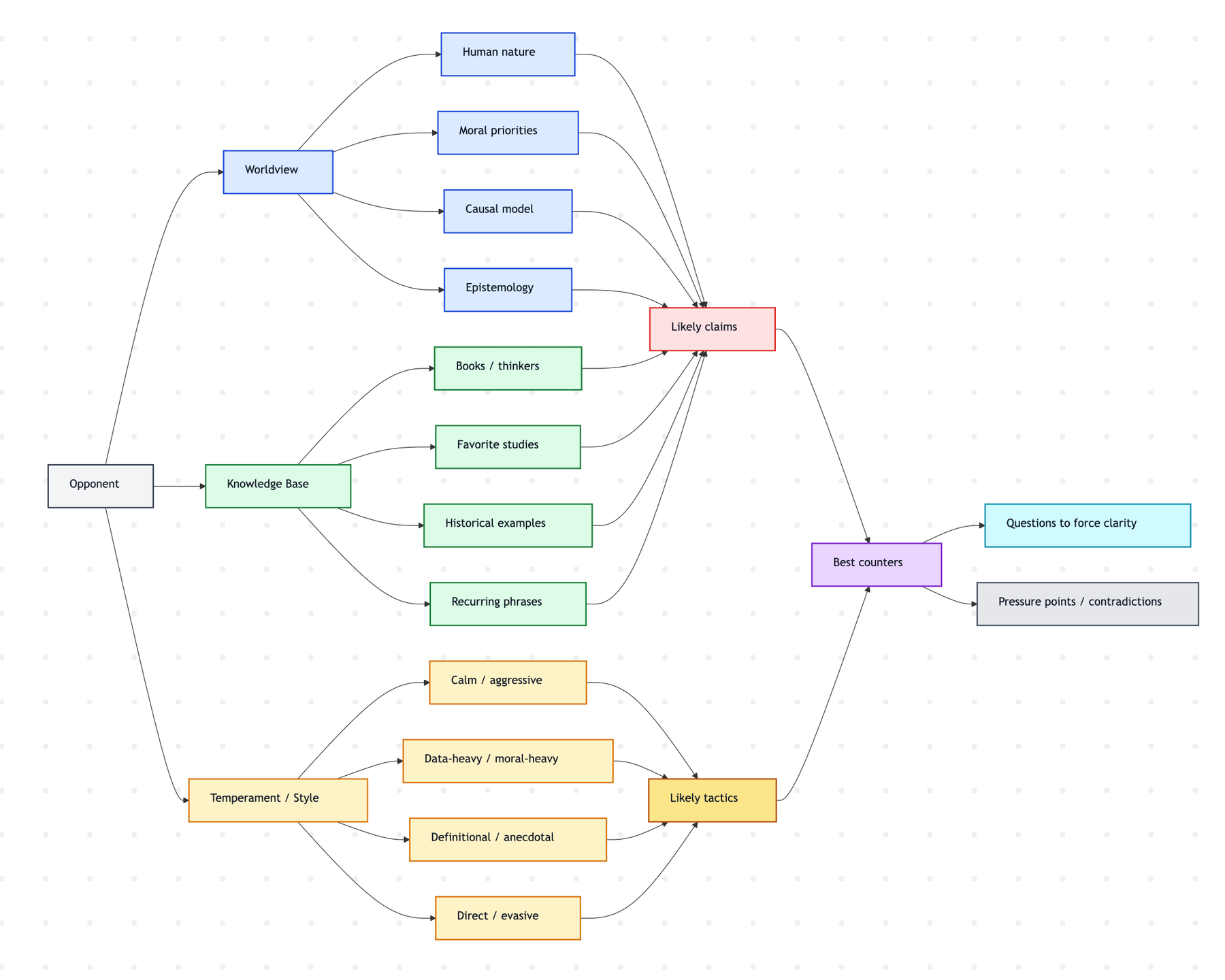
A well-established way to do this is to treat debate prep like a mix of rhetoric, adversarial analysis, and intelligence gathering. You are trying to answer four questions before the debate:
- What does this person believe at the deepest level?
- What facts, authorities, and frames do they rely on?
- What arguments are they therefore likely to make?
- Where are the pressure points, blind spots, and tradeoffs?
Here is the clearest prep process.
1. Start with the person’s underlying worldview, not their talking points
Do not begin with isolated claims. Begin by identifying:
- their moral framework
- rights-based
- utilitarian
- traditionalist
- libertarian
- religious
- nationalist
- egalitarian
- procedural/institutional
- their view of human nature
- people are basically rational
- people are driven by power/status
- institutions corrupt
- markets coordinate well
- culture matters more than policy
- incentives matter more than intentions
- their theory of social causation
- systems create outcomes
- individuals create outcomes
- economics drives politics
- culture drives economics
- elite manipulation drives events
- historical oppression explains present disparities
- their epistemology
- what counts as evidence for them?
- expert consensus?
- lived experience?
- scripture/tradition?
- statistics?
- historical analogies?
- legal text?
- common sense?
This is the foundation. Once you know these, many of their likely arguments become predictable.
2. Build a “belief map” from prior material
Gather their previous:
- debates
- interviews
- podcasts
- articles/posts
- books or essays
- clipped viral moments
- responses under pressure
Then extract and organize:
- repeated themes
- favorite examples
- go-to authorities
- phrases they reuse
- assumptions they never defend because they treat them as obvious
- issues where they become emotionally invested
Create a sheet with columns like:
- Topic
- Claim
- Deeper assumption
- Evidence they usually cite
- Preferred framing
- Likely fallback argument
- Known vulnerability
Example:
- Topic: inequality
- Claim: disparities are mainly structural
- Deeper assumption: institutions shape opportunity more than individuals
- Evidence: historical exclusion, outcome data, discrimination studies
- Preferred framing: fairness/justice
- Fallback: even if individual choices matter, systems still set the menu of choices
- Vulnerability: causal overreach, weak counterfactuals, agency minimization
3. Distinguish position, frame, and burden
A lot of debaters only prep the opponent’s position. Better prep also identifies:
- Position: what are they explicitly arguing?
- Frame: what lens are they using to make it persuasive?
- Burden: what do they think must be proven?
Example:
Two people may both oppose a policy, but one argues:
- “It violates rights.”
Another argues:
- “It produces bad outcomes.”
Same conclusion, different structure. You answer them differently.
So ask:
- Are they arguing principle or consequences?
- Are they trying to win on morality, practicality, legality, or optics?
- Are they trying to prove their case, or merely raise doubt about yours?
4. Identify their argument tree
Take each likely major claim and build downward.
For each claim, map:
- Conclusion
- Supporting premises
- Evidence/examples
- Hidden assumptions
- Rhetorical packaging
- Likely rejoinders if challenged
For example:
Conclusion: censorship is necessary
- Premise 1: misinformation causes serious harm
- Premise 2: platforms amplify harm at scale
- Premise 3: regulation reduces harm
- Hidden assumption: gatekeepers are more trustworthy than open discourse
- Packaging: safety, responsibility, public health
- Likely rejoinder: free speech is not absolute / emergency conditions justify intervention
This lets you attack:
- the premises
- the causal link
- the assumption
- the standard of proof
- the framing itself
5. Separate “core commitments” from “disposable talking points”
This matters a lot.
Some arguments they will abandon quickly. Others they cannot abandon without collapsing their whole worldview.
Look for:
Core commitments
These are the beliefs they must protect:
- equality is morally primary
- liberty is morally primary
- tradition contains wisdom
- state power is suspect
- institutions are fundamentally biased
- national cohesion matters more than abstract universalism
Disposable talking points
These are examples or stats they can swap out:
- one study
- one anecdote
- one scandal
- one quote
- one policy result
Your best prep targets the core commitments, not just the disposable examples.
6. Study how they argue, not only what they argue
Good prep includes debate-style profiling.
Track whether they usually:
- define terms narrowly or ambiguously
- shift between descriptive and moral claims
- use motte-and-bailey moves
- retreat to “I’m just raising questions”
- overload with examples instead of proving causation
- rely on emotional asymmetry
- use internal critiques
- force definitional traps
- appeal to hypocrisy rather than truth
- switch levels of abstraction when pressured
This matters because argument prediction is partly about style.
For example, some debaters:
- lead with data
- then shift to morality
- then end with ridicule
Others:
- begin with values
- use stories
- avoid empirical specifics
You want to know the sequence they tend to use.
7. Build a “likely move / likely countermove” matrix
This is one of the best prep tools.
For each major topic, write:
- their likely opening claim
- your direct answer
- their likely response to your answer
- your prebuilt counter
- your short version
- your extended version
Example:
Their likely move: “Your view ignores structural causes.”
Your answer: “Structural causes matter, but your model erases agency and overclaims causation.”
Their likely reply: “Recognizing structure does not deny agency.”
Your counter: “Then specify what degree of causal weight belongs to institutions versus behavior, and what evidence would falsify your model.”
That makes you much harder to surprise.
8. Prepare at three levels: steelman, normal, aggressive
For every major issue, prep for three versions of their case:
Steelman version
The strongest version they could give.
This prevents you from preparing against a weak caricature.
Normal version
What they usually say in real debates.
This is the most useful for live prep.
Aggressive version
What they say when cornered or when trying to score points rhetorically.
This helps you handle pivots, crowd play, and bad-faith framing without freezing.
9. Use “red team” questioning before the debate
Have someone on your side simulate the opponent and ask:
- What would they say is your hidden assumption?
- Which of your claims are vulnerable to empirical attack?
- What term are you using vaguely?
- What moral intuition are you assuming the audience shares?
- If they force you to defend first principles, are you ready?
- What would they say your argument leads to in practice?
This is standard adversarial prep logic. You are trying to discover how you look from inside their worldview.
10. Run a fast self-falsification pass
Do this before polishing rhetoric or memorizing counters. Red-teaming asks how the opponent may attack you; self-falsification asks whether the attack would be correct. The full method is in Self-Falsification Protocol for Debate Prep. For ordinary prep, use this minimum viable version:
- Choose the three load-bearing claims. If one fell, which claims would force you to revise the conclusion or most of the case? Audit those first. Ignore decorative points unless they are easy for an opponent to disprove.
- State each claim precisely. Include the population, period, comparison class, causal strength, and key definition. Separate empirical, causal, conceptual, interpretive, and normative claims; they require different tests.
- Pre-commit to the failure conditions. Before searching, write:
- Abandon if: what finding would make the claim false?
- Narrow if: what finding would require a smaller claim?
- Drop this argument if: what would undermine the evidence or inference without disproving the conclusion?
- Run one hostile test per claim. Seek the strongest credible disconfirmation, not a generic web search. Check the primary source or root dataset, the best specialist critic, a rival causal explanation, and one case where your rule points against your prior sympathies.
- Record a verdict immediately. Mark the claim survives this pass, narrows, drops, or unresolved. “Survives” means only that the claim passed the hostile test you ran, not that it is proven. Rewrite it now; do not carry the stronger wording onto the live sheet.
- Rehearse the concession. State the strongest evidence against your position accurately, then give the shortest honest response: concede, narrow, explain why it is not decisive, or suspend the claim.
Use this compact register while you work:
| Load-bearing claim | Abandon / narrow condition | Hostile test run | Strongest contrary finding | Verdict | Live wording |
|---|---|---|---|---|---|
| Survives this pass / narrows / drops / unresolved |
Exit rule
A claim is not ready for the debate sheet until you can state the strongest evidence against it without caricature and explain exactly what would make you change your mind. If you cannot, mark it unresolved or remove it.
This pass should usually take 20–30 minutes for three major claims. Spend more time only when a claim is both structurally essential and genuinely contested.
11. Pre-write definition fights
Many debates are won or lost at the definition stage.
List all key terms likely to matter:
- justice
- freedom
- equality
- rights
- harm
- truth
- democracy
- oppression
- violence
- responsibility
- racism
- fascism
- censorship
For each term, note:
- your definition
- their likely definition
- why their definition helps them
- why yours is clearer or more defensible
- what happens to the debate if their definition is accepted
This avoids getting trapped by vocabulary before the real argument starts.
12. Build “if-then” prediction chains
This is where worldview modeling becomes predictive.
Use a structure like:
- If they believe institutions are the main drivers of social outcomes,
- then they will likely interpret disparities systemically,
- therefore they will probably support interventionist remedies,
- and they will resist explanations centered on agency, culture, or biological variation.
Or:
- If they believe liberty is the highest political good,
- then they will treat coercion as presumptively suspect,
- therefore they will demand strong justification for regulation,
- and they will likely attack paternalistic policies even if those policies have beneficial outcomes.
That is how you move from “what they said before” to “what they are likely to say next.”
13. Note their preferred evidence hierarchy
Different debaters trust different kinds of proof.
Rank what they treat as persuasive:
- peer-reviewed studies
- historical examples
- legal text
- economic models
- elite testimony
- personal testimony
- moral intuition
- scriptural authority
- institutional trust
- common-sense realism
Then ask:
- what kind of evidence can move them?
- what kind of evidence only moves the audience?
- what kind of evidence do they dismiss automatically?
Sometimes you are not really debating facts. You are debating what counts as a fact.
14. Find the contradiction pressure points
Good prep includes searching for tensions such as:
- equality vs merit
- liberty vs safety
- pluralism vs moral certainty
- compassion vs incentives
- anti-elitism vs reliance on experts
- agency vs victimhood
- local autonomy vs federal enforcement
- universal principles vs tribal exceptions
You want places where their worldview produces hard tradeoffs they prefer not to name.
Then frame questions like:
- “Which principle gives way here?”
- “What is your limiting principle?”
- “What evidence would make you revise this?”
- “Do you apply this standard consistently?”
15. Prepare concise “diagnostic questions”
Before making your big case, ask questions that reveal their framework.
Examples:
- “What do you think is the main cause here: institutions, incentives, culture, or individual choice?”
- “Is your objection moral, legal, or empirical?”
- “What kind of evidence would disprove your claim?”
- “Are you arguing that this is unjust in principle or merely ineffective in practice?”
- “Which value takes priority when equality and liberty conflict?”
These questions make their worldview visible.
16. Translate all prep into a one-page live debate sheet
Do not bring a giant research archive into a live debate mentally. Compress it into:
A. Opponent profile
- worldview
- primary values
- evidence hierarchy
- style tendencies
B. Most likely claims
- top 5 arguments
- strongest example for each
C. Best counters
- one short
- one medium
- one deep
D. Trap warnings
- terms they redefine
- pivots they use
- emotional frames they deploy
E. Your return questions
- 5 questions that expose assumptions
- 5 questions that force tradeoffs
F. Your own case audit
- three load-bearing claims and their verdicts
- strongest evidence against each
- revised, defensible wording
- planned concessions and unresolved points to avoid asserting
17. Remember the main failure mode
The biggest mistake is preparing against a stereotype instead of an actual person.
So the order should be:
- Identify the real person’s worldview
- Map their actual prior arguments
- Infer likely future arguments
- Falsify your own load-bearing claims
- Pressure-test both cases in advance
- Reduce the result into usable live prep
Not:
- “He’s on the left, so he’ll say X”
- “She’s a conservative, so she’ll say Y”
That is lazy prep and often wrong.
A strong practical template
Use this before a debate:
Opponent worldview
- highest values:
- human nature:
- main causal lens:
- epistemic standard:
- sacred cows:
- taboo areas:
Likely claims
Likely evidence/examples
Likely rhetorical strategies
- definitional shift
- moral framing
- hypocrisy attack
- anecdotal overload
- audience signaling
Best counters
- premise attack:
- causal attack:
- standard-of-proof attack:
- framing reversal:
- inconsistency exposure:
Your own claim audit
| Claim | What would falsify or narrow it? | Strongest contrary evidence | Verdict | Revised live wording |
|---|---|---|---|---|
Planned concessions
- concede cleanly:
- narrow to:
- leave unresolved:
Best questions
In one sentence
The established method is: profile worldview, map recurring claims, infer argument patterns from first principles, falsify your own load-bearing claims, then pre-build counters and diagnostic questions around what survives.
If you want, I can turn this into a debate prep worksheet you can reuse before any discussion.
Belief Map
A belief map visually looks like a layered argument network. The basic idea is that you do not put isolated opinions on the page. You show how deep assumptions generate principles, which generate issue positions, which generate debate arguments, which generate rhetorical habits.
A clean way to picture it is like this:
                        BELIEF MAP

                  [View of Human Nature]
                           |
        ------------------------------------------------
        |                      |                      |
[People are shaped      [Institutions matter]   [Incentives drive behavior]
 by culture more
 than policy]
        |
        v
                 [Core Worldview / First Principles]
        ------------------------------------------------
        |                      |                      |
 [Tradition contains      [Order is fragile]     [Abstract ideals can be
   wisdom]                                         dangerous if detached
                                                    from reality]
        |
        v
                     [Moral / Political Values]
        ------------------------------------------------
        |                      |                      |
   [Stability]           [Responsibility]       [Social cohesion]
        |
        v
                       [Issue-Level Beliefs]
        ------------------------------------------------
        |                      |                      |
 [Crime is reduced       [Family breakdown is    [Schools transmit
  more by norms than      a cultural problem]     values, not just skills]
  by programs]
        |
        v
                      [Likely Debate Arguments]
        ------------------------------------------------
        |                      |                      |
 [Policy alone won't     [You cannot solve       [Neutrality is a myth;
  solve social decay]     moral disorder with     institutions always encode
                          bureaucracy]             values]
        |
        v
                     [Likely Rhetorical Moves]
        ------------------------------------------------
        |                      |                      |
 [Uses historical        [Attacks naive          [Frames opponent as too
  examples]               idealism]               abstract or utopian]
That is the basic vertical version: deepest assumptions at the top, debate behavior at the bottom.
The main visual idea
A belief map usually has 5 layers:
1. Foundational assumptions
These are the deepest beliefs:
- what people are like
- what society is like
- what causes social outcomes
- whether truth is objective, constructed, revealed, empirical, etc.
2. Core worldview
These are the person’s broad governing ideas:
- liberty first
- equality first
- order first
- tradition first
- justice as fairness
- markets solve coordination problems
- power explains social life
3. Values and principles
These are the norms they appeal to:
- fairness
- duty
- rights
- consent
- authority
- compassion
- stability
- merit
4. Issue positions
These are their views on actual topics:
- speech
- crime
- immigration
- education
- war
- religion
- inequality
5. Debate outputs
These are the arguments and moves they tend to make:
- favorite slogans
- default examples
- typical attacks
- likely pivots
- fallback defenses
A second visual style: hub-and-spoke
Another common visual is a central node with branches:
                    [CORE WORLDVIEW]
           "Institutions shape outcomes more than individuals"

                /            |            |            \
               /             |            |             \
              v              v            v              v

     [Moral Value]    [Causal Model]  [Evidence Style]  [Threat Perception]
       Fairness        Structural        Social science    Hidden power /
                        causes >         and disparity     systemic bias
                        personal choice  data

              \             |            |             /
               \            |            |            /
                --------------------------------------
                                   |
                                   v

                         [ISSUE POSITIONS]
          ---------------------------------------------------
          |                       |                        |
   [Education inequality]   [Policing disparities]   [Economic inequality]

          |                       |                        |
          v                       v                        v

                     [LIKELY DEBATE CLAIMS]
          ---------------------------------------------------
          |                       |                        |
 "Outcomes reveal         "Neutral rules can       "Formal equality is not
 structural barriers"      preserve inequity"       enough"
This is useful because you can see one central belief radiating into many positions.
Best visual format for debate prep
The most useful version is usually a tree with side notes.
Example:
[FOUNDATIONAL ASSUMPTION]
People are primarily shaped by systems and incentives
    |
    +--> [WORLDVIEW]
         Social outcomes are mostly institutional
            |
            +--> [VALUE]
                 Fairness requires correcting structural imbalance
                    |
                    +--> [ISSUE VIEW]
                         Meritocracy is often overstated
                            |
                            +--> [LIKELY ARGUMENT]
                                 Unequal outcomes suggest unequal systems
                            |
                            +--> [LIKELY EVIDENCE]
                                 Outcome disparities, historical exclusions
                            |
                            +--> [LIKELY RHETORICAL MOVE]
                                 "You're individualizing a systemic problem"
                            |
                            +--> [PRESSURE POINT]
                                 Hard to explain variation within same system
This is strong because it does three things at once:
- shows the logic chain
- predicts argument style
- shows vulnerability
Color-coding helps a lot
If you were making one visually, the cleanest system is:
- Blue = foundational assumptions
- Green = values/principles
- Orange = issue positions
- Red = likely attacks or rhetorical moves
- Gray = vulnerabilities or contradictions
So the map is not just “what they believe,” but also:
- how they argue
- where they are strongest
- where they can be challenged
What a finished map should let you see instantly
A good belief map should make it easy to answer:
- What is this person’s deepest lens?
- What values do they protect most?
- What issue positions flow from that?
- What arguments are predictable?
- What examples will they probably use?
- Where are the weak links or tradeoffs?
Simple template you could sketch on paper
                    [Deep assumptions]
                           |
                    [Core worldview]
                           |
                    [Values/principles]
                           |
                     [Issue positions]
                           |
                    [Likely arguments]
                           |
                   [Likely debate tactics]
                           |
                     [Weak points/tradeoffs]
Best way to think about it
A belief map is basically a map of intellectual causation:
What they think reality is like
leads to
what they think matters morally
leads to
what positions they take
leads to
how they argue in public