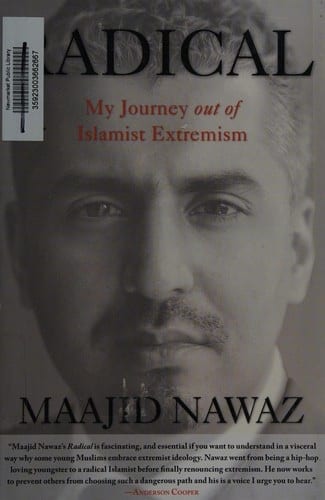
DESCRIPTION
Maajid Nawaz spent his teenage years listening to American hip-hop and learning about the radical Islamist movement spreading throughout Europe and Asia in the 1980s and 90s. At 16, he was already a ranking member in Hizb ut-Tahrir, a London-based Islamist group. He quickly rose through the ranks to become a top recruiter, a charismatic spokesman for the cause of uniting Islam’s political power across the world. Nawaz was setting up satellite groups in Pakistan, Denmark, and Egypt when he was rounded up in the aftermath of 9/11 along with many other radical Muslims. He was sent to an Egyptian prison where he was, fortuitously, jailed along with the assassins of Egyptian President Anwar Sadat. The 20 years in prison had changed the assassins’ views on Islam and violence; Maajid went into prison preaching to them about the Islamist cause, but the lessons ended up going the other way. He came out of prison four years later completely changed, convinced that his entire belief system had been wrong, and determined to do something about it. He met with activists and heads of state, built a network, and started a foundation, Quilliam, funded by the British government, to combat the rising Islamist tide in Europe and elsewhere, using his intimate knowledge of recruitment tactics in order to reverse extremism and persuade Muslims that the ‘narrative’ used to recruit them (that the West is evil and the cause of all of Muslim suffering), is false. Radical, first published in the UK, is a fascinating and important look into one man’s journey out of extremism and into something else entirely. This U.S. edition contains a “Preface for US readers” and a new, updated epilogue.
AI Summary
- Nawaz describes his journey from being a rebellious youth in Essex, England to becoming radicalized and joining the Islamist group Hizb ut-Tahrir. He rose through the ranks to become an international recruiter for the organization.[1] While studying Arabic in Egypt, Nawaz was arrested along with friends by the secret police. He faced a 5-year prison term, mental torture and solitary confinement. In prison, he underwent an intellectual transformation after interacting with Muslims of diverse backgrounds and views.[1] After being released, Nawaz publicly renounced Islamist ideology at great personal cost, including estrangement from family and friends and loss of personal security. He co-founded the Quilliam Foundation to counter Islamist extremism worldwide.[1][2]
- Nawaz argues that the way he and other Islamists operated was to disguise political demands as religious and multicultural issues. They exploited liberal sensitivities around racism to avoid scrutiny of their ideology.[3] A core idea promoted by Nawaz and Quilliam is that space must be claimed for secular identities within Islam. Muslim authenticity should not be measured by narrow interpretations of the faith.[4]
ADDITIONAL RESOURCES
Based on the provided sources, Maajid Nawaz advocates for several strategies to counter Islamist extremism:
- Developing a counter-narrative that challenges the political rhetoric of Islamist extremist ideology, such as highlighting the hypocrisy that while their envisioned states are meant as safe havens for Muslims, the majority of their victims are Muslims[14]. This aims to uncouple the political from the religious.
- Developing a counter-theology by Islamic scholars to challenge the puritanical interpretations and religious convictions that underpin Islamist extremism[14]. This should be done in parallel with the political counter-narrative.
- Promoting genuine grassroots activism advocating for democratic culture itself, not just voting for democracy[2]. Nawaz founded the Quilliam Foundation to engage in “counter-Islamist thought-generating”[1].
- Challenging extremism in all its forms through vocal opposition to anti-Semitism and criticism of those who have turned opposition to Israel into “the mother of all virtue-signals”[12].
- Openly condemning terrorism wherever it occurs, including inside Israel, as a human rights imperative[12].
- Attacking the “lazy analogy” between Israel and apartheid-era South Africa which he believes underlies the BDS movement[12].
- Criticizing the disproportionate global focus on Israel and calling out double standards[12].
- Engaging in counter-extremism initiatives in civil society, integration efforts, and democratic political participation to address both real and perceived grievances that can fuel radicalization[6].
In summary, Nawaz advocates a multi-pronged approach of developing political and religious counter-narratives, promoting democratic values, challenging all forms of extremism, and addressing grievances through civic engagement to effectively counter the ideology of Islamist extremism[1][2][6][12][14].
Citations:
[1] https://www.ted.com/speakers/maajid_nawaz
[2] https://unwatch.org/united-nations-watch-announces-human-rights-award-maajid-nawaz/
[3] https://en.wikipedia.org/wiki/Maajid_Nawaz
[4] https://www.theguardian.com/politics/2015/aug/02/maajid-nawaz-how-a-former-islamist-became-david-camerons-anti-extremism-adviser
[5] https://www.npr.org/transcripts/195238189
[6] https://www.nato.int/docu/review/articles/2012/07/27/thoughts-of-a-former-extremist/index.html
[7] https://www.rand.org/content/dam/rand/pubs/monographs/2010/RAND_MG1053.pdf
[8] https://bridge.georgetown.edu/research/factsheet-maajid-nawaz-2/
[9] https://books.google.com/books/about/Radical.html?id=r-AgngEACAAJ
[10] https://www.theatlantic.com/international/archive/2016/10/maajid-nawaz-splc-anti-muslim-extremist/505685/
[11] https://www.washingtoninstitute.org/policy-analysis/reversing-tide-radicalization
[12] https://www.timesofisrael.com/the-british-activist-who-went-from-radical-islam-to-staunch-israel-ally/
[13] https://www.amazon.com/Radical-Journey-out-Islamist-Extremism/dp/1504711149
[14] https://extremism.gwu.edu/sites/g/files/zaxdzs5746/files/downloads/Al Raffie.pdf
[15] https://ftp.scientific-computing.com/_y/edu/search?EBOOK=radical+my+journey+out+of+islamist+extremism.pdf
[16] https://www.govinfo.gov/content/pkg/CHRG-110shrg44123/html/CHRG-110shrg44123.htm
[17] https://apps.dtic.mil/sti/pdfs/AD1008888.pdf
[18] https://en.wikipedia.org/wiki/Quilliam_(think_tank)
[19] https://www.nytimes.com/2017/03/28/magazine/can-a-former-islamist-make-it-cool-to-be-moderate.html
[20] https://www.amazon.com/Radical-Journey-Out-Islamist-Extremism/dp/0762791365
HIGHLIGHTS
PREFACE TO THE US EDITION Being American (Location 67)
Sayyid Qutb’s Islamist manifesto—Milestones—out from that very prison to the wider public in the early 1960s. Qutb was the founding father of modern-day, militant Islamism, otherwise known as Jihadism. (Location 93)
It directly inspired bin Laden and Ayman al-Zawahiri, who used Milestones to form the philosophical foundations of al-Qaeda. (Location 96)
Qutb’s journey toward a more aggressive, anti-American dogma in fact began after his two-year sabbatical to 1940s America. (Location 97)
Qutb was so disillusioned by his own inability to integrate with 1940s America, and presumably hurt by the common assumption that he was African American, that it seems to have inspired within him deep shame and embarrassment, provoking in him the crudest of prejudice. (Location 103)
American is primitive in his artistic taste, both in what he enjoys as art and in his own artistic works. “Jazz” music is his music of choice. This is that music that the Negroes invented to satisfy their primitive inclinations, as well as their desire to be noisy on the one hand and to excite bestial tendencies on the other. The American’s intoxication by “jazz” music does not reach its full completion until the music is accompanied by singing that is just as coarse and obnoxious as the music itself. (Location 111)
there are more Muslims in China, Russia, India, and Europe than there are in a number of Middle-Eastern countries. (Location 130)
What better way to create an Islamist superstate than to exclusively define Muslims against everyone else? (Location 137)
During the course of my efforts to challenge Islamist extremism among Muslims, I have been told that Americans are Islamophobic, ignorant, arrogant, loud, lazy, wasteful, selfish, godless, fundamentalist, promiscuous, racist, isolationist, and imperialist. Muslims often overlook the fact that these very pejoratives are used to describe them, too. (Location 146)
My parents’ response was to turn the other cheek. There was a feeling among previous generations that they did not have a right to fight back, because they were visitors, immigrants. (Location 570)
The Ayatollah/Satanic Verses affair helped this shift along somewhat. The communities adopted a more isolationist stance, a policy of self-exclusion. For many, the nature of how they identified themselves was changing. So instead of calling themselves “British Asians” as my parents had done, this generation now defined themselves as almost exclusively Muslim. They believed that their allegiance to the global Islamic community, the ummah, prevented them from defining themselves as being part of their birth country. (Location 901)
Essentially, the rise of Islamist groups was a key factor in shifting Muslims away from their national identities toward a more exclusively Muslim one. (Location 914)
Islam is a religion, and its Shari’ah can be compared to Talmudic or Canon law. As a religion, Islam contains all the usual schisms of any other faith. There are ancient creedal disputes, from which we have the two major denominations of Sunni and Shia, each giving rise to numerous sects within their ranks. From methodological disputes, legal theorists and traditionalists debated whether scripture was best approached through systemized reasoning or oral tradition. From juristic differences, major schools of law emerged. And from a devotional angle, lapsed, traditional, fundamentalist, and extremist Muslims have always existed. Superseding all these religious disagreements, and influencing many of them politically, is the ideology of Islamism. Simply defined, Islamism is the desire to impose any given interpretation of Islam over society as law. Understood in this way, Islamism is not another religious schism, but an ideological thought that seeks to develop a coherent political system that can house all these schisms, without necessarily doing away with them. Whereas disputes within Islam deal with a person’s approach to religion, Islamism seeks to deal with a person’s approach to society. (Location 989)
As a political project, Islamism was inspired by the rise of European fascism. Like its European ideological counterparts, Islamism was not safe from its own schisms. Some groups wanted to bring about the “Islamic System” by working alongside the status quo; these were political Islamists, like the Muslim Brotherhood. Others were more revolutionary, wishing to upturn the status quo. (Location 997)
it is the totalitarian aspect of Islamism that gives rise to major concern. Much later on, Islamism would influence religious fundamentalists, too. This gave rise to a militant strand, Jihadism, and the emergence of groups like al-Qaeda. Jihadism then is the merger of literalist religion with Islamist politics. (Location 1002)
That’s crucial to understanding what Islamism is all about: it isn’t a religious movement with political consequences, it is a political movement with religious consequences. (Location 1060)
I was sixteen at the time I started hearing all this. When you’re that age, already angry and disenfranchised, you’re very susceptible to absolutes. (Location 1100)
Professor Griff. Griff was a member of the Nation of Islam: he didn’t drink, didn’t smoke, and had his S1Ws, his Security of the First World, dressed up in military gear, carrying imitation machine guns onstage. Griff’s politics were more radical and more controversial. He had given an interview to the Washington Times in which he claimed that “Jews are wicked … [and responsible for] the majority of wickedness that goes on across the globe.”* (Location 1110)
There was a methodology to these discussions, the framework of which I’ve continued to use effectively to this day: always destroy before you build. (Location 1132)
HT was very good at taking apart existing deeply held prejudices, stripping them down to their bare bones, and then rebuilding a new set of reference points. Often it was said, if you try to build on top of existing corrupt concepts, one day your ideas will fall like a stack of cards. In keeping with this, the circles first focused on a thorough critique of ideas such as freedom, human rights, and democracy. Every critique addressed an intellectual, political, and scriptural angle. These discussions were like a thorough, deep cleansing. (Location 1134)
Secular Islamic heritage, historically strong among traditional Muslims, was taking an Islamist battering. It didn’t help that some of the staunchest advocates for this secularism were not democrats but Arab despots. It followed therefore that it was Islamists who were going to liberate the lands and minds of Muslims by teaching them the impact Islam demands to have on life, society, and governance, by overthrowing these despots, rejecting the West and reclaiming their identity, and by establishing the true system for Muslims, “the Khilafah.” Secular Muslim heritage, caught completely unawares and half asleep, caved in. (Location 1149)
Islamism is a total theory that encompasses politics, economics, societal affairs, and personal spiritual ones. For Islamists, the faith element was something of a given—it was the politics and other issues that were the focus of attention. (Location 1160)
To stop thinking in terms of racial lines—and start thinking in terms of Muslims versus the rest—was (Location 1172)
The war in Bosnia was crucial to Islamism’s spread across Europe. From there it spread in the Middle East and Asia: European Muslims were radicalized by events in Bosnia, Egyptians were radicalized by events in Palestine, Pakistanis were radicalized by events in Afghanistan. It was a similar theme all over: grievances, identity crises, charismatic recruiters, and compelling narratives. (Location 1220)
It was surprising to some people how easy it felt to switch my mind-set to this new political viewpoint. I’d felt I’d found my connection with hip-hop culture, but it fell away with little argument, likely due to my particular set of circumstances and upbringing. The message of Islamism was almost tailor-made for someone like me: intellectually curious and brought up in a Western environment. I didn’t have the family or religious background to counterbalance what Nasim was telling me. The HT way of analyzing things was, ironically enough, a modern, European, sociopolitical interpretation of religion. That was the way I’d been educated at school, so I understood the reasoning from the start. (Location 1238)
Salafism and Islamism would fuse to form Jihadism, most famously seen in the eventual rise of al-Qaeda. (Location 1321)
We disguised our political demands behind religion and multiculturalism, and deliberately labeled any objection to our demands as racism. Even worse, we did this to the very generation who had been socialist sympathizers in their youth, people sympathetic to charges of racism, who like Dave Gomer were now in middle-career management posts. It is no wonder then that the authorities were unprepared to deal with politicized religion as ideological agitation; they felt racist if they tried to stop us. (Location 1333)
Islamism went through a decade of being embraced by both the left and right wings. The default liberal position was to embrace the movement as part of multicultural sensitivity: to tell people to stop practicing their faith was imperialism in nineties clothing, a colonial hangover bordering on racism. Instead, we were embraced as a new generation of anti-colonial politicized youth. Curiously, the default position on the right was to embrace us too, because it had been the Afghan Mujahideen, backed by the CIA, who fought the Soviet Union. This was when Hollywood films such as Stallone’s Rambo III portrayed the Afghan Mujahideen as heroes. (Location 1342)
inject them with the fever of Muslim jingoism. (Location 1394)
is difficult not to see that period now as the run-up to 9/11. Nobody could have foreseen what was coming, but we all felt the strength of the movement: the way that the ideas of Islamism and Jihadism were spreading and taking root. It definitely felt as though we were part of something big, that we were almost on the verge of taking over. The Taliban in Afghanistan, the Sudanese government, these seemed to be just the start of something that the West was yet to pick up on. In those days the Taliban believed Pakistan was an Islamic state already and had no gripe with the country. I remember meeting a senior Taliban commander in Raheem Yar Khan, in an effort to convince him that Pakistan was an illegitimate colonial entity. It didn’t take long for the Pakistani Taliban to adopt our more revolutionary mantra. (Location 1884)
was horrified to realize that I was abusing my faith for a mere political project. After learning in prison that Islamism was not the religion of Islam, but rather a political ideology dressed up as Islam, I no longer felt guilty for criticizing a political system inspired by modern European constructs, justified by seventh-century norms. (Location 3481)