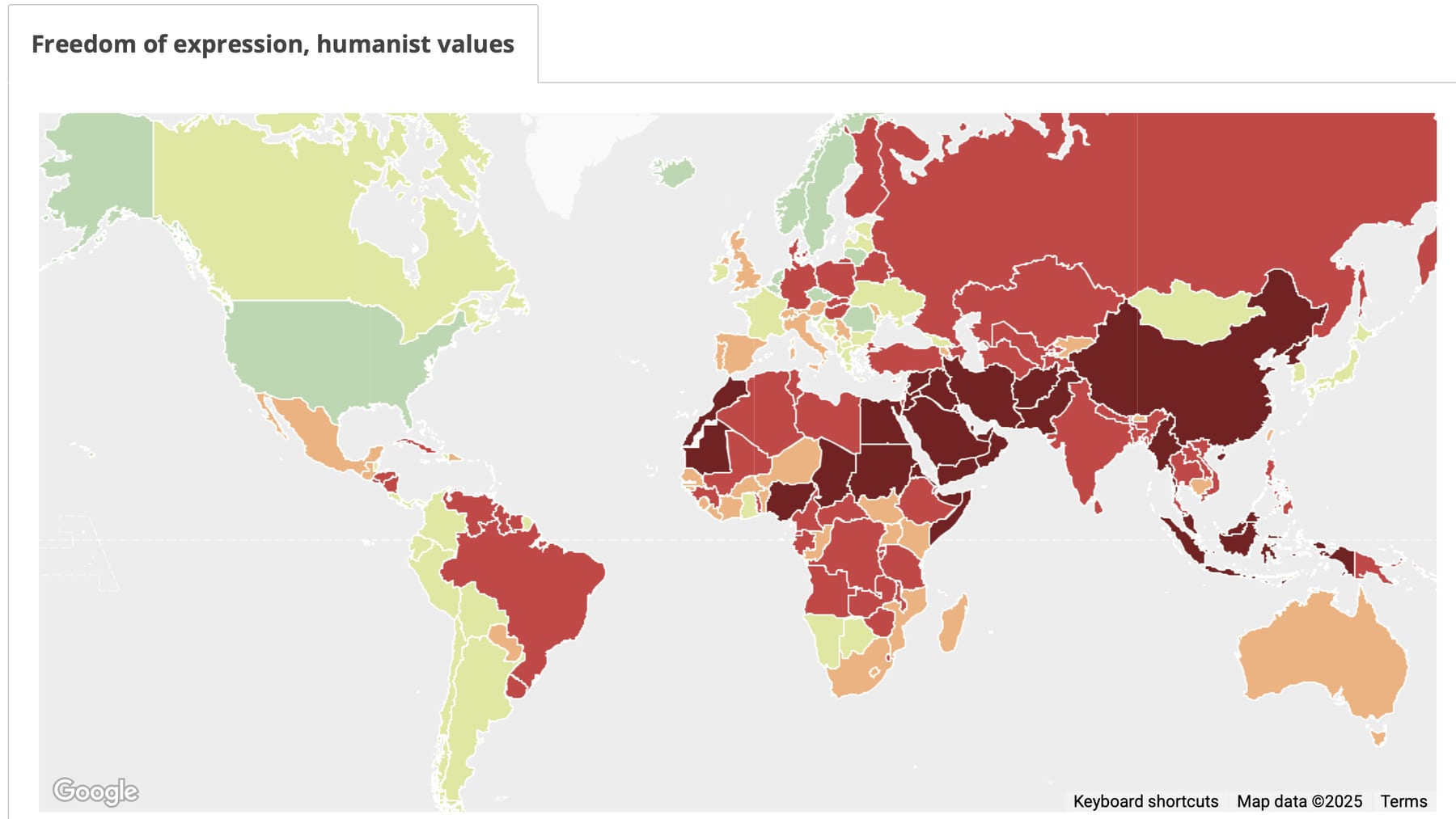
Maps - Freedom of Thought Report
Below is a high-level, approximate picture for a set of Muslim-majority countries, focused specifically on:
- Whether leaving Islam (apostasy) is criminalized
- Whether blasphemy / “insulting Islam” is criminalized
- How risky it is in practice to say you’re atheist or secular, or openly condemn Islam
The main comparative sources here are Humanists International’s Freedom of Thought Report(https://fot.humanists.international/), End Blasphemy Laws (https://end-blasphemy-laws.org/), USCIRF / US State Department reports, and specific legal analyses. (Freedom of Thought Report)
How to read the last column
Very roughly:
- “Extreme risk” – death penalty or very long prison is on the books and/or regularly sought; non-state violence is common or tolerated.
- “Severe restriction” – long prison terms or intense harassment; some people express doubt quietly or pseudonymously.
- “Restricted but possible” – laws on the books (fines / shorter prison or vague “insulting religion” provisions); small number of open atheists/secularists, usually in big cities/online, but still real risk.
- “Relatively open” – apostasy not criminal, blasphemy laws weak/abolished or rarely used; atheism and anti-religious speech are legally protected, though social stigma can still exist.
Table – Expression of atheism / secularism / criticism of Islam in selected Muslim-majority countries
| Country | Apostasy from Islam (law) | Blasphemy / “insulting Islam” (law) | Freedom to say you’re atheist / secular / condemn Islam (approx.) |
|---|---|---|---|
| Afghanistan | Apostasy explicitly outlawed and punishable by deathunder Hanafi fiqh, applied via constitution and penal provisions. (Freedom of Thought Report) | Blasphemy or criticism of Islam also punishable by death under religious law; advocacy of secularism is illegal/suppressed. (Freedom of Thought Report) | Extreme risk. Public atheism or condemnation of Islam is functionally impossible; very high risk of execution or extrajudicial killing. |
| Saudi Arabia | Apostasy criminalized; case law treats it as a capital crime. (Freedom of Thought Report) | “Apostasy” and “blasphemy” both punishable by death; broad bans on criticism of Islam and “deviation” from official Sunni doctrine. (Freedom of Thought Report) | Extreme risk. You cannot openly declare atheism or attack Islam without risking severe punishment (including death) or long imprisonment. |
| Iran | Apostasy not spelled out in the code but enforced via sharia; courts and authorities treat it as a capital offense in practice. (European Union Agency for Asylum) | Blasphemy (insulting Islam or religious sanctities) is criminalized and can carry the death penalty; used against converts and atheists. (European Union Agency for Asylum) | Extreme risk. Open atheism or harsh criticism of Islam can lead to prosecution, long prison, or death, as well as harassment by security forces and militias. |
| Qatar | Leaving Islam (apostasy) is a capital offense under Law 11/2004 (hudud crimes), though no modern executions recorded. (End Blasphemy Laws) | Blasphemy / proselytizing Muslims away from Islam punishable by imprisonment; religiously offensive materials can lead to prosecution or deportation. (End Blasphemy Laws) | Extreme risk in principle, high in practice. Publicly claiming atheism or attacking Islam is extraordinarily dangerous for citizens and risky even for foreigners. |
| Yemen | Apostasy explicitly punishable by death (Penal Code Article 259). (End Blasphemy Laws) | “Ridicule” or contempt of religion punishable by up to 5 years in prison, with higher penalty when Islam is targeted. (End Blasphemy Laws) | Extreme risk. Open atheism or condemnation of Islam can lead to capital charges or imprisonment; conflict and non-state actors add extra danger. |
| Mauritania | Article 306 of the criminal code: apostasy from Islam carries death and confiscation of property, after a short chance to “repent”. (Wikipedia) | Blasphemous speech about Islam can be treated as evidence of apostasy and punished accordingly. (Humanists International) | Extreme risk. Open disbelief or anti-Islam speech is likely to trigger apostasy proceedings and potentially capital punishment. |
| Maldives | Constitution requires all citizens to be Muslim; effectively no freedom to leave Islam. New regulations re-introduced death penalty for certain hudud offences, including apostasy, even for minors. (Wikipedia) | No real protection for non-Islamic expression; proselytizing or publicly rejecting Islam can trigger severe penalties. (Wikipedia) | Extreme risk. Declaring atheism or condemning Islam as a Maldivian citizen is legally and socially almost impossible. |
| Brunei | Syariah Penal Code 2013 (fully in force from 2019) makes apostasy punishable by death(or long prison and flogging). (Wikipedia) | Blasphemy / “insulting” Islam is criminalized under the Syariah code. (Wikipedia) | Extreme risk. Public atheism or condemnation of Islam is a direct confrontation with hudud provisions. |
| United Arab Emirates | Apostasy is criminalized under sharia-based penal provisions and is in principle a capital offense. (Wikipedia) | Blasphemy and “insulting religion” are criminal offenses; prosecutions have targeted social media users and writers. (Wikipedia) | Extreme risk in law, very high in practice. Open atheism or strong anti-Islam speech can result in prosecution, deportation, or worse. |
| Pakistan | No explicit apostasy article, but sweeping blasphemy laws(e.g. Penal Code 295-C) impose the death penalty for insulting the Prophet; dozens receive death sentences and many face mob violence. (End Blasphemy Laws) | Blasphemy includes speech deemed insulting to Islam, the Quran, or religious figures; widely used and often abused. (End Blasphemy Laws) | Extreme to very high risk.Identifying openly as atheist or directly condemning Islam is extraordinarily dangerous because blasphemy accusations can lead to death sentences or lynching. |
| Egypt | No explicit apostasy crime, but courts have annulled marriages and stripped rights of people found to have left Islam; proposals have existed to criminalize atheism. (Wikipedia) | Penal Code Article 98(f) (blasphemy) punishes “contempt of religion” with 6 months–5 years in prison; used against critics and atheists. (Wikipedia) | Severe restriction. You can be prosecuted for public atheism or criticism of Islam; high-profile cases show activists and bloggers jailed. Some secular/atheist thinkers exist but usually tread carefully or use pseudonyms. |
| Indonesia | No codified apostasy crime, but conversion away from Islam is heavily stigmatized and can create administrative barriers. (End Blasphemy Laws) | Article 156a of the Criminal Code (plus 1965 Blasphemy Law) punishes “deviant” interpretations or denial of God with up to 5 years. Atheist blogger Alexander Aan was jailed for posts denying God. (End Blasphemy Laws) | Severe restriction. Identifying as atheist or insulting Islam can bring prosecution and mob threats; some secular/agnostic discussion exists online and among urban elites but is risky. |
| Bangladesh | No explicit apostasy law, but severe social taboo. | Penal laws on “hurting religious sentiments” have been used with Islamist vigilante violence against atheist and secular bloggers; multiple writers murdered in the last decade. (End Blasphemy Laws) | Severe restriction. Public atheism or criticism of Islam has repeatedly led to assassinations and prosecutions; many secular voices live in hiding or abroad. |
| Jordan | Apostasy not in the criminal code, but sharia courts can treat someone as apostate for conversion or “blasphemy”, with civil consequences (marriage annulment, inheritance loss). (Wikipedia) | Penal Code criminalizes insulting Islam, prophets, or religious feelings, with prison terms up to 3 years. (End Blasphemy Laws) | Severe restriction. Open atheism is effectively impossible for citizens (you must list a recognized religion), and harsh criticism of Islam risks prison and social persecution. |
| Morocco | Apostasy not criminal in the penal code, but the official council of religious scholars issued a fatwa calling for death for apostates, giving religious cover for persecution. (Wikipedia) | Penal Code articles on “insulting Islam” and public impiety (including eating in public during Ramadan) carry prison terms; recent high-profile case of activist Ibtissame Lachgar prosecuted for “insulting Islam” over a T-shirt and social media posts. (Freedom of Thought Report) | Severe restriction. Quiet disbelief is widespread, but openly proclaiming atheism or calling Islam “fascist/misogynist” can land you in prison and provoke intense social backlash. |
| Iraq | Apostasy not directly criminalized, but blasphemy and public atheism are treated as serious offenses; some cases of atheists arrested after threats. (Freedom of Thought Report) | Penal Code Article 372 criminalizes “insult” to religious rituals, symbols or sacred persons, with prison penalties; Humanists International and EU bodies note the law, though enforcement is uneven. (End Blasphemy Laws) | Severe restriction. Some secular or atheist Iraqis (especially youth) express views online, but being openly atheist or attacking Islam publicly carries real risk of legal action and militia or family violence. |
| Syria | Apostasy not explicitly criminal, but conversion from Islam is socially unacceptable and can trigger persecution. (ecoi.net) | Penal Code Articles 208 and 462–464 criminalize disparaging religious rituals, with prison terms up to two years; UN and rights groups have called for repeal. (End Blasphemy Laws) | Severe restriction. Given the authoritarian state and war-time environment, public atheism or anti-Islam speech is extremely dangerous, even if not framed formally as “apostasy.” |
| Turkey | No apostasy crime; constitution is formally secular. | Penal Code Article 216(3) criminalizes “openly insulting religious values” with 6 months–1 year in prison; used against artists, writers, and social media users. (USCIRF) | Restricted but possible. There are open atheists and secularist associations, but aggressive criticism of Islam or religious symbols can trigger prosecutions and intense social hostility. |
| Tunisia | No apostasy crime; 2014 Constitution Article 6 protects freedom of conscience and explicitly forbids calling someone an apostate and inciting violence. (Human Rights Watch) | Nonetheless, “blasphemy” or “offenses against the sacred” remain contentious, and FOT notes that criticism of religion is restricted and punishable with prison under various provisions. (Freedom of Thought Report) | Restricted but possible.Compared with many Arab states, there is more space for secular and mildly critical discourse, but harsh attacks on Islam still risk prosecution and social backlash. |
| Malaysia | No federal apostasy crime, but state-level laws in most states penalize leaving Islam (fines, jail, “rehabilitation”; two states technically prescribe death but cannot enforce it). (Wikipedia) | Various laws restrict “insults” to Islam; non-Sunni or “deviant” interpretations and atheism have been targeted by religious authorities and police. (Humanists UK) | Severe restriction. Quiet disbelief is not uncommon in some urban circles, but openly declaring atheism or condemning Islam can bring religious court action, police harassment, or worse. |
| Kazakhstan | No apostasy crime; constitution defines a secular state and protects the right to decline religious affiliation. (Freedom of Thought Report) | Criminal Code Article 174/164 bans “incitement of religious hatred” and “offending religious feelings”; used in practice to prosecute critical or non-traditional speech. (Freedom of Thought Report) | Restricted but possible. You can legally be non-religious, and some people are openly atheist, but sharp criticism of Islam framed as “incitement” can draw charges. |
| Albania | No apostasy crime; constitutionally secular, with no official religion and explicit guarantee of freedom of belief and non-belief. (Wikipedia) | Old blasphemy laws were removed in the 2019 penal code; no current criminal penalty specifically for “insulting religion”. (IBA) | Relatively open. Albania is Muslim-majority by demography but legally very liberal: you can openly be atheist, secular, or criticize Islam (within normal hate-speech limits) without criminal risk. Social attitudes vary by region. |
| Bosnia & Herzegovina | No apostasy crime; complex consociational state with multiple religious communities. | No specific blasphemy statute targeting criticism of religion; main issues concern church-state entanglement and ethnic politics, not atheism per se. (Freedom of Thought Report) | Relatively open. In law, you are free to be atheist or secular and to criticize religion, though in some local contexts (especially where identity politics are strong) this may draw social pressure more than legal sanction. |
Big-picture takeaways
- Death-penalty states (Afghanistan, Saudi Arabia, Iran, Qatar, Yemen, Mauritania, Maldives, Brunei, UAE, plus Pakistan via blasphemy) are places where being openly atheist or strongly anti-Islamic is _functionally impossible_without extreme danger. (Humanists International)
- A second tier (Egypt, Indonesia, Bangladesh, Jordan, Morocco, Iraq, Syria, Malaysia, Turkey, Tunisia, Kazakhstan) uses prison-based blasphemy or “religious insult” laws plus heavy social stigma, creating a climate where a small number of people push boundaries, but the cost can be jail, exile, or violence. (Wikipedia)
- A small set of Muslim-majority but genuinely secular states (Albania, Bosnia & some others like Kosovo or Senegal not listed here) are much closer to European norms: atheism and sharp criticism of Islam are _legally_permitted, though social attitudes still vary. (Wikipedia)
If you want, next step I can: - Re-order this table by “safest → most dangerous” for open atheism,
- Or build a second table that uses a simple numeric score (1–4) so you can drop it straight into Obsidian and filter/sort visually.