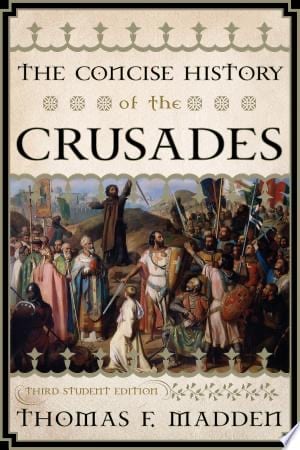
DESCRIPTION
What is the relationship between the medieval crusades and the problems of the modern Middle East? Were the crusades the Christian equivalent of Muslim jihad? In this sweeping yet crisp history, Thomas F. Madden offers a brilliant and compelling narrative of the crusades and their contemporary relevance. Placing all of the major crusades within their medieval social, economic, religious, and intellectual environments, Madden explores the uniquely medieval world that led untold thousands to leave their homes, families, and friends to march in Christ’s name to distant lands. From Palestine and Europe’s farthest reaches, each crusade is recounted in a clear, concise narrative. The author gives special attention as well to the crusades’ effects on the Islamic world and the Christian Byzantine East.
My Summary
Main Ideas, Takeaways & Similarities
Questions
I. What is the problem?
A. How is this problem formulated?
B. Why is this problem important?
C. What is the history of this problem?
D. Which prominent personalities have been interested in this problem?
II. What solutions to the problem are there?
A. What are the conclusions reached?
B. By what argument(s) is the conclusion reached?
C. What facts or assumptions serve as premises?
D. When a prominent personality offers a solution, does he also argue for or against other prominent personalities? Does he raise objections to alternative solutions? Does he consider objections to his own solutions?
III. Evaluation
A. What are the advantages and disadvantages of the alternative formulations to the problem?
B. Has the importance or history of the problem ever been misrepresented?
C. Are the solutions logically related to the premises?
D. Are the facts true? Are the assumptions acceptable? Are the objections answerable?
AI Summary
Highlights
“The New Concise History of the Crusades” by Thomas F. Madden provides a comprehensive overview of the historical events, motives, and consequences of the Crusades. It condenses the complex history of these religious and military campaigns into a concise narrative. Here is a comprehensive summary in bullet points:
- Title: The New Concise History of the Crusades
- Author: Thomas F. Madden
Introduction:
- Introduces the Crusades as a series of religious and military campaigns that spanned several centuries.
- Sets the context by describing the religious, political, and social landscape of medieval Europe and the Middle East.
- Expresses the aim of providing a concise and accessible history of the Crusades.
Chapter 1: The First Crusade (1096-1099):
- Discusses the causes and motivations behind the First Crusade, including religious fervor, the call to reclaim the Holy Land, and political factors.
- Describes the journey, battles, and eventual capture of Jerusalem by the Crusaders.
- Highlights the establishment of Crusader states in the Levant.
Chapter 2: The Crusader States (1099-1291):
- Explores the challenges faced by the Crusader states, including military threats from Muslim forces.
- Discusses the internal dynamics, governance, and interactions with local populations.
- Highlights the rise and fall of various Crusader states over time.
Chapter 3: The Later Crusades (12th-13th centuries):
- Covers subsequent Crusades, including the Second, Third, and Fourth Crusades, as well as the Children’s Crusade.
- Discusses the varying degrees of success and failure in these campaigns.
- Examines the impact of the sack of Constantinople during the Fourth Crusade.
Chapter 4: The Decline and End of the Crusades:
- Explores the factors contributing to the decline of the Crusader states and the eventual loss of Jerusalem.
- Discusses the diminishing interest and resources allocated to Crusading efforts.
- Highlights the Mamluk capture of Acre in 1291, marking the end of the major Crusades.
Chapter 5: Legacy and Impact:
- Examines the lasting impact of the Crusades on Europe, the Middle East, and beyond.
- Discusses cultural exchanges, technological advancements, and the introduction of new ideas.
- Addresses modern perspectives and debates surrounding the Crusades.
Chapter 6: Misconceptions and Revisionist History:
- Addresses common misconceptions and myths about the Crusades.
- Discusses modern revisionist interpretations and critiques of Crusade history.
- Highlights the importance of historical accuracy and context.
Conclusion:
- Summarizes the key points and historical events covered in the book.
- Emphasizes the complexity and multi-faceted nature of the Crusades.
- Encourages readers to engage with the nuanced history of the Crusades and their enduring significance in shaping the medieval world and beyond.