📓 In your handwritten notebooks
- March 21 – June 9 2026, pp. 159 — Euthyphro Dilemma dialogue tree → open PDF p171 (file not included in this release)
Index: Personal Journal
Parker vs Jay Dyer on Subjectivity > I. **The Euthyphro Dilemma Refresher**
Debate Tree
1. Core Euthyphro move (modern form)
Applied to a theistic moral view:
Question: Is an action morally good because God commands it, or does God command it because it is morally good?
Call these:
- Horn 1 (Independence): God commands it because it is good.
- Horn 2 (Dependence / DCT): It is good because God commands it. (Wikipedia)
Each horn has a problem: - Horn 1: Morality is independent of God → God is not the foundation of morality.
- Horn 2: Morality is arbitrary and God could have made cruelty or rape “good” by decree. (Wikipedia)
Most sophisticated theists now try a “third option”:“Goodness just is God’s nature; God is identical with the Good.”
This is the Aquinas / identity solution, often developed by Alston, Craig, etc. (New Advent)
Your tree is essentially:
- Get them to say which of these three pictures they actually accept.
- Push the specific costs of that picture.
2. Debate tree: structure of the exchange
Use this as a flowchart. Each node is: Their move → Your follow-up.
Step 0 – Calibration
You:
“Before we talk about the Euthyphro dilemma, can you tell me how you think God grounds morality?
- Are things right because God commands them?
- Or does God command them because they’re already right?
- Or do you think goodness just is God’s nature?”
You’re trying to locate them on the tree:
- Pure Divine Command Theory (Horn 2).
- Moral independence (Horn 1).
- Identity view: “God is the Good” / Aquinas-style.
- Vague mix / won’t commit → gently force a choice with concrete examples.
Branch A – They choose Horn 2: “Good because God commands it”
Their claim A1:
“Right and wrong are entirely based on God’s commands. Without God’s commands, nothing would be right or wrong.”
Your move A2 – The arbitrariness push:
- “So before God issued any commands, was cruelty to babies morally neutral?”
- “Could God have commanded rape, genocide, or torturing children for fun – and then those would be good?” (Wikipedia)
Force a yes/no:
- If they say “Yes, in principle God could”:
- “Then it sounds like what’s ‘good’ is just whatever happens to be willed by a powerful being, even if it’s cruelty. That makes morality arbitrary—there’s no reason why kindness is better than cruelty except ‘God said so’.”
- “But if there are no reasons behind morality, how can moral obligations be genuinely rational or _objective_rather than just divine preferences?”
- If they say “No, God could never command that because He is good/loving”:
You’ve moved them toward the identity view or Horn 1. Reply:- “Great—that means God’s commands are constrained by what is already good and loving. So _something_about goodness and love is prior to the commands. The question is: what is that standard?”
At this point, you transition to Branch B or C.
- “Great—that means God’s commands are constrained by what is already good and loving. So _something_about goodness and love is prior to the commands. The question is: what is that standard?”
Branch B – They choose Horn 1: “God commands it because it is good”
Their claim B1:
“God commands things because they are already good. Moral truths are necessary truths of reason or reality, which God knows perfectly.”
Your move B2 – Independence and the moral argument:
- “On your view, it sounds like moral truths are what they are regardless of what God wills. God recognizes them, but doesn’t create them. Is that fair?”
- “If that’s right, then even if God didn’t exist, cruelty would still be wrong and kindness still good—God just wouldn’t be there to endorse those truths.”
Then:
- “So we agree morality is objective, but it isn’t grounded in God. That means the moral argument for God’s existence (‘objective morality → God’) doesn’t work, because you’ve accepted objective morality without making it depend on God.”
Optional follow-up: - “And if we both believe there are necessary moral truths, the remaining question is which theory explains them better, not whether they logically require a deity at all.” (Stanford Encyclopedia of Philosophy)
Branch B doesn’t try to refute God’s existence, just the claim that God is needed as a foundation.
Branch C – They choose Identity View / Aquinas solution (“God is the Good”)
This is the move you explicitly asked to target.
Their claim C1 (Aquinas / identity style):
- “Goodness isn’t something outside God, and it’s not arbitrary commands either. God’s very nature is goodness itself. Things are good to the extent they resemble God’s nature.” (New Advent)
This is also how Alston and Craig describe it: God is like the standard meter bar in Paris—a concrete standard that defines what it is to be good. (Reasonable Faith)
Your counter C2 – The property dilemma (Morriston-style)
Ask:
- “When you say ‘God is good,’ what attributes are you thinking of? Usually people say things like loving, just, faithful, merciful, honest, etc.”
- “Here’s my question: Are these traits (love, justice, mercy) good because God has them, or does God have them because they’re good?”
Now two sub-horns:
- C2a – If they say “God is good because He has those properties”:
- Then the properties are what make God good, so those properties are good in themselves.
- Then there is a standard of goodness (love, justice, mercy, etc.) which God exemplifies, but which is not identical to God. So morality again looks independent of God; the identity thesis collapses back into Horn 1. (Randy Everist)
- C2b – If they say “Those properties are good only because God has them”:
- Then goodness is again arbitrary. If God had been cruel and unjust, cruelty and injustice would have been “good.”
- That leads to the absurd conclusion that if a being with a different nature had been ultimate, that nature—however monstrous—would define “good.”
- This guts the claim that morality is genuinely non-arbitrary and gives you back Horn 2 in disguise. (Georgetown Faculty)
So the identity view:Either explains God’s goodness in terms of prior moral properties (independence),
or makes those properties good just because God has them (arbitrariness).
In both directions, the original Euthyphro pressure returns.
Your counter C3 – The counterfactual / “no God” problem
Use Morriston’s point:
- “On the identity view, if God didn’t exist, nothing would be morally good or bad, because goodness = resemblance to God’s nature. So a kind, loving human wouldn’t be better than a cruel one if there were no God.” (Spot)
Then: - “That seems deeply implausible. Surely kindness, justice, and honesty would be morally better traits than cruelty, injustice, and dishonesty even in a godless world. So whatever makes those traits good can’t be simply ‘resemblance to God’.”
Your counter C4 – The unintelligibility problem
Summarize Koons and Morriston:
- “If you say ‘God’s nature is the standard of goodness, full stop,’ that doesn’t actually explain what makes that nature good. It seems to strip God’s goodness of any intelligible content. We’re told: ‘This nature is good, and that’s the end of the story.’” (Georgetown Faculty)
Then: - “But moral realism normally says certain traits are good for reasons—for example, they promote flourishing, respect persons, are justifiable to others, etc. If we’re not allowed to say why God’s nature is good, then it’s not clear we’ve got anything more than a label.”
Branch D – Modified Divine Command Theory (Adams, Alston, etc.)
If they’ve read contemporary philosophy, you may get:
Their claim D1:
“Obligations depend on God’s commands, but goodness/ badness depend on God’s essentially loving nature: an act is wrong iff it’s contrary to the commands of a loving God.” (Internet Encyclopedia of Philosophy)
Your response D2:
- “So God’s commands are constrained by what a perfectly loving nature would command. That means love is prior to the commands.”
- “If we can say ‘a loving God would never command X’ before we look at any commands, we’re appealing to a moral standard of love that we grasp independently.”
- “Again: the heavy lifting seems to be done by love as a moral property, not by the bare fact of divine will.”
Optional push:
- “Also, if you say ‘If God didn’t exist, nothing would be good or bad,’ we’re back to the counterfactual problem. If a human mother is loving and sacrificial, is she really no better than an indifferent mother in a hypothetical godless universe? That seems false, so your theory is misdescribing what makes those traits good.”
3. Practical use: how to run this argument effectively
From people who discuss debating theists, a recurring theme is: start by asking questions and letting them lay out their own view clearly instead of launching into a monologue. (Reddit)
Tactics:
- Clarify: “What, exactly, makes something morally wrong on your view?”
- Concrete cases: “Take rape / torturing children. Is it wrong because God forbids it, or does God forbid it because it’s wrong?” (StudyCorgi)
- Force a fork: “So is that independence, dependence, or ‘God’s nature’?”
- Press the internal cost of whichever fork they chose (arbitrariness, independence, or identity problems).
- Stay focused: Don’t let them wander into “But atheism can’t ground morality either.” You can say:
“That’s a separate discussion. Right now we’re just asking whether this theistic account actually works.”
4. Sample script (you can adapt this)
This is something you can rehearse and then loosen in a live debate.
You: Before we get into details, can I ask: how do you think God grounds morality?
Would you say an action is good because God commands it, or does God command it because it’s already good? Or do you think goodness just is God’s nature?
Theist: I’d say things are good because God commands them. Without God’s commands, there’s no right or wrong.
You: Okay, so killing children is wrong because God forbids it. Before God issued that command, was killing children morally neutral?
Theist: I guess so, yes.
You: Could God have commanded the opposite—that people should torture children for fun—and then that would be morally good?
Theist: Well, in principle God can do whatever He wants.
You: If that’s true, then it sounds like morality is just whatever happens to be willed by a powerful being. There’s no deeper reason why kindness is better than cruelty—only that God prefers one. That makes morality arbitrary.
If God had preferred cruelty, then cruelty would count as “good.” Do you accept that?
Theist: No, God could never command cruelty. God is perfectly good and loving.
You: Great—that’s important. So you’re saying God’s commands are constrained by what is good and loving. That means there’s a standard of goodness—love, justice, mercy—that God’s commands have to fit.
The question then is: are those things good independently of God, or only because they’re part of God’s nature?
Theist: They’re good because they’re part of God’s nature. God just is the Good.
You: So you’re taking the view Aquinas and others defend—that God’s nature is identical with the Good. Let me test that a bit.
When you say “God is good,” you mean He is loving, just, faithful, merciful, and so on, right?
Theist: Yes.
You: Now here’s my dilemma:
- Are love and justice good because God has them?
- Or does God have them because they are good?
If you say the second—that God has them because they’re good—then love and justice are good in themselves; God is good by having those already-good properties. Then morality is independent of God after all.
If you say the first—that love and justice are good only because God has them—then suppose God had been cruel and unjust instead. On your view, cruelty and injustice would then be “good,” simply because they were His nature. That seems arbitrary again: whatever the ultimate being is like automatically becomes “good,” even if it’s horrible.
Which of those do you think is right?
Theist: Well, God couldn’t have been cruel and unjust.
You: I agree that if God exists, He would be loving. But the issue is: what makes love better than cruelty?
If we answer “because God happens to be loving,” that looks arbitrary. If we answer “because love is a better way for persons to relate than cruelty,” then we’re appealing to a moral standard that doesn’t depend on God’s nature.
There’s another worry: on your view, if God didn’t exist then nothing would be morally good or bad. In a godless universe, a loving mother wouldn’t be morally better than an abusive mother. That seems obviously false. So it looks like whatever makes love better than cruelty can’t just be “resemblance to God.”
So we’re back at the Euthyphro problem:
- Either moral properties are good independently of God (and God isn’t the foundation of morality),
- Or “good” is just whatever God happens to be/command (and morality is arbitrary).
5. Good sources
These are handy to have in your notes:
- Euthyphro dilemma overview:
https://en.wikipedia.org/wiki/Euthyphro_dilemma (Wikipedia) - Divine Command Theory and Adams’s modified view:
https://iep.utm.edu/divine-command-theory/ (Internet Encyclopedia of Philosophy) - Aquinas on God’s goodness (Summa Theologiae I, q.6):
https://www.newadvent.org/summa/1006.htm (New Advent) - Wes Morriston, “Must There Be a Standard of Moral Goodness Apart from God?”
https://spot.colorado.edu/~morristo/GodGood.pdf (Spot) - Robert Koons, “Can God’s Goodness Save the Divine Command Theory from Euthyphro?”
https://faculty.georgetown.edu/koonsj/papers/Euthyphro.pdf (Georgetown Faculty)
Euthyphro Cheat Sheet vs Theistic Morality
Core Question
Is an action morally good because God commands it, or does God command it because it is morally good?
Fork it into three clear options:
- Horn 1 – Independence:
God commands X because X is good. - Horn 2 – Dependence / Divine Command:
X is good because God commands it. - “Third Way” – Identity View (Aquinas/modern theists):
Goodness just is God’s nature; God = the Good.
Your job: - Get them to pick (or drift into) one.
- Show that each option either:
- Makes morality independent of God, or
- Makes morality arbitrary.
Step 0 – Opening Questions
Use these to pin them down:
- “What makes something morally wrong, on your view?”
- “Is rape wrong because God forbids it, or does God forbid it because it’s already wrong?”
- “Do you think goodness is independent of God, dependent on His commands, or identical with His nature?”
Push them (gently) to say one of: - “Because God commands it” → go to Horn 2.
- “God commands the good” → go to Horn 1.
- “God just is goodness” / “God’s nature is the standard” → go to Identity View.
Branch A – Horn 2: “Good because God commands it”
Their claim:
Morality is whatever God commands. No commands → no right/wrong.
Your moves
- Arbitrariness Question
- “Before God commanded anything, was torturing children morally neutral?”
- “Could God have commanded rape or genocide, and then those would be good?”
- If they say “Yes, He could have”:
- “Then goodness is just whatever a powerful being decides. There’s no deeper reason why kindness is better than cruelty. That makes morality arbitrary.”
- If they say “No, He could never command that; God is good/loving”:
- “So God’s commands are constrained by what’s good and loving. That means there’s a standard of goodness that God’s commands must match. Is that standard good independently of God, or only because it’s God’s?”
This pushes them toward Horn 1 or Identity View. Switch branches.
- “So God’s commands are constrained by what’s good and loving. That means there’s a standard of goodness that God’s commands must match. Is that standard good independently of God, or only because it’s God’s?”
Branch B – Horn 1: “God commands it because it’s good”
Their claim:
Moral truths are what they are; God knows them and commands them.
Your moves
- Clarify Independence
- “So even if God never existed, kindness would still be better than cruelty; God just perfectly recognizes that. Is that right?”
- Undercut “God as moral foundation”
- “If moral truths are independent of God’s will, then morality can be objective without God causing or constituting it. That blocks the claim that we need God as the foundation of morality.”
Optional follow-up:
- “If moral truths are independent of God’s will, then morality can be objective without God causing or constituting it. That blocks the claim that we need God as the foundation of morality.”
- “We can now debate which theory best explains these necessary moral truths, but morality itself doesn’t depend on God’s existence.”
Branch C – Identity View (Aquinas, “God = the Good”)
Their claim:
Goodness isn’t outside God or mere commands. God’s nature just is goodness; God is loving, just, etc., and that nature is the standard.
Key Counter 1 – Property Dilemma
Ask:
- “When you say ‘God is good,’ what do you mean? Usually: loving, just, truthful, merciful, faithful.”
Then:Are those properties (love, justice, etc.) good because God has them,
or does God have them because they’re good? - Option 1: God is good because He has loving/just properties.
- Then those properties are good in themselves.
- God is good by exemplifying these already-good traits.
- So goodness is not identical with God; it’s a standard God lives up to → back to Horn 1 (independence).
- Option 2: Those properties are good only because God has them.
- Then if God had a cruel, unjust nature, cruelty and injustice would be “good.”
- That’s just the arbitrariness problem again → functionally Horn 2 in disguise.
Conclusion:
The identity view collapses back into either independence or arbitrariness.
Key Counter 2 – Counterfactual Problem (“No God” World)
Ask:
- “On your view, if God didn’t exist, would anything be morally good or bad?”
On strict identity theories, answer is often “No” (since good = resemblance to God’s nature).
Your reply: - “So in a godless world, a loving, honest person wouldn’t be any better than a sadistic, dishonest one? That’s extremely counterintuitive. It seems kindness would still be morally better than cruelty, even without God. So whatever makes kindness better cannot simply be ‘resemblance to God.’”
Key Counter 3 – Unintelligibility / “Just because” Problem
Point:
- “Saying ‘God’s nature is the standard of goodness, full stop’ doesn’t explain why that nature counts as good. It just labels it ‘good’.”
Push: - “Normally, when we say something is good, we can give reasons: it promotes flourishing, respects persons, is fair, etc.
If we’re not allowed to say why God’s nature is good, then ‘God is the Good’ is just a bare assertion, not a real explanation.”
Branch D – Modified Divine Command Theory (Adams, etc.)
Their claim:
- Goodness is tied to God’s loving nature.
- Moral obligations depend on the commands of a loving God (not just any commands).
Your moves
- Love as Prior Standard
- “If obligations are what a loving God would command, then we are appealing to an independent notion of ‘loving’ to constrain God’s commands.”
- Independence Again
- “If we can say ‘a loving God would never command X’ before we know any commands, then we already know independently that love forbids X. So love is the fundamental standard, not the bare fact of divine will.”
- Counterfactual Question
- “If God didn’t exist, would loving sacrifice still be better than sadistic cruelty? If yes, then love has moral status independently of God. If no, then you’re in the implausible position that love has no moral value in a godless world.”
Stock Lines You Can Reuse
Pin them down
- “Is something good because God commands it, or does God command it because it’s good?”
- “Do you think goodness is independent of God, dependent on His will, or identical with His nature?”
Arbitrariness - “If God could have commanded torture and then torture would be good, that makes morality arbitrary—just whatever a powerful being prefers.”
Independence - “If God commands what is already good, then moral truths don’t depend on God. God recognizes them, but doesn’t create them.”
Identity - “If God is good because He is loving and just, then love and justice are good in themselves. If they’re only good because He has them, then goodness is arbitrary.”
Counterfactual - “Would kindness still be better than cruelty if there were no God? If yes, morality doesn’t depend on God. If no, your view says loving sacrifice has no value whatsoever in a godless world—an extremely implausible claim.”
Debate Discipline (Meta)
- Keep them on the fork. When they say “Atheism can’t ground morality,” respond:
- “Happy to talk about that after. Right now I’m asking whether your view actually solves the Euthyphro problem.”
- Use concrete examples. Always test their view with rape, torture of children, genocide, etc. It forces real commitments.
- Don’t over-claim. The goal isn’t “I proved God doesn’t exist,” but:
- “The standard theistic stories about God and morality either make morality independent of God or make it arbitrary. So they don’t succeed as accounts of God as the foundation of morality.”
Debate Tree
This breakdown provides a strategic Debate Tree, a specific Counter-Script for the Aquinas Identity Solution, and the philosophical logic to back it up.
I. The Debate Tree (Decision Flowchart)
This tree maps the flow of the argument. Your goal is to force the opponent down one of the paths until they hit a “Game Over” contradiction.
- START: The Euthyphro Question
- “Is something moral because God commands it, or does God command it because it is moral?”
- OPTION A: “God commands it because it is moral.” (Intellectualism)
- Implication: Morality exists above God. God is subservient to a moral law. He is just a cosmic messenger.
- Result: God is not the ultimate creator or sovereign. (Theist loses Omnipotence/Sovereignty).
- OPTION B: “It is moral because God commands it.” (Voluntarism/Divine Command Theory)
- Implication: Morality is arbitrary. God could command “Rape is good” tomorrow, and it would become moral.
- Result: Morality has no objective value; “God is Good” is a meaningless statement (meaning only “God does what God wants”).
- OPTION C: “The Dilemma is False. God IS Goodness.” (The Aquinas Identity Solution)
- This is the most common sophisticated response.
- The Claim: God doesn’t follow rules, and He isn’t arbitrary. Goodness is His essential nature. He commands what He is.
- YOUR COUNTER-ATTACK (Choose one):
- Path 1: The Tautology Trap. If God is Goodness, then “God is Good” just means “God is God.” It is empty information.
- Path 2: The Arbitrary Nature. Why is God’s nature that way? Did He choose His nature?
- If Yes: We are back to Arbitrariness (Option B).
- If No: He is a slave to His nature (Option A re-skinned).
- Path 3: The Epistemological Gap. Even if God is Goodness, we only have texts(Bible/Quran) claiming to be His word. How do we judge if those texts are actually good without an external standard?
II. How to Crush the “Identity Solution” (Aquinas)
When they say, “God acts according to His nature, so He isn’t arbitrary,” they are just moving the problem back one step. Here are the three specific arguments to dismantle this.
Argument 1: The Empty Definition (Tautology)
If Goodness is identical to God, then the sentence “God is Good” is semantically identical to “God is God” or “God is Himself.”
- The Point: It renders praise meaningless. We don’t praise people for being identical to themselves. We praise them for meeting a standard of behavior. If God is the standard, He earns no moral credit for following it.
Argument 2: The “Arbitrary Essence”
Ask why God has a nature that prefers love over hate.
- The Trap:
- If God’s nature is just a “brute fact” (it just is that way for no reason), then morality is still arbitrary—it’s just “Arbitrariness of Essence” instead of “Arbitrariness of Will.”
- If God’s nature had to be that way (Logical Necessity), then God has no freedom. He is a machine running a “Goodness” program that He didn’t write.
Argument 3: The Evil God Hypothesis
If God’s nature defines Goodness, imagine a God whose nature was “Cruelty.”
- In that universe, “Goodness” would mean “Cruelty.”
- If the theist says, “But God couldn’t be cruel,” ask “Why not?”
- If they say “Because cruelty is wrong,” they are admitting there is a standard above God (Horn A).
- If they say “Because that’s not His nature,” they are admitting that if His nature were cruel, cruelty would be moral (Horn B).
III. The Debate Script
You: “I have a question about the foundation of morality. Is an action like ‘helping the poor’ good because God commands it, or does God command it because it is actually good?”
Theist (Sophisticated): “That’s a false dilemma. Aquinas solved this. God doesn’t consult a rulebook, and He doesn’t flip a coin. God is the Good. His commands flow necessarily from His perfect nature.”
You (The Pivot): “Okay, so you’re saying ‘Goodness’ and ‘God’ are identical. But that creates a new problem. If ‘Good’ is just a synonym for ‘God,’ then the statement ‘God is Good’ is a tautology. It just means ‘God is God.’ It tells us nothing about his moral character.”
Theist: “No, it means He is the standard. He is the definition of love and justice.”
You (The Trap): “But why is His nature ‘loving’ and not ‘hateful’? Did He choose to have a loving nature?”
Theist: “No, He is eternal and unchanging. He didn’t ‘choose’ to exist; He just is.”
You: “Then we have a huge problem. If He didn’t choose His nature, and His nature defines morality, then morality is just a random cosmic accident. If God happened to be a God of torture by nature, then torture would be ‘Good.’ He wouldn’t know the difference, and neither would we.”
Theist: “But God isn’t a God of torture. He is a God of Love.”
You: “You’re judging Him again. You’re using an external standard of ‘Love’ to validate God. If God is truly the _only_standard, you can’t say ‘It’s good that God is loving.’ You can only say ‘God is loving, and God is God.’ You have to admit that if God’s nature were different, morality would be different. Therefore, morality is arbitrary.”
IV. Summary of Counter-Arguments
| Theist Defense | Your Counter | Why it works |
|---|---|---|
| ”God is Goodness itself." | "Then ‘God is Good’ is a meaningless tautology.” | Replaces moral content with a definitional circle. |
| ”God acts according to His nature." | "Is His nature necessary or chosen?” | Forces them to admit God is either a robot (no freedom) or a random accident (arbitrary). |
| ”God cannot command evil." | "If He did, it would be ‘good’ by your definition.” | Exposes that they are actually using an external standard to judge what “evil” is. |
The video below provides a clear walkthrough of the dilemma and specifically addresses the limitations of the “God is Goodness” modification (often called Modified Divine Command Theory).
… The Euthyphro Dilemma (Problem for Divine Command Theory)
This video is relevant because it visually breaks down the exact circularity problem that arises when theists attempt to use the “God’s Nature” escape route.
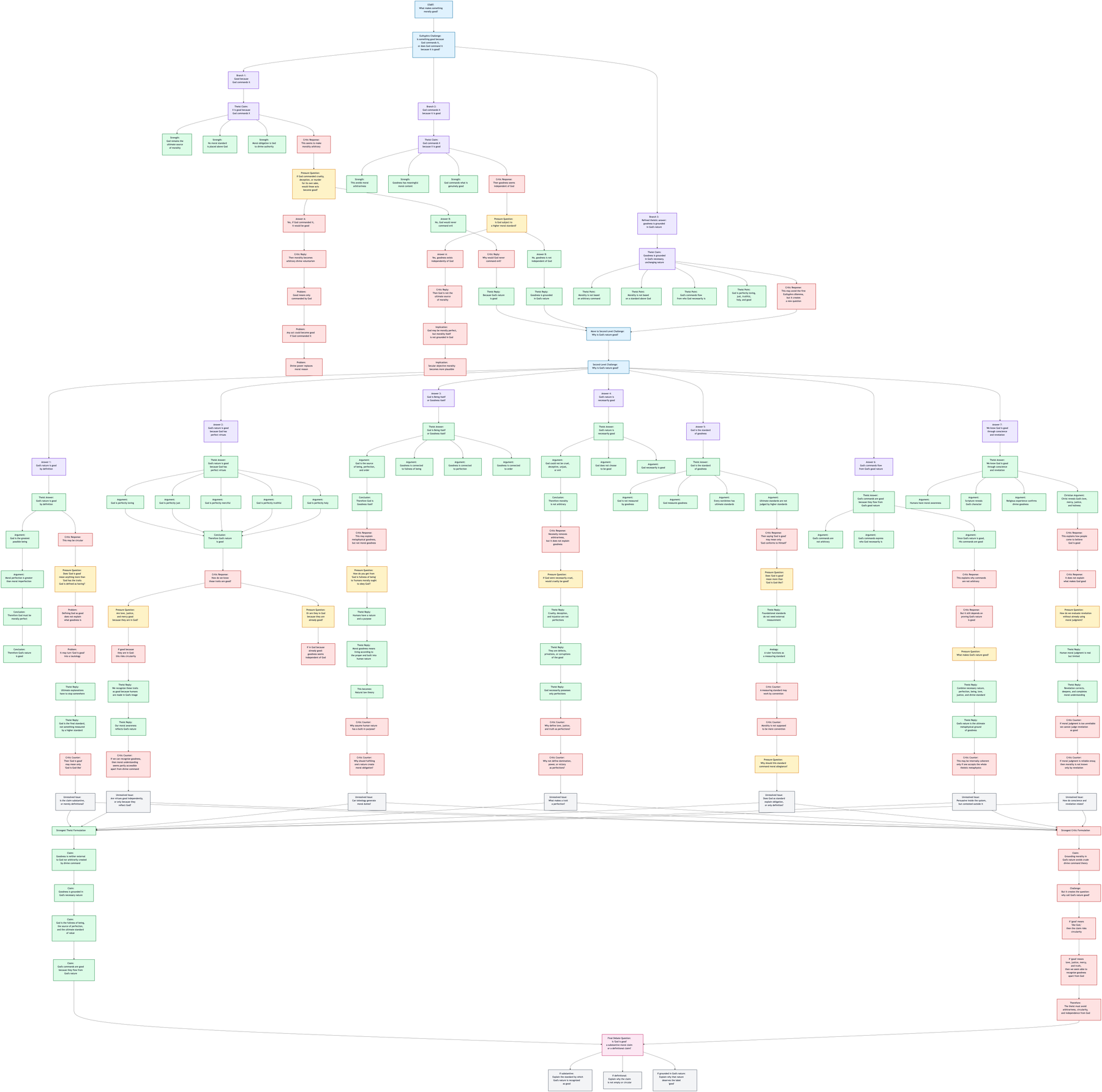
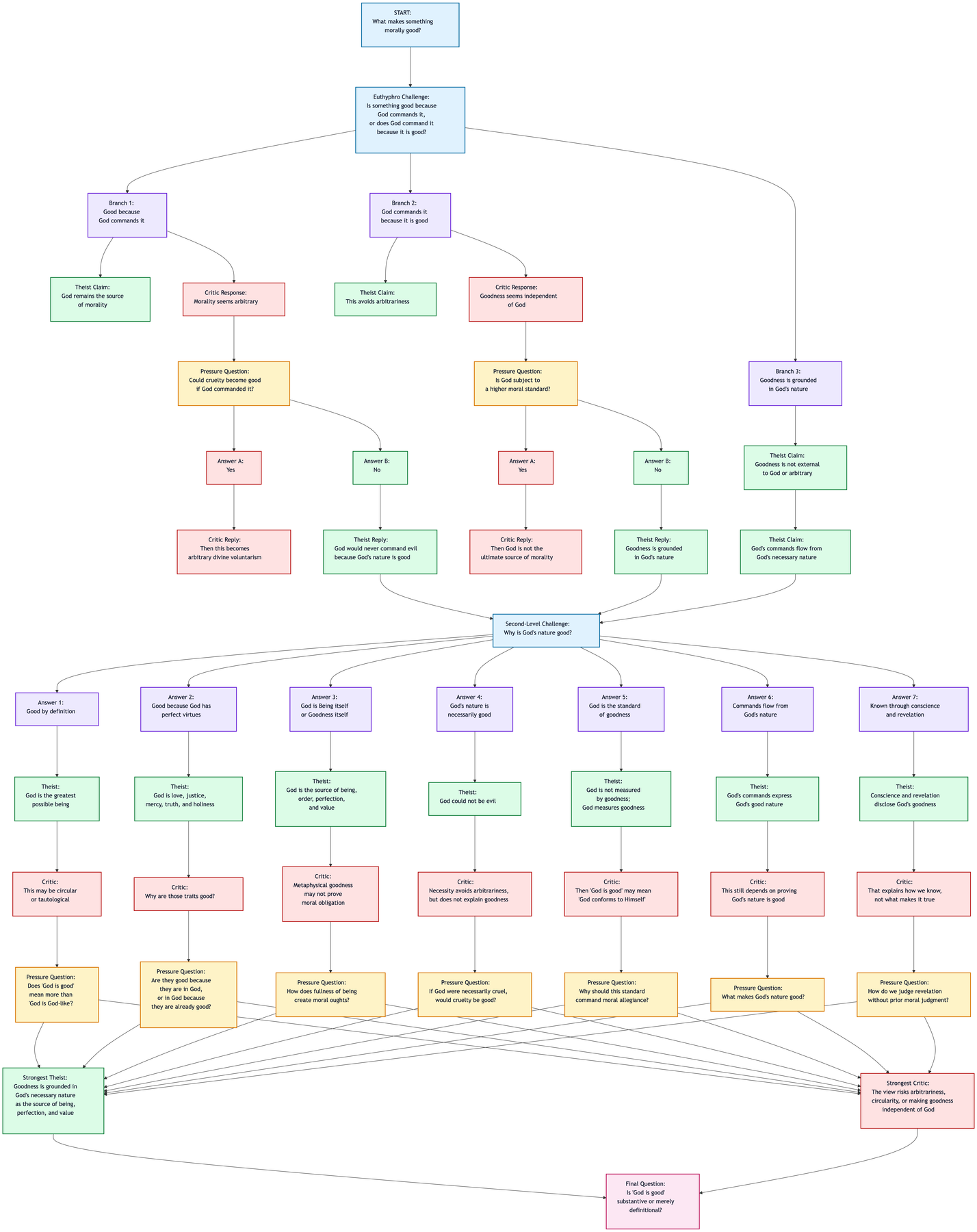
Debate Tree: Euthyphro Challenge → God’s Nature → Why Is God’s Nature Good?
1. Opening Question: What Makes Something Morally Good?
Core Question
Is something good because God commands it, or does God command it because it is good?
This is the classic Euthyphro dilemma.
2. First Branch: “Something Is Good Because God Commands It”
Claim
X is good because God commands X.
Strength of This Position
- Keeps God as the ultimate source of morality.
- Avoids placing a moral standard above God.
- Makes moral obligation dependent on divine authority.
Critic’s Response
If something becomes good merely because God commands it, then morality seems arbitrary.
Pressure Question
If God commanded cruelty, deception, or murder for its own sake, would those things become good?
Possible Theist Answers
A. “Yes, if God commanded it, it would be good.”
Critic’s Reply
- This makes morality seem arbitrary.
- It appears to reduce goodness to power or authority.
- It risks saying that any act could become good if commanded by God.
Debate Point
If morality depends only on command, then “good” may mean nothing more than “commanded by God.”
B. “No, God would never command evil.”
Critic’s Reply
Why would God never command evil?
This pushes the debate to a deeper level.
Possible answers:
- Because God is good.
- Because God’s nature is good.
- Because God is necessarily loving, just, truthful, and holy.
This leads into the later question:
Why is God’s nature good?
3. Second Branch: “God Commands It Because It Is Good”
Claim
God commands X because X is already good.
Strength of This Position
- Avoids arbitrariness.
- Makes goodness meaningful independent of mere command.
- Allows us to say God commands what is genuinely good.
Critic’s Response
Then goodness seems independent of God.
Pressure Question
If goodness is already good before God commands it, then is God the source of morality or merely its messenger?
Possible Theist Answers
A. “Goodness exists independently of God.”
Critic’s Reply
- Then God is not the ultimate ground of morality.
- God may be morally perfect, but morality itself is not grounded in God.
- This weakens the claim that atheism or secularism cannot have objective morality.
B. “Goodness is not independent of God; it is grounded in God’s nature.”
Critic’s Reply
That may avoid both horns of the dilemma, but now we need to ask why God’s nature is good.
This leads to the refined theistic answer.
4. The Refined Theistic Answer: “Goodness Is Grounded in God’s Nature”
Claim
Morality is not grounded in arbitrary divine commands. It is grounded in God’s necessary, unchanging, perfectly good nature.
Why This Is Stronger Than “God Commands It”
This avoids saying:
Good means whatever God happens to command.
Instead, it says:
God commands what is good because God’s commands flow from God’s good nature.
Theist’s Intended Escape from Euthyphro
The theist wants to say:
- Goodness is not above God.
- Goodness is not arbitrarily created by God.
- Goodness is identical with, or grounded in, God’s nature.
- God’s commands express that nature.
Critic’s Next Question
Why is God’s nature good?
This is the deeper follow-up.
5. Second-Level Challenge: Why Is God’s Nature Good?
Central Question
Is God’s nature good by definition, or is there some standard by which we recognize it as good?
This creates a new debate tree.
6. Branch One: “God’s Nature Is Good by Definition”
Claim
God is, by definition, the greatest possible being. A greatest possible being must be perfectly good. Therefore God’s nature is good.
Theist’s Argument
- God is the greatest conceivable being.
- Moral perfection is greater than moral imperfection.
- Therefore God must be morally perfect.
- So God’s nature is good.
Critic’s Response
Defining God as good does not explain goodness. It only builds goodness into the definition of God.
Pressure Question
Is “God is good” a meaningful moral claim, or does it only mean “God has the qualities God is defined as having”?
Theist’s Reply
Ultimate explanations have to stop somewhere. God is the final standard, not something measured by a higher standard.
Critic’s Counter
That may be coherent, but it risks making “God is good” tautological: God is good because God is God-like.
7. Branch Two: “God’s Nature Is Good Because God Has Perfect Virtues”
Claim
God’s nature is good because God is perfectly loving, just, merciful, truthful, faithful, and holy.
Theist’s Argument
- Love is good.
- Justice is good.
- Mercy is good.
- Truthfulness is good.
- God perfectly possesses these traits.
- Therefore God’s nature is good.
Critic’s Response
How do we know those traits are good?
Pressure Question
Are love, justice, and mercy good because they are in God, or are they in God because they are already good?
This reintroduces the Euthyphro structure.
Theist’s Reply
We recognize these traits as good because we are made in God’s image. Our moral awareness reflects God’s nature.
Critic’s Counter
If we can recognize love, justice, and mercy as good, then moral understanding seems at least partly accessible apart from simply saying “God is good.”
8. Branch Three: “God’s Nature Is Good Because God Is Being Itself / Goodness Itself”
Claim
God is not merely one being among others. God is the source of being, perfection, order, and value. Therefore God is Goodness itself.
Theist’s Argument
- Goodness is connected to fullness of being, perfection, and proper order.
- God is the fullness of being.
- God lacks nothing.
- Evil is a privation, corruption, or disorder of the good.
- Therefore God is necessarily good.
Critic’s Response
That may explain metaphysical goodness, but does it explain moral goodness?
Pressure Question
How do you get from “God is fullness of being” to “humans morally ought to obey God”?
Theist’s Reply
Human beings have a nature and a purpose. Moral goodness consists in living according to the proper end God built into human nature.
This moves into natural law theory.
Critic’s Counter
Why assume human nature has a built-in purpose, and why should fulfilling that purpose create moral obligation?
9. Branch Four: “God’s Nature Is Necessarily Good”
Claim
God does not choose to be good. God necessarily is good. God could not be cruel, deceptive, unjust, or evil.
Theist’s Argument
- God’s nature is necessary, not contingent.
- God cannot fail to be loving, just, truthful, and holy.
- Therefore morality is not arbitrary.
- God’s commands are stable because they flow from God’s necessary nature.
Critic’s Response
Necessity removes arbitrariness, but it does not explain goodness.
Pressure Question
If someone said God is necessarily cruel, would cruelty become good just because that nature is necessary?
Theist’s Reply
Cruelty, deception, and injustice are not perfections. They are defects or privations. God’s necessary nature includes only perfections.
Critic’s Counter
Why define love, justice, and truth as perfections rather than domination, power, or victory?
10. Branch Five: “God Is the Standard, Not Measured by a Standard”
Claim
God is not good because He conforms to a standard. God is the standard by which all goodness is measured.
Theist’s Argument
- Every worldview has ultimate standards.
- Those standards are not judged by a higher standard.
- God is the ultimate standard of goodness.
- Asking what standard makes God good misunderstands God’s role as the standard.
Critic’s Response
If God is the standard, then saying “God is good” may mean only “God conforms to Himself.”
Pressure Question
Does “God is good” mean anything more than “God is God-like”?
Theist’s Reply
Foundational standards do not need external measurement. They are the measure.
Analogy:
A ruler is not measured by another ruler to become a ruler; it functions as the measuring standard.
Critic’s Counter
A measuring standard may work by convention, but morality is not supposed to be mere convention. Why should this standard command moral allegiance?
11. Branch Six: “God’s Commands Flow from God’s Good Nature”
Claim
God’s commands are good because they express God’s perfectly good nature.
Theist’s Argument
- God does not arbitrarily invent morality.
- God’s commands express who God necessarily is.
- Since God’s nature is good, His commands are good.
- Therefore divine command is grounded in divine nature.
Critic’s Response
This explains why God’s commands are not arbitrary, but it still depends on the claim that God’s nature is good.
Pressure Question
What makes God’s nature good?
Theist’s Reply
The theist usually combines several answers:
God is necessarily good, maximally perfect, the source of being, the ground of value, and the standard of moral reality.
Critic’s Counter
That may be internally coherent, but it requires accepting a large metaphysical system. Without that system, the claim can look circular or definitional.
12. Branch Seven: “We Know God Is Good Through Conscience and Revelation”
Claim
We know God’s nature is good through conscience, scripture, religious experience, and revelation.
Theist’s Argument
- Humans have moral awareness.
- Scripture reveals God’s character.
- Religious experience confirms divine goodness.
- Christ, in Christian theology, reveals God’s love, justice, mercy, and holiness.
Critic’s Response
That explains how people come to believe God is good, not what makes God good.
Pressure Question
How do we evaluate whether a claimed revelation is good without already using moral judgment?
Theist’s Reply
Human moral judgment is real but limited. Revelation corrects, deepens, and completes our moral understanding.
Critic’s Counter
If human moral judgment is too unreliable to evaluate revelation, then we cannot confidently say the revelation is good. But if it is reliable enough to evaluate revelation, then morality is not known only through revelation.
13. Full Debate Flow in One Tree
START: What makes something morally good?

├── 1. Good because God commands it
│   ├── Strength: God remains source of morality
│   ├── Critique: morality becomes arbitrary
│   ├── Question: If God commanded cruelty, would cruelty be good?
│   │
│   ├── A. Yes
│   │   └── Critic: then morality is arbitrary divine voluntarism
│   │
│   └── B. No, God would never command evil
│       └── Critic: why not?
│           └── Theist: because God’s nature is good
│               └── Move to: Why is God’s nature good?
│
├── 2. God commands it because it is good
│   ├── Strength: avoids arbitrariness
│   ├── Critique: goodness seems independent of God
│   ├── Question: is God subject to a higher moral standard?
│   │
│   ├── A. Yes, goodness is independent of God
│   │   └── Critic: then God is not the source of morality
│   │
│   └── B. No, goodness is grounded in God’s nature
│       └── Move to: Why is God’s nature good?
│
└── 3. Goodness is grounded in God’s nature
    ├── Strength: avoids arbitrary command and external standard
    ├── Critique: why is God’s nature good?
    │
    ├── A. God’s nature is good by definition
    │   ├── Theist: God is the greatest possible being
    │   └── Critic: may be circular or tautological
    │
    ├── B. God’s nature contains perfect virtues
    │   ├── Theist: God is love, justice, mercy, truth, holiness
    │   └── Critic: why are those virtues good?
    │
    ├── C. God is Being itself / Goodness itself
    │   ├── Theist: goodness is fullness of being and perfection
    │   └── Critic: metaphysical goodness may not prove moral obligation
    │
    ├── D. God’s nature is necessarily good
    │   ├── Theist: God could not be evil
    │   └── Critic: necessity does not explain why the nature is good
    │
    ├── E. God is the standard
    │   ├── Theist: God is not measured by goodness; God measures goodness
    │   └── Critic: then “God is good” may mean only “God is God-like”
    │
    ├── F. God’s commands flow from God’s nature
    │   ├── Theist: commands are not arbitrary
    │   └── Critic: still depends on proving the nature is good
    │
    └── G. We know God is good by conscience/revelation
        ├── Theist: conscience and revelation disclose divine goodness
        └── Critic: this explains how we know, not what makes it true
14. Strongest Theist Formulation
The Euthyphro dilemma creates a false choice. Goodness is neither external to God nor arbitrarily created by divine command. God’s nature is necessarily good because God is the fullness of being, the source of all perfection, and the ultimate standard of value. God’s commands are good because they flow from this necessary, unchanging, perfectly loving, just, truthful, and holy nature.
15. Strongest Critic Formulation
Grounding morality in God’s nature avoids the cruder version of divine command theory, but it creates a new problem: why call God’s nature good? If “good” means “whatever God is,” then “God is good” risks becoming circular. If “good” means love, justice, mercy, and truth, then we seem able to recognize goodness apart from merely identifying it with God. So the theist must explain why God’s nature is good without making goodness arbitrary, circular, or independent of God.
16. Best Debate Strategy
If arguing the critic side
Press this sequence:
- Is morality good because God commands it, or does God command it because it is good?
- If good because commanded, could cruelty become good if God commanded it?
- If no, then God’s commands are constrained by God’s nature.
- Why is God’s nature good?
- Is it good by definition, by a higher standard, or by recognizable virtues?
- If by definition, is that circular?
- If by recognizable virtues, are those virtues good independently of God?
- If God is the standard, does “God is good” mean anything more than “God is God-like”?
If arguing the theist side
Use this sequence:
- The dilemma assumes a false split between divine command and external goodness.
- Classical theism grounds goodness in God’s necessary nature.
- God does not arbitrarily choose goodness.
- God is not measured by a standard above Himself.
- God is the ultimate standard of goodness.
- God’s commands flow from His necessary nature.
- Human moral knowledge reflects God’s image in us.
- Without an ultimate standard, secular moral claims struggle to explain objective moral obligation.
17. One-Sentence Summary
The Euthyphro challenge asks whether morality is above God or arbitrarily created by God; the refined theistic answer says morality is grounded in God’s nature, and the critic’s next move is to ask whether calling God’s nature “good” is substantive, circular, or dependent on a standard beyond God.