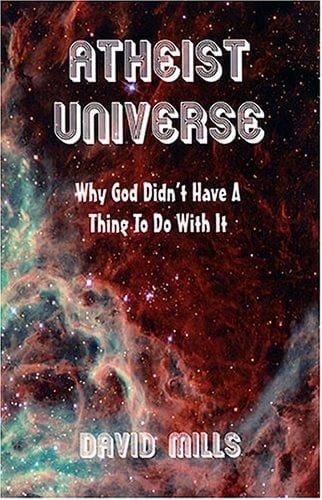
DESCRIPTION
Is there really a God? Or does God exist only in our heads? Is the Bible truly God’s Word, or a jumble of fanciful myths? This book is your front-row ticket to mankind’s most enthralling debate. An atheist for thirty years, David Mills argues that God is unnecessary to explain the universe and life’s diversity, organization and beauty. This unique and captivating book rebuts every argument ever offered to “prove” God’s existence and the Bible’s credibility - arguments from logic, common sense, Christian apologetics, philosophy, ethics, history, and up-to-the-minute science. It’s all here for you in one richly entertaining, comprehensive, and easy-to-read volume. Few other books provide such spellbinding inquiry and arrive at such a controversial and well-documented conclusion. ""The publication of David’s work on the dangers and disadvantages of devout religiosity will be very useful for anyone with harmful religious beliefs. Honest, frank, and right to the point! I found it very fine reading.” - Albert Ellis, Ph.D., father of modern psychotherapy, author of “A Guide to Rational Living and 53 other books. ""I like this material very much. David Mills says very ably and clearly all that needs to be said.” - Ashley Montagu, Ph.D., Harvard and Princeton anthropologist, author of “The Elephant Man. (Commenting on Chapter 3) What’s on the Cover? Introduction: Is This Book an Outrage? Chapter 1: Fifty Famous People Who Criticized Religion Chapter 2: Interview with an Atheist
My Summary
Main Ideas, Takeaways & Similarities
Questions
I. What is the problem?
A. How is this problem formulated?
B. Why is this problem important?
C. What is the history of this problem?
D. Which prominent personalities have been interested in this problem?
II. What solutions to the problem are there?
A. What are the conclusions reached?
B. By what argument(s) is the conclusion reached?
C. What facts or assumptions serve as premises?
D. When a prominent personality offers a solution, does he also argue for or against other prominent personalities? Does he raise objections to alternative solutions? Does he consider objections to his own solutions?
III. Evaluation
A. What are the advantages and disadvantages of the alternative formulations to the problem?
B. Has the importance or history of the problem ever been misrepresented?
C. Are the solutions logically related to the premises?
D. Are the facts true? Are the assumptions acceptable? Are the objections answerable?
AI Summary
Highlights
“Atheist Universe: Why God Didn’t Have A Thing To Do With It” by David Mills is a book that presents arguments against the existence of God and the supernatural. It explores atheistic perspectives and critiques religious beliefs. Here is a comprehensive summary in bullet points:
- Title: Atheist Universe: Why God Didn’t Have A Thing To Do With It
- Author: David Mills
Introduction:
- Introduces the author’s background and perspective as an atheist.
- Sets the tone for the book by emphasizing a naturalistic and secular worldview.
Chapter 1: The Evidence-Based Universe:
- Argues for a universe explained by natural laws and empirical evidence, rather than supernatural causes.
- Discusses the scientific method as a means to understand the natural world.
- Emphasizes skepticism toward supernatural claims.
Chapter 2: The Origin of Religion:
- Explores the historical and anthropological origins of religion.
- Discusses how early humans developed religious beliefs to explain natural phenomena and cope with the unknown.
- Highlights the cultural and psychological aspects of religious belief.
Chapter 3: The Problem of Evil:
- Addresses the philosophical problem of evil and its implications for belief in an all-powerful and benevolent God.
- Discusses the presence of suffering and injustice in the world.
- Questions the compatibility of theodicy with the existence of God.
Chapter 4: The Evolution of Morality:
- Explores the evolutionary origins of human morality and ethics.
- Discusses the idea that moral values and behaviors can be explained by natural selection and social cooperation.
- Challenges the notion that morality requires a divine source.
Chapter 5: Debunking Miracles:
- Critiques the concept of miracles and supernatural events.
- Discusses famous miracle claims and their skeptical analysis.
- Emphasizes the importance of critical thinking and skepticism in evaluating extraordinary claims.
Chapter 6: The Bible as Myth and History:
- Analyzes the Bible from a historical and literary perspective.
- Explores the presence of mythological elements and contradictions in biblical texts.
- Questions the reliability of the Bible as a historical document.
Chapter 7: The Secular State:
- Advocates for the separation of church and state.
- Discusses the importance of a secular government that respects religious freedom and neutrality.
- Critiques the influence of religion in politics and public policy.
Chapter 8: The Meaning of Life Without God:
- Addresses the existential question of life’s meaning in a secular context.
- Advocates for a human-centered approach to finding purpose and fulfillment.
- Discusses the potential for ethical and meaningful lives without belief in a deity.
Chapter 9: A Universe Without God:
- Summarizes the book’s central arguments against the existence of God and the supernatural.
- Emphasizes the role of reason, evidence, and science in understanding the universe.
Conclusion:
- Summarizes the key points and arguments presented in the book.
- Encourages readers to question and critically evaluate their beliefs.
- Advocates for a naturalistic and atheistic worldview as a valid and rational perspective.