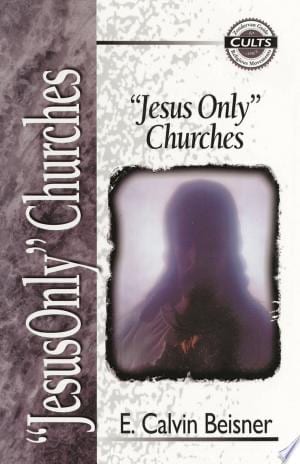
DESCRIPTION
Unlike Jehovah’s Witnesses, who deny the Trinity by demoting Jesus to a mere man, the “Jesus Only” churches deny the Trinity by claiming that there is only one God, and that Jesus is the Father and the Holy Spirit. “Jesus Only” churches not only require baptism for salvation, but also stipulate that it must be baptism in the name of the Lord Jesus Christ only, and not in the name of the Father, the son, and the Holy Spirit. Thus, these churches distort the gospel and the historic, orthodox understanding of Jesus. Why this series? This is an age when countless groups and movements, old and new, mark the religious landscape in our culture, leaving many people confused or uncertain in their search for spiritual truth and meaning. Because you may not have the time or opportunity to research these movements fully, these books provide essential and reliable information and insights for their spiritual journeys. The second wave of books in this series addresses a broad range of spiritual beliefs, from non-Trinitarian Christian sects to witchcraft and neo-paganism to classic non-Christian religions such as Buddhism and Hinduism. All books but the summary volume, Truth and Error, contain five sections: -A concise introduction to the group being surveyed -An overview of the group’s theology — in its own words -Tips for witnessing effectively to members of the group -A bibliography with sources for further study -A comparison chart that shows the essential differences between biblical Christianity and the group -Truth and Error, the last book in the series, consists of parallel doctrinal charts compiled from all the other volumes. Three distinctives make this series especially useful to readers: -Information is carefully distilled to bring out truly essential points, rather than requiring readers to sift their way through a sea of secondary details. -Information is presented in a clear, easy-to-follow outline form with “menu bar” running heads. This format greatly assists the reader in quickly locating topics and details of interest. -Each book meets the needs and skill levels of both nontechnical and technical readers, providing an elementary level of refutation and progressing to a more advanced level using arguments based on the biblical text. The writers of these volumes are well qualified to present clear and reliable information and help readers to discern truth from falsehood.
My Summary
Main Ideas, Takeaways & Similarities
Questions
I. What is the problem?
A. How is this problem formulated?
B. Why is this problem important?
C. What is the history of this problem?
D. Which prominent personalities have been interested in this problem?
II. What solutions to the problem are there?
A. What are the conclusions reached?
B. By what argument(s) is the conclusion reached?
C. What facts or assumptions serve as premises?
D. When a prominent personality offers a solution, does he also argue for or against other prominent personalities? Does he raise objections to alternative solutions? Does he consider objections to his own solutions?
III. Evaluation
A. What are the advantages and disadvantages of the alternative formulations to the problem?
B. Has the importance or history of the problem ever been misrepresented?
C. Are the solutions logically related to the premises?
D. Are the facts true? Are the assumptions acceptable? Are the objections answerable?
AI Summary
“Jesus Only Churches” is a book that examines the theological beliefs and practices of religious groups that subscribe to a “Oneness” or “Jesus Only” theology. This theology often involves a denial of the traditional doctrine of the Trinity and emphasizes the singular identity of Jesus Christ as both Father, Son, and Holy Spirit. Here is a comprehensive summary in bullet points:
- Title: Jesus Only Churches
Introduction:
- Explores the phenomenon of “Jesus Only” or “Oneness” churches and their distinctive theological positions.
- Discusses the historical development of Oneness theology and its impact on various religious groups.
Chapter 1: The Oneness Doctrine:
- Defines the core belief of Oneness theology, which asserts the absolute oneness of God, often denying the traditional doctrine of the Trinity.
- Discusses the belief that Jesus Christ is the one and only God and that Father, Son, and Holy Spirit are different manifestations or roles of the same divine entity.
Chapter 2: Historical Background:
- Traces the historical development of Oneness theology, particularly within the Pentecostal and Charismatic movements.
- Highlights the role of early Oneness leaders and their theological debates.
Chapter 3: Denominations and Churches:
- Examines the various religious denominations and churches that adhere to Oneness theology.
- Discusses the distinctive practices and teachings of these groups, such as baptism in Jesus’ name and the rejection of the traditional Trinity.
Chapter 4: Controversies and Debates:
- Explores the theological controversies and debates between Oneness believers and proponents of the Trinity.
- Discusses the role of theological scholars and apologists in these discussions.
Chapter 5: Modern Perspectives:
- Examines the contemporary landscape of Oneness theology and churches.
- Discusses the challenges and criticisms faced by Oneness groups.
- Highlights the diversity within the broader Pentecostal and Charismatic movements.
Chapter 6: Interactions and Dialogues:
- Discusses efforts to engage in interfaith dialogues and discussions between Oneness believers and proponents of traditional Christian theology.
- Highlights areas of theological agreement and disagreement.
Chapter 7: Implications:
- Explores the theological and practical implications of Oneness theology for individuals and communities.
- Discusses how these beliefs influence worship, baptism, and other religious practices.
Chapter 8: Future Directions:
- Reflects on the future of Oneness theology and its potential impact on the broader Christian landscape.
- Discusses the role of education and dialogue in addressing theological differences.
Conclusion:
- Summarizes the key themes and findings of the book.
- Emphasizes the ongoing theological debates and discussions surrounding Oneness theology.
- Encourages continued dialogue and understanding among diverse Christian communities.