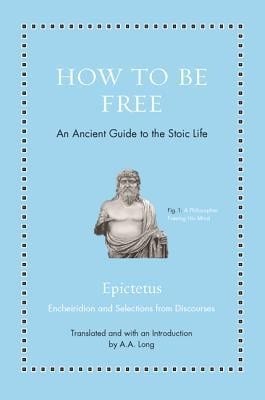
How to be free - an ancient guide to the stoic life - — en;Epictetus (Annotated).pdf (file not included in this release)
DESCRIPTION
“Born a slave, the Roman Stoic philosopher Epictetus (c. 55-135 AD) taught that mental freedom is supreme, since it can liberate one anywhere, even in a prison … Freedom, for Epictetus, is not a human right or a political prerogative but a psychological and ethical achievement, a gift that we alone can bestow on ourselves … How to Be Free features splendid new translations and the original Greek on facing pages, a compelling introduction that sets Epictetus in context and describes the importance of Stoic freedom today, and an invaluable glossary of key words and concepts. The result is an unmatched introduction to this powerful method of managing emotions and handling life’s situations, from the most ordinary to the most demanding.”—Provided by the publisher.
My Summary
Main Ideas, Takeaways & Similarities
Questions
I. What is the problem?
A. How is this problem formulated?
B. Why is this problem important?
C. What is the history of this problem?
D. Which prominent personalities have been interested in this problem?
II. What solutions to the problem are there?
A. What are the conclusions reached?
B. By what argument(s) is the conclusion reached?
C. What facts or assumptions serve as premises?
D. When a prominent personality offers a solution, does he also argue for or against other prominent personalities? Does he raise objections to alternative solutions? Does he consider objections to his own solutions?
III. Evaluation
A. What are the advantages and disadvantages of the alternative formulations to the problem?
B. Has the importance or history of the problem ever been misrepresented?
C. Are the solutions logically related to the premises?
D. Are the facts true? Are the assumptions acceptable? Are the objections answerable?
AI Summary
Highlights
INTRODUCTION (Page 8)
Epictetus (c. AD 55–135), our author and guide to the Stoic life, was born a slave (his Greek name means “acquired”), and entered service as a slave in the household of Epaphroditus, a power broker in Nero’s Rome, and himself a freedman. By the time Epictetus publicly delivered his thoughts on freedom, he had enjoyed many years of manumission, but the experience of slavery left its mark on his philosophy through and through. The first lesson of the Encheiridion, his handbook guide to Stoicism, insists that everything that is truly our own doing is naturally free, unimpeded, and unconstrained. (Page 8)
Freedom, according to this notion, is neither legal status nor opportunity to move around at liberty. It is the mental orientation of persons who are impervious to frustration or disappointment because their wants and decisions depend on themselves and involve nothing that they cannot deliver to themselves. (Page 8)
You can be externally free and internally a slave, controlled by psychological masters in the form of disabling desires and passions and cravings. (Page 9)
In the early years of the second century of our era, this ex-slave established a school for young men in the northwestern Greek city of Nicopolis (Page 9)
In his celebrated essay “Two Concepts of Liberty,” Isaiah Berlin distinguished between the “negative” notion of freedom from coercion (not being interfered with by others) and the “positive” notion of freedom to be or to live as one chooses (self-mastery or self-determination). For Epictetus these two notions come together so closely that they entail one another, as we can see in the following passage: (Page 11)
Our master is anyone who has the power to implement or prevent the things that we want or don’t want. Whoever wants to be free, therefore, should wish for nothing or avoid nothing that is up to other people. Failing that, one is bound to be a slave. (Encheiridion 14) (Page 11)
We could rewrite the second sentence along the lines: “Whoever wants to be free from coercion should restrict their wishes and aversions to things over which they have complete control.” (Page 11)
Everything we are called on to do and think about is germane to his principal question: is this something that is up to me to decide and get started on, or should I accept it calmly and dispassionately as a situation that was brought about by things that are outside my control? (Page 12)
Epictetus’s message of freedom, when reduced to succinct modern terms, might seem to fit such homely advice as “Get real,” “Grow up,” “Show what you are made of,” “Let it go,” “Mind your own business.” You can find more or less exact equivalents to these slogans in some of this book’s translated materials. Their familiarity has much to do with the way ancient Stoicism has influenced Western thought and education since the time when Epictetus, Seneca, and Marcus Aurelius were first assimilated into European and American culture. (Page 12)
You achieve harmony with nature and freedom by focusing your mind or will or assent on the things that you can control (desires, judgments, motivations) and accommodating yourself to the rest with the help of reason and understanding external nature. (Page 14)
What Epictetus insists we should do, in order to live as effectively as possible, is confront our impressions, especially those that disturb us, and accustom ourselves to manage them, interpret them, understand their occurrence, and thus bring them, or at least our response to them, under the control of our will and faculty of assent (Discourses 7, 9). (Page 15)
The key to this classification of values is the notion that goodness and badness are entirely properties of people’s minds, characters and actions—not properties of external nature or external events (Encheiridion 6, 19, 31). This doctrine restricts goodness and badness to the benefit or harm we do to ourselves by choosing and deciding to act and react as we do. Good and bad retain their basic sense of “beneficial” and “harmful” respectively, but Stoic philosophy confines the scope of benefit (goodness) and harm (badness) according to the criteria summarized in the diagram. (Page 15)
Their linguistic and conceptual reform—for that is what it amounts to—asks us to face the following questions: (1) Are such conventional goods as health and wealth always and essentially beneficial to us? (2) Are they necessary to happiness? (3) Are they up to us? (4) Are they mind dependent? And (5) Are they harmonious with our rational nature? If unequivocal answers to all these questions are negative, as the Stoics concluded, we cannot be assured of happiness if we make it conditional on getting such things or on avoiding their opposites. Moreover, by making happiness conditional on circumstance, we surrender autonomy and equanimity, and put ourselves at risk of failure and disappointment. Conversely, by restricting goodness and benefit to the mind dependent qualities of virtue and wisdom, we can secure the happiness that accords with our nature as rational beings; and we can adapt ourselves effectively to external nature and whatever else is outside our own control. (Page 16)
The Stoics agree, first of all, that we naturally prefer to be healthy and prosperous and that our natural attitude to the opposites of these conditions is negative. They agree, secondly, that we could not live a rational inclinations and ignored and harmonious these natural if we life (Page 16)
disinclinations. However, natural preferences and dislikes need to be sharply distinguished from “desires” and “aversions,” in which we fully commit our will and vest our expectations of happiness (Encheiridion 2). When we desire something or are averse to it, we typically treat the thing in question as a really big deal. Epictetus recommends us, then, not to “desire” health and premise our happiness on securing it, but accept it gratefully if it comes our way. (Page 17)
As the Stoics see it, you can flourish in adverse situations and you can fail to live well in favorable ones. What makes for a successful human life, on this outlook, is fulfillment of one’s nature as the rational animal that is one’s birthright and goal (Discourses 8 and 9). In that endeavor what matters are not the gifts of fortune, obtaining natural preferences, and avoiding naturally dislikable things, but “making reason our decisive principle in everything” (Encheiridion 51), whether we encounter adversity or prosperity. (Page 17)
Readers must decide whether and to what extent they endorse this classification of values. In my opinion, the Stoics performed a great service in sharply distinguishing the category of mental benefits and harms (things “up to us,” as Epictetus calls them) from the value of things whose causes are external to our individual intentions and responsibilities. The sharpness of the distinction highlights the ethical importance of recognizing the benefits and harms for which we are directly answerable by our intentions and emotional responses. Open to obvious challenge, though, are the presumptions that external events can be successfully insulated from the conditions for happiness and brought under the direct control of our will and desires. Isn’t it natural and only human to think that happiness is heavily dependent on external circumstances? Is the Stoic way of life accessible to the ordinary fallible person that most of us are? (Page 17)
This is a question to which Epictetus has a remarkably effective response if you agree with him that “It is every creature’s nature … to shun things that look harmful or cause harm, and to like the look of things that are beneficial or bring benefit … and that wherever people’s interest lies, that’s also the site of their reverence” (Encheiridion 31). Ethics according to this Stoic viewpoint starts from and must accommodate our basic human interest in our own individual benefit or good. We do not start from instincts of altruism. To make room, then, for the good of others, Epictetus needs to show that his message of mental freedom is not a solipsistic benefit but socially advantageous and consonant with living in harmony with human nature construed quite broadly. (Page 18)
As individuals, we benefit hugely from not being troubled by emotions like envy, jealousy, fear, and anger, and by having the corresponding virtues of patience and self-control (Encheiridion 10). Tranquility is an obvious good to the tranquil, but its benefits redound no less to our families, friends, and associates because negative emotions often motivate aggressive and hurtful behavior. (Page 18)
Seneca, writing at the time of Nero, had said it memorably: “Freedom is the prize we are working for: not being a slave to anything—not to compulsion, not to chance events—making fortune meet us on a level playing field” (Moral Letter 51.9). (Page 19)
“Whoever wants to be free should wish for nothing or avoid nothing that is up to other people” (Encheiridion 14). (Page 20)
Freedom of will, on this construal—wishing for nothing that is not up to oneself—is not the general human condition, but an arduous philosophical achievement. It consists of a state of mind and character that is free from frustration and disappointment, and free to do whatever it wants to do, because it wishes for nothing that falls outside its own power to achieve. (Page 20)
This information comes to us from Simplicius, a Platonist philosopher and commentator on Aristotle, who composed a commentary on the text in the sixth century AD, treating it anachronistically as an introduction to Platonism. (Page 22)
The Encheiridion (Page 25)
Keep this in mind then: if you think things naturally servile are free and that things not our own are ours, you will be frustrated, pained, and troubled, and you will find fault with gods and men. But if you think you own only what is yours, and that you do not own what is not yours, as you really don’t, no one will ever put pressure on you, no one will impede you, you will not reproach anyone, you will not blame anyone, you will not do a single thing reluctantly, +no one will harm you, you will have no enemy,+ because nothing harmful will happen to you. (Page 25)
First and foremost: does it involve the things up to us, or the things not up to us? And if it involves one of the things not up to us, have the following response to hand: “Not my business.” (Page 25)
So move aversion away from everything that is not up to us and transfer it to the things contrary to nature that are up to us. (Page 26)
Confine yourself to motivation and disinclination, and apply these attitudes lightly, with *reservation and without straining. (Page 26)
In the case of everything that attracts you or has its uses or that you are fond of, keep in mind to tell yourself what it is like, starting with the most trivial things. If you are fond of a jug, say: “I am fond of a jug.” Then, if it is broken, you will not be troubled. (Page 26)
In this way you will be more prepared to start on the activity, by telling yourself at the outset: “I want to bathe, and I also want to keep my will in harmony with nature.” Make this your practice in every activity. Then, if anything happens that gets in the way of your bathing, you will have the following response available: “Well, this was not the only thing I wanted; I also wanted to keep my will in harmony with nature. I shall not do that if I get angry about what is happening.” (Page 26)
terrible thing is the opinion that death is terrible. (Page 26)
fully educated person blames no one, neither himself nor anyone else. (Page 26)
Don’t preen yourself on any distinction that is not your own. If the preening horse should say “I am beautiful,” it would be acceptable. But when you are preening and say, “I have a beautiful horse,” admit that you are preening yourself on a good quality that belongs to the horse. (Page 27)
Don’t ask for things to happen as you would like them to, but wish them to happen as they actually do, and you will be all right. (Page 27)
In all circumstances keep in mind to turn in to yourself and ask what resources you have for dealing with these things. (Page 27)
Never say about anything, “I have lost it”; but say, “I have returned it.” (Page 27)
It is better to starve to death in a calm and confident state of mind than to live anxiously amidst abundance. (Page 28)
If you want to make progress, don’t mind appearing foolish and silly where outward things are concerned, and don’t wish to appear an expert. Even if some people think you are somebody, distrust yourself. It is not easy, you can be sure, to keep your own will in harmony with nature and simultaneously secure outward things. If you care about the one, you are completely bound to neglect the other. (Page 28)
If you want your children and your wife and friends to survive +no matter what, + you are silly; for you are wanting things to be up to you that are not up to you, and things to be your own that are not your own. (Page 28)
Whoever wants to be free, therefore, should wish for nothing or avoid nothing that is up to other people. (Page 28)
don’t let your appetite run ahead, but wait till the portion reaches you. If you act like this toward your children, your wife, your public positions, and your wealth, you will (Page 28)
be worthy one day to dine with the *gods. And if you don’t even take things, when they are put before you, but pass them by, you will not only dine with the gods but also share their rule. (Page 29)
Don’t hesitate, however, to sympathize with them in words and even maybe share their groans, but take care not to groan inwardly as well. (Page 29)
Your job is to put on a splendid performance of the role you have been given, but selecting the role is the job of someone else. (Page 29)
You can always win if you only enter competitions where winning is up to you. When you see someone honored ahead of you or holding great power or being highly esteemed in another way, be careful never to be carried away by the impression and judge the person to be happy. For if the essence of goodness consists in things that are up to us, there is room for neither envy nor jealousy, and you yourself will not want to be a *praetor or a senator or a consul, but to be free. The only way to achieve this is by despising the things that are not up to us. (Page 29)
Keep in mind that what injures you is not people who are rude or aggressive but your opinion that they are injuring you. So whenever someone provokes you, be aware that the provocation really comes from your own (Page 29)
judgment. Start, then, by trying not to get carried away by the impression. Once you pause and give yourself time, you will more easily control yourself. (Page 30)
Set before your eyes every day death and exile and everything +else+ that looks terrible, especially death. Then you will never have any mean thought or be too keen on anything. (Page 30)
Don’t look that way, then, but stick to your views of what is best, as one who has been appointed to this place by God. And keep in mind that if you stick to those same views, the people who used to laugh at you will admire you later, but if you lapse from them, you will be a laughingstock for a second time. (Page 30)
If you ever find yourself looking for outside approval in order to curry favor, you can be sure that you have lost your way. Be satisfied, then, simply to be a philosopher, and if you want people to think of you that way as well, appear so to yourself, and that will be +sufficient.+ (Page 30)
Don’t let yourself be worried by thinking, “My life is going to be without honor, and I will be a nobody everywhere.” If lack of honor is something bad + (as it is),+ no one but yourself could be responsible, any more than others could put you in a shameful position. You don’t really think it’s your job to secure a public office, do you, or be invited to a banquet? “Of course not.” How, then, is this still a lack of honor? And how will you be a nobody everywhere, since you need to be somebody only in the things that are up to you, and in them you can be a top person? (Page 30)
Keep in mind that you cannot expect to get an equal share of the things that are not up to us without doing the same things others have done. If you don’t hang out at someone’s door or go around with him or flatter him, how can you have the same share of his regard as the person who does these things? If you don’t pay the price these things are sold at, and want to get them for free, you would be unfair and greedy. (Page 31)
someone pays an obol and gets the lettuces, don’t think you have less than he has. While he has the lettuces, you have the unspent obol. It’s just the same in the cases we are considering. You were not invited to someone’s dinner party. That’s because you didn’t pay the host the price of the dinner. He sells it for flattery, for getting attention. Pay the price it’s sold for, then, if you think it’s worth it. (Page 31)
If someone in the street were entrusted with your body, you would be furious. Yet you entrust your mind to anyone around who happens to insult you, and allow it to be troubled and confused. Aren’t you ashamed of that? (Page 32)
In every undertaking, examine its *antecedents and their consequences, and only then proceed to the act itself. If you don’t do that, you will start enthusiastically, because you have not thought about any of the next stages; then, when difficulties appear, you will give up and be put to shame. (Page 32)
You are like a monkey mimicking whatever you see, as one thing after another takes your fancy. You haven’t pursued anything with due consideration or after thorough review; you mess about and don’t put your heart into things. (Page 32)
Do you suppose you can go in for philosophy and eat and drink just as you do now or get angry and +irritated+ in the same way? You are going to have to go without sleep, work really hard, stay away from friends and family, be disrespected by a young slave, get mocked by people in the street, and come off worse in rank, office, or courtroom, everywhere in fact. Think about all this and then see whether you want to exchange it for calm, freedom, and tranquility. If not, don’t go near philosophy; don’t be like children playing first a philosopher, and after that a tax collector, then an orator, and then an imperial official. These professions don’t match. You have to be one person, either good or bad. You have to work either on your *commanding-faculty or on external things. Either the inner or the outer should be the focus of your efforts, which means adopting the role either of a philosopher or of an ordinary person. (Page 33)
No one else, in fact, will harm you without your consent; you will be harmed only when you think you are being harmed (Page 33)
Wherever people’s interest lies, that’s also the site of their reverence. If you are careful, then, to focus your desires and aversions where you should, you will be equally careful about reverence. Nevertheless, it is fitting for +everyone+ to perform religious rituals and make customary offerings as long as they act with a pure heart, not mechanically or carelessly, and not meanly or extravagantly. (Page 34)
For if it is one of the things not up to us, it must absolutely be neither good nor bad (Page 34)
Draw up right now a definite character and identity for yourself, one that you intend to stick to whether you are by yourself or in company. (Page 35)
If you are told that someone is talking badly of you, don’t defend yourself against the story but reply: “Obviously he didn’t know my other faults, or he would have mentioned them as well.” (Page 35)
Whenever the impression of some pleasure comes into your mind, guard yourself against being carried away by it, just as you should do with impressions in general. Let the thing wait a bit, and give yourself a pause. Then think of both times—first the one when you will enjoy the pleasure, and then the one after that when you will be sorry and be angry with yourself. Now contrast them with your joy and self-satisfaction if you abstain. (Page 36)
Whenever you do something you have decided ought to be done, never try to avoid being seen doing it, even if people in general may disapprove of it. If, of course, your action is wrong, just don’t do it at all; but if it’s right, why be afraid of people whose criticism is off the mark? (Page 36)
You are careful in walking not to step on a nail or twist your ankle, and you should be just as careful to do no harm to your commanding-faculty. If we stick to this rule in every action, we shall perform what we are doing more securely. (Page 37)
Whenever people treat you badly or criticize you, remember that they are only doing and saying what they think is appropriate for them. They cannot take their lead from your opinion but only from their own. So if their opinion is incorrect, they are the people who suffer harm because they are the ones who got it wrong. When someone takes a true *conjunctive statement to be false, no harm is done to the statement but only to the person making the mistake. If you (Page 37)
start out from this position, you will be indulgent to your critics, and tell yourself each time, “That’s what they thought.” (Page 38)
These inferences are invalid: “I am richer than you, therefore I am better than you,” and “I am more eloquent than you, therefore I am better than you.” But the following inferences are more cogent: “I am richer than you, therefore my property is better than yours,” or “I am more eloquent than you, therefore my diction is better than yours.” But you yourself are neither property nor diction. (Page 38)
If people take a bath in a hurry, don’t criticize them for their bathing, but say that they do it hurriedly. If they drink a lot of wine, don’t criticize them for their drinking, but say that they drink a lot. Until you know their reasons, how do you know whether they acted wrongly. This way you will not combine indubitable impressions of a situation with an endorsement of something else that lacks this certainty. (Page 38)
Don’t ever describe yourself as a philosopher or talk much among ordinary people about your philosophical principles; simply do what the principles prescribe. At a dinner party, for instance, don’t discuss table manners, just eat nicely. (Page 38)
Don’t then, in your case, show off your philosophical principles to ordinary people, but show the actions that come from them once the principles have been absorbed. (Page 38)
The stance and hallmark of ordinary persons is never looking for help or harm from themselves, but only from things that are on the outside. The stance and hallmark of philosophers is only looking for help and harm from themselves. (Page 39)
he keeps watch on himself as though he were his own enemy plotting an attack. (Page 39)
How long will you delay thinking yourself worthy of the best and making reason your decisive principle in everything? You have received the principles you ought to endorse, and you have endorsed them. What sort of teacher, then, are you still waiting for, so you that can transfer the correction of yourself to him? You are not a boy anymore, but already a full-grown man. If you are negligent now and lazy and always procrastinating, and settling on the day after tomorrow and the next as when you will take yourself in hand, you will fail to see that you are making no progress but spending your entire life as an ordinary person until you die. Right now, then, think yourself worthy to live as a grownup making progress; and take your view of the best to be the rule that you never transgress. And whatever you encounter that is painful or pleasant or popular or unpopular, keep in mind that now is the contest, and here right now are the Olympic games, and that postponement is no longer an option, and that your progress is saved or ruined by a single day and a single action. That’s how Socrates perfected himself, by attending to nothing except reason in everything he encountered. You yourself too, even though you are not yet Socrates, ought to live as someone who wants to be a Socrates. (Page 40)
Because education is precisely learning to want all individual things to happen just as they do happen. And how do they happen? In the way that the one who has arranged them has arranged. He has arranged for there to be summer and winter, plenty and dearth, virtue and vice, and all such opposites on behalf of the harmony of the universe. And he has given each of us a body and bodily parts and property and fellow human beings. (Page 57)
For he is there against his will, and wherever someone is against his will, there he is in jail. That’s how Socrates was not in jail because he was there willingly. (Page 58)
So whenever you see someone groveling to another person or flattering him insincerely, you can confidently say that this man also is not free, and not only if he is doing it for the sake of a meager meal but even if he is hoping for a governorship or a consulship. Call people who act like this for small things petty slaves, and call the others, as they deserve, slaves on the grand scale. (Page 59)
no man is free if someone else has the power to obstruct and compel him. (Page 59)
And if you hear him say, “Poor me, what things I suffer,” call him a slave. In short, if you see him wailing, complaining, and unhappy, call him a slave in official dress. If, however, he does none of these things, don’t call him free yet but examine his judgments to see whether they are in any way subject to compulsion or obstruction or unhappiness, and if you find him to be of that sort, call him a slave on vacation at the *Saturnalia, and say that his master is away. Soon he will come back, and then you will learn the nature of this man’s sufferings. (Page 59)
Certainly not, and nothing else that is not your own, because nothing is your own that is not up to you to procure or to secure whenever you want. Keep your hands right off it, but first and foremost keep your desire well away. Otherwise, you are giving yourself up to slavery and submitting your neck to the yoke, if ever you admire what is not your own and feel strongly for things that are dependent on others and are perishable. (Page 62)
Everything everywhere is perishable and vulnerable. If you get attached to some of them even a little, you are bound to be troubled and discouraged, a prey to anxiety and distress. You will have desires that are unfulfilled and aversions that are fully realized. Are we not willing, therefore, to secure the only safety that has been granted to us—to give up the perishable and slavish things, and work on those that are imperishable and naturally free? Don’t we recall that no one does injury or benefit to another, but that the cause of each of these things is a judgment. This is what does harm and wreckage, it is this that is battle, this that is strife, and this that is war. (Page 62)
If, on the other hand, they identity their good and interest with things that are external and outside the sphere of the will, they are bound to be impeded and frustrated, subservient to those who have authority over the things that they have admired and fear; they are also bound to be utterly irreverent, since they think that God has a grudge against them, and to be unfair, since they always grab more for themselves; and they are bound to lack self-respect and generosity. (Page 65)
If you understand these truths, what is to stop you from living in a free and easy way, calmly accepting everything that can happen and putting up with what has already taken place? “Do you want me to be poor?” Bring it on, and you will learn what poverty is when a good actor plays that part. “Do you want me to hold office?” Bring it on. “Do you want me to leave office?” Bring that on too. “Do you want me to endure pains?” Bring them on as well. “And exile?” Wherever I go, I will be fine, because I was already fine here—not on account of the place but as a result of my principles, and I am going to take them with me. No one can take them away from me; they are my only possessions, irremovable ones that are enough for me wherever I am and whatever I do. (Page 65)
Yet God has not only given us these powers as the means for us to bear everything that happens without being humiliated and crushed by them, he has also, like a good king and a true father, given them without impediment or constraint or hindrance. He has made them entirely up to us, without reserving even for himself any power to impede or hinder. Since you have these powers free and entirely your own, why don’t you put them to use and take cognizance of what gifts you have received and from what donor you have received them instead of sitting grief-stricken and groaning? (Page 66)
SATURNALIA The name of the annual December festival at which Roman slaves were given a day of total freedom with license to insult their masters and be waited on at table. (Page 77)
FURTHER READING (Page 78)