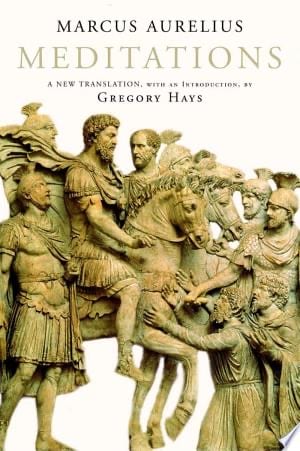
Meditations - Marcus Aurelius (Annotated).pdf (file not included in this release)
DESCRIPTION
NATIONAL BESTSELLER • Timeless insights into what it takes to lead a meaningful life—still profoundly relevant nearly two thousand years later. Now featuring a brand-new foreword from Ryan Holiday, #1 New York Times bestselling author of The Obstacle Is the Way! “Meditations offers a glimpse into [Marcus Aurelius’s] mind, his habits, and his approach to life… . I think any reader would find something useful to take away from it.”—James Clear, #1 New York Times bestselling author of Atomic Habits “It is unbelievable to see how the emperor’s words have stood the test of time… . Read a page or two anytime you feel like the world is too much.”—Arnold Schwarzenegger, The Wall Street Journal Your ability to control your thoughts—treat it with respect. It’s all that protects your mind from false perceptions—false to your nature, and that of all rational beings. A series of spiritual exercises filled with wisdom, practical guidance, and profound understanding of human behavior, Marcus Aurelius’s Meditations remains one of the greatest works of spiritual and ethical reflection ever written. With bite-size insights and advice on everything from living in the world to coping with adversity and interacting with others, Meditations has become required reading not only for statesmen and philosophers alike, but also for generations of readers who responded to the straightforward intimacy of his style. In Gregory Hays’s translation—the first in nearly four decades—Marcus’s thoughts speak with a new immediacy. In fresh and unencumbered English, Hays vividly conveys the spareness and compression of the original Greek text. Never before have Marcus’s insights been so directly and powerfully presented. With an Introduction that outlines Marcus’s life and career, the essentials of Stoic doctrine, the style and construction of the Meditations, and the work’s ongoing influence, this edition makes it possible to fully rediscover the thoughts of one of the most enlightened and intelligent leaders of any era.
My Summary
Main Ideas, Takeaways & Similarities
1. Control Over the Mind and Inner Self
- The only true domain we control is our mind—our judgments, choices, and perspective. External events cannot harm us unless we allow them to disturb our inner reason.
- “Choose not to be harmed—and you won’t feel harmed. Don’t feel harmed—and you haven’t been” (Book 4).
- Our soul takes the color of our thoughts, so we must consciously cultivate thoughts rooted in justice, humility, courage, and reason (Book 5).
2. Impermanence and Perspective
- Life is fleeting, and everything—including pain, pleasure, fame, and material possessions—fades rapidly into obscurity.
- Death is natural, no different than birth: a dissolution and recombination of elements. Fearing it is irrational, as nothing natural is inherently evil (Books 2, 4, 5).
- Posthumous fame is meaningless because those who remember us will soon die as well (Book 4).
3. Living According to Nature and Duty
- We are rational, social beings. Our duty is to act in harmony with nature, meaning:
- Fulfilling our roles with integrity and justice.
- Working for the good of others while accepting their flaws.
- Meeting obstacles as opportunities (“What stands in the way becomes the way,” Book 5).
- Daily, we should wake prepared to face ungrateful or arrogant people, remembering they act from ignorance, and we are born to work with them as parts of a greater whole (Book 2).
4. Acceptance of Fate (Amor Fati)
- All events are part of a rational, interconnected cosmos governed by Providence (or nature’s law). Everything that happens is “measured and right,” and our role is to accept it as part of the world’s order (Books 2, 4, 5).
- Complaining or resisting is like cutting away from the whole, damaging both ourselves and the unity of the cosmos (Book 5).
5. Self-Discipline and Simplicity
- We must focus on essentials: reducing unnecessary words, actions, and desires. Simplicity brings tranquility (Book 4).
- Avoid self-indulgence and distraction. Treat each task “as if it were the last thing you were doing in your life,” with justice and sincerity (Book 2).
- Work diligently, like nature’s creatures, and do not indulge in laziness (Book 5).
6. Virtue as the Highest Good
- The only true goods are virtues—wisdom, justice, courage, and self-control. Wealth, fame, pleasure, and even life itself are indifferent: they have no bearing on our moral worth (Books 3–5).
- “Never regard something as doing you good if it makes you betray a trust, lose your sense of shame, or act with hatred or hypocrisy” (Book 3).
7. Contemplation and Clarity
- Regularly analyze everything—strip things to their essence to see them as they are (Books 3, 4). This helps us judge their true value and reduces fear and desire (Book 3).
- Seek refuge in your own mind, which can always grant peace if it remains aligned with reason and nature (Book 4).
Core Wisdom of Marcus Aurelius (Condensed):
- Master your mind: Your judgments, not external events, determine your peace.
- Embrace impermanence: Life, fame, and suffering all pass swiftly; accept death as natural.
- Live by nature: Fulfill your duty as a rational, social being; obstacles are fuel for growth.
- Accept fate: Trust that all events serve the cosmos’ order; resentment only separates you from nature.
- Pursue virtue alone: Only wisdom, justice, courage, and self-control define a good life.
- Practice simplicity: Focus on essentials, act as if each deed were your last, and let go of distraction and excess.
- Seek inner refuge: Within lies the tranquility the outer world cannot touch.
Questions
I. What is the problem?
A. How is this problem formulated?
B. Why is this problem important?
C. What is the history of this problem?
D. Which prominent personalities have been interested in this problem?
II. What solutions to the problem are there?
A. What are the conclusions reached?
B. By what argument(s) is the conclusion reached?
C. What facts or assumptions serve as premises?
D. When a prominent personality offers a solution, does he also argue for or against other prominent personalities? Does he raise objections to alternative solutions? Does he consider objections to his own solutions?
III. Evaluation
A. What are the advantages and disadvantages of the alternative formulations to the problem?
B. Has the importance or history of the problem ever been misrepresented?
C. Are the solutions logically related to the premises?
D. Are the facts true? Are the assumptions acceptable? Are the objections answerable?
AI Summary
Highlights
never thought of himself as a philosopher. (Page 5)
diligent student and a very imperfect practitioner of a philosophy (Page 5)
Marcus Annius Verus (Page 5)
born, in A.D. 121 (Page 5)
boxing, wrestling, running and falconry (Page 6)
Such training was conducted in Greek as well as Latin. Since at least the beginning of the rst century B.C. the Roman upper classes had been essentially bilingual, and Marcus’s spoken and written Greek would have been as uent as the French of a nineteenthcentury Russian aristocrat or the Chinese of a Heian Japanese (Page 6)
courtier. Marcus would have read Homer’s Iliad and Odyssey and the tragedies of Euripides side by side with the Aeneid, and studied the speeches of the great Athenian orator Demosthenes as intensively as those of the Roman statesman Cicero. It was Greek writers and artists who constituted the intellectual elite at the capital; when in later life the emperor conversed with his court physician, Galen, he would have done so in the latter’s native tongue. Above all, Greek remained overwhelmingly the language of philosophy. In the late Republic and early empire, writers like Lucretius, Cicero and Seneca had worked to create a philosophical literature in Latin, with notable thinkers—Plato, Aristotle, Theophrastus, Zeno, Chrysippus, Epicurus, etc.—had all been Greeks. Serious philosophical investigation required a familiarity with the language they wrote in and the terminology they developed. That Marcus composed his own Meditations in Greek is natural enough. success. But the great (Page 7)
Ceionius died unexpectedly (Page 7)
Antoninus (Page 7)
Marcus took on the family name of his adopted father, becoming Marcus Aurelius Antoninus. (Page 7)
single greatest inuence was surely Marcus’s adopted father, Antoninus Pius. (Page 8)
Edward Gibbon’s History of the Decline and Fall of the Roman Empire describes the reign of Antoninus as “furnishing very few materials for history, which is indeed little more than the register of the crimes, follies, and misfortunes of mankind.” It furnishes equally little material for Marcus’s biography. (Page 8)
We get occasional glimpses of Marcus’s day-to-day duties from the evidence of imperial decisions preserved in letters, inscriptions and the legal codes. Surviving legislation shows a certain interest in the freeing of slaves and in regulations relating to the guardianship of orphans. Attempts have been made to tie the rst to Marcus’s philosophical convictions and the second to his own memories of life without a father. But it remains unclear how much of the policy is due to Marcus himself, and how far it diers from that of (Page 9)
Marcus’s predecessor, Antoninus. Perhaps more interesting are the traces of Marcus’s personality to be discerned in the phrasing of imperial documents, where we nd a scrupulous attention to detail and a self-consciousness about linguistic usage that seems to dierentiate Marcus from his predecessors. Neither trait surprises in the author of the Meditations or a student of Fronto, whose extant letters place great stress on the quest for the mot juste. (Page 10)
The Senate expected deference in public and hoped for inuence behind the scenes; “good” emperors were willing to play along. (Page 10)
And it is this, as much as anything else, that is responsible for his reputation as a benevolent statesman. (Page 10)
An emperor might do as he liked while he lived, but it was the senatorial historians—men like Cornelius Tacitus in the 120s or Cassius Dio in the generation after Marcus’s death—who had the last word. (Page 10)
Christians (Page 10)
The Christians’ disfavor stemmed from their failure to acknowledge the gods worshipped by the community around them. (Page 10)
Their “atheism”—their refusal to accept any god but (Page 10)
their own—endangered their neighbors as well as themselves, and their reluctance to acknowledge the divine status of the emperor threatened the social order and the well-being of the state. (Page 11)
Christianity had been illegal since the early second century (Page 11)
Trajan (Page 11)
While Christians were not to be sought out, those who confessed to the faith were to be executed. (Page 11)
170s (Page 11)
pogrom (Page 11)
devastating plague (Page 12)
second threat (Page 12)
barbarian peoples of Germany, eastern Europe and Scandinavia. (Page 12)
its failure to develop a workable policy would eventually result in the collapse of the Western empire some three centuries later. (Page 12)
In Marcus’s day three peoples presented a special problem: the Quadi, the Marcomanni, and the Jazyges (Page 12)
Much of the remainder of the reign would be spent on intermittent warfare, rst in the so-called Marcomannic Wars of the early 170s and then in a second campaign later in that decade. And most of the burden was to be borne by Marcus alone, for Verus died suddenly (apparently of a stroke) in early 169. It was a very dierent kind of war than the traditional campaign Verus’s armies had waged. The conventional military and diplomatic tactics that worked against the Parthians were of limited use here. Instead, the Romans had to negotiate with individual chieftains whose authority was limited and whose reliability was always in doubt. When negotiation failed, the only alternative was a slow and bloody succession of small-scale engagements rather than pitched battles. The progress of the campaign is recorded on the column erected in Rome to commemorate the close of the Marcomannic Wars. In spite of its triumphal purpose, the engraved scenes that spiral around the monument paint a grim picture of brutal ghting, devastation and execution. “Spiders are proud of catching ies,” Marcus notes mordantly, “men of catching hares, sh in a net, boars, bears, Sarmatians” (10.10). The gruesome vignette that opens Meditations 8.34 (“a severed hand or foot, or a decapitated head”) may well reect Marcus’s own experience. (Page 13)
Avidius Cassius (Page 13)
revolted and declared himself emperor (Page 13)
Faustina had borne at least thirteen children, many of whom had died young. By the mid-170s, Marcus had only one surviving son, Commodus, just entering his teens. (Page 14)
Two years later Marcus died at age fty-eight, the rst emperor to pass on the throne to his son since Vespasian a century before. (Page 14)
Commodus’s performance did not bear out whatever promise Marcus had discerned in him. (Page 14)
The composition of the Meditations is normally dated to the 170s— Marcus’s last decade. That this was a dark and stressful period for him can hardly be doubted. (Page 14)
“mortal questions” (Page 15)
issues as the province of religion rather than philosophy (Page 15)
philosophy also had a more practical dimension. (Page 15)
provide a “design for living”—a set of rules to live one’s life by. (Page 15)
Stoic school (Page 16)
world is organized in a rational and coherent way. (Page 16)
logos (Page 16)
basic level it designates rational, connected thought—whether envisioned as a characteristic (rationality, the ability to reason) or as the product of that characteristic (an intelligible utterance or a connected discourse). Logos operates both in individuals and in the universe as a whole. (Page 16)
John’s Gospel (Page 16)
deterministic system (Page 17)
actual substance that pervades that world (Page 17)
Of the major philosophical schools, it was Stoicism that had the greatest appeal. (Page 18)
approved of participation in public life (Page 18)
Stoicism (Page 19)
real religion of upper-class Romans. (Page 19)
Roman Stoicism, by contrast, was a practical discipline —not an abstract system of thought, but an attitude to life. (Page 19)
the application of the adjective “stoic” to a person who shows strength and courage in misfortune probably owes more to the aristocratic Roman value system than it does to Greek philosophers. (Page 19)
A more complex and much more interesting gure was the poet Lucan’s uncle, Lucius Annaeus Seneca (c. 4 B.C.– A.D. 65) (Page 20)
some critics have found it hard to reconcile Seneca’s fabulous wealth and his shameless attery of Nero with his philosophical views. Yet his works (in particular the Letters to Lucilius) remain the most engaging and accessible expressions of later Stoicism. (Page 20)
Epictetus (Page 20)
Epictetus seems to have been an especially important gure for Marcus. (Page 20)
The late Stoicism of Epictetus is a radically stripped-down version of its Hellenistic predecessor, a philosophy which “had learnt much from its competitors and had almost forgotten parts of itself.”3 Both these tendencies, the narrowing of the eld and the eclectic borrowing from non-Stoic sources, can be discerned also in the Meditations. (Page 21)
The questions that the Meditations tries to answer are primarily metaphysical and ethical ones: Why are we here? How should we live our lives? How can we ensure that we do what is right? How can we protect ourselves against the stresses and pressures of daily life? How should we deal with pain and misfortune? How can we live with the knowledge that someday we will no longer exist? It would be both pointless and impertinent to try to summarize Marcus’s responses; the inuence of the Meditations on later readers springs in part from the clarity and insistence with which he addresses these questions. It may be worthwhile, however, to draw attention to one pattern of thought that is central to the philosophy of the Meditations (as well as to Epictetus), and that has been identied and documented in detail by Pierre Hadot. This is the doctrine of the three “disciplines”: the disciplines of perception, of action and of the will. (Page 22)
discipline of perception (Page 22)
absolute objectivity of thought: that we see things dispassionately for what they are. (Page 22)
inappropriate value judgments: the designation as “good” or “evil” of things that in fact are neither good nor evil. (Page 22)
second discipline, that of action, relates to our relationship with other people. (Page 23)
This requires not merely passive acquiescence in what happens, but active cooperation with the world, with fate and, above all, with other human beings. We were made, Marcus tells us over and over, not for ourselves but for others, and our nature In our relationships with others we must work for their collective good, while treating them justly and fairly as individuals. fundamentally unselsh. is (Page 23)
Our duty to act justly does not mean that we must treat others as our equals; it means that we must treat them as they deserve. (Page 24)
third discipline, the discipline of will (Page 24)
governs our attitude to things that are not within our control, those that we have done to us (by others or by nature). (Page 24)
Instead we must see things for what they are (here the discipline of perception is relevant) and accept them, by exercising the discipline of will, or what Epictetus calls (in a phrase quoted by Marcus) “the art of acquiescence.” (Page 24)
Alexander Pope’s phrase, “whatever is, is right.” (Page 25)
Together, the three disciplines constitute a comprehensive approach to life, and in various combinations and reformulations they underlie a large number of the entries in the Meditations. We see them laid out starkly and explicitly in Meditations 7.54: Everywhere, at each moment, you have the option: to accept this event with humility [will]; to treat this person as he should be treated [action]; to approach this thought with care, so that nothing irrational creeps in [perception]. (Page 25)
“Objective judgment … Unselsh action … Willing acceptance … of all external events.” (Page 25)
I suspect that if asked what it was that he studied, his answer would have been not “Stoicism” but simply “philosophy.” (Page 26)
Adherents of most of the major schools—the Platonists, Peripatetics, Cynics, and Stoics—preferred to focus on the points they shared, rather than those that separated them. (Page 26)
Marcus credits as inuential on his own philosophical development were Stoics; Severus, for example, was a Peripatetic. Although authors like Seneca and Epictetus accepted the basic premises of the system developed by Zeno and Chrysippus, they showed no reluctance to borrow aphorisms, anecdotes, and argumentative strategies from non-Stoic sources. The Meditations follows a similar procedure. While built on a Stoic foundation, it also refers to and quotes a wide range of gures, both precursors of the Stoics and representatives of rival schools. (Page 26)
Marcus quotes Plato repeatedly (especially in Book 7), and Socratic or Platonic elements can be discerned elsewhere too. One (Page 26)
example is the so-called Socratic paradox, the claim that no one does wrong willingly, and that if men were able to recognize what is right, they would inevitably do it. “They are like this,” Marcus says of other people, “because they can’t tell good from evil” (2.1), and he repeats this assertion elsewhere. (Page 27)
Heraclitus, the mysterious gure from Ephesus (in modern-day Turkey) whose Zenlike aphorisms were proverbial for their profundity and obscurity alike. (Page 27)
Aristotle, who broke from his master to found the Peripatetic movement. (Page 28)
Stoicism’s great rival among Hellenistic philosophical systems (Page 28)
Epicurus (Page 28)
“Providence or atoms” (Page 29)
Like other late Stoics (Seneca is a notable example), he was willing to accept truth wherever he found it. (Page 30)
haphazard set of notes that constitute the book (Page 30)
entitled “To Himself” (Eis heauton) (Page 30)
From these entries and others it seems clear that the “you” of the text is not a generic “you,” but the emperor himself. “When you look at yourself, see any of the emperors” (10.31). (Page 31)
The entries perhaps bear a somewhat closer resemblance to the working notes of a practicing philosopher: (Page 31)
It suggests not a mind recording new perceptions or experimenting with new arguments, but one obsessively repeating and reframing ideas long familiar but imperfectly absorbed. (Page 31)
“spiritual exercises” composed to provide a momentary stay against the stress and confusion of everyday life (Page 31)
its purpose is not to describe or reect (let alone to “meditate”), but to urge, direct, and exhort. (Page 32)
repetitiveness (Page 32)
continual circling back to the same few problems. (Page 32)
familiar answers reframed. (Page 32)
Attempts to nd organic unity in the remaining books or development from book to book are doomed to failure. Wherever one opens the Meditations (with the exception of Book 1) we nd the same voice, the same themes; Marcus’s thought does not change or develop noticeably from one book to another. Nor can any structure or unity be discerned within individual books. It seems most likely that the division between books is a purely physical one. The transmitted “books,” in other words, represent the individual papyrus rolls of Marcus’s original, or perhaps of a later copy. When one had been lled, another was begun (Page 33)
P. A. Brunt puts it, “Reason told Marcus that the world was good beyond improvement, and yet it constantly appeared to him evil beyond remedy.” (Page 38)
persistent strain of pessimism in the work. (Page 38)
central shortcoming of his philosophy as its failure to make any allowance for joy, and I think this is a fair criticism. Marcus does not oer us a means of achieving happiness, but only a means of resisting pain. The Stoicism of the Meditations is fundamentally a defensive philosophy; (Page 39)
For Marcus, life was a battle, and often it must have seemed—what in some sense it must always be—a losing battle. (Page 39)
The century that followed Themistius and Julian was one of decline, at least in the West—decline in political institutions, and also in the knowledge of Greek. For the next thousand years Marcus’s work, like that of Homer and Euripides, would remain unknown to Western readers. (Page 41)
beginning of the tenth century it reappears (Page 41)
The fall of Constantinople to the Turks in 1453 led to an exodus of scholars, bringing with them the Greek texts that inspired the Italian Renaissance. The Meditations must have been among them. Yet even at this date the work’s survival hung by a thread. (Page 42)
printed edition did not appear until 1559 (Page 42)
To read attentively—not to be satised with “just getting the gist of it.” And not to fall for every smooth talker. And for introducing me to Epictetus’s lectures—and loaning me his own copy. (Page 56)
Independence and unvarying reliability, and to pay attention to nothing, no matter how eetingly, except the logos. And to be the same in all circumstances—intense pain, the loss of a child, chronic illness. And to see clearly, from his example, that a man can show both strength and exibility. (Page 56)
And to have learned how to accept favors from friends without losing your self-respect or appearing ungrateful (Page 56)
To investigate and analyze, with understanding and logic, the principles we ought to live by. Not to display anger or other emotions. To be free of passion and yet full of love. To praise without bombast; to display expertise without pretension. (Page 57)
Not to be constantly correcting people, and in particular not to jump on them whenever they make an error of usage or a grammatical mistake or mispronounce something, but just answer their question or add another example, or debate the issue itself (not their phrasing), or make some other contribution to the discussion—and insert the right expression, unobtrusively. (Page 57)
To recognize the malice, cunning, and hypocrisy that power produces, and the peculiar ruthlessness often shown by people from “good families.” (Page 57)
Not to be constantly telling people (or writing them) that I’m too busy, unless I really am. Similarly, not to be always ducking my responsibilities to the people around me because of “pressing business.” (Page 57)
And to help others and be eager to share, not to be a pessimist, and never to doubt your friends’ aection for you. And that when people incurred his disapproval, they always knew it. And that his friends never had to speculate about his attitude to anything: it was always clear. (Page 58)
That no one could ever have felt patronized by him—or in a position to patronize him. A sense of humor (Page 59)
The way he handled the material comforts that fortune had supplied him in such abundance—without arrogance and without (Page 59)
apology. If they were there, he took advantage of them. If not, he didn’t miss them. (Page 60)
His ability to feel at ease with people—and put them at their ease, without being pushy. His willingness to take adequate care of himself. Not a hypochondriac or obsessed with his appearance, but not ignoring things either. With the result that he hardly ever needed medical attention, or drugs or any sort of salve or ointment. (Page 60)
No bathing at strange hours, no self-indulgent building projects, no concern for food, or the cut and color of his clothes, or having attractive slaves. (The robe from his farm at Lorium, most of the things at Lanuvium, the way he accepted the customs agent’s apology at Tusculum, etc.) (Page 60)
You could have said of him (as they say of Socrates) that he knew how to enjoy and abstain from things that most people nd it hard to abstain from and all too easy to enjoy. Strength, perseverance, self-control in both areas: the mark of a soul in readiness— indomitable. (Page 61)
That I had someone—as a ruler and as a father—who could keep me from being arrogant and make me realize that even at court you can live without a troop of bodyguards, and gorgeous clothes, lamps, sculpture—the whole charade. That you can behave almost like an ordinary person without seeming slovenly or careless as a ruler or when carrying out ocial obligations. (Page 61)
That I was shown clearly and often what it would be like to live as nature requires. The gods did all they could—through their gifts, their help, their inspiration—to ensure that I could live as nature demands. And if I’ve failed, it’s no one’s fault but mine. Because I didn’t pay attention to what they told me—to what they taught me, practically, step by step. (Page 62)
That I have the wife I do: obedient, loving, humble. (Page 62)
I have seen the beauty of good, and the ugliness of evil, and have recognized that the wrongdoer has a nature related to my own (Page 64)
Stop allowing your mind to be a slave, to be jerked about by selsh impulses, to kick against fate and the present, and to mistrust the future. (Page 64)
Concentrate every minute like a Roman—like a man—on doing what’s in front of you with precise and genuine seriousness, tenderly, willingly, with justice. And on freeing yourself from all other distractions. Yes, you can—if you do everything as if it were the last thing you were doing in your life, and stop being aimless, stop letting your emotions override what your mind tells you, stop being hypocritical, self-centered, irritable. You see how few things you have to do to live a satisfying and reverent life? If you can manage this, that’s all even the gods can ask of you. (Page 65)
People who labor all their lives but have no purpose to direct every thought and impulse toward are wasting their time— even when hard at work. (Page 65)
you cannot lose another life than the one you’re living now, or live another one than the one you’re losing. (Page 68)
For you can’t lose either the past or the future; how could you lose what you don’t have? (Page 68)
The human soul degrades itself: i. Above all, when it does its best to become an abscess, a kind of detached growth on the world. To be disgruntled at anything that happens is a kind of secession from Nature, which comprises the nature of all things. ii. When it turns its back on another person or sets out to do it harm, as the souls of the angry do. (Page 68)
iii. When it is overpowered by pleasure or pain. iv. When it puts on a mask and does or says something articial or false. v. When it allows its action and impulse to be without a purpose, to be random and disconnected: even the smallest things ought to be directed toward a goal. But the goal of rational beings is to follow the rule and law of the most ancient of communities and states. (Page 69)
So we need to hurry. Not just because we move daily closer to death but also because our understanding—our grasp of the world—may be gone before we get there. (Page 71)
You need to avoid certain things in your train of thought: everything random, everything irrelevant. And certainly everything self-important or malicious. You need to get used to winnowing your thoughts, so that if someone says, “What are you thinking about?” you can respond at once (and truthfully) that you are thinking this or thinking that. And it would be obvious at once from thoughts were straightforward and your answer considerate ones—the thoughts of an unselsh person, one unconcerned with pleasure and with sensual indulgence generally, that your (Page 72)
with squabbling, with slander and envy, or anything else you’d be ashamed to be caught thinking. (Page 73)
And he cares nothing for their praise—men who can’t even meet their own standards. (Page 73)
How to act: Never under compulsion, out of selshness, without forethought, with misgivings. Don’t gussy up your thoughts. No surplus words or unnecessary actions. Let the spirit in you represent a man, an adult, a citizen, a Roman, a ruler. Taking up his post like a soldier and patiently awaiting his recall from life. Needing no oath or witness. Cheerfulness. Without requiring other people’s help. Or serenity supplied by others. (Page 73)
To stand up straight—not straightened. (Page 74)
Never regard something as doing you good if it makes you betray a trust, or lose your sense of shame, or makes you show hatred, suspicion, ill will, or hypocrisy, or a desire for things best done behind closed doors. If you can privilege your own mind, your guiding spirit and your reverence for its powers, that should keep (Page 74)
you clear of dramatics, of wailing and gnashing of teeth. (Page 75)
If you do the job in a principled way, with diligence, energy and patience, if you keep yourself free of distractions, and keep the spirit inside you undamaged, as if you might have to give it back at any moment— If you can embrace this without fear or expectation—can nd fulllment in what you’re doing now, as Nature intended, and in superhuman truthfulness (every word, every utterance)—then your life will be happy. No one can prevent that. (Page 76)
no one does the wrong thing deliberately; (Page 79)
That everything you see will soon alter and cease to exist. Think of how many changes you’ve already seen. (Page 80)
Choose not to be harmed—and you won’t feel harmed. Don’t feel harmed—and you haven’t been. (Page 81)
Two kinds of readiness are constantly needed: (i) to do only what the logos of authority and law directs, with the good of human beings in mind; (ii) to reconsider your position, when someone can set you straight or convert you to his. But your conversion should always rest on a conviction that it’s right, or benets others— nothing else. Not because it’s more appealing or more popular. (Page 82)
Not to live as if you had endless years ahead of you. Death overshadows you. While you’re alive and able—be good. (Page 82)
The tranquillity that comes when you stop caring what they say. Or think, or do. Only what you do. (Page 83)
Because most of what we say and do is not essential. If you can eliminate it, you’ll have more time, and more tranquillity. Ask yourself at every moment, “Is this necessary?” (Page 84)
Love the discipline you know, and let it support you. (Page 86)
The age of Vespasian, for example. People doing the exact same things: marrying, raising children, getting sick, dying, waging war, throwing parties, doing business, farming, attering, boasting, distrusting, plotting, hoping others will die, complaining about their own lives, falling in love, putting away money, seeking high oce and power. (Page 86)
Nothing that goes on in anyone else’s mind can harm you. Nor can the shifts and changes in the world around you. —Then where is harm to be found? In your capacity to see it. (Page 87)
justice, generosity, self-control, sanity, prudence, honesty, humility, straightforwardness, (Page 90)
Consider the abyss of time past, the innite future. (Page 90)
At dawn, when you have trouble getting out of bed, tell yourself: “I have to go to work—as a human being. What do I have to complain of, if I’m going to do what I was born for—the things I was brought into the world to do? Or is this what I was created for? To huddle under the blankets and stay warm?” (Page 92)
So you were born to feel “nice”? Instead of doing things and experiencing them? (Page 92)
Why aren’t you running to do what your nature demands? (Page 92)
People who love what they do wear themselves down doing it, they even forget to wash or eat. (Page 92)
If an action or utterance is appropriate, then it’s appropriate for you. Don’t be put o by other people’s comments and criticism. If it’s right to say or do it, then it’s the right thing for you to do or say. (Page 92)
The others obey their own lead, follow their own impulses. Don’t be distracted. Keep walking. Follow your own nature, and follow Nature—along the road they share. (Page 93)
honesty, gravity, endurance, austerity, resignation, abstinence, patience, sincerity, moderation, seriousness, high-mindedness. (Page 93)
Don’t you see how much you have to oer—beyond excuses like “can’t”? And yet you still settle for less. (Page 93)
Or is it some inborn condition that makes you whiny and grasping and obsequious, makes you complain about your body and curry favor and show o and leaves you so turbulent inside? (Page 93)
Not to feel exasperated, or defeated, or despondent because your days aren’t packed with wise and moral actions. But to get back up when you fail, to celebrate behaving like a human—however imperfectly—and fully embrace the pursuit that you’ve embarked on. And not to think of philosophy as your instructor, but as the sponge and egg white that relieve ophthalmia—as a soothing ointment, a warm lotion. Not showing o your obedience to the logos, but resting in it. Remember: philosophy requires only what your nature already demands. What you’ve been after is something else again—something unnatural. (Page 95)
The things you think about determine the quality of your mind. Your soul takes on the color of your thoughts. (Page 98)
Things have no hold on the soul. They have no access to it, cannot move or direct it. It is moved and directed by itself alone. It takes the things before it and interprets them as it sees t. (Page 98)
So it would take an idiot to feel self-importance or distress. Or any indignation, either. As if the things that irritate us lasted. (Page 99)
So other people hurt me? That’s their problem. Their character and actions are not mine. What is done to me is ordained by nature, what I do by my own. (Page 100)
How have you behaved to the gods, to your parents, to your siblings, to your wife, to your children, to your teachers, to your nurses, to your friends, to your relatives, to your slaves? Have they all had from you nothing “wrong and unworthy, either word or deed”? Consider all that you’ve gone through, all that you’ve survived. And that the story of your life is done, your assignment complete. How many good things have you seen? How much pain and pleasure have you resisted? How many honors have you declined? How many unkind people have you been kind to? (Page 101)
be tolerant with others and strict with yourself. Remember, nothing belongs to you but your esh and blood—and nothing else is under your control. (Page 102)
You can lead an untroubled life provided you can grow, can think and act systematically. (Page 102)
Not to let others hold you back. ii. To locate goodness in thinking and doing the right thing, and to limit your desires to that. (Page 102)
But true good fortune is what you make for yourself. Good fortune: good character, good intentions, and good actions. (Page 103)
The best revenge is not to be like that. (Page 105)
If you had a stepmother and a real mother, you would pay your respects to your stepmother, yes … but it’s your real mother you’d go home to. The court … and philosophy: Keep returning to it, to rest in its embrace. It’s all that makes the court—and you—endurable. (Page 106)
Pride is a master of deception: when you think you’re occupied in the weightiest business, that’s when he has you in his spell. (Page 107)
The way people behave. They refuse to admire their contemporaries, the people whose lives they share. No, but to be admired by Posterity—people they’ve never met and never will— that’s what they set their hearts on. You might as well be upset at not being a hero to your great-grandfather. (Page 109)
It’s the truth I’m after, and the truth never harmed anyone. What harms us is to persist in self-deceit and ignorance. (Page 109)
Think how much is going on inside you every second—in your soul, in your body. Why should it astonish you that so much more— everything that happens in that all-embracing unity, the world—is happening at the same time? (Page 110)
If someone asked you how to write your name, would you clench your teeth and spit out the letters one by one? If he lost his temper, would you lose yours as well? Or would you just spell out the individual letters? Remember—your responsibilities can be broken down into individual parts as well. Concentrate on those, and nish the job methodically—without getting stirred up or meeting anger with anger. (Page 110)
How cruel—to forbid people to want what they think is good for them. And yet that’s just what you won’t let them do when you get angry at their misbehavior. They’re drawn toward what they think is good for them. —But it’s not good for them. Then show them that. Prove it to them. Instead of losing your temper. (Page 110)
To escape imperialization—that indelible stain. It happens. Make sure you remain straightforward, upright, reverent, serious, unadorned, an ally of justice, pious, kind, aectionate, and doing your duty with a will. Fight to be the person philosophy tried to make you. (Page 111)
Our lives are short. The only rewards of our existence here are an unstained character and unselsh acts. (Page 111)
for a human being to feel stress is normal—if he’s living a normal human life. And if it’s normal, how can it be bad? (Page 112)
So make up your mind who you’ll choose to work with. The force that directs all things will make good use of you regardless—will put you on its payroll and set you to work. But make sure it’s not the job Chrysippus speaks of: the bad line in the play, put there for laughs. (Page 114)
Ambition means tying your well-being to what other people say or do. Self-indulgence means tying it to the things that happen to you. Sanity means tying it to your own actions. (Page 116)
What injures the hive injures the bee. (Page 117)
Surrounded as we are by all of this, we need to practice acceptance. Without disdain. But remembering that our own worth is measured by what we devote our energy to. (Page 119)
Don’t be ashamed to need help. Like a soldier storming a wall, you have a mission to accomplish. And if you’ve been wounded and you need a comrade to pull you up? So what? (Page 120)
Straight, not straightened. (Page 121)
Let it happen, if it wants, to whatever it can happen to. And what’s aected can complain about it if it wants. It doesn’t hurt me unless I interpret its happening as harmful to me. I can choose not to. (Page 121)
No matter what anyone says or does, my task is to be good. (Page 121)
To feel aection for people even when they make mistakes is uniquely human. You can do it, if you simply recognize: that they’re human too, that they act out of ignorance, against their will, and that you’ll both be dead before long. And, above all, that they haven’t really hurt you. They haven’t diminished your ability to choose. (Page 122)
Before long, nature, which controls it all, will alter everything you see and use it as material for something else—over and over again. So that the world is continually renewed. 26. When people injure you, ask yourself what good or harm they thought would come of it. If you understand that, you’ll feel sympathy rather than outrage or anger. Your sense of good and evil may be the same as theirs, or near it, in which case you have to excuse them. Or your sense of good and evil may dier from theirs. In which case they’re misguided and deserve your compassion. Is that so hard? (Page 123)
Treat what you don’t have as nonexistent. Look at what you have, the things you value most, and think of how much you’d crave them if you didn’t have them. But be careful. Don’t feel such satisfaction that you start to overvalue them—that it would upset you to lose them. (Page 123)
Discard your misperceptions. Stop being jerked like a puppet. Limit yourself to the present. Understand what happens—to you, to others. Analyze what exists, break it all down: material and cause. Anticipate your nal hours. Other people’s mistakes? Leave them to their makers. (Page 124)
Which is why observing life for forty years is as good as a thousand. Would you really see anything new? (Page 126)
Everywhere, at each moment, you have the option: to accept this event with humility to treat this person as he should be treated to approach this thought with care, so that nothing irrational creeps in. (Page 127)
Think of yourself as dead. You have lived your life. Now take what’s left and live it properly. (Page 128)
To love only what happens, what was destined. No greater harmony. (Page 128)
Look at who they really are, the people whose approval you long for, and what their minds are really like. Then you won’t blame the ones who make mistakes they can’t help, and you won’t feel a need for their approval. You will have seen the sources of both— their judgments and their actions. (Page 129)
place your own well-being in your own hands. It’s quite possible to be a good man without anyone realizing it. Remember that. (Page 130)
Perfection of character: to live your last day, every day, without frenzy, or sloth, or pretense. (Page 131)
It’s silly to try to escape other people’s faults. They are inescapable. Just try to escape your own. (Page 131)
You’ve given aid and they’ve received it. And yet, like an idiot, you keep holding out for more: to be credited with a Good Deed, to be repaid in kind. Why? (Page 131)
Now forget what they think of you. Be satised if you can live the rest of your life, however short, as your nature demands. Focus on that, and don’t let anything distract you. You’ve wandered all over and nally realized that you never found what you were after: how to live. Not in syllogisms, not in money, or fame, or self-indulgence. Nowhere. (Page 134)
rst principles. (Page 134)
nothing is good except what leads to fairness, and self-control, and courage, and free will. And nothing bad except what does the opposite. (Page 134)
For every action, ask: How does it aect me? Could I change my mind about it? (Page 134)
rst step: Don’t be anxious. Nature controls it all. (Page 135)
second step: Concentrate on what you have to do. (Page 135)
Remorse is annoyance at yourself for having passed up something that’s to your benet. But if it’s to your benet it must be good—something a truly good person would be concerned about. But no truly good person would feel remorse at passing up pleasure. So it cannot be to your benet, or good. (Page 136)
When you have trouble getting out of bed in the morning, remember that your dening characteristic—what denes a human being—is to work with others. (Page 136)
Stick to what’s in front of you—idea, action, utterance. (Page 138)
This is what you deserve. You could be good today. But instead you choose tomorrow. (Page 138)
To accept it without arrogance, to let it go with indierence. (Page 140)
Have you ever seen a severed hand or foot, or a decapitated head, just lying somewhere far away from the body it belonged to …? That’s what we do to ourselves—or try to—when we rebel against what happens to us, when we segregate ourselves. Or when we do something selsh. (Page 140)
People nd pleasure in dierent ways. I nd it in keeping my mind clear. In not turning away from people or the things that happen to them. In accepting and welcoming everything I see. In treating each thing as it deserves. (Page 142)
Give yourself a gift: the present moment. (Page 142)
External things are not the problem. It’s your assessment of them. Which you can erase right now. If the problem is something in your own character, who’s stopping you from setting your mind straight? And if it’s that you’re not doing something you think you should be, why not just do it? —But there are insuperable obstacles. Then it’s not a problem. The cause of your inaction lies outside you. —But how can I go on living with that undone? Then depart, with a good conscience, as if you’d done it, embracing the obstacles too. (Page 143)
You want praise from people who kick themselves every fteen minutes, the approval of people who despise themselves. (Is it a sign of self-respect to regret nearly everything you do?) (Page 145)
The existence of evil does not harm the world. And an individual act of evil does not harm the victim. Only one person is harmed by it—and he can stop being harmed as soon as he decides to. (Page 145)
People exist for one another. You can instruct or endure them. (Page 146)
To enter others’ minds and let them enter yours. (Page 146)
To do harm is to do yourself harm. To do an injustice is to do yourself an injustice—it degrades you. (Page 150)
And you can also commit injustice by doing nothing. (Page 150)
Objective judgment, now, at this very moment. Unselsh action, now, at this very moment. Willing acceptance—now, at this very moment—of all external events. That’s all you need. (Page 150)
Blot out your imagination. Turn your desire to stone. Quench your appetites. Keep your mind centered on itself. (Page 150)
Enter their minds, and you’ll nd the judges you’re so afraid of —and how judiciously they judge themselves. (Page 152)
Do what nature demands. Get a move on—if you have it in you— and don’t worry whether anyone will give you credit for it. And don’t go expecting Plato’s Republic; be satised with even the smallest progress, and treat the outcome of it all as unimportant. (Page 154)
You can discard most of the junk that clutters your mind— things that exist only there—and clear out space for yourself: … by comprehending the scale of the world … by contemplating innite time … by thinking of the speed with which things change—each part of every thing; the narrow space between our birth and death; the innite time before; the equally unbounded time that follows. (Page 155)
Concentrate on what you’re doing, and what you’re doing it with. (Page 158)
And how does it injure you anyway? You’ll nd that none of the people you’re upset about has done anything that could do damage to your mind. But that’s all that “harm” or “injury” could mean. Yes, boorish people do boorish things. What’s strange or unheard-of about that? Isn’t it yourself you should reproach—for not anticipating that they’d act this way? The logos gave you the means to see it—that a given person would act a given way—but you paid no attention. And now you’re astonished that he’s gone and done it. So when you call someone “untrustworthy” or “ungrateful,” turn the reproach on yourself. It was you who did wrong. By assuming that someone with those traits deserved your trust. Or by doing them a favor and expecting something in return, instead of looking to the action itself for your reward. What else did you expect from helping someone out? Isn’t it enough that you’ve done what your nature demands? You want a salary for it too? As if your eyes expected a reward for seeing, or your feet for walking. That’s what they were made for. By doing what they were designed to do, they’re performing their function. Whereas humans were made to help (Page 158)
others. And when we do help others—or help them to do something —we’re doing what we were designed for. We perform our function. (Page 159)
Everything that happens is either endurable or not. If it’s endurable, then endure it. Stop complaining. If it’s unendurable … then stop complaining. Your destruction will mean its end as well. Just remember: you can endure anything your mind can make endurable, by treating it as in your interest to do so. In your interest, or in your nature. (Page 161)
If they’ve made a mistake, correct them gently and show them where they went wrong. If you can’t do that, then the blame lies with you. Or no one. (Page 162)
If you maintain your claim to these epithets—without caring if others apply them to you or not—you’ll become a new person, living a new life. (Page 163)
Why all this guesswork? You can see what needs to be done. If you can see the road, follow it. Cheerfully, without turning back. If not, hold up and get the best advice you can. If anything gets in the way, forge on ahead, making good use of what you have on hand, sticking to what seems right. (The best goal to achieve, and the one we fall short of when we fail.) (Page 165)
When you wake up, ask yourself: Does it make any dierence to you if other people blame you for doing what’s right? It makes no dierence. (Page 165)
To stop talking about what the good man is like, and just be one. (Page 166)
Bear in mind that everything that exists is already fraying at the edges, and in transition, subject to fragmentation and to rot. Or that everything was born to die. (Page 166)
everything has to submit. But only rational beings can do so voluntarily. (Page 168)
Remember that what pulls the strings is within—hidden from us. (Page 172)
As you move forward in the logos, people will stand in your way. They can’t keep you from doing what’s healthy; don’t let them stop you from putting up with them either. Take care on both counts. Not just sound judgments, solid actions—tolerance as well, for those who try to obstruct us or give us trouble in other ways. (Page 176)
Someone despises me. That’s their problem. Mine: not to do or say anything despicable. Someone hates me. Their problem. Mine: to be patient and cheerful with everyone, including them. Ready to show them their mistake. Not spitefully, or to show o my own self-control, but in an honest, upright way. Like Phocion (if he (Page 177)
wasn’t just pretending). That’s what we should be like inside, and never let the gods catch us feeling anger or resentment. As long as you do what’s proper to your nature, and accept what the world’s nature has in store—as long as you work for others’ good, by any and all means—what is there that can harm you? (Page 178)
They atter one another out of contempt, and their desire to rule one another makes them bow and scrape. (Page 178)
The despicable phoniness of people who say, “Listen, I’m going to level with you here.” What does that mean? It shouldn’t even need to be said. It should be obvious—written in block letters on your forehead. It should be audible in your voice, visible in your eyes, like a lover who looks into your face and takes in the whole story at a glance. A straightforward, honest person should be like someone who stinks: when you’re in the same room with him, you know it. But false straightforwardness is like a knife in the back. False friendship is the worst. Avoid it at all costs. If you’re honest and straightforward and mean well, it should show in your eyes. It should be unmistakable. (Page 178)
And along with not getting angry at others, try not to pander either. Both are forms of selshness; both of them will do you harm. When you start to lose your temper, remember: There’s nothing manly about rage. It’s courtesy and kindness that dene a human being—and a man. That’s who possesses strength and nerves and guts, not the angry whiners. To react like that brings you closer to impassivity—and so to strength. Pain is the opposite of strength, (Page 180)
and so is anger. (Page 181)
At festivals the Spartans put their guests’ seats in the shade, but sat themselves down anywhere. (Page 182)
Socrates declining Perdiccas’s invitation “so as to avoid dying a thousand deaths” (by accepting a favor he couldn’t pay back). (Page 182)
Everything you’re trying to reach—by taking the long way round —you could have right now, this moment. If you’d only stop thwarting your own attempts. If you’d only let go of the past, entrust the future to Providence, and guide the present toward reverence and justice. (Page 186)
Don’t let anything deter you: other people’s misbehavior, your own misperceptions, What People Will Say, or the feelings of the body that covers you (let the aected part take care of those). And if, when it’s time to depart, you shunt everything aside except your mind and the divinity within … if it isn’t ceasing to live that you’re afraid of but never beginning to live properly … then you’ll be worthy of the world that made you. (Page 186)
God sees all our souls freed from their eshly containers, stripped clean of their bark, cleansed of their grime. He grasps with his intelligence alone what was poured and channeled from himself into them. If you learn to do the same, you can avoid a great deal of distress. When you see through the esh that covers you, will you be unsettled by clothing, mansions, celebrity—the painted sets, the costume cupboard? (Page 186)
It never ceases to amaze me: we all love ourselves more than other people, but care more about their opinion than our own. If a god appeared to us—or a wise human being, even—and prohibited us from concealing our thoughts or imagining anything without immediately shouting it out, we wouldn’t make it through a single day. That’s how much we value other people’s opinions—instead of our own. (Page 187)
The student as boxer, not fencer. The fencer’s weapon is picked up and put down again. The boxer’s is part of him. All he has to do is clench his st. (Page 188)
To be angry at something means you’ve forgotten: That everything that happens is natural. That the responsibility is theirs, not yours. (Page 192)
You’ve lived as a citizen in a great city. Five years or a hundred —what’s the dierence? The laws make no distinction. And to be sent away from it, not by a tyrant or a dishonest judge, but by Nature, who rst invited you in—why is that so terrible? Like the impresario ringing down the curtain on an actor: “But I’ve only gotten through three acts …!” (Page 194)
Yes. This will be a drama in three acts, the length xed by the power that directed your creation, and now directs your dissolution. Neither was yours to determine. So make your exit with grace—the same grace shown to you. (Page 195)