Zibaldone 2024–2025 journal
Journal connection: Habit-system notes connected to Atomic Habits.
Source boundary: These are captured journal materials; the integration does not independently verify every clipped claim, quotation, or figure.
PDF++ pages: p. 236 (file not included in this release)
Embedded preview:
Zibaldone 2024-2025.pdf (file not included in this release)
Open the complete Zibaldone page index

JamesClear-_Atomic_Habits.pdf (file not included in this release)
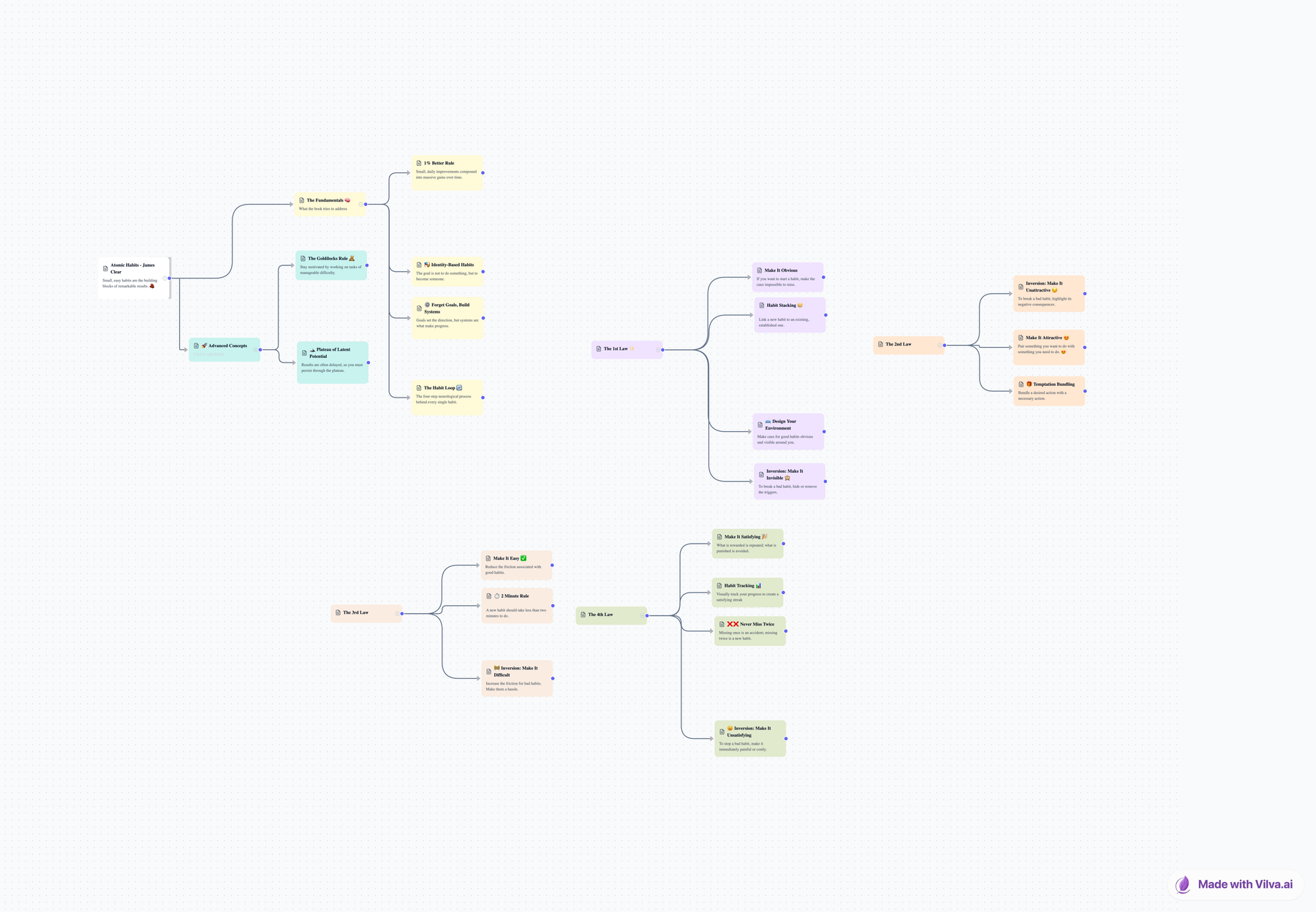
The Fundamentals - Why Tiny Changes Make a Big Difference
Chapter 1: The Surprising Power of Atomic Habits
- If you find yourself struggling to build a good habit or break a bad one, it is not because you have lost your ability to improve. It is often because you have not yet crossed the Plateau of Latent Potential.
- When you finally break through the Plateau of Latent Potential, people will call it an overnight success. The outside world only sees the most dramatic event rather than all that preceded it. But you know that it’s the work you did long ago—when it seemed that you weren’t making any progress—that makes the jump today possible.
- The task of breaking a bad habit is like uprooting a powerful oak within us. And the task of building a good habit is like cultivating a delicate flower one day at a time.
- FORGET ABOUT GOALS, FOCUS ON SYSTEMS INSTEAD
- If you completely ignored your goals and focused only on your system, would you still succeed?
- Goals are good for setting a direction, but systems are best for making progress. A handful of problems arise when you spend too much time thinking about your goals and not enough time designing your systems.
- Problem #1: Winners and losers have the same goals.
- Problem #2: Achieving a goal is only a momentary change.
- In order to improve for good, you need to solve problems at the systems level.
- Problem #3: Goals restrict your happiness.
- The problem with a goals-first mentality is that you’re continually putting happiness off until the next milestone
- goals create an “either-or” conflict: either you achieve your goal and are successful or you fail and you are a disappointment
- When you fall in love with the process rather than the product, you don’t have to wait to give yourself permission to be happy. You can be satisfied anytime your system is running. And a system can be successful in many different forms, not just the one you first envision
- Problem #4: Goals are at odds with long-term progress.
- True long-term thinking is goal-less thinking. It’s not about any single accomplishment. It is about the cycle of endless refinement and continuous improvement. Ultimately, it is your commitment to the process that will determine your progress.
- Habits are like the atoms of our lives. Each one is a fundamental unit that contributes to your overall improvement.
- atomic habits—a regular practice or routine that is not only small and easy to do, but also the source of incredible power; a component of the system of compound growth.
Chapter 2: How Your Habits Shape Your Identity (and Vice Versa)
- The first layer is changing your outcomes. This level is concerned with changing your results: losing weight, publishing a book, winning a championship. Most of the goals you set are associated with this level of change.
- The second layer is changing your process. This level is concerned with changing your habits and systems: implementing a new routine at the gym, decluttering your desk for better workflow, developing a meditation practice. Most of the habits you build are associated with this level.
- The third and deepest layer is changing your identity. This level is concerned with changing your beliefs: your worldview, your self-image, your judgments about yourself and others. Most of the beliefs, assumptions, and biases you hold are associated with this level
- The ultimate form of intrinsic motivation is when a habit becomes part of your identity. It’s one thing to say I’m the type of person who wants this. It’s something very different to say I’m the type of person who is this.
- The more pride you have in a particular aspect of your identity, the more motivated you will be to maintain the habits associated with it.
- True behavior change is identity change. You might start a habit because of motivation, but the only reason you’ll stick with one is that it becomes part of your identity.
- The goal is not to read a book, the goal is to become a reader.
- The goal is not to run a marathon, the goal is to become a runner.
- The goal is not to learn an instrument, the goal is to become a musician.
- your habits are how you embody your identity
- Whatever your identity is right now, you only believe it because you have proof of it.
- The most practical way to change who you are is to change what you do.
- Two-step process to Changing Your Identity
- Decide the type of person you want to be.
- Prove it to yourself with small wins.
Chapter 3: How to Build Better Habits in 4 Simple Steps
- A habit is a behavior that has been repeated enough times to become automatic.
- As habits are created, the level of activity in the brain decreases
- Habit formation is incredibly useful because the conscious mind is the bottleneck of the brain
- Habits reduce cognitive load and free up mental capacity, so you can allocate your attention to other tasks
- Habits do not restrict freedom. They create it.
- The cue triggers your brain to initiate a behavior. It is a bit of information that predicts a reward
- Cravings are the second step, and they are the motivational force behind every habit.
- Cues are meaningless until they are interpreted. The thoughts, feelings, and emotions of the observer are what transform a cue into a craving.
- The response is the actual habit you perform, which can take the form of a thought or an action
- the response delivers a reward. Rewards are the end goal of every habit. The cue is about noticing the reward. The craving is about wanting the reward. The response is about obtaining the reward. We chase rewards because they serve two purposes: (1) they satisfy us and (2) they teach us.
- Whenever you want to change your behavior, you can simply ask yourself:
- How can I make it obvious?
- How can I make it attractive?
- How can I make it easy?
- How can I make it satisfying?
The 1st Law: Make It Obvious
Chapter 4: The Man Who Didn’t Look Right
- The human brain is a prediction machine. It is continuously taking in your surroundings and analyzing the information it comes across
- you don’t need to be aware of the cue for a habit to begin. You can notice an opportunity and take action without dedicating conscious attention to it. This is what makes habits useful.
- It’s also what makes them dangerous. As habits form, your actions come under the direction of your automatic and nonconscious mind.
- Habit Scorecard
- Pointing-and-Calling
- One of our greatest challenges in changing habits is maintaining awareness of what we are actually doing. This helps explain why the consequences of bad habits can sneak up on us. We need a “point-and call” system for our personal lives. That’s the origin of the Habits Scorecard, which is a simple exercise you can use to become more aware of your behavior. To create your own, make a list of your daily habits.
- labels “good habit” and “bad habit” are slightly inaccurate. There are no good habits or bad habits. There are only effective habits
- “Does this behavior help me become the type of person I wish to be? Does this habit cast a vote for or against my desired identity?”
- Hearing your bad habits spoken aloud makes the consequences seem more real. It adds weight to the action rather than letting yourself mindlessly slip into an old routine.
- The process of behavior change always starts with awareness.
Chapter 5: The Best Way to Start a New Habit
- how you intend to implement a particular habit.
- The cues that can trigger a habit come in a wide range of forms
- people who make a specific plan for when and where they will perform a new habit are more likely to follow through
- I will [BEHAVIOR] at [TIME] in [LOCATION].
- When your dreams are vague, it’s easy to rationalize little exceptions all day long and never get around to the specific things you need to do to succeed.
- Give your habits a time and a space to live in the world. The goal is to make the time and location so obvious that, with enough repetition, you get an urge to do the right thing at the right time, even if you can’t say why
- Habit Stacking
- One of the best ways to build a new habit is to identify a current habit you already do each day and then stack your new behavior on top.
- Rather than pairing your new habit with a particular time and location, you pair it with a current habit.
- “After [CURRENT HABIT], I will [NEW HABIT].”
- You can also insert new behaviors into the middle of your current routines.
- No matter how you use this strategy, the secret to creating a successful habit stack is selecting the right cue to kick things off
- Many people select cues that are too vague
- Habits like “read more” or “eat better” are worthy causes, but these goals do not provide instruction on how and when to act. Be specific and clear:
- The 1st Law of Behavior Change is to make it obvious.
Chapter 6: Motivation Is Overrated; Environment Often Matters More
- People often choose products not because of what they are, but because of where they are.
- Environment is the invisible hand that shapes human behavior
- Suggestion Impulse Buying
- HOW TO DESIGN YOUR ENVIRONMENT FOR SUCCESS
- Every habit is initiated by a cue, and we are more likely to notice cues that stand out. Unfortunately, the environments where we live and work often make it easy not to do certain actions because there is no obvious cue to trigger the behavior.
- If you want to make a habit a big part of your life, make the cue a big part of your environment. The most persistent behaviors usually have multiple cues.
- By sprinkling triggers throughout your surroundings, you increase the odds that you’ll think about your habit throughout the day. Make sure the best choice is the most obvious one. Making a better decision is easy and natural when the cues for good habits are right in front of you.
- Environment design allows you to take back control and become the architect of your life. Be the designer of your world and not merely the consumer of it.
- THE CONTEXT IS THE CUE
- The cues that trigger a habit can start out very specific, but over time your habits become associated not with a single trigger but with the entire context surrounding the behavior.
- Stop thinking about your environment as filled with objects. Start thinking about it as filled with relationships. Think in terms of how you interact with the spaces around you.
- The power of context also reveals an important strategy: habits can be easier to change in a new environment. It helps to escape the subtle triggers and cues that nudge you toward your current habits.
- It is easier to associate a new habit with a new context than to build a new habit in the face of competing cues.
- Whenever possible, avoid mixing the context of one habit with another.
Chapter 7: The Secret to Self-Control
- Vietnam, soldiers spent all day surrounded by cues triggering heroin use
- Bad habits are autocatalytic: the process feeds itself. They foster the feelings they try to numb. You feel bad, so you eat junk food. Because you eat junk food, you feel bad.
- “cue-induced wanting”: an external trigger causes a compulsive craving to repeat a bad habit.
- I have never seen someone consistently stick to positive habits in a negative environment
- A more reliable approach is to cut bad habits off at the source. One of the most practical ways to eliminate a bad habit is to reduce exposure to the cue that causes it.
- Remove a single cue and the entire habit often fades away.
- Instead of summoning a new dose of willpower whenever you want to do the right thing, your energy would be better spent optimizing your environment. This is the secret to self-control. Make the cues of your good habits obvious and the cues of your bad habits invisible.
- The inversion of the 1st Law of Behavior Change is make it invisible.
The 2nd Law: Make It Attractive
Chapter 8: How to Make a Habit Irresistible
- supernormal stimuli
- Humans are also prone to fall for exaggerated versions of reality
- processed foods enhance dynamic contrast
- 2nd Law of Behavior Change: Make it Attractive
- The more attractive an opportunity is, the more likely it is to become habit-forming
- Society is filled with highly engineered versions of reality that are more attractive than the world our ancestors evolved in.
- dopamine is released not only when you experience pleasure, but also when you anticipate it.
- Your brain has far more neural circuitry allocated for wanting rewards than for liking them.
- temptation bundling
- Premack’s Principle
- more probable behaviors will reinforce less probable behaviors.
- you’ll become conditioned to do it if it means you get to do something you really want to do along the way.
- You can even combine temptation bundling with the habit stacking strategy
- The habit stacking + temptation bundling formula is:
- After [CURRENT HABIT], I will [HABIT I NEED].
- After [HABIT I NEED], I will [HABIT I WANT].
- The hope is that eventually you’ll look forward to calling three clients or doing ten burpees because it means you get to read the latest sports news or check Facebook. Doing the thing you need to do means you get to do the thing you want to do.
- The habit stacking + temptation bundling formula is:
Chapter 9: The Role of Family and Friends in Shaping Your Habits
- We don’t choose our earliest habits, we imitate them.
“The customs and practices of life in society sweep us along.” -Michel de Montaigne
- We imitate the habits of three groups in particular:
- The close.
- the closer we are to someone, the more likely we are to imitate some of their habits
- One of the most effective things you can do to build better habits is to join a culture where your desired behavior is the normal behavior
- Join a culture where (1) your desired behavior is the normal behavior and (2) you already have something in common with the group.
- Nothing sustains motivation better than belonging to the tribe.
- The many.
- When changing your habits means challenging the tribe, change is unattractive. When changing your habits means fitting in with the tribe, change is very attractive.
- The powerful.
- We are drawn to behaviors that earn us respect, approval, admiration, and status
- The close.
Chapter 10: How to Find and Fix the Causes of Your Bad Habits
- 2nd Law of Behavior Change: make it unattractive
- WHERE CRAVINGS COME FROM
- Every behavior has a surface level craving and a deeper, underlying motive
- A craving is just a specific manifestation of a deeper underlying motive. Your brain did not evolve with a desire to smoke cigarettes or to check Instagram or to play video games. At a deep level, you simply want to reduce uncertainty and relieve anxiety, to win social acceptance and approval, or to achieve status.
- One person might learn to reduce stress by smoking a cigarette. Another person learns to ease their anxiety by going for a run. Your current habits are not necessarily the best way to solve the problems you face; they are just the methods you learned to use. Once you associate a solution with the problem you need to solve, you keep coming back to it.
- The same cue can spark a good habit or a bad habit depending on your prediction. The cause of your habits is actually the prediction that precedes them.
- A craving is the sense that something is missing. It is the desire to change your internal state
- When you binge-eat or light up or browse social media, what you really want is not a potato chip or a cigarette or a bunch of likes. What you really want is to feel different.
- HOW TO REPROGRAM YOUR BRAIN TO ENJOY HARD HABITS
- You can make hard habits more attractive if you can learn to associate them with a positive experience. Sometimes, all you need is a slight mind-set shift.
- Now, imagine changing just one word: You don’t “have” to. You “get” to.
- You get to wake up early for work.
- You have to do those things, and you also get to do them.
- Story of man in wheelchair: ““I’m not confined to my wheelchair—I am liberated by it. If it wasn’t for my wheelchair, I would be bed-bound and never able to leave my house.”
- Example: Exercise. Many people associate exercise with being a challenging task that drains energy and wears you down. You can just as easily view it as a way to develop skills and build you up. Instead of telling yourself “I need to go run in the morning,” say “It’s time to build endurance and get fast.”
- motivation ritual
- The key to finding and fixing the causes of your bad habits is to reframe the associations you have about them. It’s not easy, but if you can reprogram your predictions, you can transform a hard habit into an attractive one.
The 3rd Law: Make It Easy
Chapter 11: Walk Slowly, but Never Backward
- It is easy to get bogged down trying to find the optimal plan for change: the fastest way to lose weight, the best program to build muscle, the perfect idea for a side hustle. We are so focused on figuring out the best approach that we never get around to taking action. As Voltaire once wrote, “The best is the enemy of the good.”
- difference between being in motion and taking action.
- When you’re in motion, you’re planning and strategizing and learning. Those are all good things, but they don’t produce a result.
- Action, on the other hand, is the type of behavior that will deliver an outcome.
- Motion makes you feel like you’re getting things done. But really, you’re just preparing to get something done. When preparation becomes a form of procrastination, you need to change something. You don’t want to merely be planning. You want to be practicing.
- If you want to master a habit, the key is to start with repetition, not perfection. You don’t need to map out every feature of a new habit. You just need to practice it.
- Habit formation is the process by which a behavior becomes progressively more automatic through repetition. The more you repeat an activity, the more the structure of your brain changes to become efficient at that activity.
- All habits follow a similar trajectory from effortful practice to automatic behavior, a process known as automaticity. Automaticity is the ability to perform a behavior without thinking about each step, which occurs when the nonconscious mind takes over.
- In practice, it doesn’t really matter how long it takes for a habit to become automatic. What matters is that you take the actions you need to take to make progress. Whether an action is fully automatic is of less importance.
- 3rd Law of Behavior Change: make it easy.
Chapter 12: The Law of Least Effort
- Story/Analogy: Jared Diamond in his book Guns, Germs, and Steel talks about how the shape of continents has a profound impact on human behavior. Plays a significate role (shaped east to west, like USA & Europe/Asia/Middle East) with the spread of agriculture due to climate. Ability to spread crops faster and thus cause rapid population growth.
- 3rd Law of Behavior Change: Law of Least Effort
- Energy is precious, and the brain is wired to conserve it whenever possible. It is human nature to follow the Law of Least Effort, which states that when deciding between two similar options, people will naturally gravitate toward the option that requires the least amount of work.
- The greater the obstacle—that is, the more difficult the habit—the more friction there is between you and your desired end state. This is why it is crucial to make your habits so easy that you’ll do them even when you don’t feel like it. If you can make your good habits more convenient, you’ll be more likely to follow through on them.
- The less friction you face, the easier it is for your stronger self to emerge. The idea behind make it easy is not to only do easy things. The idea is to make it as easy as possible in the moment to do things that payoff in the long run.
- Ways to Reduce Friction
- Environmental Design
- A place to practice habit along your daily routine
- Calm place to write or work
- addition by subtraction
- Story/Analogy: Japanese firms that practiced ‘lean production’ in the 1970s
- Meal delivery service
- The less friction you face, the easier it is for your stronger self to emerge. The idea behind make it easy is not to only do easy things. The idea is to make it as easy as possible in the moment to do things that payoff in the long run.
- Prime the environment
- Want to draw more? Put your pencils, pens, notebooks, and drawing tools on top of your desk, within easy reach.
- Want to exercise? Set out your workout clothes, shoes, gym bag, and water bottle ahead of time.
- Want to improve your diet? Chop up a ton of fruits and vegetables on weekends and pack them in containers, so you have easy access to healthy, ready-to-eat options during the week.
- You can also invert this principle and prime the environment to make bad behaviors difficult.
- Example: Leave phone in different room until lunch.
- It is remarkable how little friction is required to prevent unwanted behavior.
- Redesign your life so the actions that matter most are also the actions that are easiest to do.
- Environmental Design
Chapter 13: How to Stop Procrastinating by Using the Two-Minute Rule
-
Researchers estimate that 40 to 50 percent of our actions on any given day are done out of habit.
-
Examples:
- Changing into work out clothes
- Just getting into the cab to head to the gym
-
Decisive Moments: Every day, there are a handful of moments that deliver an outsized impact. I refer to these little choices as decisive moments.
-
Two Minute Rule
- Even when you know you should start small, it’s easy to start too big.
- “When you start a new habit, it should take less than two minutes to do.”
- “Read before bed each night” becomes “Read one page.”
- “Do thirty minutes of yoga” becomes “Take out my yoga mat.”
- “Study for class” becomes “Open my notes.”
- “Fold the laundry” becomes “Fold one pair of socks.”
- “Run three miles” becomes “Tie my running shoes.”
- built a daily journaling habit by specifically writing less than he felt like
- The point is to master the habit of showing up. The truth is, a habit must be established before it can be improved.
- Instead of trying to engineer a perfect habit from the start, do the easy thing on a more consistent basis. You have to standardize before you can optimize.
- As you master the art of showing up, the first two minutes simply become a ritual at the beginning of a larger routine.
- You may not be able to automate the whole process, but you can make the first action mindless. Make it easy to start and the rest will follow.
-
HABIT SHAPING (Combined with Two-Minute Rule)
Acrobat_fFWbfg5Gau 1.png (image unavailable)
Chapter 14: How to Make Good Habits Inevitable and Bad Habits Impossible
- Story / Analogy: Victor Hugo telling his assistant to lock away all his clothes due to editor giving him 6 month deadline, he then wrote Hunchback of Notre Dame two weeks early.
- Sometimes success is less about making good habits easy and more about making bad habits hard.
- commitment device
- way to lock in future behavior, bind you to good habits, and restrict you from bad ones.
- The key is to change the task such that it requires more work to get out of the good habit than to get started on it
- Story / Analogy: Mid 1800s store owner, employees stealing, bought first cash register, then went on to buy the patent and created National Cash Register company.
“Civilization advances by extending the number of operations we can perform without thinking about them.” -Alfred North Whitehead
- When working in your favor, automation can make your good habits inevitable and your bad habits impossible. It is the ultimate way to lock in future behavior rather than relying on willpower in the moment. By utilizing commitment devices, strategic onetime decisions, and technology, you can create an environment of inevitability—a space where good habits are not just an outcome you hope for but an outcome that is virtually guaranteed.
The 4th Law: Make It Satisfying
Chapter 15: The Cardinal Rule of Behavior Change
- Story / Analogy: Late 1990s, health worker Stephen Luby when to Karachi, Pakistan. Showed simple habit of washing hands with soap. Caused rapid shift in health of children.
- Story / Analogy: Wrigley & toothpaste companies introducing flavors in gun & toothpaste made them more popular.
- Cardinal Rule of Behavior Change: What is rewarded is repeated. What is punished is avoided. You learn what to do in the future based on what you were rewarded for doing (or punished for doing) in the past. Positive emotions cultivate habits. Negative emotions destroy them.
- We are not looking for just any type of satisfaction. We are looking for immediate satisfaction.
- 200,000 year old Homo sapien sapiens brain
- Immediate-return environment
- Delayed-return environment
- The human brain did not evolve for life in a delayed-return environment.
- It is only recently—during the last five hundred years or so—that society has shifted to a predominantly delayed-return environment
- Behavioral economists refer to this tendency as time inconsistency. That is, the way your brain evaluates rewards is inconsistent across time.* You value the present more than the future.
“It almost always happens that when the immediate consequence is favorable, the later consequences are disastrous, and vice versa… . Often, the sweeter the first fruit of a habit, the more bitter are its later fruits.” -Frédéric Bastiat
- the costs of your good habits are in the present. The costs of your bad habits are in the future.
- As a general rule, the more immediate pleasure you get from an action, the more strongly you should question whether it aligns with your long-term goals.
- update the Cardinal Rule of Behavior Change: What is immediately rewarded is repeated. What is immediately punished is avoided.
- The road less traveled is the road of delayed gratification. If you’re willing to wait for the rewards, you’ll face less competition and often get a bigger payoff. As the saying goes, the last mile is always the least crowded.
- People who are better at delaying gratification have higher SAT scores, lower levels of substance abuse, lower likelihood of obesity, better responses to stress, and superior social skills.
- The best way to do this is to add a little bit of immediate pleasure to the habits that pay off in the long-run and a little bit of immediate pain to ones that don’t.
- You want the ending of your habit to be satisfying. The best approach is to use reinforcement, which refers to the process of using an immediate reward to increase the rate of a behavior
- Habit Stacking (start) → Habit → Reinforcement (end)
- Immediate reinforcement can be especially helpful when dealing with habits of avoidance
- All you’re doing is resisting temptation, and there isn’t much satisfying about that.
- One solution is to turn the situation on its head. You want to make avoidance visible.
- Example:
- Savings account labeled “Leather Jacket” — Whenever you pass on a purchase, put same amount in the account.
- Savings account labeled “Trip to Europe”
- Bubble Bath
- Massage
- Eventually, as intrinsic rewards like a better mood, more energy, and reduced stress kick in, you’ll become less concerned with chasing the secondary reward. The identity itself becomes the reinforcer. You do it because it’s who you are and it feels good to be you. The more a habit becomes part of your life, the less you need outside encouragement to follow through. Incentives can start a habit. Identity sustains a habit.
- Immediate reinforcement helps maintain motivation in the short term while you’re waiting for the long-term rewards to arrive.
Chapter 16: How to Stick with Good Habits Every Day
- Making progress is satisfying, and visual measures—like moving paper clips or hairpins or marbles—provide clear evidence of your progress.
- As a result, they reinforce your behavior and add a little bit of immediate satisfaction to any activity. Visual measurement comes in many forms: food journals, workout logs, loyalty punch cards, the progress bar on a software download, even the page numbers in a book. But perhaps the best way to measure your progress is with a habit tracker.
- “Don’t break the chain” is a powerful mantra.
- Benefit #1: Habit tracking is obvious.
- Recording your last action creates a trigger that can initiate your next one.
- Habit tracking also keeps you honest. Most of us have a distorted view of our own behavior.
- Benefit #2: Habit tracking is attractive.
- The most effective form of motivation is progress. When we get a signal that we are moving forward, we become more motivated to continue down that path.
- This can be particularly powerful on a bad day. When you’re feeling down, it’s easy to forget about all the progress you have already made. Habit tracking provides visual proof of your hard work—a subtle reminder of how far you’ve come.
- Benefit #3: Habit tracking is satisfying.
- Tracking can become its own form of reward.
- Habit tracking also helps keep your eye on the ball: you’re focused on the process rather than the result. You’re not fixated on getting six pack abs, you’re just trying to keep the streak alive and become the type of person who doesn’t miss workouts.
- First, whenever possible, measurement should be automated
- Second, manual tracking should be limited to your most important habits. It is better to consistently track one habit than to sporadically track ten.
- record each measurement immediately after the habit occurs. The completion of the behavior is the cue to write it down. This approach allows you to combine the habit-stacking method
- HOW TO RECOVER QUICKLY WHEN YOUR HABITS BREAK DOWN
- never miss twice.
- The first mistake is never the one that ruins you. It is the spiral of repeated mistakes that follows. Missing once is an accident. Missing twice is the start of a new habit.
- You don’t realize how valuable it is to just show up on your bad (or busy) days. Lost days hurt you more than successful days help you.
- KNOWING WHEN (AND WHEN NOT) TO TRACK A HABIT
- The dark side of tracking a particular behavior is that we become driven by the number rather than the purpose behind it.
- This is sometimes referred to as Goodhart’s Law. Named after the economist Charles Goodhart, the principle states, “When a measure becomes a target, it ceases to be a good measure.” Measurement is only useful when it guides you and adds context to a larger picture, not when it consumes you. Each number is simply one piece of feedback in the overall system.
Chapter 17: How an Accountability Partner Can Change Everything
- Story / Analogy: Expert negotiator suggested that President had to stab and kill an innocent person before they could launch nuclear missiles
- Just as we are more likely to repeat an experience when the ending is satisfying, we are also more likely to avoid an experience when the ending is painful. Pain is an effective teacher.
- The more immediate the pain, the less likely the behavior. If you want to prevent bad habits and eliminate unhealthy behaviors, then adding an instant cost to the action is a great way to reduce their odds.
- If you’re going to rely on punishment to change behavior, then the strength of the punishment must match the relative strength of the behavior it is trying to correct.
- In general, the more local, tangible, concrete, and immediate the consequence, the more likely it is to influence individual behavior. The more global, intangible, vague, and delayed the consequence, the less likely it is to influence individual behavior.
- Example:
- Contract with friends laid out in detail
Advanced Tactics: How to Go from Being Merely Good to Being Truly Great
Chapter 18: The Truth About Talent (When Genes Matter and When They Don’t)
- The secret to maximizing your odds of success is to choose the right field of competition. This is just as true with habit change as it is with sports and business. Habits are easier to perform, and more satisfying to stick with, when they align with your natural inclinations and abilities.
- The people at the top of any competitive field are not only well trained, they are also well suited to the task. And this is why, if you want to be truly great, selecting the right place to focus is crucial.
- Our habits are not solely determined by our personalities, but there is no doubt that our genes nudge us in a certain direction. Our deeply rooted preferences make certain behaviors easier for some people than for others. You don’t have to apologize for these differences or feel guilty about them, but you do have to work with them.
- There is a version of every habit that can bring you joy and satisfaction. Find it. Habits need to be enjoyable if they are going to stick. This is the core idea behind the 4th Law. Tailoring your habits to your personality is a good start
- Pick the right habit and progress is easy. Pick the wrong habit and life is a struggle.
- explore/exploit trade-off
- After this initial period of exploration, shift your focus to the best solution you’ve found—but keep experimenting occasionally. The proper balance depends on whether you’re winning or losing. If you are currently winning, you exploit, exploit, exploit. If you are currently losing, you continue to explore, explore, explore.
- As you explore different options, there are a series of questions you can ask yourself to continually narrow in on the habits and areas that will be most satisfying to you:
- What feels like fun to me, but work to others?
- What makes me lose track of time?
- Where do I get greater returns than the average person?
- What comes naturally to me?
- When you can’t win by being better, you can win by being different. By combining your skills, you reduce the level of competition, which makes it easier to stand out. You can shortcut the need for a genetic advantage (or for years of practice) by rewriting the rules. A good player works hard to win the game everyone else is playing. A great player creates a new game that favors their strengths and avoids their weaknesses.
- Specialization is a powerful way to overcome the “accident” of bad genetics. The more you master a specific skill, the harder it becomes for others to compete with you.
- Our genes do not eliminate the need for hard work. They clarify it. They tell us what to work hard on. Once we realize our strengths, we know where to spend our time and energy.
Chapter 19: The Goldilocks Rule: How to Stay Motivated in Life and Work
- way to maintain motivation and achieve peak levels of desire is to work on tasks of “just manageable difficulty.” The human brain loves a challenge, but only if it is within an optimal zone of difficulty.
- Once a habit has been established, however, it’s important to continue to advance in small ways. These little improvements and new challenges keep you engaged. And if you hit the Goldilocks Zone just right, you can achieve a flow state.
- Improvement requires a delicate balance. You need to regularly search for challenges that push you to your edge while continuing to make enough progress to stay motivated. Behaviors need to remain novel in order for them to stay attractive and satisfying. Without variety, we get bored. And boredom is perhaps the greatest villain on the quest for self-improvement.
- The greatest threat to success is not failure but boredom. We get bored with habits because they stop delighting us. The outcome becomes expected. And as our habits become ordinary, we start derailing our progress to seek novelty. Perhaps this is why we get caught up in a never-ending cycle, jumping from one workout to the next, one diet to the next, one business idea to the next. As soon as we experience the slightest dip in motivation, we begin seeking a new strategy—even if the old one was still working. As Machiavelli noted, “Men desire novelty to such an extent that those who are doing well wish for a change as much as those who are doing badly.”
- The sweet spot of desire occurs at a 50/50 split between success and failure. Half of the time you get what you want. Half of the time you don’t. You need just enough “winning” to experience satisfaction and just enough “wanting” to experience desire. This is one of the benefits of following the Goldilocks Rule. If you’re already interested in a habit, working on challenges of just manageable difficulty is a good way to keep things interesting.
- The only way to become excellent is to be endlessly fascinated by doing the same thing over and over. You have to fall in love with boredom.
Chapter 20: The Downside of Creating Good Habits
- repetition develops fluency, speed, and skill. But then, as a habit becomes automatic, you become less sensitive to feedback. You fall into mindless repetition. It becomes easier to let mistakes slide. When you can do it “good enough” on autopilot, you stop thinking about how to do it better.
- The downside of habits is that you get used to doing things a certain way and stop paying attention to little errors. You assume you’re getting better because you’re gaining experience.
- when you want to maximize your potential and achieve elite levels of performance, you need a more nuanced approach. You can’t repeat the same things blindly and expect to become exceptional. Habits are necessary, but not sufficient for mastery. What you need is a combination of automatic habits and deliberate practice.
- Habits + Deliberate Practice = Mastery
- Mastery is the process of narrowing your focus to a tiny element of success, repeating it until you have internalized the skill, and then using this new habit as the foundation to advance to the next frontier of your development. Old tasks become easier the second time around, but it doesn’t get easier overall because now you’re pouring your energy into the next challenge. Each habit unlocks the next level of performance. It’s an endless cycle.
- HOW TO REVIEW YOUR HABITS AND MAKE ADJUSTMENTS
- Reflection and review enables the long-term improvement of all habits because it makes you aware of your mistakes and helps you consider possible paths for improvement. Without reflection, we can make excuses, create rationalizations, and lie to ourselves. We have no process for determining whether we are performing better or worse compared to yesterday.
- Practice notes
- Decision Journal (Business)
- major decisions they make each week, why they made them, and what they expect the outcome to be. They review their choices at the end of each month or year to see where they were correct and where they went wrong.
- Improvement is not just about learning habits, it’s also about fine tuning them. Reflection and review ensures that you spend your time on the right things and make course corrections whenever necessary
- Process:
- Annual Review: Tally habits during that year
- Reflection
- What went well this year?
- What didn’t go so well this year?
- What did I learn?
- Reflection
- 6 month review: Integrity Report
- What are the core values that drive my life and work?
- How am I living and working with integrity right now?
- How can I set a higher standard in the future?
- Daily habits are powerful because of how they compound, but worrying too much about every daily choice is like looking at yourself in the mirror from an inch away. You can see every imperfection and lose sight of the bigger picture. There is too much feedback. Conversely, never reviewing your habits is like never looking in the mirror.
- Annual Review: Tally habits during that year
- HOW TO BREAK THE BELIEFS THAT HOLD YOU BACK
- One solution is to avoid making any single aspect of your identity an overwhelming portion of who you are. In the words of investor Paul Graham, “keep your identity small.” The more you let a single belief define you, the less capable you are of adapting when life challenges you.
- When chosen effectively, an identity can be flexible rather than brittle. Like water flowing around an obstacle, your identity works with the changing circumstances rather than against them.
- Habits deliver numerous benefits, but the downside is that they can lock us into our previous patterns of thinking and acting—even when the world is shifting around us. Everything is impermanent. Life is constantly changing, so you need to periodically check in to see if your old habits and beliefs are still serving you.
- A lack of self-awareness is poison. Reflection and review is the antidote.
Conclusion: The Secret to Results That Last
- The holy grail of habit change is not a single 1 percent improvement, but a thousand of them. It’s a bunch of atomic habits stacking up, each one a fundamental unit of the overall system.
- Gradually, though, as you continue to layer small changes on top of one another, the scales of life start to move. Each improvement is like adding a grain of sand to the positive side of the scale, slowly tilting things in your favor. Eventually, if you stick with it, you hit a tipping point. Suddenly, it feels easier to stick with good habits. The weight of the system is working for you rather than against you.
Little Lessons from the Four Laws
- Awareness comes from desire
- Happiness is simply the absence of desire
- It is the idea of pleasure that we chase
- Peace occurs when you don’t turn your observations into problems
- With a big enough why you can overcome any how.
- Being curious is better than being smart
- Emotions drive behavior
- We can only be rational and logical after we have been emotional
- Your response tends to follow your emotions
- Suffering drives progress
- Your actions reveal how badly you want something
- Reward is on the other side of sacrifice
- Self-control is difficult because it is not satisfying
- Our expectations determine our satisfaction
- The pain of failure correlates to the height of the expectation
- Feelings come both before and after the behavior
- Desire initiates. Pleasure sustains.
- Hope declines with experience and is replaced by acceptance
HabitsCheatSheet_(1) 1.pdf (file not included in this release)
ImplementationIntentions 1.pdf (file not included in this release)
TheHabitsScorecard 1.pdf (file not included in this release)
QuestionsandAnswers 1.pdf (file not included in this release)
TheHabitLoop 1.pdf (file not included in this release)
ParentingAppendix 1.pdf (file not included in this release)
BusinessAppendix 1.pdf (file not included in this release)
HabitContract 1.pdf (file not included in this release)
HabitTracker 1.pdf (file not included in this release)
HabitStack 1.pdf (file not included in this release)
Workbook 1.pdf (file not included in this release)
How-to-Apply-These-Ideas-to-Parenting 1.pdf (file not included in this release)
BONUS-CHAPTER-HOW-TO-APPLY-THESE-IDEAS-TO-BUSINESS 1.pdf (file not included in this release)
JamesClear-_Atomic_Habits 1.pdf (file not included in this release)
Personality Tests
Our habits are not solely determined by our personalities, but there is no doubt that our genes nudge us in a certain direction.
https://jamesclear.com/atomic-habits/personality
Atomic Habits Resources
Below, you’ll find a list of useful downloads, templates, and bonuses that will help you make the most of the ideas covered in the book.
https://jamesclear.com/atomic-habits/resources
Acrobat_r3AsOGeAhE 1.png (image unavailable)
Acrobat_adTtjH8Nj0 1.png (image unavailable)
Acrobat_XLK2ZV8zjm 1.png (image unavailable)
Acrobat_Npsw2jMlhT 1.png (image unavailable)
Untitled 38 1.png (image unavailable)
Untitled 1 9 1.png (image unavailable)
Untitled 2 9 1.png (image unavailable)
Acrobat_UOxe1EEDia 1.png (image unavailable)
Acrobat_PrOsYGUTJv 1.png (image unavailable)
Acrobat_HBTe5B7a9U 1.png (image unavailable)
Acrobat_ySPSKXcRc2 1.png (image unavailable)
Acrobat_iCoKcwfWPJ 1.png (image unavailable)
Acrobat_4cV0NNyRwj 1.png (image unavailable)