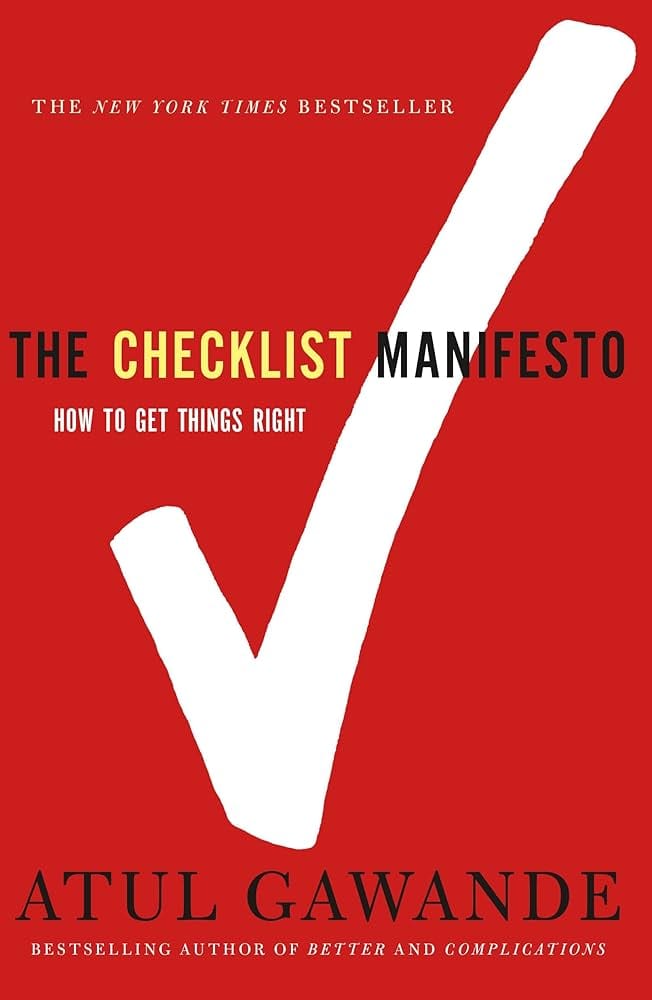

DESCRIPTION
We live in a world of great and increasing complexity, where even the most expert professionals struggle to master the tasks they face. Longer training, ever more advanced technologies-neither seems to prevent grievous errors. But in a hopeful turn, acclaimed surgeon and writer Atul Gawande finds a remedy in the humblest and simplest of techniques: the checklist. First introduced decades ago by the U.S. Air Force, checklists have enabled pilots to fly aircraft of mind-boggling sophistication. Now innovative checklists are being adopted in hospitals around the world, helping doctors and nurses respond to everything from flu epidemics to avalanches. Even in the immensely complex world of surgery, a simple ninety-second variant has cut the rate of fatalities by more than a third. In riveting stories, Gawande takes us from Austria, where an emergency checklist saved a drowning victim who had spent half an hour underwater, to Michigan, where a cleanliness checklist in intensive care units virtually eliminated a type of deadly hospital infection. He explains how checklists actually work to prompt striking and immediate improvements. And he follows the checklist revolution into fields well beyond medicine, from disaster response to investment banking, skyscraper construction, and businesses of all kinds. An intellectual adventure in which lives are lost and saved and one simple idea makes a tremendous difference.
The Checklist Manifesto_ How to Get Things - Gawande, Atul.pdf (file not included in this release)
AI Summary
1. The Problem of Complexity
- Modern professions (medicine, aviation, engineering, finance, etc.) face overwhelming complexity.
- Failures often come not from ignorance but from inability to consistently apply what we know.
- Even highly trained experts make avoidable mistakes because they overlook simple steps under pressure.
2. The Power of Checklists
- Checklists reduce errors by ensuring that critical steps are not forgotten.
- They provide a cognitive safety net, freeing experts’ minds to focus on problem-solving rather than memory.
- Checklists are not meant to replace expertise, but to support and enhance it.
3. Types of Errors
- Errors of ignorance: not knowing what to do.
- Errors of ineptitude: failing to apply correctly what is already known.
- In the modern era, most failures are from ineptitude—we know what to do, but don’t consistently do it.
4. Lessons from Aviation and Construction
- Aviation uses pre-flight checklists to drastically reduce accidents.
- Construction projects, despite their size and complexity, succeed because they use communication-driven checklists that clarify roles and ensure coordination among diverse experts.
- These industries show that systematized procedures can handle complexity better than memory or intuition alone.
5. Designing an Effective Checklist
- A good checklist is short, clear, and practical.
- It should focus on the most critical steps where failure is most dangerous.
- It should be a tool for teamwork—encouraging communication and coordination, not just box-checking.
- Overly detailed or bureaucratic checklists fail because they burden rather than aid.
6. Medicine as a Case Study
- In hospitals, simple checklists (e.g., for inserting central lines) reduced deadly infections by over 60%.
- Surgical checklists improved survival rates and lowered complication rates across multiple countries.
- These results show that small procedural tools can save thousands of lives.
7. Resistance to Checklists
- Professionals often resist checklists because they feel it undermines their autonomy or expertise.
- There is a cultural bias toward improvisation, independence, and heroic expertise.
- But the book argues that true mastery involves humility—recognizing our limits and accepting tools that keep us consistent.
8. The Broader Application
- Checklists are not just for aviation or medicine; they work in finance, disaster response, restaurants, investment, and personal life.
- They are flexible frameworks to bring order to complexity and improve reliability in any field.
9. The Manifesto
- The central thesis: We don’t need more knowledge; we need better application of existing knowledge.
- The humble checklist is a powerful tool that can save lives, prevent disasters, and ensure quality in complex systems.
- It embodies discipline, teamwork, and humility, which are more important than raw brilliance in high-stakes environments.
Highlights
new antibacterial Safeguard soap (Page 80)
Luby and his team reported their results in a landmark paper published in the Lancet in 2005. Families in the test neighborhoods received an average of 3.3 bars of soap per week for one year. During this period, the incidence of diarrhea among children in these neighborhoods fell 52 percent compared to that in the control group, no matter which soap was used. The incidence of pneumonia fell 48 percent. And the incidence of impetigo, a bacterial skin infection, fell 35 percent. These were stunning results. And they were achieved despite the illiteracy, the poverty, the crowding, and (Page 80)
even the fact that, however much soap they used, people were still drinking and washing with contaminated water. (Page 81)
Luby and his team had studied washing behavior in Pakistan, Bangladesh, and other locations around South Asia, and they found that almost everyone washes their hands after defecation. “There are strong ideas about purity in South Asia,” he said. Even when the place to wash is far away, people go and clean their hands over 80 percent of the time, a rate that would put most denizens of airport bathrooms to shame. But the washing was not very effective, the researchers found. Often people did it too quickly. Or they cleaned just the “involved” hand. Or they used ash or mud rather than soap and water. (Page 81)
Thinking back on the experiment, I was fascinated to realize that it was as much a checklist study as a soap study. So I wondered: Could a checklist be our soap for surgical care—simple, cheap, effective, and transmissible? I still had a hard time grasping how to make a checklist that could be both simple and effective for the manifold problems posed by surgery on a global scale. I was uncertain that it was even possible. But several of my colleagues were more sanguine when the idea was raised at the Geneva meeting. (Page 82)
When you’re making a checklist, Boorman explained, you have a number of key decisions. You must define a clear pause point at which the checklist is supposed to be used (unless the moment is obvious, like when a warning light goes on or an engine fails). You must decide whether you want a DOCONFIRM checklist or a READ-DO checklist. With a DO-CONFIRM checklist, he said, team members perform their jobs from memory and experience, often separately. But then they stop. They pause to run the checklist and confirm that everything that was supposed to be done was done. With a READ-DO checklist, on the other hand, people carry out the tasks as they check them off—it’s more like a recipe. So for any new checklist created from scratch, you have to pick the type that makes the most sense for the situation. (Page 100)
The checklist cannot be lengthy. A rule of thumb some use is to keep it to between five and nine items, which is the limit of working memory. Boorman didn’t think one had to be religious on this point. (Page 100)
But meanwhile, the checklist? Well, it hasn’t been ignored. Since the results of the WHO safe surgery checklist were made public, more than a dozen countries—including Australia, Brazil, Canada, Costa Rica, Ecuador, France, Ireland, Jordan, New Zealand, the Philippines, Spain, and the United Kingdom—have publicly committed to implementing versions of it in hospitals nationwide. (Page 126)
The checklist doesn’t tell him what to do, he explained. It is not a formula. But the checklist helps him be as smart as possible every step of the way, ensuring that he’s got the critical information he needs when he needs it, that he’s systematic about decision making, that he’s talked to everyone he should. With a good checklist in hand, he was convinced he (Page 132)
and his partners could make decisions as well as human beings are able. And as a result, he was also convinced they could reliably beat the market. (Page 133)