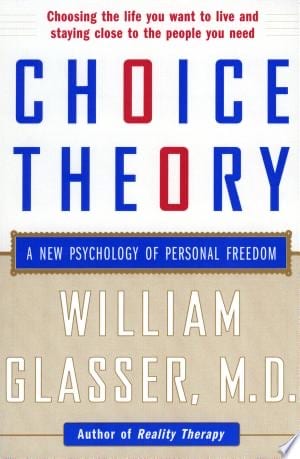
DESCRIPTION
Dr. William Glasser offers a new psychology that, if practiced, could reverse our widespread inability to get along with one another, an inability that is the source of almost all unhappiness. For progress in human relationships, he explains that we must give up the punishing, relationship–destroying external control psychology. For example, if you are in an unhappy relationship right now, he proposes that one or both of you could be using external control psychology on the other. He goes further. And suggests that misery is always related to a current unsatisfying relationship. Contrary to what you may believe, your troubles are always now, never in the past. No one can change what happened yesterday.
My Summary
Main Ideas, Takeaways & Similarities
Questions
I. What is the problem?
A. How is this problem formulated?
B. Why is this problem important?
C. What is the history of this problem?
D. Which prominent personalities have been interested in this problem?
II. What solutions to the problem are there?
A. What are the conclusions reached?
B. By what argument(s) is the conclusion reached?
C. What facts or assumptions serve as premises?
D. When a prominent personality offers a solution, does he also argue for or against other prominent personalities? Does he raise objections to alternative solutions? Does he consider objections to his own solutions?
III. Evaluation
A. What are the advantages and disadvantages of the alternative formulations to the problem?
B. Has the importance or history of the problem ever been misrepresented?
C. Are the solutions logically related to the premises?
D. Are the facts true? Are the assumptions acceptable? Are the objections answerable?
AI Summary
“Choice Theory: A New Psychology of Personal Freedom” by William Glasser is a book that introduces a psychological framework centered around the concept of personal choice. It explores how individuals can gain personal freedom and happiness by making responsible and fulfilling choices in their lives. Here is a comprehensive summary of the book in bullet points:
- The book introduces the concept of “Choice Theory,” a psychological framework developed by William Glasser that emphasizes personal responsibility and choice as the foundation for happiness and freedom.
- Glasser argues that individuals have the power to make choices in every aspect of their lives, and these choices significantly impact their mental and emotional well-being.
- The book challenges traditional psychological theories that focus on external factors, such as upbringing or genetics, as determinants of behavior. Instead, it asserts that individuals have control over their actions through the choices they make.
- Glasser distinguishes between external control psychology and choice theory. External control psychology involves trying to control others or being controlled by external forces, leading to frustration and unhappiness. In contrast, choice theory promotes internal control, where individuals take responsibility for their actions and choices.
- The book introduces the concept of “The Seven Caring Habits,” which are behaviors that contribute to healthy relationships and personal happiness. These habits include supporting, encouraging, listening, accepting, trusting, respecting, and negotiating differences.
- Glasser discusses the “Seven Deadly Habits,” which are behaviors that can harm relationships and lead to unhappiness. These habits include criticizing, blaming, complaining, nagging, threatening, punishing, and bribing or rewarding to control.
- Choice theory advocates that individuals can only change their own behavior and not the behavior of others. It encourages people to focus on their choices and actions rather than trying to change or control others.
- The book emphasizes the importance of fulfilling basic psychological needs, including love and belonging, power, freedom, fun, and survival. It suggests that individuals can achieve these needs through responsible choices.
- Glasser discusses the concept of “Quality World” as an individual’s mental picture of the people, places, things, and activities that fulfill their needs and bring them happiness.
- The book explores the role of “total behavior,” which encompasses actions, thoughts, feelings, and physiology. Glasser argues that individuals can change their behavior by focusing on their thoughts and actions.
- Glasser introduces the “Reality Therapy” approach, which is based on choice theory and focuses on helping individuals take responsibility for their choices and make more effective ones.
- “Choice Theory” provides practical strategies for improving relationships, reducing conflict, and increasing personal happiness by making responsible and fulfilling choices.
- The book emphasizes that personal freedom and happiness come from understanding and embracing the principles of choice theory and consistently making responsible choices.
“Choice Theory: A New Psychology of Personal Freedom” by William Glasser introduces a psychological framework that promotes personal responsibility and the power of choice as the keys to happiness and freedom. It challenges traditional external control psychology and offers practical strategies for improving relationships and achieving personal well-being through responsible decision-making.