Zibaldone 2024–2025 journal
Journal connection: Action-oriented notes from Do It Today.
Source boundary: These are captured journal materials; the integration does not independently verify every clipped claim, quotation, or figure.
PDF++ pages: p. 178 (file not included in this release)
Embedded preview:
Zibaldone 2024-2025.pdf (file not included in this release)
Open the complete Zibaldone page index
DESCRIPTION
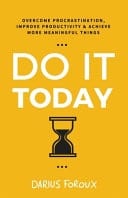
Are you also tired of putting off your dreams until “tomorrow?” Guess what! Tomorrow never comes. Am I right? I’ve procrastinated and put off my desire to write a book for a decade. I always came up with excuses like, “it’s not the right time.” Or, “I need to do more research.” But in 2015 I got tired of this endless procrastination, and finally took action. Six months later, my first book was published. Look, we all have limited time on our hands. And we’re getting closer to death every single minute. That shouldn’t scare you. That should motivate you! Time is limited, that’s why we must do the things we want: Today. In this “best of” collection, I’ve handpicked 30 of my best articles that help you to overcome procrastination, improve your productivity, and achieve all the things you always wanted. Plus, I’ve written an extensive introduction about my life and work philosophy. In Do It Today, you’ll learn: Why we procrastinate and how we can overcome it How to increase your productivity without being stressful How to achieve more meaningful things in your life so you can enjoy it more Are you ready to start reading this book? If so: Do it today-not tomorrow.
My Summary
Main Ideas, Takeaways & Similarities
Questions
I. What is the problem?
A. How is this problem formulated?
B. Why is this problem important?
C. What is the history of this problem?
D. Which prominent personalities have been interested in this problem?
II. What solutions to the problem are there?
A. What are the conclusions reached?
B. By what argument(s) is the conclusion reached?
C. What facts or assumptions serve as premises?
D. When a prominent personality offers a solution, does he also argue for or against other prominent personalities? Does he raise objections to alternative solutions? Does he consider objections to his own solutions?
III. Evaluation
A. What are the advantages and disadvantages of the alternative formulations to the problem?
B. Has the importance or history of the problem ever been misrepresented?
C. Are the solutions logically related to the premises?
D. Are the facts true? Are the assumptions acceptable? Are the objections answerable?
AI Summary
Core Theme
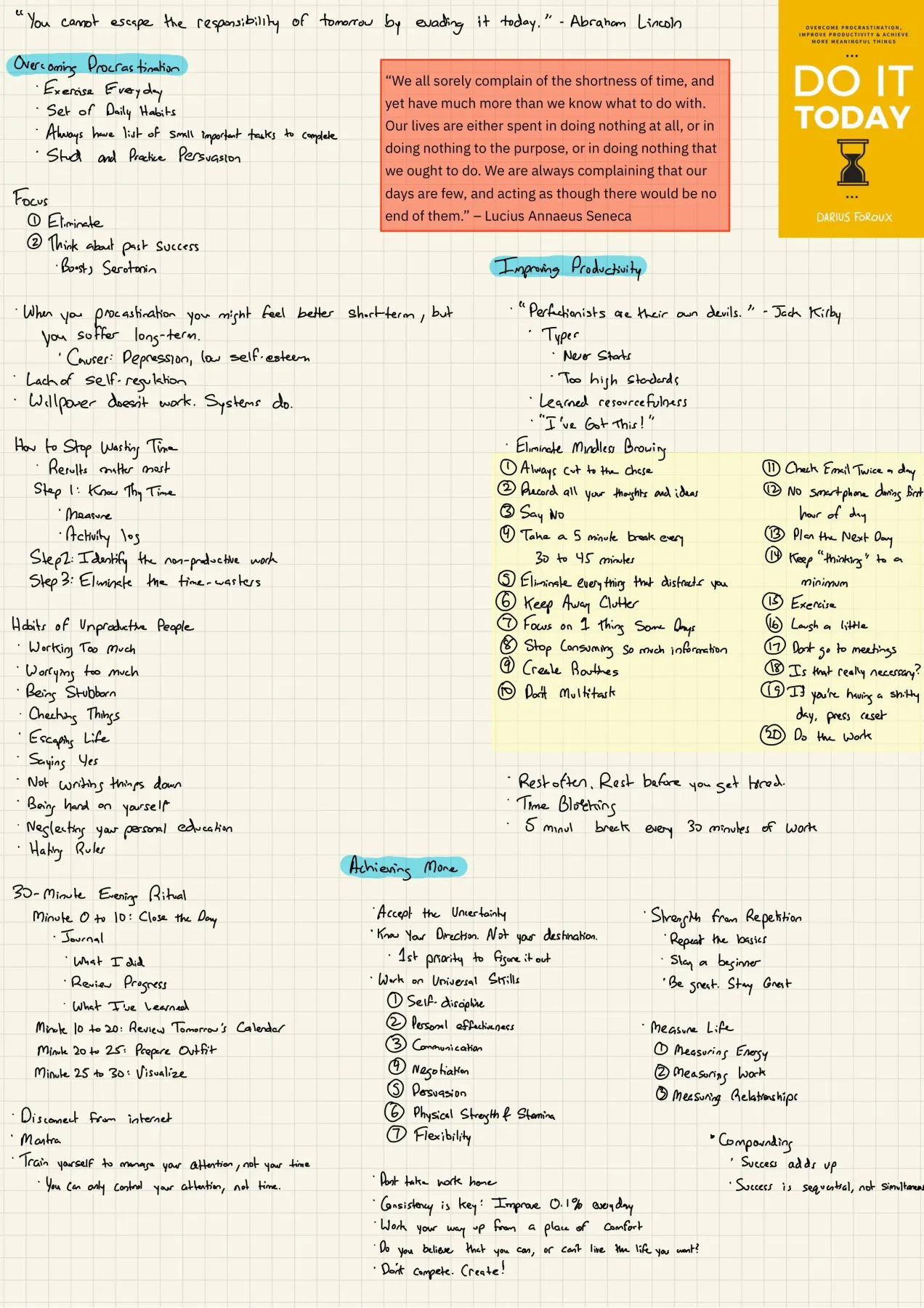
Do It Today emphasizes immediate action, disciplined habits, and systems-driven productivity to overcome procrastination, boost focus, and build a meaningful, consistent life. Success comes from mastering attention, avoiding distractions, and compounding small daily improvements.
Part I: Overcoming Procrastination
- Act Now, Not Tomorrow
- Avoid excuses like saving energy for tomorrow or waiting for perfect conditions. Push yourself fully in the present.
- Abraham Lincoln: “You cannot escape the responsibility of tomorrow by evading it today.”
- Inner Battle Against Procrastination
- Mental toughness is key. Daily habits like Stoic reflection, mindfulness, exercise, and reading strengthen self-control.
- Keep lists of important tasks, practice persuasion, and create habits that reduce friction.
- Focus Tactics
- Eliminate distractions ruthlessly: simplify life so priorities stand out.
- Boost focus by recalling past successes—this triggers serotonin and shifts mindset positively.
- Procrastination’s Costs (Tice & Baumeister study)
- Linked to depression, low self-esteem, anxiety, stress, and irrational beliefs.
- Often stems from weak self-regulation, relying on deadlines as external motivation.
- Systems Over Willpower
- Freedom is not the goal—rules and frameworks create real freedom by ensuring work gets done.
- Effective systems: deadlines for urgency, accountability, energy from exercise and diet, interval work, and elimination of distractions.
- Anchor your system to a clear why (purpose).
- Time and Productivity Awareness
- Measure time (keep an activity log). Identify and cut time-wasters.
- Avoid habits of unproductive people: overworking, excessive worry, stubbornness, compulsive checking, escapism, overcommitment, neglecting personal growth, and resisting rules.
- Daily Rituals for Control
- A 30-minute evening ritual:
- Journal your day (achievements, lessons).
- Review tomorrow’s calendar.
- Prepare outfit and materials.
- Visualize the next day’s success.
- A 30-minute evening ritual:
- Disconnect for Focus
- Internet disconnection reduces anxiety, increases calm, and helps reclaim time for meaningful activities.
- Life’s Brevity as Motivation
- Seneca: we waste life on trivialities and act as if time is endless. Focus on relationships, memories, and meaningful work.
Part II: Improving Productivity
- Eliminate Distractions (especially smartphones)
- Phones fragment attention and harm deep work.
- Defeat Perfectionism
- Two types: those who never start and those with crippling standards.
- Both lead to anxiety, depression, and stagnation.
- Adopt “learned resourcefulness”: self-control, problem-solving, and delayed gratification.
- Replace “This is the worst” or “I don’t care” with “I’ve got this.”
- Knowledge & Learning
- To read 100 books/year:
- Buy in bulk, always be reading, choose relevance, read multiple books, retain and apply lessons.
- To read 100 books/year:
- Breaks and Downtime
- Vacations and boredom boost creativity and long-term performance.
- Breaks (5 min every 30 min) enhance work quality.
- Mindless Browsing & Multitasking
- Multitaskers become “suckers for irrelevancy” (Stanford research).
- Eliminate casual browsing and unnecessary notifications.
- 20 Productivity Principles
- Cut to the chase, record ideas, say no, declutter, work in focused blocks, avoid excess information, build routines, don’t multitask, plan ahead, exercise, laugh, avoid meetings, reset when needed, and—above all—do the work.
- Time Blocking (Cal Newport)
- Schedule work in blocks to ensure progress on the right things.
- Leave buffer time, avoid over-scheduling, and adjust daily.
Part III: Achieving More
- Clarity & Universal Skills
- If direction is unclear, make figuring it out your first priority.
- Focus on seven universal skills:
- Self-discipline, personal effectiveness, communication, negotiation, persuasion, physical stamina, and flexibility.
- Boundaries & Balance
- Leave work on time and keep home life separate.
- Progress by 0.1% each day—steady growth trumps highs and lows.
- Comfort Zones & Foundations
- Growth doesn’t require misery. Build from comfort while improving skills.
- Foundations: family, close friendships, body and mind development.
- Belief & Creation
- Belief shapes reality: do you believe you can live the life you want?
- Don’t compete; create—whether it’s a career, business, or opportunities.
- Repetition & Mastery
- Strength comes from repeating basics, staying a beginner, and refining skills continuously.
- Measuring Life
- Gauge success in three areas:
- Energy (exercise, diet),
- Work (continuous learning and application),
- Relationships (quality over quantity).
- Gauge success in three areas:
- Live Like You’re Immortal
- Build legacies: careers, contributions, creations, and financial stability.
- Compounding Success
- Focus deeply on fewer priorities; success is sequential, not simultaneous (Keller & Papasan).
- Small, consistent wins create exponential results.
Key Takeaways
- Action beats hesitation: Do it now, simplify, and cut distractions.
- Systems trump willpower: Build routines, rules, and accountability.
- Attention is the real resource: Train focus, not just time.
- Steady growth, not burnout: 0.1% improvement daily compounds into major life change.
- Legacy over busyness: Prioritize relationships, contribution, and mastery over shallow distractions.
Do It Today – Action Checklist
Overcoming Procrastination
- Push yourself fully in the present – avoid saving energy for tomorrow.
- Strengthen mental toughness daily (Stoic reflection, mindfulness, exercise, reading).
- Keep lists of small but essential tasks to maintain control.
- Simplify life by eliminating distractions and unnecessary commitments.
- Boost focus by recalling past successes to trigger a positive mindset.
- Build systems and routines – don’t rely on willpower or “freedom.”
- Track your time with an activity log to identify time-wasters.
- Adopt a 30-minute evening ritual: journal, review calendar, prep outfit, visualize tomorrow.
- Disconnect from the internet regularly to regain focus and calm.
Improving Productivity
- Reduce smartphone and notification use to protect focus.
- Avoid perfectionism: start, set realistic standards, and adjust rather than freeze.
- Read and learn constantly (use the “Always Be Reading” method).
- Schedule breaks: 5 minutes for every 30 minutes of focused work.
- Avoid multitasking and eliminate mindless browsing.
- Apply 20 productivity habits (record ideas, declutter, say no, plan ahead, exercise, etc.).
- Use time blocking to schedule meaningful work and avoid over-scheduling.
Achieving More
- Clarify your direction before pursuing goals.
- Master seven universal skills: self-discipline, effectiveness, communication, negotiation, persuasion, stamina, flexibility.
- Leave work on time and separate work from personal life.
- Aim for 0.1% daily improvement to build momentum without burnout.
- Grow from a place of comfort – develop valuable skills and a solid personal foundation (family, friends, health).
- Believe in your ability to live the life you want – mindset drives results.
- Prioritize creation over competition (build opportunities if they don’t exist).
- Refine skills through repetition and stay humble as a learner.
- Measure life by energy, work (learning), and relationships – not busyness.
- Focus on fewer priorities for compounding success; progress is sequential, not simultaneous.
Highlights
Do It Today, as in, get the most out of your workout right now. Leave it all on the table. Don’t think, “I have to work tomorrow,” or anything else that you might use as an excuse not to push yourself. My mind tries to do that all the time. (Location 137)
Part I: Overcoming Procrastination (Location 260)
“You cannot escape the responsibility of tomorrow by evading it today.” - Abraham Lincoln (Location 263)
Do It Today, Not Tomorrow (Location 268)
Battling procrastination is an inner battle. (Location 280)
I exercise my mental toughness every day. (Location 305)
So I started reading about Stoicism, Pragmatism and Mindfulness; anything that helps you to control your thoughts and improve your mental toughness. I don’t want to be a slave to my thoughts. I want the opposite. (Location 307)
exercise my body every day. (Location 309)
I have a set of daily habits that help me to be in control of my life. (Location 313)
I always have a list of small (but important) tasks that I have to complete. (Location 316)
I study and practice the science of persuasion to get my message across. (Location 320)
What I Do When I Can’t Focus (Location 328)
Here are 2 things that I always do when I find myself not being able to focus on what matters. (Location 343)
- Eliminate. Eliminate. Eliminate (Location 344)
“What thing(s) should I eliminate to make my life so simple that it’s easy to focus?” (Location 361)
- Think About Past Success (Location 371)
To improve your focus, boost your serotonin activity. Research shows that exercise can do that. But something else, that’s equally effective, and a lot easier is a simple mind-exercise. All you need to do is remember positive events that happened in the past. (Location 380)
How To Beat Procrastination (backed by science) (Location 395)
When you procrastinate, you might feel better on the short-term, but you will suffer in the long-term. (Location 407)
One thing that all procrastinators have in common is that procrastination has a price. This highly cited study, published in the American Psychological Society journal, by Dianne Tice and Roy Baumeister discusses the cost of procrastination. It is related to: Depression Irrational beliefs Low self-esteem Anxiety Stress (Location 410)
“The present evidence suggests that procrastinators enjoy themselves rather than working at assigned tasks, until the rising pressure of imminent deadlines forces them to get to work. In this view, procrastination may derive from a lack of self-regulation and hence a dependency on externally imposed forces to motivate work.” (Location 428)
Willpower Doesn’t Work. Systems Do. (Location 448)
What you really need is a system for doing work. A lot of people shy away from routines, systems and frameworks because they want to have “freedom.” I’m sorry to disappoint you: Freedom is your enemy. The fact is that, if you want to get things done, you need rules. (Location 449)
If you combine the right productivity tactics, you have a productivity system. The deadlines create urgency, accountability will create responsibility, working in intervals improves your focus, exercising will give you more energy, so does a healthy diet, and eliminating distractions will take away the temptations. But there’s no system that can help you if you don’t have an inner drive. People overcomplicate that concept, but it’s simple: Why do you do what you do? (Location 459)
How To Stop Wasting Time and Improve Your Personal Effectiveness (Location 468)
Results matter the most. (Location 478)
Step 1: Know Thy Time (Location 487)
If you don’t measure your time, it’s tough to stop procrastination or improve your productivity. Because if you want to manage your time better, you have to know where it goes first. Your memory is not sufficient. If I asked you what you were doing exactly one week ago at this time, would you have an answer? There you go. (Location 490)
Keep an activity log. (Location 493)
Step 2: Identify The Non-Productive Work (Location 500)
Step 3: Eliminate The Time-Wasters (Location 507)
The Habits Of Unproductive People You Don’t Want To Copy (Location 524)
Working Too Much (Location 534)
Worrying Too Much (Location 541)
Being Stubborn (Location 547)
Checking Things (Location 557)
Escaping Life (Location 568)
Saying Yes (Location 576)
Not Writing Things Down (Location 581)
Being Hard On Yourself (Location 589)
Neglecting Your Personal Education (Location 593)
Hating Rules (Location 600)
Good news: You make up the rules. (Location 613)
For example, one of my personal rules is this: Never complain. Another one is: Read and exercise every day. And: Close the day every evening by setting your next day’s priorities. (Location 614)
This 30-Minute Evening Ritual Will Help You To Kick Life In The Ass. (Location 621)
From minute 0 to minute 10: Close The Day (Location 636)
Every evening I take 10 minutes to journal about my day. In a few sentences, I write about what I’ve accomplished, what I’ve learned, and anything that’s worth remembering. That simple exercise helps me to: Remember what I did (sounds stupid, but we forget most things we do). Review my progress and see whether I’m doing all the things that I should be doing (like reading, working out, spending time with my family, writing, talking to people I work with). (Location 637)
“At the end of each day, you should play back the tapes of your performance. The results should either applaud you or prod you.” (Location 644)
From minute 10 to minute 20: Review Tomorrow’s Calendar (Location 648)
From minute 20 to minute 25: Prepare your outfit (Location 656)
From minute 25 till minute 30: Visualize (Location 663)
Visualize the next day in detail. (Location 665)
Why Disconnecting From The Internet Improves Your Focus (Location 676)
Doing focused work is HARD. We’re always distracted. (Location 689)
DISCONNECT FROM THE INTERNET. (Location 694)
And after a while, you feel like you’re not missing out on anything. That brings a sense of calmness to your life. I also get more out of my days; I achieved more things than ever, feel less distracted, and have more time to spend on the things that make me happy. (Location 719)
Can you imagine? You’re on your deathbed, and you’re saying this to your family: “I’m glad I watched so many FAIL compilations on YouTube.” Nope. You’ll probably look back and reflect on the time you spent with your family or friends. Or the memories you made when you were traveling. Or how much you enjoyed your work. (Location 724)
The Single Biggest Reason Most People Procrastinate In Life (Location 730)
Life is too short to do work you don’t enjoy. (Location 761)
“We all sorely complain of the shortness of time, and yet have much more than we know what to do with. Our lives are either spent in doing nothing at all, or in doing nothing to the purpose, or in doing nothing that we ought to do. We are always complaining that our days are few, and acting as though there would be no end of them.” – Lucius Annaeus Seneca (Location 767)
This Ancient Habit Will Maximize Your Focus (Location 779)
The Power Of Having A Mantra (Location 790)
“A “mantra” is a sacred utterance, a numinous sound, a syllable, word or phonemes, or group of words in Sanskrit believed by practitioners to have psychological and spiritual powers.” (Location 797)
“Let’s go.” (Location 816)
After you start using your Mantra, you get into a worry-free zone. (Location 825)
How To Focus Better: Manage Your Attention (not your time) (Location 834)
Seneca, one of the most famous Stoic philosophers, said this in Letters From A Stoic: “There is never a time when new distraction will not show up.” (Location 855)
There are always distractions. So you better train yourself to manage your attention. Not your time. Because that’s the biggest mistake people make. We falsely believe that we can manage time. But time can’t be managed. The only thing you control is your attention. (Location 856)
Part II: Improving Productivity (Location 863)
“It’s like a lot of things, said the smith. Do the least part of it wrong and ye’d just as well to do it all wrong.” - Cormac McCarthy (Location 866)
Smartphones Harm Your Productivity More Than You Think (Location 872)
How Perfectionism Is Destroying Your Productivity (Location 926)
A perfectionist… Always waits for the right moment. Never makes mistakes. Always needs more time. (Location 932)
“Perfectionists are their own devils.” —Jack Kirby (Location 939)
There are two types of perfectionists: (Location 941)
The one that never starts. (Location 943)
The one that starts but has too high standards. (Location 945)
Both scenarios can cause the following: Anxiety, worry, depression, and Type A behavior. (Location 947)
“Learned resourcefulness refers to the behavioral repertoire necessary for both regressive self-control and reformative self-control. This repertoire includes self-regulating one’s emotional and cognitive responses during stressful situations, using problem-solving skills, and delaying immediate gratification for the sake of more meaningful rewards in the future.” (Location 964)
To me, that’s the sweet spot: Instead of beating yourself up when you make a mistake or if you fail yourself, you just adjust or solve the problem. Avoid the perfectionist’s favorite sentence: “OMG, this is the worst thing ever!” Also avoid the slacker’s favorite sentence: “I don’t care.” But instead, you say: “I’ve got this.” (Location 982)
How To Read 100 Books A Year (Location 990)
“Fools learn from experience. I prefer to learn from the experience of others.” (Location 996)
- Buy In Bulk (Location 999)
- A(always) B(e) R(eading) (Location 1013)
- Read Relevant Books Only (Location 1031)
- Read Multiple Books Simultaneously (Location 1042)
- Retain The Knowledge (Location 1050)
Take A Vacation: It Boosts Your Productivity And Reduces Stress (Location 1064)
- If You’re A Planner, PLAN (Location 1092)
- Make A Daily Movie (Location 1099)
- Read A LOT (Location 1105)
Bill Gates is famous for his voracious reading habit. He is also known for his ‘Think Week’ where does nothing else but read and think. (Location 1105)
- Get Bored (Location 1110)
Eliminate Mindless Browsing (Location 1129)
Clifford Nass, a sociologist from Stanford University, has researched the impact of multitasking and found that people who engage in multitasking are “suckers for irrelevancy.” We engage in multitasking because we are distracted by notifications, which are addictive. (Location 1136)
The Fix: Eliminate Browsing (Location 1144)
The point is; do something that’s worth your time. Be conscious about your time. And spend so it improves the quality of your life. (Location 1148)
20 Things That Will Make You More Productive Than Ever (Location 1150)
Always Cut To The Chase (Location 1159)
Record All Your Thoughts And Ideas (Location 1162)
Say No (Location 1166)
Take A 5 Minute Break Every 30 To 45 Minutes (Location 1170)
Eliminate Everything That Distracts You (Location 1173)
Keep Away Clutter (Location 1176)
Focus On 1 Thing Some Days (Location 1179)
Stop Consuming So Much Information (Location 1182)
Create Routines (Location 1185)
Don’t Multitask (Location 1187)
Check Email Twice A Day (Location 1191)
No Smartphone During The First Hour Of Your Day (Location 1195)
Plan The Next Day (Location 1198)
Keep ‘Thinking’ To A Minimum (Location 1201)
Exercise (Location 1204)
Laugh A Little (Location 1207)
Don’t Go To Meetings (Location 1209)
Is That Really Necessary? (Location 1212)
You’re Having A Shitty Day, Press Reset (Location 1214)
Do The Work (Location 1217)
Here’s Why Time Off Work Actually IMPROVES Your Work and Life (Location 1223)
People who never take time off to do nothing are short-term focused. “I want to reach my goals! NOW!” But as always, short-term thinking harms your long-term development and growth. What happens when you power through work and burn yourself out? In most instances, your results suffer, and you become less productive. In some cases, you even become depressed — which will set you back even longer. (Location 1234)
Prevent Rather Than Cure (Location 1238)
Dale Carnegie, a self-help pioneer, and author of How to Stop Worrying and Start Living, said it best: “So, to prevent fatigue and worry, the first rule is: Rest often. Rest before you get tired.” (Location 1241)
- You Can Check Whether You Did The Right Things (Location 1245)
At work, I know two modes: Execution Thinking (Location 1246)
- You Get To Process Your Ideas (Location 1261)
- You Can Consume More Art (Location 1274)
- You Can Focus On Other Important Things (that are not work related) (Location 1282)
- Resting Gets Boring. Quick. (Location 1292)
Time Blocking: Improve Your Focus And Get More Meaningful Work Done (Location 1302)
Computer science professor and author of Deep Work, Cal Newport, also uses time blocking. He says: “I take time blocking seriously, dedicating ten to twenty minutes every evening to building my schedule for the next day. During this planning process I consult my task lists and calendars, as well as my weekly and quarterly planning notes. My goal is to make sure progress is being made on the right things at the right pace for the relevant deadlines.” (Location 1322)
The last sentence is exactly why I schedule everything I want to do. Working is not the same thing as making progress. And Time Blocking helps me to improve my focus so I can get meaningful things done. Things that have an actual impact on my life. (Location 1326)
I plan my days and weeks in advance because I want to make sure I’m working on the RIGHT things. Too often, I get lost in completing daily tasks. (Location 1335)
Take 10 minutes every evening and plan your next day. Rearrange blocks if you must create time for other important things. (Location 1342)
Use recurring blocks for recurring tasks. For instance, I’ve scheduled two hours to write my new book every Tuesday and Thursday. (Location 1344)
Don’t over-schedule. Realistically, you can’t be productive 10 hours straight. Give yourself some time between tasks. And always schedule more time than you think you need. (Location 1345)
If You Want To Be More Productive, Research Shows You Need A Break (Location 1409)
The solution is simple: Take a 5-minute break after every 30 minutes of work. (Location 1423)
Taking breaks will also increase the quality of your work. (Location 1430)
Part III: Achieving More (Location 1455)
“A man who chases two rabbits catches neither.” - Chinese proverb (Location 1458)
Don’t Know What You Want? Improve These 7 Universal Skills (Location 1463)
Accept The Uncertainty (Location 1472)
Know Your Direction. Not Your Destination. (Location 1489)
If you can’t decide what direction you want to go in life, that’s automatically your #1 goal in life — to figure out where you want to go. That’s what Jay Abraham also recommends in Getting Everything You Can Out of All You’ve Got (which is one of my favorite business books of all time): “Your first priority is to identify what you want and then make sure you take the path that’s going to give you that. There’s nothing sadder than to see someone get to be seventy-five or eighty years old and look back regrettably because they pursued the wrong target.” (Location 1497)
Work On Universal Skills (Location 1504)
Self-Discipline: (Location 1508)
Personal Effectiveness: (Location 1510)
Communication: (Location 1512)
Negotiation: (Location 1515)
Persuasion: (Location 1517)
Physical Strength & Stamina: (Location 1518)
Flexibility: (Location 1520)
Leave The Office On Time and Don’t Take Your Work Home (Location 1526)
Leave On Time (Location 1546)
Leave Your Work At Work (Location 1560)
Consistency Is Key: Improve By 0.1% Every Day (Location 1575)
We determine our: Desire Attitude Judgments Determination (Location 1585)
What counts is that we do the right thing because that is all we can do. We don’t control outcomes. Do you see? Made a mistake? Correct it. Something goes wrong? Find a solution. (Location 1593)
don’t want ups and downs because that hurts productivity. Instead, I want to progress 0.1% every day of the year. And that’s a very realistic goal. Try it and maybe it will change your life too. (Location 1610)
Who Says You Have To Get Out Of Your Comfort Zone? (Location 1613)
Work Your Way Up From A Place Of Comfort (Location 1648)
Also, build a skill set that’s worth something. One of the reasons I don’t care about money is because I trust my ability to find work. Even when I go broke tomorrow, I’ll find a way to get work the next day. I’ve invested years and hundreds of thousands of dollars in my education. The question is: What’s your skill? How can you add value to the world? What problems can you solve? Other things that complete your foundation: Family. If you don’t have a family, create one. Friends. You can’t be friends with everyone. Stick to a few people who also stick to you. Yourself. Consciously improve your body and mind. Go to bed a little stronger and wiser every night. (Location 1658)
Lastly, don’t try to be something you’re not. If you’re an introvert, don’t pretend that you can work in a boiler room. If you’re an extrovert, don’t pretend you can work in solitude. Stay close to yourself—there’s no point in pushing yourself so badly that your life becomes miserable. (Location 1667)
If You Can Believe It, You Can Achieve It (Location 1673)
Belief is a practical instrument that you can use to shape reality. (Location 1691)
It comes down to one thing: Do you believe that you can, or can’t live the life you want? It’s as simple as that. (Location 1701)
Who wants to become a bum and die alone? (Location 1709)
Don’t Compete. Create! (Location 1743)
If You Can’t Find The Right Career, Create One (Location 1765)
Create. Create. Create. (Location 1786)
All Strength Comes From Repetition (Location 1794)
Repeat The Basics (Location 1806)
Stay A Beginner (Location 1817)
Be Great. Stay Great. (Location 1836)
How I Measure My Life (Location 1842)
- Measuring Energy (Location 1865)
Exercise every day (Location 1869)
Eat well (Location 1871)
- Measuring Work (Location 1877)
Career and life success is directly related to how much you learn. And more importantly: How much you keep learning. Education never ends. Also, income is directly related to your learning development. The more you learn, the more you earn. It’s true. Of course, there are limits to this statement. And knowledge must always be put into practice. (Location 1882)
- Measuring Relationships (Location 1889)
Why You Should Live Like You’re Immortal (Location 1901)
Building a meaningful career that you’re proud of. Contributing to other people’s lives. Creating a product or service that is useful. Investing your money for your retirement. (Location 1905)
Start living like you’re immortal. (Location 1912)
The Power Of Compounding: You Can Achieve Anything, If You Stop Trying To Do Everything (Location 1956)
Success Adds Up (Location 1963)
Are you working on a lot of things? Is your attention not on one thing? There’s a big chance that you will not achieve the best possible results. Or worse: You might fail if you try to achieve many things at the same time The reason is simple: Most of us believe that success happens all at once. Real life is different. Keller and Papasan put it well: “Success is sequential, not simultaneous.” (Location 1973)
- Do It Today, as in, get the most out of your workout right now. Leave it all on the table. Don’t think, “I have to work tomorrow,” or anything else that you might use as an excuse not to push yourself. My mind tries to do that all the time. (Location 137)
- Part I: Overcoming Procrastination (Location 260)
- “You cannot escape the responsibility of tomorrow by evading it today.” - Abraham Lincoln (Location 263)
- Do It Today, Not Tomorrow (Location 268)
- Battling procrastination is an inner battle. (Location 280)
- I exercise my mental toughness every day. (Location 305)
- So I started reading about Stoicism, Pragmatism and Mindfulness; anything that helps you to control your thoughts and improve your mental toughness. I don’t want to be a slave to my thoughts. I want the opposite. (Location 307)
- exercise my body every day. (Location 309)
- I have a set of daily habits that help me to be in control of my life. (Location 313)
- I always have a list of small (but important) tasks that I have to complete. (Location 316)
- I study and practice the science of persuasion to get my message across. (Location 320)
- What I Do When I Can’t Focus (Location 328)
- Here are 2 things that I always do when I find myself not being able to focus on what matters. (Location 343)
-
- Eliminate. Eliminate. Eliminate (Location 344)
- “What thing(s) should I eliminate to make my life so simple that it’s easy to focus?” (Location 361)
-
- Think About Past Success (Location 371)
- To improve your focus, boost your serotonin activity. Research shows that exercise can do that. But something else, that’s equally effective, and a lot easier is a simple mind-exercise. All you need to do is remember positive events that happened in the past. (Location 380)
- How To Beat Procrastination (backed by science) (Location 395)
- When you procrastinate, you might feel better on the short-term, but you will suffer in the long-term. (Location 407)
- One thing that all procrastinators have in common is that procrastination has a price. This highly cited study, published in the American Psychological Society journal, by Dianne Tice and Roy Baumeister discusses the cost of procrastination. It is related to: Depression Irrational beliefs Low self-esteem Anxiety Stress (Location 410)
- “The present evidence suggests that procrastinators enjoy themselves rather than working at assigned tasks, until the rising pressure of imminent deadlines forces them to get to work. In this view, procrastination may derive from a lack of self-regulation and hence a dependency on externally imposed forces to motivate work.” (Location 428)
- Willpower Doesn’t Work. Systems Do. (Location 448)
- What you really need is a system for doing work. A lot of people shy away from routines, systems and frameworks because they want to have “freedom.” I’m sorry to disappoint you: Freedom is your enemy. The fact is that, if you want to get things done, you need rules. (Location 449)
- If you combine the right productivity tactics, you have a productivity system. The deadlines create urgency, accountability will create responsibility, working in intervals improves your focus, exercising will give you more energy, so does a healthy diet, and eliminating distractions will take away the temptations. But there’s no system that can help you if you don’t have an inner drive. People overcomplicate that concept, but it’s simple: Why do you do what you do? (Location 459)
- How To Stop Wasting Time and Improve Your Personal Effectiveness (Location 468)
- Results matter the most. (Location 478)
- Step 1: Know Thy Time (Location 487)
- If you don’t measure your time, it’s tough to stop procrastination or improve your productivity. Because if you want to manage your time better, you have to know where it goes first. Your memory is not sufficient. If I asked you what you were doing exactly one week ago at this time, would you have an answer? There you go. (Location 490)
- Keep an activity log. (Location 493)
- Step 2: Identify The Non-Productive Work (Location 500)
- Step 3: Eliminate The Time-Wasters (Location 507)
- The Habits Of Unproductive People You Don’t Want To Copy (Location 524)
- Working Too Much (Location 534)
- Worrying Too Much (Location 541)
- Being Stubborn (Location 547)
- Checking Things (Location 557)
- Escaping Life (Location 568)
- Saying Yes (Location 576)
- Not Writing Things Down (Location 581)
- Being Hard On Yourself (Location 589)
- Neglecting Your Personal Education (Location 593)
- Hating Rules (Location 600)
- Good news: You make up the rules. (Location 613)
- For example, one of my personal rules is this: Never complain. Another one is: Read and exercise every day. And: Close the day every evening by setting your next day’s priorities. (Location 614)
- This 30-Minute Evening Ritual Will Help You To Kick Life In The Ass. (Location 621)
- From minute 0 to minute 10: Close The Day (Location 636)
- Every evening I take 10 minutes to journal about my day. In a few sentences, I write about what I’ve accomplished, what I’ve learned, and anything that’s worth remembering. That simple exercise helps me to: Remember what I did (sounds stupid, but we forget most things we do). Review my progress and see whether I’m doing all the things that I should be doing (like reading, working out, spending time with my family, writing, talking to people I work with). (Location 637)
- “At the end of each day, you should play back the tapes of your performance. The results should either applaud you or prod you.” (Location 644)
- From minute 10 to minute 20: Review Tomorrow’s Calendar (Location 648)
- From minute 20 to minute 25: Prepare your outfit (Location 656)
- From minute 25 till minute 30: Visualize (Location 663)
- Visualize the next day in detail. (Location 665)
- Why Disconnecting From The Internet Improves Your Focus (Location 676)
- Doing focused work is HARD. We’re always distracted. (Location 689)
- DISCONNECT FROM THE INTERNET. (Location 694)
- And after a while, you feel like you’re not missing out on anything. That brings a sense of calmness to your life. I also get more out of my days; I achieved more things than ever, feel less distracted, and have more time to spend on the things that make me happy. (Location 719)
- Can you imagine? You’re on your deathbed, and you’re saying this to your family: “I’m glad I watched so many FAIL compilations on YouTube.” Nope. You’ll probably look back and reflect on the time you spent with your family or friends. Or the memories you made when you were traveling. Or how much you enjoyed your work. (Location 724)
- The Single Biggest Reason Most People Procrastinate In Life (Location 730)
- Life is too short to do work you don’t enjoy. (Location 761)
- “We all sorely complain of the shortness of time, and yet have much more than we know what to do with. Our lives are either spent in doing nothing at all, or in doing nothing to the purpose, or in doing nothing that we ought to do. We are always complaining that our days are few, and acting as though there would be no end of them.” – Lucius Annaeus Seneca (Location 767)
- This Ancient Habit Will Maximize Your Focus (Location 779)
- The Power Of Having A Mantra (Location 790)
- “A “mantra” is a sacred utterance, a numinous sound, a syllable, word or phonemes, or group of words in Sanskrit believed by practitioners to have psychological and spiritual powers.” (Location 797)
- “Let’s go.” (Location 816)
- After you start using your Mantra, you get into a worry-free zone. (Location 825)
- How To Focus Better: Manage Your Attention (not your time) (Location 834)
- Seneca, one of the most famous Stoic philosophers, said this in Letters From A Stoic: “There is never a time when new distraction will not show up.” (Location 855)
- There are always distractions. So you better train yourself to manage your attention. Not your time. Because that’s the biggest mistake people make. We falsely believe that we can manage time. But time can’t be managed. The only thing you control is your attention. (Location 856)
- Part II: Improving Productivity (Location 863)
- “It’s like a lot of things, said the smith. Do the least part of it wrong and ye’d just as well to do it all wrong.” - Cormac McCarthy (Location 866)
- Smartphones Harm Your Productivity More Than You Think (Location 872)
- How Perfectionism Is Destroying Your Productivity (Location 926)
- A perfectionist… Always waits for the right moment. Never makes mistakes. Always needs more time. (Location 932)
- “Perfectionists are their own devils.” —Jack Kirby (Location 939)
- There are two types of perfectionists: (Location 941)
- The one that never starts. (Location 943)
- The one that starts but has too high standards. (Location 945)
- Both scenarios can cause the following: Anxiety, worry, depression, and Type A behavior. (Location 947)
- “Learned resourcefulness refers to the behavioral repertoire necessary for both regressive self-control and reformative self-control. This repertoire includes self-regulating one’s emotional and cognitive responses during stressful situations, using problem-solving skills, and delaying immediate gratification for the sake of more meaningful rewards in the future.” (Location 964)
- To me, that’s the sweet spot: Instead of beating yourself up when you make a mistake or if you fail yourself, you just adjust or solve the problem. Avoid the perfectionist’s favorite sentence: “OMG, this is the worst thing ever!” Also avoid the slacker’s favorite sentence: “I don’t care.” But instead, you say: “I’ve got this.” (Location 982)
- How To Read 100 Books A Year (Location 990)
- “Fools learn from experience. I prefer to learn from the experience of others.” (Location 996)
-
- Buy In Bulk (Location 999)
-
- A(always) B(e) R(eading) (Location 1013)
-
- Read Relevant Books Only (Location 1031)
-
- Read Multiple Books Simultaneously (Location 1042)
-
- Retain The Knowledge (Location 1050)
- Take A Vacation: It Boosts Your Productivity And Reduces Stress (Location 1064)
-
- If You’re A Planner, PLAN (Location 1092)
-
- Make A Daily Movie (Location 1099)
-
- Read A LOT (Location 1105)
- Bill Gates is famous for his voracious reading habit. He is also known for his ‘Think Week’ where does nothing else but read and think. (Location 1105)
-
- Get Bored (Location 1110)
- Eliminate Mindless Browsing (Location 1129)
- Clifford Nass, a sociologist from Stanford University, has researched the impact of multitasking and found that people who engage in multitasking are “suckers for irrelevancy.” We engage in multitasking because we are distracted by notifications, which are addictive. (Location 1136)
- The Fix: Eliminate Browsing (Location 1144)
- The point is; do something that’s worth your time. Be conscious about your time. And spend so it improves the quality of your life. (Location 1148)
- 20 Things That Will Make You More Productive Than Ever (Location 1150)
- Always Cut To The Chase (Location 1159)
- Record All Your Thoughts And Ideas (Location 1162)
- Say No (Location 1166)
- Take A 5 Minute Break Every 30 To 45 Minutes (Location 1170)
- Eliminate Everything That Distracts You (Location 1173)
- Keep Away Clutter (Location 1176)
- Focus On 1 Thing Some Days (Location 1179)
- Stop Consuming So Much Information (Location 1182)
- Create Routines (Location 1185)
- Don’t Multitask (Location 1187)
- Check Email Twice A Day (Location 1191)
- No Smartphone During The First Hour Of Your Day (Location 1195)
- Plan The Next Day (Location 1198)
- Keep ‘Thinking’ To A Minimum (Location 1201)
- Exercise (Location 1204)
- Laugh A Little (Location 1207)
- Don’t Go To Meetings (Location 1209)
- Is That Really Necessary? (Location 1212)
- You’re Having A Shitty Day, Press Reset (Location 1214)
- Do The Work (Location 1217)
- Here’s Why Time Off Work Actually IMPROVES Your Work and Life (Location 1223)
- People who never take time off to do nothing are short-term focused. “I want to reach my goals! NOW!” But as always, short-term thinking harms your long-term development and growth. What happens when you power through work and burn yourself out? In most instances, your results suffer, and you become less productive. In some cases, you even become depressed — which will set you back even longer. (Location 1234)
- Prevent Rather Than Cure (Location 1238)
- Dale Carnegie, a self-help pioneer, and author of How to Stop Worrying and Start Living, said it best: “So, to prevent fatigue and worry, the first rule is: Rest often. Rest before you get tired.” (Location 1241)
-
- You Can Check Whether You Did The Right Things (Location 1245)
- At work, I know two modes: Execution Thinking (Location 1246)
-
- You Get To Process Your Ideas (Location 1261)
-
- You Can Consume More Art (Location 1274)
-
- You Can Focus On Other Important Things (that are not work related) (Location 1282)
-
- Resting Gets Boring. Quick. (Location 1292)
- Time Blocking: Improve Your Focus And Get More Meaningful Work Done (Location 1302)
- Computer science professor and author of Deep Work, Cal Newport, also uses time blocking. He says: “I take time blocking seriously, dedicating ten to twenty minutes every evening to building my schedule for the next day. During this planning process I consult my task lists and calendars, as well as my weekly and quarterly planning notes. My goal is to make sure progress is being made on the right things at the right pace for the relevant deadlines.” (Location 1322)
- The last sentence is exactly why I schedule everything I want to do. Working is not the same thing as making progress. And Time Blocking helps me to improve my focus so I can get meaningful things done. Things that have an actual impact on my life. (Location 1326)
- I plan my days and weeks in advance because I want to make sure I’m working on the RIGHT things. Too often, I get lost in completing daily tasks. (Location 1335)
- Take 10 minutes every evening and plan your next day. Rearrange blocks if you must create time for other important things. (Location 1342)
- Use recurring blocks for recurring tasks. For instance, I’ve scheduled two hours to write my new book every Tuesday and Thursday. (Location 1344)
- Don’t over-schedule. Realistically, you can’t be productive 10 hours straight. Give yourself some time between tasks. And always schedule more time than you think you need. (Location 1345)
- If You Want To Be More Productive, Research Shows You Need A Break (Location 1409)
- The solution is simple: Take a 5-minute break after every 30 minutes of work. (Location 1423)
- Taking breaks will also increase the quality of your work. (Location 1430)
- Part III: Achieving More (Location 1455)
- “A man who chases two rabbits catches neither.” - Chinese proverb (Location 1458)
- Don’t Know What You Want? Improve These 7 Universal Skills (Location 1463)
- Accept The Uncertainty (Location 1472)
- Know Your Direction. Not Your Destination. (Location 1489)
- If you can’t decide what direction you want to go in life, that’s automatically your #1 goal in life — to figure out where you want to go. That’s what Jay Abraham also recommends in Getting Everything You Can Out of All You’ve Got (which is one of my favorite business books of all time): “Your first priority is to identify what you want and then make sure you take the path that’s going to give you that. There’s nothing sadder than to see someone get to be seventy-five or eighty years old and look back regrettably because they pursued the wrong target.” (Location 1497)
- Work On Universal Skills (Location 1504)
- Self-Discipline: (Location 1508)
- Personal Effectiveness: (Location 1510)
- Communication: (Location 1512)
- Negotiation: (Location 1515)
- Persuasion: (Location 1517)
- Physical Strength & Stamina: (Location 1518)
- Flexibility: (Location 1520)
- Leave The Office On Time and Don’t Take Your Work Home (Location 1526)
- Leave On Time (Location 1546)
- Leave Your Work At Work (Location 1560)
- Consistency Is Key: Improve By 0.1% Every Day (Location 1575)
- We determine our: Desire Attitude Judgments Determination (Location 1585)
- What counts is that we do the right thing because that is all we can do. We don’t control outcomes. Do you see? Made a mistake? Correct it. Something goes wrong? Find a solution. (Location 1593)
- don’t want ups and downs because that hurts productivity. Instead, I want to progress 0.1% every day of the year. And that’s a very realistic goal. Try it and maybe it will change your life too. (Location 1610)
- Who Says You Have To Get Out Of Your Comfort Zone? (Location 1613)
- Work Your Way Up From A Place Of Comfort (Location 1648)
- Also, build a skill set that’s worth something. One of the reasons I don’t care about money is because I trust my ability to find work. Even when I go broke tomorrow, I’ll find a way to get work the next day. I’ve invested years and hundreds of thousands of dollars in my education. The question is: What’s your skill? How can you add value to the world? What problems can you solve? Other things that complete your foundation: Family. If you don’t have a family, create one. Friends. You can’t be friends with everyone. Stick to a few people who also stick to you. Yourself. Consciously improve your body and mind. Go to bed a little stronger and wiser every night. (Location 1658)
- Lastly, don’t try to be something you’re not. If you’re an introvert, don’t pretend that you can work in a boiler room. If you’re an extrovert, don’t pretend you can work in solitude. Stay close to yourself—there’s no point in pushing yourself so badly that your life becomes miserable. (Location 1667)
- If You Can Believe It, You Can Achieve It (Location 1673)
- Belief is a practical instrument that you can use to shape reality. (Location 1691)
- It comes down to one thing: Do you believe that you can, or can’t live the life you want? It’s as simple as that. (Location 1701)
- Who wants to become a bum and die alone? (Location 1709)
- Don’t Compete. Create! (Location 1743)
- If You Can’t Find The Right Career, Create One (Location 1765)
- Create. Create. Create. (Location 1786)
- All Strength Comes From Repetition (Location 1794)
- Repeat The Basics (Location 1806)
- Stay A Beginner (Location 1817)
- Be Great. Stay Great. (Location 1836)
- How I Measure My Life (Location 1842)
-
- Measuring Energy (Location 1865)
- Exercise every day (Location 1869)
- Eat well (Location 1871)
-
- Measuring Work (Location 1877)
- Career and life success is directly related to how much you learn. And more importantly: How much you keep learning. Education never ends. Also, income is directly related to your learning development. The more you learn, the more you earn. It’s true. Of course, there are limits to this statement. And knowledge must always be put into practice. (Location 1882)
-
- Measuring Relationships (Location 1889)
- Why You Should Live Like You’re Immortal (Location 1901)
- Building a meaningful career that you’re proud of. Contributing to other people’s lives. Creating a product or service that is useful. Investing your money for your retirement. (Location 1905)
- Start living like you’re immortal. (Location 1912)
- The Power Of Compounding: You Can Achieve Anything, If You Stop Trying To Do Everything (Location 1956)
- Success Adds Up (Location 1963)
- Are you working on a lot of things? Is your attention not on one thing? There’s a big chance that you will not achieve the best possible results. Or worse: You might fail if you try to achieve many things at the same time The reason is simple: Most of us believe that success happens all at once. Real life is different. Keller and Papasan put it well: “Success is sequential, not simultaneous.” (Location 1973)