DESCRIPTION
Noted sports performance expert and bestselling author of Core Performance, Verstegen reveals the training program he uses with elite athletes and U.S. Special Operations Forces. As founder and president of EXOS, Mark Verstegen has trained the world’s top athletes in sports including the NFL, Major League Baseball, and worldwide soccer powers, along with the most elite “tactical athletes”—U.S. Special Operations Forces personnel. More than a decade ago, Verstegen’s groundbreaking book Core Performance revolutionized the fitness industry and made core conditioning and functional training mainstream. In his new book, Verstegen presents his most hardcore program yet: a demanding system that challenges readers to perform at the highest level. Borrowing heavily from his regimens used by the military and NFL-combine hopefuls, Verstegen breaks the system down into tough but easy-to-follow workouts that help readers become faster, more explosive, and more powerful while moving with greater efficiency and with far less potential for injury. If you’ve ever wanted to perform like the top sports champions or elite fighting forces, this is the book for you.
My Summary
Knowledge-32 1.jpg (image unavailable)
Highlights
Key Points from the Book:
- Mindset:
- Mindset is a 24-hour influence on ourselves.
- Our future is shaped by our current habits and decisions.
- Maintaining world-class habits is crucial for sustained success.
- Nutrition:
- Hydration is essential, with specific guidelines on water intake before, during, and after training.
- Focus on nutrient-dense foods like steel-cut oats, quinoa, whole grains, fruits, vegetables, and lean proteins.
- Supplementation, when used correctly, can enhance performance.
- Avoid alcohol for high performance.
- Movement:
- Incorporate various exercises including Pillar Prep, Movement Prep, Plyometrics, and Medicine Ball workouts.
- Focus on building strength across the body’s core pillars - shoulder, torso, and hips.
- Emphasize the importance of mobility and flexibility through active elongation rather than traditional stretching.
- Recovery:
- Importance of proper breathing techniques for stress reduction and cortisol control.
- Regular posture checks to ensure alignment and prevent strain.
- Recovery is not just a post-activity activity but an ongoing process.
Additional Insights:
- The book emphasizes the importance of a holistic approach to performance.
- Nutrition advice includes practical tips like carrying a water bottle, choosing smart snacks, and planning meals during travel.
- Movement strategies are not just about exercising but also include daily habits like checking posture and using a tennis ball for foot massage.
- Mindset goes beyond just goal setting; it’s about adopting a mantra that embodies personal drive and ambition.
This comprehensive approach underscores the idea that peak performance is a lifestyle, not just an occasional pursuit. It requires dedication and consistency in mindset, nutrition, movement, and recovery.
Performance is about showing up every day and hitting the bull’s-eye regardless of the situation. (Location 57)
The four pillars of that platform are Mindset, Nutrition, Movement, and Recovery. Since every day is game day, you must: Prepare for It. (Mindset) Fuel for It. (Nutrition) Train for It. (Movement) Rest for It. (Recovery) (Location 165)
The key is not to think of IT as a goal or end, but rather as a mantra, a statement that summarizes who you are, what drives you, and where you want to be. (Location 228)
Mindset is where we have an opportunity to influence ourselves twenty-four hours a day. Our current reality will define our future only if we allow it. World-class athletes remain that way as long as they maintain world-class habits. Likewise, people who struggle in specific areas continue to struggle because of their habits and decisions. (Location 258)
Though you might not feel thirsty, you’re dehydrated after sleep. Drink 16 ounces of water upon waking. You should place a glass of water on your nightstand or bathroom sink before going to sleep (and drink from it during the night if you awaken). (Location 365)
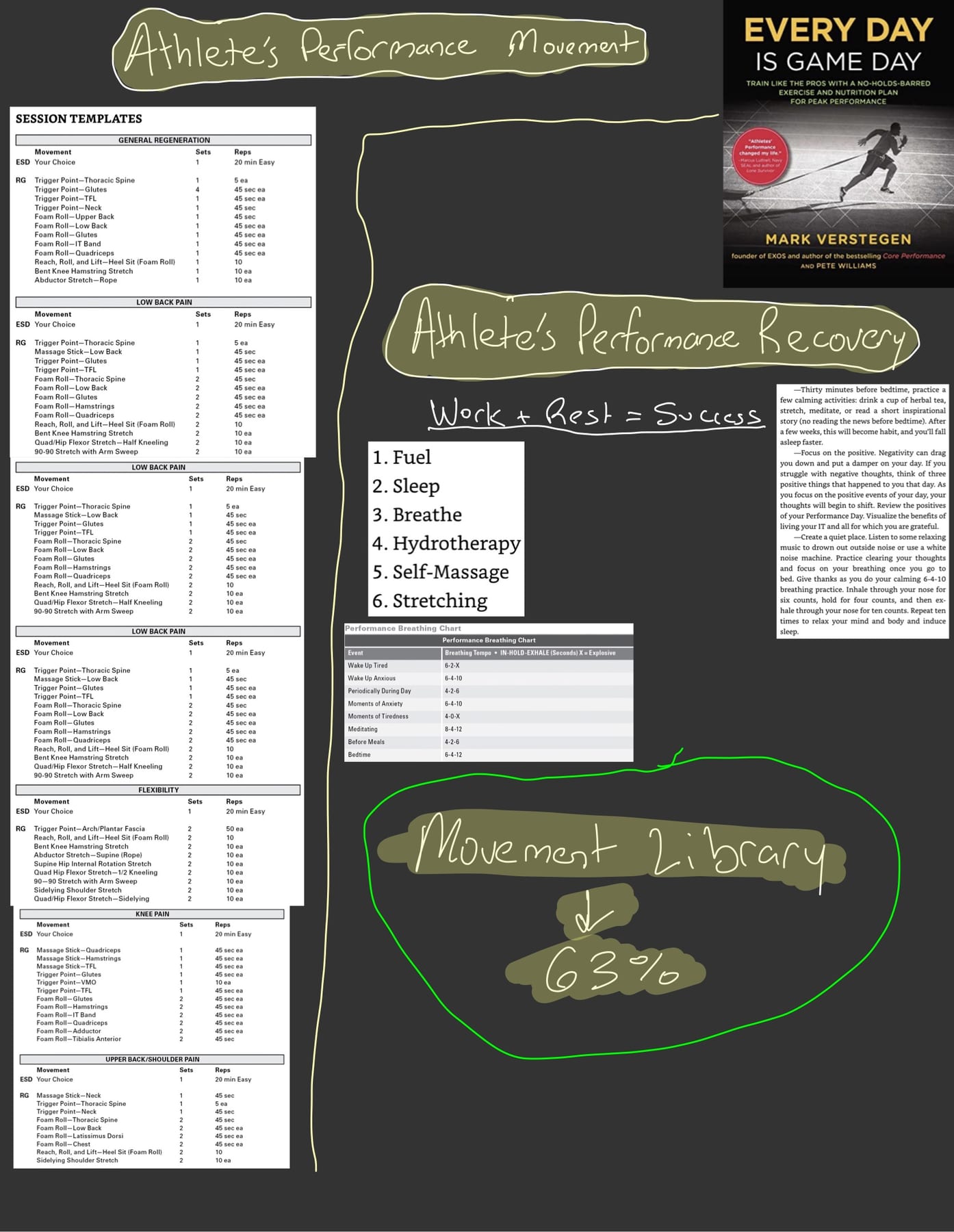
Even though you just woke up, it’s still time to recover. Take this time to extend your breath. Breathe in through your nose for six counts, hold for four counts, and breathe out through your mouth for ten counts. This extended breath out slows your breathing, reduces stress, and induces calmness. Repeat this pattern ten times to calm your nervous system and decrease cortisol production. This targeted breathing can be done during the Mindset or Movement portions of your morning ritual. (Location 389)
That’s why it’s important to check your posture a couple times each morning. Are your shoulder blades pulled back and down? Is your chest elevated? Are you “sitting tall”? (Location 420)
Take periodic five-minute breaks and do some simple Movement Prep (Location 434)
Keep a tennis ball under your desk. While standing or sitting, slip off your shoe and roll your foot back and forth over the tennis ball, applying pressure to the arch of your foot. (Location 436)
Stop drinking a half hour or more before your meal. (Location 485)
steel-cut oats, quinoa, kamut, lentils, 100 percent whole wheat bread, and sweet potatoes. Include fruits, vegetables, beans, and whole grains for their fiber and nutrient density. (Location 686)
Great protein choices are fish, chicken, eggs, low-fat dairy, Greek yogurt, beans, and legumes. (Location 707)
fatty fish like salmon, trout, and tuna, as well as flaxseed, hemp, walnuts, and omega-3 fortified foods. (Location 719)
whole grain toast with natural peanut butter, yogurt, and a banana; oatmeal, berries, almonds, and a hard-boiled egg; and an English muffin with scrambled eggs and avocado with 100 percent fruit juice. (Location 744)
Choose a hydration beverage that has at least 200 milligrams of sodium per 8 ounces to maximize electrolyte replacement. (Location 779)
Pretraining (1–2 hours before), drink 17–20 ounces. Immediately before training, drink 7–10 ounces. During training (every 10–15 minutes), drink 7–10 ounces. Post-training, drink 20 ounces for every pound lost. (Location 783)
Bottom line: If you want to be dialed in to piss excellence and be a high performer, alcohol is not part of the game plan. (Location 794)
Your Travel Checklist—Don’t Travel Without It! Shaker bottle (for shakes) Water container or bottled water Green tea bags High-fiber cereal, granola bars, EAS bars, or bars of choice (Location 863)
EAS shake packets, shake packet of choice, or 100 percent whey protein in a Ziploc bag Nuts, seeds, dried fruit, and high-fiber cereal mix Individual servings of natural peanut butter Instant oatmeal Fresh fruit and veggies (apple, banana, orange, carrots) Beef jerky, hard-boiled eggs, or low-fat cheese Sandwiches (pita, tortillas, bread) Whole grain crackers (must have at least 3 grams of fiber) (Note: Ziploc bags and plastic utensils should always be in stock in your kitchen.) (Location 867)
Breakfast choices: eggs, oatmeal, high-fiber cereal, yogurt, peanut butter, fruit Lunch/dinner choices: lean meat, whole grain bread, whole wheat pasta, regular pasta, brown rice, fruit and veggies Between-meal fuel: meal replacement bars, shakes, sandwich, fruit, veggies, nuts, beef jerky Smart Travel Reminders 1. Don’t skip meals: You must eat every three (Location 876)
hours. 2. Bring bars and shakes: These are great for light fueling and pre-/postworkout nutrition. 3. Make sure there is a lean protein choice with each meal: Grilled chicken, filet of beef, grilled fish, grilled pork, turkey, ham, and roast beef are great on sandwiches. Avoid anything fried. 4. Add your grains, wholesome carbs, fruits, and veggies: Add baked potato, rice, pasta, whole wheat bread, fresh fruit or veggies to every meal. 5. Stay hydrated! Drink 1/2 to 1 ounce per pound of body weight per day. This is especially important with air travel. Aim to drink about 8 ounces of fluid every hour on the plane. 6. Hunt at the airport: Amidst all of the restaurants at the airport, search out the sandwich shops and the kiosks. You can build a great sandwich or salad and find trail mix, nuts, bars, and water at any kiosk or airport store. 7. Write it down: If you have problems keeping your travel nutrition in check, take a small notebook with you when you travel and journal what you eat and drink during the trip. (Location 881)
We recommend consuming beta alanine in divided doses throughout the day. You can split up your doses around your training with the first coming sixty to ninety minutes before training and the second within two hours of finishing. (Location 922)
To increase your body’s stores of creatine, take 5 grams daily. (Location 933)
Caffeine stimulates the central nervous system, causes the body to use fat as fuel more effectively, and preserves muscle glycogen. You’ll feel more energetic, and your perceived rate of exertion will be lower. (Location 937)
A dose of 75 to 200 milligrams has been shown to give you a meaningful boost. (Location 951)
Simple Guide to Supplements (Location 955)
Athletes’ Performance Power Foods. (Location 966)
Almonds Artichokes Avocados Beans Beets Berries Broccoli Brussels sprouts Buffalo Cherries Chia seeds Cinnamon Citrus fruits (Location 967)
Coconut Collard greens Dark chocolate Edamame Eggs Farro Flaxseeds Garlic Ginger Grass-fed beef Greek yogurt Green tea Hemp seeds Kale Kefir Kiwi Lentils Olive oil Oregano Oysters Parsley Pecans Pistachios Pomegranates Pumpkin Quinoa Rosemary Salmon Sardines (Location 973)
Spinach Steel-cut oats Sunflower seeds Sweet potatoes/yams Swiss chard Thyme Turmeric Walnuts (Location 988)
ATHLETES’ PERFORMANCE MOVEMENT 1. Pillar Prep (Location 1054)
- Movement Prep 3. Plyometrics 4. Movement Skills 5. Medicine Ball 6. Relative Power 7. Energy Systems Development (ESD) (Location 1055)
Pillar strength is the integration of the shoulder, torso, and hips across the three planes of motion: frontal, sagittal, and transverse. (Location 1081)
lateral pillar bridges, (Location 1084)
(Static stretching, while not ideal before a workout, is a great option to enhance your flexibility after a workout.) (Location 1143)
The goal is to improve the long-term mobility and flexibility of your muscles. Rather than have them stretch and revert to where they were—as is the case with getting an occasional massage, both of which are effective strategies stretch-and-hold routines—you want your body to remember these new ranges of motion. This is done through a process of lengthening the muscle (known as active elongation), which is more effective than a traditional stretch. Here’s the difference: You don’t just passively lengthen (Location 1145)
your muscles; you actively lengthen and immediately strengthen them by contracting efficiently through this new range of motion. So instead of traditional stretching, you’re showing your muscles how to use the motion. (Location 1148)
Through plyometrics, you can improve your body’s elasticity, its ability to generate and reduce force. By doing so, you’ll make it more elastic and springy. Elasticity decreases the potential for injury and allows you to produce more force (or less, if needed) in less time. Plyometrics are the perfect blend of stability, mobility, strength, power, and dynamic balance. (Location 1212)