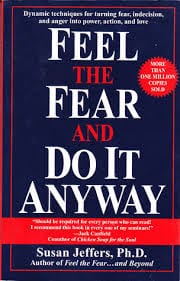

DESCRIPTION
The classic bestseller that has inspired millions to face their fears once and for all is newly revised with an updated version. Are you afraid of making decisions … asking your boss for a raise … leaving a relationship … facing the future? The world is a scary place right now—day to day stress and worry is at an all-time high—but the hard truth is that fear won’t just go away on its own. The only way to get rid of fear is to approach it, and this book is your essential guide to connecting with your inner power in order to do just that. In this enduring work of self-empowerment, now updated for the post-pandemic new normal, Dr. Susan Jeffers shares dynamic techniques and profound concepts that have helped countless people grab hold of their fears and move forward with their lives. You’ll discover: · How to raise your self-esteem · How to become more assertive · How to connect to the powerhouse within · How to create more meaning in your life · How to experience more enjoyment With warmth, insight and humor, Dr. Jeffers shows you how to become powerful in the face of your fears—and enjoy the elation of living a creative, joyous, loving life. Whatever your fear, here is your chance to push through it and find true and lasting fulfillment on the other side.
My Summary
Main Ideas, Takeaways & Similarities
Questions
I. What is the problem?
A. How is this problem formulated?
B. Why is this problem important?
C. What is the history of this problem?
D. Which prominent personalities have been interested in this problem?
II. What solutions to the problem are there?
A. What are the conclusions reached?
B. By what argument(s) is the conclusion reached?
C. What facts or assumptions serve as premises?
D. When a prominent personality offers a solution, does he also argue for or against other prominent personalities? Does he raise objections to alternative solutions? Does he consider objections to his own solutions?
III. Evaluation
A. What are the advantages and disadvantages of the alternative formulations to the problem?
B. Has the importance or history of the problem ever been misrepresented?
C. Are the solutions logically related to the premises?
D. Are the facts true? Are the assumptions acceptable? Are the objections answerable?
AI Summary
“Feel the Fear and Do It Anyway” by Susan Jeffers is a self-help book that provides guidance on overcoming fear and making positive changes in life. It offers strategies to boost confidence and take action despite feeling afraid. Here is a comprehensive summary in bullet points:
- Title: Feel the Fear and Do It Anyway
- Author: Susan Jeffers
Introduction:
- Introduces the concept of fear as a common and natural emotion.
- Emphasizes the role of fear in holding people back from pursuing their goals and dreams.
- Expresses the central idea of the book: that individuals can learn to acknowledge their fears and take action anyway.
Chapter 1: The Chatterbox:
- Discusses the inner “chatterbox” or self-talk that perpetuates fear and negativity.
- Emphasizes the importance of recognizing and challenging negative thoughts and beliefs.
- Introduces the concept of “affirmations” as a tool to counter negative self-talk.
Chapter 2: What Are You Afraid Of?
- Encourages readers to identify and categorize their specific fears.
- Discusses the range of common fears, including fear of failure, fear of success, and fear of rejection.
- Emphasizes that fear is a feeling, not a fact.
Chapter 3: Where Did That Come From?
- Explores the origins of fear, often rooted in childhood experiences or societal conditioning.
- Encourages individuals to understand the source of their fears to better address them.
- Discusses the impact of past traumas on present-day fears.
Chapter 4: How to Make a No-Lose Decision:
- Provides a framework for making decisions with confidence.
- Introduces the concept of “no-lose” decisions, where every choice leads to growth and learning.
- Discusses the importance of taking responsibility for one’s decisions.
Chapter 5: The Ten Truths:
- Presents ten fundamental truths about fear and decision-making.
- Includes truths such as “The fear will never go away as long as I continue to grow” and “It’s not so much what happens, but how I handle it that matters.”
- Offers insights and affirmations to internalize these truths.
Chapter 6: It’s Time to Start Feeling Good:
- Discusses the importance of prioritizing self-care and self-love.
- Encourages readers to pursue activities and practices that bring them joy and fulfillment.
- Emphasizes that feeling good is a choice, and it can be cultivated.
Chapter 7: The Joy of Taking Responsibility:
- Discusses the concept of responsibility and how it relates to personal empowerment.
- Encourages individuals to take responsibility for their thoughts, emotions, and actions.
- Highlights that taking responsibility is liberating and leads to greater control over one’s life.
Chapter 8: Expanding the Self:
- Explores the idea of expanding one’s comfort zone and embracing new challenges.
- Discusses the benefits of pushing boundaries and trying new experiences.
- Encourages readers to view fear as a signal to expand rather than contract.
Chapter 9: Leading a Fearless Life:
- Summarizes the key principles and strategies presented in the book.
- Encourages readers to commit to living a fearless life by taking action despite fear.
- Emphasizes the transformative power of feeling the fear and doing it anyway.
Conclusion:
- Summarizes the main concepts and teachings of the book.
- Encourages readers to apply the strategies and mindset shifts discussed to overcome fear and lead a more fulfilling life.
- Reminds readers that courage is not the absence of fear but the willingness to take action despite it.