
DESCRIPTION
Stop doing busywork. Start doing your best work. Are you over-extended, over-distracted, and overwhelmed? Do you work at a breakneck pace all day, only to find that you haven’t accomplished the most important things on your agenda when you leave the office? The world has changed and the way we work has to change, too. With wisdom from 20 leading creative minds, Manage Your Day-to-Day will give you a toolkit for tackling the new challenges of a 24/7, always-on workplace. Featuring contributions from: Dan Ariely, Leo Babauta, Scott Belsky, Lori Deschene, Aaron Dignan, Erin Rooney Doland, Seth Godin, Todd Henry, Christian Jarrett, Scott McDowell, Mark McGuinness, Cal Newport, Steven Pressfield, Gretchen Rubin, Stefan Sagmeister, Elizabeth G. Saunders, Tony Schwartz, Tiffany Shlain, Linda Stone, and James Victore. Plus, a foreword from Behance founder and CEO, Scott Belsky.
My Summary
Main Ideas, Takeaways & Similarities
Questions
I. What is the problem?
A. How is this problem formulated?
B. Why is this problem important?
C. What is the history of this problem?
D. Which prominent personalities have been interested in this problem?
II. What solutions to the problem are there?
A. What are the conclusions reached?
B. By what argument(s) is the conclusion reached?
C. What facts or assumptions serve as premises?
D. When a prominent personality offers a solution, does he also argue for or against other prominent personalities? Does he raise objections to alternative solutions? Does he consider objections to his own solutions?
III. Evaluation
A. What are the advantages and disadvantages of the alternative formulations to the problem?
B. Has the importance or history of the problem ever been misrepresented?
C. Are the solutions logically related to the premises?
D. Are the facts true? Are the assumptions acceptable? Are the objections answerable?
AI Summary
Highlights
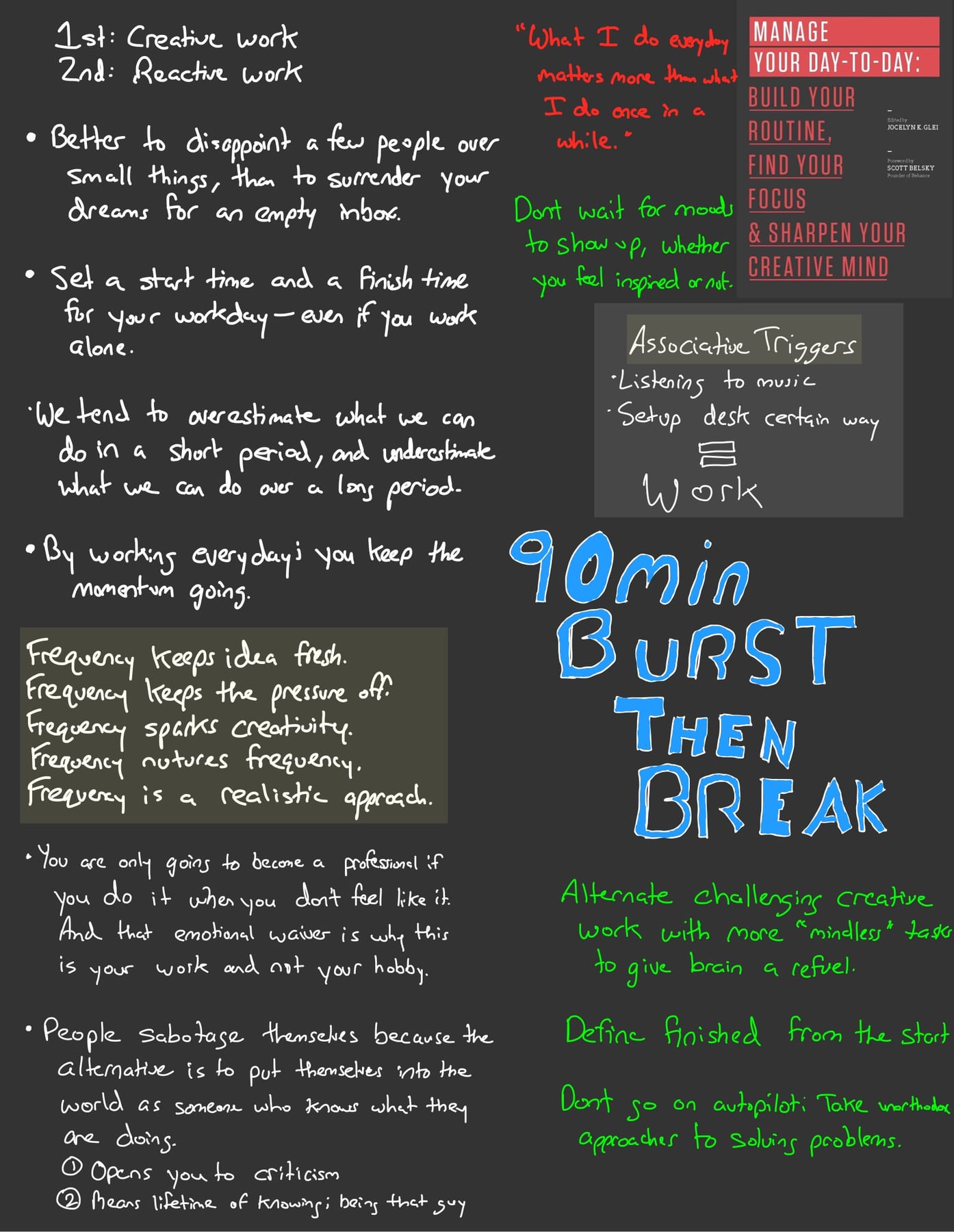
Here is an extensive bullet point summary of the key ideas from the book Manage Your Day-to-Day based on the highlights provided:
Execution and Productivity
- The most important factor for executing ideas and being creative is developing effective routines and work habits
- We have become increasingly reactive due to constant connectivity - it’s important to be proactive about priorities
- Switch creative work first, reactive work second by blocking off time for creative work daily
- Set a consistent start and end time for work each day to maintain momentum
Developing Good Habits
- Work frequently in small bursts - makes starting easier, keeps ideas fresh, reduces pressure, sparks creativity
- Committing to small consistent actions compounds over time into big results
- Having a practice means doing the work regularly even when you don’t feel like it
Building Routines
- Do meaningful work first thing in the morning before reactive work
- Use triggers like music to tell your mind it’s time to work
- Work daily on projects to build momentum over time
- Pulse between working in focused 90 minute bursts and taking breaks
- Spend solitary time to observe unproductive habits and calm your mind
- Show up consistently whether inspired or not
Finding Focus
- Schedule uninterrupted blocks of time for focused work
- Tackle projects requiring deep focus early when self-control is highest
- Eliminate distractions by turning off devices, apps, notifications unrelated to your task
- Mark progress on long term projects to stay motivated
- Alternate focused work with mindless tasks to give your brain a break
Taming Tools
- Post long term goals visible in your workspace to inform priority tasks
- Practice letting go of conversations and opportunities exceeding your bandwidth
- Distinguish compulsions from conscious helpful behaviors
- Unplug regularly to mentally reset
- Trust your instincts over technology
Creative Thinking
- Explore skills and working methods through personal projects
- Let your mind wander when stuck to tap your subconscious
- Define what finished looks like early to avoid perfectionism
- Avoid repetition - try unorthodox approaches to get unstuck
- Look at constraints as beneficial for spurring creativity
Citations:
[1]
https://ppl-ai-file-upload.s3.amazonaws.com/web/direct-files/7742445/8114793a-6076-4e03-a844-43c180c10d9a/paste.txt
Highlights
when folks want to talk creativity, what they’re really seeking is help with execution, ways to take action more effectively. (Location 100)
Our individual practices ultimately determine what we do and how well we do it. Specifically, it’s our routine (or lack thereof), our capacity to work proactively rather than reactively, and our ability to systematically optimize our work habits over time that determine our ability to make ideas happen. (Location 104)
Through our constant connectivity to each other, we have become increasingly reactive to what comes to us rather than being proactive about what matters most to us. (Location 117)
The single most important change you can make in your working habits is to switch to creative work first, reactive work second. This means blocking off a large chunk of time every day for creative work on your own priorities, with the phone and e-mail off. (Location 161)
But it’s better to disappoint a few people over small things, than to surrender your dreams for an empty inbox. Otherwise you’re sacrificing your potential for the illusion of professionalism. (Location 171)
Set a start time and a finish time for your workday—even if you work alone. (Location 191)
We tend to overestimate what we can do in a short period, and underestimate what we can do over a long period, provided we work slowly and consistently. (Location 205)
Frequency makes starting easier. Getting started is always a challenge. It’s hard to start a project from scratch, and it’s also hard each time you re-enter a project after a break. By working every day, you keep your momentum going. (Location 211)
Frequency keeps ideas fresh. (Location 216)
Frequency keeps the pressure off. (Location 221)
Frequency sparks creativity. (Location 228)
Frequency nurtures frequency. (Location 232)
Frequency is a realistic approach. (Location 242)
“What I do every day matters more than what I do once in a while. (Location 255)
The strategy is to have a practice, and what it means to have a practice is to regularly and reliably do the work in a habitual way. (Location 274)
you are only going to become a professional if you do it when you don’t feel like it. And that emotional waiver is why this is your work and not your hobby. (Location 279)
These people sabotage themselves because the alternative is to put themselves into the world as someone who knows what they are doing. They are afraid that if they do that, they will be seen as a fraud. It’s incredibly difficult to stand up at a board meeting or a conference or just in front of your peers and say, “I know how to do this. Here is my work. It took me a year. It’s great. (Location 296)
This is hard to do for two reasons: (1) it opens you to criticism, and (2) it puts you into the world as someone who knows what you are doing, which means tomorrow you also have to know what you are doing, and you have just signed up for a lifetime of knowing (Location 299)
Building a Rock-Solid Routine GREAT WORK BEFORE EVERYTHING ELSE Do your most meaningful creative work at the beginning of your day, and leave “reactive work”—like responding to e-mail or other messages—for later. JUMP-START YOUR CREATIVITY Establish “associative triggers”—such as listening to the same music or arranging your desk in a certain way—that tell your mind it’s time to get down to work. FEEL THE FREQUENCY Commit to working on your project at consistent intervals—ideally every day—to build creative muscle and momentum over time. (Location 425)
PULSE AND PAUSE Move rhythmically between spending and renewing your energy by working in ninety-minute bursts and then taking a break. GET LONELY Make a point of spending some time alone each day. It’s a way to observe unproductive habits and thought processes, and to calm your mind. DON’T WAIT FOR MOODS Show up, whether you feel inspired or not. (Location 431)
Finding Focus in a Distracted World DEFEND YOUR CREATIVE TIME Book time on your calendar for uninterrupted, focused work—and respect those blocks of time as you would any client meeting. FOCUS WHEN YOU’RE FRESH Tackle the projects that require “hard focus” early in your day. Self-control—and our ability to resist distractions—declines as the day goes on. KILL THE BACKGROUND NOISE Turn off your phone, e-mail, and any apps unrelated to your task. Even the presence of background activity (and temptation) can drain your focus. MAKE PROGRESS VISIBLE Marking progress is a huge motivator for long-term projects. Make your daily achievements visible by saving iterations, posting milestones, or keeping a daily journal. (Location 786)
GIVE YOUR BRAIN A BREAK Alternate challenging creative work with more “mindless” tasks to give your brain time to rest and refuel. TAP INTO TRANSITIONAL MOMENTS Take a break from checking your smartphone during transitional moments, and open yourself up to opportunity and serendipity. (Location 794)
Taming Your Tools KEEP THE LONG VIEW IN VIEW Post your complex, long-term goals by your workstation to keep them top of mind when prioritizing your tasks. BE CONSCIOUS OF YOUR BANDWIDTH Practice letting go of certain e-mail and social media conversations. There will always be more opportunities than you actually can take on. CHECK YOURSELF, OR WRECK YOURSELF Distinguish between compulsive and conscious behaviors. Are you acting out of boredom or blind habit when you could be serving a higher goal? (Location 1105)
HIT THE RESET BUTTON Make a ritual of unplugging on a regular basis. Turning everything off is like hitting the “reset” button on your mind—it gives you a fresh start. DON’T HOLD YOUR BREATH Be conscious of your body. Breathing deeply and regularly can decrease your stress levels and help you make better decisions. IN IMAGINATION WE TRUST Don’t trust technology over your own instincts and imagination. Doing busywork is easy; doing your best work is hard. (Location 1111)
Sharpening Your Creative Mind PRACTICE UNNECESSARY CREATION Use personal creative projects to explore new obsessions, skills, or ways of working in a low-pressure environment. WANDER LONELY AS A CLOUD Make time for your mind—and body—to wander when you’re stuck. Disengaging from the problem allows your subconscious to do its work. DEFINE “FINISHED” FROM THE START Keep your inner perfectionist in check by defining what finished looks like at the beginning of a project. And when you get there, stop! (Location 1493)
DON’T GO ON AUTOPILOT Repetition is the enemy of insight. Take unorthodox—even wacky—approaches to solving your stickiest problems and see what happens. SEARCH FOR THE SOURCE When the well runs dry, don’t blame a lack of talent. Creative blocks frequently piggyback on other problems. See if you can identify them. LOVE YOUR LIMITATIONS Look at constraints as a benefit, rather than an impediment. They activate our creative thinking by upping the ante. (Location 1499)