
DESCRIPTION
From the bestselling author of The 48 Laws of Power and The Laws of Human Nature, a vital work revealing that the secret to mastery is already within you. Each one of us has within us the potential to be a Master. Learn the secrets of the field you have chosen, submit to a rigorous apprenticeship, absorb the hidden knowledge possessed by those with years of experience, surge past competitors to surpass them in brilliance, and explode established patterns from within. Study the behaviors of Albert Einstein, Charles Darwin, Leonardo da Vinci and the nine contemporary Masters interviewed for this book. The bestseller author of The 48 Laws of Power, The Art of Seduction, and The 33 Strategies of War, Robert Greene has spent a lifetime studying the laws of power. Now, he shares the secret path to greatness. With this seminal text as a guide, readers will learn how to unlock the passion within and become masters.
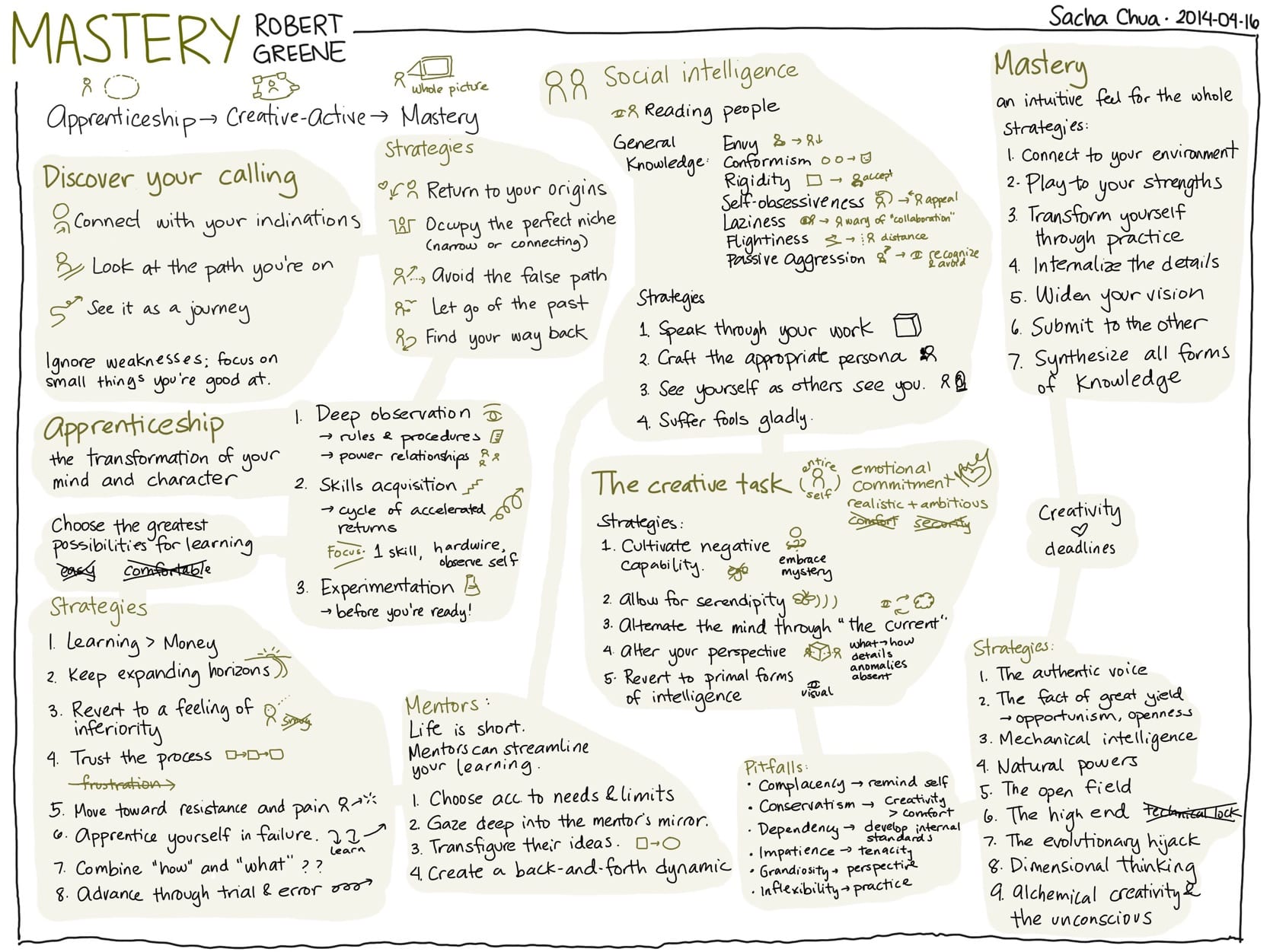
- The Path to Mastery:
- Mastery is a process, not a state of perfection. It consists of three phases: Apprenticeship, Creative-Active, and Mastery itself. The journey requires patience, persistence, and confidence. It’s a continual learning and growth process, not a destination.
- The Role of Intuition and Rationality:
- Mastery involves a combination of intuition and rationality. Intuitive powers at the mastery level blend instinctive and rational, conscious and unconscious elements. This balance allows for deeper understanding and effective decision-making.
- Importance of Passion and Persistence:
- Deep and powerful inclination toward a particular subject is crucial. This intense connection helps withstand the pains of the process, including self-doubts and setbacks. Desire and passion play a significant role in achieving mastery.
- Learning through Apprenticeship:
- The initial phase of mastery involves observing and learning from others. This apprenticeship phase is about mastering basic skills and understanding the rules. It requires deep observation, practice, and absorbing knowledge.
- Embracing Challenges and Adaptability:
- Facing challenges and adapting to new situations is essential. Avoiding the false path of pursuing goals for wrong reasons (like fame or money) and instead focusing on genuine interests and adapting to changes are key to mastery.
- Creative-Active Phase:
- In this phase, individuals apply their skills creatively and actively. They use their accumulated knowledge in original ways, exploring and experimenting within their field to create new works or ideas.
- Societal Pressures and Individuality:
- Societal pressures often lead people to conform and ignore their unique calling or vocation. Mastery involves overcoming these pressures and pursuing one’s genuine path.
- Continuous Learning and Adaptation:
- Masters are lifelong learners who continually adapt and refine their approach. They remain curious and open to new ideas, avoiding complacency and rigidity.
- Emotional Challenges:
- Emotional challenges such as boredom, impatience, and insecurity can impede the journey to mastery. Overcoming these emotional barriers is crucial for continued growth and development.
- Creativity and the Dimensional Mind:
- Creative mastery requires a “Dimensional Mind” – one that is active, transforming knowledge into something new, and not just consuming information. This involves maintaining a childlike spirit of curiosity and flexibility.
- Social Intelligence:
- Understanding and navigating social dynamics is important. This includes developing empathy, observing human behavior, and effectively interacting with others.
- Mentorship:
- Learning from mentors is vital. They provide guidance, knowledge, and feedback, helping to streamline the learning process.
- Self-Mastery:
- Mastery is not just about external achievements but also about mastering oneself. This includes developing self-awareness, self-discipline, and the ability to manage one’s emotions and thoughts.
- The Role of Natural Talent:
- While natural talent can be an asset, it’s not the sole determinant of mastery. Dedication, hard work, and a deep connection to the field are often more important.
- Balancing Creativity and Discipline:
- Mastery involves balancing creativity with discipline. While creativity allows for exploration and new ideas, discipline ensures focus and the mastery of essential skills.
Everyone holds his fortune in his own hands, like a sculptor the raw material he will fashion into a figure. But it’s the same with that type of artistic activity as with all others: We are merely born with the capability to do it. The skill to mold the material into what we want must be learned and attentively cultivated. —JOHANN WOLFGANG VON GOETHE (Location 204)
If, on the other hand, we manage these emotions and allow time to take its course, something remarkable begins to take shape. As we continue to observe and follow the lead of others, we gain clarity, learning the rules and seeing how things work and fit together. If we keep practicing, we gain fluency; basic skills are mastered, allowing us to take on newer and more exciting challenges. We begin to see connections that were invisible to us before. We slowly gain confidence in our ability to solve problems or overcome weaknesses through sheer persistence. (Location 239)
The first is the Apprenticeship; the second is the Creative-Active; the third, Mastery. (Location 249)
The human relies instead on thinking and rationality to understand its environment. But such thinking can be slow, and in its slowness can become ineffective. So much of our obsessive, internal thought process tends to disconnect us from the world. Intuitive powers at the mastery level are a mix of the instinctive and the rational, the conscious and the unconscious, the human and the animal. (Location 261)
The human visual system is not built for scanning, as a cow’s is, but for depth of focus. (Location 318)
To the extent that we believe we can skip steps, avoid the process, magically gain power through political connections or easy formulas, or depend on our natural talents, we move against this grain and reverse our natural (Location 370)
A man should learn to detect and watch that gleam of light which flashes across his mind from within, more than the luster of the firmament of bards and sages. Yet he dismisses without notice his thought, because it is his. In every work of genius we recognize our own rejected thoughts; they come back to us with a certain alienated majesty. —RALPH WALDO EMERSON (Location 385)
The basic elements of this story are repeated in the lives of all of the great Masters in history: a youthful passion or predilection, a chance encounter that allows them to discover how to apply it, an apprenticeship in which they come alive with energy and focus. They excel by their ability to practice harder and move faster through the (Location 414)
process, all of this stemming from the intensity of their desire to learn and from the deep connection they feel to their field of study. And at the core of this intensity of effort is in fact a quality that is genetic and inborn—not talent or brilliance, which is something that must be developed, but rather a deep and powerful inclination toward a particular subject. (Location 417)
This intense connection and desire allows them to withstand the pain of the process—the self-doubts, the tedious hours of practice and study, the (Location 425)
inevitable setbacks, the endless barbs from the envious. They develop a resiliency and confidence that others lack. (Location 426)
Our levels of desire, patience, persistence, and confidence end up playing a much larger role in success than sheer reasoning powers. Feeling motivated and energized, we can overcome almost anything. Feeling bored and restless, our minds shut off and we become increasingly passive. (Location 429)
A natural response when people feel overwhelmed is to retreat into various forms of passivity. If we don’t try too much in life, if we limit our circle of action, we can give ourselves the illusion of control. The less we attempt, the less chances of failure. If we can make it look like we are not really responsible for our fate, for what happens to us in life, then our apparent powerlessness is more palatable. For this reason we become attracted to certain narratives: it is genetics that determines much of what we do; we are just products of our times; the individual is just a myth; human behavior can be reduced to statistical trends. (Location 446)
If you lose contact with this inner calling, you can have some success in life, but eventually your lack of true desire catches up with you. Your work becomes mechanical. You come to live for leisure and immediate pleasures. In this way you become increasingly passive, and never move past the first phase. You may grow frustrated and depressed, never realizing that the source of it is your alienation from your own creative potential. (Location 461)
you must see your attempt at attaining mastery as something extremely necessary and positive. (Location 467)
you must convince yourself of the following: people get the mind and quality of brain that they deserve through their actions in life. (Location 474)
People who are passive create a mental landscape that is rather barren. Because of their limited experiences and action, all kinds of connections in the brain die off from lack of use. Pushing against the passive trend of these times, you must work to see how far you can extend control of your circumstances and create the kind of mind you desire—not through drugs but through action. Unleashing the masterful mind within, you will be at the vanguard of those who are exploring the extended limits of human willpower. (Location 480)
The creativity that you gain in learning a skill so deeply must be constantly refreshed, as you keep forcing your mind back to a state of openness. (Location 521)
In moving toward mastery, you are bringing your mind closer to reality and to life itself. Anything that is alive is in a continual state of change and movement. The moment that you rest, thinking that you have attained the (Location 523)
level you desire, a part of your mind enters a phase of decay. (Location 524)
Do not talk about giftedness, inborn talents! One can name great men of all kinds who were very little gifted. They acquired greatness, became “geniuses” (as we put it), through qualities the lack of which no one who knew what they were would boast of: they all possessed that seriousness of the efficient workman which first learns to construct the parts properly before it ventures to fashion a great whole; they allowed themselves time for it, because they took more pleasure in making the little, secondary things well than in the effect of a dazzling whole. —FRIEDRICH NIETZSCHE (Location 526)
“Just as a well-filled day brings blessed sleep, so a well-employed life brings a blessed death.” (Location 619)
Among his various possible beings each man always finds one which is his genuine and authentic being. The voice which calls him to that authentic being is what we call “vocation.” But the majority of men devote themselves to silencing that voice of the vocation and refusing to hear it. They manage to make a noise within themselves…to distract their own attention in order not to hear it; and they defraud themselves by substituting for their genuine selves a false course of life. —JOSÉ ORTEGA Y GASSET (Location 620)
Many of the greatest Masters in history have confessed to experiencing some kind of force or voice or sense of destiny that has guided them forward. For Napoleon Bonaparte it was his “star” that he always felt in ascendance when he made the right move. For Socrates, it was his daemon, a voice that he heard, perhaps from the gods, which inevitably spoke to him in the negative—telling him what to avoid. For Goethe, he also called it a daemon—a kind of spirit that dwelled within him and compelled him to fulfill his destiny. In more modern times, Albert Einstein talked of a kind of inner voice that shaped the direction of his speculations. All of these are variations on what Leonardo da Vinci experienced with his own sense of fate. (Location 626)
What weakens this force, what makes you not feel it or even doubt its existence, is the degree to which you have succumbed to another force in life—social pressures to conform. (Location 647)
Because you are increasingly less engaged in your career, you fail to pay attention to changes going on in the field—you fall behind the times and pay a price for this. At moments when you must make important decisions, you flounder or follow what others are doing because you have no sense of inner direction or radar to guide you. You have broken contact with your destiny as formed at birth. (Location 653)
This emphasis on your uniqueness and a Life’s Task might seem a poetic conceit without any bearing on practical realities, but in fact it is extremely relevant to the times that we live in. We are entering a world in which we can rely less and less upon the state, the corporation, or family or friends to help and protect us. It is a globalized, harshly competitive environment. We must learn to develop ourselves. At the same time, it is a world teeming with critical problems and opportunities, best solved and seized by entrepreneurs—individuals or small groups who think independently, adapt quickly, and possess unique perspectives. Your individualized, creative skills will be at a premium. (Location 685)
Your uniqueness at birth is a marker of this necessary diversity. To the degree you cultivate and express it you are fulfilling a vital role. Our times might emphasize equality, which we then mistake for the need for everyone to be the same, but what we really mean by this is the equal chance for people to express their differences, to let a thousand flowers bloom. Your vocation is more than the work that you do. It is intimately connected to the deepest part of your being and is a manifestation of the intense diversity in nature and within human culture. (Location 698)
Pindar wrote, “Become who you are by learning who you are.” (Location 702)
- Return to your origins—The primal inclination strategy (Location 718)
When Albert Einstein (1879–1955) was five, his father gave him a compass as a present. Instantly, the boy was transfixed by the needle, which changed direction as he moved the compass about. The idea that there was some kind of magnetic force that operated on this needle, invisible to the eyes, touched him to the core. What if there were other forces in the world equally invisible yet equally powerful—ones that were undiscovered or not understood? For the rest of his life all of his interests and ideas would revolve around this simple question of hidden forces and fields, and he would often think back to the compass that had sparked the initial fascination. (Location 720)
When the future film director Ingmar Bergman (1918–2007) was nine years old his parents gave his brother for Christmas a cinematograph—a moving picture machine with strips of film that projected simple scenes. He had to have it for himself. He traded his own toys to get it and once it was in his possession, he hurried into a large closet and watched the flickering images it projected on the wall. It seemed like something had magically come to life each time he turned it on. To produce such magic would become his lifelong obsession. (Location 729)
As a young boy growing up in North Carolina, John Coltrane (1926–67) felt different and strange. He was much more serious than his schoolmates; he experienced emotional and spiritual longings he did not know how to verbalize. He drifted into music more as a hobby, taking up the saxophone and playing in his high school band. Then a few years later he saw the great jazz saxophonist Charlie “Bird” (Location 743)
In order to master a field, you must love the subject and feel a profound connection to it. Your interest must transcend the field itself and border on the religious. (Location 750)
- Occupy the perfect niche—The Darwinian strategy (Location 763)
As a child growing up in Madras, India, in the late 1950s, V. S. Ramachandran knew he was different. He was (Location 763)
This was a niche he had all to himself, one he could command for years to come, that corresponded to his deepest inclinations and would serve best the cause of scientific advancement. (Location 790)
The more people there are crowded into a space, the harder it becomes to thrive there. Working in such a field will tend to wear you out as you struggle to get attention, to play the political games, to win scarce resources for yourself. You spend so much time at these games that you have little time left over for true mastery. You are seduced into such fields because you see others there making a living, treading the familiar path. You are not aware of how difficult such a life can be. (Location 827)
The game you want to play is different: to instead find (Location 830)
a niche in the ecology that you can dominate. (Location 831)
It is never a simple process to find such a niche. It requires patience and a particular strategy. In the beginning you choose a field that roughly corresponds to your interests (medicine, electrical engineering). From there you can go in one of two directions. The first is the Ramachandran path. From within your chosen field, you look for side paths that particularly attract you (in his case the science of perception and optics). When it is possible, you make a move to this narrower field. You continue this process until you eventually hit upon a totally unoccupied niche, the narrower the better. In some ways, this niche corresponds to your uniqueness, much as Ramachandran’s particular form of neurology corresponds to his own primal sense of feeling like an exception. (Location 831)
- Avoid the false path—The rebellion strategy (Location 843)
Wolfgang Amadeus Mozart (Location 844)
A false path in life is generally something we are attracted to for the wrong reasons—money, fame, attention, and so on. If it is attention we need, we often experience a kind of emptiness inside that we are hoping to fill with the false love of public approval. Because the field we choose does not correspond with our deepest inclinations, we rarely find the fulfillment that we crave. Our work suffers for this, and (Location 875)
If it is the father figure, the Leopold Mozart, that is blocking your path, you must slay him and clear the way. (Location 885)
- Let go of the past—The adaptation strategy (Location 886)
Freddie Roach (Location 886)
In dealing with your career and its inevitable changes, you must think in the following way: You are not tied to a particular position; your loyalty is not to a career or a company. You are committed to your Life’s Task, to giving it full expression. It is up to you to find it and guide it correctly. It is not up to others to protect or help you. You are on your own. Change is inevitable, particularly in such a revolutionary moment as ours. Since you are on your own, it is up to you to foresee the changes going on right now in your profession. You must adapt your Life’s Task to these circumstances. You do not hold on to past ways of doing things, because that will ensure you will fall behind and suffer for it. You are flexible and always looking to adapt. (Location 918)
Like Roach, you don’t want to abandon the skills and experience you have gained, but to find a new way to apply them. (Location 926)
- Find your way back—The life-or-death strategy (Location 930)
Buckminster Fuller (Location 931)
Perhaps what he had perceived moments earlier as his mistakes were not mistakes at all. He had tried to fit into a world (business) in which he did not belong. The world was telling him this if he only listened. (Location 963)
You cannot have everything in the present. The road to mastery requires patience. You will have to keep your focus on five or ten years down the road, when you will reap the rewards of your efforts. The process of getting there, however, is full of challenges and pleasures. (Location 981)
Temple (Location 989)
Grandin. (Location 989)
ignore your weaknesses and resist the temptation to be more like others. (Location 1024)
Do not dream or make grand plans for the future, but instead concentrate on becoming proficient at these simple and immediate skills. (Location 1025)
Do not envy those who seem to be naturally gifted; it is often a curse, as such types rarely learn the value of diligence and focus, and they pay for this later in life. (Location 1030)
II SUBMIT TO REALITY: THE IDEAL APPRENTICESHIP (Location 1044)
One can have no smaller or greater mastery than mastery of oneself. —LEONARDO DA VINCI (Location 1149)
This part of their lives—a largely self-directed apprenticeship that lasts some five to ten years—receives little attention because it does not contain stories of great achievement or discovery. (Location 1152)
If we adjust over time, we might eventually find our way; but if we make too many mistakes, we create endless problems for ourselves. We spend too much time entangled in emotional issues, and we never quite have enough detachment to reflect and learn from our experiences. The apprenticeship, by its very nature, must be conducted by each individual in his or her own way. To follow precisely the lead of others or advice from a book is self-defeating. This is the phase in life in which we finally declare our independence and establish who we are. But for this second education in our lives, so critical to our future success, there are some powerful and essential lessons that we all can benefit from, that can guide us away from common mistakes and save us valuable time. (Location 1168)
the goal of an apprenticeship is not money, a good position, a title, or a diploma, but rather the transformation of your mind and character—the first transformation on the way to mastery. (Location 1176)
Slowly, you will ground yourself in reality, in the objective world represented by the knowledge and skills that make people successful in it. You will learn how to work with others and handle criticism. In the process you will transform yourself from someone who is impatient and scattered into someone who is disciplined and focused, with a mind that can handle complexity. In the end, you will master yourself and all of your weaknesses. (Location 1180)
You do not choose apprenticeships that seem easy and comfortable. (Location 1186)
Step One: Deep Observation—The Passive Mode (Location 1200)
The greatest mistake you can make in the initial months of your apprenticeship is to imagine that you have to get attention, impress people, and prove yourself. (Location 1205)
If you impress people in these first months, it should be because of the seriousness of your desire to learn, not because you are trying to rise to the top before you are ready. (Location 1209)
what is of more interest are the rules that are unstated and are part of the underlying work culture. These concern style and values that are considered important. They are often a reflection of the character of the man or woman on top. (Location 1214)
power relationships that exist within the group: who has real control; through whom do all communications flow; who is on the rise and who is on the decline. (Location 1218)
You are like an anthropologist (Location 1221)
studying an alien culture, attuned to all of its nuances and conventions. (Location 1221)
Emptying himself of any preconceptions about life and its origins, Darwin trained himself to see things as they are. He did not theorize or generalize about what he was seeing until he had amassed enough information. Submitting to and absorbing the reality of all aspects of this voyage, he ended up piercing one of the most fundamental realities of all—the evolution of all living forms. (Location 1233)
Step Two: Skills Acquisition—The Practice Mode (Location 1243)
tacit knowledge—a (Location 1250)
greatest system ever invented for the training of skills and the achievement of tacit knowledge—the apprenticeship system of the Middle Ages. (Location 1251)
As business expanded in the Middle Ages, Masters of various crafts could no longer depend on family members to work in the shop. (Location 1253)
(the word “apprentice” itself comes from the Latin prehendere, meaning to grasp with the hand). (Location 1260)
First, it is essential that you begin with one skill that you can master, and that serves as a foundation for acquiring others. You must avoid at all cost the idea that you can manage learning several skills at a time. You need to develop your powers of concentration, and understand (Location 1276)
that trying to multitask will be the death of the process. (Location 1278)
It is better to dedicate two or three hours of intense focus to a skill than to spend eight (Location 1297)
hours of diffused concentration on it. You want to be as immediately present to what you are doing as possible. (Location 1297)
People who do not practice and learn new skills never gain a proper sense of proportion or self-criticism. They think they can achieve anything without effort and have little contact with reality. Trying something over and over again grounds you in reality, making you deeply aware of your inadequacies and of what you can accomplish with more work and effort. (Location 1301)
Real pleasure comes from overcoming challenges, feeling confidence in your abilities, gaining fluency in skills, and experiencing the power this brings. You develop patience. Boredom no longer signals the need for distraction, but rather the need for new challenges to conquer. (Location 1313)
Often you must force yourself to initiate such actions or experiments before you think you are ready. (Location 1334)
In the future, the great division will be between those who have trained themselves to handle these complexities and those who are overwhelmed by them—those who can acquire skills and discipline their minds and those who are irrevocably distracted by all the media around them and can never focus enough to learn. The Apprenticeship Phase is more relevant and important than ever, and those who discount this notion will almost certainly be left behind. (Location 1354)
In general, no matter your field, you must think of yourself as a builder, using actual materials and ideas. You are producing something tangible in your work, something that affects people in some direct, concrete way. (Location 1367)
Do not think that what is hard for you to master is humanly impossible; and if it is humanly possible, consider it to be within your reach. (Location 1372)
—MARCUS AURELIUS (Location 1373)
Value learning over money (Location 1378)
Franklin (Location 1378)
Benjamin (Location 1378)
Albert Einstein (Location 1391)
you must value learning above everything else. This will lead you to all of the right choices. You will opt for the situation that will give you the most opportunities to learn, particularly with hands-on work. You will choose a place that has people and mentors who can inspire and teach you. (Location 1424)
Keep expanding your horizons (Location 1432)
Revert to a feeling of inferiority (Location 1503)
Daniel Everett (Location 1504)
Children are generally free of these handicaps. They are dependent upon adults for their survival and naturally feel inferior. This sense of inferiority gives them a hunger to learn. Through learning, they can bridge the gap and not feel so helpless. Their minds are completely open; they pay greater attention. This is why children can learn so quickly and so deeply. (Location 1563)
Understand: when you enter a new environment, your task is to learn and absorb as much as possible. For that purpose you must try to revert to a childlike feeling of inferiority—the feeling that others know much more than you and that you are dependent upon them to learn and (Location 1569)
safely navigate your apprenticeship. You drop all of your preconceptions about an environment or field, any lingering feelings of smugness. You have no fears. You interact with people and participate in the culture as deeply as possible. You are full of curiosity. Assuming this sensation of inferiority, your mind will open up and you will have a hunger to learn. (Location 1570)
Trust the process (Location 1575)
Cesar Rodriguez’s (Location 1575)
When it comes to mastering a skill, time is the magic ingredient. Assuming your practice proceeds at a steady level, over days and weeks certain elements of the skill become hardwired. Slowly, the entire skill becomes internalized, part of your nervous system. The mind is no longer mired in the details, but can see the larger picture. It is a miraculous sensation and practice will lead you to that point, no matter the talent level you are born with. The only real impediment to this is yourself and your emotions—boredom, panic, frustration, insecurity. You cannot suppress such emotions—they are normal to the process and are experienced by everyone, including Masters. What you can do is have faith in the process. The boredom will go away once you enter the cycle. The panic disappears after repeated exposure. The frustration is a sign of progress—a (Location 1630)
signal that your mind is processing complexity and requires more practice. The insecurities will transform into their opposites when you gain mastery. Trusting this will all happen, you will allow the natural learning process to move forward, and everything else will fall into place. (Location 1636)
Move toward resistance and pain (Location 1638)
Bill Bradley (Location 1639)
John Keats (Location 1663)
To attain mastery, you must adopt what we shall call Resistance Practice. The principle is simple—you go in the opposite direction of all of your natural tendencies when it comes to practice. First, you resist the temptation to be nice to yourself. You become your own worst critic; you see your work as if through the eyes of others. You recognize your weaknesses, precisely the elements you are not good at. Those are the aspects you give precedence to in your practice. You find a kind of perverse pleasure in moving past the pain this might bring. Second, you resist the lure of easing up on your focus. You train yourself to concentrate in practice with double the intensity, as if it were the real thing times two. In devising your own routines, you become as creative as possible. You invent exercises that work upon your weaknesses. You give yourself arbitrary deadlines to meet certain standards, constantly pushing yourself past perceived limits. In this way you develop your own standards for excellence, generally higher than those of others. (Location 1696)
Apprentice yourself in failure (Location 1705)
Henry Ford (Location 1706)
Mistakes and failures are precisely your means of education. They tell you about your own inadequacies. It is hard to find out such things from people, as they are often political with their praise and criticisms. Your failures also permit you to see the flaws of your ideas, which are only revealed in the execution of them. (Location 1754)
There are two kinds of failure. The first comes from never trying out your ideas because you are afraid, or because you are waiting for the perfect time. (Location 1759)
Combine the “how” and the “what” (Location 1766)
Santiago Calatrava (Location 1767)
we live in the world of a sad separation that began some five hundred years ago when art and science split apart. (Location 1814)
This is why the work of Leonardo da Vinci continues to fascinate us, and why the Renaissance remains an ideal. This more rounded knowledge is in fact the way of the future, especially now that so much more information is available to all of us. (Location 1817)
Advance through trial and error (Location 1822)
Paul Graham (Location 1823)
You want to learn as many skills as possible, following the direction that circumstances lead you to, but only if they are related to your deepest interests. (Location 1871)
There are no shortcuts or ways to bypass the Apprenticeship Phase. (Location 1894)
It’s like chopping down a huge tree of immense girth. You won’t accomplish it with one swing of your axe. If you keep chopping away at it, though, and do not let up, eventually, whether it wants to or not, it will suddenly topple down. When that time comes, you could round up everyone you could find and pay them to hold the tree up, but they wouldn’t be able to do it. It would still come crashing to the ground…. But if the woodcutter stopped after one or two strokes of his axe to ask the third son of (Location 1897)
Mr. Chang, “Why doesn’t this tree fall?” And after three or four more strokes stopped again to ask the fourth son of Mr. Li, “Why doesn’t this tree fall?” he would never succeed in felling the tree. It is no different for someone who is practicing the Way. —ZEN MASTER HAKUIN (Location 1901)
At table, the ladies praised a portrait by a young painter. “What is most surprising,” they added, “he has learned everything by himself.” This could be seen particularly in the hands, which were not correctly and artistically drawn. “We see,” said Goethe, “that the young man has talent; however, you should not praise, but rather blame him, for learning everything by himself. A man of talent is not born to be left to himself, but to devote himself to art and good masters who will make something of him.” —JOHANN PETER ECKERMANN, CONVERSATIONS WITH GOETHE (Location 2048)
But if we are not comfortable with this fact, if we feel in general mistrustful of any kind of authority, we will succumb to the belief that we can just as easily learn something on our own, that being self-taught is more authentic. We might justify this attitude as a sign of our independence, but in fact it stems from basic insecurity. We feel, perhaps unconsciously, that learning from Masters and submitting to their authority is somehow an indictment of our own natural ability. Even if we have teachers in our lives, we tend not to pay full attention to their advice, often preferring to do things our own way. In fact, we come to believe that being critical of Masters or teachers is somehow a sign of our intelligence, and that being a submissive pupil is a sign of weakness. (Location 2065)
during the Apprenticeship Phase you will need mentors whose authority you recognize and to whom you submit. (Location 2071)
Mentors do not give you a shortcut, but they streamline the process. They invariably had their own great mentors, giving them a richer and deeper knowledge of their field. Their ensuing years of experience taught them invaluable lessons and strategies for learning. Their knowledge and experience become yours; they can direct (Location 2079)
you away from unnecessary side paths or errors. They observe you at work and provide real-time feedback, making your practice more time efficient. Their advice is tailored to your circumstances and your needs. Working closely with them, you absorb the essence of their creative spirit, which you can now adapt in your own way. What took you ten years on your own could have been done in five with proper direction. (Location 2082)
What makes the mentor-protégé dynamic so intense and so productive is the emotional quality of the relationship. By nature, mentors feel emotionally invested in your education. This can be for several reasons: perhaps they like you, or see in you a younger version of themselves, and can relive their own youth through you; perhaps they recognize in you a special talent that will give them pleasure to cultivate; perhaps you have something important to offer them, mostly your youthful energy and willingness to work (Location 2088)
hard. Being useful to them can build a powerful emotional connection to you over time. On your part, you also feel emotionally drawn to them—admiration for their achievements, a desire to model yourself after them, and so on. Mentors find this immensely flattering. (Location 2091)
because of the emotional bond, mentors will tend to divulge more of their secrets than they would to others. You must not be afraid of this emotional component to the relationship. It is precisely what makes you learn more deeply and efficiently. (Location 2096)
Do not shy away from anything menial or secretarial. You want person-to-person access, however you can get it. Once you establish a relationship, you will find other ways to continually hook them through their self-interest. Try to see the world through their eyes and ask the simple question of what it is they need most. Keeping their self-interest involved will only enhance any emotional connection they feel toward you. (Location 2130)
As the relationship progresses you can make this absorption process more conscious and direct, questioning them about the principles underlying their way of doing things. If you are clever, you can be a kind of midwife, getting them to analyze their own creativity for you, and mining all kinds of rich ideas in the process. They are often grateful for the opportunity to reveal the inner workings of their power, particularly to someone they do not perceive as a threat. (Location 2153)
Mentors have their own strengths and weaknesses. The good ones allow you to develop your own style and then to leave them when the time is right. Such types can remain lifelong friends and allies. But often the opposite will occur. They grow dependent on your services and want to keep you indentured. They envy your youth and unconsciously hinder you, or become overcritical. You must be aware of this as it develops. Your goal is to get as much out of them as possible, but at a certain point you may pay a price if you stay too long and let them subvert your (Location 2164)
In Spanish they say al maestro cuchillada—to the Master goes the knife. (Location 2177)
One repays a teacher badly if one remains only a pupil. —FRIEDRICH NIETZSCHE (Location 2186)
Frank Lloyd Wright (Location 2192)
Carl Jung (Location 2207)
V. S. Ramachandran, (Location 2223)
In selecting a mentor, you will want to keep in mind your inclinations and Life’s Task, the future position you envision for yourself. The mentor you choose should be strategically aligned with this. If your path is in a more revolutionary direction, you will want a mentor who is open, progressive, and not domineering. If your ideal aligns (Location 2258)
Sometimes part of what a mentor shows us is something we will want to avoid or actively rebel against. In this latter case, you might initially want to maintain a little more emotional distance than normally recommended, particularly if she is the domineering type. Over time you will see what to absorb and what to reject. (Location 2263)
The problem with all students, he said, is that they inevitably stop somewhere. They hear an idea and they hold on to it until it becomes dead; they want to flatter themselves that they know the truth. But true Zen never stops, never congeals into such truths. That is why everyone must constantly be pushed to the abyss, starting over and feeling their utter (Location 2315)
worthlessness as a student. Without suffering and doubts, the mind will come to rest on clichés and stay there, until the spirit dies as well. Not even enlightenment is enough. You must continually start over and challenge yourself. (Location 2317)
In fact, this indulgence and fear of hurting people’s feelings is far more abusive in the long run. It makes it hard for people to gauge where they are or to develop self-discipline. It makes them unsuited for the rigors of the journey to mastery. It weakens people’s will. (Location 2334)
In this day and age, you must get the sharpest dose of reality that is possible from your mentor. You must go in search of it and welcome it. If possible, choose a mentor who is known for supplying this form of tough love. If they shy away from giving it, force them to hold up the mirror that will reflect you as you are. Get them to give you the proper challenges that will reveal your strengths and weaknesses and allow you to gain as much feedback as possible, no matter how hard it might be to take. Accustom yourself to criticism. Confidence is important, but if it is not based on a realistic appraisal of who you are, it is mere grandiosity and smugness. Through the realistic feedback of your mentor you will eventually develop a confidence that is much more substantial and worth possessing. (Location 2339)
Even as we listen and incorporate the ideas of our mentors, we must slowly cultivate some distance from them. We begin by gently adapting their ideas to our circumstances, altering them to fit our style and inclinations. As we progress we can become bolder, even focusing on faults or weaknesses in some of their ideas. We slowly mold their knowledge into our own shape. As we grow in confidence and contemplate our independence, we can even grow competitive with the mentor we once worshipped. As Leonardo da Vinci said, “Poor is the apprentice who does not surpass his Master.” (Location 2396)
The reasons are several: at some point the relationship can become flat; it is difficult for us to maintain the same level of attention that we had in the (Location 2448)
beginning. (Location 2449)
alone—Thomas Alva Edison (Location 2464)
To learn by example is to submit to authority. You follow your master because you trust his manner of doing things even when you cannot analyze and account in detail for its (Location 2486)
effectiveness. By watching the master and emulating his efforts…the apprentice unconsciously picks up the rules of the art, including those which are not explicitly known to the master himself. —MICHAEL POLANYI (Location 2487)
The principal problem we face in the social arena is our naïve tendency to project onto people our emotional needs and desires of the moment. (Location 2493)
By moving past our usual self-absorption, we can learn to focus deeply on others, reading their behavior in the moment, seeing what motivates them, and discerning any possible manipulative tendencies. (Location 2495)
Benjamin Franklin (Location 2499)
in all of his future interactions with people, he would force himself to take an initial step backward and not get emotional. From this more detached position, he would focus completely on the people he was dealing with, cutting off his own insecurities and desires from the equation. (Location 2563)
complete and radical acceptance of human nature. People possess ingrained qualities and characters. Some are frivolous like Keith, or vindictive like his brother, or rigid like the printers. There are people like this everywhere; it has been that way since the dawn of civilization. To get upset or try to alter them is futile—it will only make them bitter and resentful. Better to accept such people as one accepts the thorns on a rose. Better to observe and accumulate knowledge on human nature, as one accumulates knowledge in the sciences. (Location 2569)
You must allow everyone the right to exist in accordance with the character he has, whatever it turns out to be: and all you should strive to do is to make use of this character in such a way as its kind of nature permits, rather than to hope for any alteration in it, or to condemn it offhand for what it is. This is the true sense of the maxim—Live and let live…. To become indignant at [people’s] conduct is as foolish as to be angry with a stone because it rolls into your path. And with many people the wisest thing you can do, is to resolve to make use of those whom you cannot alter. —ARTHUR SCHOPENHAUER (Location 2631)
Then inevitably, often in adolescence, we start to glimpse a less-than-noble side to many people, including our parents, and we cannot help but feel upset at the disparity between what we had imagined and the reality. In our disappointment, we tend (Location 2653)
to exaggerate their negative qualities, much as we once had exaggerated the positive ones. (Location 2654)
The Naïve Perspective makes us feel sensitive and vulnerable. Looking inward as to how the words and actions of others implicate us in some way, we continually misread their intentions. We project our own feelings onto them. We have no real sense of what they are thinking or what motivates them. With colleagues in the work environment, we fail to see the source of their envy or the reason for their manipulations; our attempts at influencing them are based on the assumptions that they want the same things as ourselves. With mentors and bosses, we project onto them our childhood fantasies, becoming unnecessarily adoring or fearful of authority figures and creating stormy and brittle relationships in the process. We think we understand people, but we are viewing them through a distorted lens. In this state, all of our empathic powers are rendered useless. (Location 2662)
It means moving past our tendency to idealize and demonize people, and seeing and accepting them as they are. It is a way of thinking that must be cultivated as early as possible, during the Apprenticeship Phase. (Location 2675)
But as he engaged with the real world, he began to see his charm as the actual source of his problem. Being charming was a strategy he had developed out of childish need; it was a reflection of his narcissism, of the love he had of his own words and wit. It had no relation to other people and their needs. It did not prevent them from exploiting or attacking him. To be truly charming and socially effective you have to understand people, and to understand them you have to get outside yourself and immerse your mind in their world. (Location 2680)
Instead of obsessing over himself and what other people were not giving him, he thought deeply of how they were experiencing the world, what they were feeling and missing. (Location 2690)
Emotions seen inside other people create empathy and bring a deep understanding of what makes them tick. For Franklin, this outward focus gave him a pleasant feeling of lightness and ease; his life was hardly dull, but simply free of unnecessary battles. (Location 2692)
The most effective attitude to adopt is one of supreme acceptance. The world is full of people with different characters and temperaments. We all have a dark side, a tendency to manipulate, and aggressive desires. The most dangerous types are those who repress their desires or deny the existence of them, often acting them out in the most underhanded ways. Some people have dark qualities that are especially pronounced. You cannot change such people at their core, but must merely avoid becoming their victim. You are an observer of the human comedy, and by being as tolerant as possible, you gain a much greater ability to understand people and to influence their behavior when necessary. (Location 2707)
it is interesting to observe how people behave around those in positions of power and authority. They will tend to reveal an anxiety, a resentment, or a sycophantic falseness that betrays something essential about their psychological makeup, something that goes back to their childhoods and that can be read in their body language. (Location 2736)
When you drop your defense mechanisms and pay deep attention to others, you will need to lower your guard and open yourself up to their influence as well. But as long as your emotions and empathy are directed outward, you will be able to detach yourself when necessary and analyze what you have gleaned. Resist the temptation to interpret what they say or do as somehow implicitly involving you—this will cause you to turn your thoughts inward and close off the immediacy of the connection. (Location 2738)
People will say all kinds of things about their motives and intentions; they are used to dressing things up with words. Their actions, however, say much more about their character, about what is going on underneath the surface. If they present a harmless front but have acted aggressively on several occasions, give the knowledge of that aggression much greater weight than the surface they present. In a similar vein, you should take special note of how people respond to stressful situations—often the mask they wear in public falls off in the heat of the moment. (Location 2750)
You will often notice that they wear this like a mask to hide the opposite, to distract others from the truth. They are blustery because they are inwardly very insecure; they are overly friendly because they are secretly ambitious and aggressive; or they joke to hide a mean-spiritedness. (Location 2756)
In your initial encounter you tend to be nervous, less open, and more inward. You are not really paying attention. Furthermore, people have trained themselves to appear a certain way; they have a persona they use in public that acts like a second skin to protect them. Unless you are incredibly perceptive, you will tend to mistake the mask for the reality. (Location 2764)
Often it is the quiet ones, those who give out less at first glance, who hide greater depths, and who secretly wield greater power. (Location 2768)
Most of us have these negative qualities—Envy, Conformism, Rigidity, Self-obsessiveness, Laziness, Flightiness, and Passive Aggression—in relatively mild doses. (Location 2780)
Seven Deadly Realities. (Location 2783)
People who praise you too much or who become overly friendly in the first stages of knowing you are often envious and are getting closer in order to hurt you. You should be wary of such behavior. Also, if you detect unusual levels of insecurity in a person, he or she will certainly be more prone to envy. (Location 2794)
most prudent course of action is to make sure your own behavior does not inadvertently trigger it. (Location 2797)
It is always wise to occasionally reveal your own insecurities, which will humanize you in other people’s eyes. (Location 2800)
You must be particularly careful to never make people feel stupid in your presence. Intelligence is the most sensitive trigger point for envy. (Location 2802)
But because being self-interested does not make us feel or appear noble, many people go out of their way to disguise their self-interest. Often those who are the most self-absorbed will surround their actions with a moral or saintly aura, or will make a show of supporting all of the right causes. (Location 2836)
by these appearances, when it is time to ask such people for assistance, you will often appeal to their sense of gratitude, their seemingly charitable nature, or their friendly feelings. You are then frustrated and disappointed when they politely decline to help you, or put you off long enough that you give up. Of course, they never reveal the real reason for this behavior—that there is nothing in it for themselves. (Location 2838)
When it is time to ask for a favor or help, you must think first of appealing to people’s self-interest in some way. (You should apply this to everyone, no matter their level of self-obsessiveness.) You must look at the world through their eyes, getting a sense of their needs. You must give them something valuable in exchange for helping you—a return favor that will save them time, a contact they need, and so on. Sometimes the chance to look good in doing you a favor or supporting a cause will suffice, but it is generally better to find something stronger than that—some concrete benefit they can foresee coming from you in the future. In general, in your interactions with people, find a way to make the conversations revolve around them and their interests, all of which will go far to winning them to your side. (Location 2842)
not take so seriously people’s promises or their ardor in wanting to help you. If they come through, so much the better, but be prepared for the more frequent change of heart. Rely upon yourself to get things done and you will not be disappointed. (Location 2866)
If they evade you and delay necessary action on something important to you, or make you feel guilty and leave you unsure why, or if they act harmfully but make it seem like an accident, you are most likely under a passive-aggressive attack. (Location 2878)
In general, the greatest Masters in history—Leonardo, Mozart, Darwin, and others—displayed a fluid, sensitive way of thinking that developed along with their expanding social intelligence. Those who are more rigidly intellectual and inward can go far in their fields, but their work often ends up lacking a creativity, an openness, and a sensitivity to detail that becomes more pronounced with time. In the end, the ability to think inside other people is no different from the intuitive feel Masters gain in relation to their field of study. To develop your intellectual powers at the expense of the social is to retard your own progress to mastery, and limit the full range of your creative powers. (Location 2894)
Speak through your work (Location 2908)
Craft the appropriate persona (Location 3013)
Understand: people will tend to judge you based on your outward appearance. If you are not careful and simply assume that it is best to be yourself, they will begin to ascribe to you all kinds of qualities that have little to do with who you are but correspond to what they want to see. (Location 3079)
By creating a persona that is mysterious, intriguing, and masterful, you are playing to the public, giving them something compelling and pleasurable to witness. You are allowing them to project their fantasies onto you, or directing their attention to other theatrical qualities. (Location 3087)
yourself as others see you (Location 3092)
Suffer fools gladly (Location 3158)
Johann Wolfgang Goethe (Location 3159)
He would talk very little, rarely venturing an opinion on anything. He would get his interlocutors to go on and on and about this or that subject. He would wear a pleasant mask as he listened, but inwardly he would observe them as if they were figures in a stage play. They would reveal to him their secrets, their petty dramas, and their inane ideas, and all the while he would smile and always take their side. What the courtiers did not realize was that they were supplying him with endless material—for characters, bits of dialogue, and stories of folly that would fill the plays and novels he was to write in the future. In this way he transformed his social frustrations into a most productive and pleasant game. (Location 3176)
But fools carry with them a different scale of values. They place more importance on short-term matters—grabbing immediate money, getting attention from the public or media, and looking good. They are ruled by their ego and insecurities. They tend to enjoy drama and political intrigue for their own sake. When they criticize, they always emphasize matters that are irrelevant to the overall picture or argument. They are more interested in their career and position than in the truth. You can distinguish them by how little they get done, or by how hard they make it for others to get results. They lack a certain common sense, getting worked up about things that are not really important while ignoring problems that will spell doom in the long term. (Location 3239)
Seeing this foolishness within you, you can then accept it in others. (Location 3249)
Paul Graham (Location 3257)
It is a great folly to hope that other men will harmonize with us; I have never hoped this. I have always regarded each man as an independent individual, whom I endeavored to understand with all his peculiarities, but from whom I desired no further sympathy. In this way have I been enabled to converse with every man, and thus alone is produced the knowledge of various characters and the dexterity necessary for the conduct of life. —JOHANN WOLFGANG VON GOETHE (Location 3275)
What will impede this natural creative dynamic from flourishing is not a lack of talent, but your attitude. Feeling anxious and insecure, you will tend to turn conservative with your knowledge, preferring to fit into the group and sticking to the procedures you have learned. Instead, you must force yourself in the opposite direction. (Location 3283)
Masters and those who display a high level of creative energy are simply people who manage to retain a sizeable portion of their childhood spirit despite the pressures and demands of adulthood. (Location 3433)
their minds remain open to alternative ways of seeing and approaching problems. (Location 3438)
Others have the discipline to accumulate vast amounts of knowledge and become experts in their field, but they have no flexibility of spirit, so their ideas never stray beyond the conventional and they never become truly creative. Masters manage to blend the two—discipline and a childlike spirit—together into what we shall call the Dimensional Mind. (Location 3444)
The Conventional Mind is passive—it consumes information and regurgitates it in familiar forms. The Dimensional Mind is active, transforming everything it digests into something new and original, creating instead of consuming. (Location 3448)
The human mind is naturally creative, constantly looking to make associations and connections between things and ideas. It wants to explore, to discover new aspects of the world, and to invent. To express this creative force is our greatest desire, and the stifling of it the source of our misery. (Location 3457)
To think more flexibly entails a risk—we could fail and be ridiculed. (Location 3461)
The Dimensional Mind has two essential requirements: one, a high level of knowledge about a field or subject; and two, the openness and flexibility to use this knowledge in new and original ways. (Location 3484)
Emotional Pitfalls—complacency, boredom, grandiosity, and the like—that continually threaten to derail or block our progress. (Location 3492)
it is the choice of where to direct his or her creative energy that makes the Master. (Location 3506)
your emotional commitment to what you are doing will be translated directly into your work. (Location 3515)
To aid in this process, it is often wise to choose something that appeals to your sense of unconventionality and calls up latent feelings of rebelliousness. Perhaps what (Location 3523)
you want to invent or discover is being ignored or ridiculed by others. The work that you envision will stir up controversy and ruffle some feathers. In opting for something that has deep personal appeal to you, you will naturally move in an unorthodox direction. Try to ally this with a desire to subvert conventional paradigms and go against the grain. The sense of having enemies or doubters can serve as a powerful motivating device and fill you with an added creative energy and focus. (Location 3524)
it is always best to choose a task that is slightly above you, one that might be considered ambitious on your part. This is a corollary of the Law of the Creative Dynamic—the higher the goal, the more energy you will call up from deep within. You will rise to the challenge because you have to, and will discover creative powers in yourself that you never suspected. (Location 3530)
you must let go of your need for comfort and security. (Location 3533)
CULTIVATE NEGATIVE CAPABILITY (Location 3548)
The only solution for an enlightened person is to let the mind absorb itself in what it experiences, without having to form a judgment on what it all means. (Location 3551)
They are more than ready to find their most cherished opinions contradicted by reality. This ability to endure and even embrace mysteries and uncertainties is what Keats called negative capability. (Location 3559)
To put Negative Capability into practice, you must develop the habit of suspending the need to judge everything that crosses your path. You consider and even momentarily entertain viewpoints opposite to your own, seeing how they feel. You observe a person or event for a length of time, deliberately holding yourself back from forming an opinion. You seek out what is unfamiliar—for instance, reading books from unfamiliar writers in unrelated fields or from different schools of thought. (Location 3579)
ALLOW FOR SERENDIPITY (Location 3593)
ALTERNATE THE MIND THROUGH “THE CURRENT” (Location 3664)
ALTER YOUR PERSPECTIVE (Location 3735)
This is because creative people are actually looking at what is hidden in plain sight, and not rushing to generalize and label. (Location 3746)
To look at the “how” instead of the “what” means focusing on the structure—how the parts relate to the whole. (Location 3756)
In general you want to pay greater attention to the relationships between things, because that will give you a greater feel for the picture as a whole. (Location 3763)
we must sometimes shift our focus from the macro to the micro—placing much greater emphasis on the details, the small picture. (Location 3769)
Make sure, however, that you do not become lost in the details and lose sight of how they reflect the whole and fit into a larger idea. That is simply the other side of the same disease. (Location 3780)
We routinely look for patterns in the world that confirm the paradigms we already believe in. The things that do not fit the paradigm—the anomalies—tend to be ignored or explained away. (Location 3783)
Larry Page and Sergey Brin, (Location 3793)
average person does not generally pay attention to what we shall call negative cues, what should have happened but did not. (Location 3804)
We slowly lost our previous flexibility and became largely dependent on words for our thinking. In the process, we lost our connection to the senses—sight, smell, touch—that once played such a vital role in our intelligence. (Location 3846)
The grammar of language locks us into certain forms of logic and ways of thinking. (Location 3850)
Albert Einstein, who once wrote, “The words of the language, as they are written or spoken, do not seem to play any role in my mechanism of thought. The psychical entities which seem to serve as elements in thought are certain signs and more or less clear images which can be voluntarily reproduced and combined.” (Location 3861)
Inventors such as Thomas Edison and Henry Ford thought not only in visual terms, but also in three-dimensional models. (Location 3864)
Studies have indicated that synesthesia is far more prevalent among artists and high-level thinkers. (Location 3900)
But Masters inevitably possess another quality that complicates the work process: They are not easily satisfied by what they are doing. While able to feel excitement, they also feel doubt about the worthiness of their work. They have high internal standards. As they progress, they begin to detect flaws and (Location 3910)
difficulties in their original idea that they had not foreseen. (Location 3912)
As the process begins to become more conscious and less intuitive, that idea once so alive in them starts to seem somewhat dead or stale. This is a difficult feeling to endure and so they work even harder, trying to force a solution. The harder they try, the more inner tension and frustration they create. The sense of staleness grows. In the beginning, their mind teemed with rich associations; now it seems condemned to a narrow track of thought that does not spark the same connections. At certain points in this process, lesser types would simply give up or settle for what they have—a mediocre and half-realized project. But Masters are stronger. They have been through this before, and on an unconscious level they understand that they must plow forward, and that the frustration, or the feeling of being blocked, has a purpose. (Location 3913)
At a particular high point of tension, they let go for a moment. This could be as simple as stopping work and going to sleep; or it could mean deciding to take a break, or to temporarily work on something else. What almost inevitably happens in such moments is that the solution, the perfect idea for completing the work comes to them. (Location 3919)
The mounting frustration and tightness that comes from single-minded devotion to one problem or idea will naturally lead to a breaking point. We realize we are getting (Location 3931)
nowhere. Such moments are signals from the brain to let go, for however long a period necessary, and most creative people consciously or unconsciously accept this. (Location 3932)
The key is to be aware of this process and to encourage yourself to go as far as you can with your doubts, your reworkings, and your strained efforts, knowing the value and purpose of the frustration and creative blocks you are facing. Think of yourself as your own Zen Master. Such Masters would often beat their pupils and deliberately lead them to points of maximum doubt and inner tension, (Location 3939)
knowing such moments often precede enlightenment. (Location 3941)
Among the thousands of stories of great insights and discoveries, perhaps the strangest one of all is that of Evariste Galois, a promising student of mathematics in France who in his teens revealed exceptional brilliance in algebra. In 1831, at the age of twenty, he became embroiled in a quarrel over a woman, which resulted in his being challenged to a duel. The night before the duel, certain he was going to die, Galois sat down and tried to summarize all of the ideas on algebraic equations that had been troubling him for several years. Suddenly, the ideas flowed, and even new ones came to him. He wrote all night at a feverish pitch. The next day, as he had foreseen, he died in the duel, but in the ensuing years his notes were read and published, leading to a complete revolution in higher algebra. Some of his scribbled notes indicated directions in mathematics that were so far ahead of his time, it is hard to fathom where they came from. (Location 3942)
must always try to work with deadlines, whether real or manufactured. (Location 3951)
If you don’t have such deadlines, manufacture them for yourself. (Location 3954)
six most common pitfalls that threaten us along the way. (Location 3964)
Complacency: (Location 3965)
Constantly remind yourself of how little you truly know, and of how mysterious the world remains. (Location 3976)
Conservatism: (Location 3977)
Creativity is by its nature an act of boldness and rebellion. (Location 3982)
Dependency: (Location 3987)
you must first work hard to develop internal standards and a high degree of independence. (Location 3990)
Impatience: (Location 3994)
Grandiosity: (Location 4003)
If we learn to handle criticism well, it can strengthen us and help us become aware of flaws in our work. Praise generally does harm. Ever so slowly, the emphasis shifts from the joy of the creative process to the love of attention and to our ever-inflating ego. Without realizing it, we alter and shape our work to attract the praise that we crave. (Location 4004)
Inflexibility: (Location 4012)
Being creative involves certain paradoxes. You must know your field inside and out, and yet be able to question its most entrenched assumptions. (Location 4012)
you must avoid emotional extremes and find a way to feel optimism and doubt at the same time—a difficult sensation to describe in words, but something all Masters have experienced. (Location 4019)
Engaged in the creative process we feel more alive than ever, because we are making something and not merely consuming, Masters of the small reality we create. In doing this work, we are in fact creating ourselves. (Location 4025)
STRATEGIES FOR THE CREATIVE-ACTIVE PHASE (Location 4030)
John Coltrane (Location 4043)
Understand: the greatest impediment to creativity is your impatience, the almost inevitable desire to hurry up the process, express something, and make a splash. What happens in such a case is that you do not master the basics; you have no real vocabulary at your disposal. What you mistake for being creative and distinctive is more likely an imitation of other people’s style, or personal rantings that (Location 4117)
The best route is to follow Coltrane and to love learning for its own sake. Anyone who would spend ten years absorbing the techniques and conventions of their field, trying them out, mastering them, exploring and personalizing them, would inevitably find their authentic voice and give birth to something unique and expressive. (Location 4122)
Instead of beginning with some broad goal, they go in search of the fact of great yield—a bit of empirical evidence that is strange and does not fit the paradigm, and yet is intriguing. (Location 4213)
You must keep your mind completely open—no item is too small or unimportant to escape your attention. (Location 4220)
whatever you are creating or designing, you must test and use it yourself. Separating out the work will make you lose touch with its functionality. Through intense labor on your part, you gain a feel for what you are creating. In doing this work, you see and feel the flaws in the design. You do not look at the parts separately but at how they interact, experiencing what you produce as a whole. (Location 4319)
But if you begin with a feeling of tightness and pressure, focusing on the funding, the competition, or people’s opinions, you will stifle the associative powers of the brain and quickly turn the work into something without joy or life. Second, it is best to have wide knowledge of your field and other fields, giving your brain more possible associations and connections. Third, to keep this process alive, you must never settle into complacency, as if your initial vision represents the endpoint. You must cultivate profound dissatisfaction with your work and the need to constantly improve your ideas, along with a sense of uncertainty—you (Location 4407)
you must come to embrace slowness as a virtue in itself. When it comes to creative endeavors, time is always relative. (Location 4413)
In the arts, someone establishes a style that is new and vibrant, speaking to the particular spirit of the times. It has an edge because it is so different. Soon imitators pop up everywhere. It becomes a fashion, something to conform to, even if the conformity appears to be rebellious and edgy. (Location 4485)
This can drag on for ten, twenty years; it eventually becomes a cliché, pure style without any real emotion or need. Nothing in culture escapes this deadening dynamic. (Location 4487)
The process goes as follows: You begin by looking inward. You have something you want to express that is unique to yourself and related to your inclinations. You must be sure it is not something that is sparked by some trend or fashion, but that it comes from you and is real. Perhaps it is a sound you are not hearing in music, a type of story not being told, a type of book that does not fit into the usual tidy categories. Perhaps it is even a new way of doing business. Let the idea, the sound, the image take root in you. Sensing the possibility of a new language or way of doing things, you must make the conscious decision to play against the very conventions that you find dead and want to get rid of. (Location 4490)
technical lock. (Location 4551)
In the process we lose sight of the bigger picture, the purpose of what we are doing, how each problem we face is different and requires a different approach. We adopt a kind of tunnel vision. (Location 4554)
Your project or the problem you are solving should always be connected to something larger—a bigger question, an overarching idea, an inspiring goal. Whenever your work begins to feel stale, you must return to the larger purpose and goal that impelled you in the first place. This bigger idea governs your smaller paths of investigation, and opens up many more such paths for you to look into. By constantly reminding yourself of your purpose, you will prevent yourself from fetishizing certain techniques or from becoming overly obsessed with trivial details. In this way you will play into the natural strengths of the human brain, which wants to look for connections on higher and higher levels. (Location 4563)
Oddly enough, they discovered that what really makes successful entrepreneurs is not the nature of their idea, or the university they went to, but their actual character—their willingness to adapt their idea and take advantage of possibilities they had not first imagined. This is precisely the trait—fluidity of mind—that Graham had identified in himself and in other inventors. The other essential character trait was supreme tenacity. (Location 4641)
Instead of a straight-line development from idea to fruition, the creative process is more like the crooked branching of a tree. (Location 4658)
Those who think in dualities—believing that there is such a thing as “real” and such a thing as “unreal,” and that they are distinct entities that can never become blended into a third, alchemical element—are creatively limited, and their work can quickly become dead and predictable. To maintain a dualistic approach to life requires that we repress many observable truths, but in our unconscious and in our dreams we often let go of the need to create categories for everything, and are able to mix seemingly disparate and contradictory ideas and feelings together with ease. (Location 4840)
Understand: to create a meaningful work of art or to make a discovery or invention requires great discipline, self-control, and emotional stability. (Location 4859)
Our vanity, our passions, our spirit of imitation, our abstract intelligence, our habits have long been at work, and it is the task of art to undo this work of theirs, making us travel back in the direction from which we have come to the depths where what has really existed lies unknown within us. —MARCEL PROUST (Location 4863)
Marcel Proust (Location 4876)
Cook Ting was cutting up an ox for Lord Wen-hui…. “Ah, this is marvelous!” said Lord Wen-hui. “Imagine skill reaching such heights!” Cook Ting laid down his knife and replied, “What I care about is the Way, which goes beyond skill. When I first began cutting up oxen, all I could see was the ox itself. After three years I no longer saw the whole ox. And now—now I go at it by spirit and don’t look with my eyes. Perception and understanding have come to a stop and spirit moves where it wants.” —CHUANG TZU, ANCIENT CHINESE WRITER, FOURTH CENTURY B.C. (Location 5011)
The problem we are facing here is that high-level intuition, the ultimate sign of mastery, involves a process that is qualitatively different from rationality, but is even more accurate and perceptive. It accesses deeper parts of reality. It is a highly legitimate type of intelligence, but one that has to be understood in its own right. And in understanding it, we can begin to see that such power is not miraculous, but intrinsically human and accessible to us all. (Location 5040)
The key, then, to attaining this higher level of intelligence is to make our years of study qualitatively rich. We don’t simply absorb information—we internalize it and make it our own by finding some way to put this knowledge to practical use. We look for connections between the various elements we are learning, hidden laws that we can perceive in the apprenticeship phase. If we experience any failures or setbacks, we do not quickly forget them because they offend our self-esteem. Instead we reflect on them deeply, trying to figure out what went wrong and discern whether there are any patterns to our mistakes. As we progress, we start to question some of the assumptions and conventions we have learned along the way. Soon, we begin to experiment and become increasingly active. At all points (Location 5100)
No moment is wasted if you pay attention and learn the lessons contained in every experience. (Location 5134)
Ammophila wasp. (Location 5143)
In fields such as sports or warfare, or any competitive endeavor where time is of the essence, Masters’ decisions based on intuition will be much more effective than if they had tried to analyze all of the components and figure out the best answer. There is too much information to consider in too short a time. Although the power of intuition was originally developed for the rapidity it brought, it has become something that can be applied to the sciences or the arts, or to any field in which there are complex elements and time is not necessarily the critical factor. (Location 5186)
What happens to many of us when faced with such complexity is that we feel subtly discouraged before we even try anything. More and more people in this overheated environment will be tempted to opt out. They will develop a greater taste for ease and comfort; they will increasingly settle on simplified ideas of reality and conventional ways of thinking; they will fall prey to seductive formulas that offer quick and easy knowledge. They will lose a taste for developing skills that require time and a resilient ego—it can hurt our self-esteem in the initial phases of learning a skill, as we are made so aware of our awkwardness. Such people will rail against the world and blame others for their problems; they will find political justifications for opting out, when in truth they simply cannot handle the challenges of engaging with complexity. In trying to simplify their mental lives, they disconnect themselves from reality and neutralize all of the powers developed by the human brain over so many millions of years. (Location 5200)
The intuitive mind is a sacred gift and the rational mind is (Location 5294)
a faithful servant. We have created a society that honors the servant and has forgotten the gift. —ALBERT EINSTEIN (Location 5294)
Connect to your environment—Primal Powers (Location 5306)
consummate observers. (Location 5367)
We see everything in our surroundings as a potential sign to interpret. Nothing is taken at face value. (Location 5367)
Play to your strengths—Supreme Focus (Location 5382)
Transform yourself through practice—The Fingertip Feel (Location 5611)
Internalize the details—The Life Force (Location 5695)
Widen your vision—the Global Perspective (Location 5797)
Submit to the other—The Inside-out Perspective (Location 5875)
Nietzsche once wrote, “As soon as you feel yourself against me you have ceased to understand my position and consequently my arguments! You have to be the victim of the same passion.” (Location 6000)
Synthesize all forms of knowledge— The Universal Man/Woman (Location 6002)
The reversal to mastery is to deny its existence or its importance, and therefore the need to strive for it in any way. But such a reversal can only lead to feelings of powerlessness and disappointment. This reversal leads to enslavement to what we shall call the false self. (Location 6123)
Because we think well of ourselves, but nonetheless never suppose ourselves capable of producing a painting like one of Raphael’s or a dramatic scene like one of Shakespeare’s, we convince ourselves that the capacity to do so is quite extraordinarily marvelous, a wholly uncommon accident, (Location 6146)
or, if we are still religiously inclined, a mercy from on high. Thus our vanity, our self-love, promotes the cult of the genius: for only if we think of him as being very remote from us, as a miraculum, does he not aggrieve us…. But, aside from these suggestions of our vanity, the activity of the genius seems in no way fundamentally different from the activity of the inventor of machines, the scholar of astronomy or history, the master of tactics. All these activities are explicable if one pictures to oneself people whose thinking is active in one direction, who employ everything as material, who always zealously observe their own inner life and that of others, who perceive everywhere models and incentives, who never tire of combining together the means available to them. Genius too does nothing but learn first how to lay bricks then how to build, and continually seek for material and continually form itself around it. Every activity of man is amazingly complicated, not only that of the genius: but none is a ‘miracle.’ —FRIEDRICH NIETZSCHE (Location 6148)
A plateau allows the next stage to realize itself.
The essence of boredom is to be found in the obsessive search for novelty. Satisfaction lies in mindful repetition, the discovery of endless riches in subtle variations on familiar themes.
Backsliding is a universal experience. Every one of us resists significant change, no matter whether its for the worse or fo the better. Our body, brain, and behavior have a builtin tendency to stay the same within rather narrow limits, and to sna back when changed and its a very good thing to do.
To move in one direction, you must forgo all others.
Indecision leads to inaction, which leads to low energy, depression, despair.
We fail to realize that mastery is not about perfection. Its about a process, a journey. The master is the one who stays on the path day after day, ear after year. the master is the one who is willing to try, and fail, and try against, for as long as he she lives.
The first is the Apprenticeship; the second is the Creative-Active; the third, Mastery
To the extent that we believe we can skip steps, avoid the process, magically gain power through political connections or easy formulas, or depend on our natural talents, we move against this grain and reverse our natural
A man should learn to detect and watch that gleam of light which flashes across his mind from within, more than the luster of the firmament of bards and sages. Yet he dismisses without notice his thought, because it is his. In every work of genius we recognize our own rejected thoughts; they come back to us with a certain alienated majesty. —RALPH WALDO EMERSON
Our levels of desire, patience, persistence, and confidence end up playing a much larger role in success than sheer reasoning powers. Feeling motivated and energized, we can overcome almost anything. Feeling bored and restless, our minds shut off and we become increasingly passive.
If you lose contact with this inner calling, you can have some success in life, but eventually your lack of true desire catches up with you. Your work becomes mechanical. You come to live for leisure and immediate pleasures. In this way you become increasingly passive, and never move past the first phase. You may grow frustrated and
depressed, never realizing that the source of it is your alienation from your own creative potential.
Among his various possible beings each man always finds one which is his genuine and authentic being. The voice which calls him to that authentic being is what we call “vocation.” But the majority of men devote themselves to silencing that voice of the vocation and refusing to hear it. They manage to make a noise within themselves…to distract their own attention in order not to hear it; and they defraud themselves by substituting for their genuine selves a false course of life. —JOSÉ ORTEGA Y GASSET
Pindar wrote, “Become who you are by learning who you are.”
In order to master a field, you must love the subject and feel a profound connection to it. Your interest must transcend the field itself and border on the religious.
The game you want to play is different: to instead find a niche in the ecology that you can dominate
First, it is essential that you begin with one skill that you can master, and that serves as a foundation for acquiring others. You must avoid at all cost the idea that you can manage learning several skills at a time. You need to
develop your powers of concentration, and understand that trying to multitask will be the death of the process.
Move toward resistance and pain
supreme acceptance
Often it is the quiet ones, those who give out less at first glance, who hide greater depths, and who secretly wield greater power.
You must be particularly careful to never make people feel stupid in your presence. Intelligence is the most sensitive trigger point for envy.
Rely upon yourself to get things done and you will not be disappointed.
Speak through your work
Suffer fools gladly
It is a great folly to hope that other men will harmonize with us; I have never hoped this. I have always regarded each man as an independent individual, whom I endeavored to understand with all his peculiarities, but from
whom I desired no further sympathy. In this way have I been enabled to converse with every man, and thus alone
is produced the knowledge of various characters and the dexterity necessary for the conduct of life. —JOHANN WOLFGANG VON GOETHE
Masters and those who display a high level of creative energy are simply people who manage to retain a sizeable portion of their childhood spirit despite the pressures and demands of adulthood.
their minds remain open to alternative ways of seeing and approaching problems.
Masters manage to blend the two—discipline and a childlike spirit—together into what we shall call the Dimensional Mind
The Conventional Mind is passive—it consumes information and regurgitates it in familiar forms. The Dimensional Mind is active, transforming everything it digests into something new and original, creating instead of consuming
The Dimensional Mind has two essential requirements: one, a high level of knowledge about a field or subject; and two, the openness and flexibility to use this knowledge in new and original ways.
it is always best to choose a task that is slightly above you, one that might be considered ambitious on your part. This is a corollary of the Law of the Creative Dynamic—the higher the goal, the more energy you will call up from deep within.
you must let go of your need for comfort and security.
This is because creative people are actually looking at what is hidden in plain sight, and not rushing to generalize and label.
To look at the “how” instead of the “what” means focusing on the structure—how the parts relate to the whole.
In general you want to pay greater attention to the relationships between things, because that will give you a greater feel for the picture as a whole.
Creativity is by its nature an act of boldness and rebellion.
The intuitive mind is a sacred gift and the rational mind is a faithful servant. We have created a society that honors the servant and has forgotten the gift. —ALBERT EINSTEIN
Nietzsche once wrote, “As soon as you feel yourself against me you have ceased to understand my position and consequently my arguments! You have to be the victim of the same passion.”