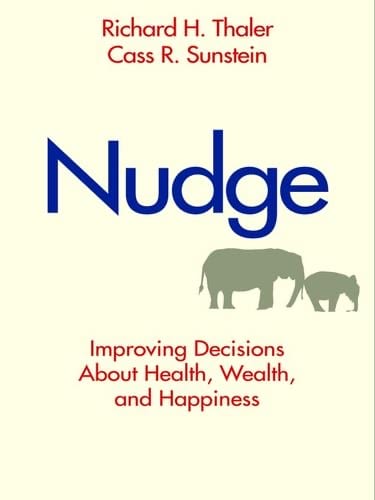
DESCRIPTION
Thaler and Sunstein offer a groundbreaking discussion of how to apply the science of choice to nudge people toward decisions that can improve their lives without restricting their freedom of choice.
My Summary
Main Ideas, Takeaways & Similarities
Questions
I. What is the problem?
A. How is this problem formulated?
B. Why is this problem important?
C. What is the history of this problem?
D. Which prominent personalities have been interested in this problem?
II. What solutions to the problem are there?
A. What are the conclusions reached?
B. By what argument(s) is the conclusion reached?
C. What facts or assumptions serve as premises?
D. When a prominent personality offers a solution, does he also argue for or against other prominent personalities? Does he raise objections to alternative solutions? Does he consider objections to his own solutions?
III. Evaluation
A. What are the advantages and disadvantages of the alternative formulations to the problem?
B. Has the importance or history of the problem ever been misrepresented?
C. Are the solutions logically related to the premises?
D. Are the facts true? Are the assumptions acceptable? Are the objections answerable?
AI Summary
Highlights
“Nudge: Improving Decisions About Health, Wealth, and Happiness” is a book written by Richard H. Thaler and Cass R. Sunstein, published in 2008. The book explores the concept of “nudging” as a way to encourage people to make better choices in various aspects of their lives. Here is a comprehensive summary of the book in bullet points:
- The book introduces the concept of “nudging,” which involves designing choices and environments to influence people’s decisions and behaviors in a positive way, without mandating or restricting their options.
- Richard H. Thaler and Cass R. Sunstein argue that people often make decisions that are not in their best interests due to cognitive biases, limited information, and external influences.
- They emphasize that nudges are a way to help individuals make choices that align with their long-term goals and well-being.
- The book discusses the principles of behavioral economics and how insights from psychology can be used to design effective nudges.
- Thaler and Sunstein provide numerous examples of nudges in various domains, including healthcare, finance, education, and environmental conservation.
- They discuss the concept of “choice architecture,” which involves structuring choices to make desirable options more appealing and accessible.
- The book explores the use of default options, such as automatic enrollment in retirement savings plans, to encourage positive behaviors.
- Thaler and Sunstein address the ethics of nudging, emphasizing the importance of transparency, choice, and individual autonomy in the design of nudges.
- They discuss the role of government and policymakers in implementing nudges to address societal challenges, such as obesity, low savings rates, and environmental conservation.
- The book provides insights into the design and evaluation of nudges, emphasizing the need for empirical testing and feedback.
- Thaler and Sunstein address objections and criticisms of nudging, including concerns about paternalism and the potential for abuse.
- They advocate for a “libertarian paternalism” approach, where nudges are designed to improve individual welfare while preserving freedom of choice.
- The book emphasizes that nudging can lead to better outcomes for individuals and society without restricting freedom or imposing mandates.
- Thaler and Sunstein reflect on the potential for nudging to promote better decisions and enhance well-being, both at the individual and collective levels.
“Nudge: Improving Decisions About Health, Wealth, and Happiness” presents a compelling argument for the use of nudges to improve decision-making in various aspects of life. Richard H. Thaler and Cass R. Sunstein’s book provides a practical and ethical framework for designing interventions that guide people toward better choices without imposing restrictions. It highlights the potential for nudging to address complex societal challenges and promote individual well-being while respecting individual autonomy.