DESCRIPTION
NATIONAL BESTSELLER STOP FOR A MOMENT. Are you here right now? Is your focus on this page? Or is it roaming elsewhere, to the past or future, to a worry, to your to-do list, or to your phone? Whether you’re simply browsing, talking to friends, or trying to stay focused in an important meeting, you can’t seem to manage to hang on to your attention. No matter how hard you try, you’re somewhere else. The consequence is that you miss out on 50 percent of your life—including the most important moments. The good news: There’s nothing wrong with you—your brain isn’t broken. The human brain was built to be distractible. The even better news: You can train your brain to pay attention more effectively. Stay with me a little longer and soon you will be able to: Focus without all the struggle. Take back your attention from the pull of distraction. And function at your peak, for all that truly matters in your life.

- Types of Attention Struggles:
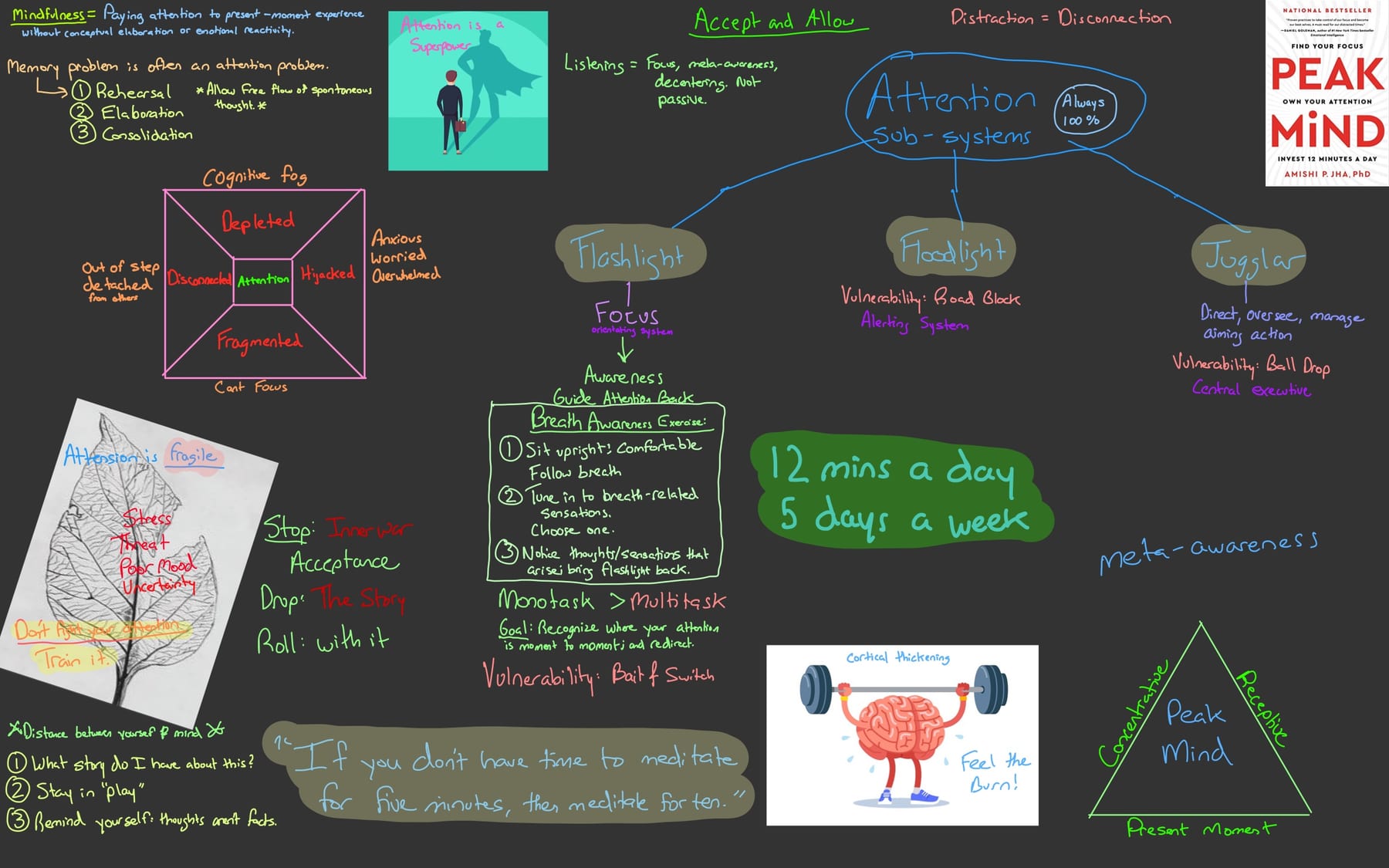
- Depleted attention: Cognitive fog.
- Hijacked attention: Anxiety, worry, overwhelming emotions.
- Fragmented attention: Inability to focus or take action.
- Disconnected attention: Feeling out of step and detached from others.
- Fragility of Attention:
- Attention is easily depleted by stress, threat, or poor mood, referred to as “kryptonite” for attention.
- Strategies for Maintaining Attention:
- Avoid fighting distractions directly; instead, cultivate the skill to position the mind effectively.
- Emphasize refocusing wandering attention, a skill critical for judgment, character, and will.
- Mindfulness:
- Defined as paying attention to the present moment without emotional reactivity.
- Regular practice (as little as 12 minutes per day) can protect against stress-related attention decline.
- Neuroscience of Attention:
- Three subsystems of attention: the “juggler” or central executive, alerting system, and orienting system.
- The “juggler” manages moment-to-moment actions and aligns them with goals.
- Challenges to Attention:
- Attention can be hijacked by stress, poor mood, and threats.
- A cycle of worsening attention and increasing stress.
- Benefits of Mindfulness Training:
- Helps to declutter the mental whiteboard, enhancing working memory and attention.
- Reduces the impact of stress on attention.
- Practical Mindfulness Exercises:
- Avoid multitasking; engage in monotasking.
- Practice breath awareness and body scans to train attention.
- Recognize and redirect mind-wandering.
- Overall Message:
- Attention is powerful yet vulnerable and needs training.
- Mindfulness is a key tool for strengthening and maintaining attention.
- Regular mindfulness practice leads to better handling of stress and enhances overall well-being.
If you’re feeling that you’re in a cognitive fog: depleted attention. If you’re feeling anxious, worried, or overwhelmed by your emotions: hijacked attention. If you can’t seem to focus so you can take action or dive into urgent work: fragmented attention. If you feel out of step and detached from others: disconnected attention. (Location 74)
attention is fragile. It can be rapidly depleted under certain circumstances—circumstances that turn out, unfortunately, to be the ones that pervade our lives. When we experience stress, threat, or poor mood—the three main things I call “kryptonite” for attention—this valuable resource is drained. (Location 112)
Don’t waste your energy trying to get better at fighting the pull on your attention. You cannot win that fight. Instead, cultivate the capacity and skill to position your mind so you don’t have to fight. (Location 141)
William James expressed the attention struggle, and the persistent lack of a solution: The faculty of voluntarily bringing back a wandering attention, over and over again, is the very root of judgment, character, and will. No one is [master of himself] if he have it not. An education which should improve this faculty would be the education par excellence. But it is easier to define this ideal than to give practical directions for bringing it about. (Location 161)
The problem is that we often don’t know what’s happening in our own minds. We lack internal cues about where our attention is moment to moment. And for this, there is a solution: pay attention to your attention. (Location 171)
The common denominator is that stressful intervals hijack attention away from the present moment. (Location 211)
Our basic definition of mindfulness was this: paying attention to present-moment experience without conceptual elaboration or emotional reactivity. I (Location 214)
mindfulness training was the only brain-training tool that consistently worked to strengthen attention across our studies. (Location 221)
if you engage in regular mindfulness practice, for as little as twelve minutes per day, you can protect against that stress- and overwhelm-related decline in attention. (Location 257)
we need to train as if our lives depend on it—because they do. Our goal: not only to survive, but also to thrive. We need to continue to navigate toward what we most want to do, whom we most want to be, and how we want to lead both others and ourselves through the inevitable stresses of life, through times of uncertainty. (Location 273)
You can start immediately. With mindfulness training we can learn to protect and strengthen our most precious resource: our attention. You can train yourself to pay attention to your attention, to know—moment to moment—what your mind is up to, if it’s serving you well, and how to intervene if it’s not. (Location 279)
“How many passes did you count?” Anybody who answers “Fifteen” is correct. But there’s another question. “Did you see the gorilla?” The response to that is usually total confusion. What gorilla?! (Location 398)
What is my attention highlighting right now? What is it shutting out? And how does this factor into the experience I have of my life? (Location 414)
Your brain is built for bias. (Location 416)
evolutionary pressures are actually what have led to many of its biases. (Location 422)
Out of those 200 degrees that you can perceive, you have high visual acuity in just two of them. (Location 432)
So far I’ve been talking about attention as if it were a single brain system—one that you can direct somewhere to selectively enhance information processing. But this is only one form of attention. There are actually three subsystems that work together to allow us to fluidly and successfully function in our complex world. (Location 492)
To direct, oversee, and manage what we’re doing, moment to moment, as well as ensure that our actions are aligned with what we’re aiming to do: this is the job of the juggler. This subsystem is what people are referring to when they talk about “executive function,” and the formal name for it is actually the “central executive.” (Location 510)
Importantly, you use your juggler to override automatic tendencies (like picking up that phone at every ping), as well as to update and revise a goal based on new information that’s come in, and to refresh the goal to remind you of what you are aiming to do. Override. Update. Refresh. (Location 522)
effective as your attention can be when it’s in any of these three modes, it won’t typically operate in multiple modes at once. (Location 528)
Attention is powerful, but it’s not invincible. Certain circumstances are potent kryptonite for attention. And unfortunately, they just so happen to be the circumstances of our lives. (Location 606)
attentional hijacking. (Location 618)
The neuroscience literature points to three main factors that determine when our attention is deployed: (Location 639)
Familiarity. (Location 640)
Salience. (Location 642)
Our own goal. (Location 646)
Three major forces degrade our attention: stress, poor mood, and threat. (Location 657)
When you experience too much stress for too long, you get caught in the downward spiral of attention degradation: the worse attention gets, the less you’re able to control it; the less you’re able to control it, the worse stress gets. (Location 665)
If you feel threatened all the time, you aren’t going to be able to engage deeply in any other task or experience. And it doesn’t matter whether the “threat” in question is a literal one or a metaphorical one. (Location 701)
stereotype threat. (Location 718)
Think of all the ways you might categorize yourself—by gender, race, sexual identity, ability or disability, weight, appearance, socioeconomic background, educational background, nationality, religion, work experience or inexperience. No matter the historical or prejudicial forces driving our experience of stereotype threat, when we feel it, it undermines our performance, our goal achievement, and even our overall psychological well-being. This is the cultural soup we live in. As great as it would be if we could just drain it away, we can’t. Stereotype threat can put us constantly “on alert” in ways that keep our attention diffused, shallow, and unable to focus. (Location 748)
uncertainty itself adds a preoccupying cognitive load that further depletes attention. (Location 770)
In our lives, what we consider challenging situations are often “conflict states.” There is a mismatch between what we perceive is happening and what should be happening. Our minds experience these conflicts in different ways: Resisting Mind: We may want whatever is happening to stop—filling us with fear, sadness, worry, resentment, or even hatred. Doubting Mind: We may have a distrust in our assessment of what is or should be happening, increasing our sense of doubt. Restless Mind: We are restless and agitated, uncertain about what is occurring but dissatisfied nonetheless. Craving Mind: We may want more of what is happening, leaving us desiring and craving for it. (Location 829)
can’t be efficiently “figured out” in that way. The reason that conflict states are attention-draining: they keep summoning attention over and over again. This continuous engagement of attention depletes it. (Location 838)
While there is substantial research that positivity is beneficial under many circumstances, tactics like positivity or suppression are not merely ineffective during periods of high stress and high demand—they can be actively damaging. (Location 862)
brain—has incredible neuroplasticity, meaning that it can reform or reorganize itself, depending on the input it receives and the processes it engages in with regularity. (Location 899)
mindfulness meditation—anchoring (Location 988)
The common advice we hear is suppress—don’t think about it right now. (Visualize something positive instead.) The new science of attention says no—instead, accept and allow. Trying to suppress has a paradoxical effect: it keeps the content in your working memory longer, because you have to actively remind yourself to keep suppressing. (Location 1104)
stress hijacks your attention away from the present moment. (Location 1113)
under higher demand: mindfulness could indeed stabilize attention. (Location 1184)
We are collectively and chronically addicted to thinking and doing, which is why shifting into a being mode does not come easily to most of us. It requires training. (Location 1239)
A peak mind is a mind that doesn’t privilege thinking and doing over being. It masters both modes of attention. It is focused and receptive, and with this balance we can overcome and rise above our attentional challenges. This is how we win the unfair fight. (Location 1241)
Attention is powerful. Attention is vulnerable. Attention is trainable. (Location 1255)
What load theory boils down to is this: the amount of attention you have remains constant. It just gets used differently, and maybe not how you want it to be used. (Location 1372)
You always use 100 percent of your attention. Attention always goes somewhere. So the question becomes: Where? (Location 1378)
There’s a big cost to task-unrelated thought. When we mind-wander, it rapidly becomes a problem in three major ways: (Location 1416)
You experience “perceptual decoupling.” (Location 1417)
You make mistakes. (Location 1421)
You amp up your stress. (Location 1430)
Because you always use 100 percent of your attention (load theory), it always goes somewhere, so if you’re not focused on your current demands, it may very well be because you are mind-wandering (experiencing task-unrelated thought) and are not mentally present in your current surroundings (perceptual decoupling). Mind-wandering is something your brain is predisposed to do, for various reasons involving, but not limited to, fast-moving saber-toothed tigers (inhibition of return), and it likely drives the vigilance decrement, which ensures that the longer you do something, the worse you’ll perform. While mind-wandering may have its roots in something useful (opportunity costs, attentional cycling), it’s bad for our ability to perform well on what we are trying to do (our “task-at-hand”) and our mood. Now that we know why we wander, we need to talk about what we can do about it. The first step is a simple one: (Location 1523)
LEARN TO RECOGNIZE THAT YOU’RE MIND-WANDERING (Location 1531)
A crisis of attention can happen anytime you don’t allow yourself a break—when you don’t allow your mind to “rest” without having any task-at-hand. Remember our distinction between mind-wandering (having off-task thoughts during a task) and daydreaming (task-free spontaneous thought and opportunity for conscious reflection, creativity, and the like)? (Location 1583)
Well, one problem today is that we are always engaged in something. (Location 1586)
Hypertasking is hyper-taxing! Even something you might think of as relaxing (scrolling through Instagram, for example, or reading an article someone shared) is more engagement. (Location 1595)
Finding Your Flashlight To find your focus, the first skill you need to develop is to notice when your attentional flashlight has wandered away from the task-at-hand. In this first “core exercise,” your goal is to repeatedly find your flashlight. This is the workout: orient attention to a target object, notice when it wanders off-target, and then reorient it back to the target. (Location 1602)
The more often you gently guide your attention back, the more easily it will follow—just (Location 1611)
Breath awareness can seem deceptively simple: focus your attention on your breath, and when the mind wanders, return it. (Location 1625)
The breath awareness exercise targets all three systems of attention, because it allows you to practice focusing—as you orient attention to the breath; noticing—staying alert and monitoring ongoing mental activity to detect mind-wandering; and redirecting—executive management of cognitive processes to make sure we return and remain on-task. (Location 1627)
CORE PRACTICE: FIND YOUR FLASHLIGHT (Location 1645)
The events in this sequence are: focus your flashlight, hold it steady, notice when it drifts, and then redirect it back to the breath. (Location 1666)
DON’T MULTITASK! (Location 1684)
monotask as much as possible. (Location 1722)
YOU WILL STILL NOT ACHIEVE PERFECT, UNFLINCHING FOCUS (Location 1740)
one of the most important tenets of mindfulness training: the point is not that you’re never going to get distracted. That’s not possible. The goal, rather, is to be able to recognize where your attention is moment to moment so that when you do get distracted, you can easily and adeptly move your flashlight back to what it needs to be on. (Location 1764)
how do you keep important content on your whiteboard longer if you need more time? Simple: keep paying attention to what’s there. (Location 1795)
we don’t always realize that we are overloaded. (Location 1955)
You’ve learned by now how powerful salient distractors can be. Anything especially salient, or “loud” (literally or metaphorically), will definitely capture your attention, whether it’s in your external environment (producing sights, sounds, or other sensations) or in your mindscape (thoughts, memories, emotions). One of the ramifications of this is that once the “loud” thing lands in your working memory, it may write over what you were trying to hang onto. Result: whatever previous content you were in the process of either maintaining (keeping the traces active for use) or encoding (“writing” more permanently into long-term memory) is disrupted. This form of disruption highlights again how deeply intertwined working memory and attention are. (Location 1966)
Working Memory and the Three Subsystems of Attention (Location 1972)
The flashlight encodes information and maintains it in working memory, “retracing” it on the whiteboard to keep it there for longer. — Key vulnerability: Bait and Switch When your attention is automatically “captured” or yanked by something salient, this more exciting (to your attention) content overwrites what was being maintained. Voluntary attention then starts retracing this new content. The prior information is lost forever, gone without a trace. The floodlight gains access to the whiteboard to accomplish an urgent goal. Under acute threat or stress, your alerting system temporarily blocks access to working memory to ensure that your brain’s action systems prioritize basic survival behaviors (fight, flight, freeze) over any other goals or plans. — Key vulnerability: Road Block The alerting system can be set off by feelings of threat, even when there is no real danger. This temporarily cuts off access to working memory and impairs any functions that rely on it (like long-term memory, social connection, and emotion regulation). The juggler keeps your current goals active on the whiteboard, and updates these goals as circumstances change. — Key vulnerability: Ball Drop Overload, blanking, and distraction in working memory all derail the central executive’s juggler, leading to lost goals and misguided behaviors. The juggler drops the ball. (Location 1975)
STRESS-RELATED MENTAL TIME TRAVEL YANKS THE ATTENTIONAL FLASHLIGHT AWAY FROM OUR PRESENT-MOMENT EXPERIENCE AND INCREASES THE CLUTTER ON OUR MENTAL WHITEBOARD. (Location 2024)
MINDFULNESS TRAINING HELPS TO DECLUTTER THE MENTAL WHITEBOARD, SO THAT WORKING MEMORY WORKS BETTER. (Location 2028)
We need to stop holding down the rewind or fast-forward buttons and stay in play, to experience every note in the song of our lives, to hear and take in what’s happening around us. (Location 2111)
As you train yourself to monitor what’s happening in the present moment, you’ll default less and less to long, unproductive, and off-task bouts of mental time travel. You’ll get better at noticing mind-wandering and asking: What are the contents of my working memory right now, and are they supporting me for what is needed right now? Or would shifting back to the present moment be best? If so, redirect your attention back to the sights, sounds, and demands of the present moment. (Location 2118)
CORE PRACTICE BOOSTER: WATCH YOUR WHITEBOARD Repeat the previous steps. We begin the same way we did with the basic Find Your Flashlight in chapter 4, by sitting in a chair, comfortable but upright, resting your hands in your lap, and closing or lowering your eyes (to limit visual distraction). Again, select prominent breath-related sensations. Remember the metaphor of your attention as a flashlight, the beam pointing toward your selected breath-related body sensation. When your flashlight drifts to something else … Notice where it goes. This is a new step! In the first exercise, I asked you to notice if attention wandered away, and if so to immediately move your flashlight back to your breath. This time, I want you to pause for a moment and observe where the flashlight is now directed. Give it a label. Identify what type of distraction has appeared on your whiteboard. Is it a thought, an emotion, or a sensation? A thought could be a worry, a reminder, a memory, an idea, an item on your to-do list. An emotion could be a feeling of frustration, an urge to stop doing the practice and do something else, a twinge of happiness, a swell of stress. A sensation is something in your physical body: An itch. A sore muscle. Noticing that your back hurts from sitting there, or noticing something you heard, smelled, touched, or saw (such as a door slamming, food cooking, the cat jumping in your lap, lights flashing). (Location 2126)
Make this a quick process. Notice if you begin going down a rabbit hole of elaborating on the distraction, or asking why you are thinking about this particular topic, or defaulting to unsupportive habits like chastising yourself for getting distracted in the first place. It is not your job right now to answer these questions or reprimand yourself. Now is actually the time to notice what is on your whiteboard but not to engage with it. Just label the contents as best you can from these three categories: thought, emotion, sensation. And then … Move on. Come back to the present moment, back to your breath, after every instance of labeling. If it’s a strong experience, it might pop up repeatedly—then just label it again. Repeat. Each time you notice yourself mind-wandering, tag the content of your mind-wandering (as thought, emotion, or sensation) and then come back to your breath. (Location 2138)
If I’m distracted, is there a cost? If I miss this moment, is that important to me? (Location 2158)
When we stay in play—when we are filling up our whiteboards with the present moment—we have a much greater chance of encoding that moment into long-term memory. We all want to “remember better.” Can mindfulness help us also press the record button? Yes. But pressing record isn’t quite as straightforward as it may seem. (Location 2211)
What we think is a memory problem is often an attention problem. (Location 2247)
purpose of memory is not to allow us to savor the past, but rather to help us act in the world now. (Location 2290)
feature of memory is once again yoked to attention, which privileges novel and outlier events. (Location 2294)
Forgetting is a good thing. It’s a feature, not a flaw in our biological makeup. (Location 2311)
Using digital devices like phones and laptops to record what we most want to remember ends up having the opposite effect. (Location 2345)
lot of the issues we see around memory and aging are actually misattributed. The problem is not “you’re losing your memory.” Rather, the problem is “you weren’t paying attention and failed to encode.” (Location 2393)
Like attention, memory must serve as a filter, selecting what’s relevant and what’s not, what should be highlighted, and what should be dumped. (Location 2398)
To remember, you do three critical things. The first: rehearsal. You trace over information—the (Location 2417)
Then: elaboration. Similar to rehearsal, this involves relating new experiences or facts to knowledge or memories you already have. You can store a much stronger memory for things when you already have a base of knowledge. (Location 2421)
finally: consolidation. This is what happens as you’re performing the above two functions, and it ultimately leads to the memory being stored. As the brain replays information, it’s laying down new neural pathways and then going over them, strengthening those new connections. (Location 2426)
If your attention is constantly engaged, with zero mental downtime for you to experience the emergence of conscious spontaneous thought, you may be degrading the link between working memory and long-term memory. You’re disabling vital consolidation processes. (Location 2432)
Salient in your inner landscape are things that are: Self-related Emotional Threatening Novel (Location 2453)
one way to boost our chances of remembering the things we care about is to use mindfulness training to root ourselves in the body. (Location 2473)
CORE PRACTICE: BODY SCAN As with the other practices, begin by sitting comfortably, closing your eyes, and finding your flashlight: bring your attention to your breath sensations. But now, we’re not going to keep it there, on the breath. We’re going to move it through the body. We’re going to keep that focus—that beam of attention—concentrated, though the focus will move, sweeping slowly, like a searchlight through the body. Start by directing your attention to one of your toes. Take note of whatever sensations you notice there. Cold? Warm? Tingling? Tightness in your shoes? Nothing? Notice it, then move on to the other toes, and the other foot. Go slowly! If you’re trying this for three minutes, as with the last exercise, think of your body in thirds and take about a minute with each section. Gradually move your attention up from your lower body—your lower legs and then your upper legs—to your core: the pelvic area, lower torso, upper torso; to your upper body: your shoulders, upper arms, lower arms, and hands. Then finally move attention up to your neck, your face, the back of your head, and finally the top of your head. Pay attention to each sensation—or lack of sensation—rising and falling away, moment by moment, but don’t fixate on it. Move the flashlight along. Throughout this practice, as you are moving your attention slowly up your body, whenever your mind wanders simply return it to the area of the body where your attention was directed before the mind-wandering occurred, then continue. (Location 2493)
if you want to remember the things you experience and the things you learn, you need to allow for the free flow of spontaneous thought. If your days are all engagement, all the time, you’re skipping a critical step we discussed earlier: opportunities for consolidation. (Location 2538)
have space to let the mind roam free, unconstrained by any task or demand. (Location 2558)
Remind yourself that these unconstrained mind moments are valuable—more valuable than filling every second with tasks. (Location 2562)
Simulations allow us to: try out various options; project ourselves into the past, the future, or even into other people’s minds; and create vivid versions of reality that guide decision making. (Location 2675)
Our virtual-reality capabilities are a double-edged sword: our simulations can be too good. (Location 2689)
Jim Carrey: “Our eyes are not only viewers, but projectors that are running a second story over the picture we see in front of us all the time.” (Location 2711)
This incessant simulating we do (largely by default) quickly becomes a problem when: (Location 2715)
You’re simulating “kryptonite.” (Location 2716)
Your simulation causes you to make decisions that don’t align with your longer-term goals or sense of civility. (Location 2720)
Your simulations lead you to a mental model that is wholly wrong … causing your course of action to skew wrong. (Location 2724)
Nuanced, flawed, and incomplete content is often the raw material feeding our simulations, from both long-term memory and the world around us, and the current brain science suggests that we have little to no conscious awareness of it. (Location 2767)
In this mindful mode, you don’t try to predict or strategize or analyze—you merely, but mindfully, observe. (Location 2780)
training the mind to be able to shift into a mindful mode vs. the highly prevalent simulation mode is a necessary safety net—because your mind is so prone to doing everything listed in the right-hand column. (Location 2789)
“Mindful Mode” vs. “Simulation Mode” (Location 2791)
Without intervention, we live our lives almost entirely in simulation mode. (Location 2805)
We need to be able to shift out of a simulation mode into a mindful one so that we can open our eyes and see what is actually around us vs. the virtual reality of our making. (Location 2807)
peak mind “cheat sheet” (Location 2817)
Know that you will have a story. (Location 2819)
Step one is realizing this and noticing it whenever you can. Asking yourself “What story do I have about this?” is a good habit to get into. (Location 2820)
Stay in “play.” (Location 2821)
Remind yourself: thoughts aren’t facts! (Location 2825)
way that you do this is by putting some distance between yourself and the current contents of your mind. (Location 2828)
Decenter: Take a distanced, observational view. Watch the memory unfold from an “audience” perspective. Accept any feelings associated with the memory, letting them arise and pass away. (Location 2856)
Decentering is a powerful technique because it weakens the hold that mind-wandering episodes can have on our attention. (Location 2877)
On-Demand Practice: “Bird’s-Eye View” Get the data. Observe yourself and the situation at a distance. Get the raw data of what you are experiencing, not an analysis of it. Replace. Watch your inner dialogue and distance yourself from it. It helps to replace “I” statements with “you” or your name. Better yet, just notice what is coming up: Amishi thinks she can’t get this done. She’s afraid her talk won’t go well. Remember that thoughts come and go. As thoughts bubble up, remember that thoughts are merely constructions in your mind; they will appear and they will fade away. I pictured each thought as a bubble, floating away into the sky. (Location 2895)
You can cultivate an awareness of which simulations or elaborations are filling up your working memory without sacrificing decisiveness and action. In fact, having that awareness enhances those abilities by giving you the flexibility not only to reframe a situation, but to de-frame it based on the raw data that emerge. (Location 2923)
“Dropping the Story” (Location 2925)
the first critical step to dropping the story is to know that you have one. And that is one of the most challenging attentional skills to build. (Location 2962)
We’re used to living in action mode: thinking and doing. Mindfulness training unlocks a new mode: noticing, observing, and being. (Location 2977)
Dropping the story, then, is not a single action, but rather an ongoing process—one that requires you to become aware, over and over, of what’s happening not only around you, but also inside your own mind. (Location 3003)
We are paying attention. But our attention is too narrow or too wide, too stable or too unstable. You’re paying attention in some way successfully—but it’s not appropriate for the moment. To correct that, you need meta-awareness. (Location 3035)
What am I perceiving? How am I processing it? And is the form my attention is taking aligned with my goals? (Location 3076)
The problem is not mind-wandering—the problem is mind-wandering without meta-awareness. (Location 3117)
meta-awareness goes up, mind-wandering goes down. (Location 3173)
Our goal with mindfulness training is to increase our meta moments so that we can actually execute the attentional pivots that are so critical for our success and well-being. (Location 3186)
CORE PRACTICE: RIVER OF THOUGHT (Location 3215)
Would you run outside to talk to every person who walks by your house? No. So treat the thoughts that arise for you throughout the day in the same way. You can’t stop them from coming any more than you can stop people from walking down your street. But you can change the way that you interact with them. You can decide when to engage with them, and when not to, and instead allow them to pass by. (Location 3250)
High-quality interactions require high-integrity mental models. And to make them, we need to draw on all our attentional skills: Pushing the flashlight where we want it to be. Resisting or correcting the pull of salient distractors. Simulating but also dropping the story when the mental model is wrong—when it doesn’t match up with the other person’s. (If you’ve ever used the phrase “not on the same page,” you know what that feels like.) And finally, you need that meta-awareness piece to implement it all. (Location 3354)
Distraction = Disconnection (Location 3360)
poor mood degrades working memory, and a degraded working memory causes more poor mood. (Location 3397)
We need to be aware of our emotional state so we can intervene to regulate it, as needed. (Location 3401)
Suppression is fueled by executive attention and working memory, and it requires these resources to continue to do the suppressing. While you’re actively suppressing, it leaves less cognitive bandwidth to do much else. (Location 3421)
stop, drop, and roll. Stop the inner war against the actual circumstances—just accept them. It is what it is. Let me be clear: this does not mean that you are “all good” with the situation. It has nothing to do with your judgement about the actual event. It just means that you are accepting the actuality of what has occurred. Drop the story—your assessment of this situation is merely one story. Not the only one. Roll with it—keep going, keep moving, get curious about what the next moment will bring. (Location 3431)
It’s easy to think of “listening” as a passive thing. In fact, it’s quite active and demanding, if you do it well. It takes your attentional control, your emotional regulation, and your compassion. It takes focus, meta-awareness, and decentering. It’s not passive at all. It’s heavy lifting. And it’s extraordinarily valuable. To listen, really listen, is often the “action” we most urgently need to perform. This story of how attention changed the course of a conflict gives me hope. It shows us what presence—so simple, yet so difficult—can actually achieve. (Location 3462)
peak mind is not about striving to get somewhere else. It’s simpler, more elegant, and doable. I think of it like a triangle: the base is the present moment, and the sides are two forms of attention—one side, receptive attention so we can notice, observe, and be, and the other side, concentrative attention so we are focused and flexible. (Location 3502)
During a difficult interaction, take a moment to pause. It can be the length of one breath. Or, before a difficult interaction, take a moment and picture this person. Then, remind yourself: “This person has experienced pain, just like me. This person has experienced loss, just like me. Joy, just like me. Was born from a mother, just like me; will die someday, just like me.” If these phrases don’t resonate with you, feel free to substitute with other phrases that emphasize the common humanity we share with others. (Location 3535)
CORE PRACTICE: CONNECTION PRACTICE (Location 3567)
So why aren’t we getting the same kind of science-backed guidance on how to keep our minds fit? (Location 3690)
Note: Draw exercise and use to visualize
better attention—to achieve better performance, better emotion regulation, better communication and connection—one form of mental training consistently shown to work is mindfulness training. It’s no longer a mystery: mindfulness practices can train the brain to operate differently by default. (Location 3692)
improvements in attention and working memory. Less mind-wandering. More decentering and meta-awareness. (Location 3700)
we see changes in brain structures and brain activity that correspond with these improvements over time: cortical thickening in key nodes within the networks tied to attention (think of this as the brain’s version of better muscle tone for the specific muscles that a workout targets), better coordination between the attention network and the default mode network, and less default mode activity. (Location 3702)
Tags: blue
Note: Draw a brain and show the links
positivity training was not only less effective than the mindfulness training, it appeared to be actively depleting attention and working memory in these predeployment soldiers. (Location 3751)
Tags: orange
positivity requires reappraisal and reframing, (Location 3753)
Tags: orange
Minimum Effective Dose (Location 3797)
Tags: orange
Mindfulness training does indeed have a dose-response effect, which means the more you practice, the more you benefit. (Location 3834)
Tags: orange
The key is having a goal that is not just inspiring, but possible. (Location 3837)
Tags: orange
practice twelve minutes a day, five days a week. (Location 3839)
Tags: pink
You know what they say: if you don’t have time to meditate for five minutes, then meditate for ten.” (Location 3867)
Tags: pink
The point wasn’t getting the grass watered. The point was that he watered the grass. (Location 3950)
Note: Find an activity for myself that is an mindfulness exercise
When you wake up in the morning, don’t roll over and grab your phone, or hop right up. Lie on your back. Take ten or even just five deep breaths. Focus on the breath. And maybe notice the thoughts that arise. It’ll give you insight—information about yourself, your mind, your attention—that you can use today. (Location 3958)
mindful teeth brushing. (Location 3961)
shield his attention from the “loop of doom.” (Location 3976)
Why was her husband so naturally terrible at one aspect of attention, and great at another? Where do these natural abilities and vulnerabilities come from? (Location 3980)
Note: Goal to be present and use apps to keep track of tasks calendars dates instead of relying on active memory so I can live more completely
One of the challenges we have is that after a week or two of participating in a mindfulness training course, some people say, “I feel worse, I feel more stressed.” My answer to that? It’s a good sign. It means it’s working. You temporarily feel worse because you’re becoming more meta-aware. (Location 3989)
It’s not that these things are happening more—it’s that you’ve become more aware of them. (Location 3993)
That moment, the moment of “Do I really need to do twelve minutes?” or “How much longer until the timer goes off?” or “Can’t I do a different practice?”—that’s your “mental burn.” It’s the equivalent of a muscle burn as you do a squat, though it feels like restlessness. Boredom. Discomfort. Walt Piatt says that his service members like to say, “Embrace the suck.” (Location 4010)
positivity and relaxation don’t work under high stress. You’re spending your cognitive fuel trying to build that lovely, imaginary world instead of building your core capacities: The ability to notice where your attention is, to bring your mind back when it wanders. The ability to fill your whiteboard with the present-moment experience. The ability to resist story-making and to simply observe. The ability to become aware of when your mind needs to be redirected. These are the skills that will serve you, especially during challenging circumstances. (Location 4022)
body-scan practice. (Location 4058)
I asked the girl to close her eyes. I asked her what was happening in her big toe. In her knees. In her stomach. I asked her to describe what she was feeling. Afraid, she said. I asked her what the fear felt like. She told me it felt like butterflies in her stomach, then like a tightness in her chest. She got calmer, even as she was more attuned to the fear she was feeling. (Location 4058)
distress tolerance—our (Location 4073)
builds our understanding and confidence that we can tackle what’s coming. (Location 4075)
new science of attention is that for us to lead full and successful lives, attention must not only be focused for us to take action, but it must also be receptive so we can notice and observe. (Location 4170)
Having a peak mind means living fully in the face of everything we have to deal with as human beings. Through stress and grief, through joy and tragedy. (Location 4195)
three types of practices that work to strengthen attention. (Location 4212)
goal was to direct your attention first to a specific target object—your breath (Find Your Flashlight)—and (Location 4214)
bodily sensations (Body Scan), (Location 4215)
Focus, maintain, notice, redirect. (Location 4217)
second category (Location 4218)
keeping watch, (Location 4218)
attention should be receptive and broad. (Location 4219)
open monitoring practices (Location 4219)
noticing, monitoring, receptive, open. (Location 4221)
meta-awareness, (Location 4225)
Researchers on the science of behavior change and habit creation recommend choosing an “anchor activity” for any new thing you want to add to your day. When you do the “anchor,” you perform the new habit you want to build. So, for example, your anchor could be coffee: “When I turn on the coffee maker to brew, I sit down and do my practice.” (Location 4249)
Note: How can I apply this to my daily routine?
Week One (Location 4260)
Week Two (Location 4315)
Week Three (Location 4369)
Week Four (Location 4415)
Weeks Five Through Forever (Location 4464)
The Peak Mind Pivot (Location 4488)