DESCRIPTION
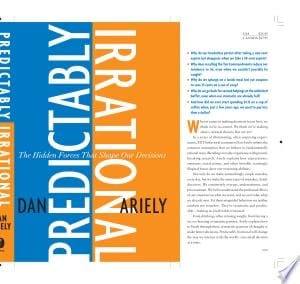
Intelligent, lively, humorous, and thoroughly engaging, “The Predictably Irrational” explains why people often make bad decisions and what can be done about it.
My Summary
Main Ideas, Takeaways & Similarities
Questions
I. What is the problem?
A. How is this problem formulated?
B. Why is this problem important?
C. What is the history of this problem?
D. Which prominent personalities have been interested in this problem?
II. What solutions to the problem are there?
A. What are the conclusions reached?
B. By what argument(s) is the conclusion reached?
C. What facts or assumptions serve as premises?
D. When a prominent personality offers a solution, does he also argue for or against other prominent personalities? Does he raise objections to alternative solutions? Does he consider objections to his own solutions?
III. Evaluation
A. What are the advantages and disadvantages of the alternative formulations to the problem?
B. Has the importance or history of the problem ever been misrepresented?
C. Are the solutions logically related to the premises?
D. Are the facts true? Are the assumptions acceptable? Are the objections answerable?
AI Summary
Highlights
“Predictably Irrational: The Hidden Forces That Shape Our Decisions” is a book by Dan Ariely that explores the quirks and biases in human decision-making processes. It sheds light on the irrational aspects of our choices and the underlying psychological factors that influence them. Here’s a comprehensive summary in bullet points:
Title: Predictably Irrational: The Hidden Forces That Shape Our Decisions
Content Overview:
- Introduction: The Puzzle of Irrationality:
- Introduces the concept of irrational decision-making.
- Poses questions about why people often make choices that seem contrary to their best interests.
- The Truth About Relativity:
- Discusses the impact of relativity on decision-making.
- Explains how our choices are influenced by the context in which they are presented.
- The Fallacy of Supply and Demand:
- Examines the effect of supply and demand dynamics on pricing and consumer behavior.
- Introduces the concept of “arbitrary coherence.”
- The Cost of Zero Cost:
- Explores how the word “free” influences our decisions.
- Discusses the hidden costs associated with free products or offers.
- The Cost of Social Norms:
- Investigates the role of social norms in shaping behavior.
- Discusses experiments related to social norms and fairness.
- The Influence of Arousal:
- Examines the impact of emotional arousal on decision-making.
- Discusses how heightened emotions can lead to impulsive choices.
- The Problem of Procrastination and Self-Control:
- Explores the challenges of self-control and procrastination.
- Discusses strategies for overcoming procrastination.
- The High Price of Ownership:
- Analyzes the phenomenon of the endowment effect.
- Explores how ownership influences our attachment to possessions.
- Keeping Doors Open:
- Discusses the concept of “opportunity cost” and its role in decision-making.
- Explores the reluctance to commit to choices that close off other options.
- The Effect of Expectations:
- Examines how expectations shape our experiences and perceptions.
- Discusses the placebo effect and its implications.
- The Power of Price:
- Investigates the psychological impact of price and perceived value.
- Discusses the influence of premium pricing on consumer choices.
- The Context of Our Character, Part I:
- Explores the impact of external cues and environments on moral decision-making.
- Discusses experiments related to cheating and honesty.
- The Context of Our Character, Part II:
- Continues the exploration of moral decision-making and dishonesty.
- Discusses the role of social contracts and trust.
- Beer and Free Lunches:
- Discusses the concept of behavioral economics and its implications.
- Encourages readers to be aware of their irrational tendencies and make better decisions.
Legacy:
- “Predictably Irrational” has had a significant impact on the field of behavioral economics.
- It has popularized the idea that humans are predictably irrational and influenced how businesses and policymakers approach decision-making.
- The book provides numerous real-world examples and experiments to illustrate the hidden forces that shape our choices, making it accessible and thought-provoking for a wide audience.