DESCRIPTION
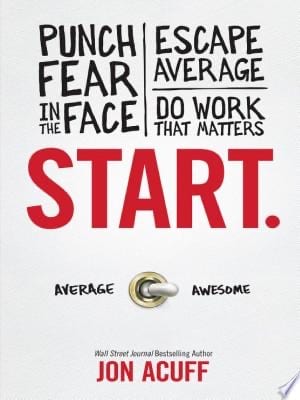
Wall Street Journal best-selling author Jon Acuff reveals the steps to getting unstuck and back onto the path of being awesome. Over the last 100 years, the road to success for most everyone has been divided into five stages that mirror the decades of working life: Your 20s are a period of Learning. This is the decade of trying a thousand things, exploring a multitude of interests, and discovering what really motivates you. Your 30s are a period of Editing. This is the decade of sorting out interests, where you discover what you really care about and who you really are. Your 40s are a period of Mastering. This is the decade of narrowing focus, honing skill sets, and becoming an expert in your field. Your 50s are a period of Harvesting. This is the decade of reaping the benefits of good decisions and enjoying the highest income-earning period in a career. Your 60s are a period of Guiding. This is the decade of mentoring, training, and encouraging others on their own road to success. Every successful person has followed these steps regardless of their occupation. But three things have changed the path to success and erased the decades associated with them: Finish lines are dead – Boomers are realizing that a lot of the things they were promised aren’t going to materialize, and they have started second and third careers. Anyone can play – Technology has given access to an unprecedented number of people who are building online empires and changing their lives in ways that would have been impossible years ago. Hope is boss – The days of “success first, significance later,” have ended. A new generation doesn’t want to change the world eventually; they want to change it now through the wells they kickstart in Africa and the TOMS they wear on their feet. The value system has been flipped upside down. The result is that you’ve got an entire generation pushing down to start over, another generation pushing up to start for the first time, and in the middle of this collision, the tools to actually change the world. Experience years now trump chronological age. And while none of the five stages can be skipped, they can be shortened and accelerated. There are only two paths in life: average and awesome. The average path is easy because all you have to do is nothing. The awesome path is more challenging, because things like fear only bother you when you do work that matters. The good news is Start gives readers practical, honest, actionable insights to be more awesome, more often. It’s time to punch fear in the face, escape average, and do work that matters. It’s time to Start.
Highlights
Here is an extensive bullet point summary of the key ideas from the book Punch Fear in the Face, along with some of your highlighted passages:
The Map of Awesome Life Stages
- Everyone goes through 5 stages: Learning, Editing, Mastering, Harvesting, Guiding
- In your 20s, you’re in Learning stage. In 30s, you Edit to focus on passions. In 40s, you Master your craft. In 50s, you Harvest the benefits. In 60s, you Guide others.
- You don’t have to wait until traditional ages to move through the stages. You can “game the map” and accelerate your progress.
Facing Your Fears
- “Write down what your voices of fear and doubt tell you. Mock them. Make them face the truth.”
- Fear argues both extremes: “Don’t chase dreams” or “Do it perfectly.” Knock its legs out.
- Share your fears with others. You’ll see you’re not alone. Look for root patterns.
Living with Purpose
- “Forget finding purpose. Live with purpose.” Purpose often finds you mid-stride.
- Don’t get stuck trying to “name your passion.” Just start taking small steps.
Escaping Average
- Do an “average audit” of areas feeling stagnant: physical, spiritual, financial, family, social, intellectual, career.
- Be realistic about current circumstances but unrealistic about future.
- “Some beats none.” Any progress is better than nothing.
Learning Stage
- Audit your time. Find 30 mins to “rescue” for your dreams.
- Give yourself grace when you stumble back to average. Perfection not the goal.
Editing Stage
- “What gives me the most joy?” Don’t start with money or convenience.
- Write a “wild success paragraph” for each passion. Which brings most joy?
Mastering Stage
- Admit you may not have just one clear dream. Try tactics anyway.
- Find events, volunteering opportunities, part-time jobs to help you improve.
- Focus on reps and keep failing forward.
Harvesting Stage
- Create small finish lines so every day/week has some “harvest.”
- Don’t be a jerk. Check if your ego has climbed any “entitlement ladders.”
Guiding Stage
- Make sure fame and success are just side effects, not your reason for being.
- When’s the last time you failed at something new or took a risk? Get uncomfortable.
- Be deliberate about guiding others each week.
I’ve included some of your highlighted passages inline in the summary as well to emphasize key points. Let me know if you need any clarification or have additional questions!
Citations:
[1]
https://ppl-ai-file-upload.s3.amazonaws.com/web/direct-files/7742445/748f695b-c501-4dec-9c8c-6b055a090f13/paste.txt
the best map in the world doesn’t matter if you don’t know where you are.”
most of us, when it comes to figuring out where we’re headed in life, never stop to ask the simple question, “Where am I?”
“What do you do when all the excuses you used to not chase your dream are gone? What do you do then?”
every awesome life has gone through the same five stages. 1. Learning 2. Editing 3. Mastering 4. Harvesting 5. Guiding
In your 20s, you resided in Learning.
In your 30s, you moved on up to Editing.
You prioritized your passions. You eliminated old habits that wrecked you in your 20s and concentrated on doing more of the things you love and less of the things you hate. It was a winnowing period. You focused your career, your relationships, and every part of your life.
In your 40s, you ascended to Mastering.
In your 50s, you basked in Harvesting.
your 60s, you entered a place of Guiding.
Retirement is dead.
Hope is boss.
Once you know how the map works, you can shorten the time you spend in each destination. You can game the map. You don’t have to wait until you are 50 to harvest. You don’t have to wait until you are 40 to be an expert. And you don’t have to be 20 to start a new adventure.
You used to turn sticks into swords or dirty flip-flops into glass slippers. You climbed trees and made forts and thought being a doctor wasn’t out of reach. Nothing was out of reach. Then, somewhere along the way, you lost it.
When a parent, a boss, a teacher, a spouse, or a friend tells you what you can’t be, they’re predicting a future they don’t control. They don’t know what 25 or 35 or 55 looks like for you.
What if, when he didn’t make the varsity basketball team his sophomore year of high school, Michael Jordan’s dad had pulled him aside and, putting his arm around a young Michael, said, “You know you’re not going to play in the NBA, right? You know that’s not in the cards for you, don’t you?”
Age is no longer the primary factor that determines where you are on the map. Life is now less about how old you are and more about when you decide to live.
Regardless of your age or station in life, it all comes down to one simple truth: you just have to start.
Fear tends to argue both sides of the coin, leaving you absolutely no room to stand. Here are two of the complete opposite things it will tell you: “Don’t chase your dream at all.” And, “If you chase your dream, you have to do it all at once.”
The start is the only moment you’re the boss of.
We want to plan the road to awesome. We want to talk about our ten-year visions. We want to detail every step before we take a single one. To make sure there’s no room for mistakes or failure. But when we do that, when we squeeze our lives and purposes that tightly, we eliminate any room for surprises.
You have to be brutally realistic about your present circumstances and wildly unrealistic about your future circumstances.
Be brutally realistic when you answer the question from the first chapter, “Where am I right now?”
You must never confuse faith that you will prevail in the end—which you can never afford to lose—with the discipline to confront the most brutal facts of your current reality, whatever they might be.
We tell that story in popular culture so often, we start to believe that dreaming or walking down the road to awesome is an inherently selfish idea. As if you only have two options: abandon every commitment you have and dream, or resign yourself to an average life in order to honor your commitments.
“Begin with the end in mind.”
One of the worst things you can do is try to find your purpose in life. Nothing cripples you like trying to “find your purpose,” or “figure out your dream,” or “name your passion.”
I’m not a fan of “finding your purpose.” I’m a fan of “living with purpose.”
Forget finding a purpose. It’s a never-ending story that will leave you empty. Live with purpose instead.
The second secret about purpose is that it usually finds you. Purpose is attracted to motion. Purpose is attracted to momentum. Purpose loves to surprise you mid-stride. Very rarely will it greet you on your front doorstep. More often than not, you’ll encounter purpose in the middle of the road when you least expect it.
Stories without dragons are boring.
Doubt and fear are like muscles. Every time you believe a lie about yourself, it gets easier to believe it the next time. If you listen to your voices for the next ten years, they’ll only be stronger in ten years. They’ll get louder and closer to the surface. They’ll need less proof to pop up and get all mouthy. Simply put, if you don’t kill your voices, they will kill you.
Don’t start getting up earlier on your road to awesome just because it worked in my life. Get up earlier because you want the best shot at success. Get up earlier because you want access to your best willpower. Get up earlier because you want the way your brain works and the way your physiology reacts to be your friend, not your foe.
In order to survive, I came up with a five-step secret to getting it all done. If you’re busy too, feel free to use it: 1. Admit that you can’t possibly get it all done. 2. Give yourself the grace to accept that as reality, not failure. 3. Do the things you can do with your full attention. 4. Celebrate what happens during Step 3 instead of obsessing over the things you didn’t get to. 5. Repeat as necessary.
That’s the goal of our entire time in the land of Editing. We have to, and more importantly get to decide what we’ll call diamonds and what we’ll call rocks. That decision, and our ability to constantly come back to it to make sure we’re staying true, has the power to change the way you see the entire world.
The challenge to editing your own value system is that the world will constantly try to convince you that you’ve got it wrong. When you walk out of the mine holding your diamonds in your hand, the rest of the world may try to convince you they are rocks. Don’t listen. You should never chase awesome with someone else’s definition.
“if you fly over New York City, Central Park kind of looks like this wasted green space. There in the heart of this bustling city is this lump of grass. Imagine all the buildings and commerce and innovation we could put on that space! But New York City knows that, without Central Park, it would combust. It would implode and collapse on itself without that space, that sanctuary. The problem is that most people have put buildings on top of every part of their lives. They have no Central Park in their day or their week or their month.
Do you know what’s better than words? Action. Actions always beat words. Action always beats intention. What you’ve done is always more powerful than what you’re going to do.
Innocence Innocence lost Coping with the loss Resolution
The same principle applies with success. If you don’t start again, if you don’t share what you’ve learned with other travelers and head back to the land of Learning with a fresh start, yesterday’s successes will start to define your today and tomorrow. Instead of just celebrating them, which you should do, you’ll start to protect them—to manicure the myth. And you’ll be afraid to start over for fear of losing your successful identity. That’s why I got stuck in the land of Guiding. I didn’t start again quickly enough because I was fearful of losing my successful identity.
Myth #1: You shouldn’t guide until you feel ready.
Myth #2: You should only share your successes.
Myth #3: Everyone should guide the exact same way.
Punch Fear in the Face
1. Buy a journal. You’ll keep walking in circles unless you document your experience.
2. Answer the question, “What do my voices of fear and doubt tell me?” Every time you bump into one, write it down.
3. Mock each fear you write down. If you’re afraid you’ll lose your job and never be able to find a new one if
4. Once you’re done laughing at your fears, make them face the truth. Next to each one, write what is true (e.g., “Everyone will laugh at me if I try this new dream.” Truth = “My friends won’t laugh. My sister won’t laugh. I just proved that ‘everyone’ was a lie.”). (See pages 70–71 for more examples of how I do this.)
5. Look for patterns in your voices. Fear always likes to pretend it’s brand-new each time. It’s not. Chances are you’ll be able to identify four or five primary fears at the root of every voice.
6. Fear masquerades as new because it wants you to waste energy looking for a new way to fight it. Now that we know we’ve seen it before, we can look for a successful tool we’ve used in the past to combat it. What’s something that has worked for you before that could work for you today?
7. Identify a “mirror friend,” someone who will reflect the truth of your experience back to you. This is a friend who will listen and then help you see the situation you’re in
for what it really is.
8. Share the voices of fear and doubt you run into with your mirror friend or someone else you trust.
9. Think you’re the only one who hears a certain voice of fear? Visit nomorevoices.com and see that you’re not alone. Find your voice and share it with a community of people who are on the road to awesome just like you.
10. Fear is schizophrenic—it always tries to argue both sides of the coin. It will tell you that you can’t chase your dream or that if you do, it must be perfect. Knock its legs out by writing down the opposite things it is saying to you right now (e.g., “It’s too late to chase your dream” and “You should chase your dream later”).
Escape Average
1. If we’re going to escape average, we need to know where we feel like average has crept into our lives. Do an “average audit.” Survey the seven key areas of your life: physical, spiritual, financial, family, social, intellectual, and career. Write down which ones feel average. (We’ll need this list when we get down to step 6 in this section.)
2. Be brutally realistic about your present circumstances. List out your current debts (e.g., student loans, mortgage, credit card, etc.). List out your current roles (e.g., father, husband, coach, etc.). List out your current assets that may contribute to your dream (e.g.,
3. Be wildly unrealistic about your future circumstances. We’re going to take dozens of steps toward our dream in the weeks to come, but right now, just free write every crazy thing you’d like to do (e.g., you’ve never played guitar before, but someday you want to play the Ryman Auditorium in Nashville, Tennessee). Everything you wrote down during step 2 doesn’t exist.
4. Recognize that there will ALWAYS be tension in your life between steps 2 and 3. Do regular temperature checks to make sure you have not pendulum swung too far in either direction.
5. One of the first things that happens when we escape average is that we face the “great wall of purpose.” Which of the five purpose lies from pages 47–49 do you struggle with the most? (1. Everyone but you knows exactly what his is; 2. You’ll only have one; 3. You should have it figured out by the time you’re 22 years old; 4. It changes everything instantly; 5. You have to know the finish lines before you cross the starting line.)
6. Every big finish began with a small start. Looking at the results of your “average audit,” what’s an area where you want to make a small start? We tend to see the whole mountain first, not the first step. Write down a list of first steps you could take (e.g., lose one pound, update one section of your resume, ask one person on a date, etc.).
7. Write “Some beats none” on a Post-it note and place it on your alarm clock, computer, or fridge. When fear tells you that if you don’t have time to run five miles today, then you shouldn’t bother running two, remind it that “some beats none.”
8. Ask one successful person in your life if at the start of their journey they knew exactly where they’d be standing today. If they say, “No, of course not,” hug them and walk away encouraged. If they say, “Yes, of course! I predicted this years ago!” keep looking for someone honest.
9. Standing on the shoulders of a giant is one of the ways you can accelerate your journey down the road to awesome. Who in your life right now may be a giant? Someone who has already traveled the same path you’re on and could share some advice with you?
10. Write one giant in your life a thank-you note today. Nothing kills the toxin of ego like gratefulness, and we’ve all been helped by at least one person in our lives.
11. Before we jump into the land of Learning, make sure your feet are on the ground. Have you climbed the rungs of an entitlement ladder anywhere in your life? If you asked friends if you were on an entitlement ladder, what would they say?
The Land of Learning
1. Do a seventy-two-hour audit, writing down the thirty-minute chunks of time you spend over a three-day period (two work days and one weekend day). Example: Monday, thirty-minute commute, eight hours of work, one hour lunch break, etc. (If you have the patience to do a weeklong audit, that’s even better.)
2. Review the result of your audit and find your “5 a.m.,” which is thirty minutes you can rescue to work on your dream each week.
3. Immediately realize there are more than thirty minutes available. Rescue as much time as you want.
4. Create a clear picture of why you’re getting up early or staying up late to work on your dream. For example, I hate getting up early. But I tend to go to bed earlier if I remember that it means I get to write more in the morning, which I love doing. Be hyper-clear about the reward that is behind the work. Write in your journal, “I’m being selfish at 5 a.m. because ____.”
5. Write a list of all the things you won’t get done now that you’re focusing more on things that matter (e.g., “It will take me forty-eight hours to respond to emails instead of twenty-four hours because I’m going to work on my
business plan instead of obsessively checking email.”). Don’t feel ashamed or guilty about what balls you may drop. Drop them on purpose.
6. Crash your plane. Answer the question, “If I died today, what would I regret not being able to do?” Write down one to five answers. If you have more, that’s fine; you may just need to spend more time in Editing (page 86).
7. Take your list from step 6 and honestly ask yourself, “Are those the things I’m spending time doing right now?” If the answer is yes, awesome. If the answer is no, ask yourself, “Why not?” What’s keeping you from doing those things?
8. Answer the question,“What can’t I stop doing?” (pages 91–92)
9. Be a student of you. Think back to the most successful project, idea, diet, or goal you ever completed. What did you learn about the way you work best in that situation that can be applied to this one? Example: I was able to lose weight when I had a team of people cheering me on. If I’m going to work on being awesome at ____, I need to put together a team of supporters in order to succeed (page 92).
10. Take what you learn from step 9 and apply it to every tactic I share going forward. If you work best with low details, go lower than I suggest. If you work best with high
details, go more detailed in the actions I suggest. Customize this section of the book to your strengths.
11. Identify one small, nonfatal experiment you can do this week with your dream (page 100). Starting a blog is an example of a good one. Me starting an ad agency with a near stranger is a bad example because it proved to be fatal to our friendship.
12. Give yourself copious amounts of grace for the moments you will inevitably stumble back onto the road to average without realizing it. Perfection will tell you nobody else does that. That’s a lie. Perfect isn’t the goal or even possible. Awesome is, and even awesome makes mistakes along the way.
The Land of Editing
1. Ask this question first: “What gives me the most joy?” Don’t ask, “What am I good at right now?” or “What will make me the most money?” or “What will cause the least inconvenience in my life?”
2. What dream for you would actually be a park bench? What dream is your version of Frisbee golf (pages 110–11)? For instance, I wrote technical copy for companies for years, but that was a park bench for me. It was good work, and I got paid well, but it wasn’t something that fit what I felt called to do.
3. Finish this sentence: “This would never work, but I’ve always wanted to ____.”
4. Find an anti-mentor—someone you never want to end up like. Write down what it is about their life that you fear will become true of yours. With that answer, what are some obvious steps you can take to ensure that doesn’t happen? (Side note: Never tell someone they are your anti-mentor. For some crazy reason, people don’t like that.)
5. Write a list of your diamonds (e.g., family, friendships, work, etc.) (pages 121–22).
6. Now write a list of your rocks (e.g., having zero emails in my inbox, taking care of my yard, keeping up with the Joneses, etc.).
7. Write down that same list, only this time use the time audit you did in the land of Learning as your guide. Are there any big discrepancies between what you think your diamonds are and what your calendar really says they are? If so, what do you want to do about them?
8. Have you ever chased someone else’s diamonds? Have you ever chased someone else’s dream because you were afraid to chase your own? Make sure the dream you’re editing is your own and not your mom’s, your dad’s, or a teacher’s you had who said, “You’d be good at __.”
9. Go into the observatory tower and write a “wild success paragraph” for each diamond you identified in steps 5 and 7. If you were wildly successful with each idea, which one would generate the most joy in your life (and subsequently other people’s lives)?
10. Answer the “mountain climber questions.” What’s something you’d still do even if no one ever clapped? What’s something you’d still do if you never made a dollar? What’s something you’d still do if you never earned a second in the spotlight (pages 131–33)?
11. Create your own seesaw. If you had to pick two passions and put them on either side of a seesaw, which one would you want to win (pages 130–31)?
12. Build a “later list” to store all the good ideas you might explore the next time you edit your life.
13. Write a paragraph describing who your “secret self” really is (pages 133–34).
The Land of Mastering
1. Admit you feel like the only one who read this book and wasn’t able to find just one thing they want to master. Realize that’s not true and proceed with the tactics anyway.
2. Figure out if there’s a way to volunteer somewhere in order to get better at what you’re passionate about. If the answer is yes, decide if you have the time to do that.
3. Decide if there is a part-time job you could take to move you down the road to awesome. Don’t be so quick to dismiss this one if your goal isn’t career-related. If your goal is to lose weight and there’s a part-time job that would force you to be physically active, it may be a good fit.
4. Survey your life and decide if there’s ever been something you experienced that made you think, I could do that better. Was that the start of a dream that needs to be explored, like the taxi driver on pages 141–42, or just a fleeting observation?
5. Find and attend one event centered around whatever it is you’re trying to master.
6. Set a “rep” goal for the month. Write down every rep you do and what you learned from the experience (page 146).
7. Create a list of people who are doing what you’d like to do. Research one to three things from each of these people that you can incorporate into your own road to awesome.
8. Scribble down “Who said it?” and “Why did they say it?” on a Post-it note. Stick that note to your computer for the next time someone criticizes your dream.
9. Beat critic’s math by reversing the numbers. Take the negative feedback you received and divide it by all the positive feedback. For example, three Amazon one-star reviews of my last book divided by the total number of books I sold means 0.004 percent of people hated it. If my daughter got a 99.996 on a test, I wouldn’t worry about that 0.004 percent she missed. Find your real number and write it down. Then laugh at how silly it is to let 0.004 percent of people control your day.
10. Start a preemptive thank-you list. By the time you hit Harvesting, you may think you accomplished all of this on your own. You didn’t. Create a list of the people you need to thank when you are successful.
11. Start looking for a fellow traveler, someone who is hustling on their own dream. Mirror friends are critical, but a fellow traveler will have trench wisdom and advice that a mirror friend might not have.
12. Sacrifice is an accelerant. Create a list of things you are willing to sacrifice in the pursuit of awesome. Later, when you’re mad that you didn’t get to go somewhere or do something because you were focused on the long-term win, review this list and remember why.
13. Create a full box of ammo for why you won’t give up before you get to awesome. Some days, “working so my kids have a brighter future” will be enough. Other days, “friends who hold me accountable” will be enough. In the moments when it gets hard to keep going, you’ll be glad you have 101 reasons to not quit.
14. Identify a little bit of Central Park in your life (page 157).
15. Write down three of your expectations for the road ahead. For example, “I expect to have a new job in the next six months at a company in Austin, Texas.” Detail them as specifically as possible to make sure you’re not harboring any “secret” expectations (pages 158–61).
The Land of Harvesting 1. No one gives up when they can see the finish line. If your harvest feels far away, create a series of small finish lines so that each day or week can have a bit of harvest hidden in it. Example: Writing a book takes forever, so I made chapter finish lines and sometimes even daily word count finish lines to keep me going. 2. Ask your mirror friend or fellow travelers if they feel like you’ve taken any exits or climbed any entitlement ladders along the road to awesome (pages 170–73). 3. Don’t be a jerk. Repeat as necessary. 4. That last one was easy, right? Probably took you ten seconds. To take it even further, ask someone who loves you enough to tell you something you may not like to hear, “Am I being a jerk these days?” 5. Make a list of the “action payments” you’re paying toward your dream. If the list is small, don’t complain when the harvest is too. If that’s not okay with you, make more payments (pages 174–75).
6. Build a brag table (pages 184–85). 7. If the harvest doesn’t feel as big as you wish it were, give yourself the “10,000 hours test,” using Ericsson’s principle of how long expertise takes. Add up all the hours you’ve worked on your dream. If it’s less than 10,000, don’t worry about the size of your harvest. You’ve got some more mastering to do. If it’s greater than 10,000 and the harvest is still small, be patient. Weeds grow quickly; the best crops take longer. 8. Make a list of the things that got you to Harvesting that you no longer need to do and those that you must continue. Example: To grow my blog community, I initially used to comment on dozens of blogs. As it grew and I had my own traffic, I had to stop commenting on other blogs so much and instead focus on writing my blog more. 9. Check to make sure “self-sabotage” has not reared its ugly head. Are there any situations right now where you’re drilling holes in your own ship? If the answer is yes, call it what it is—“fear of success”—and punch it in the face. 10. Review your diamond and rock list to make sure any unwanted changes have not happened to your priorities along the way. The Land of Guiding 1. Make sure the stuff you acquired in the land of
Harvesting (money, accolades, fame, success, etc.) are merely consequences of being awesome, not your reason to be. Great things mutate into great exits if we’re not careful. 2. When is the last time you failed? Have you been carrying it around too long? Or are you coasting based on a success you experienced? If so, avoid both exits back to average by launching another small experiment for your dream (pages 209–10). 3. Using the “student of you” technique, write down three of the best ways you could guide someone else. Example: I’m great at one-on-one interactions; I’m best at speaking to groups of ten or less, etc. 4. Write a list of three people you could guide in your life right now. 5. List three successes you could share with someone. 6. List three failures you could share with someone. 7. Pick one day a week that you will set aside time to deliberately guide someone else. Example: Every Friday morning you go out to breakfast with someone who needs some advice or encouragement. It won’t happen unless you’re intentional. 8. Create a list of people you’re okay with disappointing as you spend time being deliberate with how you guide (pages 212–14).
9. Identify a new part of your life to take back down the road to awesome. Review the “later list” from the land of Editing, if you created one. 10. Review the journal you’ve been keeping. Or blog or whatever form of record worked best for how you tracked progress. If you’re going to march down the road again, it helps to know where the dragons and potholes are so you can avoid them on the second trip. 11. Start again.