
DESCRIPTION
A leading management consultant outlines seven organizational rules for improving effectiveness and increasing productivity at work and at home.
My Summary
Main Ideas, Takeaways & Similarities
Questions
I. What is the problem?
A. How is this problem formulated?
B. Why is this problem important?
C. What is the history of this problem?
D. Which prominent personalities have been interested in this problem?
II. What solutions to the problem are there?
A. What are the conclusions reached?
B. By what argument(s) is the conclusion reached?
C. What facts or assumptions serve as premises?
D. When a prominent personality offers a solution, does he also argue for or against other prominent personalities? Does he raise objections to alternative solutions? Does he consider objections to his own solutions?
III. Evaluation
A. What are the advantages and disadvantages of the alternative formulations to the problem?
B. Has the importance or history of the problem ever been misrepresented?
C. Are the solutions logically related to the premises?
D. Are the facts true? Are the assumptions acceptable? Are the objections answerable?
AI Summary
Highlights
- Paradigm Shift:
- Covey introduces the concept of a paradigm shift, which is a change in perception or worldview. He emphasizes the importance of shifting from a mindset of dependence to one of independence and ultimately interdependence.
- The Seven Habits:
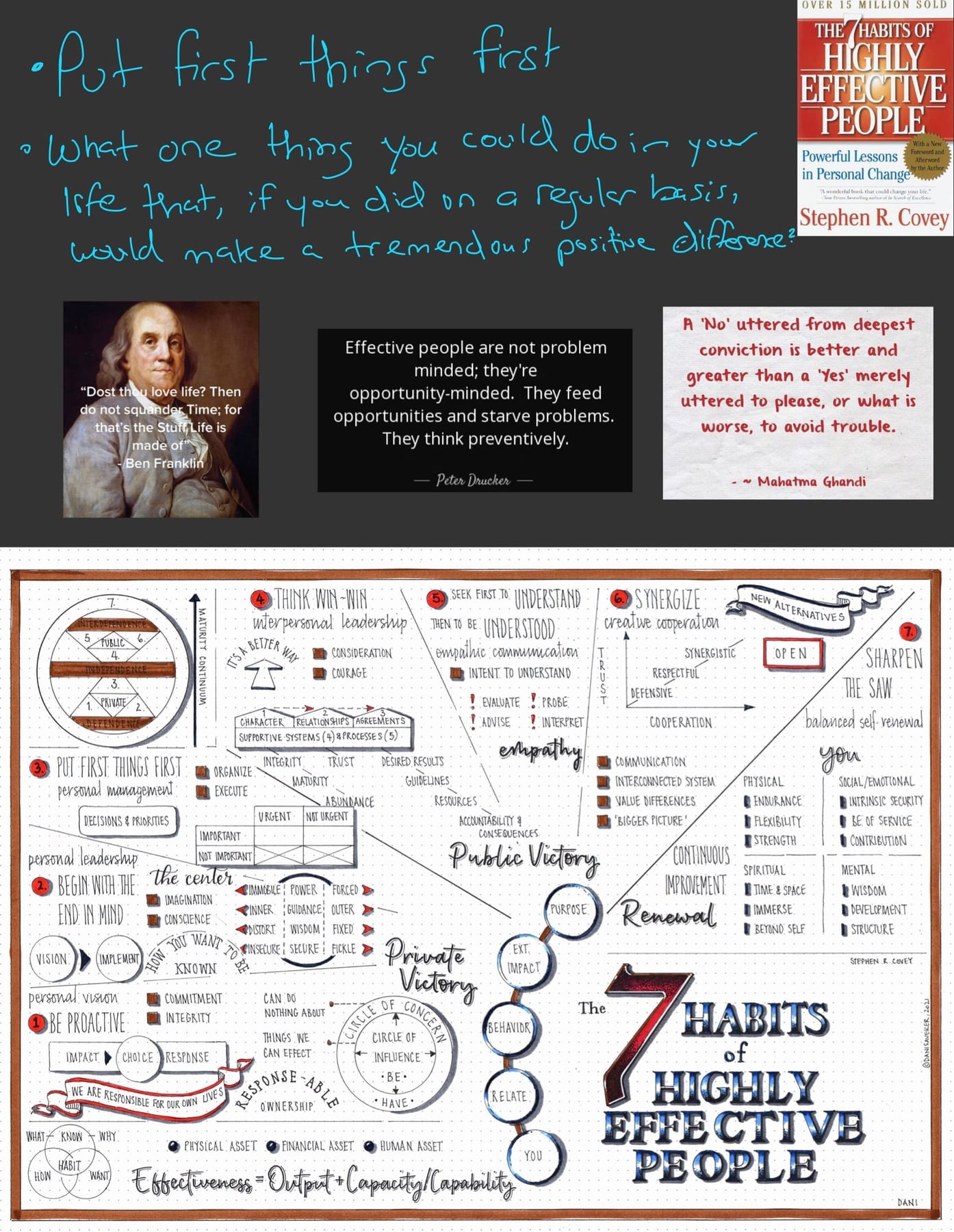
- Covey outlines the seven habits that form the core framework of the book. They are:
- Habit 1: Be Proactive
- Habit 2: Begin with the End in Mind
- Habit 3: Put First Things First
- Habit 4: Think Win-Win
- Habit 5: Seek First to Understand, Then to Be Understood
- Habit 6: Synergize
- Habit 7: Sharpen the Saw
- Covey outlines the seven habits that form the core framework of the book. They are:
- Habit 1: Be Proactive:
- Being proactive means taking responsibility for your own actions and decisions.
- Covey introduces the idea of the “circle of concern” and the “circle of influence.” Effective people focus on what they can control (circle of influence) and work to expand it.
- Habit 2: Begin with the End in Mind:
- Covey encourages readers to define their long-term goals and values. He introduces the concept of creating a personal mission statement.
- Beginning with the end in mind means having a clear vision of your desired outcomes and aligning your actions with that vision.
- Habit 3: Put First Things First:
- This habit emphasizes prioritization and time management. Covey introduces the Time Management Matrix, which categorizes tasks as urgent or important.
- Effective people focus on important but not necessarily urgent tasks (Quadrant II) to prevent crises and achieve long-term goals.
- Habit 4: Think Win-Win:
- Covey promotes a mindset of seeking mutually beneficial solutions in interpersonal interactions.
- Instead of zero-sum thinking, where one person’s gain is another’s loss, effective people aim for win-win solutions that benefit all parties involved.
- Habit 5: Seek First to Understand, Then to Be Understood:
- Covey emphasizes the importance of empathetic communication. He introduces the idea of the “empathic listening” paradigm.
- Effective communication involves genuinely trying to understand others’ perspectives before expressing your own.
- Habit 6: Synergize:
- Synergy is the idea that collaborative efforts can achieve more than individual actions. Covey encourages teamwork and valuing diverse perspectives.
- Effective people leverage the strengths of others to create innovative solutions.
- Habit 7: Sharpen the Saw:
- This habit focuses on self-renewal and self-improvement. Covey emphasizes the need to balance and renew four key aspects of life: physical, social/emotional, mental, and spiritual.
- Regularly investing in these areas leads to increased effectiveness and resilience.
- The Path to Interdependence:
- Covey argues that the ultimate goal is interdependence, where individuals and groups work together synergistically.
- Interdependence is based on trust, shared goals, and mutually beneficial relationships.
- Personal Responsibility and Choice:
- Throughout the book, Covey underscores the importance of personal responsibility and proactive choice-making.
- He encourages readers to take control of their lives and make choices aligned with their values and principles.
- Paradigms and Principles:
- Covey distinguishes between paradigms (perceptions or worldviews) and principles (timeless, universal truths).
- Principles are the foundation of effective living and decision-making.