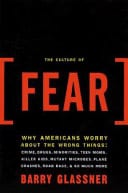
DESCRIPTION
In the wake of his popular Career Crash and Bodies, Glassner (sociology, U. of Southern California) describes fear as a pathology that has swept the country. He exposes the people and organizations that manipulate perceptions and profit from anxieties, among them politicians shouting crime to win office, advocacy groups that raise money by exaggerating the prevalence of particular diseases, and television programs that dig up a new scare per week to maintain ratings. The Martians, he says, are not coming. Annotation copyrighted by Book News, Inc., Portland, OR
My Summary
Main Ideas, Takeaways & Similarities
Questions
I. What is the problem?
A. How is this problem formulated?
B. Why is this problem important?
C. What is the history of this problem?
D. Which prominent personalities have been interested in this problem?
II. What solutions to the problem are there?
A. What are the conclusions reached?
B. By what argument(s) is the conclusion reached?
C. What facts or assumptions serve as premises?
D. When a prominent personality offers a solution, does he also argue for or against other prominent personalities? Does he raise objections to alternative solutions? Does he consider objections to his own solutions?
III. Evaluation
A. What are the advantages and disadvantages of the alternative formulations to the problem?
B. Has the importance or history of the problem ever been misrepresented?
C. Are the solutions logically related to the premises?
D. Are the facts true? Are the assumptions acceptable? Are the objections answerable?
AI Summary
Highlights
“The Culture of Fear: Why Americans Are Afraid of the Wrong Things” is a book written by Barry Glassner, first published in 1999. The book critically examines the role of fear in American society and argues that many of the fears that dominate public discourse are often misguided or exaggerated. Here is a comprehensive summary of the book in bullet points:
- The book challenges the prevailing perception that Americans are living in an increasingly dangerous world and are constantly under threat.
- Barry Glassner argues that many of the fears that dominate public discourse are based on misinformation, distortion, and exaggeration by various societal institutions, including the media, politicians, and interest groups.
- He discusses how fear is used as a tool to manipulate public opinion and advance certain agendas, such as political campaigns and policy initiatives.
- The book explores the role of the media in amplifying fear by sensationalizing stories and focusing on rare or extreme events that are not representative of everyday life.
- Glassner discusses the phenomenon of “socially constructed fears,” where certain issues or groups are scapegoated and portrayed as threats to society, leading to unnecessary anxiety and discrimination.
- He highlights specific examples of socially constructed fears, including the “crack baby” scare, school shootings, and the “stranger danger” myth.
- The book addresses the disconnect between the actual risks people face in their daily lives and the fears that dominate public discourse.
- Glassner discusses how fear can lead to harmful consequences, such as increased stress, social divisions, and misguided policy decisions.
- He argues that focusing on the wrong fears distracts society from addressing real and pressing issues, such as poverty, inequality, and healthcare.
- The book encourages critical thinking and media literacy as tools to assess and challenge the culture of fear.
- Glassner emphasizes the importance of data and evidence-based analysis in understanding and addressing societal concerns.
- He advocates for a more rational and balanced approach to assessing and addressing risks and fears.
- The book concludes by calling for a cultural shift away from the culture of fear toward a more informed and proactive society.
“The Culture of Fear: Why Americans Are Afraid of the Wrong Things” challenges the prevailing narrative of fear and anxiety in American society. Barry Glassner’s book provides a critical examination of how fear is constructed and perpetuated by various institutions and argues that many of these fears are unfounded or exaggerated. It encourages readers to question the sources of fear and advocate for a more rational and evidence-based approach to societal concerns.