DESCRIPTION
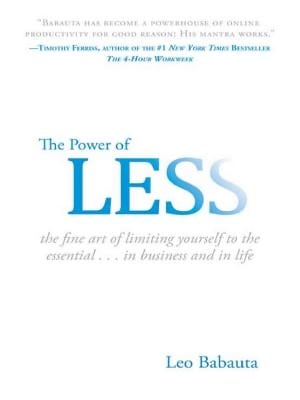
With the countless distractions that come from every corner of a modern life, it’s amazing that were ever able to accomplish anything. The Power of Less demonstrates how to streamline your life by identifying the essential and eliminating the unnecessary freeing you from everyday clutter and allowing you to focus on accomplishing the goals that can change your life for the better. The Power of Less will show you how to: Break any goal down into manageable tasks Focus on only a few tasks at a time Create new and productive habits Hone your focus Increase your efficiency By setting limits for yourself and making the most of the resources you already have, youll finally be able work less, work smarter, and focus on living the life that you deserve.
My Summary
Main Ideas, Takeaways & Similarities
“The Power of Less,” written by Leo Babauta, emphasizes the importance of simplifying tasks and commitments in order to improve productivity and focus. Here is a summary in bullet points:
- Focus on the Essential: Babauta advises focusing on fewer tasks and commitments to enhance productivity and quality. By limiting ourselves to essential tasks, we can allocate our resources and energy more efficiently.
- Set Limitations: Setting limits for daily tasks and commitments can help manage time better. Babauta suggests choosing three essential tasks to complete each day.
- Simplify Tasks: Break down larger tasks into smaller, manageable steps. This approach makes daunting tasks seem more achievable and reduces procrastination.
- Establish Routines: Developing routines for daily activities can streamline processes and reduce decision fatigue. This includes establishing morning routines, work routines, and even cleaning routines.
- Declutter Your Environment: A clutter-free environment promotes a clearer mind and reduces distractions. Babauta emphasizes the importance of decluttering both physical and digital spaces.
- Learn to Say No: Saying no to non-essential commitments and tasks frees up time for what truly matters. This principle applies to both personal and professional aspects of life.
- Practice Mindfulness: Being present in the moment and mindful of current tasks improves focus and effectiveness. Mindfulness can also reduce stress and enhance overall well-being.
- Slow Down: Taking time to slow down and not rush through tasks can lead to better quality work and more enjoyment in daily activities.
“The Power of Less” advocates for a minimalist approach to productivity and life, encouraging readers to focus on what truly matters by eliminating the unnecessary.
Questions
I. What is the problem?
A. How is this problem formulated?
B. Why is this problem important?
C. What is the history of this problem?
D. Which prominent personalities have been interested in this problem?
II. What solutions to the problem are there?
A. What are the conclusions reached?
B. By what argument(s) is the conclusion reached?
C. What facts or assumptions serve as premises?
D. When a prominent personality offers a solution, does he also argue for or against other prominent personalities? Does he raise objections to alternative solutions? Does he consider objections to his own solutions?
III. Evaluation
A. What are the advantages and disadvantages of the alternative formulations to the problem?
B. Has the importance or history of the problem ever been misrepresented?
C. Are the solutions logically related to the premises?
D. Are the facts true? Are the assumptions acceptable? Are the objections answerable?
AI Summary
Chapter 1: Why Less is Powerful
Summary of “The Power of Less” Pages 17-23
The Concept of Less Being Powerful
The excerpt from “The Power of Less” by Leo Babauta discusses the idea that in a world where the pursuit of more is often seen as better, there are inherent limits to what we can do and consume. The author argues that constantly trying to increase the volume of our activities does not necessarily lead to meaningful accomplishments. Instead, it can result in a lot of unimportant tasks being done, leading to stress and overwork.
Illustrative Example: Two Reporters
Babauta presents a comparison between two reporters to illustrate his point. The first reporter produces a high volume of articles with little impact, while the second reporter focuses on producing one high-impact story. The second reporter’s approach leads to long-term recognition and career advancement, demonstrating the power of focusing on less but more impactful work.
Lessons from the Haiku
The haiku, a form of Japanese poetry, is used as a metaphor for the power of less. The constraints of the haiku force the poet to choose only the essential words to convey a powerful message. This principle is applied to productivity, suggesting that by setting limitations, we are compelled to focus on the essential, which leads to greater impact with minimal resources.
Choosing High-Impact Tasks
In our work lives, Babauta suggests that we can choose to focus on fewer, high-impact tasks rather than trying to accomplish a multitude of tasks. He provides two methods for determining which tasks have the most impact:
- Examine your task list: Evaluate each task based on its potential long-term impact and relevance to your long-term goals.
- Start with your goals: Plan tasks that directly further your long-term goals, ensuring that daily activities are aligned with achieving high-impact outcomes.
Applying Limitations to Life
The author extends the concept of applying limitations to all aspects of life, not just work tasks. By imposing limits, such as checking emails only twice a day or reducing the number of possessions, we can simplify our lives and focus on what is essential. Babauta encourages readers to consider which areas of their lives are overwhelming and what they would like to simplify.
In summary, “The Power of Less” advocates for setting limitations and choosing the essential to create a greater impact with fewer resources. This approach can be applied to various aspects of life, leading to a more focused and meaningful existence[1].
Chapter 2: The Art of Setting Limits
The excerpt from “The Power of Less: The Fine Art of Limiting Yourself to the Essential…in Business and in Life” by Leo Babauta, focuses on the concept of setting limits to improve one’s life. Babauta argues that modern lives are cluttered with too much stuff, information, tasks, and clutter, leading to stress and inefficiency. He likens living without limits to trying to fit an entire library into a single box, which is impossible and overwhelming. The key message is that by imposing limits on ourselves, we can simplify our lives, focus on what’s truly important, and become more effective and fulfilled.
The Art of Setting Limits
Babauta emphasizes the importance of setting limits in various aspects of our lives, including email, daily tasks, phone usage, and the number of projects we undertake. He suggests that living without limits dilutes our power and effectiveness, spreading us too thin and leaving us too tired to handle important matters. By contrast, setting limits simplifies our lives, making them more manageable and less stressful. It allows us to focus our energy on a smaller number of things, which leads to greater achievement and effectiveness.
How Limits Can Help
The benefits of setting limits are manifold:
- Simplification: Life becomes more manageable and less stressful.
- Focus: Energy is concentrated on fewer tasks, leading to better performance.
- Prioritization: Only the most important tasks are tackled, leading to a more fulfilling life.
- Achievement: Focusing on fewer projects at a time leads to their completion and greater overall achievement.
- Respect for Time: Setting limits sends a message that one’s time is valuable, leading others to respect it more.
- Effectiveness: By doing less busywork and more important work, one becomes more effective.
What to Set Limits On
Babauta advises starting with areas of life that feel overloaded or where improvement is desired. He recommends beginning with one area at a time to avoid the risk of failure associated with taking on too much simultaneously. Potential areas for setting limits include email, daily tasks, phone usage, and the number of active projects.
How to Set Limits
Setting limits involves:
- Analyzing current usage levels and choosing an ideal, lower limit.
- Testing the new limit for about a week to see if it works.
- Adjusting the limit as necessary based on the test period.
- Making the new limit a habit before moving on to another area of life.
Babauta concludes that learning to set limits and focus on the essentials can unleash the true power of living with less. This approach forces individuals to prioritize and simplify, leading to a more effective and fulfilling life.
Chapter 3: Choosing the Essential, and Simplifying
The provided chapter from “The Power of Less” by Leo Babauta focuses on two main principles: choosing the essential and simplifying. Babauta argues that to simplify effectively, one must first identify what is essential. This process involves asking oneself a series of questions to determine one’s values, goals, passions, and the most impactful tasks. By doing so, one can prioritize and reduce the number of projects, tasks, incoming information, commitments, and clutter.
Choosing the Essential: A Series of Questions
Babauta suggests using the following questions to guide the process of identifying what is essential:
- What are your values? Determine what is most important to you.
- What are your goals? Define what you want to achieve in life, in the next year, month, or day.
- What do you love? Consider who and what you enjoy spending time with and doing.
- What is important to you? Make a list of the most important things in your life or work.
- What has the biggest impact? Choose tasks or projects that make the most significant difference.
- What has the most long-term impact? Consider the long-term value of your actions.
- Needs vs. wants. Distinguish between what you need and what you want.
- Eliminate the nonessential. Remove nonessential items from your list.
- Continual editing process. Regularly review and eliminate nonessentials until only the essential remains.
Applying the Questions
Babauta advises applying these questions to various aspects of life to focus on the essentials:
- Life commitments: Reduce nonessential commitments by considering your values, goals, and passions.
- Yearly goals: Choose one or two essential goals to focus on for the year.
- Work projects and tasks: Prioritize projects and tasks using the essential questions.
- Emails: Select only the most essential emails to respond to.
- Finances: Align spending with your goals and values to cut nonessential expenses.
- Clutter: Use the needs vs. wants question to eliminate clutter.
- Regular review: Continually reassess what is essential as things change over time.
Principle 3: Simplifying - Eliminating the Nonessential
Once the essential has been identified, the next step is to eliminate everything else. This may involve crossing off unimportant tasks, delegating, postponing, and learning to say “no” to nonessential requests. Babauta emphasizes that simplifying is not about emptying one’s life but about making space for what truly matters. Saying “no” is part of committing to the essentials and will become easier with practice, leading to long-term benefits and respect from others for your time and commitments[1].
Chapter 4: Simple Focus
The chapter from “The Power of Less” by Leo Babauta, titled “Simple Focus,” emphasizes the importance of focus as a crucial tool for enhancing effectiveness in life. Babauta outlines Principle 4, which advocates for focusing on fewer things to become more productive and reduce stress and anxiety. The chapter is structured around several key areas where focus can significantly impact one’s life:
- Focus on a Goal: Babauta argues that focus, not self-discipline or motivation, is the most critical factor in achieving goals or establishing new habits. Maintaining focus on a goal or habit increases the likelihood of success.
- Focus on the Present: Focusing on the present moment can reduce stress, increase enjoyment of life, and boost effectiveness. This practice, however, requires effort and is developed over time.
- Focus on the Task at Hand: Engaging deeply in a single task can lead to a state of “flow,” where time seems to disappear, and one is fully immersed in the activity. This state is associated with happiness and can be achieved by choosing work that is passion-driven and minimizing distractions.
- Focus on the Positive: Replacing negative thoughts with positive ones is a skill that Babauta credits with helping him overcome challenges like quitting smoking. Focusing on positive outcomes and being grateful can lead to happiness.
- Single-Tasking: Babauta advocates for single-tasking over multitasking, citing the inefficiency and stress associated with juggling multiple tasks. He suggests focusing on the most important task first, minimizing distractions, and taking breaks to maintain sanity.
- Focusing on the Present: Similar to single-tasking, focusing on the present involves practicing mindfulness in everyday activities, such as eating or washing dishes, to stay calm and productive.
Babauta provides practical advice for implementing these focus strategies, including starting the day with the most important task, turning off distractions, and practicing mindfulness throughout the day. He emphasizes that the key to mastering focus on the present is continuous practice and being gentle with oneself during the process.
Chapter 5: Create New Habits, and the Power of Less Challenge
The chapter from “The Power of Less” by Leo Babauta, titled “Create New Habits, and the Power of Less Challenge,” emphasizes the importance of forming new habits as a means to make lasting improvements in one’s life. The author argues that trying to adopt multiple habits simultaneously can lead to being overwhelmed and ultimately failing to make any lasting changes. Instead, Babauta advocates for the Power of Less approach, which involves focusing on one habit at a time, dedicating a month to each habit to ensure all energy is concentrated on its formation.
The Power of Less Challenge is a thirty-day program designed to help individuals form new habits. The steps of the challenge are as follows:
- Select one habit for the Challenge: Choose only one habit per month that you believe will have the most significant impact on your life.
- Write down your plan: Detail your daily goals, when you will perform the habit, what your “trigger” will be (an existing routine that will precede the new habit), and who you will report your progress to.
- Post your goal publicly: Share your intention to form a new habit with as many people as possible to create a sense of commitment.
- Report on your progress daily: Inform the same group of people about your success or failure in achieving your daily goal.
- Celebrate your new habit: After thirty days, if you have been consistent, the new habit should be well established.
The effectiveness of the Challenge is attributed to several factors:
- Commitment: Publicly committing to the Challenge and setting measurable goals significantly increases the likelihood of success.
- Accountability: Daily reporting encourages adherence to the habit.
- Encouragement: Sharing struggles and receiving support from others can help maintain motivation.
- Inspiration: Observing the success of others can serve as motivation.
Babauta also outlines a few rules to ensure the success of the Challenge:
- Focus on only one habit at a time.
- Choose an easy and achievable goal.
- Set a measurable goal.
- Be consistent in performing the habit at the same time each day.
- Report your progress daily.
- Maintain a positive attitude and expect occasional setbacks.
Finally, Babauta recommends twelve key habits to start with, suggesting that these could make a significant difference in the lives of most people:
- Set your 3 Most Important Tasks (MITs) each morning.
- Practice single-tasking.
- Process your inbox to empty.
- Check email only twice a day.
- Exercise for five to ten minutes a day.
- Work while disconnected from distractions.
- Follow a morning routine.
- Eat more fruits and vegetables every day.
- Keep your desk decluttered.
- Say no to commitments and requests that aren’t on your Short List.
- Declutter your house for fifteen minutes a day.
- Stick to a five-sentence limit for emails.
By following these guidelines and focusing on one habit at a time, individuals can leverage the Power of Less to create meaningful and lasting changes in their lives[1].
Chapter 6: Start Small
- Enthusiasm for change often diminishes quickly, leading to failure, as seen in many New Year’s resolutions.
- Starting small applies to any goal, habit change, or life change.
- Why Starting Small Works:
- Narrows focus, increasing effectiveness.
- Maintains energy and enthusiasm for longer periods.
- Easier to manage and more likely to ensure success.
- Small successes can build upon each other, leading to significant achievements.
- Gradual change is more sustainable and likely to last.
- How to Apply Starting Small:
- Exercise: Begin with 5-10 minutes a day.
- Waking Early: Start by waking 15 minutes earlier.
- Productivity: Focus on a task for 5-10 minutes at a time.
- Email Effectiveness: Reduce email checking frequency slightly.
- Healthy Eating: Make one dietary change at a time.
- Major Projects: Tackle one small task at a time.
- Decluttering: Start with decluttering one drawer.
Chapter 7: Simple Goals and Projects
- The Power of Less emphasizes the importance of limiting oneself to fewer goals to achieve more. The book suggests that spreading oneself too thin across many goals can dilute effectiveness and lead to unfinished goals.
- The One Goal System: A method proposed by the book where individuals focus on one main goal at a time, breaking it down into manageable sub-goals and tasks. This approach is designed to increase effectiveness and ensure progress towards the goal.
- Choose a single goal that is deeply desired and can realistically be completed within six months to a year.
- Break the main goal down into smaller, achievable sub-goals.
- Set weekly goals that contribute to the achievement of the sub-goal.
- Focus on daily actions that move you closer to the weekly goal, making it the most important task of the day.
- Simple Projects List: The book advises creating a list of all ongoing projects and then narrowing it down to the top three. This prioritization helps in focusing efforts and increasing the chances of completion.
- All other projects should be placed on an “On Deck List” and only moved to the active list once the top three are completed.
- At least one of the top three projects should be related to the main goal to ensure continuous progress towards it.
- The book argues against multitasking at the task level but supports project-level multitasking due to inevitable waiting times in projects.
- Focus on Completion: The key to effective project management is focusing on completion rather than getting caught up in organizing or technology. Daily focus should be on tasks that move the project towards completion.
- Visualize the desired outcome of the project and break the project into tasks.
- Choose three Most Important Tasks (MITs) daily, focusing on project-related tasks to ensure progress.
- Regularly reassess progress to stay focused on completion.
- Dealing with External Control: For those who do not have complete control over their projects list, the book offers strategies to limit the number of projects being worked on, such as making a personal projects list, employing delay tactics, discussing the system with a boss, or asking the boss to prioritize projects.
The chapter from “The Power of Less” provides a structured approach to goal setting and project management, advocating for simplicity and focus to enhance productivity and achieve desired outcomes.
Chapter 8: Simple Tasks
- Simplifying tasks is crucial for effectiveness and reducing stress, focusing on doing less but more effectively.
- The concept of Most Important Tasks (MITs) involves choosing only three tasks that are the focus of your day, which are the tasks you most want or need to get done.
- It’s suggested to start with three MITs and adjust as necessary, with the idea that these tasks are prioritized above all others each day.
- At least one of the MITs should be related to one of your goals to ensure progress towards your dreams.
- MITs should be done first thing in the morning to prevent them from being overlooked due to a busy schedule.
- The keys to making MITs work include setting them first thing in the morning, limiting to three, ensuring one is goal-related, focusing on these tasks above others, and doing them early in the day.
- For task management, it’s also important to focus on the size of tasks, breaking down large tasks into smaller, more manageable ones that can be completed in a shorter amount of time to avoid procrastination.
- Small tasks are preferable as they are less intimidating and more likely to be completed, helping to maintain momentum and progress towards larger goals.
Chapter 9: Simple Time Management
- Simple Time Management: Emphasizes the importance of keeping time management simple and flexible, avoiding rigid schedules and complicated planning. It suggests that for many, especially those with fluid work arrangements, a minimalist approach to time management can be more effective.
- An Open Approach: Proposes a radical shift from scheduling appointments to living more spontaneously, allowing life to be guided by the moment rather than a calendar. This includes minimizing meetings and using a calendar only as a loose guide for potential events, not as a strict schedule.
- Prioritizing Tasks: Highlights the importance of knowing your priorities and deciding what to do based on these priorities, available time, and energy levels. It suggests focusing on one task at a time to increase productivity and achieve a state of “flow,” where one is fully immersed and focused on the task at hand.
- Most Important Tasks (MITs): Recommends starting each day by identifying three most important tasks (MITs) to accomplish, focusing the day around these tasks rather than a packed schedule. This approach aims to simplify daily objectives and increase focus and productivity.
- Reducing Tasks: Advises on the need to reduce the number of tasks one has, focusing only on those that provide the most significant return on time investment. This includes eliminating, delegating, or postponing tasks to simplify and reduce stress.
- Batch Processing: Suggests grouping similar small tasks (e.g., phone calls, emails, errands) and completing them in batches to save time and reduce task-switching. This method aims to prioritize important tasks and simplify the daily schedule.
- Simple Time Management Tools: Recommends using simple tools for time management, such as a basic calendar (paper or online like Google Calendar) and a simple notebook or text file for capturing tasks and ideas. The emphasis is on simplicity and ease of use to support the minimalist time management approach.
Chapter 10: Simple E-Mail
- E-mail has become a central part of work and personal communication, but it can also be overwhelming and distract from more important tasks.
- The book advocates for minimizing time spent on e-mail, setting limitations to enhance e-mail effectiveness, and aiming to keep the inbox empty through simple rules and habits.
- To manage e-mail better, it’s suggested to simplify, set limits, and focus on important tasks like the One Goal or top projects, applying the Power of Less.
- Limiting the number of in-boxes (including text messages, voice mails, paper documents, etc.) is crucial. This involves listing all information sources, evaluating their value, and combining or eliminating unnecessary ones to reduce stress and improve productivity.
- It’s recommended to check e-mail only at predetermined times to avoid constant interruptions and focus on more important work. Suggestions include checking e-mail twice a day and avoiding first thing in the morning to prevent e-mail from dictating the day’s agenda.
- Turning off e-mail notifications can help avoid distractions and stick to a schedule of checking e-mails less frequently.
- Reducing incoming e-mail streams by using filters, unsubscribing from unnecessary notifications, and setting expectations with contacts can help manage the inbox more effectively.
- Processing e-mails to empty involves creating a temporary folder for a full inbox, using an external to-do system for e-mails requiring action, processing e-mails quickly and decisively, and being liberal with deleting or archiving e-mails.
- Writing concise e-mails, with a self-imposed limit on sentence length, can save time and make e-mail communication more efficient.
- Overall, the chapter emphasizes the importance of managing e-mail efficiently by applying principles of simplicity and limitation, allowing for a focus on more significant tasks and goals.
Chapter 11: Simple Internet
- The Internet’s Role: The chapter discusses the pervasive nature of the Internet in our lives, highlighting its various functions such as shopping, communication, work, and entertainment. It notes that the Internet can be a significant distraction and productivity sink if not used judiciously.
- Applying the Power of Less: The author suggests applying the principles of “The Power of Less” to Internet usage by setting limitations to use it more effectively and to enhance productivity both online and offline.
- Awareness and Tracking: The first step to controlling Internet usage is to track it for three days using tools like Toggl, yaTimer, or Tick. This helps in understanding actual time spent and identifying time-wasting websites that do not contribute to one’s goals.
- Conscious Internet Use: After becoming aware of usage patterns, the next step is to consciously plan Internet use. This involves setting limits, having a purpose for each session, and distinguishing between work and leisure browsing. The author suggests creating a schedule that includes blocks of time for different types of online activities.
- Focus and Working Offline: To increase productivity, the author recommends disconnecting from the Internet when doing focused work. This involves doing necessary online research first, then working offline to avoid distractions. Tips include using a timer, writing down tasks that require the Internet for later, and rewarding oneself after completing tasks.
- Discipline and Avoiding Distractions: The Internet can be addictive, and working while disconnected may be challenging. To overcome this, one should set specific rules for Internet use, resist the urge to go online, apply positive public pressure, reward oneself for sticking to the rules, and use delay strategies to manage urges.
- Breaking the Internet Addiction: The author advises focusing on breaking the Internet addiction for at least a week, using strategies like setting rules, allowing urges to pass, seeking support from others, rewarding oneself, and employing delay tactics. Over time, practicing disconnection can become more comfortable and rewarding.
Chapter 12: Simple Filing
- Introduction to Simple Filing: The chapter discusses the common issue of disorganized paper stacks on desks in offices, highlighting the inefficiency and stress caused by such disorganization. It emphasizes the importance of creating a simple system for organizing paperwork and routinely using it to maintain a clean and clear workspace.
- Creating a Simple Filing System:
- Reduce Before Organizing: Advises eliminating unnecessary papers before organizing. Suggests consolidating all papers into one big pile for sorting, aiming to reduce clutter significantly.
- Sorting Process: Involves going through each document to decide its fate—toss, route to someone else, or file for future reference.
- Simple Filing Method: Recommends an alphabetical filing system using plain manila folders with labels for each client, vendor, or project. Emphasizes the need for simplicity and immediate filing to avoid piles.
- Maintaining the Filing System:
- File Immediately: Stresses the importance of filing documents right away to prevent accumulation and disorganization.
- Have Materials on Hand: Suggests keeping a supply of manila folders and labels readily available to facilitate immediate filing.
- Reduce Filing Needs Over Time: Encourages gradually reducing the need for physical filing by storing information online, reducing incoming paper, and stopping unnecessary printing.
- Home Paperwork Tips:
- Create a “Mail Center”: Recommends establishing a dedicated area in the home for handling mail and incoming paperwork, equipped with an in-box, wastebasket, filing system, and necessary tools.
- Immediate Action on Bills and Tasks: Suggests paying bills immediately upon processing and entering tasks or appointments into a to-do list or calendar without delay.
- Immediate Filing: Once action is taken on a piece of paper, it should be filed immediately to prevent clutter.
- Conclusion: The chapter concludes by emphasizing the simplicity and efficiency of the proposed filing system, both in the workplace and at home. It highlights the importance of making immediate filing a habit to eliminate clutter and maintain organization.
Chapter 13: Simple Commitments
- Reducing commitments in life can significantly impact productivity, effectiveness, and the ability to pursue passions, exercise, read, find quiet time, or spend time with loved ones. It requires determination and the ability to say “no.”
- Lives are often overloaded with various commitments, including work, family, civic duties, hobbies, and online activities. These commitments, though individually manageable, cumulatively consume all spare time and energy.
- To manage commitments, it’s essential to take inventory of all current commitments, categorizing them into areas such as work, family, civic duties, and hobbies.
- Creating a “Short List” of four to five most important commitments helps identify what truly matters. This list should reflect personal values, priorities, and goals.
- Eliminating nonessential commitments is crucial for freeing up time and reducing stress, allowing focus on essential commitments that align with the Short List.
- Learning to say “no” to new commitments is vital for maintaining a manageable list of commitments. This involves recognizing requests for what they are, being honest about one’s capacity, and being firm in refusal.
- Simplifying personal life involves making time for what one loves, eliminating as much as possible from one’s private life, and scheduling free time to engage in activities on the Short List.
- Tips for simplifying personal life include doing less during the day, leaving space between tasks, eliminating non-essentials from the to-do list, enjoying every task, single-tasking, eliminating stress, creating time for solitude, and practicing being present.
- Simplifying life not only makes it more enjoyable and less rushed but also allows for focusing on what truly matters, leading to a more fulfilling and balanced life.
Chapter 14: Simple Daily Routine
- Leo Babauta emphasizes the importance of simple daily routines, particularly in the morning and evening, to enhance productivity and bring calmness to life.
- Morning routines are highlighted as a transformative tool that can set the tone for the day, allowing for solitude, exercise, and goal setting.
- Babauta shares his personal morning routine, which includes waking up early, enjoying coffee in silence, running, writing, and reading.
- The author suggests creating a personalized morning routine that includes activities promoting solitude, quiet, or stress relief, and sticking to it until it becomes a habit.
- A list of morning routine ideas is provided, including having coffee or tea, watching the sunrise, exercising, reading, and journaling, with a recommendation to keep the routine simple and adjustable.
- Evening routines are presented as equally beneficial, helping to prepare for the next day, unwind, and spend quality time with loved ones.
- Suggestions for evening routines include cooking dinner, journaling, reading, exercising, and preparing for the next day, with an emphasis on relaxation and avoiding work-related activities.
- Babauta outlines steps to establish routines effectively: focusing on them as a primary goal, making them rewarding, and logging progress to ensure they become a lasting habit.
Chapter 15: Declutter Your Work Space
The chapter from “The Power of Less” by Leo Babauta focuses on decluttering your workspace, specifically your desk, and extends the concept to decluttering other areas of your life, including your home. Here’s a summary of the key points:
- Benefits of a Clean Desk:
- Focus: A decluttered desk minimizes distractions, allowing you to concentrate on the task at hand, thereby increasing effectiveness and efficiency.
- Calm: A clean workspace reduces stress and promotes a Zen-like sense of calm, which is crucial for productivity and well-being.
- Getting Started with Decluttering:
- Initial Steps: Begin by setting aside time for decluttering, removing all paperwork and non-essential items from your desk, and then processing each item systematically.
- Processing Items: Sort through each item on your desk by either trashing it, delegating it, filing it, doing it immediately, or adding it to a to-do list.
- Down to the Essentials:
- Identify Essentials: Determine what you truly need on your desk to perform your job effectively. This usually includes your computer, phone, an in-box, and possibly a notebook and pen.
- Decluttering Process: Apply the same decluttering process to other areas of your desk and office, including drawers and shelves, by removing everything, sorting through items, and only keeping what’s essential.
- Maintaining a Decluttered Workspace:
- Simple System: Develop a simple system and a few key habits to keep your workspace decluttered, such as using an in-box for incoming papers and regularly processing this in-box to keep your desk clear.
- Regular Maintenance: Schedule regular decluttering sessions to prevent clutter from accumulating again.
- Extending Decluttering Beyond the Workspace:
- Decluttering Your Home: The same principles applied to decluttering your workspace can be used to declutter your home, leading to a less stressful, more appealing, and easier to clean living space.
- Keeping Your Home Simple: Create a system to prevent clutter from accumulating in your home, including designating a home for everything, scheduling regular decluttering sessions, and examining your buying habits to reduce the influx of new items.
The chapter emphasizes the importance of decluttering not just as a means to a cleaner space, but as a way to enhance focus, efficiency, and overall well-being.
Chapter 16: Slow Down
- Slow Down: Modern life is characterized by a breakneck pace of consuming information, food, and media, leading to stress and burnout. Slowing down can lead to happiness and increased effectiveness and productivity.
- Importance of Attention: Our attention is constantly divided, preventing us from completing tasks effectively. Focusing attention more slowly and deliberately on one task at a time can reduce stress and increase productivity.
- Slow Working: Working at a slower pace can be more productive than a frantic pace. Key methods include choosing work you love, selecting important tasks, finding a quiet peak time, clearing distractions, enjoying the work, and practicing focus.
- Slow Eating: Eating slowly can lead to weight loss, better digestion, less stress, and a more enjoyable eating experience. It’s a simple act that can have profound effects on overall health and lifestyle.
- Slow Driving: Driving more slowly can save gas, lives, time, and sanity. It simplifies life by reducing stress and allowing for a more enjoyable journey. Tips for slow driving include playing relaxing music, ignoring other drivers, leaving early, brainstorming, keeping to the right, and enjoying the drive.
Chapter 17: Simple Health and Fitness
The chapter from “The Power of Less” by Leo Babauta focuses on simplifying health and fitness strategies to improve energy, productivity, and overall well-being. Here’s a summary of the key points:
- The Importance of Exercise and Healthy Eating: Exercise and a healthy diet are fundamental for better health and energy, but many find it challenging to maintain these habits due to various obstacles.
- Common Difficulties in Maintaining Fitness: People struggle with restrictive diets, hidden calories, the temptation of junk food, and maintaining a consistent exercise routine due to unrealistic goals, lack of visible results, and life’s interruptions.
- A Simple Fitness Plan: Babauta proposes a gradual approach to fitness and diet, emphasizing the importance of forming sustainable habits over seeking immediate results.
- Step 1: Forming the Exercise Habit
- Start with light, manageable workouts and gradually increase intensity.
- Schedule workout times and treat them as important appointments.
- Be consistent and avoid skipping workouts.
- Find a workout partner and hold yourself accountable.
- Step 2: Making Gradual Healthy Diet Changes
- Eat when lightly hungry and choose light, healthy foods.
- Make gradual changes to your diet, focusing on whole foods.
- Eat slowly and stop eating before feeling completely full.
- Step 3: Continuation, Short-Term Goals, and Accountability
- Gradually increase exercise intensity and variety.
- Continue improving your diet by trying new healthy recipes and foods.
- Set short-term fitness and diet goals to stay motivated.
- Keep a log of your eating and exercise habits and share your progress for accountability.
- Step 1: Forming the Exercise Habit
- Motivation for Exercise: Babauta lists 30 motivations for exercise, including the feeling after a workout, making time for oneself, the calories burned, having fun, stress relief, and setting and achieving goals.
This chapter emphasizes that real health and fitness come from making small, sustainable changes rather than drastic, short-term efforts.
Chapter 18: On Motivation
- One of the biggest challenges in achieving any goal is finding the motivation to stick with it. This chapter aims to help readers meet their goals and build habits by providing a guide to motivation.
- Motivation is what drives you toward a goal and keeps you going when things get tough. Positive motivation, where you genuinely want to do something, is more effective than negative motivation.
- To start with the right motivation, it’s important to start small, focus on one goal at a time, examine your motivation, really want it, commit publicly, get excited, build anticipation, and post your goal visibly.
- To sustain motivation when struggling, it’s helpful to hold yourself back initially, just start even if you don’t feel like it, stay accountable, squash negative thoughts with positive ones, think about the benefits, get excited again, read about your goal, find like-minded friends, read inspiring stories, build on your successes, get through low points, get help, chart your progress, reward yourself often, go for mini-goals, get a coach or take a class, never skip two days in a row, use visualization, be aware of urges to quit and overcome them, and find pleasure in the process.