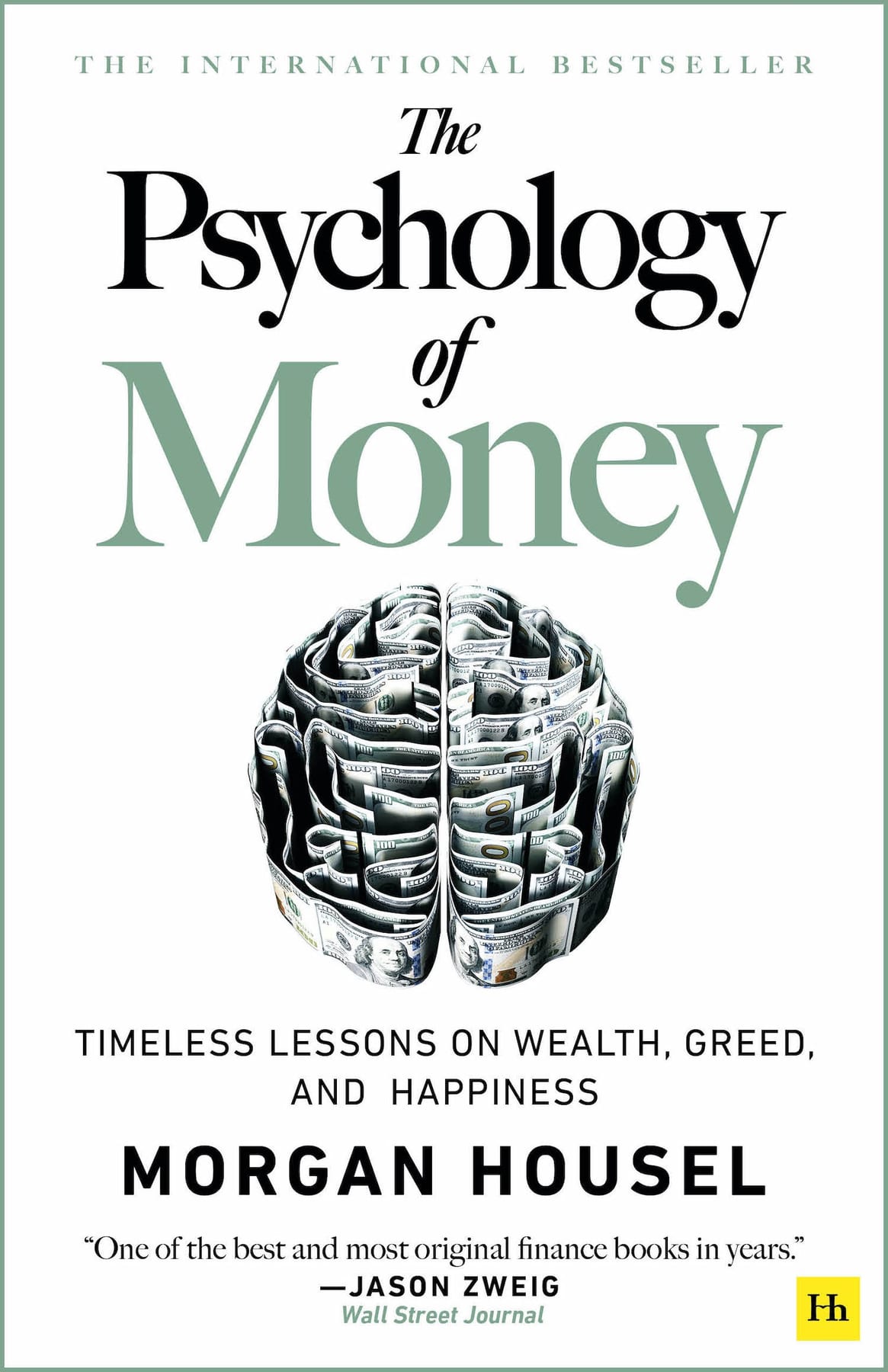

Description
Morgan Housel argues that doing well with money depends far more on behavior than on intelligence or technical knowledge. In twenty short, self-contained chapters he shows how personal experience, luck and risk, social comparison, and the stories people tell themselves shape financial decisions that formulas cannot capture. His practical case rests on a few linked ideas: compounding rewards time above all, so survival and room for error matter more than high returns; wealth is the money you don’t spend, not the income you display; and money’s greatest value is control over your own time. He urges readers to know when they have enough, to choose strategies that are reasonable enough to stick with rather than coldly optimal, and to play their own game instead of copying people with different goals. A closing postscript traces how postwar American expectations about consumption and debt outlived the conditions that created them.
Vault PDF and source boundary
Attachment (file not included in this release)
Attachment (file not included in this release)Navigation note: all PDF links in this note use the one-based viewer-page count of this 211-page vault copy, not the printed edition’s pagination.
Evidence boundary: these notes reconstruct the author’s argument from the supplied book. Distinctive claims are attributed to the author; they have not been independently fact-checked.
My highlights
Kindle and PDF highlights for this book live in .
Chapter-by-Chapter Overview
Linked reading map
Use the entries below to jump to the full argument, analytical divisions, essential evidence, concepts, conclusion, and reflection questions for each part of the book.
- Introduction: Housel contrasts a frugal janitor who died rich with a bankrupt Harvard-trained executive to argue that financial success is a soft skill of behavior, better understood through psychology and history than through formulas.
- 1. No One’s Crazy: People’s money beliefs are anchored in the markets and circumstances they personally lived through, so choices that look crazy make sense to their makers, and everyone is a newcomer to modern finance.
- 2. Luck & Risk: Luck and risk are siblings that shape outcomes beyond effort, making the line between bold and reckless visible only in hindsight, so we should judge cautiously and learn from broad patterns.
- 3. Never Enough: Through Gupta, Madoff and LTCM, Housel shows the danger of moving goalposts and endless social comparison, and argues that knowing when you have enough protects what you can never afford to lose.
- 4. Confounding Compounding: Ice ages and Buffett’s late-life fortune show that compounding turns small, persistent advantages into enormous results, so durable, repeatable returns sustained for decades matter more than the highest returns.
- 5. Getting vs. Staying Wealthy: Getting money requires risk and optimism, but keeping it requires frugality and paranoia; survival lets compounding work, so investors should be unbreakable, plan for failure, and combine optimism with caution.
- 6. Tails, You Win: A small number of outlier events drive most results in art, venture capital, public markets and careers, so frequent failure is normal and an investor’s behavior during rare panics matters most.
- 7. Freedom: Control over one’s time is the strongest common predictor of happiness and the highest dividend money pays, yet richer Americans have traded that control for bigger possessions and always-on thought work.
- 8. Man in the Car Paradox: People buy status goods to win admiration, but observers admire the car and imagine themselves in it, so humility and kindness earn more respect than expensive things.
- 9. Wealth is What You Don’t See: Being rich means visible income and spending, while being wealthy means unspent assets held as future options, and wealth’s invisibility makes it hard to recognize and imitate.
- 10. Save Money: The savings rate, governed by the gap between ego and income, matters more than income or returns, and saving without a specific goal buys flexibility, an unmeasured but increasingly valuable return.
- 11. Reasonable > Rational: Investors should choose strategies they can tolerate and sustain rather than mathematically optimal ones, because commitment through hard periods is one of the strongest drivers of long-term results.
- 12. Surprise!: History is a poor forecasting tool because the most important events are unprecedented and markets structurally change, so distant history should yield only general lessons about human behavior.
- 13. Room for Error: Margin of safety makes forecasting unnecessary; investors need room for emotional volatility, lower assumed returns, no ruinous leverage, and savings that guard against unimaginable risks and single points of failure.
- 14. You’ll Change: People underestimate how much their goals will change, which threatens long compounding plans, so they should avoid extreme financial choices and abandon outdated goals without clinging to sunk costs.
- 15. Nothing’s Free: Market returns carry a hidden price of volatility, fear and regret; trying to avoid it usually costs more, so investors should treat volatility as an admission fee rather than a fine.
- 16. You & Me: Bubbles form when short-term traders come to set prices and long-term investors mistake those prices for information, so each person must identify their own game and time horizon.
- 17. The Seduction of Pessimism: Pessimism sounds smarter than optimism because losses loom larger, money affects everyone, trends are extrapolated without adaptation, and setbacks arrive faster than compounding progress, even though optimism is usually the better bet.
- 18. When You’ll Believe Anything: Stories are the economy’s most powerful force; under high stakes and limited control people embrace appealing fictions and fill knowledge gaps with narratives that create an illusion of control.
- 19. All Together Now: Framing financial advice like informed medical consent, Housel condenses the book into short lessons on humility, saving, time horizon, room for error, avoiding ruin, and playing your own game.
- 20. Confessions: Housel describes his family’s pursuit of independence through a fixed lifestyle, a mortgage-free house, a large cash reserve, and low-cost index funds, choices meant to be reasonable rather than optimal.
- Postscript: Postwar policy, shared prosperity and accepted debt created expectations of similar lifestyles that outlasted the economy’s turn toward inequality, driving household borrowing, the 2008 crisis, and political anger.
Review
Handwrite First
Use this section with the book and notes closed. Retrieval matters more than polished prose.
1. Before Reading
- Prediction:
- Question I want answered:
- What I already think about money and behavior:
- What I expect to disagree with:
2. Closed-Book Recall Dump
-
Main claims I remember:
-
Key evidence, stories, or contrasts:
-
People, numbers, and concepts:
-
What feels fuzzy or incomplete:
3. Core Argument From Memory
- The book or chapter in one sentence:
- The problem Housel is correcting:
-
The causal chain:
- Best evidence I remember:
- Most important qualification:
4. Feynman Check
Explain the argument in plain language to an intelligent reader who thinks personal finance is mainly a matter of math and discipline. Circle any term—soft skill, luck and risk, enough, compounding, survival, tails, rich versus wealthy, reasonable versus rational, room for error, fee versus fine, or appealing fiction—that you cannot define without looking.
5. Pushback From Memory
- Strongest alternative explanation:
- Claim Housel may overstate:
- Evidence that would change my mind:
- What follows from Housel’s evidence, and what remains anecdote or interpretation:
Type Into Obsidian
After checking the chapter notes and source links, correct the handwritten reconstruction.
1. Correction After Checking
- What I remembered accurately:
- What I distorted or omitted:
- Page or passage that corrected me:
2. Clean Core Argument
- Thesis:
- Reasoning:
- Essential evidence:
- Qualification:
- Connection to the book:
3. Connections
- Antifragile — how does Taleb’s “avoid ruin at all costs” compare with Housel’s room for error and barbelled personality?
- Stumbling on Happiness — how does Gilbert’s work on mispredicting future selves support Housel’s End of History Illusion chapter?
- Principles - Ray Dalio — where does Dalio’s systematic, rule-based approach clash with Housel’s “reasonable over rational”?
- Profit First - Mike Michalowicz — how does paying yourself first put Housel’s savings-rate argument into practice?
- New connection:
4. Flashcards / Atomic Recall
- Q: Why does Housel say Buffett’s “secret is time”? A: About $81.5 billion of his $84.5 billion came after his mid-60s; starting later and retiring at 60 with the same returns would have left him around $11.9 million.
- Q: What is the difference between being rich and being wealthy? A: Rich is current income, usually visible through spending; wealthy is income not spent, held as hidden assets that provide future options and flexibility.
- Q: What does Housel mean by room for error, and why is it not just conservatism? A: It is a margin of safety that “renders the forecast unnecessary”; conservatism avoids a level of risk, while margin of safety raises the odds of surviving at a given level of risk.
- Q: Why should investors treat volatility as a fee rather than a fine? A: Volatility is the admission price for market returns; seen as a fine it prompts attempts to avoid it, which usually cost more, while a fee is a price accepted for something worth having.
- Q: What is the highest dividend money pays, according to Housel? A: Control over your time: the ability to do what you want, when you want, with whom you want, for as long as you want.
Retention Check
24 Hours Later
- Reconstruct the chapter’s structure in five steps.
- Name one claim, one story or statistic, and one qualification.
1 Week Later
- Compare this chapter with the chapter before and after it.
- Explain which money habit or belief of your own the chapter challenges.
1 Month Later
- Rebuild the book’s three clusters—why money judgment fails, how wealth grows and survives, and what money is for—without opening the note.
- Identify the lesson you have actually applied, the one you resist, and what evidence would settle it for you.
Notes
Book Argument and Reading Map
Housel’s governing claim is that financial success is a soft skill: “doing well with money has a little to do with how smart you are and a lot to do with how you behave.” Finance is taught like physics, with formulas and laws, but it behaves like psychology, because outcomes depend on people with feelings, histories and incentives. That is why a janitor like Ronald Read can outperform a Harvard-trained executive like Richard Fuscone, a result Housel says has no parallel in surgery or engineering. The book makes its case through 20 short, independent chapters, each isolating one feature of how people actually think about money.
The first cluster of chapters explains why judgment about money is so unreliable. Beliefs are anchored in personal experience, so “no one is crazy” even when their choices look crazy to others (Chapter 1). Luck and risk shape outcomes more than we admit, so success and failure are “never as good or as bad as it seems” and the best lessons come from broad patterns rather than extreme cases (Chapter 2). History is a poor map of the future because the events that matter most are unprecedented and the system keeps changing (Chapter 12). People change too, so plans made by a past self may not suit a future one (Chapter 14). And beliefs are held together by stories, especially appealing fictions we want to be true, which fill gaps in our knowledge and give a false sense of control (Chapter 18).
The second cluster explains how wealth actually grows and survives. Compounding is the dominant force, and its main input is time: Buffett’s skill is investing, but “his secret is time” (Chapter 4). Because compounding needs uninterrupted years, survival matters more than brilliance; getting wealthy and staying wealthy are different skills, and the second requires frugality, paranoia and a “barbelled” mix of long-run optimism and short-run caution (Chapter 5). Outcomes are dominated by tails, so it is normal to be wrong often and still succeed, and an investor’s lifetime results depend most on behavior during rare moments of panic (Chapter 6). The price of returns is volatility, fear and regret, best understood as a fee rather than a fine (Chapter 15). The unifying practical principle is room for error: a margin of safety that “renders the forecast unnecessary,” protects against ruin and leverage, and guards even against risks no one can imagine (Chapter 13).
The third cluster asks what money is for and how to behave with it. Its highest dividend is control over time (Chapter 7). Status spending buys less admiration than people think (Chapter 8). Being rich (visible income and spending) differs from being wealthy (unspent assets held as options), and wealth is hard to learn because it is invisible (Chapter 9). The savings rate, governed by the gap between ego and income, is the most controllable driver of wealth, and saving needs no specific goal because its hidden return is flexibility (Chapter 10). A sense of enough stops people from risking what they need for what they don’t (Chapter 3). Strategies should be reasonable rather than rational, because a plan you can stick with beats an optimal plan you abandon (Chapter 11). Investors should identify their own game and time horizon and not take cues from people playing a different one (Chapter 16), and they should recognize why pessimism sounds smarter than optimism even though optimism is usually the better bet (Chapter 17).
The book closes by refusing to prescribe. Chapter 19 lists its lessons under a medical-consent analogy: there are universal truths in money, but only you know what you want. Chapter 20 shows Housel’s own household choices, organized around independence, including decisions that are “indefensible on paper” but help him sleep at night. The postscript scales the argument to a nation, tracing how postwar experience set expectations of shared lifestyles and comfortable debt that persisted after the economy became unequal. Across all of it, the through-line is that money decisions are made “at the dinner table,” not on spreadsheets, and that the most durable financial skills are patience, humility and the ability to survive being wrong.
Interpretive guardrails
- “No one is crazy” explains behavior; it does not excuse it. Housel still calls some choices, such as lottery tickets when broke, bad ideas.
- “Reasonable over rational” licenses tolerable imperfection, not any choice that feels good. He limits stock picking and day trading to small amounts and still warns against acting on forecasts.
- “Enough” and “room for error” are not pleas for timidity. Housel distinguishes margin of safety from conservatism and endorses taking risk that cannot ruin you.
- Optimism, in Housel’s sense, means the odds favor good long-run outcomes despite setbacks; it is not a belief that things will be fine.
- The book’s evidence is mostly anecdotes and selected statistics. By Housel’s own rule (Chapter 2), they illustrate broad patterns rather than prove them, and his personal choices in Chapter 20 are offered as an example, not a template.
Introduction: The Greatest Show On Earth
Chapter Objective and Through Line
Housel opens with the book’s premise: doing well with money “has a little to do with how smart you are and a lot to do with how you behave.” Behavior is hard to teach, even to very smart people, so a genius who loses control of his emotions can be a financial disaster while an ordinary person with a few behavioral skills can become wealthy. The introduction sets this premise against the way finance is usually taught, as a math-based field in which data go into a formula and the reader is assumed simply to act on the answer. Attachment (file not included in this release)
The argument proceeds by contrast. Two paired stories (a reckless tech executive and the janitor Ronald Read set against the Harvard-trained executive Richard Fuscone) show that in finance, unlike surgery or engineering, the untrained can outperform the credentialed. Housel offers two explanations, luck and behavior, and says the second is “more common”: financial success is a soft skill rather than a hard science. He calls that soft skill the psychology of money. Attachment (file not included in this release)
The introduction also explains the book’s form. It grows out of a 2018 report on 20 flaws and biases in money behavior, and it is written as 20 short, independent chapters around a common theme. The method is narrative and historical rather than technical: Housel wants to persuade through short stories, because he thinks money is better understood through psychology and history than through formulas.
Chapter Structure at a Glance
- Two anecdotes establish the premise: intelligence without self-control leads to ruin; modest behavior sustained over time leads to wealth.
- Finance is unusual among fields: outsiders can beat experts, which needs explaining.
- Behavior, not knowledge, is the main explanation: luck matters, but the commoner cause is a soft skill.
- The way finance is taught misses this: formulas say what to do but not what happens in your head when you try.
- Collective learning has not improved money behavior: unlike medicine, finance shows little evidence of progress.
- Psychology and history explain finance better than math: the 2008 crisis is the case that convinced him.
- The book’s design follows: 20 short, stand-alone chapters.
Section-by-Section Argument
Paired stories and the puzzle they pose (analytical division)
Housel uses the anecdotes to frame a question rather than to moralize. Ronald Read saved what little he could, bought blue-chip stocks, and waited decades until his savings compounded into more than $8 million. Richard Fuscone borrowed heavily to expand a Greenwich mansion and went bankrupt when the 2008 crisis hit, with “high debt and illiquid assets.” Housel’s summary is blunt: “Ronald Read was patient; Richard Fuscone was greedy.” Attachment (file not included in this release)
- He explicitly says the lesson is not simply “be more like Ronald,” though that is not bad advice. The point is that such stories are unique to finance: there is no story of a janitor outperforming top nuclear engineers.
- The valet-era tech executive who skipped gold coins into the ocean and later went broke shows the same thing from the other side: brilliance does not protect against emotional, status-driven behavior.
Why finance resists formula (analytical division)
Finance is taught like physics, with rules and laws, when it behaves more like psychology, with emotion and nuance. Housel does not say formulas are wrong. His claim is that “knowing what to do tells you nothing about what happens in your head when you try to do it.” Attachment (file not included in this release)
- Health and money comparison: both affect everyone, but medicine has visibly progressed while finance, despite recruiting top graduates, shows no compelling evidence that people have become better investors or savers.
- Bridge collapse vs. financial crisis: engineers can agree on why a bridge failed because physics is uncontroversial. After 2008, every explanation had an equally convincing rebuttal, because finance is driven by behavior that “might make sense to me but look crazy to you.”
- To understand debt or panic selling, Housel says, study the history of greed, insecurity and optimism, or the agony of fearing for your family, rather than interest-rate math. He borrows Voltaire’s line: “History never repeats itself; man always does.”
The book’s design (analytical division)
The 20 chapters each name what Housel considers an important and often counterintuitive feature of money psychology. They can be read independently. Some passages reappear unaltered from the 2018 report.
Key Concepts and Distinctions
- Concept: The psychology of money. Housel’s name for the soft skill of behaving well with money, as opposed to technical knowledge.
- Significance: It is the book’s organizing claim; every later chapter is one facet of it.
- Concept: Soft skill vs. hard science. Finance outcomes depend on temperament, patience and self-control more than on formulas.
- Significance: It explains why expertise does not guarantee financial success and why outsiders can win.
- Concept: Knowing vs. doing. A correct rule (save 10 percent, keep an emergency fund) does not determine behavior.
- Significance: It justifies a book of stories and psychology rather than another set of rules.
Chapter Conclusion and Significance
The introduction concludes that the technical side of money is overemphasized and the behavioral side underappreciated, and that short stories are the right tool for correcting the balance. It sets up a recurring structure in the book: an outcome that looks like a matter of skill or knowledge turns out to depend on patience, emotion, history and circumstance.
One qualification matters for the rest of the book. Housel names luck as a genuine alternative explanation for the Read–Fuscone contrast and promises to address it. The claim that behavior is the “more common” explanation is his judgment from experience, not a demonstrated result.
Questions for Reflection
- If financial success is mostly a soft skill, what would it mean to “teach” it, given Housel’s claim that behavior is hard to teach even to smart people?
- Does the Read–Fuscone contrast show that behavior beats knowledge, or only that leverage and timing can destroy anyone? What would separate the two explanations?
- Is Housel right that finance, unlike medicine, shows no collective learning, or has learning happened in forms (index funds, retirement accounts) that individual behavior has not yet absorbed?
Chapter 1: No One’s Crazy
Chapter Objective and Through Line
The chapter’s thesis is in its title: “People do some crazy things with money. But no one is crazy.” Housel argues that financial views are formed by personal experience, and that experience differs enormously by generation, family, income, country and luck. Your own experience is “maybe 0.00000001% of what’s happened in the world, but maybe 80% of how you think the world works.” Equally intelligent people can therefore disagree about risk, recessions and investing without either being irrational. Attachment (file not included in this release)
The argument moves from experience to justification to novelty. First, lived experience beats second-hand learning, and research confirms that investors’ risk-taking tracks the conditions of their early adulthood. Second, every financial decision “makes sense to them in that moment” because it plugs available information into a personal model of the world. Third, the modern financial system is so new that everyone is a beginner. The chapter sets the book’s tone of charity toward other people’s choices and supplies the first reason behavior beats formula: no one’s formula is built from the same inputs.
Chapter Structure at a Glance
- Experience anchors belief: different lives teach different, equally persuasive lessons about money.
- Lived experience beats study: history cannot reproduce fear and uncertainty, so reading about a crisis is not the same as surviving one.
- Evidence supports the claim: investors’ lifetime choices track the markets and inflation of their youth.
- Every decision has an internal logic: even apparently bad choices answer to a story that makes sense to the chooser.
- The modern system is very young: retirement saving, mass college, index funds and consumer debt are recent, so no one has inherited experience.
- Conclusion: misbehavior reflects unique experience and inexperience, not madness.
Section-by-Section Argument
Experience over information (analytical division)
Housel’s core claim is that “no amount of studying or open-mindedness can genuinely recreate the power of fear and uncertainty.” Spreadsheets can model the frequency of market crashes, but they cannot model looking at your children and wondering if you have ruined their future. He quotes Michael Batnick: “some lessons have to be experienced before they can be understood.” Attachment (file not included in this release)
- JFK and the Depression: Kennedy’s family fortune grew during the 1930s, and he said he learned about the Depression only by reading at Harvard. The example shows that even a shared historical event produces very different personal experiences.
- Malmendier and Nagel (2006): using 50 years of the Survey of Consumer Finances, they found that lifetime investment decisions are “heavily anchored” to early-adult experiences. People who grew up in high inflation hold fewer bonds; those who grew up in strong markets hold more stocks. Their conclusion: risk tolerance “depends on personal history.” Housel’s gloss: not intelligence or education but “the dumb luck of when and where you were born.” Attachment (file not included in this release)
- Birth-year gaps: someone born in 1970 saw the S&P 500 rise almost tenfold in real terms during their teens and 20s; someone born in 1950 saw it go nowhere. Bill Gross admits his bond career rode a generational fall in interest rates.
The internal logic of “bad” decisions (analytical division)
Housel extends the argument from beliefs to decisions. People can be misinformed, bad at math or swayed by marketing, but “every financial decision a person makes, makes sense to them in that moment.” They tell themselves a story shaped by their experience. Attachment (file not included in this release)
- Lottery tickets: the lowest-income U.S. households spend about $412 a year on tickets, four times the highest-income groups, while 40 percent of Americans cannot cover a $400 emergency. Housel imagines the buyer’s reasoning: a ticket is “paying for a dream” that wealthier people are already living. He still calls it a bad idea; the point is “What you’re doing seems crazy but I kind of understand why you’re doing it.”
- The Foxconn comment: a worker’s nephew argues his aunt’s factory job was a step up from her earlier life. Housel does not endorse the view but uses it to show how experience changes what looks black and white.
- Financial decisions are made “at the dinner table, or in a company meeting,” where history, ego, pride and incentives mix, not on a spreadsheet.
Everyone is a newbie (analytical division)
The second reason for misbehavior is that the foundations of modern money decisions are “practically infants.” The expectation of a dignified, self-funded retirement dates from roughly the 1980s. Attachment (file not included in this release)
- Before World War II most Americans worked until they died; men over 65 had labor-force participation above 50 percent until the 1940s.
- The first Social Security check (1940) was $22.54; only a quarter of those 65 or older had pension income in 1975.
- The 401(k) dates from 1978, the Roth IRA from 1998. Mass college, index funds, hedge funds and widespread consumer debt are similarly recent.
- Housel’s analogy: dogs domesticated 10,000 years ago still keep wild behaviors, yet we expect to adapt to a 20-to-50-year-old financial system.
Key Concepts and Distinctions
- Concept: Experience-anchored beliefs. Views about money formed mainly by one’s own small slice of history.
- Significance: It explains reasonable disagreement and grounds the book’s refusal to call others crazy.
- Concept: The decision story. The narrative each person uses to make a financial choice make sense at the time.
- Significance: It shifts analysis from “is this rational?” to “what experience makes this seem reasonable?”
- Concept: Financial novelty. Modern saving and investing institutions are only decades old.
- Significance: It gives a structural, not personal, reason why people are bad at them.
Chapter Conclusion and Significance
Housel concludes that “we all do crazy stuff with money, because we’re all relatively new to this game and what looks crazy to you might make sense to me.” The chapter’s contribution is a stance as much as a claim: humility about one’s own views and charity toward others’. It also prepares later chapters on reasonableness over rationality and on playing your own game.
A tension remains. Housel insists that some choices (lottery tickets when broke) are still bad, so “no one is crazy” is an explanation, not a defense. The chapter leaves open how one should correct experience-driven biases if study cannot substitute for experience.
Questions for Reflection
- If reading history cannot change behavior the way experience does, what practices, if any, could close that gap?
- Which of your own money beliefs might trace to the markets, inflation or family finances of your early adulthood?
- Does understanding the internal logic of a bad decision make it easier or harder to change, in yourself or in policy?
Chapter 2: Luck & Risk
Chapter Objective and Through Line
Housel’s thesis is that luck and risk are siblings: “the reality that every outcome in life is guided by forces other than individual effort.” Because the world is too complex for your actions to determine 100 percent of your outcomes, you cannot believe in one without equally respecting the other. The governing maxim, borrowed from Scott Galloway, is “Nothing is as good or as bad as it seems.” Attachment (file not included in this release)
The chapter develops the claim in three moves. A matched pair of stories (Bill Gates’s one-in-a-million luck at Lakeside, Kent Evans’s one-in-a-million death) shows the two forces at equal magnitude. Housel then explains why we ignore them: luck is hard to measure and rude to credit, and we judge others’ failures as bad decisions while excusing our own as bad luck. Finally, he shows the practical cost: if we cannot separate skill from luck and risk, we cannot learn reliably from success and failure. His remedies are to study broad patterns rather than extreme individuals and to arrange your life so that risk cannot knock you out. The chapter extends Chapter 1’s humility from beliefs to outcomes.
Chapter Structure at a Glance
- Two equal and opposite forces: Gates and Evans show luck and risk at the same magnitude, in opposite directions.
- Why both are overlooked: they are hard to quantify and socially awkward to name.
- Asymmetric judgment: others’ failures look like bad decisions; our own look like bad risk.
- The learning problem: the line between bold and reckless is often visible only in hindsight.
- First remedy: be careful whom you praise or scorn; not all outcomes come from effort.
- Second remedy: focus on broad, common patterns, not extreme cases.
- Practical stance: distrust success, forgive failure, and stay in the game.
Section-by-Section Argument
Gates and Evans (analytical division)
Housel’s “quick math” narrows 303 million high-school-age people in 1968 to about 300 at Lakeside, one of the only schools in the world with a computer. Gates himself said, “If there had been no Lakeside, there would have been no Microsoft.” Kent Evans, Gates’s best friend and by Gates’s account the best student in the class, died in a mountaineering accident before graduating, roughly a one-in-a-million event. “The same force, the same magnitude, working in opposite directions.” Attachment (file not included in this release)
- Housel does not deny Gates’s intelligence and work ethic; he adds the head start to them.
- “For every Bill Gates there is a Kent Evans who was just as skilled and driven but ended up on the other side of life roulette.”
Why we ignore luck and misjudge failure (analytical division)
Asked what he wanted to know about investing that we cannot know, Robert Shiller answered: “The exact role of luck in successful outcomes.” Housel argues we default to ignoring luck because crediting it to others seems jealous and crediting it to ourselves is demoralizing. Attachment (file not included in this release)
- Bhashkar Mazumder’s finding that brothers’ incomes correlate more than their heights or weights shows the weight of family circumstance, yet “two rich brothers” will not think it applies to them.
- A stock that goes nowhere might reflect a bad decision or a good decision with 80 percent odds that landed in the unlucky 20 percent. In daily life we rarely measure which.
- Asymmetric attribution: “someone else’s failure is usually attributed to bad decisions, while your own failures are usually chalked up to the dark side of risk.” Attachment (file not included in this release)
Bold or reckless? (analytical division)
The stakes are learning. We try to learn by saying “Do what she did, avoid what he did,” but without knowing what share of an outcome was repeatable we may copy the wrong thing.
- Vanderbilt and Rockefeller broke laws and are often praised as visionaries; Enron did the same and is condemned. Perhaps one dodged the law and the other met risk.
- Benjamin Graham’s greatest gains came from a concentrated GEICO stake that broke his own diversification rules. Graham asked: “One lucky break, or one supremely shrewd decision—can we tell them apart?” Attachment (file not included in this release)
- Zuckerberg is praised for rejecting Yahoo’s offer; Yahoo is mocked for rejecting Microsoft’s. Housel admits he cannot extract a lesson.
- “The line between ‘inspiringly bold’ and ‘foolishly reckless’ can be a millimeter thick and only visible with hindsight.”
Two directions forward (analytical division)
Housel offers two guides. First, be careful whom you admire and whom you look down on; his letter to his son says “not all success is due to hard work, and not all poverty is due to laziness.” Second, focus on broad patterns, because the more extreme an outcome, the more likely it was shaped by extreme luck or risk and the less it applies to you. Emulating Warren Buffett is hard; acting on the common finding that control over one’s time correlates with happiness (developed in Chapter 7) is feasible. Attachment (file not included in this release)
Key Concepts and Distinctions
- Concept: Luck and risk as siblings. The same external force producing good or bad outcomes beyond individual effort.
- Significance: Admitting luck in success commits you to admitting risk in failure.
- Concept: Asymmetric attribution. Blaming others’ bad outcomes on decisions and one’s own on circumstance.
- Significance: It distorts both judgment of others and self-assessment.
- Concept: Bold vs. reckless. Often indistinguishable before outcomes are known.
- Significance: It warns against drawing lessons from vivid individual successes.
- Concept: Broad patterns vs. extreme cases. Common regularities are more transferable than outliers.
- Significance: It is Housel’s main methodological rule for learning from money stories.
Chapter Conclusion and Significance
Housel closes with Gates’s line that “Success is a lousy teacher,” and adds that failure can be one too, misleading smart people into thinking sound decisions were terrible. The practical answer is to arrange your finances so that “a bad investment here and a missed financial goal there won’t wipe you out so you can keep playing until the odds fall in your favor.” That sentence previews the survival themes of Chapters 5 and 13. Attachment (file not included in this release)
The unresolved tension is that the book itself teaches through individual stories. Housel’s own rule implies that readers should treat his anecdotes as illustrations of patterns, not as proofs.
Questions for Reflection
- If bold and reckless are indistinguishable before the outcome, can any decision rule be judged good in advance? What would count as evidence?
- How should a reader apply Housel’s “broad patterns” rule to his own book of stories?
- Does recognizing luck in success undermine personal responsibility, or does it make responsibility more precise?
Chapter 3: Never Enough
Chapter Objective and Through Line
The chapter argues that a sense of enough is one of the most important and most neglected financial skills. It begins with John Bogle’s story of Joseph Heller at a billionaire’s party: told that the host had made more in a day than Catch-22 had earned in its whole history, Heller replied, “Yes, but I have something he will never have … enough.” Attachment (file not included in this release)
The problem Housel addresses is why people who already have everything risk it for more. Two criminal cases (Rajat Gupta and Bernie Madoff) and one legal one (Long-Term Capital Management) show the pattern at its extreme. Housel then generalizes to four lessons for anyone who reaches a point where their money covers every reasonable need: stop the goalpost from moving, recognize social comparison as an unwinnable game, understand that enough is not timidity, and identify things never worth risking. The chapter connects Chapter 2’s attention to risk with the book’s later themes of survival and freedom: the main reason to know when you have enough is to stop taking risks that could destroy what matters.
Chapter Structure at a Glance
- Heller’s “enough” names the theme: wealth without a limit can never satisfy.
- Extreme cases show the danger: Gupta and Madoff, already rich and admired, risked everything for more.
- Non-criminal versions exist: LTCM’s wealthy traders lost everything chasing returns they did not need.
- Buffett’s principle: do not risk what you have and need for what you don’t have and don’t need.
- Four lessons for ordinary readers: moving goalposts, social comparison, enough as wisdom, and invaluable things.
- Bridge forward: building enough does not require dangerous risk; the next chapter’s tool is compounding.
Section-by-Section Argument
People who had everything (analytical division)
Housel stresses that both Gupta and Madoff were genuinely successful before their crimes. Gupta, orphaned in Kolkata, became CEO of McKinsey, sat on Goldman Sachs’s board and was reportedly worth $100 million by 2008. Seconds after learning of Buffett’s planned $5 billion investment in Goldman, he called hedge fund manager Raj Rajaratnam, who bought 175,000 shares. Both went to prison. Madoff ran a legitimate, highly profitable market-making firm before his Ponzi scheme. Attachment (file not included in this release)
- The comparison that sharpens the point: a Nigerian scammer told The New York Times that “poverty will not make you feel the pain.” Crime at the edge of survival is different. Gupta and Madoff “already had everything” and “threw it all away because they wanted more.”
- LTCM (1998): traders worth tens or hundreds of millions, mostly invested in their own fund, lost everything during the strongest economy in history. Buffett: “To make money they didn’t have and didn’t need, they risked what they did have and did need.” Attachment (file not included in this release)
1. The hardest financial skill is getting the goalpost to stop moving
If expectations rise with results, more effort brings no added satisfaction. The danger is when “the taste of having more … increases ambition faster than satisfaction,” so that you feel behind and take ever greater risk to catch up. Housel notes that modern capitalism generates both wealth and envy, and cites the saying that “Happiness … is just results minus expectations.”
2. Social comparison is the problem here
Housel builds a ladder: a rookie earning $500,000 is rich until he compares himself with teammate Mike Trout; Trout’s $36 million a year is small next to top hedge fund managers’ hundreds of millions, who look up at Buffett’s $3.5 billion gain in 2018, who looks up at Jeff Bezos’s $24 billion. “The ceiling of social comparison is so high that virtually no one will ever hit it.” The only way to win is not to fight. A Las Vegas dealer’s advice fits: “The only way to win in a Las Vegas casino is to exit as soon as you enter.” Attachment (file not included in this release)
3. “Enough” is not too little
Housel rejects the objection that enough means leaving opportunity on the table. Enough is “realizing that the opposite—an insatiable appetite for more—will push you to the point of regret.” His analogy: no one learns their food limit by eating until they vomit, yet many people learn their financial limit only by breaking, whether through burnout, an unsustainable allocation, or, at the extreme, crime.
4. There are many things never worth risking, no matter the potential gain
After prison, Gupta said he had learned not to get attached to his reputation. Housel calls this “the worst possible takeaway” and lists what is invaluable: reputation, freedom and independence, family and friends, being loved by those you want to love you, and happiness. Knowing when you have enough is your best chance of keeping them. Attachment (file not included in this release)
Key Concepts and Distinctions
- Concept: Enough. A level of wealth at which further gains are not worth further risk.
- Significance: It is the stopping rule that protects what matters from the pursuit of more.
- Concept: Moving goalposts. Expectations that rise as fast as or faster than results.
- Significance: It explains why the rich can feel behind and take reckless risks.
- Concept: Social comparison ceiling. There is always someone richer, so the comparison game cannot be won.
- Significance: It identifies the main engine of moving goalposts.
- Concept: Asymmetric stakes. Risking what you have and need for what you neither have nor need.
- Significance: It turns “enough” from a moral preference into a risk principle.
Chapter Conclusion and Significance
Housel concludes that the inability to refuse a potential dollar “will eventually catch up to you,” and that your best chance of keeping the invaluable things is to stop taking risks that could harm them once you have enough. The chapter adds an ethical and psychological limit to the book’s financial advice: survival matters more than maximization.
He qualifies the scope. Gupta and Madoff are extreme examples, and the lessons are addressed to the minority of readers whose income or savings cover “every reasonable thing they need and a lot of what they want.” He also concedes that envy can fuel hard work. Where enough lies, he does not specify.
Questions for Reflection
- Is “enough” a fixed number, a feeling, or a decision rule about risk? Which version does Housel’s argument actually require?
- Given that the chapter’s main cases are extreme criminal ones, does the lesson transfer cleanly to ordinary careers and portfolios?
- If envy fuels effort, can a person keep ambition while stopping the goalpost from moving?
Chapter 4: Confounding Compounding
Chapter Objective and Through Line
The chapter argues that compounding is the most powerful and least intuitive force in wealth building, and that time, not exceptional returns, is its main driver. Housel’s summary of Warren Buffett makes the point: “His skill is investing, but his secret is time.” Attachment (file not included in this release)
The argument starts outside finance with the science of ice ages, which shows how a small, persistent condition (snow that survives a cool summer) can grow into continental ice sheets. Housel then applies the lesson to Buffett and Jim Simons, to the exponential growth of computer storage, and to the human tendency to think linearly. He concludes that because compounding is counterintuitive, people neglect it and chase the highest returns, when good investing is really about “pretty good returns that you can stick with” for the longest time. The chapter answers Chapter 3’s promise of a safe tool for building enough and leads directly into Chapter 5’s argument that staying in the game matters more than winning big.
Chapter Structure at a Glance
- Ice ages as analogy: small, lasting changes produce enormous results through feedback.
- Buffett’s fortune is mostly time: nearly all of it accumulated after age 50.
- Simons confirms it: higher returns but fewer years yield a smaller fortune.
- Exponential growth defies intuition: linear thinking underestimates compounding, even among experts.
- The practical consequence: people pursue high returns instead of durable ones.
- Conclusion: sustainable, repeatable returns over a long period let compounding “run wild.”
Section-by-Section Argument
What ice ages teach about growth (analytical division)
Scientists long sought a grand cause for repeated ice ages. Milanković traced them to small orbital changes, and Köppen found the mechanism: moderately cool summers that fail to melt the previous winter’s snow, starting a self-reinforcing cycle. Glaciologist Gwen Schultz: “It is not necessarily the amount of snow that causes ice sheets but the fact that snow, however little, lasts.” Attachment (file not included in this release)
- Housel’s takeaway: “you don’t need tremendous force to create tremendous results.” If a little growth fuels further growth, a small base can produce results that “seem to defy logic.”
Buffett and Simons (analytical division)
Of Buffett’s $84.5 billion net worth at the time of writing, $84.2 billion came after his 50th birthday and $81.5 billion after his mid-60s. Housel’s thought experiment: if Buffett had started with $25,000 at 30 and retired at 60, while still earning his 22 percent annual returns, he would have about $11.9 million, “99.9% less than his actual net worth.” Attachment (file not included in this release)
- Jim Simons has compounded at 66 percent annually since 1988, about three times Buffett’s rate, yet is worth about 75 percent less, because he found his stride only at 50. Attachment (file not included in this release)
- The comparison isolates time as the variable: the better investor is less rich because he had fewer years.
Why compounding is counterintuitive (analytical division)
Housel argues that compound-interest tables surprise people rather than change them, because “linear thinking is so much more intuitive than exponential thinking.” Adding nine 8s is easy; multiplying them yields 134,217,728.
- Hard drives: storage gained 296 megabytes from 1950 to 1990 and 100 million megabytes since. Even optimists in the 1950s would not have predicted growth “30 million times larger.” Attachment (file not included in this release)
- Bill Gates in 2004 questioned why anyone would need Gmail’s gigabyte of storage, showing that even experts anchor on old scales.
- Housel’s joke title for the most important investing book: Shut Up And Wait, one page with a long-term chart of economic growth.
From returns to durability (analytical division)
The practical conclusion is that the counterintuitive nature of compounding may explain most disappointing trades and strategies. People reasonably focus on earning the highest returns, but those tend to be “one-off hits that can’t be repeated.” Good investing is “earning pretty good returns that you can stick with and which can be repeated for the longest period of time.” Attachment (file not included in this release)
Key Concepts and Distinctions
- Concept: Compounding. Growth that becomes the base for further growth.
- Significance: It makes duration the dominant variable in long-run wealth.
- Concept: Linear vs. exponential thinking. The mind extrapolates additively and underestimates multiplicative growth.
- Significance: It explains why people neglect the most powerful tool they have.
- Concept: Highest returns vs. sustainable returns. Spectacular but unrepeatable gains versus good gains held for decades.
- Significance: It reframes investing success around endurance, setting up Chapter 5.
Chapter Conclusion and Significance
Housel concludes that most of Buffett’s success comes from investing consistently “for three-quarters of a century,” a fact no book title celebrates because the math is hard to grasp. The chapter supplies the engine of the book’s later advice: if time drives wealth, then avoiding interruption, staying solvent and staying patient become the central skills.
The argument rests partly on hypothetical extrapolations (Buffett starting later, Simons compounding for 70 years) that Housel himself calls “ridiculous, impractical numbers.” They illustrate sensitivity to time rather than predict anyone’s results.
Questions for Reflection
- If time is the secret, what does that imply for someone who starts investing late? Does Housel’s argument offer them anything?
- Why might a compound-interest table surprise people without changing their behavior?
- Is the Buffett–Simons comparison a fair test of time versus skill, given their different strategies and fund structures?
Chapter 5: Getting Wealthy vs. Staying Wealthy
Chapter Objective and Through Line
The chapter distinguishes two skills that people treat as one. “There are a million ways to get wealthy,” Housel writes, “But there’s only one way to stay wealthy: some combination of frugality and paranoia.” If he had to summarize money success in one word, it would be survival. Attachment (file not included in this release)
Getting money requires risk, optimism and putting yourself out there. Keeping it requires the opposite: humility, fear of loss, frugality and the recognition that some success was luck and may not repeat. Housel joins this distinction to Chapter 4: compounding only works if you survive long enough to let it run, so avoiding ruin is the precondition for every other advantage. He then turns the survival mindset into three practical principles: aim to be financially unbreakable, plan for the plan failing, and hold a “barbelled” personality that is optimistic about the long run and paranoid about the short run. The chapter is the hinge between the book’s account of compounding and its later chapters on room for error and pessimism.
Chapter Structure at a Glance
- Same event, opposite fates, same ending: Livermore and Germansky show that getting wealthy and staying wealthy are separate skills.
- Survival defined: the ability to stick around without wiping out matters more than growth or insight.
- Why survival is key: few gains justify ruin, and compounding requires uninterrupted time.
- Buffett’s negative virtues and Rick Guerin’s leverage: what Buffett did not do explains his success.
- Principle 1: be unbreakable rather than chase the biggest returns.
- Principle 2: plan on the plan not going according to plan; build margin of safety.
- Principle 3: combine long-run optimism with short-run paranoia.
Section-by-Section Argument
Two men in 1929 (analytical division)
Jesse Livermore, short the market, made the equivalent of more than $3 billion in the October 1929 crash; Abraham Germansky, heavily invested in stocks, was last seen tearing ticker tape on Wall Street. Four years later Livermore, overconfident, had lost everything through ever-larger bets and debt, and he eventually took his own life. “They were both very good at getting wealthy, and equally bad at staying wealthy.” Attachment (file not included in this release)
Survival as strategy (analytical division)
Housel cites turnover among the Forbes 400 (about 20 percent per decade for reasons other than death or transfers) and Michael Moritz’s explanation of Sequoia Capital’s four decades of success: “we’ve always been afraid of going out of business.” The conclusion: “Not ‘growth’ or ‘brains’ or ‘insight.’ The ability to stick around for a long time, without wiping out or being forced to give up, is what makes the biggest difference.”
- Survival matters for two reasons: few gains are worth wiping yourself out over, and compounding needs years, like planting oak trees.
- What Buffett didn’t do: get carried away with debt, panic-sell in 14 recessions, sully his reputation, attach himself to one strategy, rely on others’ withdrawable money, or burn out. Attachment (file not included in this release)
- Rick Guerin, once a partner of Buffett and Munger, was “just as smart” but “in a hurry.” Levered with margin loans in the 1973–74 crash, he was forced to sell his Berkshire stock to Buffett at under $40 a share. Attachment (file not included in this release)
- Taleb: “Having an ‘edge’ and surviving are two different things: the first requires the second.”
1. More than I want big returns, I want to be financially unbreakable
Being unbreakable, Housel thinks, may also produce the biggest returns, because it keeps you in the game long enough for compounding. Cash looks costly in a bull market, but if it prevents one forced, ill-timed stock sale in a bear market, its real return “could be many multiples” of its yield. “Merely good returns sustained uninterrupted for the longest period of time … will always win.”
2. Planning is important, but the most important part of every plan is to plan on the plan not going according to plan
Few plans survive reality; the previous 20 years brought September 11, a housing bust, a financial crisis, a record rally and a pandemic. A plan that still works if markets return 4 percent rather than 8 is more valuable. “Many bets fail not because they were wrong, but because they were mostly right in a situation that required things to be exactly right.” Attachment (file not included in this release)
- Housel distinguishes margin of safety from conservatism: conservatism avoids a level of risk, while margin of safety “is raising the odds of success at a given level of risk by increasing your chances of survival.” The more margin you have, the smaller your edge needs to be. (Chapter 13 develops this.)
3. A barbelled personality—optimistic about the future, but paranoid about what will prevent you from getting to the future—is vital
Sensible optimism is the belief that the odds are in your favor over time “even if what happens in between is filled with misery.” Housel uses the pruning of synaptic connections between ages two and 20 as an analogy for progress through loss, then lists 170 years of American calamities (wars, pandemics, 33 recessions, 102 market falls of over 10 percent) during which living standards rose twentyfold. “You need short-term paranoia to keep you alive long enough to exploit long-term optimism.” Attachment (file not included in this release)
Key Concepts and Distinctions
- Concept: Getting wealthy vs. staying wealthy. Two different skills requiring opposite temperaments.
- Significance: It explains why skilled money-makers often end up broke.
- Concept: Survival. Avoiding ruin and forced exit so that time can work.
- Significance: It ties Chapter 4’s compounding to practical caution.
- Concept: Margin of safety. Room for error that raises the odds of success at a given level of risk.
- Significance: It distinguishes Housel’s advice from simple conservatism.
- Concept: Barbelled personality. Long-run optimism held together with short-run paranoia.
- Significance: It resolves the apparent conflict between expecting growth and preparing for disaster.
Chapter Conclusion and Significance
Housel ends with Livermore’s own reflection that “no price is too high for a speculator to pay to learn that which will keep him from getting the swelled head.” Getting wealthy made Livermore feel staying wealthy was inevitable. The chapter’s central claim is that the second skill matters most over time, and it reframes success as the absence of catastrophic mistakes rather than the presence of brilliant ones.
The tension Housel acknowledges is psychological: a mind that is paranoid and optimistic at once is hard to maintain “because seeing things as black or white takes less effort than accepting nuance.”
Questions for Reflection
- Housel says cash’s real return can be many times its yield. How would you measure that, and when might the argument fail?
- Is the difference between margin of safety and conservatism a real distinction or a matter of framing?
- Livermore’s success made him overconfident. What would a “survival mindset” have looked like for him in 1930?
Chapter 6: Tails, You Win
Chapter Objective and Through Line
The chapter argues that tail events (rare outliers at the far ends of a distribution) drive most outcomes in business and investing. “You can be wrong half the time and still make a fortune.” Because the results we pay attention to (the huge, the famous, the profitable) are almost all tail events, we underestimate how normal failure is and overreact when it happens. Attachment (file not included in this release)
Housel builds the case in three layers. First, portfolios: art dealer Heinz Berggruen, Disney’s Snow White, venture capital and, surprisingly, the Russell 3000 all show a few winners producing nearly all returns. Second, behavior: an investor’s lifetime result depends on how he acts during the small share of time when everyone else is panicking. Third, attitude toward failure: in tail-driven fields even the best are often wrong, so frequent failure is not evidence of doing something wrong. The chapter extends Chapter 5’s survival logic, since a portfolio can only capture its tails if it stays in the game, and it reframes the book’s emphasis on behavior around the rare moments that matter most.
Chapter Structure at a Glance
- A third explanation beyond skill and luck: buy broadly, hold long, and let a few winners carry the portfolio.
- Tails dominate famous successes: Disney’s 400 cartoons mattered less than 83 minutes of Snow White.
- Even “safe” public stocks are tail-driven: most Russell 3000 companies failed, and 7 percent produced the gains.
- Behavioral tails: what you do during rare moments of panic determines most of your returns.
- Failure is normal: good investors and businesses are wrong often by design.
- We see only finished successes: comedians’ club sets and Buffett’s duds are hidden.
Section-by-Section Argument
Portfolios of mostly failures (analytical division)
Horizon Research explains great art collectors this way: they “bought vast quantities of art,” a subset turned out to be great, and they held long enough for the portfolio’s return “to converge upon the return of the best elements.” Berggruen could be wrong about 99 percent of his acquisitions and still be “stupendously right.” Attachment (file not included in this release)
- Disney made more than 400 cartoons by the mid-1930s, most beloved and most money-losing. Snow White earned $8 million in six months of 1938, paid all debts and bought the Burbank studio.
- Venture capital: of 21,000 financings from 2004 to 2014, 65 percent lost money and about half a percent (roughly 100 companies) returned 50x or more, producing most of the industry’s returns.
The same pattern in public markets (analytical division)
Housel’s surprise is that “boring, diversified” large companies behave like venture capital. Since 1980, 40 percent of Russell 3000 components lost at least 70 percent of their value and never recovered, while effectively all the index’s return came from 7 percent of companies. Yet the index rose more than 73-fold. Attachment (file not included in this release)
- Carolco (Rambo, Terminator 2) went public in 1987, earned half a billion in revenue in 1991, and was bankrupt by 1996. Its story matters “because it’s common.”
- Tails exist inside winners too: Amazon’s gains come mainly from Prime and AWS, Apple’s from the iPhone.
Tail moments in investor behavior (analytical division)
Napoleon defined a military genius as “the man who can do the average thing when all those around him are going crazy.” Housel applies it to investing: decisions during the roughly 1 percent of time when everyone panics matter more than everything else. Attachment (file not included in this release)
- Sue, Jim and Tom (1900–2019): investing $1 a month, Sue (who never stopped) ends with $435,551; Jim (who sat out recessions) $257,386; Tom (who exited and re-entered late) $234,476. Keeping calm during the roughly 22 percent of months in or near recession gave Sue almost three-quarters more.
- Behavior during a few months of 2008–09 likely mattered more than everything from 2000 to 2008. Like piloting, investing is “hours and hours of boredom punctuated by moments of sheer terror.”
Failure as the normal cost of tails (analytical division)
In tail-driven fields, being right about half the time is good. Peter Lynch: “If you’re terrific in this business, you’re right six times out of 10.” Investing is unlike flying a plane, where you must be perfect. Attachment (file not included in this release)
- Jeff Bezos after the Fire Phone: “we’re working on much bigger failures right now.” Reed Hastings said Netflix’s “hit ratio is way too high.” Housel calls these “a smart acknowledgement of how tails drive success.”
- Chris Rock tests material in 40 or 50 small-club shows; what appears on TV is the tail of hundreds of attempts.
- Buffett has owned 400 to 500 stocks and made most of his money on 10. Munger: without a few top investments, Berkshire’s record “is pretty average.” Attachment (file not included in this release)
Key Concepts and Distinctions
- Concept: Tail events. Rare, extreme outcomes that account for most results.
- Significance: They explain why most attempts fail without the overall strategy failing.
- Concept: Portfolio thinking. Owning many bets and holding long enough for the winners to dominate.
- Significance: It links tail logic to broad diversification and patience.
- Concept: Behavioral tails. Rare moments of collective panic in which an investor’s choices matter most.
- Significance: It defines genius as doing the average thing when others are going crazy.
- Concept: Survivorship of visible success. We see finished products, not the failures behind them.
- Significance: It makes our own setbacks feel abnormal when they are typical.
Chapter Conclusion and Significance
Housel concludes with Soros: “It’s not whether you’re right or wrong that’s important, but how much money you make when you’re right and how much you lose when you’re wrong.” Accepting that tails drive everything makes it normal “for lots of things to go wrong, break, fail, and fall.” The chapter adds a distributional argument to the book: since outcomes are dominated by outliers, the right response is broad exposure, patience and calm during rare crises, not perfect judgment.
A qualification sits beneath the argument. Tail logic only rewards those who can afford the many failures and survive until the winners arrive, which is why it depends on Chapter 5’s emphasis on survival and room for error.
Questions for Reflection
- If most public companies fail, what does that imply for picking individual stocks versus owning an index?
- The Sue, Jim and Tom example compares mechanical rules. How well does it capture the emotional reality of investing through a crisis?
- Can a person apply tail thinking to a career, where each “bet” costs years, as easily as to a portfolio?
Chapter 7: Freedom
Chapter Objective and Through Line
Housel’s thesis is that “the highest form of wealth is the ability to wake up every morning and say, ‘I can do whatever I want today.’” If happiness has a common denominator, it is that people want to control their lives. Money’s “greatest intrinsic value … is its ability to give you control over your time.” Control over time is therefore “the highest dividend money pays.” Attachment (file not included in this release)
The chapter develops the claim from research to personal experience to social history. Angus Campbell’s work identifies a sense of control as a better predictor of wellbeing than income or other objective conditions. Housel’s failed banking internship and Derek Sivers’s story show what control feels like in practice. He then explains a puzzle: Americans are much richer than in the 1950s but not happier, because they have traded control over time for bigger and better things, and because knowledge work follows people home. The chapter fulfills Chapter 2’s promise to show a broad, usable pattern, and it supplies the positive purpose of saving that later chapters (especially 9 and 10) assume.
Chapter Structure at a Glance
- Control is the universal fuel of happiness: Campbell’s research ranks it above income, house size and job prestige.
- Money buys control in increments: from a sick day to choosing when to retire.
- Lack of control spoils even loved work: Housel’s internship and the concept of reactance.
- Small savings can buy large freedom: Sivers’s $12,000 mattered more than selling his company.
- Richer but not happier: Americans bought stuff while losing control of their time.
- Thought work erases the end of the workday.
- The elderly confirm it: no one valued money or status; they valued time with people.
Section-by-Section Argument
Control as the predictor of wellbeing (analytical division)
Angus Campbell’s 1981 The Sense of Wellbeing in America found that “having a strong sense of controlling one’s life is a more dependable predictor of positive feelings of wellbeing than any of the objective conditions of life we have considered.” Housel translates this into a ladder of independence that money buys: a few sick days without financial strain, waiting for the right job after a layoff, six months of expenses so you are “not … terrified of your boss,” a lower-paying but flexible job, and finally retiring when you want rather than when you must. Attachment (file not included in this release)
When work you love feels like work you hate (analytical division)
Housel wanted to be an investment banker solely for the money, then lasted one month of a four-month internship because every waking hour belonged to his boss. “Doing something you love on a schedule you can’t control can feel the same as doing something you hate.” Psychologists call the resistance to imposed choice reactance. Attachment (file not included in this release)
- Derek Sivers lived on about $1,000 a month, saved $12,000 by age 22, and quit his job to become a full-time musician. When asked about selling his company later, he said it “didn’t make a big difference in my life … The difference happened when I was 22.”
Richer, not happier (analytical division)
The United States is the richest nation in history, yet there is little evidence its citizens are happier than in the 1950s. In a 2019 Gallup poll, 55 percent of Americans reported “a lot of stress” the previous day, versus 35 percent elsewhere. Median family income more than doubled in real terms from 1955 to 2019, and median home size grew from 983 to 2,436 square feet. Housel’s explanation: “we’ve used our greater wealth to buy bigger and better stuff. But we’ve simultaneously given up more control over our time.” Attachment (file not included in this release)
- Rockefeller spent his days in quiet thought because his product was decisions. In 1870 most jobs were manual; today 38 percent are managerial or professional and 41 percent are service jobs that rely on thinking. When your tool is your head, work never stays at the factory.
- Derek Thompson: for knowledge workers, “the modern factory is not a place at all. It is the day itself.”
What the old say (analytical division)
Karl Pillemer interviewed a thousand elderly Americans for 30 Lessons for Living. Not one said to work as hard as possible to buy things, to be as wealthy as one’s neighbors, or to choose work for earning power. They valued friendships, belonging to something larger, and unstructured time with their children. “Your kids don’t want your money … anywhere near as much as they want you.” Attachment (file not included in this release)
Key Concepts and Distinctions
- Concept: Control over time. The ability to do what you want, when you want, with whom you want, for as long as you want.
- Significance: Housel names it the highest dividend of wealth and the main reason to save.
- Concept: Reactance. Resistance and unhappiness when choices feel imposed.
- Significance: It explains why high pay without control can make people miserable.
- Concept: Stuff vs. time. Rising consumption alongside declining control over one’s days.
- Significance: It resolves the puzzle of rising wealth without rising happiness.
Chapter Conclusion and Significance
Housel concludes: “Controlling your time is the highest dividend money pays.” The chapter shifts the book from how wealth grows to what wealth is for. It also defines a measure of success that is independent of comparison with others, which links back to Chapter 3’s sense of enough.
He admits the problem is hard because “everyone’s different,” and his first step is only to acknowledge what does and does not make almost everyone happy. The structural cause he identifies (thought-based work) is not something individual saving fully solves.
Questions for Reflection
- If knowledge work keeps the mind on the job around the clock, how much control can savings actually buy back?
- Is Campbell’s “sense of control” the same thing as Housel’s control over time, or a broader psychological state?
- Sivers’s $12,000 bought freedom because his costs were low. Which matters more for control: savings or expectations?
Chapter 8: Man in the Car Paradox
Chapter Objective and Through Line
This two-page chapter makes one point about status spending. As a valet, Housel dreamed of owning a Ferrari because it would signal that the driver was smart, rich and important. Yet he rarely looked at the drivers. People seeing a nice car think not “that guy is cool” but “if I had that car people would think I’m cool.” Attachment (file not included in this release)
The paradox is that people want wealth to signal that they should be admired, but onlookers bypass admiring the owner “because they use your wealth as a benchmark for their own desire to be liked and admired.” Expensive things therefore buy less respect than people imagine. The chapter is the counterpart to Chapter 7: control over time is the highest dividend money pays, and admiration through possessions is “one of the lowest.”
Chapter Structure at a Glance
- The valet’s observation: onlookers admire the car, not the driver.
- The paradox stated: wealth meant to win admiration becomes a benchmark for others’ desires.
- The general lesson: the same applies to homes, jewelry and clothes.
- The qualification and alternative: wealth and cars are fine, but humility, kindness and empathy earn more respect.
Section-by-Section Argument
Housel quotes the letter he wrote after his son’s birth: “You might think you want an expensive car, a fancy watch, and a huge house. But I’m telling you, you don’t. What you want is respect and admiration from other people, and you think having expensive stuff will bring it. It almost never does—especially from the people you want to respect and admire you.”
- The drivers likely felt admired, but Housel was “only gawking at the car, and imagining myself in the driver’s seat.”
- He extends the logic to big homes, jewelry and clothes: “Almost certainly.”
He explicitly does not argue for abandoning wealth or fancy cars (“I like both”). The point is that “using money to buy fancy things may bring less of it than you imagine,” and “Humility, kindness, and empathy will bring you more respect than horsepower ever will.” Attachment (file not included in this release)
Key Concepts and Distinctions
- Concept: Man in the car paradox. Status goods meant to attract admiration instead redirect attention to the observer’s own wishes.
- Significance: It undercuts a main motive for conspicuous spending.
- Concept: Respect vs. possessions. Respect comes more reliably from character than from goods.
- Significance: It points money toward goals it can actually serve.
Chapter Conclusion and Significance
The chapter adds a psychological reason to doubt that spending buys social standing, preparing for Chapter 9’s argument that real wealth is unseen. The claim rests on Housel’s own valet experience and introspection rather than evidence, and he presents it as a “subtle recognition,” not a rule.
Questions for Reflection
- Is Housel’s valet experience typical, or do some audiences genuinely admire the owner of status goods?
- If people know the paradox, why does status spending persist?
- What forms of spending, if any, escape the paradox?
Chapter 9: Wealth is What You Don’t See
Chapter Objective and Through Line
The chapter’s irony is in its title: “Wealth is what you don’t see.” We judge financial success by visible signals (cars, homes, photos) because we cannot see bank accounts. But a person driving a $100,000 car tells you only one thing: they have $100,000 less, or $100,000 more debt, than before. Wealth is “the nice cars not purchased,” “financial assets that haven’t yet been converted into the stuff you see.” Attachment (file not included in this release)
From this observation Housel draws a key distinction between being rich (a current income, visible in spending) and being wealthy (income not spent, held as options for later). He argues that confusing the two causes “countless poor money decisions,” and that wealth’s invisibility makes it hard to learn, since people learn by imitation and the wealthy hide their restraint. The chapter builds on Chapter 8’s critique of status spending and sets up Chapter 10’s case for saving.
Chapter Structure at a Glance
- Appearances mislead: a valet’s Porsche-driving acquaintance turns out to be in default.
- Wealth defined negatively: it is what is not spent.
- Rich vs. wealthy: current income versus accumulated, unseen assets.
- The exercise analogy: being rich is like exercising and then overeating; wealth is net calories burned.
- Invisibility blocks learning: we imitate rich role models because wealthy ones are hidden.
- Conclusion: many modest-looking people are wealthy and many rich-looking people are near insolvency.
Section-by-Section Argument
Appearances and the definition of wealth (analytical division)
“Roger,” a valet customer, drove a Porsche until it was repossessed, then arrived without shame in an old Honda. “Los Angeles is full of Rogers.” Housel notes that modern capitalism has made “fake it until they make it” a “cherished industry.”
- Rihanna’s financial advisor, sued after she nearly went bankrupt, asked whether it was “really necessary to tell her that if you spend money on things, you will end up with the things and not the money?” Housel’s answer: yes, people need to be told. Many who want to be millionaires really mean “I’d like to spend a million dollars.” Attachment (file not included in this release)
- He goes further than Bill Mann’s advice to spend only money you have: “The only way to be wealthy is to not spend the money that you do have … it’s the very definition of wealth.”
Rich vs. wealthy (analytical division)
“Rich is a current income.” Rich people are easy to spot; “they often go out of their way to make themselves known.” “But wealth is hidden. It’s income not spent. Wealth is an option not yet taken to buy something later.” Its value lies in “options, flexibility, and growth.” Attachment (file not included in this release)
- Diet analogy: Bill Bryson reports that people overestimate calories burned in a workout by a factor of four and then eat about twice what they burned. “Exercise is like being rich.” Wealth is turning down the treat meal and burning net calories, creating a gap “between what you could do and what you choose to do.”
- Even wealthy big spenders show us only their richness: the house they bought, not the house they could have bought.
Why wealth is hard to learn (analytical division)
Most people “deep down, want to be wealthy,” meaning they want freedom and flexibility, but because having money is equated with spending it, the restraint wealth requires stays invisible. Ronald Read became a role model only after his death, because every penny was hidden even from people who knew him. Housel’s analogy: learning to write without being able to read great authors. Attachment (file not included in this release)
Key Concepts and Distinctions
- Concept: Rich. Current income, typically visible through spending.
- Significance: It is what people see and imitate, often mistaking it for financial success.
- Concept: Wealthy. Accumulated unspent income held as future options.
- Significance: It is the actual source of freedom and flexibility (Chapter 7), and it is invisible.
- Concept: The visibility problem. People learn by imitation, but wealth’s defining behavior is restraint, which cannot be seen.
- Significance: It explains why building wealth is hard even for those who want it.
Chapter Conclusion and Significance
Housel concludes that “the world is filled with people who look modest but are actually wealthy and people who look rich who live at the razor’s edge of insolvency,” and urges care when judging others or setting goals. The rich–wealthy distinction is one of the book’s load-bearing ideas: it explains why income and spending are poor guides to financial health and why the next chapter’s case for saving is necessary. Attachment (file not included in this release)
He qualifies the argument by acknowledging that some wealthy people do spend heavily. The point is not that spending proves poverty but that spending reveals only richness.
Questions for Reflection
- If wealth is invisible, what practical ways are there to learn from wealthy people?
- Does defining wealth as “not spending” risk turning saving into an end rather than a means? How does Chapter 7 answer that?
- Is the rich–wealthy distinction mainly about money, or about the time horizon of one’s choices?
Chapter 10: Save Money
Chapter Objective and Through Line
The chapter tries to convince two groups to save: those who think they can’t and those who think they don’t need to. Its first claim: “building wealth has little to do with your income or investment returns, and lots to do with your savings rate.” Savings and frugality are the parts of the money equation most in your control, and they have “a 100% chance of being as effective in the future as they are today.” Attachment (file not included in this release)
Housel builds the argument in stages. An energy analogy shows that efficiency, not new supply, solved the 1970s oil fear. He then argues that wealth is relative to need, that past a certain income spending reflects ego, that saving does not require a specific goal, and that savings carry a hidden return in flexibility, a return that grows as globalization makes intelligence less of an advantage. The chapter turns Chapter 9’s definition of wealth into a practical program and connects it to Chapter 7’s value of control.
Chapter Structure at a Glance
- Savings rate beats income and returns: you can build wealth without a high income but not without a high savings rate.
- The energy analogy: efficiency, which is controllable, mattered more than finding more oil, which is not.
- Wealth is relative to need: a lower-need, worse investor can be better off.
- Needs past a certain income sit below the ego: raise humility rather than income.
- Save without a goal: saving hedges an unpredictable world.
- Hidden return: savings buy flexibility and control over time.
- Flexibility as a competitive advantage: intelligence no longer distinguishes people in a connected world.
Section-by-Section Argument
Efficiency over supply (analytical division)
In the 1970s the world seemed to be running out of oil. It didn’t, mainly because of efficiency: the United States uses 60 percent less energy per dollar of GDP than in 1950, and average miles per gallon has doubled since 1975. Finding energy depends on geology and geopolitics; using it efficiently “is largely in our control.” Likewise, investment returns are “shrouded in uncertainty,” while frugality is “finance’s conservation and efficiency.” Attachment (file not included in this release)
- “Wealth is just the accumulated leftovers after you spend what you take in.”
Wealth relative to need (analytical division)
Two people with equal net worth: one earns 8 percent and needs half as much to be happy; the other earns 12 percent but lets lifestyle compound as fast as assets. The worse investor is better off. Learning to be happy with less creates the same gap as a raise, “but easier and more in your control.” Attachment (file not included in this release)
- Professionals grind 80-hour weeks to add a tenth of a percentage point of return while ignoring “two or three full percentage points of lifestyle bloat.”
Ego and the ability to save (analytical division)
Past basic, comfortable and enriching needs, “spending beyond a pretty low level of materialism is mostly a reflection of ego approaching income.” Savings can be defined as “the gap between your ego and your income,” so the most powerful way to save more may be “to raise your humility.”
- Housel’s chain: savings come from spending less; you spend less if you desire less; “you will desire less if you care less about what others think of you.”
- People with enduring financial success “tend to have a propensity to not give a damn what others think about them.”
Saving for its own sake (analytical division)
Saving only for specific goals “makes sense in a predictable world. But ours isn’t.” Saving is a hedge against life’s ability “to surprise the hell out of you at the worst possible moment.” Savings without a goal give “options and flexibility, the ability to wait and the opportunity to pounce.” Attachment (file not included in this release)
- That return is “incalculable” in two senses: too valuable to price and literally unmeasurable, so it tends to be overlooked.
- Cash earning 0 percent may produce an extraordinary return if it lets you take a more purposeful job or wait for opportunities when others are desperate.
Flexibility in a connected world (analytical division)
A century ago competition was hyper-local; now thought-based jobs compete in global talent pools. “I’m smart” is a weak answer to “How do I stand out?” when almost 600 people ace the SAT every year. As intelligence becomes hyper-competitive and technical skills are automated, advantage tilts toward soft skills, “perhaps most of all, flexibility.” Attachment (file not included in this release)
Key Concepts and Distinctions
- Concept: Savings rate. The share of income not spent.
- Significance: Housel makes it the most controllable and reliable driver of wealth.
- Concept: Ego–income gap. Savings as the difference between income and the spending ego demands.
- Significance: It locates the problem of saving in psychology, not arithmetic.
- Concept: Goal-free saving. Saving as a hedge against an unpredictable future.
- Significance: It justifies saving even without a planned purchase.
- Concept: Hidden return of flexibility. The unmeasurable value of options and time that savings provide.
- Significance: It explains why low-yield savings can still be enormously valuable.
Chapter Conclusion and Significance
Housel concludes that “having more control over your time and options is becoming one of the most valuable currencies in the world,” so “more people can, and more people should, save money.” The chapter gives the book its most concrete instruction while keeping its psychological framing: the obstacle to saving is less income than desire shaped by others’ opinions.
The argument assumes readers are “past a certain level of income,” and Housel addresses his case to that group. It says little about people whose basic needs absorb their income, and the claims about global competition and flexibility are offered as reasoned judgment rather than measured evidence.
Questions for Reflection
- Where is the line between “comfortable basics” and spending that reflects ego, and who gets to draw it?
- Is the energy-efficiency analogy apt, given that frugality has limits while investment returns compound without a ceiling?
- Can the “hidden return” on savings be estimated at all, or does its unmeasurability make it easy to overstate?
Chapter 11: Reasonable > Rational
Chapter Objective and Through Line
“You’re not a spreadsheet. You’re a person. A screwed up, emotional person.” The chapter’s advice follows: “Do not aim to be coldly rational when making financial decisions. Aim to just be pretty reasonable.” Reasonable strategies are more realistic and easier to stick with, and sticking with a strategy “is what matters most when managing money.” Attachment (file not included in this release)
Housel develops the distinction through an analogy from medicine. Fever helps fight infection, so wanting a fever can be rational, but no one wants one because it hurts. Finance has the same gap: academic finance seeks optimal strategies, while real people want the strategy “that maximizes for how well they sleep at night.” He then argues that reasonable choices can be rationally justified when they increase endurance, since time in the market is strongly linked to returns. The chapter generalizes Chapter 1’s charity toward others’ choices into a standard for one’s own, and it ties the book’s emphasis on survival and compounding to the emotional conditions that make staying invested possible.
Chapter Structure at a Glance
- Fever as an analogy: beneficial in principle, intolerable in practice.
- Rational vs. reasonable defined: treatment must be tolerable to the patient; finance must be tolerable to the investor.
- Markowitz’s own portfolio: the pioneer of portfolio theory split 50/50 to minimize regret.
- Technically true but contextually nonsense: a leveraged retirement strategy works on paper but no one could follow it.
- A rational case for “irrational” choices: loving your investments increases commitment, which raises the odds of success.
- Other reasonable deviations: home bias, small stock-picking itches, forecasting and family loyalty.
Section-by-Section Argument
Fever and the limits of rationality (analytical division)
Julius Wagner-Jauregg won the 1927 Nobel Prize for treating neurosyphilis by inducing malarial fevers; about 6 in 10 treated patients recovered versus 3 in 10 untreated. Modern evidence supports fever’s role against infection, yet fever is almost universally suppressed. Housel’s explanation: “Fevers hurt. And people don’t want to hurt.” A doctor’s goal is to cure disease “within the confines of what’s reasonable and tolerable to the patient.” “It may be rational to want a fever if you have an infection. But it’s not reasonable.” Attachment (file not included in this release)
How investors actually decide (analytical division)
Harry Markowitz, Nobel laureate for the math of risk and return, said of his own 1950s allocation: “My intention was to minimize my future regret. So I split my contributions 50/50 between bonds and equities.” Housel draws two points: minimizing regret is hard to justify on paper but easy in real life, and that is fine. A reasonable investor decides among co-workers, a spouse and a brother-in-law; “Investing has a social component that’s often ignored.” Jason Zweig: “people are neither rational nor irrational. We are human.” Attachment (file not included in this release)
- The Yale leverage study (2008) proposed that young savers use two-to-one margin, tapering with age, and showed higher expected wealth even if a 50 percent drop wiped them out, provided they carried on. Housel: “The math works on paper … But it’s almost absurdly unreasonable.” No normal person would continue after losing everything. Attachment (file not included in this release)
Love your investments (analytical division)
Housel offers “a rational reason to favor what look like irrational decisions”: commitment. Few variables correlate more with performance than “commitment to a strategy during its lean years.” The historical odds of making money in U.S. markets are 50/50 over a day, 68 percent over a year, 88 percent over ten years and (so far) 100 percent over 20 years. “Anything that keeps you in the game has a quantifiable advantage.” If you love the company or strategy, down periods are blunted by a sense of meaning. Attachment (file not included in this release)
Reasonable deviations (analytical division)
- Home bias is irrational until you see investing as giving money to strangers; familiarity can help you keep backing them.
- Day trading and stock picking are poor bets but reasonable “in small amounts if they scratch an itch” and leave diversified holdings alone. Josh Brown: “it’s my money, I get to do whatever.”
- Forecasting is mostly terrible, but it is human to want a view of the future; acting on forecasts is the danger.
- Jack Bogle invested in his son’s high-fee active funds: “We do some things for family reasons … life isn’t always consistent.” Attachment (file not included in this release)
Key Concepts and Distinctions
- Concept: Rational vs. reasonable. Mathematically optimal choices versus choices a real person can tolerate and sustain.
- Significance: It is Housel’s standard for evaluating financial strategies.
- Concept: Regret minimization. Choosing to limit the pain of being wrong rather than to maximize expected return.
- Significance: It shows that even experts optimize for emotional outcomes.
- Concept: Technically true, contextually nonsense. Strategies whose math is valid but whose demands on behavior are impossible.
- Significance: It explains why optimal plans often fail in practice.
- Concept: Commitment as edge. Attachment that keeps an investor holding through bad periods.
- Significance: It turns an apparently irrational feeling into a rational advantage, because time in the market raises the odds of success.
Chapter Conclusion and Significance
The chapter concludes that being reasonable is not a lapse in rigor but a better fit with how people actually behave, and that endurance can make a reasonable plan outperform an optimal one that gets abandoned. It adds the book’s clearest decision standard: choose what you can stick with.
Housel’s caveats remain. Stock picking and day trading are reasonable only in small amounts, and acting on forecasts is still dangerous. “Reasonable” licenses tolerable imperfection, not any choice that feels good.
Questions for Reflection
- How would you tell the difference between a reasonable deviation and a rationalized mistake?
- Does “love your investments” conflict with Chapter 14’s warning that people change and with Chapter 19’s advice to avoid becoming too attached to views?
- The holding-period statistics come from U.S. history. How much should they inform behavior in other markets or eras?
Chapter 12: Surprise!
Chapter Objective and Through Line
The chapter opens with Scott Sagan’s line: “Things that have never happened before happen all the time.” Housel’s target is what he calls the “historians as prophets” fallacy: “an overreliance on past data as a signal to future conditions in a field where innovation and change are the lifeblood of progress.” History calibrates expectations and shows where people go wrong, “But it is not, in any way, a map of the future.” Attachment (file not included in this release)
The argument rests on the book’s founding contrast. Geology, meteorology and medicine can model the future from the past because their subjects do not change; investing is “a massive group of people making imperfect decisions,” and, as Feynman joked, physics would be harder “if electrons had feelings.” Housel then names two dangers of leaning on history: it misses the unprecedented outliers that matter most, and it ignores structural changes that make old data inapplicable. Benjamin Graham’s evolving formulas illustrate the second. The chapter concludes with a rule about how to use history: the further back you look, the more general your lessons should be. It sets up Chapter 13’s question of how to plan for a future history cannot map.
Chapter Structure at a Glance
- The fallacy named: history is mostly surprises, yet it is treated as a guide to the future.
- Why finance differs from hard science: people with feelings and changing stories drive it.
- Experience breeds overconfidence: having lived through events does not confer forecasting skill.
- Danger 1: history misses the outlier events that move the needle most.
- Danger 2: history ignores structural change.
- Graham as case study: his formulas changed with every edition.
- Using history well: general lessons about human behavior travel; specific trends and trades do not.
Section-by-Section Argument
Why history fails as prophecy (analytical division)
Money is driven by “the stories people tell themselves and the preferences they have for goods and services,” which change with culture and generation. Housel adds that we over-admire people who have “been there, done that,” though “experience leads to overconfidence more than forecasting ability.” Michael Batnick asks whether veterans of 1987, 2000 and 2008 might be anchored to those outcomes rather than prepared for new ones. Attachment (file not included in this release)
1. You’ll likely miss the outlier events that move the needle the most
A handful of people (Hitler, Stalin, Mao, Princip, Edison, Gates, King) and events (the Depression, World War II, the Manhattan Project, vaccines, antibiotics, ARPANET, 9/11, the Soviet collapse) shaped most of the last century. Their effects compound: Housel traces a chain from 9/11 to Fed rate cuts, the housing bubble, the financial crisis, a weak job market, rising college enrollment and $1.6 trillion in student loans. Attachment (file not included in this release)
- Surprises occur not because models are wrong or intelligence is low but because outcomes hinge on unforeseeable contingencies.
- Using past extremes as worst cases assumes “the history of unprecedented events doesn’t apply to the future.” Taleb’s examples: Egyptian scribes using the Nile’s past high-water mark, and Fukushima built for the worst past earthquake. Housel calls this “a failure of imagination.”
- Daniel Kahneman’s lesson: “what you should learn when you make a mistake because you did not anticipate something is that the world is difficult to anticipate.” Attachment (file not included in this release)
2. History can be a misleading guide … because it doesn’t account for structural changes that are relevant to today’s world
The 401(k) and Roth IRA, the rise of venture capital, the S&P 500’s changing composition (no financials before 1976, tech now over a fifth), accounting and disclosure rules, and lengthening gaps between recessions (from about two years in the late 1800s to eight over the last half-century) all mean older data describe a different system. Housel says the cause of these changes matters less than the fact that “things clearly changed.”
- Benjamin Graham: few of the formulas in The Intelligent Investor still work. Buying below net working assets is now rarely possible, and avoiding stocks above 1.5 times book value would have left you holding almost only banks and insurers. Graham was not wrong; he kept changing his formulas with each edition, and before he died said he no longer advocated elaborate security analysis because “the situation has changed a great deal.” Attachment (file not included in this release)
How to use history (analytical division)
“The further back you look, the more likely you are to be examining a world that no longer applies,” so recent history is often the better guide. Templeton called “it’s different this time” the four most dangerous words but admitted it is different at least 20 percent of the time. The rule: “The further back in history you look, the more general your takeaways should be.” Greed, fear, behavior under stress and response to incentives are stable; specific trends, trades, sectors and causal relationships are “evolution in progress.” Attachment (file not included in this release)
Key Concepts and Distinctions
- Concept: Historians as prophets. Treating past data as a reliable forecast in a changing system.
- Significance: It is the chapter’s central error and a warning against data-heavy confidence.
- Concept: Unprecedented outliers. The most consequential events had no precedent when they occurred.
- Significance: Past worst cases cannot bound future ones.
- Concept: Structural change. Shifts in institutions, markets and the economy that make old data inapplicable.
- Significance: It explains why old formulas, including Graham’s, stop working.
- Concept: General vs. specific lessons. Stable human behavior versus changing market specifics.
- Significance: It preserves a role for history while limiting its use.
Chapter Conclusion and Significance
Housel concludes that “the correct lesson to learn from surprises is that the world is surprising,” and that the one forecast reliably accurate throughout history is that surprises will move the needle most. History remains valuable for understanding people, not for predicting markets. The chapter supplies the epistemic ground for the book’s emphasis on room for error: if the future cannot be mapped, plans must survive what no one foresaw.
There is a tension he leaves open. The book draws heavily on history, and several of its own arguments (stocks’ long-run odds in Chapter 11, 170 years of growth in Chapter 5) use long data series. His rule implies these should be read as lessons about behavior and endurance rather than as forecasts.
Questions for Reflection
- Is “recent history is often the best guide” consistent with the warning that experience breeds overconfidence?
- How should a retirement plan use historical return data if the worst future outcomes may exceed the worst past ones?
- Which of the book’s own lessons are “general” in Housel’s sense, and which are closer to specific market claims?
Chapter 13: Room for Error
Chapter Objective and Through Line
The chapter develops the idea Chapter 5 introduced as margin of safety into a full account of how to act under uncertainty. Its model is the blackjack card counter, who tilts the odds slightly in his favor but knows any hand can go wrong, so he never bets so much that a loss ends the game. “There is never a moment when you’re so right that you can bet every chip in front of you.” Attachment (file not included in this release)
Housel’s central text is Benjamin Graham’s remark that “the purpose of the margin of safety is to render the forecast unnecessary.” Room for error (margin of safety or redundancy) is “the only effective way to safely navigate a world that is governed by odds, not certainties.” The argument moves from why people neglect room for error, to why it is not merely conservatism, to where investors should apply it (emotional volatility tolerance, retirement return assumptions, and avoidance of ruin through leverage), and finally to protection against risks no one can imagine. The chapter answers Chapter 12’s question of how to plan when history cannot predict, and it underpins Chapter 14’s discussion of plans that outlast changing selves.
Chapter Structure at a Glance
- Card counting as model: a small edge is only useful if you can survive the losses.
- Graham’s principle: margin of safety makes forecasting unnecessary.
- Why people avoid it: the belief that someone must know the future and that hedging wastes accurate views.
- Room for error enables endurance: it is not conservatism but a way to capture rare, compounding gains.
- Three applications: volatility you can bear emotionally, lower assumed returns, and no risk of ruin.
- Unimaginable risks: the mice at Stalingrad and startup surprises.
- Avoid single points of failure: above all, sole reliance on a paycheck.
Section-by-Section Argument
Odds, not certainties (analytical division)
Card counter Kevin Lewis notes that even with a 2 percent edge, the casino wins 49 percent of the time, so a player needs at least a hundred betting units of capital. Housel generalizes: “History is littered with good ideas taken too far, which are indistinguishable from bad ideas.” The response is to widen “the gap between what you think will happen and what can happen while still leaving you capable of fighting another day.” Attachment (file not included in this release)
- Analysts give price targets rather than ranges; pundits who speak in certainties attract larger followings than those who speak in probabilities.
- Max Bazerman found people expect others’ home renovations to run 25 to 50 percent over budget but their own to finish on time and on budget. Attachment (file not included in this release)
Room for error is not timidity (analytical division)
People avoid room for error because they assume someone must know the future and that not acting on an accurate view is costly. Housel argues the opposite: room for error “lets you endure a range of potential outcomes, and endurance lets you stick around long enough to let the odds of benefiting from a low-probability outcome fall in your favor.” Cash that lets you endure hardship in stocks gives an edge over the person who gets wiped out.
- Bill Gates kept enough cash to pay a year’s payroll with no incoming payments. Buffett pledged to run Berkshire with “more than ample cash” and said he “will not trade even a night’s sleep for the chance of extra profits.” Attachment (file not included in this release)
Where investors need room for error (analytical division)
- Volatility: a 30 percent decline may be survivable on a spreadsheet but not mentally. Investors quit from exhaustion; spouses demand new plans. “Having a gap between what you can technically endure versus what’s emotionally possible is an overlooked version of room for error.”
- Retirement returns: U.S. stocks have returned about 6.8 percent a year after inflation since the 1870s, but returns may be lower, a bear market may coincide with retirement, or a medical emergency may force withdrawals. Housel assumes his lifetime returns will be one-third below the historic average and saves accordingly. Attachment (file not included in this release)
- Ruin: Housel names a “Russian roulette should statistically work” syndrome, attachment to favorable odds when the downside is unacceptable. Taleb: “You can be risk loving and yet completely averse to ruin.” Something with 95 percent odds will almost certainly fail at some point in a lifetime. Leverage “pushes routine risks into something capable of producing ruin,” and wipeout also removes the chance to exploit the recovery, as homeowners in 2009 and Lehman Brothers found. Housel’s answer is a barbelled portfolio: risk with one portion, terror with the other. Attachment (file not included in this release)
Risks you cannot imagine (analytical division)
At Stalingrad in 1942, fewer than 20 of a German reserve unit’s 104 tanks worked because field mice had eaten the electrical insulation. “You can plan for every risk except the things that are too crazy to cross your mind.” Housel’s Collaborative Fund portfolio companies faced floods, repeated break-ins, eviction from a plant, a health-department closure over a dog, a spoofed CEO email and a founder’s breakdown. Attachment (file not included in this release)
- The defense is to avoid single points of failure, as jets do with four redundant electrical systems. “The biggest single point of failure with money is a sole reliance on a paycheck to fund short-term spending needs.”
- This returns to Chapter 10: save for things you cannot predict, “the financial equivalent of field mice.” Attachment (file not included in this release)
Key Concepts and Distinctions
- Concept: Room for error (margin of safety). The gap between what you expect and what you can survive.
- Significance: It replaces forecasting as the basis for planning.
- Concept: Technical vs. emotional tolerance. What your finances can absorb versus what you can bear psychologically.
- Significance: It extends room for error from numbers to behavior.
- Concept: Optimism bias in risk-taking. Accepting favorable odds on bets whose downside is ruin.
- Significance: It explains why leverage is uniquely dangerous.
- Concept: Single point of failure. A dependency whose failure collapses the whole system.
- Significance: It names the main structural risk in household finance.
Chapter Conclusion and Significance
Housel ends by repeating the book’s planning rule: “the most important part of every plan is planning on your plan not going according to plan.” Few plans that prepare only for known risks survive the real world. The chapter consolidates the survival theme of Chapters 5 and 6 into a method and grounds the case for savings in risk management rather than thrift.
He concedes that “no margin of safety offers a 100% guarantee” and that choosing the size of a buffer “is more art than science.” His one-third discount is a personal rule sized to let him sleep well, not a derived optimum.
Questions for Reflection
- How do you size room for error without either underinsuring or hoarding so much that you forgo reasonable risk?
- Is the distinction between conservatism and margin of safety clearer here than in Chapter 5? What would distinguish them in a real portfolio?
- If unimaginable risks cannot be listed, how can anyone tell whether their redundancy is sufficient?
Chapter 14: You’ll Change
Chapter Objective and Through Line
The chapter’s premise is that “people are poor forecasters of their future selves.” Housel opens with a friend who overcame long odds to become a doctor and now repeats “Awful career, man.” Imagining a goal is easy; imagining it amid the real stresses of pursuing it is something else, and that gap undermines long-term financial planning. Attachment (file not included in this release)
The problem is a collision with compounding. Charlie Munger’s first rule of compounding is never to interrupt it unnecessarily, and people like Ronald Read and Buffett grew rich by doing the same thing for decades. But most people change so much that “rather than one 80-something-year lifespan, our money has perhaps four distinct 20-year blocks.” Housel’s answer has two parts: avoid extreme plans that invite regret, and accept change quickly rather than staying loyal to goals set by a past self. The chapter extends Chapter 12’s uncertainty about the world to uncertainty about oneself, and it adds a new form of room for error to Chapter 13: balance as protection against future regret.
Chapter Structure at a Glance
- A dream achieved and regretted: the doctor friend shows how goals look different from inside.
- Life paths shift repeatedly: tractor driver to lawyer to stay-at-home parent to underprepared retiree.
- The End of History Illusion: people see how much they have changed but underestimate future change.
- Conflict with compounding: changing goals interrupt the long, uninterrupted runs compounding needs.
- First response: avoid extreme ends of financial planning; aim for moderation everywhere.
- Second response: accept change and drop sunk costs quickly.
Section-by-Section Argument
Shifting goals and the End of History Illusion (analytical division)
Housel’s hypothetical life arc moves from childhood tractor dreams to law, to a flexible job, to staying home because childcare is expensive, to discovering at 70 that retirement is unaffordable. Only 27 percent of college graduates have jobs related to their major. “It is one thing to say, ‘We don’t know what the future holds.’ It’s another to admit that you, yourself, don’t know today what you will even want in the future.” Attachment (file not included in this release)
- The End of History Illusion is the tendency to recognize past change but underestimate future change. Daniel Gilbert: “young people pay good money to get tattoos removed that teenagers paid good money to get.” People from 18 to 68 underestimate how much they will change. Attachment (file not included in this release)
- Both austere low-income living and luxury-funding overwork can be happy now, but each carries a future risk: being unprepared for family or retirement, or regretting youth spent in a cubicle.
Avoid the extremes (analytical division)
Housel’s first guideline is to avoid extreme plans. People adapt to most circumstances, so the benefits of an extreme plan (the simplicity of having little, the thrill of having a lot) wear off, while its downsides become “enduring regrets.” Regret is worse when abandoning a plan makes you feel you must run “twice as fast to make up for lost time.” Because compounding needs endurance in savings, careers and relationships, “balance at every point in your life becomes a strategy to avoid future regret and encourage endurance.” Attachment (file not included in this release)
- The concrete target: “moderate annual savings, moderate free time, no more than a moderate commute, and at least moderate time with your family.”
Accept change and drop sunk costs (analytical division)
Some of the most miserable workers Housel knows stay in a career only because they chose it at 18. The trick is to “accept the reality of change and move on as soon as possible.” Jason Zweig describes Daniel Kahneman discarding finished drafts without hesitation: “I have no sunk costs.” Sunk costs “make our future selves prisoners to our past, different, selves,” like letting a stranger make your decisions. Attachment (file not included in this release)
Key Concepts and Distinctions
- Concept: End of History Illusion. Underestimating how much one’s personality, desires and goals will change.
- Significance: It makes long-term plans fragile, because the person they serve will be different.
- Concept: Interrupted compounding. Changes of direction that restart the clock on careers, savings or investments.
- Significance: It explains why personal change has a financial cost.
- Concept: Moderation as regret insurance. Avoiding extremes in saving, work, commuting and family time.
- Significance: It is a behavioral version of room for error.
- Concept: Sunk costs. Anchoring decisions to irrecoverable past effort.
- Significance: Dropping them quickly lets a changed person get back to compounding.
Chapter Conclusion and Significance
Housel concludes that financial goals made “when you were a different person should be abandoned without mercy versus put on life support,” and that “the quicker it’s done, the sooner you can get back to compounding.” The chapter adds the reader’s own instability to the book’s catalogue of uncertainties and tempers its praise of decades-long consistency.
There is a tension he admits: “There is no easy solution to this problem.” Endurance and openness to change pull against each other, and the chapter’s two recommendations (moderate plans that last, and quick abandonment of plans that no longer fit) are meant to reconcile them rather than eliminate the conflict.
Questions for Reflection
- How do you tell the difference between a plan that no longer fits you and a plan you are abandoning because of a temporary bad stretch?
- Is moderation in everything genuinely protective, or does it risk a life that fits no version of yourself especially well?
- Does “love your investments” (Chapter 11) sit comfortably with “drop sunk costs without mercy”?
Chapter 15: Nothing’s Free
Chapter Objective and Through Line
The chapter argues that “everything has a price, and the key to a lot of things with money is just figuring out what that price is and being willing to pay it.” The difficulty is that many prices are invisible “until you’ve experienced them firsthand, when the bill is overdue.” Attachment (file not included in this release)
For investing, the price of returns is not money but “volatility, fear, doubt, uncertainty, and regret.” Housel argues that because this price is unseen, people try to get returns without paying it, through market timing, tactical funds, or corporate earnings management, and usually end up paying more. His central reframing is to see volatility as a fee rather than a fine: a cost of admission for a worthwhile product, not a punishment for doing something wrong. The chapter supplies the emotional complement to Chapters 4 to 6: compounding and tail returns are available only to those who pay the volatility fee and stay in.
Chapter Structure at a Glance
- Prices are often hidden: GE’s collapse and Immelt’s line show how hard things look easy from outside.
- The price of market returns is emotional: volatility, fear and regret.
- Three options: pay the price, accept a lower-return asset, or try to steal the return.
- Theft rarely works: tactical funds and individual traders underperform.
- Corporate smoothing defers the bill: Welch’s GE and Fannie and Freddie.
- Fee, not fine: reframing volatility as an admission price makes it bearable.
Section-by-Section Argument
Hidden prices (analytical division)
GE was the world’s largest company in 2004; by 2018 its stock had fallen from $40 to $7. Departing CEO Jeff Immelt told his successor: “Every job looks easy when you’re not the one doing it.” Housel takes the point broadly: “Most things are harder in practice than they are in theory,” often because we fail to identify the price of success. The S&P 500 rose 119-fold in the 50 years to 2018, yet “successful investing looks easy when you’re not the one doing it.” Attachment (file not included in this release)
Paying versus stealing (analytical division)
Buying a $30,000 car offers three options: pay, buy a cheaper used car, or steal it. Investing offers the same: accept volatility, choose a lower-return asset, or try to get the return without the volatility. The Dow returned about 11 percent a year from 1950 to 2019 while spending much of that period at least 5 percent below its prior high. The bigger the return, the higher the price: Netflix returned more than 35,000 percent from 2002 to 2018 but traded below its previous high on 94 percent of days; Monster Beverage returned 319,000 percent from 1995 to 2018 but was below its previous high 95 percent of the time. Attachment (file not included in this release)
- Tactical funds: of 112 funds designed to switch between stocks and bonds, only nine beat a simple 60/40 fund on a risk-adjusted basis during the 2010–2011 decline, the exact conditions they were built for.
- The average equity fund investor underperformed their own funds by half a percentage point a year through buying and selling. “By trying to avoid the price, investors end up paying double.” Attachment (file not included in this release)
Smoothing as deferred cost (analytical division)
Under Jack Welch, GE beat quarterly estimates by a penny, often pulling gains forward, including “selling” locomotives to financial partners while keeping the risk. Shareholders got consistency without paying for uncertainty; then “the bill came due,” and “the penny gains of Welch’s era became dime losses.” Freddie Mac and Fannie Mae under-reported earnings in the early 2000s to spread gains across periods, buying “the illusion of not having to pay the price.”
Fee, not fine (analytical division)
Why do people pay willingly for cars and vacations but resist the price of investment returns? Because that price is not visible, so a market decline “feels like a fine for doing something wrong.” Fines are meant to be avoided; fees are accepted for something worth having. Disneyland’s $100 ticket feels like a fee because the trade is obvious. “Volatility is almost always a fee, not a fine.” You can choose cheaper parks (cash and bonds), but “you’ll usually get what you pay for.” Attachment (file not included in this release)
Key Concepts and Distinctions
- Concept: The price of returns. Volatility, fear, doubt, uncertainty and regret as the currency investors pay.
- Significance: It explains why simple long-term advice is hard to follow.
- Concept: Fee vs. fine. A cost accepted for value versus a penalty for wrongdoing.
- Significance: The framing determines whether investors endure declines or flee them.
- Concept: Getting something for nothing. Timing, tactical switching and earnings smoothing as attempts to avoid the price.
- Significance: These usually raise the eventual cost.
Chapter Conclusion and Significance
Housel ends with “Find the price, then pay it,” while admitting there is “no guarantee” the fee will be worth it: “Sometimes it rains at Disneyland.” The chapter gives the reader a mental frame for staying invested, which the book’s compounding and tail arguments require.
The analogy carries a qualification. A Disneyland ticket buys a known experience; the volatility fee buys only favorable odds. Housel acknowledges this but argues the frame is still the right one for enduring declines.
Questions for Reflection
- Is the fee-versus-fine frame a true description of markets or a useful fiction for enduring them?
- How should an investor decide which “park” (stocks, bonds, cash) is worth its admission price given their own tolerance?
- Are there legitimate ways to reduce the volatility fee without “stealing” the return, such as diversification or rebalancing?
Chapter 16: You & Me
Chapter Objective and Through Line
The chapter offers an overlooked explanation of financial bubbles that also applies to personal behavior: “Investors often innocently take cues from other investors who are playing a different game than they are.” Housel sets aside the usual answer, greed, not because it is false but because, as Chapter 1 argued, “no one is crazy,” and stopping at greed misses how people rationalized their choices at the time. Attachment (file not included in this release)
The argument rests on rejecting the notion “that assets have one rational price in a world where investors have different goals and time horizons.” A price that is absurd for a 30-year holder can be sensible for a day trader. Bubbles form when momentum draws in short-term traders until they set prices, and damage occurs when long-term investors take those prices as information. Housel then applies the same logic to consumer spending and ends with a practical rule: identify the game you are playing. The chapter develops Chapter 11’s point that reasonable choices depend on the person, and it introduces time horizon as a central variable for the remaining chapters.
Chapter Structure at a Glance
- Bubbles resist explanation: like wars, they have many conflicting causes and no agreed diagnosis.
- No single rational price: the right price depends on the investor’s time horizon.
- How bubbles form: momentum shifts the investor base from long-term to short-term.
- Evidence from two bubbles: dot-com turnover and housing flips.
- Where the damage occurs: long-term investors copy prices set by short-term traders.
- The same error in spending: copying the consumption of people with different goals.
- Remedy: write down the game you are playing and ignore the rest.
Section-by-Section Argument
One asset, many prices (analytical division)
What should you pay for Google stock? It depends on who you are: a 30-year holder should analyze discounted cash flows; a ten-year holder, industry prospects and management; a one-year holder, product cycles and bear-market risk; a day trader, “who cares?” “Prices that look ridiculous to one person can make sense to another.” Attachment (file not included in this release)
Shrinking time horizons (analytical division)
Money chases returns, and momentum reasonably attracts short-term traders. “Bubbles form when the momentum of short-term returns attracts enough money that the makeup of investors shifts from mostly long term to mostly short term.” Rising valuations are a symptom; the cause is “time horizons shrinking.” Attachment (file not included in this release)
- Dot-com: record trading volume was a defining headline, and the average mutual fund had 120 percent annual turnover in 1999, implying horizons of about eight months.
- Housing: flips (homes sold twice in 12 months) rose fivefold from 2000 to 2004. A $700,000 Florida tract home makes little sense for a family but perfect sense for someone flipping it in months.
- Housel calls these participants speculators, perhaps irresponsible, “But I don’t think you can call all of them irrational.” Attachment (file not included in this release)
When games collide (analytical division)
“Bubbles do their damage when long-term investors playing one game start taking their cues from those short-term traders playing another.” Cisco at $60 in 1999 was valued at $600 billion; Burton Malkiel noted its implied growth would make it larger than the U.S. economy within 20 years. For a day trader $60 was reasonable; for a long-term buyer who assumed others “know something I don’t,” it was “a disaster in the making.” Attachment (file not included in this release)
- A CNBC commentator saying “buy this stock” does not know whether you are a teenager trading for fun, an elderly widow, or a hedge fund manager closing a quarter.
- Rising prices “are a drug that can turn value-conscious investors into dewy-eyed optimists.”
Spending and the game you play (analytical division)
Consumer spending is socially driven, but we see others’ purchases, not their goals. A young lawyer seeking partnership may need an appearance that Housel, “a writer who can work in sweatpants,” does not; copying the lawyer’s spending gives Housel the cost without the career benefit. Attachment (file not included in this release)
- Housel’s own written statement: “I am a passive investor optimistic in the world’s ability to generate real economic growth and I’m confident that over the next 30 years that growth will accrue to my investments.” Everything unrelated, such as this year’s market or next year’s recession, belongs to “a game I’m not playing.”
Key Concepts and Distinctions
- Concept: Time horizon. The period over which an investor needs an asset to perform.
- Significance: It determines what price is rational and what information matters.
- Concept: Bubbles as horizon shifts. Momentum turning the price-setting population from long-term to short-term.
- Significance: It explains bubbles without assuming mass irrationality.
- Concept: Different games. Investors and consumers with different goals using the same prices and signals.
- Significance: Copying people playing a different game is the source of harm.
Chapter Conclusion and Significance
Housel concludes that “few things matter more with money than understanding your own time horizon and not being persuaded by the actions and behaviors of people playing different games than you are.” The chapter gives the reader a filter for market noise and social spending alike, and it extends the book’s charitable reading of behavior to speculators.
He explicitly limits the claim: he does not think bubbles can ever be fully explained, and he offers this as one overlooked reason among many, not the cause.
Questions for Reflection
- If a day trader’s price is rational for the day trader, is any market price “wrong”? What would that mean?
- How could a long-term investor tell, in real time, whether prices are being set by people playing a different game?
- Write your own one-sentence statement of the game you are playing. What noise does it let you ignore?
Chapter 17: The Seduction of Pessimism
Chapter Objective and Through Line
The chapter argues that “optimism is the best bet for most people because the world tends to get better for most people most of the time,” yet pessimism “sounds smarter,” commands more attention, and is more persuasive. Housel’s task is to explain why, while insisting, per Chapter 1, that pessimists are not crazy: there are valid reasons pessimism is seductive, and knowing them helps us not take it too far. Attachment (file not included in this release)
He first defines optimism carefully: not a belief that everything will be great (that is complacency), but “a belief that the odds of a good outcome are in your favor over time, even when there will be setbacks along the way.” He then shows the asymmetry in how forecasts of doom and boom are received, and gives four reasons for it: evolved loss aversion, the systemic reach of money, pessimists’ straight-line extrapolation, and the different speeds of progress and setback. The chapter generalizes Chapter 5’s barbelled personality and Chapter 15’s volatility fee into a view of how to read news and forecasts.
Chapter Structure at a Glance
- Optimism defined: favorable odds over time despite setbacks, not complacency.
- The asymmetry illustrated: a front-page doom forecast versus an imagined, accurate forecast of Japan’s postwar boom.
- Pessimism sounds smarter: in media, newsletters and intellectual culture.
- Reason 1: losses loom larger than gains, an evolved instinct.
- Reason 2: money is systemic, so financial bad news affects everyone.
- Reason 3: pessimists extrapolate trends without accounting for adaptation.
- Reason 4: progress is too slow to notice; setbacks are too fast to ignore.
Section-by-Section Argument
The asymmetry (analytical division)
On December 29, 2008, The Wall Street Journal ran a front-page article on Russian professor Igor Panarin’s forecast that the United States would split into six pieces by mid-2010. Housel contrasts this with what would have happened had a Japanese academic in the famine years after 1946 accurately predicted Japan’s coming boom: nearly 15-fold economic growth, doubled life expectancy, decades of low unemployment. “They would have been summarily laughed out of the room.” Attachment (file not included in this release)
- “Tell someone that everything will be great and they’re likely to either shrug you off … Tell someone they’re in danger and you have their undivided attention.”
- The newsletter industry is “populated by prophets of doom” though stocks have risen 17,000-fold in a century including dividends.
- John Stuart Mill: “not the man who hopes when others despair, but the man who despairs when others hope, is admired by a large class of persons as a sage.” Attachment (file not included in this release)
Why pessimism persuades (analytical division)
- Loss aversion: Kahneman says “losses loom larger than gains” because organisms that treat threats as more urgent survive and reproduce.
- Money is ubiquitous: a hurricane threatens few Americans directly, but a recession threatens everyone. A 1 percent fall gets “blood red” headlines and an explanation; a 1 percent rise barely registers. Only 2.5 percent of Americans owned stocks in 1929, yet the crash froze economic activity because people watched the market as “an index of their fates.” Attachment (file not included in this release)
- Straight-line extrapolation: Lester Brown predicted in 2008 that China’s demand would exhaust world oil. Instead, oil rose from $20 to $138 a barrel, fracking and horizontal drilling followed, U.S. output went from about five to 13 million barrels a day, and world output exceeded 100 million. “Threats incentivize solutions in equal magnitude.” Attachment (file not included in this release)
- Speed asymmetry: “There are lots of overnight tragedies. There are rarely overnight miracles.” The Wright brothers flew in 1903, but the public did not grasp it until 1908, and in 1909 the Washington Post said there would never be commercial air freight, five months before the first cargo flight. Heart-disease death rates have fallen more than 70 percent since 1965, saving perhaps half a million American lives a year, but slow progress draws less attention than sudden disasters. Attachment (file not included in this release)
Housel ties the last point to compounding: “Growth is driven by compounding, which always takes time. Destruction is driven by single points of failure, which can happen in seconds, and loss of confidence, which can happen in an instant.” A 40 percent decline over six months draws congressional investigations; a 140 percent gain over six years goes almost unnoticed.
Key Concepts and Distinctions
- Concept: Optimism (properly defined). Belief that the odds favor a good outcome over time despite setbacks.
- Significance: It separates Housel’s position from complacency.
- Concept: Loss aversion. Losses weigh more than equivalent gains.
- Significance: It provides the evolutionary root of pessimism’s pull.
- Concept: Adaptation. Supply, demand and technology respond to problems in hard-to-predict ways.
- Significance: It explains why straight-line pessimistic forecasts usually fail.
- Concept: Speed asymmetry. Progress compounds slowly; setbacks strike suddenly.
- Significance: It explains why pessimistic narratives are fresher and easier to build.
Chapter Conclusion and Significance
Housel ends with Stephen Hawking, who said his expectations were “reduced to zero when I was 21. Everything since then has been a bonus.” Pessimism lowers expectations and narrows the gap between possible outcomes and outcomes you feel good about: “Expecting things to be bad is the best way to be pleasantly surprised when they’re not.” He notes the irony that this “is something to be optimistic about.” Attachment (file not included in this release)
The chapter does not dismiss pessimism; Housel says it is fine to be pessimistic or even apocalyptic, since countries do sometimes disintegrate. His claim is about calibration: pessimism is overweighted relative to its track record, and investors must still pay the price of volatility amid long-run growth.
Questions for Reflection
- Is Housel’s optimism a claim about the world’s trajectory or a claim about which bet is most reasonable for an individual? Does the difference matter?
- The oil example shows markets adapting. Are there problems where adaptation is too slow or fails, and how should an optimist treat them?
- How does the Hawking ending, which praises low expectations, fit with the chapter’s case for optimism?
Chapter 18: When You’ll Believe Anything
Chapter Objective and Through Line
The chapter argues that “stories are, by far, the most powerful force in the economy.” Housel opens with an alien observing America at the end of 2007 and the end of 2009: the same cities, factories, desks, universities and patents, with better technology. Yet households were $16 trillion poorer, 10 million more people were unemployed, and the stock market had halved. The only change the alien could not see was “the stories we told ourselves about the economy.” Attachment (file not included in this release)
Housel distinguishes this narrative damage from tangible damage like Germany’s destroyed factories in 1945. Once the story of ever-rising home prices broke, a chain of defaults, lost lending, layoffs and reduced spending followed. He then draws two personal lessons for a story-driven world: we believe stories more readily the more we want them to be true, and we fill gaps in our knowledge with coherent narratives that hide our ignorance. The chapter deepens Chapter 1’s “unique mental model” and Chapter 16’s different games into an account of belief itself, and it gives a new reason for room for error.
Chapter Structure at a Glance
- Same capacity, different story: 2007 and 2009 differ mainly in narrative, yet the damage was enormous.
- Lesson 1: the more you want something to be true, the more you overestimate its odds (“appealing fictions”).
- High stakes and limited control breed belief: folk remedies, plague cures, financial quackery.
- Room for error as protection: widen the gap between what you want and what you need to be true.
- Lesson 2: everyone has an incomplete view but builds a complete narrative to fill the gaps.
- The illusion of control: we demand forecasts in fields of uncertainty because we want them to be fields of precision.
Section-by-Section Argument
Narrative as economic force (analytical division)
In 2007 the story was stable home prices, prudent bankers and accurately priced risk; in 2009 “we stopped believing that story.” “Other than clinging to a new narrative, we had an identical—if not greater—capacity for wealth and growth.” Stories “are the fuel that can let the tangible parts of the economy work, or the brake that holds our capabilities back.”
1. The more you want something to be true, the more likely you are to believe a story that overestimates the odds of it being true
A centenarian named Armistice Day 1918 as the happiest day of her life “because we knew there would be no more wars ever again.” Housel calls such beliefs appealing fictions, which arise when smart people seeking solutions face “a combination of limited control and high stakes.” A Yemeni father who allowed a burning stick to be pushed through his sick son’s chest said, “When you have no money, and your son is sick, you’ll believe anything.” Defoe recorded London’s plague-era market in “infallible preventive pills.” Attachment (file not included in this release)
- Investing offers “daily opportunities for extreme rewards,” so people believe financial quackery as they never would weather quackery. Viewers cannot calibrate a 1 percent chance and default to belief.
- About 85 percent of active mutual funds underperformed their benchmark over the ten years to 2018, yet nearly $5 trillion is invested in them. Madoff’s never-varying returns should have been obvious, but “He told a good story, and people wanted to believe it.” Attachment (file not included in this release)
- The protection: “The bigger the gap between what you want to be true and what you need to be true to have an acceptable outcome, the more you are protecting yourself.” The biggest risk is not being slightly wrong but wanting something so badly that your forecast range is not “in the same ballpark as reality.”
- The Fed’s late-2007 forecast for 2008–09 ranged from 1.6 to 2.8 percent growth; the economy contracted by more than 2 percent. Predicting recession is painful, so even worst cases were “slow-ish.” The bias works in both directions: someone who sells expecting recession will see doom everywhere. Attachment (file not included in this release)
2. Everyone has an incomplete view of the world. But we form a complete narrative to fill in the gaps
Housel’s one-year-old daughter knows nothing of bills or careers, but she does not wander in confusion; she explains his leaving for work as “Dad isn’t playing with me.” Adults do the same: we “don’t know what [we] don’t know” and explain the world through the models we have. Liddell Hart notes that even history requires selection and so becomes art; Kahneman says hindsight “gives us the illusion that the world is understandable.” Attachment (file not included in this release)
- Assuming the market rises by its historical average each year beat the average forecasts of the top 20 Wall Street strategists. Carl Richards: “Risk is what’s left over when you think you’ve thought of everything.” Attachment (file not included in this release)
- Demand for forecasts persists because, as Philip Tetlock wrote, “We need to believe we live in a predictable, controllable world.” “The illusion of control is more persuasive than the reality of uncertainty.”
- Precision vs. uncertainty: NASA’s New Horizons reached Pluto about a minute earlier than predicted after nine and a half years, because astrophysics is a field of precision. Finance is driven by human behavior, but we want it to be like the trip to Pluto. Attachment (file not included in this release)
- Kahneman found start-up founders always say at least 80 percent of their outcome depends on their own firm, neglecting competitors and markets.
Key Concepts and Distinctions
- Concept: Narrative damage. Economic harm caused by a change in shared stories rather than in physical capacity.
- Significance: It establishes stories as a real economic force.
- Concept: Appealing fiction. A belief held because one wants it to be true, under high stakes and limited control.
- Significance: It explains financial quackery and why sophisticated people fall for it.
- Concept: Want-need gap. The difference between what you hope is true and what must be true for an acceptable outcome.
- Significance: It is room for error applied to belief.
- Concept: Illusion of control. Treating fields of uncertainty as fields of precision.
- Significance: It explains persistent demand for forecasts that do not work.
Chapter Conclusion and Significance
Housel concludes that we must think the world makes sense based on what we happen to know (“It’d be too hard to get out of bed in the morning if you felt otherwise”), but the confident, mistaken alien “is all of us.” The chapter turns the book’s skepticism inward: our own understanding of markets is a story filling gaps, and the remedy, once again, is a margin of safety wide enough to survive being wrong. Attachment (file not included in this release)
The chapter leaves a tension between its two claims. Stories are the economy’s most powerful force, yet each person’s story is incomplete and partly fictional. Housel does not say how to choose better stories, only how to be less exposed to bad ones.
Questions for Reflection
- If narratives drive real economic outcomes, is it ever rational to “believe” a story you think is only partly true?
- Where in your own financial life is the gap between what you want to be true and what you need to be true narrowest?
- Is the 2007–2009 comparison fair, given that debt and losses were real even if buildings and skills were unchanged?
Chapter 19: All Together Now
Chapter Objective and Through Line
This is the book’s summary chapter: “a few short and actionable lessons that can help you make better financial decisions.” Its distinctive contribution is not the lessons themselves, most of which restate earlier chapters, but the frame Housel places around them. He opens with a cautionary story about advice. Attachment (file not included in this release)
In 1931 Clarence Hughes went to the dentist in pain and woke with 16 fewer teeth and his tonsils removed; he died a week later. His wife sued not because surgery was risky but because he had never consented. For most of history, medicine assumed every patient wants to be cured and there is one right way to cure them. Jay Katz’s work helped shift medicine toward laying out options and letting patients decide, because “the interactions between physicians and patients are also complex.” Housel’s parallel: “I can’t tell you what to do with your money, because I don’t know you.” There are universal truths in money, as in medicine, but people legitimately apply them differently. The lessons that follow are offered in that spirit. Attachment (file not included in this release)
Chapter Structure at a Glance
- The dentist story: advice that ignores what the person wants can do harm.
- The medical shift: from treating disease to treating patients, who value outcomes differently.
- The financial parallel: universal truths, individual applications.
- The lessons: a compact list, each tied to an earlier chapter.
- Closing principle: “Respect the mess” — there is no single right answer.
Section-by-Section Argument
Advice and consent (analytical division)
The pre-consent ethos was not ego or malice but belief in two premises: every patient wants to be cured, and there is a universal right cure. Katz called reliance on physicians’ benevolent judgment “dangerous nonsense.” Housel adopts the corrected model: doctors and advisers “know the odds” and “know what tends to work,” but the person must choose. Attachment (file not included in this release)
The lessons, mapped to earlier chapters (analytical division)
Housel’s list, given here in his own wording with the chapters that develop each point:
- Humility when things go right, forgiveness when they go wrong, because “it’s never as good or as bad as it looks” (Chapter 2).
- Less ego, more wealth: saving is the gap between ego and income, and wealth is what you don’t see (Chapters 9 and 10).
- Manage money to sleep at night: “the best universal guidepost for all financial decisions” (Chapter 11).
- Increase your time horizon: time “makes little things grow big and big mistakes fade away” and “pushes results closer towards what people deserve,” though it cannot neutralize luck and risk (Chapter 4). Attachment (file not included in this release)
- Become OK with a lot of things going wrong: judge the full portfolio, not individual investments (Chapter 6).
- Use money to gain control over your time (Chapter 7).
- Be nicer and less flashy (Chapter 8).
- Save. Just save. No specific reason needed (Chapters 10 and 13).
- Define the cost of success and be ready to pay it, as a fee rather than a fine (Chapter 15).
- Worship room for error, which buys endurance (Chapters 5 and 13). Attachment (file not included in this release)
- Avoid the extreme ends of financial decisions (Chapter 14).
- Like risk, but be paranoid of ruinous risk, because ruin prevents future risks that pay off (Chapters 5 and 13).
- Define the game you’re playing (Chapter 16).
- Respect the mess: “Smart, informed, and reasonable people can disagree in finance … There is no single right answer; just the answer that works for you” (Chapter 1).
Key Concepts and Distinctions
- Concept: Informed consent in financial advice. Advisers supply odds and principles; individuals choose based on their own values.
- Significance: It frames the whole list as guidance rather than prescription.
- Concept: Universal truths vs. personal application. Some principles hold generally, but how to apply them varies.
- Significance: It reconciles the book’s firm lessons with its insistence that no one is crazy.
Chapter Conclusion and Significance
The chapter compresses the book into a checklist and tells the reader how to use it: as a set of tested principles that each person must fit to their own goals. Its added value is the consent frame, which explains why a book so full of advice repeatedly refuses to prescribe. It also previews Chapter 20, where Housel shows how he applies the principles to himself.
Because nearly every lesson is developed elsewhere, this section is deliberately brief and points back to the relevant chapters rather than re-explaining them.
Questions for Reflection
- Which single lesson on the list would most change your current financial behavior, and what stops you from acting on it?
- Does the medical consent analogy hold, given that financial advice is often given by people with conflicts of interest?
- Are any of the lessons in tension with each other (for example, “like risk” and “worship room for error”)? How would you reconcile them?
Chapter 20: Confessions
Chapter Objective and Through Line
Housel closes the main text by answering Sandy Gottesman’s interview question, “What do you own, and why?” The question exposes “a mile-wide gap between what makes sense—which is what people suggest you do—and what feels right to them—which is what they actually do.” Half of U.S. mutual fund managers do not invest in their own funds, and Ken Murray’s essay “How Doctors Die” showed doctors choosing far less aggressive end-of-life care for themselves than for patients. Attachment (file not included in this release)
Housel does not treat this gap as simple hypocrisy. It shows that in complicated, emotional matters “there is no one right answer,” only what works for you and leaves you “sleeping well at night.” Important decisions are made “at the dinner table,” often to avoid disappointing a spouse or child rather than to maximize returns. He then describes his family’s own approach to saving and investing, organized around one goal: independence. The chapter is the book’s worked example, showing reasonable over rational, room for error, enough and time horizon in one household’s choices.
Chapter Structure at a Glance
- Advice versus practice: experts often do differently than they recommend, and that is not always bad.
- The goal is independence, not riches.
- Savings: a lifestyle fixed in their 20s, so raises go to an “independence fund.”
- Choices that make no sense on paper: no mortgage and about 20 percent in cash.
- Investing: from stock picking to low-cost index funds, dollar-cost averaged.
- Simplicity and tails: effort and results are weakly correlated; focus on savings, patience and optimism.
Section-by-Section Argument
How my family thinks about savings
Housel adopts Charlie Munger’s line: “I did not intend to get rich. I just wanted to get independent.” Chasing top returns or leveraging for luxury “look like games people do to impress their friends.” His father, who became a doctor at 40 with three children, kept a frugal lifestyle and high savings, and after two decades as an emergency-room doctor simply quit. Independence “doesn’t mean you’ll stop working. It means you only do the work you like with people you like at the times you want for as long as you want.” Attachment (file not included in this release)
- Housel and his wife settled into a “decent” lifestyle on entry-level pay and kept it as incomes rose, so nearly every raise went to savings. “We got the goalpost of lifestyle desires to stop moving at a young age.” He notes it works only because both agree equally.
- No mortgage: “the worst financial decision we’ve ever made but the best money decision we’ve ever made.” Rates were very low, and any rational adviser would borrow and invest, “But our goal isn’t to be coldly rational; just psychologically reasonable.” “At some point you have to choose between being happy or being ‘right.’” Attachment (file not included in this release)
- About 20 percent in cash outside the house, “close to indefensible on paper,” because “cash is the oxygen of independence” and they never want to be forced to sell stocks. He is “saving for a world where curveballs are more common than we expect.” Munger: “The first rule of compounding is to never interrupt it unnecessarily.”
How my family thinks about investing
Housel began as a stock picker holding around 25 stocks and does not know whether he beat the market. Now every stock they own is in low-cost index funds. His summary: “Every investor should pick a strategy that has the highest odds of successfully meeting their goals,” and for most, “dollar-cost averaging into a low-cost index fund will provide the highest odds of long-term success.” Attachment (file not included in this release)
- He is not against active investing: beating the market “should be hard,” and 85 percent of large-cap active managers failed to beat the S&P 500 over the decade ending 2019. People who call stock picking insane while urging their kids to become pro athletes show that “we all think about odds a little differently.”
- His frugality changes the calculation: “I can afford to not be the greatest investor in the world, but I can’t afford to be a bad one.” Attachment (file not included in this release)
- They invest every paycheck’s leftovers in U.S. and international index funds, max out retirement accounts and fund 529 plans. “Effectively all of our net worth is a house, a checking account, and some Vanguard index funds.”
- Effort vs. results: because tails drive outcomes, there is “little correlation between investment effort and investment results.” His strategy relies on “a high savings rate, patience, and optimism,” especially the first two, which he can control. Attachment (file not included in this release)
Key Concepts and Distinctions
- Concept: Independence. The ability to do work you like, with people you like, on your own schedule.
- Significance: It is Housel’s personal version of Chapter 7’s control over time and the organizing goal of all his choices.
- Concept: Financial decision vs. money decision. The mortgage-free house is a poor financial decision but a good money decision.
- Significance: It is the clearest illustration of reasonable over rational.
- Concept: Cash as oxygen. Liquidity that prevents forced sales and protects compounding.
- Significance: It applies room for error and survival to a household.
- Concept: Highest odds of meeting your goals. Choosing strategy by goal fulfillment, not maximum return.
- Significance: It justifies index investing for a frugal household without condemning active investing.
Chapter Conclusion and Significance
Housel admits he has changed his strategy before and may again, but says his family will always aim for independence and “whatever maximizes for sleeping well at night,” which he calls “the mastery of the psychology of money.” He ends by returning to the book’s first claim: “But to each their own. No one is crazy.”
He repeatedly qualifies his choices: they “would not work for everyone,” he is “not recommending” the cash allocation, and perhaps they “just have a lower risk tolerance than others.” The chapter is an illustration of the book’s principles in one life, not a template.
Questions for Reflection
- Housel calls his paid-off house a bad financial but good money decision. What would a comparable decision look like in your own finances?
- How much does Housel’s strategy depend on a high, stable household income and a shared commitment between spouses?
- Is “highest odds of meeting your goals” a better investing criterion than “highest expected return”? What does each leave out?
Postscript: A Brief History of Why the U.S. Consumer Thinks the Way They Do
Chapter Objective and Through Line
The postscript applies the book’s psychology to a whole society. To understand the modern American consumer, Housel says, “you have to know how they got here.” His short version: “Things were very uncertain, then they were very good, then pretty bad, then really good, then really bad, and now here we are.” He offers not a detailed history but “a story of how things fit together,” admitting it leaves out much and that he is “likely to agree with anyone who points out what I’ve missed.” Attachment (file not included in this release)
The narrative runs in ten numbered stages from 1945 to roughly 2020. Its central mechanism is a mismatch between facts and expectations. The postwar decades built an economy that grew broadly and evenly, financed by newly acceptable household debt, and they set an expectation that most Americans should live similar, comprehensible lifestyles. From the 1980s, growth continued but flowed to a narrower group, while expectations of shared lifestyles and comfort with debt persisted. People stretched to keep up, debt rose from a high base, and the result was 2008 and a politics of grievance. The postscript extends Chapter 1 (experience shapes beliefs), Chapter 3 (social comparison) and Chapter 18 (stories as economic force) from individuals to a nation.
Chapter Structure at a Glance
- 1945, fear of a new depression: millions of returning soldiers needed homes and jobs.
- Policy creates the consumer: low rates, the GI Bill and new consumer credit made spending a strategy.
- Boom: pent-up demand plus a hidden 1930s productivity surge.
- Shared gains: the poor became less poor, and lifestyles converged.
- Manageable debt: debt rose fast but from a low base, alongside strong incomes.
- Cracks after 1973: inflation, recession, foreign competition and a new generation.
- A different boom: growth resumed after 1982 but became highly unequal.
- The big stretch: people borrowed to match lifestyles their incomes could not support.
- Paradigm persistence: post-2008 policy helped asset owners most.
- Political anger: movements across the spectrum shouting “Stop the ride, I want off.”
Section-by-Section Argument
1–2. War’s end and the intentional birth of the American consumer
Sixteen million Americans served; most came home within 18 months to a housing shortage (fewer than 12,000 homes a month were built in 1943), vanished war jobs and a marriage boom. The Council of Economic Advisers warned Truman in 1946 of “a full-scale depression some time in the next one to four years.” Attachment (file not included in this release)
- The Fed, not yet politically independent, held short-term rates at 0.38 percent from 1942 for seven years, mainly to finance war debt, which also made borrowing for homes and goods cheap. “Consumption became an explicit economic strategy.” Attachment (file not included in this release)
- The GI Bill offered mortgages often with no money down; the first credit card appeared in 1950; all interest, including on credit cards, was tax deductible.
3–5. Boom, equality and manageable debt
The Depression had “supercharged resourcefulness, productivity, and innovation,” unnoticed until the 1950s. Car sales went from near zero during the war to 21 million from 1945 to 1949; seven million homes were built from 1945 to 1950. Attachment (file not included in this release)
- “The country got rich by making the poor less poor.” Average wages doubled from 1940 to 1948 and again by 1963; real income growth for the bottom 20 percent matched the top 5 percent from 1950 to 1980. Women’s and minorities’ gains, though limited by later standards, were “extraordinary.” Attachment (file not included in this release)
- Lifestyles converged: the rich and poor used the same razors, phones and TVs, and three TV networks kept the nation “literally in sync.” Housel flags this as crucial: “People measure their well-being against their peers,” and most people’s peers lived similar lives.
- Household debt rose fivefold from 1947 to 1957 but stayed below 60 percent of income through the 1970s; homeownership rose from 47 percent (1900–1940) to 62 percent by 1970, and a new generation “did not fear debt as their parents had.” Attachment (file not included in this release)
6. Things start cracking
From 1973, recession, persistent inflation and rates rising to 8 percent coincided with Vietnam, riots, assassinations and the rise of Japan, China and Middle Eastern oil power. Baby Boomers, with different norms from the Depression-and-war generation, came of age as the tailwinds faded. Housel’s key principle: “Everything in finance is data within the context of expectations,” and “Expectations always move slower than facts.” Attachment (file not included in this release)
7–8. A different boom and the big stretch
Growth after 1982 matched the 1950s in size, but “the same amount of growth found its way into totally different pockets”: between 1993 and 2012 the top 1 percent’s incomes grew 86.1 percent, the bottom 99 percent’s 6.6 percent. Housel deliberately sets aside why this happened and what to do about it; what matters is that it occurred while Americans held two postwar ideas: that you should live like most other Americans, and that debt to finance that life is acceptable. Attachment (file not included in this release)
- Joe and Peter: Joe, a banker earning $900,000, buys a 4,000-square-foot house and two Mercedes. Peter, earning $80,000 and raised to believe American lifestyles were similar, stretches with a huge mortgage, $45,000 in card debt and leased cars. Attachment (file not included in this release)
- While median wages were flat, the median new home grew 50 percent larger; the real average car loan more than doubled from 1975 to 2003; household debt-to-income climbed from about 60 percent in 1973 to more than 130 percent by 2007. Debt service takes over 21 percent of income for those below the median versus just over 8 percent for the highest earners. This time debt rose “from a high base,” ending in a Minsky moment in 2008. Attachment (file not included in this release)
9–10. Persistence and anger
The response to 2008 (quantitative easing, backstopping corporate debt) and two decades of tax cuts benefited asset owners most. “The economy works better for some people than others. Success isn’t as meritocratic as it used to be.” Postwar expectations persisted “because they felt so good for so many people when they were valid.” The Tea Party, Occupy Wall Street, Brexit and Donald Trump each represent, in part, people shouting “Stop the ride, I want off.” Housel cautions against attributing Trump to inequality alone, and notes that social media intensifies awareness of how others live. Attachment (file not included in this release)
Key Concepts and Distinctions
- Concept: Expectations lag facts. Beliefs formed in one era persist after conditions change.
- Significance: It is the postscript’s causal engine, scaling Chapter 1’s experience-anchoring to a society.
- Concept: Lifestyle equality. The postwar norm that people at different incomes lived comparable lives.
- Significance: It explains why later inequality produced stretching rather than acceptance.
- Concept: Cultural acceptance of debt. Postwar policy and prosperity made household borrowing normal.
- Significance: It turned rising aspirations into rising leverage.
- Concept: The big stretch. Borrowing to match peers’ consumption without matching income.
- Significance: It links social comparison (Chapter 3) to the 2008 crisis.
Chapter Conclusion and Significance
Housel says he is “not pessimistic.” Unemployment was at a decades low, low-wage workers’ pay was rising faster than the rich’s, net college costs had largely stopped rising, and few would trade today’s health care, communication and civil rights for the 1950s. But “expectations move slower than reality on the ground,” so even a new middle-class boom might not quickly dispel the sense that “the odds are stacked against everyone but those at the top.” He ends: “History is just one damned thing after another.” Attachment (file not included in this release)
The postscript is explicitly selective and interpretive. Housel declines to adjudicate the causes of inequality or its remedies, and he presents his chain of events as a plausible linking narrative rather than a proven causal account. Its value for the book is to show the psychology of money (experience, comparison, stories, debt) operating at national scale.
Questions for Reflection
- Is “expectations move slower than facts” a sufficient explanation for rising household debt, or does it understate policy, credit supply and costs like housing and college?
- Housel deliberately avoids asking why inequality rose. What does that choice gain and lose for his argument?
- How would Peter’s situation look if he applied the book’s lessons on enough, wealth you don’t see, and playing your own game?