

DESCRIPTION
The modern classic on building self-esteem to improve your mindset, achieve more, and boost your relationships with your partner, kids, co-workers, and more—from a pioneering psychotherapist “Brilliant, laser-focused, and critically relevant, Dr. Nathaniel Branden’s ‘pillars’ give us a lifelong set of foundations upon which to build our families, our schools and our businesses.”—Dennis Waitley, Ph.D., author of The Psychology of Winning. Six Pillars of Self-Esteem is the culmination of a lifetime of clinical practice and study, hailed as the most significant work on the topic. Immense in scope and vision and filled with insight into human motivation and behavior, it is essential reading for anyone with a personal or professional interest in self-esteem. Dr. Nathaniel Branden introduces the six pillars—six action-based practices for daily living that provide the foundation for self-esteem—and explores the central importance of self-esteem in five areas: the workplace, parenting, education, psychotherapy, and the culture at large. Six Pillars of Self-Esteem provides concrete guidelines for teachers, parents, managers, and therapists who are responsible for developing the self-esteem of others. And it shows why—in today’s chaotic and competitive world—self-esteem is fundamental to our personal and professional power.
My Summary
Main Ideas, Takeaways & Similarities
Questions
I. What is the problem?
A. How is this problem formulated?
B. Why is this problem important?
C. What is the history of this problem?
D. Which prominent personalities have been interested in this problem?
II. What solutions to the problem are there?
A. What are the conclusions reached?
B. By what argument(s) is the conclusion reached?
C. What facts or assumptions serve as premises?
D. When a prominent personality offers a solution, does he also argue for or against other prominent personalities? Does he raise objections to alternative solutions? Does he consider objections to his own solutions?
III. Evaluation
A. What are the advantages and disadvantages of the alternative formulations to the problem?
B. Has the importance or history of the problem ever been misrepresented?
C. Are the solutions logically related to the premises?
D. Are the facts true? Are the assumptions acceptable? Are the objections answerable?
AI Summary
Highlights---
Author: Nathaniel Branden
URL: https://m.media-amazon.com/images/I/51bHnczVAYL.jpg
Category: Books
Genre:

- Self-Improvement
PATH: PATH
up: - "Self-Improvement MOC"
- The Importance of Self-Esteem:
- Branden argues that self-esteem is a fundamental psychological need and a key determinant of a person’s overall well-being and success.
- Healthy self-esteem is crucial for forming fulfilling relationships, pursuing goals, and leading a satisfying life.
- The Six Pillars of Self-Esteem:
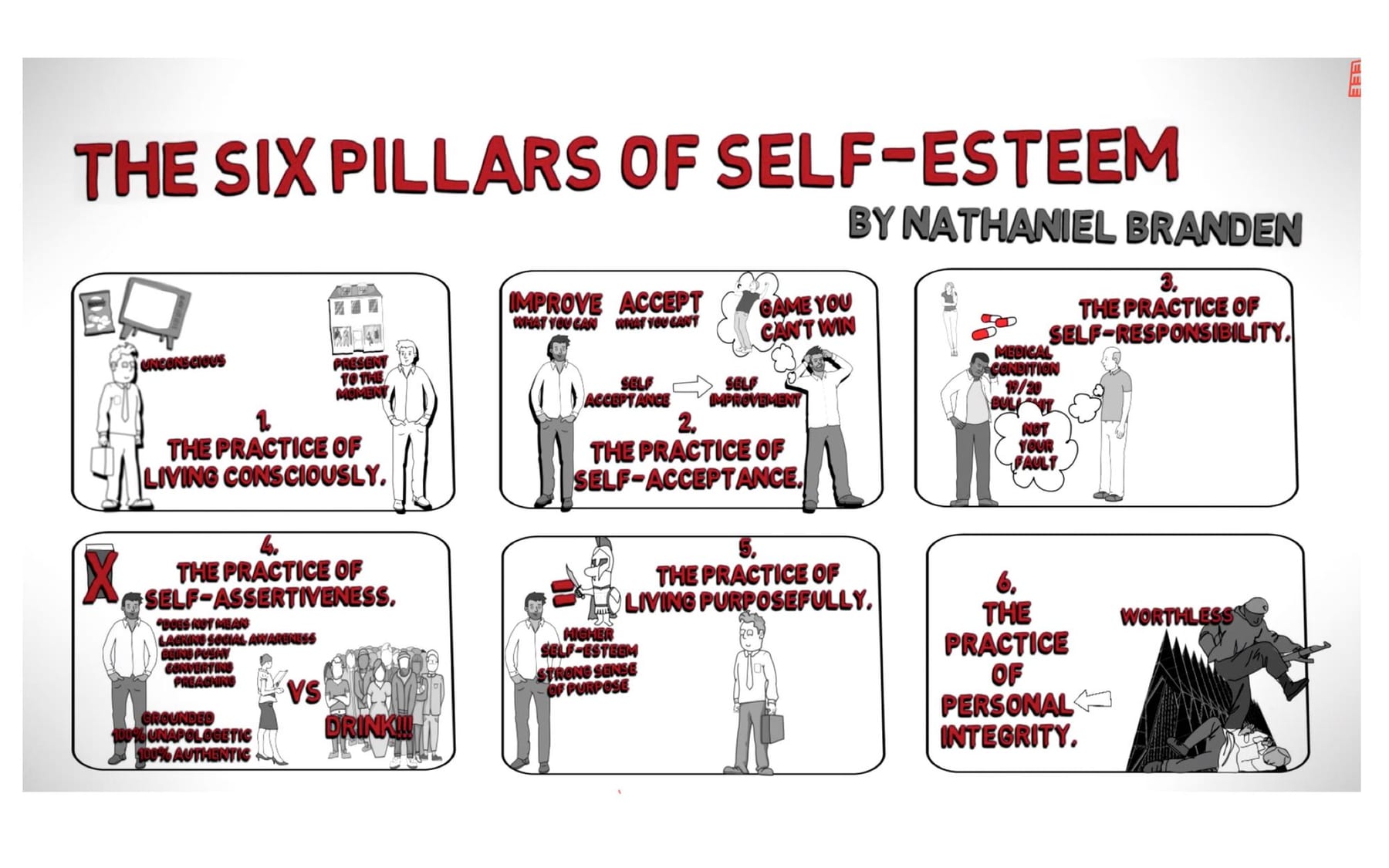
- Branden identifies six key practices, or “pillars,” that contribute to the development and maintenance of self-esteem. They are:
- Pillar 1: The Practice of Living Consciously
- Pillar 2: The Practice of Self-Acceptance
- Pillar 3: The Practice of Self-Responsibility
- Pillar 4: The Practice of Self-Assertiveness
- Pillar 5: The Practice of Living Purposefully
- Pillar 6: The Practice of Personal Integrity
- Branden identifies six key practices, or “pillars,” that contribute to the development and maintenance of self-esteem. They are:
- Pillar 1: The Practice of Living Consciously:
- Living consciously involves being present in the moment, fully aware of one’s thoughts, feelings, and actions.
- Mindfulness and self-awareness are essential for making informed choices and taking responsibility for one’s life.
- Pillar 2: The Practice of Self-Acceptance:
- Self-acceptance entails embracing both one’s strengths and weaknesses without self-condemnation.
- Recognizing that it is okay to be imperfect and that self-esteem is not contingent on perfection is crucial.
- Pillar 3: The Practice of Self-Responsibility:
- Self-responsibility means taking ownership of one’s life and choices.
- Acknowledging that one has control over their responses and actions empowers individuals to create positive change.
- Pillar 4: The Practice of Self-Assertiveness:
- Self-assertiveness involves expressing one’s thoughts, feelings, and needs honestly and respectfully.
- It requires standing up for oneself and setting boundaries while respecting the rights and boundaries of others.
- Pillar 5: The Practice of Living Purposefully:
- Living purposefully means setting and pursuing meaningful goals that align with one’s values.
- Having a sense of direction and purpose gives life meaning and contributes to self-esteem.
- Pillar 6: The Practice of Personal Integrity:
- Personal integrity involves living in alignment with one’s values and principles.
- Consistency between one’s beliefs, actions, and values is a cornerstone of self-esteem.
- Building Self-Esteem:
- Branden provides practical exercises and strategies for building and nurturing self-esteem.
- These exercises include journaling, self-reflection, and goal setting.
- The Role of Childhood and Relationships:
- Branden acknowledges the impact of childhood experiences and relationships on self-esteem.
- However, he emphasizes that adults have the power to reframe their self-concept and develop healthier self-esteem.
- Self-Esteem in Action:
- The book offers real-life examples of individuals who have transformed their self-esteem and lives through the practice of the six pillars.
- Branden highlights the potential for personal growth and self-improvement at any stage of life.
- The Continuous Journey:
- Branden emphasizes that self-esteem is not a fixed state but an ongoing process.
- Regularly practicing the six pillars leads to continuous self-improvement and increased self-esteem.
The higher our self-esteem, the steering the drive to express ourselves, reflecting the sense of richness within. The lower our self-esteem the more urgent the need to “prove” ourselves — or to forget ourselves by living mechanically and unconsciously.
The higher our self-esteem, the more open, honest, and appropriate our communications are likely to be, because we believe our thoughts have value and therefore we welcome rather than fear clarity.
What is required for many of us, paradoxical though it may sound, is the courage to tolerate happiness without self-sabotage.
When we are moved primarily by fear, sooner or later we precipitate the very calamity we dread. If we fear condemnation, we behave in ways that ultimately elicit disapproval. If we fear anger, eventually we make people angry.
If my aim is to prove I am “enough,” the project goes on to infinity—because the battle has already lost on the day I conceded the issue was debatable.
When we have unconflicted self-esteem, joy is our motor, not fear. It is happiness that we wish to experience, not suffering that we wish to avoid. Our purpose is self-expression, not self-avoidance or self-justification. Our motive is not to “prove” our worth but to live our possibilities.
If we develop habit patterns that cripple or incapacitate us for effect functioning and that cause us to distrust ourselves, it would be irrational to suggest that we “should” go on feeling just as efficacious and worthy as we would feel if our choices had been better.
Self-respect; Conviction of our own value. Not comparative or competitive. Conviction that our life and well-being are worth acting to support, protect, nurture; that we are good and worthwhile and deserving of the respect of others; and that our happiness and personal fulfillment are important enough to work for.
Relaxation implies that we are not hiding from ourselves and are not at war with who we are. Chronic tension conveys a message of some form of internal split, some form of self-avoidance or self-repudiation, some aspect of the self being disowned or held on a very tight leash.
When self-esteem is low, we are often manipulated by fear. Fear of reality, to which we feel inadequate. Fear of facts about ourselves—or others—that we have denied, disowned, or repressed. Fear of the collapse of our pretenses. Fear of exposure. Fear of the humiliation of failure and, sometimes, the responsibilities of success. We live more to avoid pain than to experience joy.
Since self-esteem is a consequence, a product of internally generated practices, we cannot work on self-esteem dirt, neither our own nor anon else’s. We must address ourselves to the source. If we understand what these practices are, we can commit to initiating them within ourselves and to dealing with others in such a way as to facilitate or encourage them to do likewise.
Six-Pillars of Self-Esteem:
Living consciously, self-acceptance, self-responsilbility, self-assertiveness, living purposefully, personal integrity
Self-acceptance is the refusal to regard any part of ourselves—our bodies, our emotions, our thoughts, our actions, our dreams—as alien, as “not me.” It is our willingness to experience rather than to disown whatever may be the facts of our being at a particular moment—to think our thoughts, own our feelings, be present to reality of our behavior.
When we fully experience and crept negative feelings, we are able to let go of them; they have been allowed to have their say and they relinquish enter stage. I need to open myself to and fully experience unwanted emotions, not just perfunctorily recognize them.
No one owes me the fulfillment of my wishes.
Taking responsibility for my happiness is empowering. It places my life back in my own hands.
One of the most Important of moments is when the client grasps that no one is coming. No one is coming to save me; no one is coming to make life right for me; no one is coming to solve my problems. If I don’t do something, nothing is going to get better.
Self-assertion entails the willingness to confront rather than evade the challenges of life and to strive for mastery.
Self-discilipine requires the ability to defer immediate gratification in the service of a remote goal. This is the ability to project consequences into the future—to think, plan, and live long-range. Neither an individual nor a business can function effectively, let alone flourish, in an absence of this practice.
Success in life belongs to those who do.
The root of our self-esteem is not our achievements but those internally generated practices that, among other things, make it possible for us to achieve.