DESCRIPTION
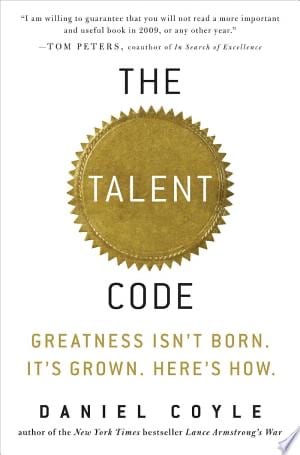
What is the secret of talent? How do we unlock it? This groundbreaking work provides readers with tools they can use to maximize potential in themselves and others. Whether you’re coaching soccer or teaching a child to play the piano, writing a novel or trying to improve your golf swing, this revolutionary book shows you how to grow talent by tapping into a newly discovered brain mechanism. Drawing on cutting-edge neurology and firsthand research gathered on journeys to nine of the world’s talent hotbeds—from the baseball fields of the Caribbean to a classical-music academy in upstate New York—Coyle identifies the three key elements that will allow you to develop your gifts and optimize your performance in sports, art, music, math, or just about anything. • Deep Practice Everyone knows that practice is a key to success. What everyone doesn’t know is that specific kinds of practice can increase skill up to ten times faster than conventional practice. • Ignition We all need a little motivation to get started. But what separates truly high achievers from the rest of the pack? A higher level of commitment—call it passion—born out of our deepest unconscious desires and triggered by certain primal cues. Understanding how these signals work can help you ignite passion and catalyze skill development. • Master Coaching What are the secrets of the world’s most effective teachers, trainers, and coaches? Discover the four virtues that enable these “talent whisperers” to fuel passion, inspire deep practice, and bring out the best in their students. These three elements work together within your brain to form myelin, a microscopic neural substance that adds vast amounts of speed and accuracy to your movements and thoughts. Scientists have discovered that myelin might just be the holy grail: the foundation of all forms of greatness, from Michelangelo’s to Michael Jordan’s. The good news about myelin is that it isn’t fixed at birth; to the contrary, it grows, and like anything that grows, it can be cultivated and nourished. Combining revelatory analysis with illuminating examples of regular people who have achieved greatness, this book will not only change the way you think about talent, but equip you to reach your own highest potential.
My Summary
Main Ideas, Takeaways & Similarities
Questions
I. What is the problem?
A. How is this problem formulated?
B. Why is this problem important?
C. What is the history of this problem?
D. Which prominent personalities have been interested in this problem?
II. What solutions to the problem are there?
A. What are the conclusions reached?
B. By what argument(s) is the conclusion reached?
C. What facts or assumptions serve as premises?
D. When a prominent personality offers a solution, does he also argue for or against other prominent personalities? Does he raise objections to alternative solutions? Does he consider objections to his own solutions?
III. Evaluation
A. What are the advantages and disadvantages of the alternative formulations to the problem?
B. Has the importance or history of the problem ever been misrepresented?
C. Are the solutions logically related to the premises?
D. Are the facts true? Are the assumptions acceptable? Are the objections answerable?
AI Summary
Highlights
“The Talent Code: Greatness Isn’t Born. It’s Grown. Here’s How” is a book by Daniel Coyle, published in 2009. The book explores the science of skill development and provides insights into how talent is cultivated. Here is a comprehensive summary of the book in bullet points:
- “The Talent Code” delves into the nature of talent and skill development, challenging the notion that greatness is solely a product of innate ability.
- The book introduces the concept of “talent hotbeds,” which are specific environments and communities that consistently produce exceptionally talented individuals.
- Daniel Coyle explores the neurological and physiological processes that underlie skill acquisition and talent development.
- He emphasizes the role of myelin, a substance in the brain’s white matter, in enhancing the speed and accuracy of neural transmissions, which are crucial for skill mastery.
- The book discusses the importance of deep practice, a form of deliberate and focused training that involves making mistakes and pushing the limits of one’s abilities.
- Coyle introduces the “10,000-hour rule,” which suggests that achieving mastery in a skill or domain typically requires approximately 10,000 hours of dedicated practice.
- The book provides examples of talent hotbeds, such as the Brazilian soccer academies, Russian tennis camps, and a music school in upstate New York, to illustrate the principles of skill development.
- Coyle highlights the significance of coaching and mentoring in nurturing talent, citing the impact of expert guidance and feedback.
- He explores the role of motivation, passion, and the “ignition” of talent, which involves finding one’s deep-seated interest and drive.
- The book discusses the value of struggle and perseverance in the learning process, emphasizing the importance of embracing challenges and setbacks.
- Coyle emphasizes the idea that talent is not fixed but can be cultivated and grown through deliberate practice and the right conditions.
- He provides practical insights and strategies for individuals, parents, educators, and coaches to facilitate skill development and talent growth.
- “The Talent Code” encourages readers to adopt a growth mindset and believe in their potential to achieve greatness through dedicated effort and focused practice.
Daniel Coyle’s book offers a compelling exploration of the science of talent and skill development. “The Talent Code” challenges the notion that talent is solely the result of innate ability and highlights the role of deep practice, myelin, and the right learning environments in cultivating exceptional skills. The book provides practical advice and inspiration for individuals looking to unlock their potential and achieve mastery in their chosen fields.