
DESCRIPTION
Fitness, money, and wisdom — here are the tools. Over the last two years, Tim Ferriss has collected the routines and tools of world-class performers around the globe while interviewing them for his self-titled podcast. Now the distilled notebook of tips and tricks that helped him double his income, flexibility, happiness, and more is available as Tools of Titans.
My Summary
Main Ideas, Takeaways & Similarities
Questions
I. What is the problem?
A. How is this problem formulated?
B. Why is this problem important?
C. What is the history of this problem?
D. Which prominent personalities have been interested in this problem?
II. What solutions to the problem are there?
A. What are the conclusions reached?
B. By what argument(s) is the conclusion reached?
C. What facts or assumptions serve as premises?
D. When a prominent personality offers a solution, does he also argue for or against other prominent personalities? Does he raise objections to alternative solutions? Does he consider objections to his own solutions?
III. Evaluation
A. What are the advantages and disadvantages of the alternative formulations to the problem?
B. Has the importance or history of the problem ever been misrepresented?
C. Are the solutions logically related to the premises?
D. Are the facts true? Are the assumptions acceptable? Are the objections answerable?
AI Summary
Highlights
- Wealthy and Successful Habits:
- The book highlights routines, habits, and philosophies that many successful people share.
- Consistency in routines is emphasized as a key to success.
- Health and Wellness:
- The importance of physical fitness, diet, and mental health is frequently discussed.
- Techniques such as meditation, mindfulness, and regular exercise are recommended.
- Productivity and Efficiency:
- Time management and efficiency are crucial for high achievers.
- Tools and techniques for better productivity, like the Pareto principle (80/20 rule) and batching tasks, are discussed.
- Learning and Education:
- Continuous learning and self-education are common among top performers.
- Methods to learn more effectively, including language learning and skill acquisition techniques, are provided.
- Mindset and Psychology:
- The book delves into the psychological traits of successful people, like resilience, grit, and a positive mindset.
- Overcoming fear and dealing with failure are important themes.
- Networking and Relationships:
- The value of building and maintaining strong professional and personal relationships is emphasized.
- Networking strategies and the importance of mentorship are discussed.
- Wealth Management:
- Strategies for financial growth and wealth management are shared by successful entrepreneurs and investors.
- Advice on investing, saving, and spending wisely is included.
- Creativity and Innovation:
- Emphasis on thinking outside the box and fostering creativity.
- Techniques to stimulate creative thinking and innovation are suggested.
- Philosophy and Spirituality:
- The book touches upon philosophical beliefs and spiritual practices that guide high performers.
- The role of spirituality and personal values in achieving success is explored.
- Miscellaneous Life Advice:
- Diverse tips on travel, lifestyle, and personal development.
- Emphasis on the importance of work-life balance and finding personal fulfillment.
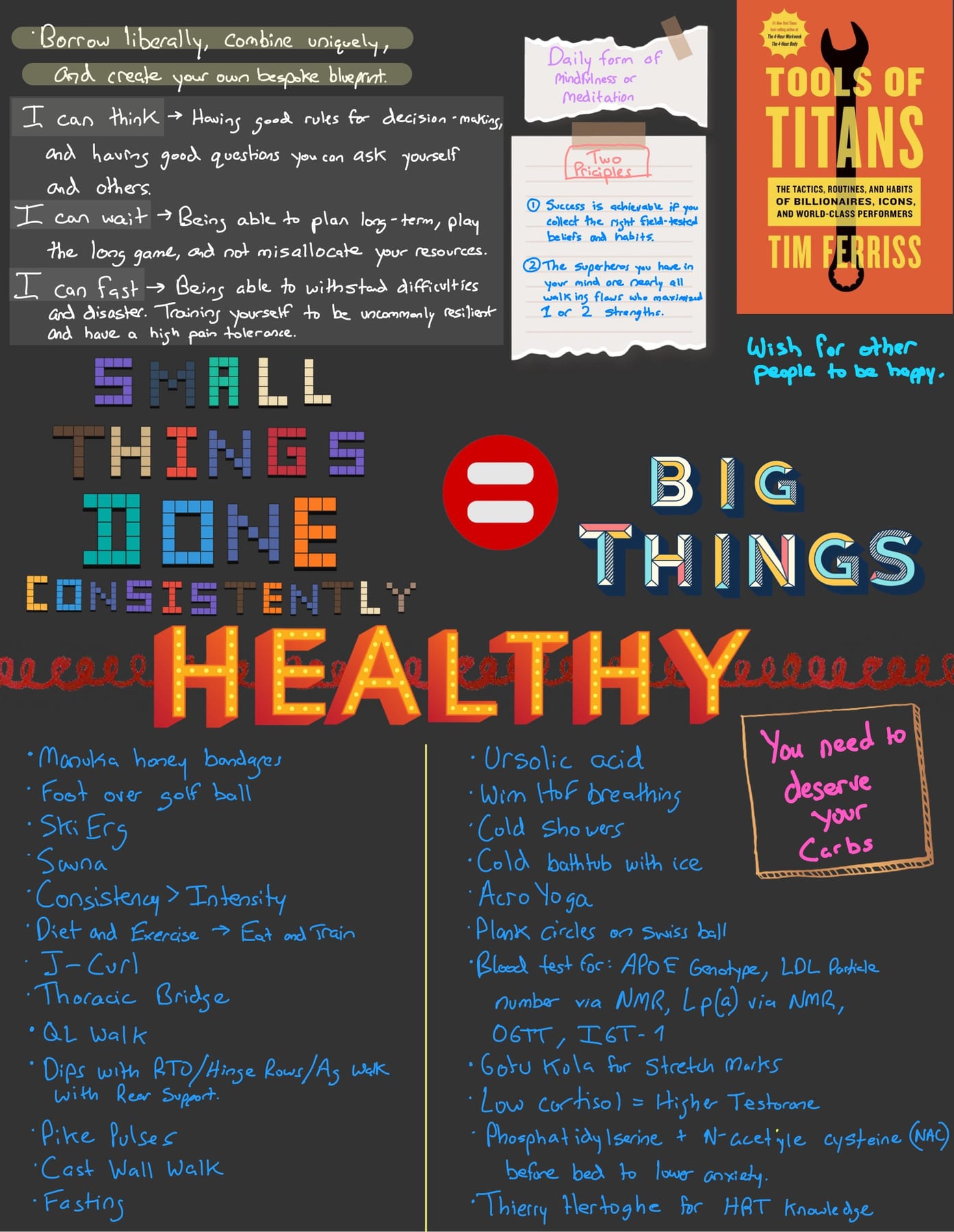
It’s the small things, done consistently, that are the big things (Location 367)
More than 80% of the interviewees have some form of daily mindfulness or meditation practice (Location 372)
Borrow liberally, combine uniquely, and create your own bespoke blueprint. (Location 388)
The superheroes you have in your mind (idols, icons, titans, billionaires, etc.) are nearly all walking flaws who’ve maximized 1 or 2 strengths. (Location 417)
mess. How the hell does he ever get anything done?” Everyone is fighting a battle you know nothing about. The heroes in this book are no different. Everyone struggles. Take solace in that. (Location 421)
“Hyperthermic conditioning” (calculated heat exposure) can help you to increase growth hormone (GH) levels and substantially improve endurance. I now take ~20-minute sauna sessions post-workout or post-stretching at least four times per week, typically at roughly 160 to 170°F. If nothing else, it seems to dramatically decrease DOMS (delayed-onset muscle soreness). (Location 589)
“eat and train.” (Location 645)
3 Movements Everyone Should Practice J-Curl (page 15) Shoulder Extension: Lift a dowel behind your back (standing), or sit on the floor and walk your hands backward behind your hips. Thoracic Bridge: Elevate your feet enough to feel the bulk of the stretch in the upper back and shoulders, not the lower back. The feet might be 3+ feet off the ground. Ensure you can concentrate on straightening your arms (and legs, if possible), holding the position, and breathing. (Location 662)
Good Goals for Adult Non-Gymnasts The following goals incorporate many different aspects of strength and mobility into single movements: Beginner: J-Curl Intermediate: Straddle Press Handstand [TF: I’m working on this] Advanced: Stalder Press Handstand (Location 669)
QL Walk—An Unusual Warmup (Location 686)
Jefferson Curl (J-Curl) (Location 697)
Dips with RTO (Ring Turn Out) (Location 711)
Hinge Rows (Location 718)
Ag Walks with Rear Support (Location 729)
Pike Pulses (Location 739)
Cast Wall Walk (Location 748)
Dom has discussed the idea of a therapeutic “purge fast” with his colleague Dr. Thomas Seyfried of Boston College. Per Dom: “If you don’t have cancer and you do a therapeutic fast 1 to 3 times per year, you could purge any precancerous cells that may be living in your body.” (Location 818)
I now aim for a 3-day fast once per month and a 5- to 7-day fast once per quarter. (Location 849)
“Ur Spray” Ursolic Acid (Location 1026)
KetoForce (Location 1043)
KetoCaNa, (Location 1043)
like Jocko [Willink, page 412], believes that you shouldn’t need caffeine or alcohol. He also thinks, “You should sweat like you’re being chased by the police daily.” (Location 1089)
A Mind-Blowing Experiment Before I describe the exercise, I shall repeat my usual refrain: Don’t be stupid and hurt yourself, please. Use a very soft surface in case you face plant. Do a set of push-ups and end a few repetitions short of failure. Record the number. Rest at least 30 minutes. Do ~40 repetitions of the following breathing exercise: Max inhale (raise chest) and “let go” exhale (drop chest sharply). The let-go exhale can be thought of as a short “hah.” If you’re doing this correctly, after 20 to 30 reps you might feel loose, mild lightheadedness, and a little bit of tingling. The tingling is often felt in the hands first. On the last breathing cycle, breathe in completely, exhale completely, then do another set of push-ups. More often than not, people will experience a sharp increase in the max number of push-ups, even though their lungs are empty. (Location 1116)
Wim, surfing king Laird Hamilton (page 92), and Tony Robbins (page 210) all use cold exposure as a tool. It can improve immune function, increase fat loss (partially by increasing levels of the hormone adiponectin), and dramatically elevate mood. (Location 1125)
you can start with a cold water “finish” to showers. Simply make the last 30 to 60 seconds of your shower pure cold. (Location 1130)
regimen, often alternated with heat, which we covered on page 7. My full “workout” process then, is 1) pre-workout BCAA, 2) workout, 3) post-exercise whey protein, 4) immediate heat (~20 minutes) followed by 5) cold (5 to 10 minutes). I repeat the hot-cold cycle 2 to 4 times. (Location 1133)
My post-workout cold routine is as follows: Put ~40 pounds of ice (this will depend on your bathtub size) into a bathtub, and then fill with water. That order avoids splashing and speeds things up. Instacart is helpful for ice delivery, or buy a garage freezer just for bags of ice, which is far easier (Location 1136)
than fancy ice-making or cooling contraptions. 15 to 20 minutes later, when the water reaches ~45°F, it is ready for use. I drop a $5 immersion thermometer from Carolina Biological Supply Company in the water for tracking. Coach Sommer (page 9) uses the low 50s°F for his athletes. After heat, I enter the ice bath, keeping my hands out of the water. This allows me to stay in for longer, as capillary density is high in the hands. Hands go under for the last 3 to 5 minutes. (Location 1138)
He just wants to hug heart-to-heart with everyone.” (Location 1149)
AcroYoga, which blends the spiritual wisdom of yoga, the loving-kindness of Thai massage, and the dynamic power of acrobatics. (Location 1179)
“Let go of what’s not working and really assess what is working and ‘what can I be excited about?’ It’s not that bad things don’t happen to me. I don’t label a lot of things good/bad. [Instead, I ask] can I evolve from this? What do I want now? Where is my center now?” (Location 1245)
The Prophet by Kahlil Gibran: “I love really condensed, shakti [empowerment]-filled, energy-filled statements—something that you can read in a few minutes or you can read for your whole life.” [TF: This little tome is fewer than 100 pages long. Spend the extra $5 for the version with the author’s illustrations.] (Location 1249)
Tell people what you want, not what you don’t want, and keep it simple. (Location 1286)
FLYER: (Location 1290)
BASE: (Location 1300)
Deconstructing Sports and Skills with Questions (Location 1353)
Who is good at [SPORT] despite being poorly built for it? Who’s good at this who shouldn’t be? Who are the most controversial or unorthodox athletes or trainers in [SPORT]? Why? What do you think of them? Who are the most impressive lesser-known teachers? What makes you different? Who trained you or influenced you? Have you trained others to do this? Have they replicated your results? What are the biggest mistakes and myths you see in [SPORT] training? What are the biggest wastes of time? What are your favorite instructional books or resources on the subject? If people had to teach themselves, what would you suggest they use? If you were to train me for 12 weeks for a [FILL IN THE BLANK] competition and had a million dollars on the line, what would the training look like? What if I trained for 8 weeks? (Location 1359)
Glute Medius Workout (Location 1418)
week. (Location 1429)
#2—Front Kick/Swing (Location 1436)
#3—Back Swing (Location 1438)
#4—Full Front and Back Swing (Location 1440)
#5—Clockwise Circles (Location 1441)
#6—Counterclockwise Circles (Location 1444)
#7—Bicycle Motion (Location 1445)
Plank Circles on Swiss Ball The goal of this separate exercise is to create scapular (shoulder blade) movement and rotation. Scapular mobility is one of the keys to upper-body function and longevity. (Location 1447)
Get into a plank position with your elbows propped on a Swiss ball, forearms pointing straight ahead. Don’t sag between the shoulder blades or at the lower back (keep the “hollow” and “protracted” positions described on page 19). Start with the legs wide for stability, and you can narrow the feet as you get stronger. Keeping your body in this position, use your forearms to move the ball as described below. One set consists of 10 to 15 reps of each of the following with no rest in between: Clockwise circles Counter-clockwise circles Forward and backward (i.e., sliding the elbows forward 6 to 12 inches and then back to your ribs) When you’re doing this correctly, you should feel your entire shoulder blades (scapulae) moving. Peter will do 3 total sets per workout, 2 times per week. He will superset these with “Wolverines” (Google it) on a cable machine. If done correctly, Wolverines target the rhomboids more than the deltoids. (Location 1450)
5 Blood Tests Peter GENERALLY Recommends (Location 1458)
APOE Genotype: “This informs my thinking on a person’s risk for Alzheimer’s disease (AD). (Location 1461)
LDL Particle Number via NMR (Location 1466)
Lp(a) (“L-P-little-A”) via NMR: (Location 1469)
OGTT (Oral Glucose Tolerance Test): (Location 1476)
(Insulin-like Growth Factor-1): (Location 1480)
“If you’re over 40 and don’t smoke, there’s about a 70 to 80% chance you’ll die from one of four diseases: heart disease, cerebrovascular disease, cancer, or neurodegenerative disease.” (Location 1508)
Mistakes Were Made (But Not by Me) by Carol Tavris and Elliot Aronson. (Location 1568)
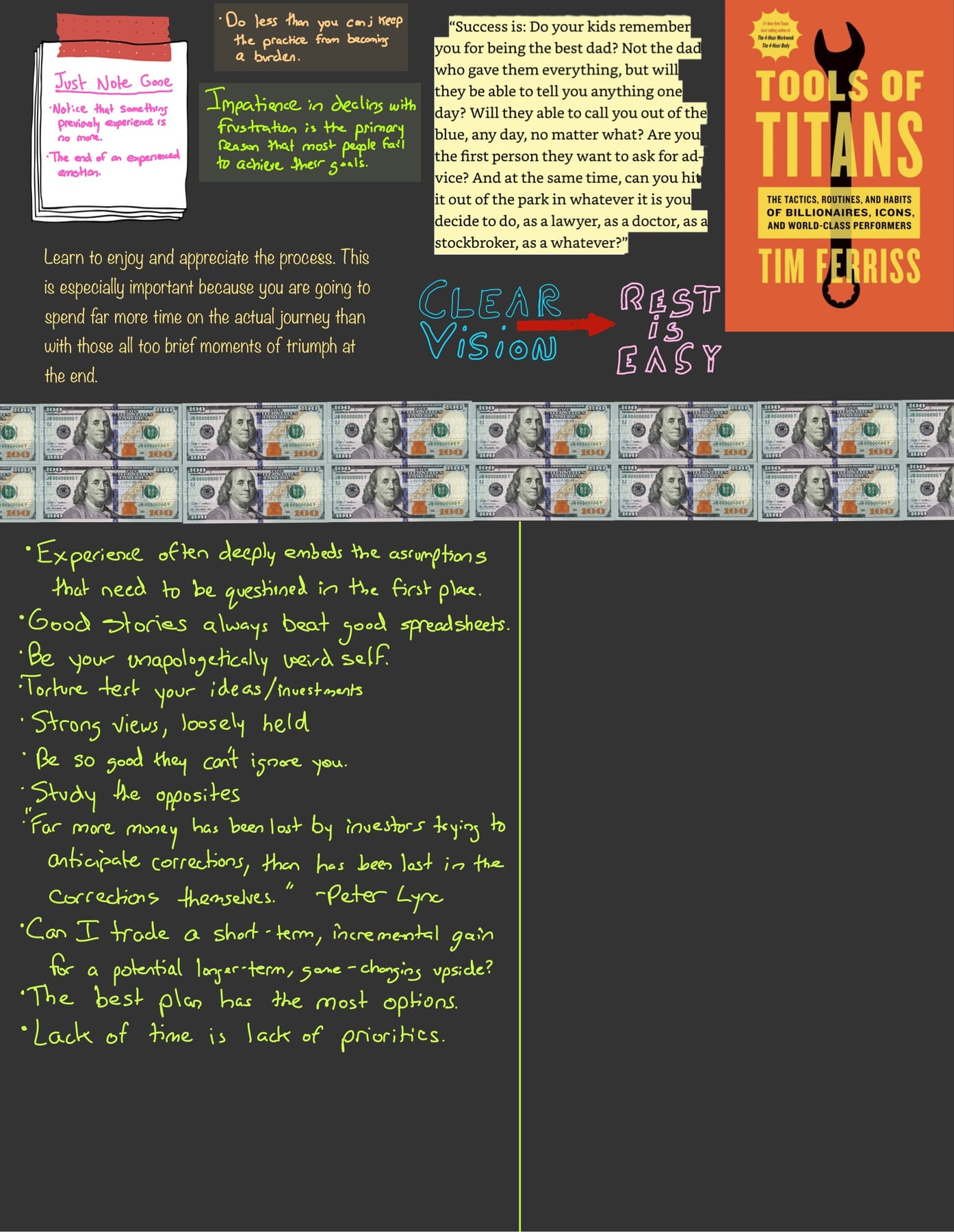
“Success is: Do your kids remember you for being the best dad? Not the dad who gave them everything, but will they be able to tell you anything one day? Will they be able to call you out of the blue, any day, no matter what? Are you the first person they want to ask for advice? And at the same time, can you hit it out of the park in whatever it is you decide to do, as a lawyer, as a doctor, as a stockbroker, as a whatever?” (Location 1581)
“We’re Not an Object, We’re a Process” (Location 1593)
Stretch Marks (Location 1650)
herb called gotu kola (Location 1650)
for 6 months. (Location 1652)
gotu kola bioabsorbable (Location 1654)
one dropperful of Gaia Herbs Gotu Kola Leaf liquid extract per day, (Location 1656)
levels—before bed, I take phosphatidylserine and N-acetyl cysteine (NAC). For me, this also has a noticeable impact on lowering anxiety the following day. (Location 1688)
Step #1 in a Squat Warmup “There’s a lot of research that shows that mobility in the ankle is what decreases the probability of any lower extremity injuries, whether it’s an ACL tear or hamstring pull or groin tear or whatever. So the first thing I would do [in a warmup prior to squatting] is go on a calf machine and stretch the calves, and then go down and statically stretch for 8 seconds. I’d finish off with voluntary contraction, because it resets the pattern for strength. Research is clear: If you do static stretching and you don’t finish with a contraction, you’re more likely to get an injury.” TF: This, along with Paul Levesque’s recommendation, prompted me to take Cossack squats seriously (see page 87). I pay more attention to my calves now than ever before, both for injury prevention and upper-leg flexibility (see Christopher Sommer, page 9). (Location 1698)
59 Seconds: Change Your Life in Under a Minute by Richard Wiseman (for stress reduction) (Location 1714)
Two Warmups: Halos and Cossack Squats (Location 1796)
Halos (Location 1798)
Cossack Squat (Location 1801)
3 High-Yield Exercises—Pavel’s “Simple & Sinister” Kettlebell Program One-arm swing Turkish get-up (TGU) Goblet squat (Location 1836)
effective midsection exercises are ‘power breathing,’ hollow rocks, Janda sit-ups, hanging leg raises, and ‘hard-style planks.’ (Location 1850)
My Favorite Odd Stretch—Windmills Kettlebell windmills (or “high windmills”) are incredible for hip rehab and “prehab.” The standing position is similar to yoga’s trikonasana, but you support 70 to 80% of your weight on one leg while you keep a kettlebell overhead. (Location 1866)
“Calm Is Contagious” (Location 1872)
Burgener warmup (Location 2472)
Tags: blue
Nutriforce WODPak (Location 2494)
One Tactic for Chronic Pain—Use a Close Cousin of the Movement That Injured You (Location 2495)
Vans Classic Slip-On skate shoe (Location 2502)
Even if it was to get on a bike and ride for 15 minutes to reset things. I learned early that it seemed any time I did that, I didn’t get jet lag.” (Location 2529)
Is that a dream or a goal? (Location 2535)
‘Why would I be wound up? I’m either ready or I’m not. Worrying about it right now ain’t gonna change a damn thing. Right? Whatever’s gonna happen is gonna happen. I’ve either done everything I can to be ready for this, or I haven’t.’” (Location 2549)
5 Morning Rituals that Help Me Win the Day (Location 2718)
#1—Make Your Bed (<3 minutes) (Location 2725)
#2—Meditate (10 to 20 minutes) (Location 2752)
#3—Do 5 to 10 Reps of Something (<1 minute) (Location 2757)
#4—Prepare “Titanium Tea” (Location 2763)
#5—Morning Pages or 5-Minute Journal (Location 2776)
The idea is to do less formal practice than you are capable of. For example, if you can sit in mindfulness for 5 minutes before it feels like a chore, then don’t sit for 5 minutes, just do 3 or 4 minutes, perhaps a few times a day. (Location 2915)
- Just Note Gone There is a simple practice that can greatly enhance your ability to notice the absence of pain [whether physical, mental, or emotional], though it isn’t only concerned with pain. With “Just Note Gone” we train the mind to notice that something previously experienced is no more. For example, at the end of a breath, notice that the breath is over. Gone. As a sound fades away, notice when it is over. Gone. At the end of a thought, notice that the thought is over. Gone. At the end of an experience of emotion—joy, anger, sadness, or anything else—notice it is over. Gone. (Location 2931)
impatience in dealing with frustration is the primary reason that most people fail to achieve their goals. (Location 3001)
The secret is to show up, do the work, and go home. (Location 3003)
Learn to enjoy and appreciate the process. This is especially important because you are going to spend far more time on the actual journey than with those all too brief moments of triumph at the end. (Location 3007)
If the commitment is to a long-term goal and not to a series of smaller intermediate goals, then only one decision needs to be made and adhered to. Clear, simple, straightforward. Much easier to maintain than having to make small decision after (Location 3011)
small decision to stay the course when dealing with each step along the way. This provides far too many opportunities to inadvertently drift from your chosen goal. The single decision is one of the most powerful tools in the toolbox. (Location 3012)
‘Tonight, I will be in my bed. (Location 3079)
often deeply embeds the assumptions that need to be questioned in the first place. When you have a lot of experience with something, you don’t notice the things that are new about it. You don’t notice the idiosyncrasies that need to be tweaked. You don’t notice where the gaps are, what’s missing, or what’s not really working.” (Location 3082)
“Good Stories Always Beat Good Spreadsheets” (Location 3104)
“Whether you are raising money, pitching your product to customers, selling the company, or recruiting employees, never forget that underneath all the math and the MBA bullshit talk, we are all still emotionally driven human beings. We want to attach ourselves to narratives. We don’t act because of equations. We follow our beliefs. We get behind leaders who stir our feelings. In the early days of your venture, if you find someone diving too deep into the numbers, that means they are struggling to find a reason to deeply care about you.” (Location 3105)
“Weirdness is why we adore our friends… . Weirdness is what bonds us to our colleagues. Weirdness is what sets us apart, gets us hired. Be your unapologetically weird self. In fact, being weird may even find you the ultimate happiness.” TF: As an example—mullet wigs. CHRIS: “If you could bring one thing to make for an amazing party night, it’s wigs, seriously. Go to Amazon right now and order 50 mullet wigs. Mullet wigs change everything.” (Location 3112)
“Whenever [Ben] brings in a deal, I just beat the shit out of it. I might think it’s the best idea I’ve ever heard of, but I’ll just trash the crap out of it and try to get everybody else to pile on. And then, at the end of it, if he’s still pounding the table saying, ‘No, no, this is the thing …’ then we say we’re all in. We’re all behind you… . It’s a ‘disagree and commit’ kind of culture. (Location 3152)
‘Be so good they can’t ignore you.’” (Location 3184)
My preferred late-night “Silicon Valley speedball” for writing deadlines is a combination of Cruz de Malta yerba mate tea and 2 to 3 glasses of Malbec red wine. Not mixed but alternated. I sip the tea over hours with a traditional bombilla straw, taking a swig of the nectar of the gods every 5 to 10 minutes. Pro tip: Your writing does not get better after the third glass. (Location 3190)
Study the Opposites (Location 3202)
“‘Far more money has been lost by investors trying to anticipate corrections, than has been lost in corrections themselves.’—Peter Lynch” (Location 3222)
“My confidence came from my vision… . I am a big believer that if you have a very clear vision of where you want to go, then the rest of it is much easier. Because you always know why you are training 5 hours a day, you always know why you are pushing and going through the pain barrier, and why you have to eat more, and why you have to struggle more, and why you have to be more disciplined… . I felt that I could win it, and that was what I was there for. I wasn’t there to compete. I was there to win.” (Location 3253)
Can I trade a short-term, incremental gain for a potential longer-term, game-changing upside? Is there an element here that might be far more valuable in 5 to 10 years (e.g., ebook rights 10 years ago)? Might there be rights or options I can explicitly “carve out” and keep? If you can cap the downside (time, capital, etc.) and have the confidence, take uncrowded bets on yourself. You only need one winning lottery ticket. (Location 3329)
Seeking Wisdom: From Darwin to Munger, by Peter Bevelin. (Location 3372)
“If [more] information was the answer, then we’d all be billionaires with perfect abs.” TF: It’s not what you know, it’s what you do consistently. (Location 3380)
“So, my advice to my 30-year-old self is, don’t be a donkey. You can do everything you want to do. You just need foresight and patience.” (Location 3430)
Lack of time is lack of priorities. If I’m “busy,” it is because I’ve made choices that put me in that position, so I’ve forbidden myself to reply to “How are you?” with “Busy.” I have no right to complain. Instead, if I’m too busy, it’s a cue to reexamine my systems and rules. (Location 3460)
for life, I think of all of this maximization—getting the maximum dollar out of everything, the maximum out of every second, the maximum out of every minute—you don’t need to stress about any of this stuff. Honestly, that’s been my approach ever since. I do things, but I stop before anything gets stressful. (Location 3484)
‘We are whatever we pretend to be.’” (Location 3510)
Most “superheroes” are nothing of the sort. They’re weird, neurotic creatures who do big things DESPITE lots of self-defeating habits and self-talk. (Location 3617)
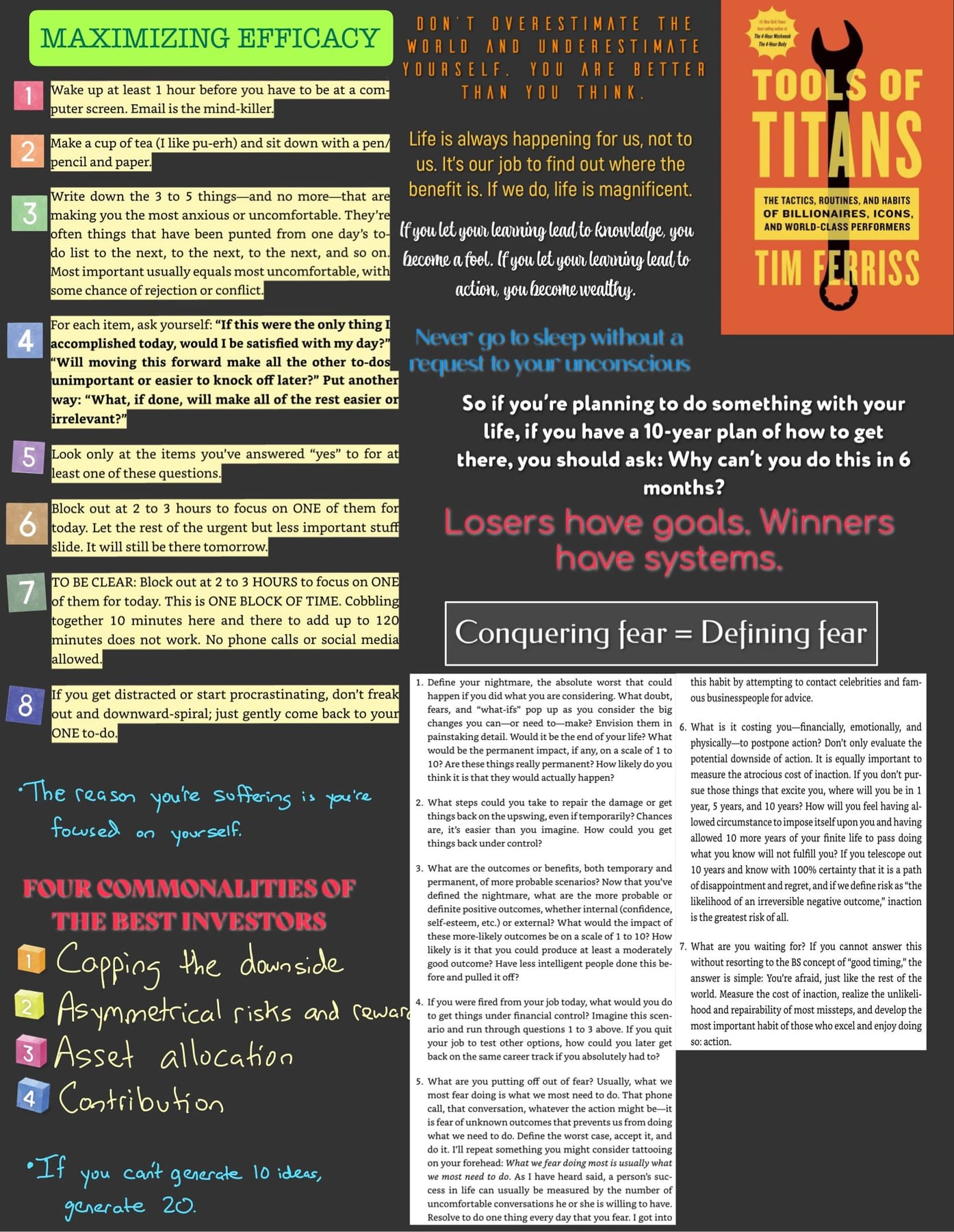
To compensate and cope, here’s my 8-step process for maximizing efficacy (doing the right things): Wake up at least 1 hour before you have to be at a computer screen. Email is the mind-killer. Make a cup of tea (I like pu-erh) and sit down with a pen/pencil and paper. Write down the 3 to 5 things—and no more—that are making you the most anxious or uncomfortable. They’re often things that have been punted from one day’s to-do list to the next, to the next, to the next, and so on. Most important usually equals most uncomfortable, with some chance of rejection or conflict. For each item, ask yourself: “If this were the only thing I accomplished today, would I be satisfied with my day?” “Will moving this forward make all the other to-dos unimportant or easier to knock off later?” Put another way: “What, if done, will make all of the rest easier or irrelevant?” Look only at the items you’ve answered “yes” to for at least one of these questions. Block out at 2 to 3 hours to focus on ONE of them for today. Let the rest of the urgent but less important stuff slide. It will still be there tomorrow. TO BE CLEAR: Block out at 2 to 3 HOURS to focus on ONE of them for today. This is ONE BLOCK OF TIME. Cobbling together 10 minutes here and there to add up to 120 minutes does not work. No phone calls or social media allowed. If you get distracted or start procrastinating, don’t freak out and downward-spiral; just gently come back to your ONE to-do. (Location 3618)
Being busy is a form of laziness—lazy thinking and indiscriminate action. Being busy is most often used as a guise for avoiding the few critically important but uncomfortable actions. (Location 3641)
Don’t overestimate the world and underestimate yourself. You are better than you think. (Location 3645)
Martha Argerich. (Location 3776)
To have your mind explode, search “Tchaikovsky Piano Concerto No 1 FULL Argerich Charles Dutoit” and check out minute 31. (Location 3778)
So I think, every day, it’s something to reflect on and think about ‘How do I become less competitive in order that I can become more successful?’ ” (Location 4224)
The Monopoly Question: Are you starting with a big share of a small market? The Secret Question: Have you identified a unique opportunity that others don’t see? The Distribution Question: Do you have a way to not just create but deliver your product? (Location 4237)
something as simple as pre-scheduled workouts acts as scaffolding around which you can more effectively plan and execute your day. (Location 7149)
“I think that in order to truly experience the light and the bright, you have to see the darkness. I think if you shield yourself from the darkness, you’ll not appreciate—and fully understand—the beauty of life.” (Location 7158)
“If you want to be tougher mentally, it is simple: Be tougher. Don’t meditate on it.” (Location 7169)
“You can’t blame your boss for not giving you the support you need. Plenty of people will say, ‘It’s my boss’s fault.’ No, it’s actually your fault because you haven’t educated him, you haven’t influenced him, you haven’t explained to him in a manner he understands why you need this support that you need. That’s extreme ownership. Own it all.” (Location 7187)
being able to detach as a leader is critical.” (Location 7235)