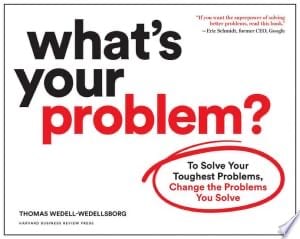
DESCRIPTION
“The author makes a compelling case that we often start solving a problem before thinking deeply about whether we are solving the right problem. If you want the superpower of solving better problems, read this book.” — Eric Schmidt, former CEO, Google Are you solving the right problems? Have you or your colleagues ever worked hard on something, only to find out you were focusing on the wrong problem entirely? Most people have. In a survey, 85 percent of companies said they often struggle to solve the right problems. The consequences are severe: Leaders fight the wrong strategic battles. Teams spend their energy on low-impact work. Startups build products that nobody wants. Organizations implement “solutions” that somehow make things worse, not better. Everywhere you look, the waste is staggering. As Peter Drucker pointed out, there’s nothing more dangerous than the right answer to the wrong question. There is a way to do better. The key is reframing, a crucial, underutilized skill that you can master with the help of this book. Using real-world stories and unforgettable examples like “the slow elevator problem,” author Thomas Wedell-Wedellsborg offers a simple, three-step method - Frame, Reframe, Move Forward - that anyone can use to start solving the right problems. Reframing is not difficult to learn. It can be used on everyday challenges and on the biggest, trickiest problems you face. In this visually engaging, deeply researched book, you’ll learn from leaders at large companies, from entrepreneurs, consultants, nonprofit leaders, and many other breakthrough thinkers. It’s time for everyone to stop barking up the wrong trees. Teach yourself and your team to reframe, and growth and success will follow.
In “What’s Your Problem?” by Thomas Wedell, the focus is on the critical importance of correctly identifying and framing problems to find effective solutions. The book emphasizes that the way we frame a problem significantly influences the solutions we devise. By reframing, or looking at a problem from a different perspective, we can sometimes discover much better solutions.
Key points from the book include:
- The Importance of Reframing: Reframing is essential for effective problem-solving. It involves looking beyond the immediate details of a problem to understand it from multiple perspectives.
- Optimism in Problem-Solving: A fundamental trait of good problem solvers is their optimism. This positive outlook enables them to approach problems constructively.
- Types of Reframing: The book describes two ways of reframing a problem: exploring the frame (delving deeper into the original problem) and breaking the frame (stepping away entirely from the initial framing).
- Mental Breakthroughs: In many cases, especially in daily life, solving problems depends more on mental breakthroughs than on technological solutions.
- Generating Multiple Options: One effective strategy in problem-solving is to generate a variety of options from which to choose.
- Questions for Problem Identification: The book proposes several questions to help identify and understand problems more effectively, such as rethinking the goal, examining areas where the problem doesn’t exist, understanding personal or collective roles in the problem, and considering perspectives of others involved.
- Types of Problems: Wedell categorizes problems into three types: ill-defined messes or pain points, goals that are unclear or difficult to achieve, and situations where someone is overly attached to a particular solution.
- Reviewing and Reframing Problems: The process involves questioning the truth of the problem statement, identifying self-imposed limitations, clarifying the problem, locating the problem’s source, recognizing emotions involved, and identifying any false trade-offs.
- Challenges in Reframing: The book also discusses challenges such as choosing which frame to focus on, identifying unknown causes, and overcoming resistance to outside involvement or silo thinking.
Overall, “What’s Your Problem?” by Thomas Wedell offers a comprehensive guide to reframing problems in various contexts, highlighting the importance of perspective and mental flexibility in finding effective solutions.
How much do we waste—time, money, energy, even lives—by solving the wrong problems? (Location 113)
The way you frame a problem determines which solutions you come up with. By shifting the way you see the problem—that is, by reframing it—you can sometimes find radically better solutions. (Location 129)
sometimes, to solve a hard problem, you have to stop looking for solutions to it. Instead, you must turn your attention to the problem itself—not just to analyze it, but to shift the way you frame it. (Location 151)
The most basic trait of good problem solvers is their optimism. (Location 247)
Reframing, in comparison, is a higher-level activity. It is when you ask, Is the speed of the elevator the right thing to focus on? Being good at reframing is not necessarily about the details. It is more about seeing the big picture and having the ability to consider situations from multiple perspectives. (Location 255)
The result, modeled on dating apps for humans, was a playful app called BarkBuddy, through which people could see profiles of adoptable dogs and contact the shelter that held them. (Location 281)
there are two different ways of reframing a problem—call it exploring versus breaking the frame. (Location 324)
Exploring the frame is when you delve deeper into the original problem statement. (Location 327)
It is similar to analyzing the problem, but with the added element that you keep an eye out for overlooked aspects of the situation that might make a difference. (Location 328)
Breaking the frame is when you step away completely from the initial framing of the problem. (Location 332)
But in a surprisingly large number of cases—especially those encountered in our daily lives—the solution to a problem depends not on technological but on mental breakthroughs. (Location 357)
Reframing is not about finding the real problem; it’s about finding a better problem to solve (Location 383)
Research has shown that one of the most powerful things you can do when solving problems is to generate multiple options to choose from (Location 387)
Look outside the frame. What are we missing? Rethink the goal. Is there a better objective to pursue? Examine bright spots. Where is the problem not? Look in the mirror. What is my/our role in creating this problem? Take their perspective. What is their problem? (Location 512)
WHAT’S YOUR PROBLEM TYPE? (Location 703)
Problem type 1: an ill-defined mess or pain point (Location 723)
Problem type 2: a goal we don’t know how to reach (Location 742)
Problem type 3: someone fell in love with a solution (Location 757)
REVIEW THE PROBLEM (Location 775)
Here are the questions: Is the statement true? Are there simple self-imposed limitations? Is a solution “baked into” the problem framing? Is the problem clear? With whom is the problem located? Are there strong emotions? Are there false trade-offs? (Location 779)
Choosing which frame to focus on (when you end up with too many framings) Identifying unknown causes of a problem (when you don’t have any idea what’s going on) Overcoming silo thinking (when people resist outside involvement) (Location 2576)