📓 In your handwritten notebooks
- March 21 – June 9 2026, pp. 209 — *When Breath Becomes Air — Kalanithi* → open PDF p226 (file not included in this release)
Index: Personal Journal
DESCRIPTION
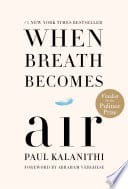
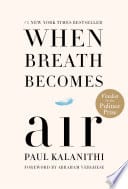
#1 NEW YORK TIMES BESTSELLER • PULITZER PRIZE FINALIST • This inspiring, exquisitely observed memoir finds hope and beauty in the face of insurmountable odds as an idealistic young neurosurgeon attempts to answer the question, What makes a life worth living? “Unmissable … Finishing this book and then forgetting about it is simply not an option.”—Janet Maslin, The New York Times ONE OF THE BEST BOOKS OF THE YEAR: The New York Times Book Review, People, NPR, The Washington Post, Slate, Harper’s Bazaar, Time Out New York, Publishers Weekly, BookPage At the age of thirty-six, on the verge of completing a decade’s worth of training as a neurosurgeon, Paul Kalanithi was diagnosed with stage IV lung cancer. One day he was a doctor treating the dying, and the next he was a patient struggling to live. And just like that, the future he and his wife had imagined evaporated. When Breath Becomes Air chronicles Kalanithi’s transformation from a naïve medical student “possessed,” as he wrote, “by the question of what, given that all organisms die, makes a virtuous and meaningful life” into a neurosurgeon at Stanford working in the brain, the most critical place for human identity, and finally into a patient and new father confronting his own mortality. What makes life worth living in the face of death? What do you do when the future, no longer a ladder toward your goals in life, flattens out into a perpetual present? What does it mean to have a child, to nurture a new life as another fades away? These are some of the questions Kalanithi wrestles with in this profoundly moving, exquisitely observed memoir. Paul Kalanithi died in March 2015, while working on this book, yet his words live on as a guide and a gift to us all. “I began to realize that coming face to face with my own mortality, in a sense, had changed nothing and everything,” he wrote. “Seven words from Samuel Beckett began to repeat in my head: ‘I can’t go on. I’ll go on.’” When Breath Becomes Air is an unforgettable, life-affirming reflection on the challenge of facing death and on the relationship between doctor and patient, from a brilliant writer who became both. Finalist for the PEN Center USA Literary Award in Creative Nonfiction and the Books for a Better Life Award in Inspirational Memoir
Part I: In Perfect Health I Begin
Highlight(yellow) - Page 20 · Location 357
He had reached some compromise in his mind that fatherhood could be distilled; short, concentrated (but sincere) bursts of high intensity could equal… whatever it was that other fathers did. All I knew was, if that was the price of medicine, it was simply too high.
Highlight(yellow) - Page 30 · Location 446
What makes human life meaningful?
Highlight(yellow) - Page 38 · Location 517
Only later would I realize that our trip had added a new dimension to my understanding of the fact that brains give rise to our ability to form relationships and make life meaningful. Sometimes, they break.
Highlight(yellow) - Page 42 · Location 559
Moral speculation was puny compared to moral action.
Highlight(yellow) - Page 43 · Location 569
Cadaver dissection epitomizes, for many, the transformation of the somber, respectful student into the callous, arrogant doctor.
Highlight(yellow) - Page 49 · Location 612
In our rare reflective moments, we were all silently apologizing to our cadavers, not because we sensed the transgression but because we did not.
Highlight(yellow) - Page 68 · Location 788
this is how 99 percent of people select their jobs: pay, work environment, hours. But that’s the point. Putting lifestyle first is how you find a job—not a calling.)
Highlight(yellow) - Page 81 · Location 903
But in residency, something else was gradually unfolding. In the midst of this endless barrage of head injuries, I began to suspect that being so close to the fiery light of such moments only blinded me to their nature, like trying to learn astronomy by staring directly at the sun. I was not yet with patients in their pivotal moments, I was merely at those pivotal moments. I observed a lot of suffering; worse, I became inured to it. Drowning, even in blood, one adapts, learns to float, to swim, even to enjoy life, bonding with the nurses, doctors, and others who are clinging to the same raft, caught in the same tide.
Highlight(yellow) - Page 86 · Location 948
Amid the tragedies and failures, I feared I was losing sight of the singular importance of human relationships, not between patients and their families but between doctor and patient.
Highlight(yellow) - Page 96 · Location 1037
To me, that hardness always seems brittle, unrealistic optimism the only alternative to crushing despair.
Highlight(yellow) - Page 97 · Location 1050
Being with patients in these moments certainly had its emotional cost, but it also had its rewards. I don’t think I ever spent a minute of any day wondering why I did this work, or whether it was worth it. The call to protect life—and not merely life but another’s identity; it is perhaps not too much to say another’s soul—was obvious in its sacredness.
Highlight(yellow) - Page 100 · Location 1072
Science, I had come to learn, is as political, competitive, and fierce a career as you can find, full of the temptation to find easy paths.
Highlight(yellow) - Page 102 · Location 1089
How little do doctors understand the hells through which we put patients.
Part II: Cease Not till Death
Highlight(yellow) - Page 125 · Location 1279
(Alexander Pope: “A little learning is a dangerous thing; / Drink deep, or taste not the Pierian spring.”)
Highlight(yellow) - Page 134 · Location 1354
It occurred to me that my relationship with statistics changed as soon as I became one.
Highlight(yellow) - Page 165 · Location 1640
I could hear Emma’s voice again: You have to figure out what’s most important to you.
Highlight(yellow) - Page 168 · Location 1666
Although I had been raised in a devout Christian family, where prayer and Scripture readings were a nightly ritual, I, like most scientific types, came to believe in the possibility of a material conception of reality, an ultimately scientific worldview that would grant a complete metaphysics, minus outmoded concepts like souls, God, and bearded white men in robes. I spent a good chunk of my twenties trying to build a frame for such an endeavor. The problem, however, eventually became evident: to make science the arbiter of metaphysics is to banish not only God from the world but also love, hate, meaning—to consider a world that is self-evidently not the world we live in. That’s not to say that if you believe in meaning, you must also believe in God. It is to say, though, that if you believe that science provides no basis for God, then you are almost obligated to conclude that science provides no basis for meaning and, therefore, life itself doesn’t have any. In other words, existential claims have no weight; all knowledge is scientific knowledge.
Highlight(yellow) - Page 170 · Location 1684
The favorite quote of many an atheist, from the Nobel Prize–winning French biologist Jacques Monod, belies this revelatory aspect: “The ancient covenant is in pieces; man at last knows that he is alone in the unfeeling immensity of the universe, out of which he emerged only by chance.”
Highlight(yellow) - Page 172 · Location 1700
Human knowledge is never contained in one person. It grows from the relationships we create between each other and the world, and still it is never complete. And Truth comes somewhere above all of them,
Highlight(yellow) - Page 197 · Location 1936
Graham Greene once said that life was lived in the first twenty years and the remainder was just reflection.
Highlight(yellow) - Page 198 · Location 1943
Yet one thing cannot be robbed of her futurity: our daughter, Cady. I hope I’ll live long enough that she has some memory of me. Words have a longevity I do not. I had thought I could leave her a series of letters—but what would they say? I don’t know what this girl will be like when she is fifteen; I don’t even know if she’ll take to the nickname we’ve given her. There is perhaps only one thing to say to this infant, who is all future, overlapping briefly with me, whose life, barring the improbable, is all but past.
Highlight(yellow) - Page 199 · Location 1948
When you come to one of the many moments in life where you must give an account of yourself, provide a ledger of what you have been, and done, and meant to the world, do not, I pray, discount that you filled a dying man’s days with a sated joy, a joy unknown to me in all my prior years, a joy that does not hunger for more and more but rests, satisfied. In this time, right now, that is an enormous thing.
Epilogue by Lucy Kalanithi
Highlight(yellow) - Page 208 · Location 2031
was there some way to re-create home here? Between BiPAP puffs, he answered: “Cady.”
Highlight(yellow) - Page 215 · Location 2085
Paul’s decision not to avert his eyes from death epitomizes a fortitude we don’t celebrate enough in our death-avoidant culture. His strength was defined by ambition and effort, but also by softness, the opposite of bitterness. He spent much of his life wrestling with the question of how to live a meaningful life, and his book explores that essential territory. “Always the seer is a sayer,” Emerson wrote. “Somehow his dream is told; somehow he publishes it with solemn joy.” Writing this book was a chance for this courageous seer to be a sayer, to teach us to face death with integrity.
Highlight(yellow) - Page 219 · Location 2118
Relying on his own strength and the support of his family and community, Paul faced each stage of his illness with grace—not with bravado or a misguided faith that he would “overcome” or “beat” cancer but with an authenticity that allowed him to grieve the loss of the future he had planned and forge a new one.
Highlight(yellow) - Page 219 · Location 2121
He let himself be open and vulnerable, let himself be comforted. Even while terminally ill, Paul was fully alive; despite physical collapse, he remained vigorous, open, full of hope not for an unlikely cure but for days that were full of purpose and meaning.
Highlight(yellow) - Page 223 · Location 2156
What happened to Paul was tragic, but he was not a tragedy.
Highlight(yellow) - Page 223 · Location 2157
It never occurred to me that you could love someone the same way after he was gone, that I would continue to feel such love and gratitude alongside the terrible sorrow, the grief so heavy that at times I shiver and moan under the weight of it.