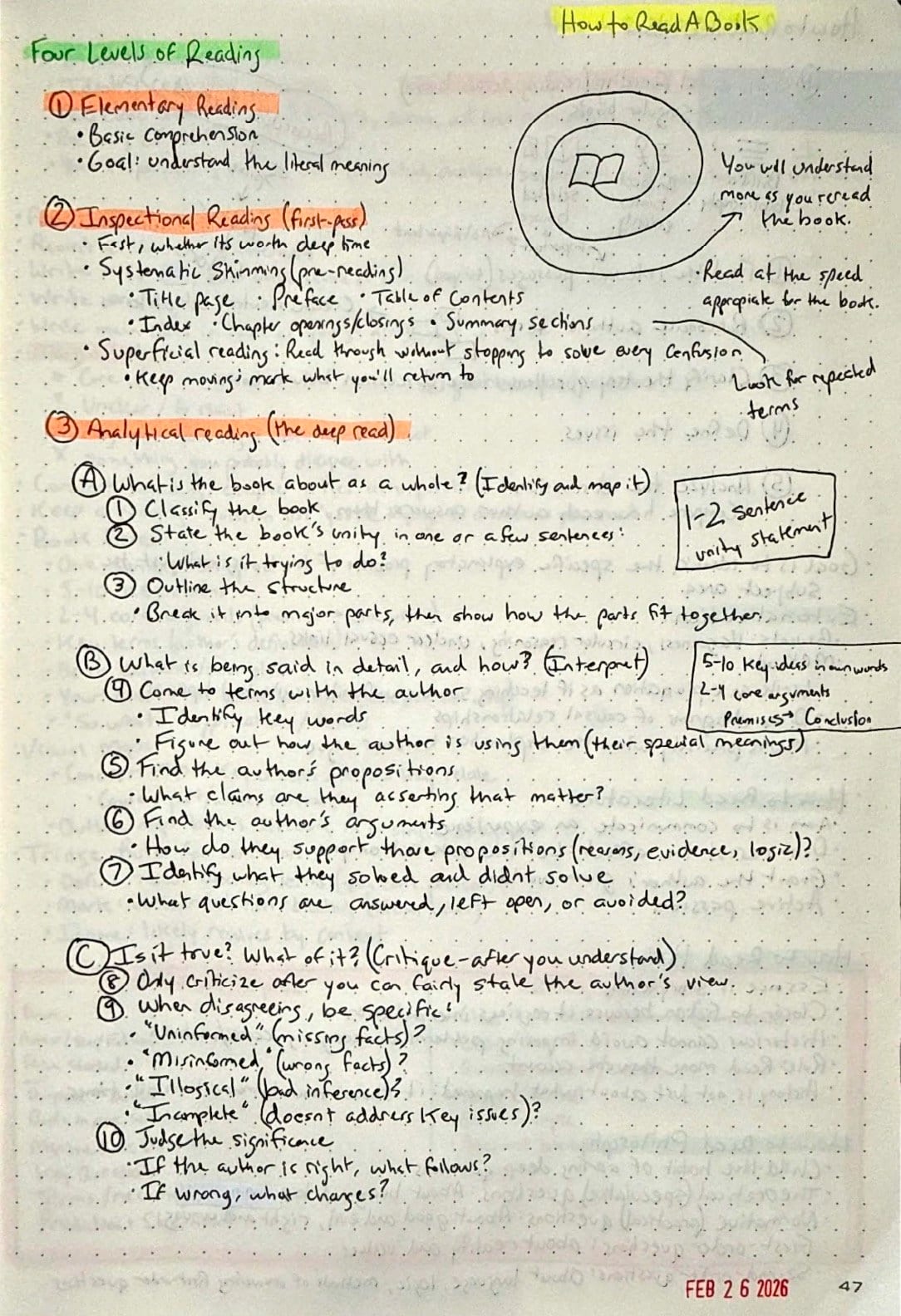
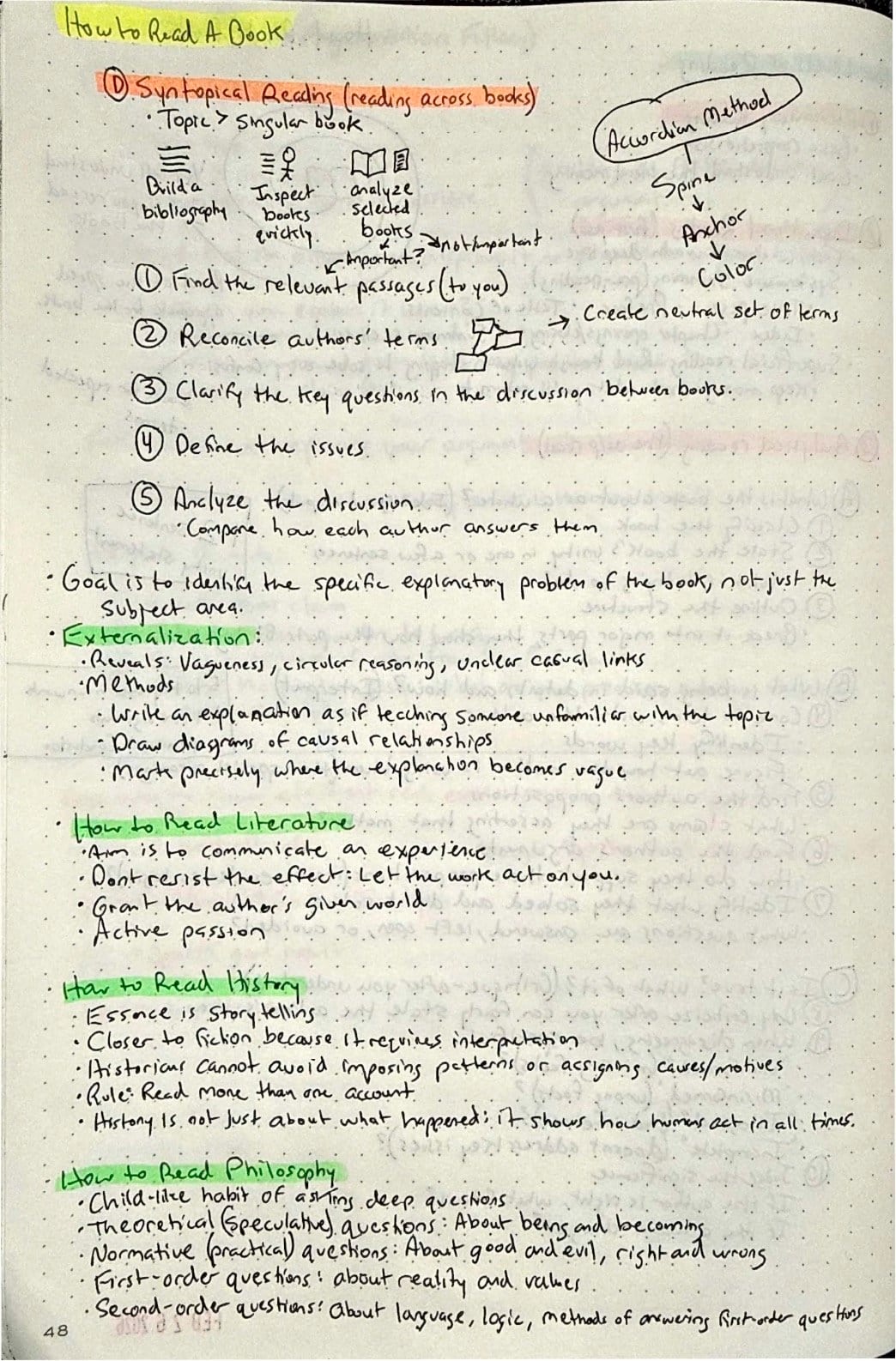
📓 Handwritten journal
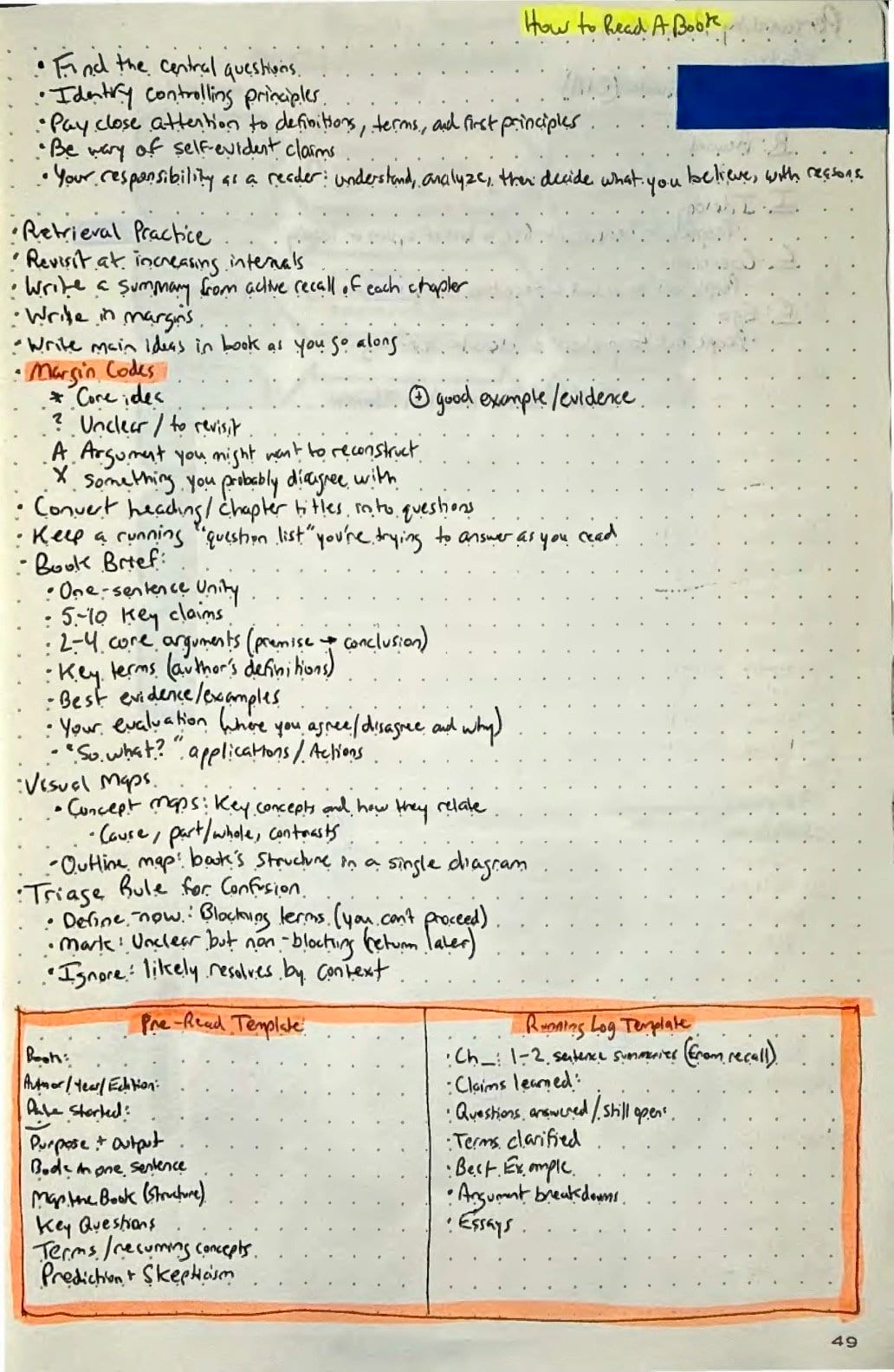
Journal connection: Three pages turn the book into a usable reading workflow: inspectional reading, structural questions, active interrogation, and moving from information to understanding.
Source boundary: This is your handwritten reading synthesis; consult the book for exact terminology and sequence.
PDF++ pages: p. 53 (file not included in this release) · p. 54 (file not included in this release) · p. 55 (file not included in this release)
Embedded preview:
Journal - Feb-March 21 2026.pdf (file not included in this release)
Open the journal index
DESCRIPTION
With half a million copies in print, How to Read a Book is the best and most successful guide to reading comprehension for the general reader, completely rewritten and updated with new material. A CNN Book of the Week: “Explains not just why we should read books, but how we should read them. It’s masterfully done.” –Farheed Zakaria Originally published in 1940, this book is a rare phenomenon, a living classic that introduces and elucidates the various levels of reading and how to achieve them—from elementary reading, through systematic skimming and inspectional reading, to speed reading. Readers will learn when and how to “judge a book by its cover,” and also how to X-ray it, read critically, and extract the author’s message from the text. Also included is instruction in the different techniques that work best for reading particular genres, such as practical books, imaginative literature, plays, poetry, history, science and mathematics, philosophy and social science works. Finally, the authors offer a recommended reading list and supply reading tests you can use measure your own progress in reading skills, comprehension, and speed.
readabooknotes.pdf (file not included in this release)
readabooknotes 2.pdf (file not included in this release)
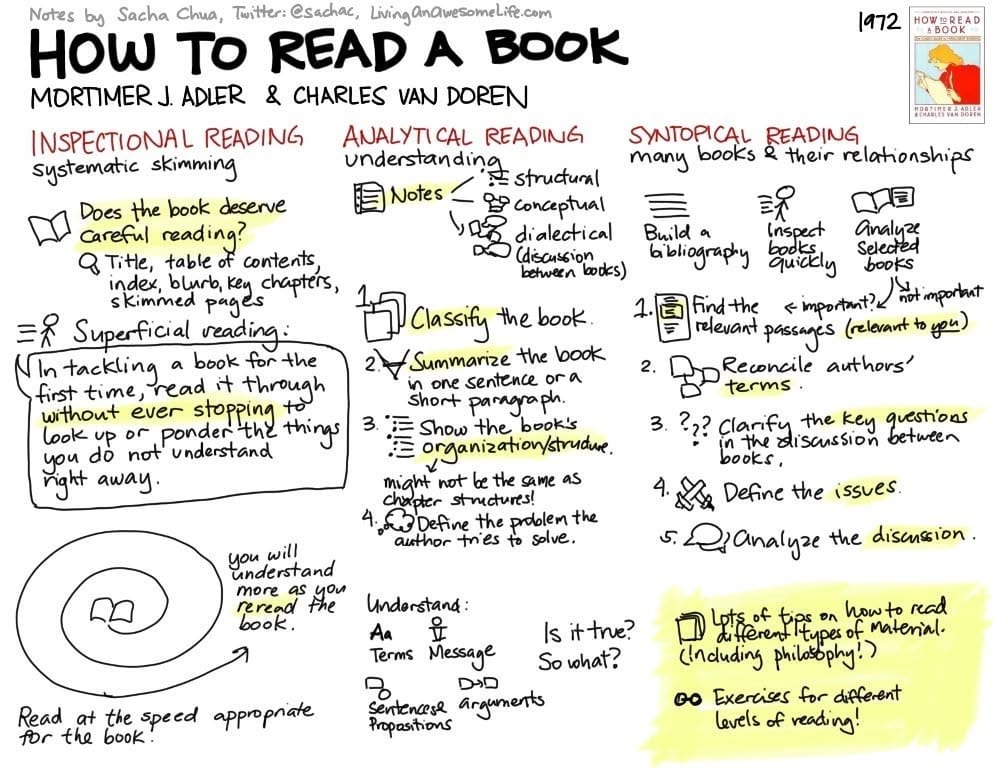
Summary by Stephen Petro
Main Ideas Summary
The speaker’s central argument is that reading more books does not automatically make you smarter. What matters is how you read. Many people read a lot but still struggle to:
- explain what they read,
- apply it,
- or think independently with it.
To fix this, the speaker presents a system based on Mortimer Adler’s How to Read a Book: four core reading techniques that transform reading from passive consumption into active, high-level thinking.
Core Thesis
Reading should be treated as a method of thinking, not just information intake.
The four techniques build on one another:
- Inspectional reading (orient yourself first)
- Analytical reading (treat books as arguments)
- Externalization (make your thinking visible through notes/writing)
- Syntopical reading (compare multiple works to build synthesis)
Together, they help a reader move from:
- passive agreement,
- to critical evaluation,
- to intellectual honesty,
- to genuine synthesis across perspectives.
Technique 1: Inspectional Reading (Orientation Before Detail)
Main idea
Before reading deeply, first survey the book to understand:
- its structure,
- its purpose,
- its internal logic,
- and the problem it is trying to solve.
The speaker emphasizes that this is not shallow reading for its own sake; it is strategic orientation.
Historical examples used
- Charles Darwin: He often did not read books straight through at first. Instead, he skimmed:
- table of contents,
- introductions,
- conclusions,
- chapter summaries,
and organized material under themes (e.g., variation, instinct, geology, domestication) so he could compare ideas across sources later.
- Isaac Newton: His work reflects a commitment to beginning with structure and foundations (definitions, axioms, propositions, corollaries). The point is that serious understanding starts with first principles and orientation, not random detail.
Why it feels difficult at first
Many people feel anxiety when doing this because school training conditions them to equate “seriousness” with linear, cover-to-cover reading.
Common mistake
The speaker says people often confuse a topic with a problem.
- Weak understanding: “This book is about economics.”
- Stronger understanding: “This book is trying to explain how prices coordinate behavior under scarcity.”
The goal is to identify the specific explanatory problem, not just the subject area.
Practical method given
Set aside 20–30 minutes at the start of a serious book for an orientation session:
- read the table of contents,
- skim intro and conclusion,
- look for repeated terms and conceptual signposts,
- identify patterns.
The session should end only when you can state in your own words:
- the specific problem the author is trying to solve, and
- the general strategy being used.
Key takeaway
Inspectional reading gives you a map before you begin the journey. Without it, deep reading becomes cognitively heavier and less coherent.
Technique 2: Analytical Reading (Treat Books as Arguments, Not Authorities)
Main idea
The second technique is to read books as arguments or proposals, not as containers of unquestioned truths.
Instead of asking only “What does the author say?”, the reader asks:
- What is the author trying to explain?
- What assumptions is the argument built on?
- What evidence supports it?
- Where are the logical gaps or ambiguities?
Educational reflex the technique opposes
The speaker argues formal schooling often trains students to assume books contain “correct answers” and that their job is to absorb and reproduce them. Adler’s model instead trains readers to engage books critically.
Historical examples used
- John Stuart Mill: He reportedly approached works as if preparing to argue against them in court, actively looking for:
- hidden premises,
- ambiguous definitions,
- logical gaps.
This made him refine his own views rather than passively adopting others’.
- Albert Einstein: He emphasized understanding the physical meaning of theories, not just formal mathematical correctness. He evaluated ideas by whether he could reconstruct them from first principles. This aligns with Adler’s idea that readers must test claims, not defer to authority or elegance.
Two common failures in early attempts
- Passive agreement
Accepting an argument because it sounds plausible. - Premature criticism
Attacking an argument before fully understanding its evidence and structure.
The speaker says both distort thinking and promote ideological or dogmatic bias.
What happens with practice
At first, analytical reading is slow and frustrating because it reveals how many ideas have been allowed to pass unexamined. Over time:
- you notice assumptions more quickly,
- your sensitivity to authority decreases,
- your attention to actual structure and content increases.
Practical method given
After each chapter, close the book and write responses to three questions:
- What problem is the author trying to solve?
- What solution is being proposed?
- Under what conditions would that solution break down?
Also write at least one serious objection (even provisional). If you cannot think of one, the speaker says that is usually a sign you have stopped thinking critically.
Key takeaway
Analytical reading transforms reading into active reasoning, making the reader a participant rather than a passive recipient.
Technique 3: Externalization (Make Thinking Visible)
Main idea
Understanding remains fragile if it exists only in your head. Adler’s third technique is externalization: writing notes, explanations, and diagrams to make your thinking:
- inspectable,
- testable,
- and correctable.
The speaker stresses that note-taking is not merely for memory; it is for exposing errors in your own reasoning.
Historical examples used
- Leonardo da Vinci: His notebooks include sketches, revisions, margin questions, and repeated drawings from different angles. Writing/drawing functioned as tools to test whether his explanations actually held up.
- Darwin: His notebooks show early speculative entries that later get revised or abandoned. By writing uncertainty down, he made it possible to correct it.
Why this matters
Externalization reveals:
- vagueness,
- circular reasoning,
- unclear causal links,
that often remain hidden when thinking stays internal.
Many people interpret this discomfort as failure, but the speaker frames it as a necessary part of becoming a strong thinker.
Benefits over time
When practiced consistently, externalization develops:
- a more accurate sense of what you do and do not understand,
- intellectual humility,
- intellectual honesty,
- reduced false confidence.
The speaker warns that false confidence is especially dangerous because it makes people think they understand things they actually cannot explain.
Practical method given
After each reading session:
- write an explanation as if teaching someone unfamiliar with the topic,
- draw diagrams of causal relationships,
- mark precisely where the explanation becomes vague.
That vague point is the place that requires more study.
Key takeaway
Externalization converts “I think I get it” into something you can actually evaluate. It is a tool for diagnosing understanding, not just recording content.
Technique 4: Syntopical Reading (Synthesis Across Multiple Works)
Main idea
Even the best single book provides only a partial view of a complex issue. The fourth technique is syntopical reading: reading multiple serious works around a meaningful question and comparing them to build synthesis.
This is the highest-level technique in the system and addresses the problem of overconfidence after mastering one text.
Historical examples used
- Darwin: He did not derive natural selection from one source; he integrated geology, population theory, breeding manuals, and travel narratives, comparing strengths and failures across explanations.
- Adam Smith: Before writing The Wealth of Nations, he immersed himself in moral philosophy, history, jurisprudence, and political economy. His work reflects synthesis shaped by tensions among these fields.
- Einstein: Relativity emerged through integrating problems across mechanics, electromagnetism, and geometry—fields often treated separately at the time.
Early-stage difficulty
Early syntopical reading can feel destabilizing because people often:
- collect multiple books without integrating them,
- let contradictions coexist without resolution,
- feel anxious when no single text gives a final answer.
The speaker frames this as a sign of real progress, not failure. Reaching this stage means the reader is operating at a level many people never reach.
What mature practice looks like
Over time, the reader begins to:
- form questions before opening a book,
- evaluate texts critically rather than treating them as final authorities,
- choose a meaningful question (not just a topic),
- read multiple works from different perspectives,
- track agreements, tensions, and blind spots,
- write syntheses even when incomplete.
Key takeaway
Syntopical reading is how deep understanding is built in complex domains: not by mastering one source, but by comparing, integrating, and revising across perspectives.
The Developmental Arc Across the Four Techniques
A key idea in the transcript is that these techniques are not isolated tricks; they form a progressive system:
- Inspectional reading gives orientation (what is this book trying to do?)
- Analytical reading tests the argument (does it work?)
- Externalization exposes your own understanding (can I explain it clearly?)
- Syntopical reading expands and integrates (how does this compare across sources?)
This progression moves the reader from: - passive consumption,
- to critical engagement,
- to self-correction,
- to synthesis and independent thinking.
Repeated Themes and Deeper Lessons
1) Reading is a skill, not just a habit
The speaker repeatedly emphasizes that many people read often but never learn the methods that produce insight.
2) Discomfort is part of real learning
Each technique creates discomfort at first:
- inspectional reading feels like “not reading properly,”
- analytical reading feels slow and frustrating,
- externalization exposes confusion,
- syntopical reading creates instability through contradiction.
The speaker treats this discomfort as evidence that genuine thinking is happening.
3) Intellectual humility and honesty matter
The system is designed to reduce false confidence and increase accurate self-assessment—knowing what you understand and what you don’t.
4) The goal is independent thought
The techniques are meant to help readers:
- think critically,
- avoid dogmatism,
- resist authority bias,
- and generate their own syntheses rather than parroting sources.
Practical Overall Message
The speaker’s practical message is that if you want reading to actually improve your thinking, you should stop treating books as things to “finish” and start treating them as tools for:
- orientation,
- argument analysis,
- written clarification,
- and cross-text synthesis.
In other words, the value of reading comes not from volume but from method.
Final Takeaway
This transcript presents Adler’s four reading techniques as a complete framework for transforming reading into a serious intellectual discipline. The main claim is that “smart reading” means:
- survey first,
- interrogate arguments,
- write to expose your thinking,
- and synthesize across multiple works.
The result is not just better recall of books, but stronger judgment, clearer reasoning, and more independent thought.
Summary
Chapter 1: The Activity and Art of Reading
- Reading as Central to Understanding
The book is written for those who read in order to gain understanding, not just information. Historically, intelligent people relied heavily on reading, though today radio, television, and other media compete for that role. These media often package opinions so effectively that people adopt ready-made ideas rather than thinking for themselves. Adler argues this undermines genuine understanding. - Active vs. Passive Reading
Reading is always somewhat active, but it can be more or less so. Good reading requires exertion and effort, much like catching in baseball—both writer and reader are active participants in communication. The more the reader engages and demands of himself and the text, the better he reads. Active reading involves multiple distinct acts and skills, not just receiving information passively.
The Goals of Reading
- Reading for Information
This occurs when the text is entirely intelligible to the reader. It may add facts but does not deepen understanding since no intellectual challenge is present. For example, reading familiar history facts that confirm what one already knows. - Reading for Understanding
This occurs when the text challenges the reader, requiring them to grapple with unfamiliar or difficult ideas. Here the writer is “superior” in understanding, and the reader works actively to overcome the gap. This process elevates the reader’s mind, moving from less understanding to more. Unlike information-gathering, this is a major exertion requiring skill, effort, and intellectual discipline. - Entertainment
Reading for pleasure is acknowledged but dismissed as not requiring effort or rules. While good books can be read for entertainment, the book focuses on reading aimed at understanding.
Reading as Learning
- Information vs. Enlightenment
To be informed is to know facts; to be enlightened is to understand their meaning, causes, and connections. Merely memorizing an author’s words is insufficient; true learning involves knowing what the author means and why. Adler stresses not confusing being widely read with being well-read—depth matters more than volume. - Learning by Instruction vs. Discovery
- Instruction (aided discovery): Learning from a teacher (through books or lectures).
- Discovery (unaided): Learning by investigating the world directly.
Both require active thought, observation, imagination, and memory. Reading for understanding is akin to discovery, though with the guidance of another mind (the author).
Present and Absent Teachers
- Listening vs. Reading
Listening involves learning from a present teacher who can answer questions directly. Reading, however, is learning from an absent teacher (the book). This forces the reader to do the work of thinking and analysis, making it more demanding but also potentially more rewarding. - Continuing Education
For those outside formal schooling, real growth depends on learning from books without a teacher’s guidance. Thus, mastering the art of reading is essential for lifelong education.
Key Takeaways
- Reading well is an active art requiring effort and skill, not passive reception.
- Two goals of reading exist: information (facts) and understanding (deep insight). The latter is more valuable and more demanding.
- Learning comes through instruction or discovery—reading is aided discovery, where the author serves as an absent teacher.
- Good reading elevates the mind, moving from less to more understanding, and is essential for lifelong intellectual growth.
Chapter 2: The Levels of Reading
1. Elementary Reading
- Definition: The most basic level, where one learns to recognize words and sentences, usually taught in elementary school.
- Question asked: “What does the sentence say?”
- Focus: Mechanics of reading—decoding words and simple comprehension.
- Note: Difficulties here often stem from poor early training. Many speed-reading courses aim to improve efficiency at this level. Even skilled readers revisit this stage when dealing with an unfamiliar language.
2. Inspectional Reading
- Definition: Systematic skimming or pre-reading under time constraints.
- Question asked: “What is the book about?”
- Focus: Grasping surface knowledge—structure, type of book (novel, history, science), and main ideas.
- Value: Saves effort by separating superficial acquaintance with a book from deeper understanding. Most readers skip this step and mistakenly combine superficial and deep reading.
- Example: Reading the table of contents, summaries, or scanning headings before diving into the text.
3. Analytical Reading
- Definition: Thorough, complete, and the best reading possible with unlimited time.
- Question asked: Many organized questions about the book’s meaning and arguments.
- Focus: Deep understanding. Analytical reading “chews and digests” a book (echoing Francis Bacon’s remark about tasting, swallowing, or digesting books).
- Use: Necessary when the goal is understanding, not merely information or entertainment. Without it, genuine intellectual growth is rare.
4. Syntopical Reading
- Definition: The highest, most complex level, also called comparative reading.
- Question asked: “How do multiple books relate to a subject?”
- Focus: Reading many books together, comparing and contrasting them, and constructing an analysis of a subject that may not appear in any one text.
- Value: The most active and rewarding form of reading. Demands skill, but allows the reader to create new insights beyond individual works.
Key Takeaways
- Reading progresses through four cumulative levels: Elementary → Inspectional → Analytical → Syntopical.
- Elementary and inspectional reading deal with basic comprehension and surface-level understanding.
- Analytical reading transforms reading into an active intellectual effort, essential for genuine learning.
- Syntopical reading is the pinnacle, enabling comparative analysis across texts and the creation of original insights.
Chapter 3: The First Level of Reading: Elementary Reading
Historical Context
- The 1970s were called “the decade of reading” due to growing concern about literacy.
- Three historical forces shaped this focus:
- Democratic education ideal: America’s long-standing goal of universal literacy, which succeeded early but created challenges as schools had to teach less-motivated and disadvantaged students.
- Evolving teaching methods:
- ABC method (19th century) → sounding out letters and syllables.
- Phonic method → recognizing sounds rather than letter names.
- Sight method → recognizing whole words or sentences before letters, popular in the 1920s–30s.
- Later methods included “look-say,” “language experience,” “eclectic,” linguistic, and programmed approaches.
- Pendulum swings have moved between phonics and sight-based methods.
- Criticism of schools: Reading instruction has always faced scrutiny, and failures in literacy have gained urgency with rising high school and college enrollments.
Stages of Learning to Read
Adler outlines four stages of elementary reading, each marking progress toward basic literacy:
- Reading Readiness (birth–6/7 years):
- Requires physical, intellectual, language, and personal readiness.
- Teaching too early frustrates children; delaying is less harmful.
- Initial Reading (1st grade):
- Children learn 300–400 sight words and begin using context and phonics.
- The “mystery” of discovering meaning in written symbols occurs here.
- Vocabulary Growth (around 4th grade):
- Rapid vocabulary expansion, ability to use context for unfamiliar words, and recognition of reading as both academic and personal.
- Mature Elementary Reading (junior high):
- Ability to assimilate reading across subjects, compare viewpoints, and read independently, though still unsophisticated.
- Provides “functional literacy”—enough for daily life but not advanced understanding.
Stages vs. Levels
- These four stages all belong to elementary reading, the first of Adler’s four levels of reading.
- Completing this level prepares students to move on to inspectional, analytical, and syntopical reading.
- By assumption, readers of Adler’s book have at least ninth-grade literacy (end of stage four).
Higher Education and Reading
- Historically, high schools and colleges offered little or no instruction beyond elementary reading.
- Rising enrollments revealed widespread deficiencies; remedial courses became common, even at universities (e.g., half of CUNY’s 1971 freshmen).
- Most “effective reading” or “speed reading” courses are remedial, not aimed at higher reading skills.
- Ideally:
- High schools should graduate students as competent analytical readers.
- Colleges should produce syntopical readers, able to compare texts and conduct independent research.
- Today, many students reach this only after years of graduate study—if at all.
Democratic Education and Reading
- Universal literacy is essential, but functional literacy is not enough.
- A democracy requires citizens who are competent readers—able to go beyond decoding words to genuine understanding.
- Adler insists that society must aim higher than producing merely “functionally literate” citizens; the goal must be a nation of readers capable of deep thought and independent learning.
Key Takeaways
- Elementary reading has four developmental stages: readiness, initial reading, vocabulary growth, and mature elementary reading.
- Functional literacy is insufficient; higher levels of reading (inspectional, analytical, syntopical) are essential for intellectual growth.
- U.S. schools and colleges largely fail to teach beyond elementary reading, leaving higher skills for graduate programs or individual effort.
- Democracy depends on more than basic literacy—it requires citizens who can read deeply, think critically, and understand complex ideas.
Chapter 4: The Second Level of Reading: Inspectional Reading
Definition and Scope
- Inspectional reading is the second true level of reading, following elementary reading and preceding analytical reading.
- Each level is cumulative: inspectional reading includes elementary skills and anticipates analytical reading.
- Its purpose: to get the most out of a book in a limited time.
Two Types of Inspectional Reading
1. Systematic Skimming (Pre-reading)
- Used when you don’t know if a book deserves full reading or when time is limited.
- Goal: discover the main ideas, structure, and whether the book is worth deeper study.
- Steps include:
- Examine the title page and preface – note scope, aim, and category.
- Study the table of contents – understand structure, like consulting a road map.
- Check the index – spot key terms, topics, and references.
- Read the dust jacket blurb – often written by the author, can reveal the book’s main points.
- Look at pivotal chapters – focus on summary statements.
- Dip into the book – read a few paragraphs or pages here and there, especially the conclusion.
- Analogy: like a detective scanning for clues to the central idea.
- Result: within minutes or an hour, you know the book’s kind, structure, argument, and whether it deserves deeper effort.
2. Superficial Reading
- Applied when tackling difficult books.
- Rule: Read the book straight through without stopping for unfamiliar words, footnotes, or puzzles.
- Focus on what you can understand, leaving difficult parts for later rereadings.
- Example: Students often lose Shakespeare or Adam Smith by over-analyzing word-by-word on first read; better to read through quickly first, then return for depth.
- Benefit: even partial understanding prepares the ground for later full comprehension.
Speed Reading and Comprehension
- Many speed reading courses are essentially remedial, focusing on elementary reading efficiency (fixations, regressions, subvocalization).
- They can help eliminate wasteful habits and allow varying speeds depending on the text.
- But true comprehension requires higher-level reading skills (especially analytical reading).
- Key principle: Every book should be read no more slowly than it deserves, and no more quickly than you can read it with comprehension.
- Example: The Declaration of Independence:
- The list of grievances can be read quickly.
- But the opening paragraphs, with terms like “inalienable rights” and “consent of the governed,” require very slow, thoughtful reading.
Summary of Inspectional Reading
- There is no one “right” speed—different books require different rates.
- Skimming helps decide whether a book deserves analytical reading and provides structural orientation.
- Superficial reading allows first contact with difficult texts without being bogged down.
- Inspectional reading both saves time and prepares the mind for deeper engagement.
- It anticipates analytical reading: skimming aligns with grasping structure, superficial reading with first interpretation.
Key Takeaways
- Inspectional reading is active and strategic, not casual browsing.
- It includes two complementary approaches: systematic skimming (structural overview) and superficial reading(first pass through difficult content).
- Proper use of this level prevents wasted time and builds the foundation for analytical reading, the next stage.
Chapter 5: How to Be a Demanding Reader
Active vs. Passive Reading
- Reading for profit (understanding) requires staying awake and engaged, unlike reading for entertainment or as a sedative.
- Good books demand effort; they are often “over your head,” and real growth comes from stretching to meet them.
- The key to active reading: asking questions while you read.
The Four Fundamental Questions of Reading
Adler distills the essence of active reading into four questions that apply to any worthwhile text:
- What is the book about as a whole?
- Identify the main theme and its subordinate parts.
- What is being said in detail, and how?
- Grasp the author’s ideas, assertions, and arguments.
- Is the book true, in whole or part?
- After understanding, judge its truth.
- What of it?
- Assess significance: why it matters, what follows, and what it implies.
- Inspectional reading helps with the first two questions.
- Analytical reading requires addressing all four, especially truth and significance.
- Syntopical reading emphasizes the last question, comparing implications across multiple texts.
Making a Book Your Own
- Passive reading is insufficient—marking a book is essential to engage in a dialogue with the author.
- Writing in a book keeps you alert, clarifies your thinking, and aids memory.
- Marking demonstrates genuine intellectual ownership, not just physical ownership.
Methods of Marking:
- Underlining key points.
- Vertical lines in margins for emphasis.
- Stars/asterisks for the most important passages.
- Numbering arguments or sequences.
- Cross-references to other pages (“Cf.”).
- Circling key words.
- Margin notes: questions, summaries, or reduced statements.
- Endpapers:
- Back endpapers → personal index of main points.
- Front endpapers → outline of the book’s overall structure (shows true understanding).
The Three Kinds of Note-making
- Structural notes – focus on form and organization (useful in inspectional reading).
- Conceptual notes – record ideas, arguments, and insights (analytical reading).
- Dialectical notes – compare and contrast across books, mapping a shared discussion (syntopical reading).
Forming the Habit of Reading
- Skill = habit of following rules. Knowing rules is necessary, but mastery comes from practice until actions fuse into a seamless performance.
- Analogy: learning to ski. Beginners must focus on many separate, awkward motions, but with practice these fuse into fluid, graceful movement.
- Similarly, reading well requires patience and repeated practice until individual acts (questioning, marking, note-making) coalesce into second nature.
- Reading is even harder than skiing because it involves mental acts—thinking about one’s own thoughts. But it can be mastered with effort.
Key Takeaways
- Active reading = asking and answering four key questions.
- Ownership of books comes through marking and note-making.
- Three kinds of notes (structural, conceptual, dialectical) correspond to inspectional, analytical, and syntopical reading.
- Mastery is a habit, formed by practice until rules become instinctive.
- Reading well is difficult, but like any art, it can be learned and perfected.
Chapter 6: Pigeonholing a Book
Why Focus on Whole Books
- Adler stresses that the rules of analytical reading are best applied to whole books because they present the greatest challenges.
- If one can read a difficult book (e.g., philosophy, science, epic literature), then reading shorter forms like articles, stories, or abstracts becomes much easier.
Rule 1 of Analytical Reading
“You must know what kind of book you are reading, and you should know this as early as possible—preferably before you begin.”
- Distinguish fiction (novels, plays, poems) from expository works (nonfiction aiming to convey knowledge).
- Classification is crucial, yet often neglected by readers who ignore signals in the title, preface, table of contents, index, and blurb.
Titles and Misunderstandings
- Misreading or not thinking about titles leads to confusion:
- The Origin of Species (Darwin) is often mistakenly recalled as The Origin of the Species—a misunderstanding of scope.
- The Decline and Fall of the Roman Empire (Gibbon) is misread as “rise and fall,” which causes readers to expect Republican history not covered in the book.
- Careful attention to titles and chapter headings provides essential information about purpose, scope, and structure.
Broad Classifications
- Fiction vs. Expository works.
- Within expository: History, Philosophy, Science, Mathematics.
- Crucial distinction: Theoretical vs. Practical books.
Theoretical vs. Practical Books
- Theoretical: Aim at knowledge (“knowing that”). Concerned with truth, facts, or explanations.
- Practical: Aim at action (“knowing how”). Concerned with rules, conduct, and improvement.
- Examples: manuals, “how to” guides, political or moral treatises, orations.
- Practical works include both instructional guides and normative works (ethics, politics, economics).
- Example:
- Kant’s Critique of Pure Reason → theoretical.
- Kant’s Critique of Practical Reason → practical.
- Practical books use language like “should,” “ought,” “good,” “bad,” “ends,” “means.”
- Theoretical books use language like “is,” “true,” “fact.”
Subtypes of Theoretical Works
- History: Narratives of events situated in time and place (chronotopic). Focus on particular happenings.
- Science: Seeks laws and generalizations; often requires special or experimental observation. Example: Darwin’s Origin of Species or Newton’s Opticks.
- Philosophy: Seeks general truths, but appeals to common human experience (everyday reasoning). Example: Locke’s Essay Concerning Human Understanding.
- Distinction:
- Science → special experience (laboratories, fieldwork).
- Philosophy → common experience (accessible to all).
- Some works mix both, e.g., William James’ Principles of Psychology.
- Distinction:
Why Classification Matters
- Different types of books “teach” differently, requiring different reading approaches.
- Just as teachers in history, science, and philosophy use different methods, readers must adjust their approach depending on the type of book.
- Without proper classification, deeper analytical reading becomes confused and ineffective.
Key Takeaways
- First rule of analytical reading: identify the type of book early.
- Distinguish fiction vs. expository; within expository, classify as theoretical (history, science, philosophy) or practical.
- Titles, prefaces, tables of contents, and keywords give important clues.
- Practical works are action-oriented, normative, or instructive; theoretical works aim at truth and knowledge.
- Science and philosophy differ by the kind of experience they appeal to—special vs. common.
- Correct classification determines the proper method of reading and understanding.
Chapter 7: X-Raying a Book
The Skeleton of a Book
- Every good book has a unity and an organized structure. To read analytically is to uncover this skeleton, not just skim the surface.
- Poor books lack clear structure; the best books, though complex, are more unified and thus more readable.
Rule 2: State the Unity of the Whole Book
- Express the book’s main theme in one sentence or a short paragraph.
- This is not about type (fiction, philosophy, science) but about the main point the author is trying to make.
- Example: Aristotle summarized Homer’s Odyssey as one unified story of Odysseus’ long absence, his trials, and return.
- Similarly, Tom Jones reduces to the formula: “Boy meets girl, boy loses girl, boy gets girl.”
- For nonfiction:
- Aristotle’s Ethics: inquiry into happiness and virtue.
- Adam Smith’s Wealth of Nations: inquiry into the sources of national wealth in a labor-divided economy.
- Darwin’s Origin of Species: account of variation and natural selection as the basis of species.
- Locke’s Essay: inquiry into the origin, certainty, and limits of human knowledge.
- The point is not to parrot the author’s summary, but to formulate a concise, accurate statement of the book’s unity.
Rule 3: Set Forth the Major Parts
- Identify the major parts and show how they relate to the unity and to one another.
- Example:
- The U.S. Constitution → Preamble, Legislative, Executive, Judicial, Federal/State relations, Amendments, etc.
- Aristotle’s Ethics → happiness, voluntary action, virtues/vices, intermediate states, friendship, pleasure.
- Outlining can vary in detail depending on purpose; the goal is to show how parts form an organized whole.
- A book may be imperfectly structured, but the reader’s task is to find as much order as possible.
Reciprocal Arts of Reading and Writing
- Writing begins with structure (skeleton), then adds flesh (details).
- Reading does the opposite: uncovering the skeleton beneath the flesh.
- Good writing shows unity, clarity, and coherence. Good reading identifies these.
- These rules help distinguish well-made books from badly made ones.
Rule 4: Find the Author’s Problems
- Every expository book starts from questions the author is trying to answer.
- The reader must identify the main problem and the sub-problems, in logical order.
- Theoretical questions: existence, causes, properties, relations.
- Practical questions: ends to be sought, means to achieve them, right vs. wrong actions.
- Example: Herodotus’ Histories states clearly the problem of preserving memory of human actions and causes of conflict.
The First Stage of Analytical Reading
The first four rules form a group, aimed at answering the question: “What is the book about as a whole?”
- Classify the book by kind and subject matter.
- State its unity as briefly as possible.
- Enumerate major parts and show how they relate to the whole.
- Define the problems the author is trying to solve.
Together, these rules constitute the first stage of analytical reading, focused on understanding a book’s structure.
Key Takeaways
- Analytical reading begins by uncovering a book’s structure.
- Four rules guide this stage: classify, state unity, outline parts, and define the author’s problems.
- Examples from literature, science, philosophy, politics, and law show how unity and structure can be grasped across genres.
- These rules distinguish good books from poorly made ones and prepare readers for deeper critical engagement.
Chapter 8: Coming to Terms with an Author
The Transition to Interpretation
- After outlining a book’s structure (first stage of analytical reading), the reader moves to interpretation—understanding the author’s message in detail.
- The central task of this stage is “coming to terms.”
- Communication occurs only when writer and reader use the same words with the same meanings.
Words vs. Terms
- Words are inherently ambiguous; most have multiple meanings.
- Terms are words used unambiguously within a specific context.
- Communication fails when the reader interprets words differently than the author.
- Dictionaries list possible meanings, but terms exist only in context—when writer and reader align on usage.
- Expository works aim for unambiguous terms; poetry, by contrast, often thrives on ambiguity.
Rule 5 of Analytical Reading
“Find the important words and through them come to terms with the author.”
This involves two steps:
- Spot the key words—those that matter most to the author’s argument.
- Determine their precise meaning as used in the book.
How to Identify Important Words
- Most words in any book are ordinary and familiar.
- Key words are those:
- That give the reader difficulty.
- That the author emphasizes (italics, quotation marks, explicit definitions).
- That belong to the technical vocabulary of a field (e.g., “species” in Darwin, “wealth” in Adam Smith).
- That the author debates with other writers about.
- Special vocabularies: Science, philosophy, and other fields have technical terms, though philosophers often coin or repurpose words.
- Synonyms complicate things: one term may be expressed by several words (e.g., “insight” and “enlightenment”), and one word may signify several terms depending on context.
- Phrases can also serve as terms when authors use them to reduce ambiguity.
Finding the Meanings
- Mark unfamiliar or confusing words and study them in context.
- A word may have one stable meaning (Euclid’s “point”) or shift between several related ones.
- Meanings are discovered by interpreting unknown words through surrounding known words.
- The process resembles solving a jigsaw puzzle—each clarified term helps clarify others.
The Challenge and Payoff
- Bad authors use words ambiguously without clarification; good authors distinguish and define their terms.
- Readers must be active: inattentive readers fail by treating all words as ordinary.
- Mastering this rule greatly enhances comprehension, as identifying and tracking terms unlocks the author’s precise ideas.
- Further study of grammar and logic refines this skill, but even basic practice of finding important words and resolving their meanings yields significant improvement in understanding.
Key Takeaways
- Interpretation requires coming to terms with the author.
- Terms ≠ words: a term is a word used unambiguously in context.
- Rule 5: spot important words and determine their precise meanings.
- Important words are those emphasized, technical, disputed, or troublesome to the reader.
- The process is iterative—like assembling a puzzle—and essential to true understanding.
- Readers who fail to attend to key words remain superficial; those who do unlock the book’s deeper meaning.
Chapter 9: Determining an Author’s Message
From Terms to Propositions
- After identifying important words (Rule 5), the next step is to interpret sentences and the propositions they contain.
- A proposition is the author’s declaration of judgment—what he affirms or denies.
- Rule 6: _Mark the most important sentences and discover the propositions they contain._==
- Not every sentence expresses a proposition:
- Questions state problems, not answers.
- Wishes or intentions reveal aims, not knowledge.
- Compound sentences may hold multiple propositions.
- Example: Machiavelli’s The Prince sentence on inspiring fear actually contains at least three propositions (about fear, hatred, and property/women). To judge it, one must separate and understand each proposition.
From Propositions to Arguments
- A proposition alone is insufficient; the reader must grasp why the author holds it.
- Rule 7: Locate or construct the basic arguments in the book by finding them in the connection of sentences.
- An argument is a sequence of propositions where some provide reasons for a conclusion.
- Authors may state arguments clearly (e.g., Euclid, Aquinas), scatter them across many pages, or even omit steps.
- Readers must sometimes reconstruct arguments by linking scattered sentences.
- Induction vs. Deduction:
- Induction → moves from particular facts to generalization.
- Deduction → moves from general truths to further general truths.
- Readers must note assumptions and self-evident propositions (axioms, common notions) that underlie arguments.
- Example: “The whole is greater than its parts” is not a trivial tautology but a genuine self-evident truth grounded in common experience.
Finding the Author’s Solutions
- Returning to the problems identified in Rule 4, the reader must now assess whether the author has solved them.
- Rule 8: Find out what the author’s solutions are.
- Questions to ask:
- Which problems are solved?
- Which remain unsolved?
- Did the author know which he failed to solve?
- This final interpretive step ensures the reader has fully grasped what the author is saying in detail and how.
The Second Stage of Analytical Reading
Rules 5–8 together form the second stage of analytical reading (interpretation):
- Come to terms with the author’s key words.
- Grasp propositions by finding key sentences.
- Identify arguments from connected propositions.
- Determine solutions to the problems posed.
This stage answers the second of Adler’s four fundamental reading questions:
“What is being said in detail, and how?”
Key Takeaways
- Propositions = content of sentences; arguments = connection of propositions.
- Readers must distinguish important from unimportant sentences, then extract and restate propositions in their own words.
- Arguments must sometimes be reconstructed; spotting assumptions and self-evident truths is key.
- Interpretation culminates in evaluating the author’s solutions to problems.
- Rules 5–8 mark the complete method of interpretive reading, preparing the reader for critical engagement.
Chapter 10: Criticizing a Book Fairly
Reading as Conversation
- Reading a book is like a conversation between author and reader.
- The author speaks first, but the reader has the last word through judgment.
- Good conversation—like good reading—requires intellectual etiquette, not bickering.
Teachability as a Virtue
- The reader has both the opportunity and obligation to talk back.
- A good book seeks to teach or persuade; the reader must respond with a considered judgment: agree, disagree, or suspend judgment.
- Teachability ≠ subservience.
- True teachability is active: exercising independent judgment after full understanding.
- The most teachable reader is the most critical.
The Role of Rhetoric
- The arts of grammar and logic support understanding (first two stages of reading).
- Rhetoric governs the third stage: judging and responding.
- Communication involves not just being understood but persuading or convincing.
- Readers must be responsive (understand intention) and responsible (form their own judgments).
Rule 9: Understanding Before Criticism
- Rule 9: You must be able to say, “I understand,” before saying “I agree,” “I disagree,” or “I suspend judgment.”
- Misconception: criticism = disagreement. In fact, agreement, disagreement, and suspension are all critical judgments.
- To agree or disagree without understanding is meaningless.
- Even suspending judgment requires understanding the issue at hand.
- Readers must guard against premature criticism, especially when reading only parts of a book or works that depend on other writings (e.g., judging Kant’s Critique of Pure Reason without his Critique of Practical Reason).
Rule 10: Disagree Reasonably, Not Contentiously
- Rule 10: When you disagree, do so reasonably, not disputatiously.
- Inspired by Plato and Aristotle: truth must be honored above personal victory.
- Disputatious readers seek quarrels instead of truth.
- Real profit from conversation (or reading) lies in learning, not “winning.”
Rule 11: Respect Knowledge vs. Opinion
- Rule 11: Respect the difference between knowledge and mere personal opinion, by giving reasons for any critical judgment.
- Knowledge = defensible, evidence-supported opinion.
- Opinion (in this sense) = unsupported personal feeling or prejudice.
- The reader must:
- Share the author’s reasons when agreeing.
- Provide independent reasons when disagreeing.
- This ensures that disagreements are not futile exchanges of opinion but attempts at reasoned resolution.
The Three General Maxims of Critical Reading
- Understand first (Rule 9).
- Avoid contentiousness (Rule 10).
- Respect the distinction between knowledge and opinion; give reasons for judgments (Rule 11).
Together, these principles establish the intellectual etiquette for fair criticism, enabling real conversation between reader and author.
Chapter 11: Agreeing or Disagreeing with an Author
Agreement and Understanding
- A reader must first achieve understanding before moving to agreement or disagreement.
- “I don’t understand” can itself be a valid critical remark, but only if the reader can show that the book is disorganized, unclear, or contradictory.
- True agreement means both understanding the author’s words and accepting their claims about reality.
- Disagreement is possible even with full understanding, since authors make judgments about the world that may be right or wrong.
Prejudice and Judgment
- Good controversy requires avoiding emotional bias and prejudice.
- Three conditions for intelligent disagreement:
- Acknowledge emotions so they do not masquerade as reasons.
- Make assumptions and prejudices explicit.
- Attempt impartiality—read sympathetically, and consider the author’s viewpoint.
- These ideals are rarely achieved perfectly, but they set the tone for respectful criticism.
Four Valid Grounds for Adverse Criticism
When a reader says, “I understand but disagree,” there are four precise criticisms he can make:
- Uninformed: Author lacks relevant knowledge.
- Example: Darwin lacked genetics knowledge; Gibbon lacked historical facts later discovered.
- Misinformed: Author asserts something false.
- Example: Spinoza on democracy; Aristotle on reproduction; Aquinas on heavenly bodies.
- Illogical: Author reasons poorly or inconsistently.
- Example: Machiavelli’s faulty conclusion about laws and arms; Hobbes’ inconsistency about qualities.
- Incomplete: Author fails to solve all problems, misses implications, or does not fully develop distinctions.
- Example: Aristotle’s Politics lacking concepts of universal suffrage; Euclid’s geometry missing alternate postulates.
- The first three deal with soundness of premises and reasoning.
- The fourth concerns completeness of the author’s achievement.
Obligations of the Reader
- If the reader cannot prove the author uninformed, misinformed, or illogical, he must agree at least in part.
- Disagreement without evidence is mere prejudice.
- Incompleteness allows for suspension of judgment, not rejection.
NOTE
The Rules of Analytical Reading (Summary)
Stage I: Finding What a Book Is About
- Classify the book.
- State its unity.
- Outline major parts.
- Define the author’s problems.
Stage II: Interpreting the Book- Identify key terms.
- Extract main propositions.
- Find or construct arguments.
- Determine which problems are solved.
Stage III: Criticizing the Book
- General Etiquette:
9. Understand before judging.
10. Disagree reasonably, not contentiously.
11. Distinguish knowledge from opinion; give reasons.- Special Criteria:
12. Show the author is uninformed.
13. Show the author is misinformed.
14. Show the author is illogical.
15. Show the author’s analysis is incomplete.
The Four Basic Reading Questions
- What is the book about as a whole?
- What is being said in detail, and how?
- Is it true?
- What of it?
These questions summarize all the reader’s obligations. Applying them requires effort but is the path to becoming truly “well-read.”
Chapter 12: Aids to Reading
Intrinsic vs. Extrinsic Reading
- Intrinsic reading: understanding a book by itself, using one’s own effort and following the rules of analytical reading.
- Extrinsic reading: using outside aids—sometimes necessary, but best employed only after exhausting intrinsic efforts.
- Overreliance on aids like dictionaries or commentaries weakens reading ability. The goal is to need them less over time.
Four Categories of Extrinsic Aids
- Relevant Experience
- Common experience (shared by most people) is useful for reading fiction and philosophy.
- Special experience (scientific experiments, travel, specialized research) is vital for reading science and often history.
- Test of understanding: Can you supply concrete examples of the author’s point from your own experience?
- Other Books
- Great books form a conversation across time; understanding one often requires knowledge of earlier works.
- Example: To understand The Federalist Papers, one should first know the Articles of Confederation, the Constitution, and works by Montesquieu, Rousseau, and Locke.
- Order matters: later books build on earlier ones; respecting chronology helps comprehension.
- Most important in philosophy and history; less so in fiction.
- Commentaries and Abstracts
- Should be used sparingly and only after reading the book yourself.
- Risks: commentators may be wrong or incomplete; relying on them narrows your own understanding.
- Useful roles:
- Refreshing memory of a book already read.
- Deciding whether a book is relevant for syntopical reading.
- Rule: never read introductions or commentaries first; they distort your perspective.
- Reference Books (Dictionaries, Encyclopedias, etc.)
- Require prior knowledge to use effectively:
- Know what you want to find.
- Know which kind of reference book to use.
- Know how it is organized.
- Know whether the information sought is considered knowable.
- Dictionaries: more than spelling guides—they record meanings, grammar, synonyms/antonyms, and word histories. Best used when encountering key technical or unfamiliar terms. Avoid “swallowing the dictionary” or using it to settle philosophical disputes.
- Encyclopedias: valuable for factual information, but limited since they lack arguments and imaginative literature. Good ones show relations among facts; indexes can reveal underlying structures of knowledge. Should be consulted across multiple editions/times to avoid cultural bias.
- Require prior knowledge to use effectively:
Key Takeaways
- Extrinsic aids supplement, not replace, intrinsic reading. Use them only after independent effort.
- Relevant experience grounds understanding; other books supply context; commentaries should confirm, not dictate; reference works provide facts, not wisdom.
- The best readers minimize dependence on external aids while knowing how to use them intelligently when needed.
Chapter 13: How to Read Practical Books
General vs. Particular Rules
- The 15 rules of analytical reading apply broadly to expository works, but practical books require adaptation and flexibility.
- Unlike theoretical works, practical books deal with action—what one ought to do—so they cannot directly solve problems.
- Practical problems are solved only by acting, not by reading. Books can only provide rules or principles to guide action.
The Two Kinds of Practical Books
- Rule Books
- Present general prescriptions, maxims, or directions (e.g., cookbooks, driver’s manuals).
- Arguments focus on showing why rules are sound—through appeal to principles or examples.
- Example: “A stitch in time saves nine” → rule stated as both imperative and declarative.
- Books of Practical Principles
- Explain principles underlying rules (e.g., works in economics, politics, morals).
- Appear theoretical but are practical because they aim at improving human behavior.
- Reader must infer implied rules and imagine how they apply in real life.
- Both kinds may mix rules and principles, but emphasis reveals the type.
Practical vs. Theoretical Truth
- Theoretical books: judged by correspondence with reality.
- Practical books: judged by two conditions:
- Effectiveness – Does the rule work?
- Ends – Are the ends right or desirable?
- Agreement depends on sharing the author’s ends.
- Example: If one values economic justice (Marx), Marx’s prescriptions may seem true; if one values stability (Burke), they may seem false.
The Role of Persuasion
- Practical works inevitably contain oratory and propaganda—they try to persuade readers of both ends and means.
- Authors must appeal to both reason and emotion, because action involves the will.
- Readers must develop “sales resistance”: the ability to detect emotive appeals, weigh them, and not accept them unconsciously.
- Unlike theoretical works, here the author’s personality and context matter (e.g., Aristotle and slavery; Machiavelli and Italian politics; Hobbes and civil war).
Adapting the Four Basic Questions
Practical books require a shift in how Adler’s four reading questions are applied:
- What is the book about?
- Identify the author’s objectives—what problems he wants solved, what he wants readers to do.
- What is being said in detail, and how?
- Focus on means: what methods are proposed for achieving the ends.
- Is it true?
- Judge not just correspondence with reality, but whether ends are worthwhile and means appropriate.
- What of it?
- Agreement implies action. If you truly agree with the author’s ends and means, refusal to act reveals hidden disagreement.
- Some practical books aim at universal ends (e.g., all should read better), others at selective ends (e.g., making chocolate mousse). Readers must judge applicability to themselves but beware of self-deception.
Key Takeaways
- Practical books cannot solve problems; only action can.
- They fall into rule books and books of principles; both must be read differently.
- Practical truth depends on both effectiveness of means and desirability of ends.
- Persuasion and context are intrinsic; readers must resist propaganda yet remain open.
- The four basic questions of reading adapt for practice: objectives, means, truth (ends + means), and implication in action.
Chapter 14: How to Read Imaginative Literature
The Paradox of Reading Fiction
- Reading imaginative literature (novels, plays, poems) is paradoxically harder to do well than reading expository works, yet more people think they can do it.
- Many enjoy fiction but cannot articulate why, suggesting they read only superficially.
- Expository works aim to teach (knowledge).
- Imaginative works aim to communicate an experience (pleasure, beauty).
- Beauty is harder to analyze than truth, making literary criticism difficult.
How Not to Read Imaginative Literature
- Don’t resist the effect: Let the work act on you. Read with active passion rather than aggressive analysis.
- Don’t read it as expository writing:
- Expository → clarity, explicitness, unambiguous terms.
- Imaginative → ambiguity, metaphor, implication, multiple meanings.
- Don’t apply standards of factual truth:
- A novel’s “truth” is its plausibility within its created world, not factual accuracy.
- Aristotle: correctness differs in poetry vs. politics or science.
- Example: Othello is unique; not every Moor or Venetian couple—fiction creates singular imaginative realities.
General Rules for Reading Fiction (Analogues to Expository Rules)
Structural Rules
- Classify by kind – lyric (emotional moment), novel (extended plot and character interplay), or play (action and dialogue).
- Grasp the unity – state the plot briefly; unity lies in narrative rather than argument.
- Identify parts – characters, incidents, crises, climax, and resolution, noting how they build the whole. Unlike expository works, parts of fiction lack independent meaning when separated.
Interpretive Rules - Elements as terms – episodes, characters, thoughts, and actions are the “terms.”
- Scene as propositions – the setting and social world link characters and events into coherence.
- Plot as argument – follow the unfolding of the plot as the dynamic equivalent of reasoning. Aristotle: plot is the “soul” of a story.
Critical Rules - Appreciation before criticism – don’t judge until you experience what the author intended.
- Grant the author’s given world – don’t object to choice of subject or setting, but judge how well it is executed.
- Judgment concerns beauty, not truth – fiction is judged by the pleasure and depth of its artistic achievement.
Appreciation and Taste
- True criticism of fiction begins with appreciation—experiencing the world the author created.
- Only then can one evaluate:
- First judgments are matters of taste (likes and dislikes, often reflecting the reader more than the book).
- Deeper criticism points to elements in the work that caused those reactions, developing standards of literary judgment.
- Over time, reflective appreciation fosters good taste in literature, a skill anyone can acquire through active, passionate reading.
Key Takeaways
- Fiction aims to communicate experience through imagination, not knowledge through reason.
- Reading imaginative works requires passive openness yet active passion, distinct from logical analysis.
- Rules of reading apply by analogy: classify, find unity, follow parts and plot, appreciate before judging.
- Criticism should focus on beauty and execution, not factual accuracy.
- Good literary taste is cultivated by consciously reflecting on why fiction pleases and how it achieves artistic effects.
Chapter 15: Suggestions for Reading Stories, Plays, and Poems
The Fourth Question in Imaginative Literature
- The four basic reading questions adapt differently for fiction:
- What is it about? – unity of plot.
- What is being said in detail, and how? – roles of characters and incidents.
- Is it true? – judged as poetical truth (plausibility, satisfaction, beauty).
- What of it? – unlike expository works, imaginative works are ends in themselves (fine art). No action is required; to read well is simply to experience.
- Yet fiction can inspire action (e.g., Orwell’s Animal Farm, Huxley’s Brave New World, Solzhenitsyn’s The First Circle), which explains why such works are censored. Still, their essence lies in being experienced, not acted upon.
How to Read Stories
- Read quickly and immersively, ideally in one sitting, to preserve unity of plot and intensity of detail.
- Don’t worry if characters or incidents seem confusing at first; clarity comes with completion.
- Finish the story to truly grasp its meaning; unlike life, it ends decisively.
- Fiction satisfies conscious and unconscious needs: love, justice, sadism/masochism, desire for order.
- Great stories endure because they meet universal unconscious needs—especially the longing for justice and understanding.
Reading Epic Poetry
- Major epics (Iliad, Odyssey, Aeneid, Divine Comedy, Paradise Lost) are highly demanding due to their grandeur and scope, not just their verse form.
- They require immense attention, imagination, and perseverance, but reward readers as richly as any literature.
- Epics form the backbone of Western tradition, alongside the Bible, and deeply influence later literature.
How to Read Plays
- Plays are incomplete when read; they must be imagined as performed.
- Best approach: direct the play in your mind—assign tone, action, and staging.
- Example: Hamlet’s soliloquy (“To be or not to be”) shifts depending on whether he overheard Polonius’ plotting.
- Exceptions: Aristophanes (breaking the fourth wall with political speeches) and Shaw (writing prefaces to his plays).
- Practical tips: read in one sitting; read puzzling passages aloud.
- Great plays (Greek tragedians, Shakespeare, Molière, a few moderns) contain some of humanity’s deepest insights.
A Note on Tragedy
- Greek tragedy is especially challenging: often fragments of trilogies, unfamiliar staging, reliance on myths once well-known.
- Yet their power transcends obstacles. They also provide frameworks for later playwrights.
- Two aids for reading Greek tragedy:
- Time is the essence of tragedy – choices must be made without enough time, leading to errors.
- Visualize scale – protagonists (on buskins) as larger-than-life figures, chorus as ordinary humans.
How to Read Lyric Poetry
- Poetry is words in disciplined form. Ignore overbroad (poetry as mere impulse) or too narrow definitions.
- Rules:
- Read straight through once to grasp unity, even if unclear.
- Read again aloud – rhythm, rhyme, and sound clarify meaning and allow the poem to “work” on you.
- Poems often contain conflicts (love vs. time, life vs. death, transience vs. eternity).
- Examples: Shakespeare’s sonnets, Marvell’s To His Coy Mistress, MacLeish’s You, Andrew Marvell.
- Don’t overemphasize biography or context—understanding comes from rereading the poem itself.
- A great lyric deserves a lifetime of revisiting, revealing new depths over time.
Key Takeaways
- Imaginative works differ from expository ones: they are experienced, not acted upon, though they may inspire action.
- Stories should be read quickly and immersively to grasp unity and unconscious satisfactions.
- Epics are demanding but central to literary culture and repay effort.
- Plays must be imagined as performed; great tragedies reveal profound truths.
- Lyric poetry demands rereading, especially aloud, to unlock rhythm, unity, and hidden conflicts.
Chapter 16: How to Read History
Defining History
- Adler defines history as narrative accounts of past events, not just raw documents, diaries, or interviews.
- Essence of history is storytelling—even document collections imply a narrative.
The Elusiveness of Historical Facts
- Historical facts are elusive, more so than courtroom evidence.
- Even basic facts like the Civil War’s start/end dates are debated (Fort Sumter in 1861 vs. Lincoln’s election, assassination, or ongoing racial struggles).
- The significance of facts depends on interpretation—why did they happen, what could have been avoided, why do they matter?
Theories of History
- History sits between science and fiction, but is closer to fiction because it requires interpretation.
- Historians cannot avoid imposing patterns or assigning causes/motives.
- Some fit events into grand schemes (Providence, progress, cycles).
- Others deny any knowable pattern (e.g., Tolstoy’s skepticism about causation).
- Rule: Read more than one account of an event to grasp multiple perspectives.
The Universal in History
- History is not just about what happened; it shows how humans act in all times.
- Example: Thucydides’ Peloponnesian War matters not for perfect accuracy, but for its enduring lessons on human folly, ambition, and conflict.
- History is the story of what led to now; read it for present and future guidance.
Questions to Ask of History
- What is the book about? – know its scope and limits.
- How is the story told? – chronological, thematic, or otherwise? What aspect does the historian consider most fundamental?
- Is it true? – evaluate plausibility of human behavior; check if sources are misused or misunderstood.
- What of it? – history affects action, especially politics; poor historical reading can lead to dangerous decisions.
How to Read Biography and Autobiography
- Biography = history of a person’s life. Must be read with same critical questions as history.
- Types:
- Definitive: exhaustive, scholarly, based on all available sources (e.g., Boswell’s Life of Johnson).
- Authorized: commissioned, often biased, presenting the subject favorably.
- Ordinary: accurate but not exhaustive; good for insight into character.
- Didactic: written to teach moral lessons (e.g., Plutarch’s Lives).
- Autobiography: inherently flawed since no one can tell the whole truth about themselves; yet all writing is partly autobiographical.
- Guidance: read multiple biographies, treat autobiographies with skepticism, focus first on what is plainly said before searching for hidden motives.
How to Read About Current Events
- Analytical reading applies to newspapers, magazines, and books on current affairs.
- Core difficulty: facts are elusive now, just as in history—reporters act as filters with biases and limits of knowledge.
- Five questions for current-events reading:
- What does the author want to prove?
- Whom does he want to convince?
- What assumptions or prejudices does he share with his audience?
- What special language does he use (charged terms like “Communism”)?
- Does he really know the facts?
- Warning: Caveat lector—Let the reader beware. Unlike with Aristotle or Shakespeare, contemporary authors may consciously or unconsciously distort.
A Note on Digests
- Digests (e.g., Reader’s Digest, Time, Newsweek) save time by condensing information but demand careful reading.
- The more condensed, the more selective—thus bias increases.
- Readers must infer what was left out, making digest-reading one of the most demanding forms of reading.
Key Takeaways
- History is narration, inevitably shaped by perspective; read multiple accounts.
- Biography blends history and character study; definitive works are reliable, autobiographies less so but still revealing.
- Current events are history-in-the-making; critical awareness of bias, audience, and language is essential.
- Digests provide efficient summaries but require skepticism, as condensation magnifies the author’s filter.
Chapter 17: How to Read Science and Mathematics
Classical vs. Modern Scientific Works
- Before the late 19th century, major scientific books (e.g., Galileo, Newton, Darwin) were written for lay audiences as well as specialists.
- Today, science is mostly written by experts for experts, leaving general readers dependent on popularizations.
- Popular science varies in quality; readers must learn to distinguish good from bad and read the good ones carefully.
Reading Classical Scientific Books
- The rule of analytical reading most relevant here: state clearly the problem the author is trying to solve.
- Purpose for lay readers: not to gain current technical knowledge but to understand the history and philosophy of science.
- Key tasks:
- Identify assumptions vs. established arguments.
- Recognize inductive reasoning (from evidence to generalization) as central to science.
- Supplement reading with firsthand experience (e.g., laboratory demonstrations, museum specimens).
Examples:
- Lavoisier’s Elements of Chemistry (1789): Revolutionized method and language of chemistry. Preface alone reveals importance of method and terminology.
- Newton’s Principia: Skip proofs on first reading; focus on statements, lemmas, corollaries, and scholiums (esp. General Scholium at end of Book III).
- Newton’s Optics: Minimal math, accessible through descriptions of experiments—many repeatable by readers.
- Galileo’s Two New Sciences: Harder because of dialogue form; requires effort to uncover revolutionary insights.
- Hippocrates, Harvey, Gilbert: Great works in medicine and magnetism not dependent on math, accessible through understanding their central problems.
Facing Mathematics
- Many fear math due to poor teaching or “symbol blindness.” Adler argues mathematics is a language—with vocabulary, grammar, and syntax—that can be learned like any other.
- Mathematics is emotionally neutral, precise, and intellectually beautiful.
- Euclid’s Elements: a model of logical clarity and beauty.
- Propositions include constructions (Q.E.F.) and theorems (Q.E.D.).
- Demonstrates deductive reasoning with certainty, unlike philosophy’s dependence on uncertain real-world assumptions.
Approach:
- Begin with Euclid, then Archimedes or Apollonius.
- For scientific works with math: skim complex details, focus on structure and key conclusions.
- Use pencil and margin notes—math requires active engagement.
Reading Popular Science
- Popularizations avoid detailed experiments and heavy math, making them easier but still demanding active effort.
- Best examples: Scientific American articles, Whitehead’s Introduction to Mathematics, Barnett’s The Universe and Dr. Einstein, Commoner’s The Closing Circle.
- Though theoretical, such works often have practical implications (e.g., environmental crisis, atomic physics).
- Mathematics itself is one of the great “mysteries” of the modern world; understanding it through works like Whitehead’s expands intellectual horizons.
Key Takeaways
- Scientific classics should be read for problems, methods, and philosophy, not as current textbooks.
- Induction and assumptions are central—distinguish what is assumed from what is argued.
- Mathematics = a language, learnable and beautiful; start with Euclid.
- Popular science must be read actively; while easier than classics, it still demands disciplined reading.
- The aim is not expertise but participation in the great tradition of human reason and scientific discovery.
Chapter 18: How to Read Philosophy
Philosophy Begins in Wonder
- Philosophy arises from the childlike habit of asking deep questions—about existence, purpose, and meaning—that adults often suppress.
- Great philosophers preserve this childlike wonder with mature reasoning, asking basic yet profound questions.
The Kinds of Questions Philosophers Ask
- Theoretical (speculative) questions – about being and becoming:
- What does it mean to exist?
- Do all things change?
- Are some things immutable or necessary?
- What is causation?
- Normative (practical) questions – about good and evil, right and wrong:
- What is justice? What is the good life?
- Are some goods higher than others?
- What duties, rights, and obligations do humans have?
- What constitutes a good society or just polity?
- Philosophy is divided into theoretical (metaphysics, philosophy of nature, epistemology) and practical (ethics, political philosophy).
Modern Philosophy and the Great Tradition
- Distinction between:
- First-order questions – about reality and values.
- Second-order questions – about language, logic, and methods of answering first-order questions.
- Modern philosophy has often abandoned first-order questions, focusing narrowly on linguistic or analytic problems, making it less accessible.
- The great tradition (Plato to Kant) wrote primarily for thoughtful laypeople, addressing first-order questions.
Philosophical Method
- Unlike science or history, philosophy relies on thinking with common human experience, not experiments or research.
- Good philosophy = clear questions + rigorous thinking + well-structured arguments.
- Readers must distinguish genuine philosophical questions from those better answered by science (e.g., ancient debates about celestial vs. terrestrial matter, resolved by telescopes and physics).
Philosophical Styles
- Dialogue – Plato’s conversational, dramatic, heuristic method; uniquely successful.
- Treatise/Essay – Aristotle, Kant; systematic, orderly exposition, laying out problems, arguments, and objections.
- Meeting Objections – Aquinas; question posed, false answers given, objections raised, then refuted in structured debate form.
- Systematic/Mathematical Style – Descartes and Spinoza; tried to model philosophy on mathematics (clarity, formal proofs), but often too rigid.
- Aphoristic Style – Nietzsche, Pascal (unfinished); thought-provoking but fragmented, more poetic than rigorous.
Hints for Reading Philosophy
- Find the central questions the philosopher asks.
- Identify controlling principles (stated or unstated assumptions shaping the work).
- Example: Plato’s belief in conversation as the highest human activity.
- Example: Aristotle’s insight that happiness is the whole of the good, not just the highest good.
- Example: Kant’s principle of the mind’s limitations.
- Pay close attention to definitions, terms, and first principles—many are abstract, but rooted in common experience.
- Be wary of self-evident claims—test them against your own daily observations.
- Philosophy demands the reader think along with the author; there are no shortcuts.
Making Up Your Own Mind
- Philosophy is about making your own judgments, not deferring to experts.
- Disagreement among philosophers reveals either unsolved problems or deep mysteries.
- Your responsibility as a reader: understand, analyze, then decide what you believe, with reasons.
A Note on Theology
- Natural theology – a branch of philosophy, reasoning about God from common experience (e.g., Aristotle’s unmoved mover).
- Dogmatic theology – grounded in religious faith and authority.
- To read it well: temporarily accept its first principles (as with math axioms), then judge the reasoning.
- Errors often arise from rejecting the dogmas prematurely or assuming conclusions are dogmatic merely because principles are.
How to Read Canonical Books
- Canonical works (Bible, Koran, Marx, Mao, Freud, military manuals, etc.) are read with reverence and orthodoxy.
- These are texts where only one “right” reading is allowed, dictated by authority.
- The reader’s role is to make sense of the text and find it true—if necessary, by consulting an interpreter (priest, teacher, party official).
- Canonical reading is restrictive—less freedom, but potentially more certainty and belonging.
- The Bible, in particular, is the most widely and carefully read canonical text in Western tradition.
Key Takeaways
- Philosophy is rooted in basic questions about existence and values, like those children ask.
- Reading philosophy requires focus on questions, arguments, assumptions, and principles, not mere information.
- Philosophers use different styles of exposition, but all require active, reflective engagement.
- Philosophy is about thinking for yourself—you cannot outsource answers to experts.
- Theology and canonical works add unique challenges: they require acceptance of principles grounded in faith or authority, and demand obedience rather than free interpretation.
Chapter 19: How to Read Social Science
The Pervasiveness of Social Science
- Social science concepts and terminology saturate modern life—in journalism, social criticism, and even fiction.
- Current issues like race, crime, poverty, education, and governance are framed in its language.
- Social science is widely taught in schools and universities, with enrollments often exceeding those in pure sciences.
- Its reach extends into professional fields (law, education, administration) and popular culture, creating both accessibility and confusion.
What Counts as Social Science?
- Core disciplines: anthropology, economics, politics, sociology.
- Extensions: law, education, business, public administration, and parts of psychology.
- Psychology: debated—excluded by strict definitions, included by broader ones due to inseparability of individuals and their social environment.
- Behavioral sciences: initially emphasized measurable behavior; today often synonymous with social sciences.
- History: contributes data but not itself a social science, as it doesn’t yield systematic patterns or laws.
- Social science is thus a mixed and imprecise category, incorporating many strands of inquiry.
The Apparent Ease of Reading Social Science
- Social science writing feels easy because:
- Data often come from familiar experiences.
- Expository style resembles narrative.
- Jargon (e.g., “alienation,” “status,” “in-group,” “infrastructure”) is widely used.
- Readers bring strong prior opinions on issues (e.g., “social problems”), unlike in philosophy.
The Real Difficulties
- The same familiarity creates obstacles:
- Readers’ commitments and biases hinder impartial analysis.
- Overuse and misuse of terms (e.g., “Gross National Product”) lead to confusion.
- Unlike “hard sciences,” social sciences lack stipulation of usage—definitions are fluid, contested, and evolving.
- Social science writing is often a mixture of science, philosophy, history, and even fiction, making classification difficult.
- Analytical readers must:
- Identify which strands dominate in a work.
- Recognize shifting combinations of narrative, data, and normative claims.
- Suspend personal prejudices long enough to grasp the author’s meaning.
Reading Social Science Literature
- Unlike philosophy or history, there are few definitive classics.
- Most topics (e.g., law enforcement, race, taxation) require reading multiple works, as no single book is authoritative.
- Social science is a fast-changing field—new editions and studies constantly replace older ones.
- Thus, while analytical rules apply to individual works, syntopical reading (comparative, across many books)is essential to truly understand social science.
Key Takeaways
- Social science pervades modern discourse, shaping thought across disciplines and popular culture.
- It is a mixed form of writing—blending science, philosophy, history, and sometimes fiction—making it hard to classify and read critically.
- Its apparent ease hides real challenges: jargon, shifting definitions, and the reader’s own biases.
- Because the field evolves rapidly and lacks definitive texts, syntopical reading is indispensable.
- This chapter closes Part Three and introduces Part Four, highlighting the transition from analytical to syntopical reading.
Chapter 20: The Fourth Level of Reading: Syntopical Reading
The Challenge of the “Same Subject”
- Syntopical reading = reading multiple books on the same subject.
- But “same subject” is elusive: books may use the same word (e.g., “love”) in wildly different ways, covering everything from cosmic attraction to human desire.
- Identifying the true subject often happens after reading widely, not before. You may need to inspect dozens of works before knowing which are relevant.
The Role of Inspection
- Inspectional reading is crucial preparation:
- Helps eliminate irrelevant works from a large bibliography.
- Prevents wasting years reading everything analytically.
- Allows researchers to identify which works deserve deep attention.
- Students often waste time by reading all books at the same pace. Skillful inspection separates useful from irrelevant material.
The Five Steps of Syntopical Reading
- Find relevant passages – Within selected books, locate sections directly bearing on your problem. Books serve your problem, not the reverse.
- Bring authors to terms – Create a neutral terminology across works. Translate each author’s language into a shared framework.
- Get the questions clear – Frame neutral questions that all authors can be interpreted as answering, explicitly or implicitly.
- Define the issues – Identify where authors agree/disagree; organize controversies into structured issues.
- Analyze the discussion – Order questions and issues to illuminate the problem, preserving dialectical objectivity.
Dialectical Objectivity
- The syntopical reader must look at all sides, take no sides.
- Absolute objectivity is impossible, but the goal is to resist bias in summarizing, emphasizing, or arranging issues.
- Always quote authors’ own words alongside summaries to safeguard accuracy.
- Contribution of syntopical reading is not solving problems directly, but mapping the debate so truth can emerge from the clash of views.
Example: The Idea of Progress
- Adler’s team conducted a large syntopical project on progress:
- Built a bibliography of 450 works through wide inspection.
- Faced chaotic disagreements about what “progress” meant.
- Developed neutral terms (e.g., distinguishing “non-meliorative advance” from genuine progress).
- Central question: Does progress occur in history? Three broad answers: yes, no, unknowable.
- Sub-questions: Is progress necessary or contingent? Will it continue or plateau? Does it affect human nature or only institutions?
- Subordinate issues: knowledge, technology, economy, politics, morals, and art.
- The analysis didn’t solve the question of progress but clarified the entire field of debate.
The Syntopicon
- A practical tool: an index to the Great Books of the Western World, listing 3,000 topics with references.
- Benefits:
- Initiative – lets beginners enter the great books through short, topic-specific passages.
- Suggestive – sparks related interests.
- Instructive – sharpens interpretation by comparing passages across authors and topics.
- Limitation: restricted to the Great Books set, but still a valuable starting point for any syntopical project.
Principles Underlying Syntopical Reading
- Critics argue syntopical reading is impossible (authors’ terms are sacrosanct; books cannot “talk” to each other; style is inseparable from content).
- Adler rejects this:
- Translation is difficult but possible.
- Authors across time can converse through the reader’s mediation.
- Rational communication transcends style—content matters.
- Conclusion: syntopical reading is not only possible but essential for tackling great and perennial problems.
Summary Outline of Syntopical Reading
Stage I: Surveying the Field
- Build a tentative bibliography.
- Inspect books to refine bibliography and clarify subject.
Stage II: Syntopical Reading Proper - Inspect relevant books for key passages.
- Create a neutral terminology.
- Frame neutral questions.
- Define issues by classifying opposing answers.
- Analyze the discussion, ordering issues clearly.
Throughout: maintain dialectical detachment—look at all sides, take no sides.
Key Takeaways
- Syntopical reading = the highest level of reading, serving the reader’s problem, not any one author.
- It requires inspectional efficiency, neutral terminology, clear questions, structured issues, and objective analysis.
- Its value lies not in final answers but in mapping the intellectual terrain of great debates.
- Tools like the Syntopicon make this work manageable and initiate beginners into the great tradition.
Chapter 21: Reading and the Growth of the Mind
The Task of the Reader
- The authors conclude by reaffirming that activity is the essence of good reading.
- Active reading means asking questions of a text and answering them according to its type.
- The four levels of reading (elementary, inspectional, analytical, syntopical) are cumulative, with emphasis placed on analytical and syntopical reading since these are the least familiar and most demanding.
- Adler reminds readers: if you accept the aim of becoming a better reader and the methods presented, you are obliged to practice reading in this new, more effortful way.
What Good Books Can Do
- Improvement in reading skill requires books that are “over your head”—works that stretch your ability.
- Books of mere amusement or simple information do not expand skill; they only add diversion or facts.
- Truly good books reward effort twice:
- By improving your reading skill.
- By teaching you about life and deepening wisdom, not just knowledge.
- Great books confront enduring human problems—love, justice, mortality, the divine—that have no final solutions but yield lifelong reflection.
The Pyramid of Books
- Adler distinguishes three classes of books:
- The vast majority (99%+): read only for amusement or information. Skimming suffices.
- A few thousand “good books”: worth full analytical reading once. They stretch the mind but can be exhausted by a single thorough reading.
- Fewer than one hundred “great books”: inexhaustible works (e.g., Homer, Newton, Shakespeare). These grow with the reader, revealing new depths at each rereading.
- Recognition of a great book: after a thorough reading, you suspect there is still more; on rereading, the book seems to have “grown” because your mind has grown.
Growth of the Mind
- Unlike the body, which peaks around thirty, the mind can grow indefinitely—unless it atrophies through disuse.
- Mental atrophy comes from dependence on external props (television, news, passive entertainment). These simulate activity but fail to sustain true growth.
- Reading well = mental exercise. It keeps the mind alive, stretching intellectually, morally, and spiritually.
- Without growth, the mind begins to wither, just as people who stop engaging after retirement often decline rapidly.
Key Takeaways
- To improve, you must read books above your current capacity—the ones that demand analytical effort.
- Most books entertain or inform; only a few thousand truly educate; fewer than a hundred are inexhaustibly great.
- Great books deepen wisdom and must be returned to repeatedly as you grow.
- The mind never stops growing if it is exercised, and active reading is one of the best forms of lifelong growth.
Appendix B: How Adler Creates His Reading Tests
- Selects Passages Across Genres
- Adler pulls short excerpts from philosophy, science, history, literature, and social science.
- Purpose: to force you to adapt your reading approach to the type of work.
- Asks Core Analytical Questions
- Each test directs the reader to answer one of the four basic questions:
- What is the book about?
- What is being said in detail?
- Is it true?
- What of it?
- He varies the focus depending on the passage (sometimes asking for unity, sometimes for propositions, sometimes for criticism).
- Each test directs the reader to answer one of the four basic questions:
- Forces Active Reconstruction
- Instead of giving you the answers, Adler asks you to outline, paraphrase, or restate arguments in your own words.
- The exercises are about showing your work, not guessing a correct response.
- Teaches by Contrast
- Some passages are chosen because they are especially difficult or ambiguous.
- The challenge forces you to use inspectional techniques (skimming, asking what’s central) and analytical methods (finding terms, propositions, arguments).
Main Points Behind the Tests
- Reading Skill = Asking the Right Questions
- Adler’s tests always circle back to the core rules of analytical reading. The aim is not memorization but habitual questioning of texts.
- Discipline Through Variety
- By moving across philosophy, science, literature, etc., the reader learns that different books demand different approaches.
- Training to Suspend Judgment
- Many exercises emphasize withholding agreement/disagreement until you fully understand. This builds intellectual humility and patience.
- Synthetic vs. Analytic Growth
- The tests show how individual analytical efforts (on one book) prepare you for syntopical reading (across many books).
How to Do It Yourself When Reading Books
Here’s a step-by-step method you can use to create your own “Adler-style” reading tests while working through books:
Step 1: Identify the Type of Book
- Practical? Theoretical? Imaginative? Historical?
- This determines what kind of questions you’ll ask (rules vs. truths vs. experiences).
Step 2: Ask the Four Basic Questions
- Write them in your notes for every chapter or section:
- What is this about as a whole?
- What are the main points (terms, propositions, arguments)?
- Is it true (factually, logically, or artistically)?
- What of it (implications for action or reflection)?
Step 3: Test Yourself on Structure
- Try to state the unity of the chapter or book in one sentence.
- Outline its parts and how they fit together.
- This tests your ability to see the “forest” before the “trees.”
Step 4: Test Yourself on Interpretation
- List the key terms and define them in the author’s sense.
- Translate key propositions into plain language.
- Reconstruct at least one argument (premises → conclusion).
Step 5: Test Yourself on Criticism
- Apply Adler’s four grounds for disagreement:
- Is the author uninformed?
- Misinformed?
- Illogical?
- Incomplete?
- Or, if you agree, write down why and what evidence supports it.
Step 6: Cross-Examine with Other Books
- Pick a central issue from the text (e.g., “What is justice?”).
- Jot down how other authors you’ve read would answer.
- This is the beginning of syntopical reading.
Step 7: Write Your Own “Test Questions”
- For each book, draft 3–5 questions that:
- Test comprehension (e.g., “What problem is Locke trying to solve in Chapter 5 of the Second Treatise?”).
- Test interpretation (e.g., “How does Locke define property? How does it differ from Aristotle’s view?”).
- Test evaluation (e.g., “Is Locke’s justification for property persuasive in today’s world?”).
Practical Template (Obsidian-Ready)
### Adler-Style Reading Test (Book Title, Author)

**1. Unity of the Work**
- One-sentence summary:
- Outline of main parts:

**2. Key Concepts**
- Important terms:
- Main propositions:

**3. Arguments**
- Reconstruct 1–2 arguments:
  - Premises →
  - Conclusion →

**4. Critical Judgment**
- Do I agree/disagree? Why?
- Is the author uninformed, misinformed, illogical, or incomplete?

**5. What of It?**
- Implications for my life, studies, or future reading.

**6. Cross-References**
- Other authors on the same issue:
Recommended Reading List
How to Read a Book- The classic guide to intelligent reading — Mortimer J_ Adley, Charles Van Doren — Revised and updated edition, New York, 1972 — 9780671212094 — 21f17b66cba1c3a7d74a26afc357f0f9 — Anna’s Archive pages 356 - 371.pdf (file not included in this release)