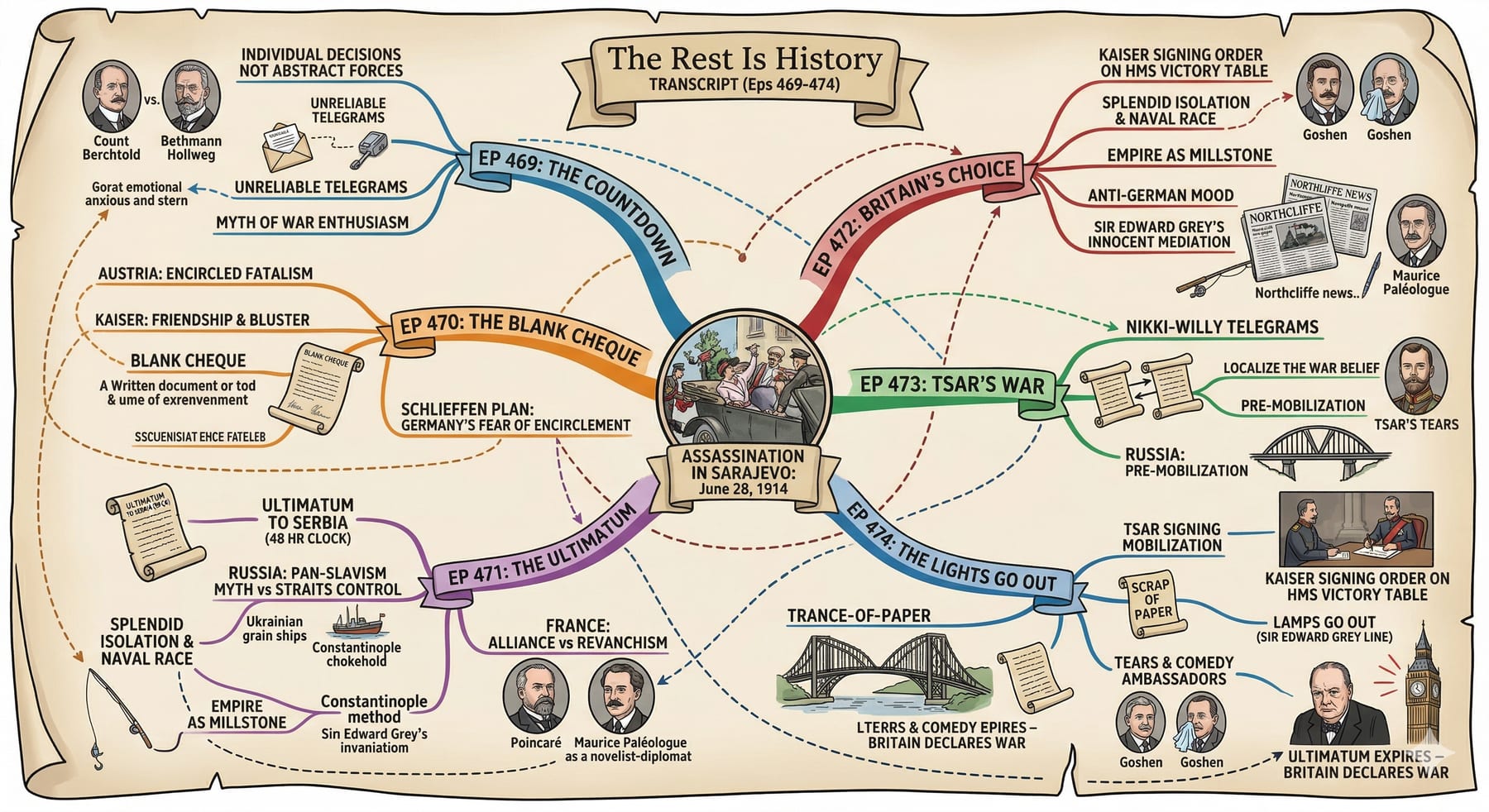
Countdown to Armageddon (Part 1)
Overall takeaway
- This episode is the opening move in a new series on the July Crisis. Its main purpose is not to narrate the whole descent into war yet, but to set up the interpretive lens: the hosts argue that World War I should not be explained mainly through abstract forces like “militarism” or “nationalism” alone, nor through the cliché of “old men sending the young to die.” Instead, they emphasize contingent decisions by specific individuals working under pressure, with limited information, personal biases, prestige anxieties, and dangerous misreadings of previous crises. (Podcasts - Your Podcast Transcripts)
- The episode also frames the outbreak of war as a civilizational rupture. It opens with Stefan Zweig’s recollection of the ecstatic mood of August 1914, then immediately turns that memory inside out: the hosts present the outbreak of war as the hinge from which the central catastrophes of the 20th century followed, including Nazism, Bolshevism, World War II, the Holocaust, communism, the Cold War, and the division of Europe. (Podcasts - Your Podcast Transcripts)
Main ideas and arguments
1) The episode rejects the simplest popular explanation
- The hosts argue against the familiar moral picture that the war was caused by reactionary, nationalist, elderly warmongers who knowingly sacrificed Europe’s youth. They explicitly push back on that image, saying the decision-makers were often not especially old, not uniformly reactionary, and in some cases were liberals, moderates, or even cosmopolitan figures with personal ties across borders. (Podcasts - Your Podcast Transcripts)
- They also argue that this “fathers lied / doomed youth” interpretation gained power because it was embedded in the culture produced by the war itself. In other words, later poetry, memory, and mourning shaped how people came to explain the war. That makes the myth emotionally powerful, but in their view historically incomplete. (Podcasts - Your Podcast Transcripts)
2) Their preferred lens is contingency, agency, and miscommunication
- A major historiographical point in the episode is that the July Crisis should be understood through real people making real choices, not through impersonal abstractions alone. The hosts favor an approach associated in the episode with Christopher Clark and Thomas G. Otte: politicians and diplomats in Vienna, Berlin, Paris, London, and St. Petersburg made decisions in contingent circumstances, often with fragmentary information and slow, distorted communication through telegrams and intermediaries. (Podcasts - Your Podcast Transcripts)
- That is why the hosts stress that the war was not “automatic.” They directly reject the idea that the war was inevitable regardless of Sarajevo. They argue that the identity of the victims, the assassin, and the location all mattered. In their telling, Sarajevo is not just a trigger for an already predetermined explosion; it is part of the explanation. (Podcasts - Your Podcast Transcripts)
3) Austria-Hungary is presented as frightened, humiliated, and narrowly focused
- One of the strongest themes in the episode is that Austria-Hungary saw the assassination not as just another terrorist act, but as an attack linked to Serbia and embedded in a longer struggle over imperial survival. The hosts stress that Vienna reacted with genuine shock, that the imperial press treated Franz Ferdinand and Sophie as grievously wronged victims, and that Austrians viewed the crime as connected to Serbian political and intelligence networks rather than random anarchist violence. (Podcasts - Your Podcast Transcripts)
- The hosts also emphasize the emotional and strategic context behind Vienna’s reaction. Austria-Hungary is described as a declining, anxious, multinational empire already worried about fragmentation, especially from Serbian nationalism and South Slav agitation along its borders. Serbia had recently grown stronger, and influential Austrian figures already believed that, sooner or later, Serbia had to be crushed before it further undermined the empire. (Podcasts - Your Podcast Transcripts)
- Franz Conrad von Hötzendorf is presented as the clearest hawk in this part of the story. The hosts remind listeners that he had repeatedly urged war against Serbia before the assassination, while Franz Ferdinand had often resisted. This creates one of the episode’s key ironies: the murdered archduke is often remembered as bellicose, but the hosts insist he was actually a restraining voice and a spokesman for peace inside the Habsburg system. (Podcasts - Your Podcast Transcripts)
4) Prestige is treated as one of the central engines of escalation
- The episode repeatedly returns to “prestige” as a driver. Austria’s leadership is shown thinking that if it failed to punish Serbia after the murder of the heir and his wife, it would advertise weakness, invite further challenges, and accelerate imperial decay. In that mindset, what looks like aggression could be understood by its authors as self-defense. (Podcasts - Your Podcast Transcripts)
- That is one of the episode’s most important conceptual points: leaders often justified offensive action as defensive necessity. The hosts do not excuse that logic, but they want listeners to understand it from inside the worldview of Austrian officials. (Podcasts - Your Podcast Transcripts)
5) The Austrians are portrayed as suffering from “tunnel vision”
- Another major argument is that Austria’s leaders focused obsessively on Serbia while giving insufficient thought to the wider alliance consequences. The hosts say historians often note this tunnel vision: Vienna concentrated on “settling accounts” with Serbia and underestimated how its move might draw in Russia and then the wider European alliance system. (Podcasts - Your Podcast Transcripts)
- The episode adds a second related mistake: Austrian leaders believed time was running out. They felt that sympathy after the assassination would fade, so action had to come quickly. That pushed them toward compression of decision-making and away from broader strategic reflection. (Podcasts - Your Podcast Transcripts)
- A third mistake was misreading precedent. Austria had previously issued ultimatums over Bosnia in 1908 and Albania in 1913 and seen Serbia back down. Austrian leaders therefore assumed Serbia would likely retreat again, and that Russia might do the same. The hosts suggest they drew the wrong lesson from prior crises: after backing down twice, Russia might instead decide “never again.” (Podcasts - Your Podcast Transcripts)
6) Not everyone in Vienna wanted war, but the hawks sought Germany to override resistance
- Count István Tisza appears as an important internal obstacle. The episode presents him as warning that Sarajevo should not become a pretext for settling scores with Serbia. His resistance shows that Austria-Hungary was not a single-minded machine unanimously bent on war. (Podcasts - Your Podcast Transcripts)
- But the hawkish faction believed Germany could help bring him around. That is the hinge on which the episode ends: Austria decides to send Count Alexander Hoyos to Berlin with a memorandum and a personal letter from Emperor Franz Joseph to Kaiser Wilhelm II. The implication is that the next crucial stage in the story will be Germany’s response. (Podcasts - Your Podcast Transcripts)
7) Germany is presented as more complicated than the standard caricature
- The hosts spend substantial time arguing that Wilhelmine Germany should not simply be conflated with the Third Reich. Yes, they acknowledge its militarist features and the army’s prestige, but they also emphasize that Germany had the world’s largest socialist party, the strongest trade union movement in Europe, a highly developed welfare state, and immense intellectual, scientific, and industrial vitality. (Podcasts - Your Podcast Transcripts)
- This matters because it complicates moral shorthand. Germany is shown as both militarized and modern, both hierarchical and socially advanced, both culturally brilliant and geopolitically intimidating. The hosts want the listener to resist flattening it into a one-dimensional pre-Nazi villain state. (Podcasts - Your Podcast Transcripts)
8) Kaiser Wilhelm II is introduced as both absurd and consequential
- Much of the second half of the episode is really character study. The Kaiser is introduced as a figure many listeners will expect to be “the culprit,” but the hosts deliberately complicate that expectation. They note that historians still debate how central he was, and they contrast harsher biographical interpretations with views that see him as comic, unstable, theatrical, and often ignored by his own officials. (Podcasts - Your Podcast Transcripts)
- The hosts explain his personality through his birth injury, damaged arm, brutal childhood treatment, strained upbringing, unstable self-confidence, craving for British admiration, and tendency to oscillate between swagger and insecurity. The portrait is psychological as much as political: they want listeners to see how vanity, humiliation, and a longing for recognition might matter in high politics. (Podcasts - Your Podcast Transcripts)
- At the same time, they stop short of calling him a straightforward architect of war in this episode. They note his bombast, his bizarre indiscretions, his Daily Telegraph embarrassment, and his theatrical geopolitical talk, but they also stress that he had not actually launched a European war before 1914 and had often sided with Franz Ferdinand’s more peaceable instincts. (Podcasts - Your Podcast Transcripts)
- His reaction to the assassination is presented as sincerely emotional. He is shown as shocked by the murder of Franz Ferdinand and Sophie, whom he counted as friends. That human reaction matters to the episode because it reinforces the larger theme: these are not cardboard villains but flawed actors whose emotions, loyalties, and misjudgments shape events. (Podcasts - Your Podcast Transcripts)
Key historical events referenced
- Assassination of Archduke Franz Ferdinand and Sophie in Sarajevo on 28 June 1914: the event that begins the crisis and the previous four-part podcast arc. (Podcasts - Your Podcast Transcripts)
- Austria-Hungary’s annexation of Bosnia-Herzegovina in 1908: cited as one earlier crisis in which Serbia and Russia had backed down, encouraging Austrian overconfidence in 1914. (Podcasts - Your Podcast Transcripts)
- The Balkan Wars and the Albania dispute in 1913: another recent precedent in which Austrian pressure had worked, again feeding the illusion that firmness would produce retreat rather than escalation. (Podcasts - Your Podcast Transcripts)
- German unification in 1870–71 after the Franco-Prussian War: used to explain both Germany’s prestige and France’s humiliation, including the loss of Alsace-Lorraine. (Podcasts - Your Podcast Transcripts)
- Edward VII’s funeral and the social-political world of European dynastic elites: referenced to illustrate Wilhelm’s relationship with Britain and the interconnectedness of ruling families before 1914. (Podcasts - Your Podcast Transcripts)
- The Daily Telegraph affair: invoked as an example of Wilhelm’s indiscretion and erratic public persona. (Podcasts - Your Podcast Transcripts)
- The Kiel Regatta: the setting in which Wilhelm receives news of the assassination, symbolizing the strange mixture of elite leisure, Anglo-German sociability, and looming catastrophe. (Podcasts - Your Podcast Transcripts)
Important people emphasized in the transcript
- Stefan Zweig: used to frame the emotional atmosphere and tragic hindsight of 1914. (Podcasts - Your Podcast Transcripts)
- Rebecca West: invoked for the idea that there are “too many facts” to make simple sense of how war happened. (Podcasts - Your Podcast Transcripts)
- Count Leopold Berchtold: presented as a cultivated, moderate-seeming Austrian statesman whose decision-making becomes central after Sarajevo. (Podcasts - Your Podcast Transcripts)
- Franz Conrad von Hötzendorf: the clearest Austrian hawk in this episode, long advocating war on Serbia. (Podcasts - Your Podcast Transcripts)
- István Tisza: a major internal restraining figure within the Habsburg system. (Podcasts - Your Podcast Transcripts)
- Kaiser Wilhelm II: introduced as eccentric, insecure, debated, and potentially crucial. (Podcasts - Your Podcast Transcripts)
- Franz Ferdinand: reinterpreted here as more dovish than his later reputation suggests. (Podcasts - Your Podcast Transcripts)
Books, articles, and sources mentioned in the episode
- Stefan Zweig, The World of Yesterday — quoted at the opening to capture the emotional intoxication of August 1914 and the vanished Habsburg world. (Podcasts - Your Podcast Transcripts)
- Rebecca West, Black Lamb and Grey Falcon — cited for the line about the problem being not too few facts, but too many. (Podcasts - Your Podcast Transcripts)
- Christopher Clark, The Sleepwalkers: How Europe Went to War in 1914 — invoked as a major modern interpretation stressing contingency and multi-sided responsibility. (Podcasts - Your Podcast Transcripts)
- Thomas G. Otte, July Crisis: The World’s Descent into War, Summer 1914 — recommended in the episode as a more person-centered study of the crisis. (Podcasts - Your Podcast Transcripts)
- George Monbiot, “Lest We Forget” — mentioned as an example of the “old men killed their children” interpretation that the hosts reject. (Podcasts - Your Podcast Transcripts)
- Rudyard Kipling — cited for lines reflecting the bitterness of wartime loss after his son’s death. (Podcasts - Your Podcast Transcripts)
- Wilfred Owen — mentioned for his rewriting of the Abraham and Isaac story to condemn sacrificial slaughter. (Podcasts - Your Podcast Transcripts)
- Benjamin Britten, War Requiem — referenced as a later artistic work drawing on Owen’s antiwar poetry. (Podcasts - Your Podcast Transcripts)
- Barbara W. Tuchman, The Guns of August — brought in through the JFK/Cuban Missile Crisis analogy as a later statesman’s lesson book about escalation. (Podcasts - Your Podcast Transcripts)
- John C. G. Röhl’s work on Kaiser Wilhelm II — referenced as a harsher interpretive line on Wilhelm’s personality and political effect. (Podcasts - Your Podcast Transcripts)
- Max Hastings — mentioned as a contrasting view, seeing Wilhelm more as a comic or theatrical figure than an all-powerful mastermind. (Podcasts - Your Podcast Transcripts)
- The Daily Telegraph interview with Wilhelm II — used as an example of his indiscretion and lack of discipline. (Podcasts - Your Podcast Transcripts)
What the episode is really trying to get the listener to see
- The war did not come from a single evil mastermind or from one abstract force alone. It came from a chain of decisions made by imperfect statesmen who felt threatened, misread signals, overvalued prestige, underestimated escalation, and believed they could control a regional war. (Podcasts - Your Podcast Transcripts)
- Austria-Hungary is the immediate engine in this episode. The hosts are especially interested in how a declining power can become dangerous when it feels humiliated and believes that delay equals death. (Podcasts - Your Podcast Transcripts)
- Germany, meanwhile, is being prepared not yet as the sole villain, but as the indispensable next actor. The episode ends on the threshold of Berlin’s decision, making clear that the crucial next question is whether Germany will restrain Austria or enable it. (Podcasts - Your Podcast Transcripts)
Related topics for further exploration
- The “blank cheque” and Germany’s actual response to Austria in July 1914
- The Fischer thesis versus Christopher Clark and Thomas Otte on war guilt
- Austria-Hungary as a declining multinational empire
- Serbian nationalism, the Black Hand, and state-linked violence
- Franz Ferdinand’s real politics versus his later reputation
- Prestige, deterrence, and “defensive aggression” in international relations
- The role of slow communications and alliance commitments in crisis escalation
- How World War I memory was shaped by Kipling, Owen, Britten, and later antiwar literature
The Kaiser’s Blank Cheque (Part 2)
Overall argument of the episode
- This episode focuses on the German side of the July Crisis, especially the visit of Count Alexander Hoyos to Berlin on 5 July 1914 and the decision by Kaiser Wilhelm II and Chancellor Theobald von Bethmann Hollweg to give Austria-Hungary the famous “blank cheque”: a promise of support against Serbia. The hosts’ central claim is that this was a reckless and catastrophic decision, but not necessarily one made because Germany consciously wanted a full European war. They argue that Berlin expected a localized war against Serbia, assumed Russia would back down, and badly misjudged the wider consequences. (Podcasts - Your Podcast Transcripts)
- A second major theme is the episode’s effort to complicate the standard caricature of pre-1914 Germany. The hosts push back against the idea that Berlin was sitting in a fully coordinated, eagerly war-seeking posture just waiting for a pretext. Instead, they stress improvisation, under-briefing, holiday absences, personal emotion, and miscalculation. Germany is still presented as culpable, but culpable more through hubris, carelessness, and false confidence than through a clearly articulated plan for world conquest in that exact moment. (Podcasts - Your Podcast Transcripts)
Key points and main ideas
1) Austria comes to Berlin looking for backing, not mediation
- The episode opens with Franz Joseph’s letter to Wilhelm II, dated 2 July 1914, portraying the Sarajevo assassination as the result of a broader Serbian and Pan-Slav agitation that threatened both the Habsburg dynasty and the empire itself. The letter frames Serbia not as a nuisance but as an existential danger. (Podcasts - Your Podcast Transcripts)
- The hosts emphasize that Austria’s leaders, especially Berchtold and Conrad von Hötzendorf, had already been thinking for a long time about how to deal with Serbia. Sarajevo was not treated merely as a cynical excuse; they genuinely saw it as confirmation that the Serbian threat had become intolerable. (Podcasts - Your Podcast Transcripts)
- Count Hoyos arrives in Berlin as a committed hard-liner. In conversation with Arthur Zimmermann, he reportedly says Serbia should be hit hard and even partitioned, showing that at least some Austrian decision-makers were thinking in annihilationist or near-annihilationist terms about Serbia from the start. (Podcasts - Your Podcast Transcripts)
2) Berlin is shown as surprisingly unprepared and casual
- One of the episode’s striking points is that Berlin is described as almost administratively half-empty when Hoyos arrives. It is summer, key figures are away, Bethmann Hollweg is at his country estate, Moltke the Younger is in Carlsbad for his health, and the Kaiser is preparing for a cruise to the Norwegian fjords. (Podcasts - Your Podcast Transcripts)
- Drawing on Thomas G. Otte’s July Crisis, the hosts stress that the Germans had not even properly briefed the Kaiser before the Austrian ambassador arrived. This matters because it supports their argument that the blank cheque was not the product of a perfectly choreographed war conspiracy at that exact moment, but of hurried, under-processed decision-making at the top. (Podcasts - Your Podcast Transcripts)
- The episode uses this lack of preparation to challenge the popular image of Germany as already operating like a single-minded war machine that instantly saw Sarajevo as a ready-made chance to invade France. The hosts say that is not how the Berlin scene looked on 5 July. (Podcasts - Your Podcast Transcripts)
3) The Kaiser’s decision is explained through emotion, impulse, and misjudgment
- The episode presents Wilhelm II as initially more cautious than his reputation suggests. When first shown the Austrian documents, he recognizes that a strike on Serbia risks a wider European complication because of Russia’s alignment with Serbia, and says he needs to speak with Bethmann Hollweg. (Podcasts - Your Podcast Transcripts)
- After lunch, however, he swings toward full support. He tells the Austrian ambassador that Austria has Germany’s backing, that it should act quickly, and that the present moment is the most advantageous one because outrage over the assassination is still fresh. (Podcasts - Your Podcast Transcripts)
- The hosts argue that this does not show Wilhelm seeking a world war. Their interpretation is that he believed Russia would protest but not fight, and that firm German backing would deter Russian intervention. The disaster, in their telling, lies in this misreading. (Podcasts - Your Podcast Transcripts)
- They also add a personal dimension: Franz Ferdinand had been Wilhelm’s friend, and the hosts suggest that outrage over the assassination helped intensify the Kaiser’s response. That emotional factor is treated as important, and often overlooked. (Podcasts - Your Podcast Transcripts)
4) Speed becomes a strategic obsession
- A recurring theme is that both Austrians and Germans believe the crisis must be exploited quickly. The hosts argue that on this narrow point the Kaiser’s logic was not irrational: the longer Austria waited, the more the moral shock of Sarajevo would fade and the harder it would be to mobilize sympathy for punitive action. (Podcasts - Your Podcast Transcripts)
- The diary of the Kaiser’s adjutant, Hans von Plessen as rendered in the transcript, is used to show that Berlin’s inner circle believed “the sooner the Austrian strike against Serbia, the better,” and also assumed Russia would stay out. That diary is important because it captures both the urgency and the complacency in German thinking. (Podcasts - Your Podcast Transcripts)
5) Bethmann Hollweg is presented as moderate, not cartoonishly demonic
- The hosts go out of their way to de-caricature Bethmann Hollweg. They present him as a cultivated, moderate conservative, grieving his wife, reading Plato in Greek, and regarded in Britain as respectable and measured. Richard Haldane is quoted as calling him the “Abraham Lincoln of Germany.” (Podcasts - Your Podcast Transcripts)
- That portrayal matters because the episode wants to show that the men enabling catastrophe were not all obvious fanatics or theatrical villains. Bethmann is shown as a serious statesman who nonetheless endorses Austria’s course and confirms Germany’s support. The point is that moderation of style does not prevent disastrous judgment. (Podcasts - Your Podcast Transcripts)
6) The “blank cheque” is framed as real, but misunderstood by those giving it
- The hosts are clear that Germany did indeed give Austria a blank cheque: Berlin tells Vienna, in effect, do what you think necessary; we stand behind you. (Podcasts - Your Podcast Transcripts)
- But they also insist that the Germans did not think they were signing on for a world war. Their interpretation is that Berlin imagined a regional settlement by force, not an uncontrollable chain reaction. That distinction is central to the entire episode. (Podcasts - Your Podcast Transcripts)
7) The episode pushes back on several common myths about Germany in 1914
- The hosts explicitly challenge the idea that Germany’s decision was mainly driven by anti-British hatred. They say Anglo-German relations had indeed been tense, but by 1914 they were on an improving trajectory, and Britain was not central to the Kaiser’s thinking in this meeting. (Podcasts - Your Podcast Transcripts)
- They also raise, then question, the popular notion that the blank cheque simply reflected a German establishment already committed to the Schlieffen Plan, a war against France and Russia, and a larger program of continental conquest. The hosts do not deny German militarism, but in this episode they argue that the immediate decision of 5 July was driven more by assumptions of deterrence and limited war than by a cleanly stated desire for general war. (Podcasts - Your Podcast Transcripts)
- Another myth they push back against is the claim that the Germans went on holiday as part of a sinister deception. The hosts’ view is that they went on holiday because they genuinely did not think a general European war was about to erupt. (Podcasts - Your Podcast Transcripts)
8) Austria is portrayed as reckless, fatalistic, and strangely inattentive to Russia
- The episode returns repeatedly to Austria’s astonishing narrowness of focus. Even after getting German support, Austrian leaders keep thinking mainly about Serbia and give remarkably little practical attention to the Russian question. (Podcasts - Your Podcast Transcripts)
- Using Christopher Clark’s The Sleepwalkers, the hosts quote the image of the Austrians as “hedgehogs scurrying across a highway with their eyes averted from the onrushing traffic.” The metaphor captures the hosts’ view that Vienna was acting with tunnel vision in a setting where the real danger lay in great-power escalation. (Podcasts - Your Podcast Transcripts)
- The episode offers several explanations for this blindness:
- Austria was dazzled by German military backing and assumed Russia would not dare intervene. (Podcasts - Your Podcast Transcripts)
- Many Austrian elites felt they had nothing left to lose, since the empire already seemed endangered from within. (Podcasts - Your Podcast Transcripts)
- They believed they were so clearly in the right that even the Tsar would ultimately recognize the legitimacy of punishing regicides and terrorists. (Podcasts - Your Podcast Transcripts)
9) The ultimatum is recognized as dangerously harsh even by Franz Joseph
- Late in the episode, Berchtold and Hoyos bring the draft ultimatum to Franz Joseph at Bad Ischl on 21 July. The hosts say Franz Joseph immediately recognizes that it is very harsh and that Russia will not tolerate it. (Podcasts - Your Podcast Transcripts)
- Yet he still approves moving ahead. That moment is used to underline one of the series’ darkest themes: several key actors can see the danger, yet proceed anyway, trusting that somehow the worst will not happen. (Podcasts - Your Podcast Transcripts)
Historical events and developments referenced
- Assassination of Archduke Franz Ferdinand and Sophie in Sarajevo, 28 June 1914: the trigger for the crisis and the moral basis for Austria’s demand to act. (Podcasts - Your Podcast Transcripts)
- Franz Joseph’s letter to Wilhelm II, 2 July 1914: frames Serbia and Pan-Slav agitation as a direct threat to the Habsburg realm. (Podcasts - Your Podcast Transcripts)
- Hoyos Mission to Berlin, 5 July 1914: Austria seeks German backing; the crucial day of the blank cheque. (Podcasts - Your Podcast Transcripts)
- German confirmation on 6 July 1914 by Bethmann Hollweg: Berlin formally reassures Austria of full support. (Podcasts - Your Podcast Transcripts)
- Haldane Mission of 1912: referenced to show that Anglo-German relations had included serious efforts at accommodation. (Podcasts - Your Podcast Transcripts)
- Boxer Rebellion, 1900: referenced through Hoyos and Zimmermann as former “China hands.” (Podcasts - Your Podcast Transcripts)
- Draft ultimatum shown to Franz Joseph at Bad Ischl, 21 July 1914: marks the transition from strategic backing to concrete diplomatic coercion. (Podcasts - Your Podcast Transcripts)
Important people discussed
- Franz Joseph — elderly Habsburg emperor, convinced Serbia represents a dynastic and imperial threat. (Podcasts - Your Podcast Transcripts)
- Kaiser Wilhelm II — emotionally affected, impulsive after lunch, gives Austria broad backing while assuming Russia will back down. (Podcasts - Your Podcast Transcripts)
- Count Alexander Hoyos — Austrian envoy and hard-liner, advocating drastic action against Serbia. (Podcasts - Your Podcast Transcripts)
- Count László Szögyény-Marich — Austro-Hungarian ambassador who delivers the key papers to the Kaiser. (Podcasts - Your Podcast Transcripts)
- Theobald von Bethmann Hollweg — German chancellor, portrayed as sober and cultivated but fully willing to support Austria. (Podcasts - Your Podcast Transcripts)
- Franz Conrad von Hötzendorf — long-standing Austrian hawk on Serbia, mentioned as part of the Viennese push for decisive action. (Podcasts - Your Podcast Transcripts)
- Arthur Zimmermann — rising German foreign office figure; his conversation with Hoyos reveals the extremity of Austrian thinking. (Podcasts - Your Podcast Transcripts)
- Hans von Plessen — the Kaiser’s adjutant, whose diary is used as a source for German assumptions about speed and Russian passivity. (Podcasts - Your Podcast Transcripts)
- Richard Haldane — cited for his positive assessment of Bethmann Hollweg. (Podcasts - Your Podcast Transcripts)
Books, articles, and sources mentioned
- Christopher Clark, The Sleepwalkers — the major interpretive work shaping the episode’s argument that the war emerged from contingent choices and misjudgments rather than a single master plan. (Podcasts - Your Podcast Transcripts)
- Thomas G. Otte, July Crisis — cited for the point that the Germans had prepared unseriously and had not even properly briefed the Kaiser. (Podcasts - Your Podcast Transcripts)
- Franz Joseph’s letter to Wilhelm II — quoted at the start of the episode as a primary source reflecting Habsburg fears. (Podcasts - Your Podcast Transcripts)
- Hans von Plessen’s diary — used as a primary source for elite German assumptions on 5 July. (Podcasts - Your Podcast Transcripts)
- Berchtold’s diary — cited near the end to capture the gravity with which Austrian leaders viewed the moment. (Podcasts - Your Podcast Transcripts)
Deeper interpretation of the transcript
- The episode’s strongest analytical move is to separate culpability from premeditated omniscience. Germany is shown as deeply responsible because it enables Austria at the decisive moment, but the hosts argue it does so while sincerely believing the crisis can still be contained. That makes the story not less tragic, but more so: leaders can trigger catastrophe while thinking they are managing it. (Podcasts - Your Podcast Transcripts)
- The transcript also keeps returning to a moral-psychological point: Austrian and German elites thought they were acting in the name of order, decency, punishment of terrorism, and defense of legitimate monarchy. The hosts’ point is not that they were right, but that they did not see themselves as villains. (Podcasts - Your Podcast Transcripts)
- In that sense, the episode is about how limited war becomes total war: not because every actor wants Armageddon, but because each thinks escalation can be controlled, each assumes the other side will blink, and each reads its own cause as obviously justified. (Podcasts - Your Podcast Transcripts)
Related topics for further exploration
- The Russian response to the blank cheque and why St. Petersburg did not back down
- The French role in the July Crisis and the diplomacy of the Franco-Russian alliance
- The Austrian ultimatum to Serbia and which clauses were designed to be unacceptable
- The Schlieffen Plan and how war-planning interacted with political crisis management
- The debate between the Fischer thesis and later interpretations like Clark and Otte
- How the language of terrorism, deterrence, punishment, and prestige functioned in 1914
- The relationship between personal monarchy and modern bureaucracy in the late imperial states
- Whether Bethmann Hollweg and Wilhelm II were reckless opportunists, trapped statesmen, or both
The Austrian Ultimatum (Part 3)
Overall argument of the episode
- This episode shifts the focus of the July Crisis away from Vienna and Berlin and onto the Franco-Russian side, especially the meeting between President Raymond Poincaré and Tsar Nicholas II in St. Petersburg on 20 July 1914, just as Austria-Hungary is preparing to deliver its ultimatum to Serbia. The hosts’ main claim is that the road to war cannot be understood only through Austrian and German choices; Russia and France also matter enormously, because both powers are already primed to take a hard line in the Balkans and to treat prestige, alliance credibility, and strategic position as worth major risk. (Podcasts - Your Podcast Transcripts)
- The episode also argues that the crisis is driven by a recurring logic the hosts keep returning to: “aggression as a form of defense.” Austria believes punishing Serbia is necessary for imperial survival; Russia believes backing down again in the Balkans would destroy its status as a great power; France believes a Balkan war may be the best setting for a future showdown in which Russia will stand firmly beside it. In the hosts’ telling, all sides persuade themselves that escalation is necessary to preserve peace, status, or security. (Podcasts - Your Podcast Transcripts)
Key points and main ideas
1) The Franco-Russian summit is presented as a major turning point
- The episode opens with a vivid recollection by Maurice Paléologue, the French ambassador in St. Petersburg, describing the ceremonial arrival of the French president. The hosts use this scene to stress that the leaders of the two allied powers flanking Germany are meeting at an extremely sensitive moment, even though Austria has not yet formally delivered its ultimatum to Serbia. (Podcasts - Your Podcast Transcripts)
- A crucial point is that Austria waits until the French have left St. Petersburg before serving the ultimatum. The hosts present this as a sign that Vienna wants to avoid immediate Franco-Russian coordination at the most delicate moment. (Podcasts - Your Podcast Transcripts)
2) Russia’s Balkan policy is explained in strategic, not purely sentimental, terms
- The hosts push back against the lazy idea that Russia’s support for Serbia is mainly about vague Pan-Slavism or Orthodox brotherhood. They say those themes existed, but argue that the deeper driver was strategy, especially Russia’s concern with the Straits connecting the Black Sea to the Mediterranean. Whoever dominates the Balkans can threaten Russia’s economic and naval access through that route. (Podcasts - Your Podcast Transcripts)
- In the episode’s framing, the Balkans are important to Russia because they form the strategic hinterland to the Bosporus and Dardanelles. If a hostile power dominates that region, Russia risks being choked economically and militarily. That makes the Serbian question, in Russian eyes, about much more than sympathy for fellow Slavs. (Podcasts - Your Podcast Transcripts)
- The hosts also stress Russia’s sense of humiliation and accumulated grievance. In both the Bosnian annexation crisis and the disputes around the Balkan Wars, Russia had previously backed down. Their argument is that by 1914 Russian elites feel they cannot retreat a third time without forfeiting their standing as a great power. (Podcasts - Your Podcast Transcripts)
3) Russia is portrayed as stronger and more confident than in 1905
- The episode emphasizes that Russia is no longer the same power that had been beaten by Japan and shaken by revolution. By 1914 it has modernized, invested in railways and armaments, and rebuilt confidence. The hosts note that Russian leaders feel much less weak than they did a decade earlier. (Podcasts - Your Podcast Transcripts)
- They also bring in Dominic Lieven to suggest a broader imperial mindset: some Russians saw Austria-Hungary and the Ottoman Empire as aging, doomed structures whose resistance to historical decline was somehow illegitimate. This adds a harder edge to Russian policy than a purely defensive reading would allow. (Podcasts - Your Podcast Transcripts)
4) Sazonov immediately constructs a counter-narrative to Austria’s case
- A major theme in the episode is the importance of Sergei Sazonov, the Russian foreign minister. The hosts say that within days of Sarajevo he begins circulating an interpretation in which Austria is cynically exploiting the murder as a pretext to crush Serbia, and Germany is the real force behind Vienna. (Podcasts - Your Podcast Transcripts)
- In that narrative, Franz Ferdinand was not genuinely mourned by the Austrians, Bosnia hated Habsburg rule anyway, and the whole Serbian angle is inflated or instrumentalized. The hosts note that Christopher Clarktreats this as an interpretation with remarkable staying power, since many people still basically explain July 1914 that way. (Podcasts - Your Podcast Transcripts)
- One of the episode’s important interpretive moves is to show that the struggle over war guilt begins before the war itself. Sazonov is already shaping the story into one where Austria has no real right to strike Serbia and Germany is the puppeteer. (Podcasts - Your Podcast Transcripts)
5) France is depicted as anxious, alliance-dependent, and quietly revanchist
- The hosts portray France as deeply committed to Russia because it fears eventual abandonment by a more powerful ally. Drawing on Christopher Clark, they argue that French policy is built around binding Russia close through finance, diplomacy, and military coordination. (Podcasts - Your Podcast Transcripts)
- France is not presented as openly seeking war in July 1914, but the hosts do argue that French leaders believe another war with Germany is likely someday, and that if it comes, it should happen on terms favorable to France, ideally with Russia fully engaged and with a chance to recover Alsace-Lorraine. (Podcasts - Your Podcast Transcripts)
- The phrase the hosts use is effectively another version of “defensive aggression”: French leaders do not necessarily desire immediate war for its own sake, but they are ready to think of a Balkan crisis as a useful tripwire that could bring Russia into a wider confrontation under good alliance conditions. (Podcasts - Your Podcast Transcripts)
6) The episode stresses that French domestic politics were oddly distracted
- In one of the episode’s more striking contrasts, the hosts note that French public attention after Sarajevo was not fully fixed on the Balkan crisis because many were absorbed by the sensational Caillaux affair. They describe the scandal surrounding Henriette Caillaux, who shot the editor of Le Figaro, as dominating public attention at the very moment Europe was approaching disaster. (Podcasts - Your Podcast Transcripts)
- The point is not just comic relief. The hosts use it to show how contemporaries did not experience July 1914 with the hindsight of later generations. Even while statesmen maneuvered toward catastrophe, parts of public opinion were focused elsewhere. (Podcasts - Your Podcast Transcripts)
7) Serbia’s decision is presented as contingent, not predetermined
- Once the ultimatum arrives, the hosts say Serbian ministers are shaken and dejected. They consider asking for more time, but know Austria is unlikely to grant it because the 48-hour deadline is designed to keep pressure high and restrict diplomatic maneuvering. (Podcasts - Your Podcast Transcripts)
- The episode presents a historiographical split here. Thomas Otte is said to argue that Serbia could never truly have accepted the note because it intruded too far into Serbian sovereignty. Christopher Clark, however, is presented as more open to the idea that at least some Serbian ministers were tempted to accept most or all of it. (Podcasts - Your Podcast Transcripts)
- The hosts then cite Luigi Albertini, who interviewed Serbian ministers and officials and found some claiming their first instinct had been essentially to say “fine.” The implication is that Serbia’s response was shaped not only by the note itself, but by the expectation of Russian backing. (Podcasts - Your Podcast Transcripts)
8) Russia’s reaction becomes the hinge of the crisis
- One of the clearest claims in the episode is that any account of the First World War’s origins that minimizes Russia is missing something fundamental. The hosts argue that once the ultimatum is delivered, the decisive question becomes how Russia reacts, because Serbian calculations change completely if St. Petersburg stands firm behind Belgrade. (Podcasts - Your Podcast Transcripts)
- The transcript depicts Sazonov opening the ultimatum and immediately declaring, in effect, “This is a European war.” The Tsar is initially less convinced that Germany truly wants such a war, but Sazonov pushes the harder line. (Podcasts - Your Podcast Transcripts)
- That tension matters because it shows a split even within Russia: Nicholas II is still capable of doubting the most alarmist interpretation, while Sazonov reads the ultimatum as the start of a continental showdown. (Podcasts - Your Podcast Transcripts)
9) Maurice Paléologue is presented as a dangerously irresponsible accelerant
- A large part of the episode becomes a character study of Maurice Paléologue, whom the hosts depict as vain, imaginative, theatrical, and badly suited to an explosive diplomatic moment. They quote Sir George Buchanan’sjudgment that Paléologue’s imagination ran away with him and made him prone to exaggerated political interpretations. (Podcasts - Your Podcast Transcripts)
- The hosts are especially hard on him because, with Poincaré and Viviani at sea, Paléologue becomes the crucial French intermediary in St. Petersburg. Rather than cooling tempers, he is portrayed as encouraging Sazonov to take a hard line and to think that only firmness will work against Germany and Austria. (Podcasts - Your Podcast Transcripts)
- This becomes one of the episode’s broad lessons: diplomacy in 1914 is carried out through human intermediaries with egos, prejudices, delays, and distortions. Without quick direct communication, people like Paléologue can help turn suspicion into policy. (Podcasts - Your Podcast Transcripts)
10) Russia effectively gives Serbia its own “blank cheque”
- The hosts say that on the night of 24–25 July, Russia sends word to Serbia that accepting the ultimatum would amount to suicide and that Russia will stand by it. In effect, Serbia receives a kind of counter–blank cheque from Russia. (Podcasts - Your Podcast Transcripts)
- This is crucial to the episode’s structure. Austria had earlier received German backing; now Serbia is reassured by Russia. The crisis becomes much harder to localize because each smaller actor is reinforced by a great-power patron. (Podcasts - Your Podcast Transcripts)
11) Russian mobilization is framed as “defensive,” but deeply escalatory
- At the meeting on 25 July at Krasnoe Selo, Sazonov urges the Tsar and ministers to begin partial mobilization of the western military districts. The hosts stress that this is not yet full general mobilization and is understood by its authors as a defensive precaution meant to make Austria back down. (Podcasts - Your Podcast Transcripts)
- But the episode underlines the paradox: the mobilization is called defensive, yet it drastically raises the stakes. From that point onward, somebody will have to reverse course in a major way, either by cancelling Russian mobilization or by abandoning the Austrian ultimatum strategy. (Podcasts - Your Podcast Transcripts)
- This ties directly back to the hosts’ larger theme that July 1914 is full of actors taking escalatory steps while sincerely telling themselves they are acting to preserve peace, prestige, or deterrence. (Podcasts - Your Podcast Transcripts)
12) The episode ends with extreme compression of time
- The hosts close by emphasizing the ticking clock: Serbia’s reply is due at 6:00 p.m. on Saturday, 25 July, and they say there are now only seven days left before world war begins. This gives the whole episode its tone of tightening inevitability, even though the series as a whole continues to stress contingency and bad choices rather than fate. (Podcasts - Your Podcast Transcripts)
Historical events and developments referenced
- Poincaré’s visit to St. Petersburg on 20 July 1914 as a key moment of Franco-Russian alliance coordination. (Podcasts - Your Podcast Transcripts)
- The Austro-Hungarian ultimatum to Serbia, held back until after the French departure and delivered with a 48-hour deadline. (Podcasts - Your Podcast Transcripts)
- The Russo-Japanese War and the 1905 Revolution, used to frame Russia’s earlier weakness and later recovery. (Podcasts - Your Podcast Transcripts)
- The Bosnian annexation crisis and the Balkan Wars, which shaped Russian and Austrian expectations in opposite directions. (Podcasts - Your Podcast Transcripts)
- The long French desire to recover Alsace-Lorraine, which the hosts treat as an important background motive in French strategy. (Podcasts - Your Podcast Transcripts)
- The Russian partial mobilization meeting at Krasnoe Selo on 25 July 1914, presented as a decisive escalatory step. (Podcasts - Your Podcast Transcripts)
Important people emphasized in the transcript
- Nicholas II — portrayed as conservative, hesitant, and less immediately alarmist than Sazonov. (Podcasts - Your Podcast Transcripts)
- Sergei Sazonov — the Russian foreign minister, presented as decisive, hard-line, and central to framing the crisis as a continental showdown. (Podcasts - Your Podcast Transcripts)
- Raymond Poincaré — shown as deeply committed to the Russian alliance and to maintaining French strategic leverage against Germany. (Podcasts - Your Podcast Transcripts)
- Maurice Paléologue — depicted as flamboyant, imaginative, and dangerously encouraging of Russian firmness. (Podcasts - Your Podcast Transcripts)
- René Viviani — mentioned as being at sea with Poincaré while events escalate in St. Petersburg. (Podcasts - Your Podcast Transcripts)
- Sir George Buchanan — cited for his skeptical assessment of Paléologue’s temperament. (Podcasts - Your Podcast Transcripts)
Books, articles, and sources mentioned in the episode
- Christopher Clark, The Sleepwalkers — the most frequently invoked interpretive work in the episode, especially on Sazonov’s narrative, French anxieties about Russia, and the Balkan “tripwire” idea. (Podcasts - Your Podcast Transcripts)
- Thomas G. Otte, July Crisis — cited for the argument that Serbia could not realistically have accepted the ultimatum. (Podcasts - Your Podcast Transcripts)
- Luigi Albertini’s interviews and work on 1914 — cited for evidence that some Serbian ministers were initially tempted simply to accept the ultimatum. (Podcasts - Your Podcast Transcripts)
- Dominic Lieven — mentioned for the idea that some Russians saw Austria-Hungary and the Ottoman Empire as historically doomed empires. (Podcasts - Your Podcast Transcripts)
- Maurice Paléologue’s recollections/memoirs — effectively used at the opening for the scene-setting account of Poincaré’s arrival. (Podcasts - Your Podcast Transcripts)
- Sir George Buchanan’s diplomatic judgment of Paléologue — used as a character source. (Podcasts - Your Podcast Transcripts)
Deeper interpretation of the episode
- The deepest point in this episode is that the war’s expansion is not explained simply by one side’s wickedness. The hosts are showing how each alliance system radicalizes the other: Austrian pressure on Serbia stiffens Russia; Russian backing stiffens Serbia; French backing stiffens Russia; German backing had earlier stiffened Austria. The crisis widens because every actor fears the humiliation of backing down more than the danger of escalation. (Podcasts - Your Podcast Transcripts)
- The transcript also strongly suggests that prestige is as important as material interest. Russia fears losing great-power status, France fears losing alliance relevance, and Austria fears losing imperial authority. That shared obsession with prestige helps explain why all three powers can describe aggressive behavior as necessary self-defense. (Podcasts - Your Podcast Transcripts)
- Another important insight is the role of communications technology and diplomatic mediation. The hosts repeatedly stress that leaders cannot instantly clarify intentions, so ambassadors and intermediaries inject their own interpretations into events. This is one reason Paléologue matters so much in the episode. (Podcasts - Your Podcast Transcripts)
Related topics for further exploration
- The exact clauses of the Austrian ultimatum and why some were seen as incompatible with Serbian sovereignty
- Russian mobilization: partial vs general mobilization and why the distinction mattered so much
- The debate over whether France encouraged Russia more than later French memory admitted
- Maurice Paléologue’s historical reputation and whether he exceeded his instructions
- Sazonov’s diplomacy and Russian war aims in 1914
- Alsace-Lorraine and French revanchism before World War I
- The broader history of the Franco-Russian alliance
- How historians differ on 1914: Fischer, Clark, Otte, Albertini, and Lieven
Britain’s Fateful Choice (Part 4)
Overall argument of the episode
- This episode shifts the July Crisis story toward Britain, asking why the most powerful naval empire in the world was still so uncertain, passive, and ambiguous in the crucial days after the Austrian ultimatum to Serbia. The hosts argue that Britain had enormous global power but no settled intention to fight a continental war, and that its leaders were still hoping for mediation, compromise, or a localized settlement even after reading a note they recognized as extreme. (Podcasts - Your Podcast Transcripts)
- The episode’s second big claim is that Britain’s hesitation came from the structure of its foreign policy. Britain had moved away from “splendid isolation” and into understandings with France and Russia, but those arrangements had been formed mainly to protect the empire, not to prepare for a giant land war in Europe. That left Britain in an awkward middle position: tied to France and Russia, worried about Germany, but not yet mentally committed to intervention. (Podcasts - Your Podcast Transcripts)
- The third major theme is that Britain’s mediation efforts were sincere but unrealistic. Sir Edward Grey tried to organize a four-power mediation, but the hosts argue he badly underestimated how far Berlin, Vienna, Paris, and St. Petersburg had already moved toward confrontation. In their telling, Britain was not absent because it did not matter; it was absent because its leaders were still thinking in an older, calmer diplomatic mode that no longer matched events. (Podcasts - Your Podcast Transcripts)
Key points and main ideas
1) Britain is powerful, imperial, and oddly ill-prepared for a continental war
- The hosts emphasize Britain’s paradoxical position in 1914. It still has the largest empire in the world and the strongest navy, but only a small army by continental standards. Its recent wars had mostly been colonial campaigns or “police actions,” not the kind of mass industrial war being contemplated in Europe. That is essential to understanding why British statesmen do not initially think in the same way as Russians, Germans, Austrians, or Frenchmen. (Podcasts - Your Podcast Transcripts)
- Britain’s older strategic model, as the hosts present it, was to use sea power, subsidies, and diplomacy rather than huge armies. Historically, Britain had joined coalitions when needed, but it had also cultivated a habit of standing somewhat apart and intervening only selectively. That legacy shaped British thinking in July 1914. (Podcasts - Your Podcast Transcripts)
2) The empire had pushed Britain into awkward friendships
- One of the episode’s most interesting arguments is that Britain’s empire acted as a strategic burden as much as a source of strength. The hosts say British policymakers formed closer ties with France in 1904 and Russia in 1907 largely to calm imperial flashpoints in Africa and Asia, not because Britain naturally preferred those countries over Germany. (Podcasts - Your Podcast Transcripts)
- The hosts frame this almost as a form of imperial pragmatism. France and Russia were the powers most likely to clash with Britain across the globe, so making arrangements with them reduced imperial friction. That meant Britain ended up diplomatically closer to countries many British liberals found ideologically unattractive, especially autocratic Russia. (Podcasts - Your Podcast Transcripts)
- This leads to one of the episode’s central insights: British alignment with France and Russia did not necessarily reflect a simple anti-German worldview. In fact, many influential Britons still thought Germany was culturally close, politically respectable, and possibly a more “natural” partner than Russia. (Podcasts - Your Podcast Transcripts)
3) Britain’s relationship with Germany was more complicated than simple hostility
- The hosts stress that prewar Britain was not uniformly anti-German. There was genuine anxiety about Germany, especially because of the naval race, invasion scares, and the rapid rise of German industry. But there was also deep admiration for German culture, education, science, and social organization. (Podcasts - Your Podcast Transcripts)
- They emphasize how culturally entangled the two societies still were. British elites admired German music, literature, and scholarship; Germans admired British culture in return. Figures like Joseph Chamberlain and Richard Haldane had even wanted closer ties or an alliance with Germany, and by early 1914 some British leaders thought relations were actually improving. (Podcasts - Your Podcast Transcripts)
- The hosts also discuss a kind of proto-Thucydides Trap dynamic: Germany was rising in industrial power and trade, which made Britain uneasy. But they argue this rivalry was not fully predetermined. Britain could have imagined Germany as either a rival or a partner, and in 1914 many people still thought accommodation was possible. (Podcasts - Your Podcast Transcripts)
4) Grey is presented as honorable, intelligent, and badly out of sync with reality
- Sir Edward Grey is portrayed with a mix of admiration and criticism. The hosts clearly like him, but they also show that he was still operating under the assumption that the great powers could be reasoned into moderation through good-faith diplomacy. He believed that if he proposed mediation calmly enough, the others might come around. (Podcasts - Your Podcast Transcripts)
- The problem, as the hosts frame it, is that Grey’s intended partners in mediation did not really exist in the way he imagined. France and Germany were already too committed to firmness and alliance logic to embrace neutral mediation sincerely. Britain was trying to convene a concert of Europe at the very moment the concert had already broken down. (Podcasts - Your Podcast Transcripts)
- Grey is also shown as still somewhat sympathetic to Austria before reading the ultimatum. But once he sees the text, he is shocked and calls it the most formidable declaration he has seen one state address to another. Even then, however, the cabinet’s first instinct is not intervention but avoiding a European war. (Podcasts - Your Podcast Transcripts)
5) The British cabinet is shocked by the ultimatum, but still wants to stay out
- The cabinet meeting of 24 July 1914 is the dramatic center of the British side of the episode. Churchill’s later recollection is used to capture the atmosphere: the Austrian note suddenly makes the European crisis feel terrifyingly real. (Podcasts - Your Podcast Transcripts)
- Yet the cabinet’s reaction is not “we must fight.” It is almost the opposite. The hosts say the cabinet is adamant that Britain should avoid being dragged into a general European war. This is one of the most important points in the episode: shock at Austria’s ultimatum does not automatically translate into a willingness to intervene militarily. (Podcasts - Your Podcast Transcripts)
- Prime Minister H. H. Asquith is used to illustrate that mood. He recognizes that Europe is near “Armageddon,” but still assumes Britain may remain only a spectator. He thinks Austria has a serious case against Serbia in some respects, but also thinks Austria is handling matters with foolish brutality. (Podcasts - Your Podcast Transcripts)
6) Asquith and Grey both still hope for a limited outcome
- The hosts present Asquith’s ideal outcome as something like a controlled reprimand of Serbia: enough to satisfy Austria, but not enough to trigger continental war. That is also basically how they portray Grey’s instinct. Neither man wants Serbia to humiliate Austria, but neither wants the situation to spiral. (Podcasts - Your Podcast Transcripts)
- Their criticism is that this hope reflects a serious failure of intelligence and imagination. British leaders did not fully grasp how committed the continental powers already were, or how little room remained for a face-saving compromise. (Podcasts - Your Podcast Transcripts)
7) Grey’s four-power mediation is the episode’s emblem of British misreading
- Grey proposes a four-power mediation involving Britain, France, Germany, and Italy. In theory this would restrain Austria and Russia and prevent escalation. In practice, the hosts argue, it had major flaws from the start. (Podcasts - Your Podcast Transcripts)
- First, France and Germany were not genuinely committed to such mediation. Second, the lineup itself would look biased against Austria. Third, Grey still believed the powers were flexible enough to compromise, when in reality they had already largely moved into bloc politics and brinkmanship. (Podcasts - Your Podcast Transcripts)
- This is one of the episode’s clearest analytical claims: British diplomacy failed not because the idea of mediation was morally wrong, but because it arrived too late and was based on a misreading of what the other capitals were already prepared to do. (Podcasts - Your Podcast Transcripts)
8) German leaders still seem to believe the crisis can remain local
- The hosts say that even as Grey proposes mediation, German leaders are dismissing it and still assuming that Russia will bluster rather than fight. Kaiser Wilhelm rejects Grey’s idea as useless and as a betrayal of Austria, while figures in the German Foreign Office tell journalists that Russia will likely protest loudly but stop there. (Podcasts - Your Podcast Transcripts)
- The hosts interpret this as reckless self-delusion. Germany is not necessarily shown here as deliberately seeking world war in that exact moment, but as badly underestimating how seriously Russia is taking the crisis. (Podcasts - Your Podcast Transcripts)
9) Eyre Crowe voices the hard-line British strategic case
- A major figure in the episode is Sir Eyre Crowe, the British Foreign Office official the hosts describe as fiercely anti-German despite his German background. Crowe becomes the voice of the argument that Britain has effectively already chosen its side whether it admits it or not. (Podcasts - Your Podcast Transcripts)
- In his memo of 25 July, Crowe argues that British neutrality would be disastrous no matter who won. If Germany and Austria won, Britain would face a Europe dominated by hostile powers. If France and Russia won without British help, they would despise Britain and threaten its imperial position. His conclusion is that British policy has created obligations Britain can no longer evade. (Podcasts - Your Podcast Transcripts)
- This memo matters because it lays out the strategic logic that would soon pull Britain toward war: neutrality might look like peace, but in Crowe’s view it would actually destroy Britain’s long-term security and prestige. (Podcasts - Your Podcast Transcripts)
10) Serbia’s reply is presented as a diplomatic masterpiece of ambiguity
- The episode then shifts back to Serbia on 25 July, the day the ultimatum expires. The Serbian government is shown in panic, making limited military preparations, scrambling with a jammed typewriter, revising its response repeatedly, and trying to balance submission with survival. (Podcasts - Your Podcast Transcripts)
- The hosts insist that the famous Serbian reply is often misunderstood. They say Serbia did not simply accept everything except point six. Instead, it accepted much in principle but attached caveats, legal qualifications, or conditions of proof that hollowed out the substance of Austria’s demands. (Podcasts - Your Podcast Transcripts)
- Their judgment is that the reply was brilliantly drafted: it appeared conciliatory enough to impress outside opinion, but not enough to satisfy Vienna’s actual objectives. In effect, it gave Austria a document that looked moderate to the world while remaining unusable from the Austrian point of view. (Podcasts - Your Podcast Transcripts)
11) Diplomacy is shown as both absurdly human and fatally ineffective
- One of the episode’s most memorable anecdotes is about Velizar Janković, one of the Serbian ministers drafting the reply, whose family is vacationing on the Adriatic inside Austria-Hungary. Trying to get help from the German ambassador, he is accidentally driven to the Austrian embassy instead. (Podcasts - Your Podcast Transcripts)
- The story matters because it illustrates the strange mix of intimacy and catastrophe in prewar Europe: families vacation across borders, passports are often unnecessary, diplomats behave with personal courtesy, and yet those same states are minutes away from severing relations. The hosts repeatedly underline this human, almost comic quality of the diplomatic world, even while it is failing on the largest scale imaginable. (Podcasts - Your Podcast Transcripts)
12) Austria treats the Serbian reply as rejection and moves on
- When Prime Minister Nikola Pašić delivers Serbia’s reply just before the deadline, Austrian minister Baron Giesl quickly decides it is insufficient. The hosts stress that he does not need to deliberate for long: from his perspective, the caveats and qualifications render the document useless. (Podcasts - Your Podcast Transcripts)
- Giesl breaks off relations, burns his ciphers, locks the embassy, hands the keys to the Germans, and leaves for the station. This sequence symbolizes the end of diplomacy at the Serbian level and the transition from ultimatum politics to open confrontation. (Podcasts - Your Podcast Transcripts)
13) Austrian public enthusiasm is real, but limited and misleading
- The hosts describe cheering crowds in Vienna after the Serbian reply is rejected. Students sing patriotic songs and celebrate revenge for the murdered archduke. But they also caution against reading this as enthusiasm for a full world war. Austria’s public, they argue, thinks mainly in terms of a punitive war against Serbia, not a civilizational catastrophe. (Podcasts - Your Podcast Transcripts)
- Emperor Franz Joseph’s muted response, “well then, there it is,” provides a somber contrast to the public mood. It closes the episode with a sense that Europe is now moving from crisis to abyss. (Podcasts - Your Podcast Transcripts)
Key historical events referenced
- Cabinet meeting in London, 24 July 1914: Grey reads the Austrian ultimatum to colleagues, shocking the cabinet but not yet producing a commitment to intervene. (Podcasts - Your Podcast Transcripts)
- Entente Cordiale (1904) and Anglo-Russian Convention (1907): presented as the diplomatic background that pulled Britain closer to France and Russia for imperial reasons. (Podcasts - Your Podcast Transcripts)
- Fashoda Crisis (1898): referenced as an example of imperial friction Britain wanted to reduce through accommodation with France. (Podcasts - Your Podcast Transcripts)
- Boer War and the late-19th/early-20th-century naval race: used to explain British insecurity, invasion scares, and changing views of Germany. (Podcasts - Your Podcast Transcripts)
- Serbia’s reply to the Austrian ultimatum, 25 July 1914: treated as a pivotal diplomatic text, deliberately conciliatory in tone but evasive in substance. (Podcasts - Your Podcast Transcripts)
- Austro-Serbian rupture, evening of 25 July 1914: Giesl rejects the reply, severs relations, and leaves Belgrade. (Podcasts - Your Podcast Transcripts)
Important people emphasized in the episode
- Sir Edward Grey — British foreign secretary, sincere believer in mediation, shocked by the ultimatum, but still not ready to abandon diplomacy. (Podcasts - Your Podcast Transcripts)
- H. H. Asquith — prime minister, aware of looming continental disaster but still hoping Britain can remain outside it. (Podcasts - Your Podcast Transcripts)
- Winston Churchill — cited through his later memoir as a witness to the cabinet’s reaction. (Podcasts - Your Podcast Transcripts)
- Sir Eyre Crowe — hard-line Foreign Office official arguing that neutrality would be strategically ruinous. (Podcasts - Your Podcast Transcripts)
- Paul Cambon — French ambassador in London, a key intermediary in Grey’s mediation efforts. (Podcasts - Your Podcast Transcripts)
- Prince Lichnowsky and Count Benckendorff — German and Russian ambassadors in London, part of the diplomatic environment Grey is trying to manage. (Podcasts - Your Podcast Transcripts)
- Nikola Pašić — Serbian prime minister delivering the reply just before the deadline. (Podcasts - Your Podcast Transcripts)
- Baron Giesl — Austrian representative in Belgrade who rejects Serbia’s response and breaks off relations. (Podcasts - Your Podcast Transcripts)
- Franz Joseph — Habsburg emperor whose subdued reaction contrasts with Viennese street enthusiasm. (Podcasts - Your Podcast Transcripts)
Books, articles, and sources mentioned
- Winston Churchill, The World Crisis — quoted at the beginning for the British cabinet’s reaction to the Austrian note. (Podcasts - Your Podcast Transcripts)
- Christopher Clark, The Sleepwalkers — cited multiple times for interpretation of British policy, elite attitudes toward Germany, and the broader crisis. (Podcasts - Your Podcast Transcripts)
- Rudyard Kipling, “Dane-Geld” — referenced through the discussion of Eyre Crowe’s anti-appeasement attitude toward Germany. (Podcasts - Your Podcast Transcripts)
- Daily Mail / Northcliffe press invasion scares — mentioned as part of the anti-German atmosphere in Britain. (Podcasts - Your Podcast Transcripts)
- Daily News interview with Lloyd George, New Year’s Day 1914 — cited to show that Anglo-German relations were seen by some as improving. (Podcasts - Your Podcast Transcripts)
Deeper interpretation of the episode
- The episode’s deepest point is that Britain’s “fateful choice” was not yet a clean decision for war or peace. It was a crisis of strategic ambiguity: Britain had built a foreign policy that tied it to France and Russia but had not psychologically or politically reconciled itself to what those ties might require in a real continental emergency. (Podcasts - Your Podcast Transcripts)
- It also suggests that July 1914 was shaped not only by hawks and war plans but by badly timed moderation. Grey’s mediation instinct was decent, rational, and in another setting might have worked. Here it failed because it was operating in a diplomatic world that had already moved past compromise. (Podcasts - Your Podcast Transcripts)
- Finally, the episode shows how easy it is to misunderstand Serbia’s reply as near-total surrender. The hosts argue the reply mattered precisely because it was crafted to win sympathy abroad while remaining unacceptable to Austria. That is why it could simultaneously look moderate to outside observers and still help push Europe closer to war. (Podcasts - Your Podcast Transcripts)
Related topics for further exploration
- Britain’s eventual decision to enter the war and the role of Belgian neutrality
- The difference between ententes and formal alliances in pre-1914 diplomacy
- The naval race and British invasion-scare literature before 1914
- Eyre Crowe’s 1907 memorandum and British views of Germany
- The exact text and legal logic of the Serbian reply
- How historians differ on whether Grey’s mediation had any real chance
- The role of ambassadors like Cambon and Lichnowsky in the final days before war
- Public enthusiasm in July 1914 versus later memory of disillusionment
The Tsar Chooses War (Part 5)
Overall argument of the episode
- This episode presents July 27–30, 1914 as the moment when the crisis stops looking like a local Balkan punishment and starts becoming a true European war. Its central claim is that there was still a widespread belief that the war could be localized or avoided, but that belief rested on illusions in Berlin, London, and St. Petersburg alike. The Kaiser still thought Russia would not fully intervene; British leaders were still trying to mediate; and the Tsar still recoiled from the idea of mass slaughter even as his advisers pushed him toward mobilization. (Podcasts - Your Podcast Transcripts)
- The episode’s real hinge is the Tsar’s move to full mobilization. The hosts frame that decision as reluctant rather than eager: Nicholas II is shown as resistant, emotional, and fearful of sending “thousands and thousands of men to their deaths,” while Sergei Sazonov and the military leadership argue that delay will destroy Russia. In the hosts’ telling, once that order is sent out, the crisis enters a radically more dangerous phase. (Podcasts - Your Podcast Transcripts)
- A second major theme is the tragic irony of dynastic Europe. The episode opens with the “Nicky-Willy” telegrams, emphasizing that the Tsar and Kaiser were cousins with a long habit of semi-private, semi-official correspondence about peace and diplomacy. That familial intimacy makes the slide toward war appear even more tragic: the catastrophe is not being driven by strangers who hate one another, but by interconnected rulers trapped in systems of prestige, alliance, fear, and bad judgment. (Podcasts - Your Podcast Transcripts)
Key points and main ideas
1) The episode opens by stressing how personal the old order still was
- The quotation from a 1909 birthday letter from Wilhelm II to Nicholas II is used to establish the old European dynastic world: cousin monarchs exchanging affectionate messages, discussing family, holidays, and politics in the same breath. The hosts stress that these messages were not purely private, since foreign office officials helped shape them, but they still reveal genuine personal ties. (Podcasts - Your Podcast Transcripts)
- That opening matters because it sets up one of the episode’s strongest contrasts: on the surface, the rulers of Europe still inhabit a world of family intimacy, leisure, and court etiquette; underneath, their governments are moving toward industrial war. The hosts use that contrast to heighten the sense of a civilization on the brink without fully realizing it. (Podcasts - Your Podcast Transcripts)
2) Wilhelm II is portrayed as reckless, vain, and still half in denial
- The hosts emphasize that the Kaiser is still on holiday, having spent time on his yacht, attended the Kiel Regatta, and socialized cordially with British naval officers. They use this to stress that the crisis is unfolding in a strange atmosphere where elite sociability and geopolitical disaster coexist. (Podcasts - Your Podcast Transcripts)
- Even after being shown the Austrian ultimatum, Wilhelm is portrayed as believing that there will not be a general war. The hosts quote him reacting to the note as “firm,” but also show him assuming the Serbs would not risk wider war and the Russians would not intervene decisively. Admiral Müller is presented as seeing more clearly than the Kaiser that the note could lead to war. (Podcasts - Your Podcast Transcripts)
- The hosts’ interpretation of Wilhelm is psychologically pointed: he is not shown here as calmly planning Armageddon, but as a blusterer who talks big and assumes things will somehow work out. Their metaphor is that he is a “Mister Toad” figure who cannot quite face consequences. That does not absolve him; it makes him dangerous in a different way. (Podcasts - Your Podcast Transcripts)
3) Berlin still thinks the war can be localized
- When Wilhelm returns to Germany on Monday, July 27, Bethmann Hollweg keeps him away from Berlin because public demonstrations could inflame the situation. That detail shows both how volatile the atmosphere has become and how anxious the German leadership is to avoid looking as though it is theatrically embracing war. (Podcasts - Your Podcast Transcripts)
- Yet the inner German mood remains strikingly complacent. The hosts quote the adjutant Hans von Plessensaying the Austrians are not even ready to move, that Berlin still hopes to localize the war, and that Britain appears likely to remain neutral. This is one of the episode’s most important points: the German elite still believes it can back Austria, preserve prestige, and avoid continental war. (Podcasts - Your Podcast Transcripts)
- The episode uses Prince Lichnowsky’s reporting from London to explain that illusion. Berlin thinks Edward Grey feels some sympathy for Austria and does not want to be drawn too tightly into a pro-French, pro-Russian line. In other words, Germany’s gamble continues to rest on misreading Britain as much as on underestimating Russia. (Podcasts - Your Podcast Transcripts)
4) Britain still represents the last major hope for mediation
- The episode description explicitly says there is still a broad sense that war might be avoided, with Sir Edward Grey trying to mediate among Serbia, Russia, Austria, and Germany. This matters because it shows the hosts do not treat war as inevitable even at this late stage; they present it as the outcome of further choices made after multiple opportunities for restraint. (Podcasts - Your Podcast Transcripts)
- But Grey’s efforts are shown as failing against the speed of events. By the time Austria formally declares war on Serbia and Russia’s power brokers are pushing the Tsar toward war, mediation is being overtaken by mobilization and military action. That tension between diplomatic language and military reality is central to the episode. (Podcasts - Your Podcast Transcripts)
5) Austria’s declaration of war turns the crisis into open conflict
- The episode description identifies Franz Joseph’s signing of the declaration of war on Serbia as the decisive formal step on the Austrian side. That is the moment when the diplomatic crisis becomes an actual war, even if many still hope it can remain confined to the Balkans. (Podcasts - Your Podcast Transcripts)
- The description then adds a vivid operational detail: in the early hours after the declaration, a major railway bridge near Belgrade is blown up and Austro-Hungarian warships emerge “from the darkness,” emphasizing that the war is no longer theoretical. The hosts seem to use these details to dramatize the shift from notes, telegrams, and cabinet meetings to actual violence. (Podcasts - Your Podcast Transcripts)
6) The Tsar is portrayed as hesitant, emotional, and deeply reluctant
- The episode’s title is slightly ironic. “The Tsar chooses war” does not mean Nicholas is shown eagerly embracing it. The transcript instead presents him as resisting pressure, losing his temper when urged to authorize full mobilization, and insisting that he does not want to unleash mass death. (Podcasts - Your Podcast Transcripts)
- That portrayal matters because it fits the hosts’ broader interpretation of the July Crisis: catastrophe is not driven only by obvious warmongers. It is also driven by hesitant, weak, or confused rulers who cannot resist the pressure of advisers, alliance logic, and strategic fear. Nicholas becomes another tragic participant rather than a simple villain. (Podcasts - Your Podcast Transcripts)
7) Sazonov and the Russian high command push the decisive escalation
- The key human agent on the Russian side is Sergei Sazonov. In the transcript, he goes to Peterhof Palace at about 3 p.m., tells Nicholas that war is no longer avoidable, and insists that Germany is effectively spoiling for a fight. The hosts note that Sazonov seems genuinely to believe this, which is important because it shows escalation being driven by sincere fear as well as strategic calculation. (Podcasts - Your Podcast Transcripts)
- Nicholas initially refuses, but Sazonov wears him down. At about 4 p.m., Sazonov telephones General Yanushkiewicz with the order to transmit mobilization, and the episode includes the striking line about smashing the telephone so that the Tsar cannot reverse the decision. The hosts use this almost as a symbol of how statesmen and generals can lock a system into motion once political hesitation has been overcome. (Podcasts - Your Podcast Transcripts)
- The description of the Central Telegraph Office in St. Petersburg reinforces that symbolism. The rows of silent operators, the calm atmosphere, and the clicking of machines sending the order across the empire give the decision an impersonal, mechanical quality: once made, it becomes a networked act, not just a private wish of the Tsar. (Podcasts - Your Podcast Transcripts)
8) Mobilization is shown as the step that makes retreat far harder
- The hosts frame Russian mobilization as the step that radically narrows remaining room for diplomacy. Even before the final plunge into general war, the order itself changes the meaning of the crisis: it signals that Russia is no longer merely warning Austria and Germany but is preparing for a continental struggle. (Podcasts - Your Podcast Transcripts)
- This fits one of the broader themes of the whole series so far: leaders keep telling themselves that they are taking defensive or precautionary measures, but each one of those measures makes the next step harder to avoid. The German hope of localization, the Austrian declaration of war, Grey’s fading mediation, and Russian mobilization all collide here. (Podcasts - Your Podcast Transcripts)
Key historical events referenced
- May 8, 1909: Wilhelm’s birthday letter to Nicholas, used to illustrate the long-running “Nicky-Willy” correspondence and the dynastic background to the crisis. (Podcasts - Your Podcast Transcripts)
- Kiel Regatta and the Kaiser’s Norwegian cruise: used to show the bizarre coexistence of leisure, Anglo-German friendliness, and impending catastrophe. (Podcasts - Your Podcast Transcripts)
- July 27, 1914: Wilhelm returns to Germany after the ultimatum crisis has deepened, but Berlin still believes the war can be localized. (Podcasts - Your Podcast Transcripts)
- Austria’s declaration of war on Serbia: the formal beginning of hostilities, signed by Franz Joseph. (Podcasts - Your Podcast Transcripts)
- Explosion near Belgrade and appearance of Austro-Hungarian warships: the first vivid sign that the crisis has crossed into active warfare. (Podcasts - Your Podcast Transcripts)
- Russian full mobilization: Nicholas, after resistance, authorizes the order that Yanushkiewicz sends through the empire’s telegraph system. (Podcasts - Your Podcast Transcripts)
- British cabinet discussion of Germany and Belgium: flagged in the episode description as the next major issue for London once the crisis is clearly spinning out of control. (Podcasts - Your Podcast Transcripts)
Important people emphasized
- Kaiser Wilhelm II
- shown as impulsive, vain, and still convinced general war can be avoided
- surprised by the firmness of Austria’s note
- assumes Russia will not pile in decisively (Podcasts - Your Podcast Transcripts)
- Tsar Nicholas II
- presented as reluctant, emotional, and resistant to full mobilization
- fears sending huge numbers of men to their deaths
- finally yields under pressure (Podcasts - Your Podcast Transcripts)
- Sergei Sazonov
- the key Russian escalator in this episode
- argues war is unavoidable and Germany wants a fight
- pushes the Tsar into authorizing mobilization (Podcasts - Your Podcast Transcripts)
- Theobald von Bethmann Hollweg
- tries to manage the Kaiser’s public appearance on his return
- appears as a cautious political manager in Berlin, though still inside a system of dangerous miscalculation (Podcasts - Your Podcast Transcripts)
- Admiral Müller
- serves as an early voice of alarm
- thinks Austria’s note could indeed mean war, unlike Wilhelm (Podcasts - Your Podcast Transcripts)
- Hans von Plessen
- his diary captures Berlin’s lingering belief in localization and British neutrality (Podcasts - Your Podcast Transcripts)
- Prince Lichnowsky
- his reports from London help sustain Berlin’s belief that Britain will not intervene decisively (Podcasts - Your Podcast Transcripts)
- Franz Joseph
- signs the declaration of war on Serbia, making the crisis openly military (Podcasts - Your Podcast Transcripts)
- Sir Edward Grey
- still attempting mediation even as events outrun diplomacy (Podcasts - Your Podcast Transcripts)
Main ideas the episode is pushing
- War is still not treated as inevitable until very late. The episode repeatedly stresses that many key actors still think there is a path short of general war. That false optimism is part of the tragedy. (Podcasts - Your Podcast Transcripts)
- Personal relationships do not prevent structural disaster. The dynastic cousinhood of Wilhelm and Nicholas, symbolized by the Nicky-Willy messages, does not stop alliance logic and military timetables from taking over. (Podcasts - Your Podcast Transcripts)
- Localization is the great illusion. Berlin thinks it can keep the war Balkan; London thinks it can mediate; Russia thinks mobilization is necessary for survival. Each capital acts from its own logic, but together those logics destroy the possibility of containment. (Podcasts - Your Podcast Transcripts)
- Reluctant rulers can still unleash catastrophe. Nicholas’s hesitation and Wilhelm’s self-delusion are both part of the problem. The episode is not telling a simple story of mustache-twirling warmongers; it is telling a story of weak judgment under pressure. (Podcasts - Your Podcast Transcripts)
- Mobilization is both technical and moral. The image of the telegraph office suggests that once a mobilization order is issued, state machinery takes over. The human reluctance of the ruler is swallowed by administrative momentum. (Podcasts - Your Podcast Transcripts)
Books, articles, or sources mentioned
From the transcript excerpt and episode description visible on the page, the clearest sources mentioned are:
- The “Nicky-Willy” telegrams / letters between Wilhelm II and Nicholas II. (Podcasts - Your Podcast Transcripts)
- Hans von Plessen’s diary, quoted for Berlin’s belief that the war could still be localized and Britain would stay neutral. (Podcasts - Your Podcast Transcripts)
- Admiral Müller’s recollection/diary perspective, used to contrast with the Kaiser’s denial. (Podcasts - Your Podcast Transcripts)
- The episode description itself, which highlights Austria’s declaration of war, Belgrade, Russian pressure on Nicholas, and the British cabinet turning toward Belgium. (Podcasts - Your Podcast Transcripts)
I did not see clearly named book titles in the visible transcript excerpt I could access for this episode, so I would not confidently attribute any specific books beyond those primary-source references.
Related topics for further exploration
- The Nicky-Willy telegrams in full and what they reveal about dynastic diplomacy
- The difference between partial and full mobilization in Russian planning
- Why Berlin still thought Britain might stay neutral
- The significance of Austria’s declaration of war on Serbia versus Russia’s mobilization in historians’ debates about escalation
- The role of telegraphy and mobilization timetables in making rollback difficult
- The transition from the July Crisis to the invasion of Belgium
- How historians differ on whether Russian mobilization was the decisive turning point or just one step in a chain already set in motion
The Lights Go Out (Part 6)
Overall takeaway
- This final episode is about the closing of the last diplomatic exits and the way the outbreak of war is experienced emotionally in Berlin, London, and Paris. Its core claim is that when the final break comes, every major power still thinks of itself as acting defensively or honorably, even while Europe crosses into general war. The hosts use that to distinguish 1914 from the more openly aggressive moral posture of Nazi Germany in 1939. (Podcasts - Your Podcast Transcripts)
- The episode also emphasizes the strange mixture of theatrical patriotism, genuine emotion, and tragic blindness at the moment of decision: the Kaiser signs mobilization orders amid tears and hymn-singing; Grey looks out across London and makes his famous “lamps” remark; Bethmann Hollweg and the British ambassador are both said to cry; and yet the actual machinery of war keeps moving forward regardless. (Podcasts - Your Podcast Transcripts)
Key points and main ideas
1) Germany enters war in a mood of ceremony, unity, and self-justification
- The episode opens with the Kaiser signing the mobilization order at dawn, with Falkenhayn and Bethmann Hollweg present, and the hosts dwell on the symbolism of the table made from timber from HMS Victory. The point is not really antiquarian; it is to dramatize the irony that Germany’s war mobilization is staged amid lingering cultural ties to Britain, even as Berlin still seems to think Britain may not intervene. (Podcasts - Your Podcast Transcripts)
- Immediately afterward, the Kaiser appears before the crowd, patriotic hymns are sung, and he gives the famous line that he no longer sees parties, only Germans. The hosts treat this as the culmination of the role he had always imagined for himself: the ruler who dissolves internal division in a moment of national danger. (Podcasts - Your Podcast Transcripts)
- The hosts interpret the crowd mood less as simple bloodlust than as a release from partisan fragmentation. Their argument is that many people experienced the outbreak of war as a sudden feeling of solidarity, shared purpose, and suspension of domestic conflict. They compare that emotional unity to rare moments of collective feeling in later British life, while also noting the cliché that people expected the war to be short and adventurous. (Podcasts - Your Podcast Transcripts)
2) The episode challenges the simplistic idea that 1914 crowds were just “happy for war”
- The hosts do not deny the excitement in the streets, but they complicate it. Their point is that patriotic enthusiasm at the outbreak of war was tied to a sense that ordinary politics had dissolved and that the nation had become one body again. In this telling, the joy is less about a thought-through desire for slaughter and more about belonging, purpose, and release from faction. (Podcasts - Your Podcast Transcripts)
- That matters because it fits the series’ broader theme: the road to war was not driven only by cartoon villains or obvious maniacs. It was also driven by ordinary people, leaders, and publics who felt morally serious, united, and even uplifted by what they thought was a necessary national trial. (Podcasts - Your Podcast Transcripts)
3) French reactions are split between despair and grim satisfaction
- The visible transcript presents René Viviani as shaken and devastated, while the German representative leaves behind the message “c’est le suicide de l’Europe.” That line is used to capture the sense, at least in some elite circles, that the crisis has become civilizational rather than merely diplomatic. (Podcasts - Your Podcast Transcripts)
- By contrast, the hosts portray Raymond Poincaré as the opposite: a man from Lorraine who, in their interpretation, had always wanted a reckoning with Germany and now effectively has it. That is less a neutral historical fact than the hosts’ interpretive judgment about his deep motives, but it is clearly one of the episode’s sharpest claims. (Podcasts - Your Podcast Transcripts)
4) Grey’s “lamps are going out” line is the episode’s emotional centerpiece
- One of the clearest set pieces in the episode is Sir Edward Grey standing at the window and saying, “The lamps are going out all over Europe. We shall not see them lit again in our lifetime.” The hosts treat this not just as a famous quote, but as the perfect expression of the series’ whole mood: a civilization dimming into catastrophe. (Podcasts - Your Podcast Transcripts)
- They also briefly address the question of authenticity. In the transcript, they say the remark was recorded by J. Spender, editor of the Westminster Gazette, and cite his related note, “I feel like a man who has wasted his life.” That gives the moment a documentary anchor rather than leaving it as pure legend. (Podcasts - Your Podcast Transcripts)
5) Belgium becomes the final moral and diplomatic hinge for Britain
- The episode presents the German passage through Belgium and Luxembourg as the critical fact that crystallizes Britain’s position. Bethmann Hollweg is quoted admitting both that Germany is violating the law and that it thinks necessity justifies the breach. That is one of the most important lines in the episode because it captures the hosts’ larger theme that 1914 leaders consistently describe escalation as unavoidable self-defense. (Podcasts - Your Podcast Transcripts)
- In the famous exchange with the British ambassador, Bethmann is said to reduce Belgian neutrality to a “scrap of paper,” while the hosts stress how powerful that phrase became in British propaganda. Their point is that the Belgian treaty gave Britain a compelling public moral language for intervention: not merely balance-of-power politics, but defense of law, treaty obligation, and a small state’s freedom. (Podcasts - Your Podcast Transcripts)
6) Germany still sees itself as the wronged party
- The hosts repeatedly underline that German leaders did not think of themselves as launching an obviously criminal war. Bethmann’s language is quoted as that of a state fighting for its life, trapped between enemies, forced to “cut its way out.” The episode insists that this mentality is essential to understanding both the outbreak of World War I and the later German conviction that it had been unjustly blamed and betrayed. (Podcasts - Your Podcast Transcripts)
- They explicitly connect this to the later history of the Weimar and Nazi eras: unless one understands how many Germans in 1914 believed they were blameless and defensive, one cannot fully grasp the later potency of the “stab in the back” mentality. This is one of the episode’s most consequential interpretive bridges between 1914 and the rise of Nazism. (Podcasts - Your Podcast Transcripts)
- The hosts contrast this sharply with World War II. In their telling, Nazi Germany in 1939 was openly aggressive in a way imperial Germany in 1914 was not. That does not make 1914 innocent; it makes it tragically different, because the actors are sincerely persuading themselves that they are compelled rather than predatory. (Podcasts - Your Podcast Transcripts)
7) Personal emotion and elite manners survive right up to the brink
- One of the episode’s recurring motifs is how emotionally intimate these final moments remain. Bethmann and the British ambassador Sir Edward Goschen are both said to cry. Goschen even asks to compose himself before leaving so the staff will not see him in tears. The hosts dwell on this to show how unlike 1939 the moment feels: the men breaking Europe apart still operate inside an old world of etiquette, sentiment, and gentlemanly conduct. (Podcasts - Your Podcast Transcripts)
- The same motif appears in the anecdote reported by Margo Asquith, where Lichnowsky says Germany had to go through Belgium and had not really reckoned with the old treaty. That remark compresses the episode’s tragedy into one sentence: military necessity, as Germany saw it, has outrun diplomacy and law. (Podcasts - Your Podcast Transcripts)
8) Britain’s declaration of war is shown as both messy and decisive
- The episode notes that the British ultimatum was clumsily worded enough that even its exact expiry time was not entirely clear. The cabinet then waits in Downing Street with Asquith, Churchill, Haldane, Lloyd George, and Grey, hoping for some last-minute reply from Berlin. None comes, and the hosts say the telegraph lines have already been cut, underscoring that the military logic has already outrun diplomatic procedure. (Podcasts - Your Podcast Transcripts)
- The closing image is strongly staged: Big Ben strikes, crowds outside Westminster sing “God Save the King,” and the Admiralty flashes the order to the fleet: “Commence hostilities at once against Germany.” That is the moment the hosts present as the definitive transformation of the crisis into a fully general European war. (Podcasts - Your Podcast Transcripts)
Historical events and turning points emphasized
German mobilization and war mood
- The Kaiser signs the mobilization order in the early hours, with Falkenhayn and Bethmann Hollweg present. (Podcasts - Your Podcast Transcripts)
- Berlin crowds celebrate national unity, and the Kaiser proclaims that he sees no parties, only Germans. (Podcasts - Your Podcast Transcripts)
Moral collapse of diplomacy
- Germany openly acknowledges violating Belgian and Luxembourg neutrality while claiming necessity. (Podcasts - Your Podcast Transcripts)
- Bethmann’s “scrap of paper” framing of treaty obligations becomes a propaganda gift to Britain. (Podcasts - Your Podcast Transcripts)
Britain enters the war
- Grey’s “lamps are going out” remark marks the emotional recognition that Europe is passing into a dark new era. (Podcasts - Your Podcast Transcripts)
- Britain waits for a German reply, receives none, and issues the Admiralty order to begin hostilities against Germany. (Podcasts - Your Podcast Transcripts)
Important people in the episode
- Kaiser Wilhelm II
- Signs the mobilization order.
- Embraces his role as national war leader and “supreme warlord.”
- Serves as the episode’s symbol of theatrical patriotism and imperial self-dramatization. (Podcasts - Your Podcast Transcripts)
- Theobald von Bethmann Hollweg
- Justifies the invasion route through Belgium and Luxembourg as a legal wrong made necessary by survival.
- Frames Germany’s war as defensive and existential.
- Delivers the “scrap of paper” line in the famous meeting with the British ambassador. (Podcasts - Your Podcast Transcripts)
- Sir Edward Grey
- Provides the episode’s defining elegiac line about the lamps going out.
- Appears in the final cabinet wait before Britain enters the war. (Podcasts - Your Podcast Transcripts)
- Sir Edward Goschen
- Brings Britain’s declaration of war.
- Is depicted as overwhelmed enough to cry after the interview with Bethmann. (Podcasts - Your Podcast Transcripts)
- Raymond Poincaré
- Presented by the hosts as the French statesman most inwardly satisfied that the long confrontation with Germany has finally arrived. (Podcasts - Your Podcast Transcripts)
- René Viviani
- Depicted as devastated and physically shaken as Europe collapses into war. (Podcasts - Your Podcast Transcripts)
- Prince Lichnowsky
- Functions as the rare German exception in the hosts’ broader portrait of a country convinced of its blamelessness.
- Appears again in the Margo Asquith anecdote about Belgium. (Podcasts - Your Podcast Transcripts)
- J. Spender
- Important as the witness/source for Grey’s lamps remark.
- Identified as editor of the Westminster Gazette. (Podcasts - Your Podcast Transcripts)
Books, articles, or sources mentioned
The visible transcript for this episode seems to lean more on primary quotations and anecdotal sources than on named secondary monographs. The clearly identifiable items in the visible excerpt are:
- J. Spender / the Westminster Gazette — cited as the source recording Grey’s “lamps are going out” remark. (Podcasts - Your Podcast Transcripts)
- Imperial War Museum propaganda posters — mentioned in connection with the “scrap of paper” phrase and British wartime messaging around Belgium. (Podcasts - Your Podcast Transcripts)
- Sigmund Freud — referred to as someone quoted in earlier episodes to help interpret mass psychology at the outbreak of war. (Podcasts - Your Podcast Transcripts)
- Churchill’s 1940 wartime rhetoric — invoked as a comparison for the Kaiser’s unity speech, though not as a formal cited text title in the visible excerpt. (Podcasts - Your Podcast Transcripts)
- The hosts’ earlier Nazi series — referenced to support their point about German memory of 1914 and later “stab in the back” politics. (Podcasts - Your Podcast Transcripts)
I did not see clearly named history books in the visible excerpt of this episode’s transcript, so I would be careful about attributing specific monographs unless you want me to cross-check the episode against likely works from the series as a whole. (Podcasts - Your Podcast Transcripts)
Deeper interpretation
- The biggest idea in this final episode is that the moral language of defense can coexist with actual escalation. Germany breaks international law but claims survival requires it. Britain enters the war in the name of treaty obligation and Belgian freedom. France and Germany both think the other has forced its hand. The result is a war in which nearly everyone feels wronged and justified at the same time. (Podcasts - Your Podcast Transcripts)
- A second major idea is that the episode treats August 1914 as the death of an older Europe: not only a diplomatic order, but a social and emotional world of dynastic ties, gentlemanly etiquette, liberal progress, and assumptions of civilizational continuity. Grey’s “lamps” line becomes the symbol for that entire civilizational break. (Podcasts - Your Podcast Transcripts)
- A third major idea is that the war’s opening psychology helps explain the bitterness of its aftermath. If Germans in 1914 sincerely believed they had fought a defensive war with “clean hands,” then defeat, blame, and the Versailles settlement would feel not like justice but like humiliation and false accusation. The hosts make that connection explicit as part of the long arc from 1914 to the Nazi period. (Podcasts - Your Podcast Transcripts)
Related topics for further exploration
- The invasion of Belgium and why it mattered so much for British public opinion and policy. (Podcasts - Your Podcast Transcripts)
- The “scrap of paper” controversy and its use in British propaganda. (Podcasts - Your Podcast Transcripts)
- How German defensive-war thinking fed later “stab in the back” politics. (Podcasts - Your Podcast Transcripts)
- The difference between World War I and World War II moral self-understandings, especially in Germany. (Podcasts - Your Podcast Transcripts)
- The Guns of August, the Battle of the Marne, and the Christmas Truce, which the hosts explicitly say they may cover later. (Podcasts - Your Podcast Transcripts)