DESCRIPTION
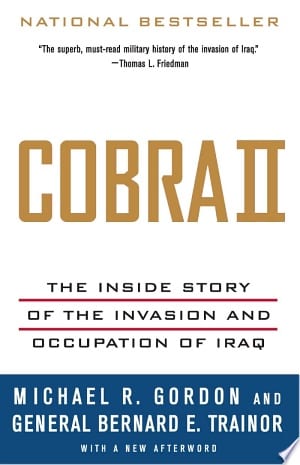
Written by the chief military correspondent of the New York Times and a prominent retired Marine general, this is the definitive account of the invasion of Iraq. A stunning work of investigative journalism, Cobra II describes in riveting detail how the American rush to Baghdad provided the opportunity for the virulent insurgency that followed. As Gordon and Trainor show, the brutal aftermath was not inevitable and was a surprise to the generals on both sides. Based on access to unseen documents and exclusive interviews with the men and women at the heart of the war, Cobra II provides firsthand accounts of the fighting on the ground and the high-level planning behind the scenes. Now with a new afterword that addresses what transpired after the fateful events of the summer of 2003, this is a peerless re-creation and analysis of the central event of our times.
My Summary
Main Ideas, Takeaways & Similarities
Questions
I. What is the problem?
A. How is this problem formulated?
B. Why is this problem important?
C. What is the history of this problem?
D. Which prominent personalities have been interested in this problem?
II. What solutions to the problem are there?
A. What are the conclusions reached?
B. By what argument(s) is the conclusion reached?
C. What facts or assumptions serve as premises?
D. When a prominent personality offers a solution, does he also argue for or against other prominent personalities? Does he raise objections to alternative solutions? Does he consider objections to his own solutions?
III. Evaluation
A. What are the advantages and disadvantages of the alternative formulations to the problem?
B. Has the importance or history of the problem ever been misrepresented?
C. Are the solutions logically related to the premises?
D. Are the facts true? Are the assumptions acceptable? Are the objections answerable?
AI Summary
“Cobra II: The Inside Story of the Invasion and Occupation of Iraq” by Michael R. Gordon and Bernard E. Trainor is a detailed account of the 2003 Iraq War, focusing on the planning, execution, and consequences of the U.S.-led invasion and occupation. Here is a comprehensive summary in bullet points:
- Title: Cobra II: The Inside Story of the Invasion and Occupation of Iraq
- Authors: Michael R. Gordon and Bernard E. Trainor
Introduction:
- Sets the stage for the book’s examination of the Iraq War.
- Highlights the various factors, personalities, and decisions that led to the invasion.
Chapter 1: Planning and Strategy:
- Discusses the pre-war planning for the invasion of Iraq.
- Explores the development of Operation Iraqi Freedom and the initial military strategy.
Chapter 2: The Buildup:
- Chronicles the buildup of U.S. forces in the region leading up to the invasion.
- Describes the diplomatic efforts and negotiations with allies and the United Nations.
Chapter 3: The Invasion Begins:
- Details the launch of the invasion on March 19, 2003.
- Discusses the initial military successes and the march towards Baghdad.
Chapter 4: Stumbling Blocks:
- Examines early challenges and setbacks encountered by coalition forces.
- Discusses the unexpected resistance faced in southern Iraq and urban warfare in Basra.
Chapter 5: The Siege of Baghdad:
- Chronicles the coalition’s advance towards Baghdad.
- Discusses the strategy and decision-making during the siege of the Iraqi capital.
Chapter 6: The Fall of Saddam Hussein:
- Describes the capture of Saddam Hussein in December 2003.
- Discusses the impact on the Iraqi resistance and the Ba’athist regime.
Chapter 7: The Occupation Phase:
- Examines the post-invasion occupation of Iraq.
- Discusses the challenges of governance, security, and reconstruction.
Chapter 8: Insurgency and Uprising:
- Chronicles the emergence of the Iraqi insurgency.
- Discusses the role of various insurgent groups and foreign fighters.
Chapter 9: The Battle of Fallujah:
- Details the two major battles for Fallujah in 2004.
- Discusses the challenges of urban warfare and counterinsurgency efforts.
Chapter 10: Political Transition:
- Explores the political transition in Iraq, including the formation of a transitional government.
- Discusses the challenges of establishing a new political order.
Chapter 11: The Civil War:
- Chronicles the descent into sectarian violence and civil war.
- Discusses the role of Shia militias, Sunni insurgents, and sectarian tensions.
Chapter 12: The Surge:
- Examines the decision to implement the “surge” strategy in 2007.
- Discusses the increase in U.S. troop levels and the efforts to quell violence.
Chapter 13: The End of the Occupation:
- Chronicles the withdrawal of U.S. combat troops in 2011.
- Discusses the legacy of the Iraq War and its impact on the region.
Conclusion:
- Summarizes the key events and consequences of the Iraq War.
- Reflects on the lessons learned and the challenges faced during the invasion and occupation.
Legacy:
- “Cobra II” provides a comprehensive and detailed account of the Iraq War from planning to aftermath.
- The book offers insights into the decision-making process, military strategy, and the challenges faced by coalition forces.
- It has contributed to the understanding of the complexities and consequences of the Iraq War and its impact on the Middle East.