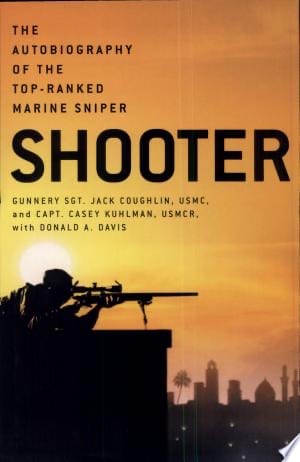
DESCRIPTION
With more than sixty confirmed kills, Coughlin is the Marine Corps’ top ranked sniper. This is the harrowing first-person account of his life on and off the modern battlefield.
My Summary
Main Ideas, Takeaways & Similarities
Questions
I. What is the problem?
A. How is this problem formulated?
B. Why is this problem important?
C. What is the history of this problem?
D. Which prominent personalities have been interested in this problem?
II. What solutions to the problem are there?
A. What are the conclusions reached?
B. By what argument(s) is the conclusion reached?
C. What facts or assumptions serve as premises?
D. When a prominent personality offers a solution, does he also argue for or against other prominent personalities? Does he raise objections to alternative solutions? Does he consider objections to his own solutions?
III. Evaluation
A. What are the advantages and disadvantages of the alternative formulations to the problem?
B. Has the importance or history of the problem ever been misrepresented?
C. Are the solutions logically related to the premises?
D. Are the facts true? Are the assumptions acceptable? Are the objections answerable?
AI Summary
Highlights
Here is a thorough summary of the book “Shooter: The Autobiography of the Top-Ranked Marine Sniper” by Jack Coughlin and Casey Kuhlman in bullet points:
- Title: Shooter: The Autobiography of the Top-Ranked Marine Sniper
- Authors: Jack Coughlin and Casey Kuhlman
Introduction:
- A memoir that provides an inside look into the life and experiences of a top-ranked Marine sniper.
- Offers insights into the challenges, tactics, and mindset required for sniper warfare.
Chapter 1: Early Life and Training
- Details the author’s upbringing and early interest in firearms.
- Describes his decision to join the Marine Corps and the rigorous training involved.
- Highlights the importance of discipline and marksmanship skills in becoming a sniper.
Chapter 2: Sniper School
- Chronicles the author’s journey through sniper school.
- Discusses the specialized training, including long-range shooting and camouflage.
- Emphasizes the mental and physical demands of sniper training.
Chapter 3: First Deployment
- Recounts the author’s first deployment to Somalia during Operation Restore Hope.
- Describes the chaotic and dangerous conditions in Somalia.
- Provides insights into the role of snipers in providing cover and support.
Chapter 4: Urban Warfare in Mogadishu
- Details the intense urban combat during the Battle of Mogadishu.
- Discusses the challenges of sniping in an urban environment.
- Highlights the author’s experiences and decisions during the battle.
Chapter 5: Return to Civilian Life
- Explores the difficulties of transitioning from military service to civilian life.
- Discusses the author’s struggles with post-traumatic stress disorder (PTSD).
- Emphasizes the importance of seeking support and treatment for mental health.
Chapter 6: Sniper Operations in Iraq
- Chronicles the author’s return to military service during the Iraq War.
- Describes sniper operations in the Iraqi desert and urban areas.
- Discusses the precision and tactics required in combat situations.
Chapter 7: Sniper Team Dynamics
- Explores the relationships and teamwork among sniper teams.
- Discusses the trust and communication required for successful missions.
- Highlights the bond between snipers and their spotter partners.
Chapter 8: The Mindset of a Sniper
- Discusses the mental preparation and discipline necessary for snipers.
- Explores the ethical dilemmas and moral decisions faced by snipers.
- Addresses the emotional toll of taking human lives in combat.
Chapter 9: Sniper Operations in Ramadi
- Recounts the author’s experiences during the Battle of Ramadi in Iraq.
- Describes the intense urban warfare and insurgent threats.
- Highlights the author’s role in protecting fellow Marines.
Chapter 10: Legacy and Reflections
- Reflects on the author’s career as a Marine sniper and his contributions.
- Discusses the impact of war on soldiers and veterans.
- Emphasizes the importance of honoring and supporting veterans.
Conclusion:
- Summarizes the key experiences and lessons shared in the book.
- Encourages readers to gain a deeper understanding of the sacrifices and challenges faced by military snipers.
- Emphasizes the importance of recognizing the bravery and service of soldiers like the author.