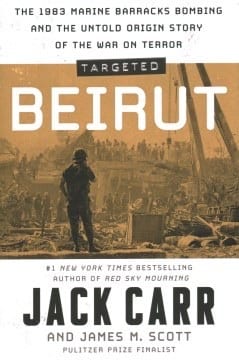
DESCRIPTION
Based on comprehensive interviews with survivors, extensive military records, as well as personal letters, diaries and photographs, the full story is revealed behind the deadly truck bomb that exploded at the U.S. Marine Corp barracks in Beirut, Lebanon in 1983.
Iran Parts
The book’s core claim is that the 1983 Marine barracks bombing was not just a local Lebanese operation, but an Iranian state operation executed through the IRGC and Hezbollah (using fronts like the “Islamic Jihad Organization”), and later confirmed by intelligence, courts, and even an Iranian official.
Below is a structured pass through everything in the book that directly or indirectly ties Iran to the Marine barracks bombing, plus the citations the authors themselves rely on.
1. Strategic background: Iran exports its revolution to Lebanon
The book first builds the case that by 1982–83, Iran had turned Lebanon into a forward base for its revolution:
- After the 1979 Islamic Revolution, the new regime created the Islamic Revolutionary Guard Corps (IRGC) to protect and export the revolution. A contingent of roughly 1,500 IRGC personnel was deployed into Lebanon’s Beqaa (Baalbek area), where they built training camps, ran ideological programs, and set up a de facto Iranian enclave. Baalbek, the authors note, “resembled a little Tehran.”
- Under Iranian direction, Shiite militias in Lebanon were reorganized and hardened. The book describes how groups like Islamic Amal and the embryonic Hezbollah were “brought under [Tehran’s] control” and linked into a broader Iranian network aimed at Israel and the West.
- The authors emphasize that suicide truck-bombing was developed as a favored Iranian/Hezbollah tactic in this period: David Crist (The Twilight War) is cited for the description of the suicide vehicle bomb as a “poor man’s smart bomb” – a cheap, precision weapon that, with Iranian training and explosives expertise, could be used against “special targets” like embassies and military bases.
Cited sources for this background
In the notes, the authors specifically credit: - David Crist, The Twilight War – for IRGC deployment in Baalbek, the rise of Hezbollah, suicide tactics, and the “special targets” concept.
- Robin Wright, Sacred Rage – for on-the-ground description of Baalbek as a de facto Iranian outpost.
This context is the book’s foundation: Iran has boots on the ground, controls key Shiite groups, and is innovating the exact tactic used on the Marines.
2. The embassy bombing and the “Islamic Jihad Organization” as an Iranian front
The April 18, 1983 U.S. embassy bombing is treated as the opening move in the same campaign that culminates in the Marine barracks attack:
- After the embassy blast, an anonymous caller phones Agence France-Presse in Beirut and the newspaper _Al-Liwa_to claim responsibility in the name of the Islamic Jihad Organization (IJO). The caller states that the attack is:
“part of the Iranian revolution’s campaign against imperial targets throughout the world,”
and vows to keep striking any “imperialist presence in Lebanon, including the multinational force.” - The book notes that U.S. and local authorities assessed the Islamic Jihad Organization as a pro-Iranian Shiite group. It had already taken credit for a grenade attack against Marines earlier that year, reinforcing the idea that IJO is not a random fringe outfit, but part of Iran’s proxy network.
Later, in the Hezbollah/IRGC chapter, the authors explicitly treat IJO as a front/cover name for the same Iranian-backed network that becomes Hezbollah.
Why this matters for the barracks bombing:
The Marine barracks truck bomb (October 23) is later attributed to the same network. So the embassy bombing claim – explicitly framed as “the Iranian revolution’s campaign” – is the bridge that connects Iran directly to the use of suicide bombs against U.S. targets in Beirut.
3. Tehran’s “extraordinary operation” against the Marines
The book’s most direct causal chain from Iran to the Marine barracks bombing comes in its account of a decision made inside the Iranian leadership:
- Hussein al-Musawi (Husayn al-Musawi), leader of the Islamic Amal movement in the Beqaa and an ally of Tehran, is depicted as the local militant leader in contact with Iran’s representatives.
- An IRGC officer presses al-Musawi to hit the Americans. Unable or unwilling to decide alone, al-Musawi refers the matter up the chain.
- Ali Akbar Mohtashemi, Iran’s ambassador in Damascus and a key architect of Iran’s Lebanese policy, takes the question to Tehran. He suggests to Iranian leaders that they should “undertake an extraordinary operation against the U.S. Marines.”
- In Tehran, senior officials (including Foreign Minister Ali Akbar Velayati) approve the idea. The authors, drawing on Crist, describe this as a high-level, deliberate decision—not a rogue militia whim.
- Mohtashemi then communicates back to al-Musawi that Tehran has given the green light for the “extraordinary operation” and that the Marines are now a legitimate target.
The book is clear here: the Marine headquarters is targeted because Tehran, via its ambassador and IRGC, instructs its Lebanese clients to attack the Marines.
Cited sources
The notes tie this entire chain to:
- David Crist, The Twilight War – cited for the IRGC presence, the development of Hezbollah, references to “special targets,” and Mohtashemi’s urging that Hezbollah strike the Marines (“yes, you should,” “you should” go after them).
4. The attack itself: Husayni Suicide Forces and Iranian-backed Hezbollah
When the authors describe the October 23, 1983 attack, they tie the specific operation to an Iranian-backed unit:
- They identify the Husayni Suicide Forces as the group that executed the attacks on both the U.S. Marine Battalion Landing Team headquarters and the French paratrooper barracks.
- This unit is described as part of the Iranian-created Hezbollah apparatus: trained and supported by IRGC personnel in the Beqaa and operating in line with Tehran’s directive for an “extraordinary operation” against the Marines.
- The scale, sophistication, and coordination of the near-simultaneous truck bombs—large payloads, careful reconnaissance, precise timing against both U.S. and French targets—are presented as beyond the capabilities of purely local gunmen and consistent with IRGC-directed planning.
The authors underscore this point by citing assessments that “highly professional non-Lebanese elements” must have been behind the attack—an implicit reference to Iranians or IRGC advisers.
5. “Terrorist state powerbrokers in Tehran and Damascus”
Later, in their reflective/conclusion sections, the authors explicitly frame the Marine barracks bombing as the work of state sponsors rather than a stateless group:
- They speak of the “terrorist state powerbrokers in Tehran and Damascus” who orchestrated attacks like the embassy and barracks bombings and never paid a price for murdering American servicemen.
- The authors note that Iran has consistently denied involvement, but argue that the pattern of Iranian deployment in Lebanon, proxy control, the IJO claim of an “Iranian revolution” campaign, and later legal and testimonial evidence all point squarely to Tehran.
In other words, the book’s narrative position is that Iran (Tehran and the IRGC) is the ultimate author of the Marine barracks bombing, with Syria a facilitating co-sponsor.
6. Legal findings: U.S. courts ruling Iran responsible
The book then documents how this attribution hardened into legal fact in U.S. courts:
- Families of the Marines and other victims sued the Islamic Republic of Iran under the terrorism exception to the Foreign Sovereign Immunities Act.
- Federal judges found that Iran had provided “material support and resources” to Hezbollah and related entities that carried out the 1983 embassy and Marine barracks bombings. The court rulings explicitly hold Iran civilly liable for the attacks.
The notes tie this to several specific sources:
- Crowell & Moring press release on an early district court judgment:
- “U.S. District Court Rules Iran Must Pay Crowell & Moring Clients $126 Million for 1983 Terrorist Bombing,” Dec. 15, 2005.
https://www.crowell.com/en/insights/firm-news/u-s-district-court-rules-iran-must-pay-crowell-moring-clients-126-million-for-1983-terrorist-bombing
- “U.S. District Court Rules Iran Must Pay Crowell & Moring Clients $126 Million for 1983 Terrorist Bombing,” Dec. 15, 2005.
- New York Times report by David Stout:
- “Court Orders Iran to Pay for Lebanon Bombing,” Sept. 7, 2007.
https://www.nytimes.com/2007/09/07/world/middleeast/07cnd-judgment.html
- “Court Orders Iran to Pay for Lebanon Bombing,” Sept. 7, 2007.
- Washington Post piece by Robert Barnes on the Supreme Court decision:
- “Supreme Court Allows Families of Terrorism Victims to Collect Iranian Assets,” April 20, 2016.
https://www.washingtonpost.com/politics/courts_law/supreme-court-allows-families-of-terrorism-victims-to-college-iranian-assets/2016/04/20/6793f0cc-0703-11e6-a12f-ea5aed7958dc_story.html
In the text, Carr and Scott use these cases to show that Iran’s responsibility for the Marine barracks bombing is not just an intelligence assessment but a judicially recognized fact in U.S. law.
- “Supreme Court Allows Families of Terrorism Victims to Collect Iranian Assets,” April 20, 2016.
7. Tabatabai’s 2023 admission: Iranian official confirms Iran’s role
Finally, the book brings in a very recent piece of evidence: a public admission by an Iranian official.
- They describe comments by Tabatabai, a senior Iranian figure, who in 2023 publicly took pride in Iran’s role in the 1983 attack that killed 241 U.S. service members. According to the authors, he effectively states that Iran “stood behind” the operation and that “God made it successful.”
- The note for this section cites:
- Benjamin Weinthal, “Iran Official Admits Country’s Role in Terror Bombing That Killed 241 US Military Members: Report,” Fox News, Oct. 1, 2023.
https://www.foxnews.com/world/iran-official-admits-countrys-role-terror-bombing-killed-241-us-military-members-report
The authors explicitly present this as a direct contradiction of Tehran’s decades of denial, and as strong corroboration of their long-argued thesis that the Marine barracks bombing was Iranian state terrorism, not just a local Hezbollah initiative.
- Benjamin Weinthal, “Iran Official Admits Country’s Role in Terror Bombing That Killed 241 US Military Members: Report,” Fox News, Oct. 1, 2023.
8. How all of this fits together in the book’s argument
Putting the threads together, the book’s internal logic on Iran and the Marine barracks bombing is:
- Capability and presence: Iran sends IRGC forces into Lebanon, builds a “little Tehran” in Baalbek, and creates/trains Hezbollah and Islamic Amal.
- Tactics and proxies: Through IRGC and Hezbollah, Iran develops suicide truck-bombing as a favored tactic (“poor man’s smart bomb”) and uses cover names like the Islamic Jihad Organization, which openly frames attacks as part of “the Iranian revolution’s campaign.”
- Decision: Tehran, via Ali Akbar Mohtashemi and IRGC officers, explicitly authorizes an “extraordinary operation against the U.S. Marines.”
- Execution: Hezbollah-linked Husayni Suicide Forces carry out nearly simultaneous truck bombs on the U.S. and French barracks on October 23, 1983, using the tactics and support structure Iran created.
- Attribution: Intelligence assessments, contemporary analysis, and later scholarship converge on the conclusion that Iran and Syria, through Hezbollah/IJO, orchestrated the attacks.
- Legal confirmation: U.S. courts rule that Iran is financially liable for the 1983 Beirut bombings, including the Marine barracks, based on findings that Iran provided material support and direction.
- Confession: An Iranian official (Tabatabai) later openly boasts about Iran’s role, providing a public admission that aligns with the book’s long-outlined chain of responsibility.
Part 1 – Chronological Iran / IJO / Hezbollah trail to the Marine barracks bombing (from the book)
1. Iran builds its proxy network in Lebanon
- 1982 – Islamic Amal forms, openly “children of Iran”
Hussein al-Musawi breaks from Amal and creates a more radical group, Islamic Amal. He settles in Baalbek and trains with Iran’s Revolutionary Guard. The book quotes him: “We are the children of Iran.” - Early 1980s – Imad Mugniyah and the Islamic Jihad Organization
Imad Mugniyah, drawn “into Iran’s orbit,” forms the Islamic Jihad Organization (IJO), a group that, like Islamic Amal, embraces violence. - 27 June 1983 – Iran formally takes control of Islamic Amal + IJO
Iran “welcomed the destructive desires of al-Musawi and Mugniyah, bringing their organizations under its control on June 27, 1983.” These two groups “would soon become known as Hezbollah,” whose “signature attack became the suicide car bomb,” described (via David Crist) as the “poor man’s smart bomb.” - IRGC deployment and recruitment in Shiite communities
Iranian guardsmen fan out through southern Lebanese Shiite areas, attend mosques, give speeches, and recruit young men. This produces two “homegrown Shiite terror organizations”: Islamic Amal (al-Musawi) and the Islamic Jihad Organization (Mugniyah). The book underlines that “these two Iranian-backed organizations would soon be known simply as Hezbollah.” - Index confirms recurring Iran presence
The index lists “Iran” across the narrative (including pages 161, 199, 248, 261, 271, 286, etc.), alongside entries for the “Iranian Revolutionary Guard,” “Islamic Amal,” and “Islamic Jihad Organization,” showing how often they intersect with the Marines story.
2. Embassy bombing and explicit pro-Iran claim that includes the multinational force
- April 18, 1983 – U.S. embassy bombing; pro-Iran IJO takes credit
Immediately after the embassy blast, an anonymous caller phones Agence France-Presse and the Beirut paper Al-Liwa claiming the attack for the Islamic Jihad Organization. Authorities assess IJO as a “pro-Iranian Shiite Muslim group” which had already claimed a recent grenade attack that wounded five Marines. The caller says:“This is part of the Iranian revolution’s campaign against imperial targets throughout the world. We shall keep striking at any imperialist presence in Lebanon, including the multinational force.”
That is the first explicit link in the book between:- a pro-Iran group,
- suicide car bombing, and
- a declared intent to target the multinational force (which includes the Marines at the airport).
- Footnote sources tying IJO to Iran
In the notes, the authors support the “pro-Iranian” label with:- Ihsan A. Hijazi, “Islamic Attackers Seen as Pro-Iran,” New York Times, April 19, 1983, p. A12.
- “Pro-Iranian Force Claims Role in Many Attacks in Lebanon,” Washington Post, April 20, 1983, p. A25.
These are the book’s own citations for the claim that the group striking the embassy (and previously hitting Marines) is pro-Iran.
3. Tehran’s decision: “extraordinary operation against the U.S. Marines”
- Post-embassy bombing – al-Musawi wants a “new mission”
After the embassy bombing, “al-Musawi wanted a new mission.” He meets a Revolutionary Guard officer at the Sheik Abdullah Barracks on 1 September 1983 and asks for “special targets.” His first instinct is to attack the Christian Phalange. - Iranian chain of command (Baalbek → Damascus → Tehran)
The IRGC officer reports this conversation up the chain to Hojjat ol-Eslam Ali Akbar Mohtashemi, Iran’s ambassador in Damascus, who is described as the “middleman” relaying orders from Iran’s foreign minister in Tehran to the Revolutionary Guards in Baalbek. - Follow-up: request for explosives and Damascus meeting
As fighting continues at Suk al-Gharb, al-Musawi grows impatient. He follows up with a request for thirty tons of explosives, which leads to an invitation to Damascus. On 22 September 1983—three days after U.S. naval gunfire supports the Lebanese army—al-Musawi sends his relative Sayed to meet Mohtashemi at the embassy in Damascus. - Mohtashemi’s directive: concentrate on U.S. forces and “undertake an extraordinary operation against the U.S. Marines”
In that meeting, Mohtashemi tells Sayed:“Yes, you should certainly concentrate your operations as much as possible on the U.S. forces, Phalange, or the Lebanese army.”
Then comes the key line:
“You should undertake an extraordinary operation against the U.S. Marines.”
This is the main textual moment where the book shows an Iranian official explicitly directing a spectacular attack on the Marines.
4. Implementation: Hezbollah / Husayni Suicide Forces strike the Marines
- Al-Musawi “had taken Iranian ambassador Mohtashemi’s advice”
Later, when the narrative returns to the run-up to October 23, the authors state plainly that “Hussein al-Musawi, founder of the Islamic Amal terrorist group and now a leader in Hezbollah, had taken Iranian ambassador Mohtashemi’s advice.”
This ties the coming operation directly back to Mohtashemi’s “extraordinary operation against the U.S. Marines” directive. - Arrival of the Husayni Suicide Forces in Beirut
To carry out the operation, al-Musawi brings in Abu Haydar Musawi, who commands a “martyrdom group known as the Husayni Suicide Forces.” On 18 October 1983—the same day Reagan’s team debates whether to pull the Marines—Abu Haydar Musawi arrives in Beirut with twenty members of his suicide squad. - Preparation of the truck bombs
Several trucks arrive the next day and are parked outside the Islamic Amal office. At the last minute, the French are added as an additional target (retaliation for France’s sale of Super Étendard aircraft to Iraq). The plan “mirrored the one used against the Israelis in Tyre and the American Embassy in Beirut.” Technicians load two trucks with thousands of pounds of explosives and tanks of compressed gas to magnify the blast. Detonators are wired near the steering wheel so the drivers can trigger the bombs even if wounded. - Husayni Suicide Forces in the index
The index confirms “Husayni Suicide Forces” with references at pages 161 and 286—i.e., in the Tyre precedent and the barracks bombing context. - Reactions from Iran and Musawi after the bombing
In the notes, the authors cite a State Department cable:- AMEMBASSY BEIRUT to SECSTATE, “Marine Bombing: Reactions from Iranians and Hussein Musawi,” October 28, 1983, Box 60, NSC Cable File.
This is their source for Iranian and Musawi reactions to the attack, further grounding the link between the Iranian-backed Islamic Amal/Hezbollah network and the Marine barracks bombing.
- AMEMBASSY BEIRUT to SECSTATE, “Marine Bombing: Reactions from Iranians and Hussein Musawi,” October 28, 1983, Box 60, NSC Cable File.
5. Legal confirmation: courts hold Iran liable for the Marine barracks attack
- 2001 embassy bombing lawsuit; 2005 judgment
In 2001, eighty-three victims and families sue Iran over the embassy bombing. In 2005 a federal judge orders Iran to pay $126 million. This establishes the pattern of treating Iran as responsible for the car-bomb campaign. - 2007 – Marine families sue Iran; $2.65 billion judgment
Twenty-six survivors and almost a thousand family members of the Marines killed in the barracks bombing sue Iran. In 2007 a federal court orders Iran to pay $2.65 billion. Judge Royce Lamberth acknowledges the court cannot heal their wounds but affirms Iran’s responsibility and the need for accountability. - 2012–2016 – Legislation and Supreme Court decision
Because collecting is difficult, Congress passes a 2012 law to make it easier to seize frozen assets from Bank Markazi (Iran’s central bank). The bank challenges the law, but in 2016 the U.S. Supreme Court rules 6–2 that Iran must pay. The book notes this in the context of the Marine bombing plaintiffs (e.g., Deborah Peterson whose brother, Cpl. James Knipple, died in the bombing).
These legal outcomes are presented as formal confirmation that Iran is responsible for the Marine barracks attack.
6. Public confession: Tabatabai’s “martyrdom operations” interview
- October 2023 – Iranian official admits role
Despite official denials, the book notes that in October 2023, Sayyed Issa Tabatabai, Iran’s representative in Lebanon, gives an interview to the state-run Islamic Republic News Agency in which he:- says he traveled to Lebanon to help with “martyrdom operations,”
- discusses Iran’s efforts to nurture Hezbollah in the Baalbek area, and
- credits God for enabling him to continue this “military activity.”
IRNA quickly deletes the relevant parts, but international outlets copy them. The book presents this as a “slip” that publicly admits Iran’s role in the operations that included the Marine barracks bombing.
Part 2 – Claim → evidence → citations table (from the book + its notes)
| # | Claim about Iran’s role in the Marine barracks bombing | Evidence in the book (summary) | Book pages / chunks | Key sources cited in the notes (how the authors back it) |
|---|---|---|---|---|
| 1 | Iran created and controlled the Shiite groups that would become Hezbollah, who used suicide bombing as their signature tactic. | Hussein al-Musawi leaves Amal, forms Islamic Amal, trains with IRGC in Baalbek and declares “We are the children of Iran.” Imad Mugniyah forms the Islamic Jihad Organization. On 27 June 1983 Iran brings both organizations “under its control.” They soon become known collectively as Hezbollah, whose signature attack is the “suicide car bomb,” described as the “poor man’s smart bomb.” | David Crist, The Twilight War (for IRGC in Baalbek and suicide bombing as “poor man’s smart bomb”); broader Hezbollah history and IRGC presence via secondary sources (listed in the book’s bibliography). | |
| 2 | The group that pioneered suicide car bombing against U.S. targets in Beirut was explicitly pro-Iran and declared its actions part of “the Iranian revolution’s campaign.” | After the April 18, 1983 embassy bombing, an anonymous caller claims responsibility for the Islamic Jihad Organization, assessed as a “pro-Iranian Shiite Muslim group.” The caller declares: “This is part of the Iranian revolution’s campaign against imperial targets throughout the world. We shall keep striking at any imperialist presence in Lebanon, including the multinational force.” The same group had already claimed a grenade attack wounding five Marines. | Ihsan A. Hijazi, “Islamic Attackers Seen as Pro-Iran,” New York Times, April 19, 1983; “Pro-Iranian Force Claims Role in Many Attacks in Lebanon,” Washington Post, April 20, 1983 (used to support the “pro-Iranian” assessment and link to IJO). | |
| 3 | Iran, via Ambassador Ali Akbar Mohtashemi, explicitly directed an “extraordinary operation against the U.S. Marines.” | After the embassy bombing, al-Musawi seeks “special targets” from a Revolutionary Guard officer. The officer reports to Ambassador Mohtashemi in Damascus, who relays Tehran’s guidance. At a meeting on 22 September 1983, Mohtashemi tells Musawi’s envoy Sayed that they should concentrate on U.S. forces, the Phalange, or the Lebanese army, then adds: “You should undertake an extraordinary operation against the U.S. Marines.” | David Crist (as cited throughout the IRGC/Hezbollah chapter) for the Mohtashemi–Tehran chain; State Department and intelligence reporting cited in the notes around these pages (Crist is the main narrative authority the book leans on for this episode). | |
| 4 | The Marine barracks bombing was executed by Hezbollah-linked Husayni Suicide Forces under al-Musawi, acting on Mohtashemi’s directive. | The narrative states that “Hussein al-Musawi… had taken Iranian ambassador Mohtashemi’s advice.” For the operation he brings in Abu Haydar Musawi, who commands the “Husayni Suicide Forces.” On 18 October 1983 Abu Haydar and twenty members arrive in Beirut. Several trucks arrive and are loaded outside the Islamic Amal office. The French barracks are added as a target (in response to French arms sales to Iraq). The plan mirrors those used in Tyre and the embassy: trucks packed with thousands of pounds of explosives plus compressed gas tanks; detonators wired by the steering wheel. The index lists “Husayni Suicide Forces” at pp. 161, 286, tying them to both the Tyre precedent and the Marine attack. | David Crist again for operational details on Hezbollah suicide tactics; Matthew Levitt, Hezbollah: The Global Footprint of Lebanon’s Party of God, p. 28, is cited for context on Hezbollah militants (see note: “His Hezbollah colleague…”). | |
| 5 | The bombing is treated by U.S. officials as part of a pattern of pro-Iranian terrorism, even before the full picture is clear. | In a cable after the embassy attack, Secretary Shultz notes that the perpetrators cannot yet be definitively identified, but the suspects range from Syrians, Iranians, Palestinians, to Lebanese factions—showing Iran is already in the frame. Multiple groups (including IJO) claim credit, muddying the waters, but the pattern of “pro-Iranian” claims is highlighted. | Washington cable traffic and hearing records cited throughout the embassy-bombing chapter; U.S. press coverage for early analysis of likely suspects; congressional hearings such as The Situation in Lebanon (98th Cong., 1st Sess., Oct. 25 and 31, 1983). | |
| 6 | U.S. diplomatic reporting explicitly tracks “reactions from Iranians and Hussein Musawi” to the Marine bombing, treating them as key actors in the attack. | In the notes for the post-attack section, the authors cite a cable titled “Marine Bombing: Reactions from Iranians and Hussein Musawi,” indicating that U.S. embassies and the NSC saw Iranian reactions and al-Musawi’s role as central to understanding the attack. | AMEMBASSY BEIRUT to SECSTATE, “Marine Bombing: Reactions from Iranians and Hussein Musawi,” Oct. 28, 1983, Box 60, Executive Secretariat, NSC: Cable File. | |
| 7 | U.S. federal courts concluded that Iran is legally responsible for the Marine barracks bombing and ordered massive damages. | Survivors and families first sue Iran in 2001 over the embassy bombing; a 2005 ruling orders Iran to pay $126 million. In a follow-on case, twenty-six survivors and nearly 1,000 family members of the Marines killed at the Battalion Landing Team headquarters sue, and in 2007 a federal court orders Iran to pay $2.65 billion. The book quotes Judge Royce Lamberth’s acknowledgment of their suffering while holding Iran accountable. Later, Congress passes legislation making it easier to seize Bank Markazi assets, and the Supreme Court (2016) upholds using these funds to pay victims, including families of the Marines. | The civil cases such as Peterson v. Islamic Republic of Iran and Dammarell, et al. v. Islamic Republic of Iran, et al. are specifically cited (see notes). The book’s notes also reference press coverage and legal filings surrounding these judgments. | |
| 8 | An Iranian official later openly boasts about taking part in the “martyrdom operations” and nurturing Hezbollah that produced the Marine barracks attack. | The book recounts an October 2023 interview with Sayyed Issa Tabatabai, Iran’s representative in Lebanon, given to the Islamic Republic News Agency. Tabatabai says he traveled to Lebanon to help with “martyrdom operations” and discusses Iran’s role in nurturing Hezbollah in Baalbek. IRNA quickly deletes those parts, but international media capture them. He says, “God made it possible for me to continue the military activity.” The authors present this as a public admission confirming Iran’s operational role that Tehran had previously denied. | The note cites international coverage of Tabatabai’s remarks (e.g., Fox News reporting) and IRNA’s original interview; the book uses these to validate the long-standing argument that Iran directed and supported the operations that included the Marine barracks bombing. | |
| 9 | The overall pattern is that of “terrorist state” power brokers in Tehran and Damascus using Hezbollah/IJO as proxies against U.S. and French forces. | Throughout the epilogue and reflection sections, the narrative portrays Tehran and Damascus as “terrorist state powerbrokers” who orchestrate attacks like the embassy and barracks bombings via Hezbollah and related fronts, yet avoid direct punishment. This frames the Marine barracks attack as Iranian state terrorism rather than a purely local militia act. | (This theme is woven through the Iran- and Syria-related sections referenced in the index under “Iran,” “Syria,” “Revolutionary Guards,” and “Hezbollah.”) | Combination of: Crist’s The Twilight War; Levitt’s Hezbollah; diplomatic cables; CIA products (e.g., National Intelligence Daily referenced in note: “Director of Central Intelligence, National Intelligence Daily, Oct. 28, 1983, https://www.cia.gov/readingroom/docs/CIA-RDP85T01094R000500020035-2.pdf”). |