Zibaldone 2024–2025 journal
Journal connection: A visual overview of the Sudan conflict and humanitarian crisis.
Source boundary: These are captured journal materials; the integration does not independently verify every clipped claim, quotation, or figure.
PDF++ pages: p. 97 (file not included in this release)
Embedded preview:
Zibaldone 2024-2025.pdf (file not included in this release)
Open the complete Zibaldone page index
War 04/2023-
-
Belligerents
-
- Sudanese Army
-
- Rapid Support Forces (RSF)
-
- War in Sudan (2023–present) - Wikipedia
- Children ‘piled up and shot’: new details emerge of ethnic cleansing in Darfur | Global development | The Guardian
- Arab-led RSF has orchestrated a concerted 12-month campaign of ethnic cleansing against Sudan’s non-Arab Masalit tribe in West Darfur.
- Since fighting erupted between the RSF and Sudan’s military in April 2023, more than 8 million people have fled their homes amid a humanitarian crisis that the UN warns is one of the largest in decades.
- The current flashpoint, El Fasher, is the last city held by Sudan’s military in Darfur. The city is encircled by the RSF, and diplomats fear it is on the “precipice of a large-scale massacre”.
- Human Rights Watch Report - The Massalit Will Not Come Home May 2024 (file not included in this release)
- Conflict Between Warring Parties in Sudan Pushing Millions to Brink of Famine, Top UN Officials Tell Security Council, Warning Entire Generation Could Be Destroyed | Meetings Coverage and Press Releases
- As famine looms in Sudan, the hungry eat soil and leaves
- Akok, 41, reached Al Lait in December, but has no work and can’t feed the family. At times, they go two or three days without eating. When that happens, Akok said, he watches helplessly as his wife and children dig holes in the ground with a stick, slide their hands in and grab some soil. Then they roll the soil into a ball, put it in their mouths and swallow it with water. “I keep telling them not to do it, but it’s hunger,” he said. “There is nothing I can do.”
- Parts of Sudan are on the brink of famine – a brewing crisis that is man-made. Agriculture has been ravaged as farmers have had their harvested crops stolen by the RSF and fled their lands due to the violence.
- international aid arriving in Sudan is being blocked by the military from reaching people in areas where starvation has set in.
- Sudanese army and RSF blame each other for stolen aid
- Almost 18 million people in Sudan – more than a third of the nation’s 49 million people – are facing “high levels of acute food insecurity,” according to the Integrated Food Security Phase Classification (IPC), a globally recognized hunger monitor. The IPC also estimates that of this group, nearly five million people are one step from famine.
- Isobel Coleman, deputy administrator of USAID, the U.S. government relief agency, said Sudanese army chief General Abdel Fattah al-Burhan and RSF leader General Mohamed Hamdan Dagalo were responsible for aid not reaching people.
- Sudan has become the largest displacement crisis, with one in every eight internally displaced persons worldwide
- Half the pop unemployed
- Banking system collapsed
- Telecommunications blackout
- Economy contracted 40%
- The RSF laid siege to areas across the capital like Banat located near Sudanese army bases, in an effort to squeeze troops trying to hold off advances by the paramilitary. Food began to vanish. Markets were destroyed in the fighting. Residents said people ran out of cash after Khartoum’s banks were looted by RSF militiamen, who made off with piles of banknotes and gold. The RSF has denied it was involved in the looting.
- By November, RSF forces had cut off electricity and severed the main water pipeline to Banat, residents said. Soldiers from a nearby army base and civilians began hunting cats to eat. Women carrying food were searched at RSF checkpoints, accused of supporting the army, beaten and sexually assaulted, Hassan said.
- She and the other adults began skipping meals, sometimes for two days straight, so the children could eat. Tree leaves boiled in water and sprinkled with spices became a part of their diet.
- A global authority on food insecurity, the Famine Early Warning Systems Network, reported in March that areas in the capital are at “risk of famine” as the warring parties have “employed siege-like tactics to cut off supplies to their opponent.”
- The woman said she had been feeding her son a few spoons of chickpeas a day for months, while she was pregnant and skipping meals. After she had a baby girl, she was unable to breastfeed and could only find expired formula to feed her newborn. Her boy had developed a blood deficiency and was vomiting repeatedly, she said.
- RSF raping at checkpoints
- When her children tell her they’re hungry, she tells them their father is coming with food, even though she knows he isn’t. “Sometimes I just wish a shell would kill me so I don’t have to see my children crying from hunger,” she said.
- RSF attacking farmers, stealing harvests and contributing to the famine
- “Aid is not allowed to go from SAF to RSF,” said Mohammed Qazilbash, Sudan director for humanitarian group Plan International, using the acronym for the Sudanese Armed Forces. “Food is being used as a weapon of war.”
- When the RSF invaded El Gezira in December, UN officials gave the paramilitary’s commanders the coordinates of warehouses where thousands of metric tons of aid were being stored – enough to feed close to 1.5 million people for a month in the state. They shared the locations in the hope that the aid would be protected and received assurances from the RSF that it would, said Brady, the Sudan director for OCHA. But almost all the aid in the warehouse was stolen.
- Achek Kuol Ngor, a 30-year-old South Sudanese woman from the Abu Jarra camp, said her twins died just 12 days after she gave birth to them in May last year. Asked how they died, she replied: “Sick and hungry.”
Entities
- Rapid Support Forces
- Rapid Support Forces - Wikipedia
- Government of Sudan
- Paramilitary
- primarily composed of, the Janjaweed militias which previously fought on behalf of the Sudanese government. Its actions in Darfur qualify as crimes against humanity in the opinion of Human Rights Watch.
- Janjaweed membership consists of Arab nomad tribes from the Sahel
- Janjaweed - Wikipedia
- During the Sudanese political crisis of 2019, the military junta that took control of the country employed RSF to violently crack down on pro-democracy demonstrators.
- The Rapid Support Forces (RSF) is a paramilitary group in Sudan, primarily composed of members from various Arab tribes, particularly those from the Darfur region. The majority of RSF members adhere to Islam, which is the predominant religion in Sudan. However, the RSF’s operations are driven more by political and military objectives than by religious motivations.
It’s important to note that the RSF has been involved in conflicts that have had significant impacts on various ethnic and religious communities in Sudan. For instance, during the conflict in Darfur, the RSF, evolving from the Janjaweed militias, was accused of targeting non-Arab ethnic groups, leading to severe human rights violations.
In the ongoing civil war that began in April 2023, clashes between the RSF and the Sudanese Armed Forces (SAF) have further exacerbated ethnic and religious tensions. Reports indicate that both the SAF and the RSF have attacked religious places, including mosques and churches, affecting religious communities across the country.
- Rapid Support Forces - Wikipedia
People
- General Hemedti (Mohamed Hamdan Dagalo)
- Abdel Rahman Joma’a Barakallah
- Abdel Raheem
B5 notebook pages
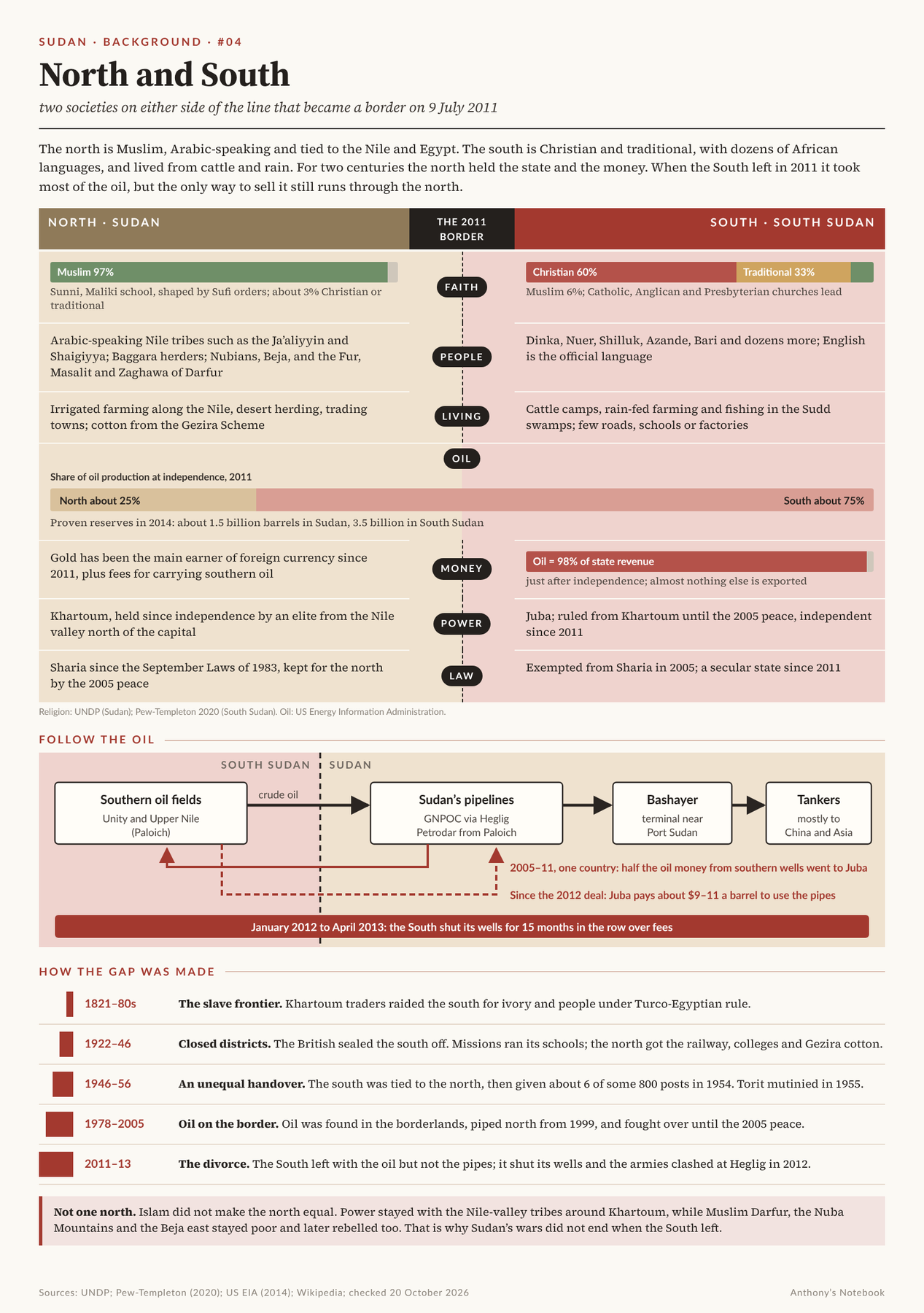
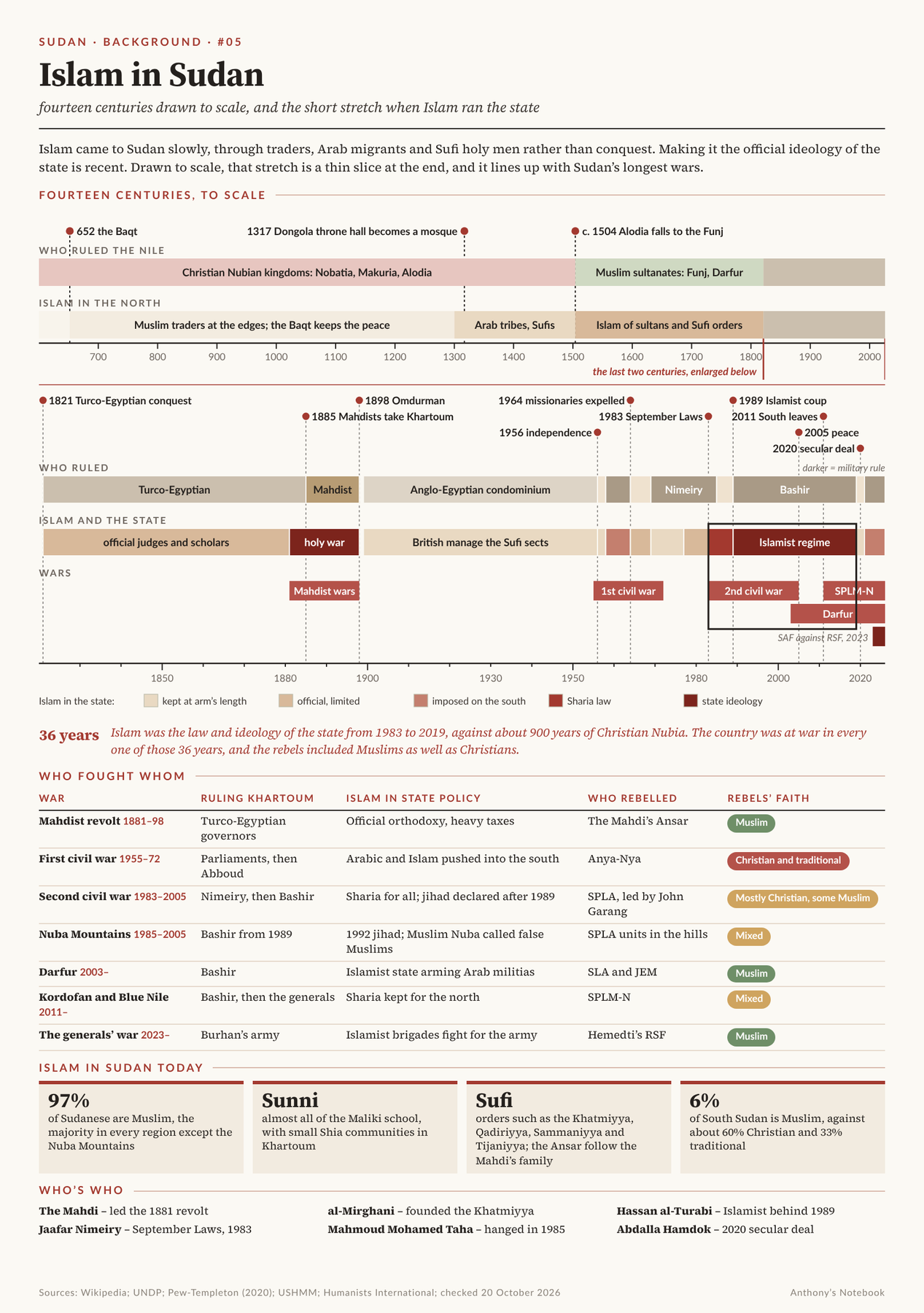
History of Sudan: Timeline and Table of Wars and Genocides
Timeline of Key Historical Events in Sudan
Ancient and Medieval Periods
- 2500-1500 BC: Kerma kingdom in Nubia, present-day northern and central Sudan.
- 1550-1069 BC: Much of Sudan is part of the New Kingdom of Egypt.
- 1070 BC - 350 AD: Kingdom of Kush emerges.
- 350-1500: Sequence of medieval Christian kingdoms, including Nobatia, Makuria, and Alodia.
- 639-641: Muslim Arabs conquer Byzantine Egypt and attempt to invade Nubia but are defeated.
- 14th and 15th Centuries: Bedouin tribes overrun most of Sudan.
- 1504-1821: Sultanate of Sennar or Blue Sultanate.
Ottoman and Colonial Periods
- 1821: Ottoman ruler of Egypt, Muhammad Ali, conquers northern Sudan.
- 1881: Mahdist War begins against Ottoman-Egyptian rule.
- 1884-85: Siege of Khartoum; General Gordon is killed.
- 1896-98: General Kitchener leads military campaigns, culminating in the Battle of Omdurman.
- 1899-1955: Sudan under joint British-Egyptian rule.
Post-Colonial Period
- 1956: Sudan gains independence.
- 1955-1972: First Sudanese Civil War.
- 1969: Colonel Gaafar Nimeiry’s coup.
- 1983: Nimeiry introduces Sharia Islamic law.
- 1983-2005: Second Sudanese Civil War.
- 1989: Colonel Omar al-Bashir’s coup.
- 2003-2020: War in Darfur.
- 2011: South Sudan gains independence.
- 2019: Army ousts President Bashir.
- 2020: Sudan signs peace deal with the Sudan Revolutionary Front.
- 2023: Power struggle within the military government leads to widespread fighting.
Table of Wars and Genocides in Sudan
| Period | Conflict/Genocide | Description | Estimated Casualties |
|---|---|---|---|
| 1955-1972 | First Sudanese Civil War | Conflict between the north and south over regional autonomy. | ~500,000 |
| 1983-2005 | Second Sudanese Civil War | Continuation of the first civil war, leading to South Sudan’s independence. | ~2 million (war, famine, disease) |
| 2003-2020 | War in Darfur | Conflict between government forces and rebel groups in Darfur, involving ethnic cleansing. | ~300,000 |
| 2023-present | Current Civil War | Power struggle between the Sudanese Armed Forces and the Rapid Support Forces (RSF). | ~15,000 (as of mid-2024) |
| 2003-2009 | Darfur Genocide | Systematic ethnic cleansing by Janjaweed militias supported by the government. | ~300,000 |
Detailed Descriptions of Major Conflicts
First Sudanese Civil War (1955-1972)
The First Sudanese Civil War was primarily a conflict between the northern and southern regions of Sudan, driven by the south’s demands for greater autonomy. The war resulted in significant loss of life and displacement, ending with the Addis Ababa Agreement in 1972, which granted the south self-governance[1][3][4].
Second Sudanese Civil War (1983-2005)
The Second Sudanese Civil War was a continuation of the first, sparked by the central government’s imposition of Sharia law and the abolition of the Southern Sudan Autonomous Region. The conflict was marked by severe violence, famine, and disease, leading to the death of approximately 2 million people. It concluded with the Comprehensive Peace Agreement in 2005, paving the way for South Sudan’s independence in 2011[1][3][4].
War in Darfur (2003-2020)
The War in Darfur began when rebel groups in the Darfur region took up arms against the Sudanese government, accusing it of neglect and oppression. The government’s response involved supporting the Janjaweed militias, which carried out widespread atrocities, including ethnic cleansing. The conflict resulted in the deaths of around 300,000 people and the displacement of millions[8][15][17].
Current Civil War (2023-present)
The ongoing civil war in Sudan started in April 2023, involving a power struggle between the Sudanese Armed Forces, led by Gen. Abdel Fattah al-Burhan, and the Rapid Support Forces (RSF), led by Gen. Mohamed Hamdan Dagalo (Hemedti). The conflict has caused significant casualties and displacement, with warnings of potential genocide in Darfur[7][9][16][19].
Darfur Genocide (2003-2009)
The Darfur Genocide involved systematic ethnic cleansing by the Janjaweed militias, supported by the Sudanese government, against non-Arab populations in Darfur. The International Criminal Court charged President Omar al-Bashir and other officials with genocide and crimes against humanity. The genocide resulted in the deaths of approximately 300,000 people and the displacement of millions[8][15][17].
This comprehensive timeline and table provide an overview of the major conflicts and genocides that have shaped Sudan’s history, highlighting the significant human toll and ongoing challenges faced by the country.
Citations:
[1] https://www.bbc.com/news/world-africa-14094995
[2] https://en.wikipedia.org/wiki/Timeline_of_Sudanese_history
[3] https://www.bbc.com/news/world-africa-14095300
[4] https://www.rescuesouthsudan.org/sudan-timeline-of-events/
[5] https://www.britannica.com/topic/history-of-Sudan
[6] https://apnews.com/general-news-290aba2d7ba94493bc23111ca1b937c7
[7] https://www.bbc.com/news/world-africa-59035053
[8] https://en.wikipedia.org/wiki/War_in_Darfur
[9] https://www.washingtonpost.com/opinions/2024/04/24/sudan-civil-war-rsf-genocide-darfur-hemedti/
[10] https://acleddata.com/10-conflicts-to-worry-about-in-2022/sudan/mid-year-update/
[11] https://www.statista.com/chart/26044/sudan-coup-timeline/
[12] https://data.unhcr.org/en/situations/sudansituation
[13] https://sites.tufts.edu/atrocityendings/2015/08/07/sudan-2nd-civil-war-darfur/
[14] https://concernusa.org/news/timeline-south-sudan-history/
[15] https://www.npr.org/2023/04/27/1172152816/sudans-rival-generals-share-a-troubled-past-genocide-in-darfur
[16] https://www.chathamhouse.org/publications/the-world-today/2024-02/sudan-collapsing-heres-how-stop-it
[17] https://www.britannica.com/place/Sudan/Conflict-in-Darfur
[18] https://www.aljazeera.com/news/2023/5/31/fighting-in-sudan-a-timeline-of-key-events
[19] https://www.npr.org/2023/10/21/1206104009/sudan-war
https://upload.wikimedia.org/wikipedia/commons/4/42/Historical_Timeline_of_Sudan.png
